Freud’s
Psychoanalysis
Presented By:
Saurav Bikram
Thapa
Sigmund Freud
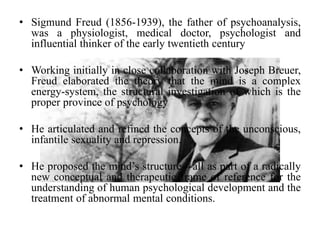
• Sigmund Freud (1856-1939), the father of psychoanalysis,
was a physiologist, medical doctor, psychologist and
influential thinker of the early twentieth century
• Working initially in close collaboration with Joseph Breuer,
Freud elaborated the theory that the mind is a complex
energy-system, the structural investigation of which is the
proper province of psychology
• He articulated and refined the concepts of the unconscious,
infantile sexuality and repression.
• He proposed the mind’s structure—all as part of a radically
new conceptual and therapeutic frame of reference for the
understanding of human psychological development and the
treatment of abnormal mental conditions.
• After studying medicine at the University of Vienna,
Freud worked and gained respect as a physician.
Through his work with respected French neurologist
Jean-Martin Charcot, Freud became fascinated with the
emotional disorder known as hysteria.
• His friend and mentor Dr. Josef Breuer introduced him
to the case study of a patient known as Anna O.
• The two physicians concluded that there was no organic
cause for Anna O's difficulties, but that having her talk
about her experiences had a calming effect on the
symptoms. Freud and Breuer published the
work Studies in Hysteria in 1895. It was she herself
who referred to the treatment as "the talking cure."
Joseph Breuer 1842- 1945 Anna. O (1859–1936)
•Austrian physician who made key
discoveries in neurophysiology
•Acknowledged by Sigmund Freud
and others as the principal forerunner
of psychoanalysis
•Anna O. was the pseudonym of
a patient named Bertha
Pappenheim
•Austrian-Jewish feminist and
the founder of the Jüdischer
Frauenbund (League of Jewish
Women), a social pioneer
• His works include The Interpretation of
Dreams (1900) and Three Essays on the
Theory of Sexuality (1905). These works
became world famous, but Freud’s theory of
psychosexual stages has long been a subject of
criticism and debate.
• Freud also influenced many other prominent
psychologists, including his daughter Anna
Freud, Melanie Klein, Karen Horney, Alfred
Alder, Erik Erikson, and Carl Jung.
• In 1896, after the death of his father, Freud felt
compelled to learn more about his own psyche.
He decided to psychoanalyze himself, setting
aside a portion of each day to examine his own
memories and dreams, beginning with his early
childhood.
• During these sessions, Freud developed his
theory of the Oedipal complex (named for the
Greek tragedy), in which he proposed that all
young boys are attracted to their mothers and
view their fathers as rivals. As a normal child
matured, he would grow away from his mother.
Freud described a similar scenario for fathers and
daughters, calling it the Electra complex (also
from Greek mythology).
Major Publications by Sigmund Freud:
 (1895) Studies in Hysteria
 (1900) The Interpretation of Dreams
 (1901) The Psychopathology of Everyday Life
 (1905) Three Essays on the Theory of
Sexuality
 (1905) Fragment of an Analysis of a Case of
Hysteria
 (1923) The Ego and the Id
 (1930) Civilization and its Discontents
 (1939) Moses and Monotheism
Psychoanalytic theory
• According to Freud, there
are only two basic drives
that serve to motivates all
thoughts, emotions and
behaviour.
• These two drives are sex
and aggression or Eros and
Thanatos, or life and death,
respectively, they underlie
every motivation we as
humans experience.
• While it sounds primitive, it must not be looked at merely
as sexual activity and aggressive acts.
• These drives entail the whole survival instinct and could,
perhaps, be combined into this one drive, the drive to stay
alive, procreate and prevent others from stopping or
reducing these needs.
• Freud became convinced that many of the nervous
symptoms displayed by patients could not be explained
purely from a physiological point of view.
• Nor could the rational and systematic laws of science be
applied to irrational and self-defeating behaviours such as
phobias and conversion hysterias (physical complaints that
have no apparent physiological cause).
• It was against this background that Freud
developed his now famous psychoanalytic
treatment of neurotic disorders.
• His therapeutic work led to the development of
a comprehensive theory of personality and
child development which focused largely on
the emotional aspects of human functioning.
• Thus the term psychoanalysis can relate both
to the treatment and to the theory.
Psychoanalytical Theory of Personal
Development
• The personality consists of three major
structures:
The id, which is biologically determined
and represents all the instinctual drives
which are inherited;
The ego, which develops in order to help
satisfy the id's needs in a socially
acceptable way
The superego, representing the
individual's internal framework
(conscience and ego ideal) of the moral
values which exist in the surrounding
culture.
The Id
• The id works in keeping with the pleasure
principle, which can be understood as a
demand to take care of needs immediately.
• The hungry infant, screaming itself blue. It
doesn't "know" what it wants in any adult
sense; it just knows that it wants it and it wants
it now. The infant, in the Freudian view, is
pure, or nearly pure id. And the id is nothing if
not the psychic representative of biology.
Unfortunately, although a
wish for food, such as the
image of a juicy steak,
might be enough to satisfy
the id, it isn't enough to
satisfy the organism. The
need only gets stronger, and
the wishes just keep coming.
But when one hasn’t
satisfied some need, such as
the need for food, it begins
to demand more and more
of attention, until there
comes a point where one
can't think of anything else.
This is the wish or drive
breaking into consciousness.
The Ego
• The ego, unlike the id, functions according to
the reality principle, which says "take care of a
need as soon as an appropriate object is
found." It represents reality and, to a
considerable extent, reason. However, as the
ego struggles to keep the id (and, ultimately,
the organism) happy, it meets with obstacles in
the world.
• It occasionally meets with objects that
actually assist it in attaining its goals. And it
keeps a record of these obstacles and aides. In
particular, it keeps track of the rewards and
punishments meted out by two of the most
influential objects in the world of the child -
mom and dad.
• It is not completed until about seven years of
age. In some people, it never is completed.
The Superego
• The superego reflects the internalization of
cultural rules, mainly taught by parents applying
their guidance and influence.
• There are two aspects to the superego: One is
the conscience, which is an internalization of
punishments and warnings. The other is called
the ego ideal. It derives from rewards and positive
models presented to the child.
• The conscience and ego ideal communicate their
requirements to the ego with feelings like pride,
shame, and guilt.
Topographical Model of Personality
Psychoanalyst Sigmund Freud believed that
behaviour and personality derives from the
constant and unique interaction of conflicting
psychological forces that operate at three
different levels of awareness: the preconscious,
the conscious, and the unconscious.
The Iceberg Metaphor
Freud likened these three levels of mind to an iceberg. The top of the iceberg that
you can see above the water represents the conscious mind. The part of the iceberg
that is submerged below the water but is still visible is the preconscious. The bulk of
the iceberg lies unseen beneath the waterline and represents the unconscious.
• The conscious mind: This includes everything
that we are aware of. This is the aspect of our
mental processing that we can think and talk
about rationally. A part of this includes our
memory, which is not always part of
consciousness but can be retrieved easily at
any time and brought into our awareness.
• The preconscious mind: This is the part of the
mind that represents ordinary memory. While
we are not consciously aware of this
information at any given time, we can retrieve
it and pull it into consciousness when needed.
• The unconscious mind: This is a reservoir of
feelings, thoughts, urges, and memories that
outside of our conscious awareness. Most of
the contents of the unconscious are
unacceptable or unpleasant, such as feelings of
pain, anxiety, or conflict. According to Freud,
the unconscious continues to influence our
behaviour and experience, even though we are
unaware of these underlying influences.
Stages of Psychosexual Development
• Freud’s Stages of Psychosexual Development are, like
other stage theories completed in predetermined
sequence and can result in either successful completion
or a healthy personality or result in failure, leading to
unhealthy personality.
• This theory, probably most controversial, as Freud
believed that we develop through stages based upon a
particular erogenous zone.
• During each stage, an unsuccessful completion means
that the child becomes fixated on that particular
erogenous zone and either over or under indulges once
s/he becomes an adult.
1. Oral Stage—Birth to 18 months
• During the oral stage, the child is focused on oral
pleasures (sucking, swallowing, biting).
• Too much or too little gratification can result in an Oral
Fixation or Oral Personality which is evidenced by a
preoccupation with oral activities.
• This type of personality may have a stronger tendency
to smoke, drink alcohol, over-eat, or bit his nails.
• Personality wise, these individuals may become overly
dependent on others, gullible and perpetual followers.
On the other hand, they may also develop pessimism
and aggression toward others.
• Traits developed:
Children learn to postpone satisfaction of their
needs.
They become aware of themselves and others.
With this awareness, comes the realization,
that all wishes cannot be fulfilled.
2. Anal Stage—18 months to 3 years
• The child’s focus of pleasure in this stage is on
eliminating and retaining faeces.
• Through society’s pressure, mainly via parents,
the child has to learn to control anal stimulation.
• In terms of personality, after effects of an anal
fixation during this stage can result in an
obsession with cleanliness, perfection and control
(anal retentive). On the opposite end of the
spectrum, they may become messy and
disorganised (anal expulsive).
• Traits developed:
Successful resolution of this phase provides basis
for:
the development of personal autonomy,
a capacity for independence and personal
initiative and without guilt,
a capacity for self-determination without a sense
of shame or self doubt,
lack of ambivalence and
capacity of cooperation.
3. Phallic Stage—Ages 3 to 6 years
• The pleasure zone switches to the genitals. During this stage
boys develop unconscious sexual desires for their mothers.
Because of this, he becomes rivals with his father and sees
him as competition for the mother’s affection.
• During this time, boys also develop a fear that their father
will punish them for these feelings, such as by castrating
them. This group of feelings is known as Oedipus Complex
(after the Greek Mythological figure who accidentally killed
his father and married his mother.)
• Later it was added that girls go through a similar situation,
developing unconscious sexual attraction to their father.
Although Freud disagreed with this theory, it has been
called the Electra Complex.
• According to Freud, out of fear of castration and due to the
strong competition of his father, boys eventually decide to
identify with him rather than fight him. By identifying with
his father, the boy develops masculine characteristics and
identifies himself as a male and represses his sexual feelings
toward his mother.
• Traits developed:
 The phallic stage provides the foundation for a sense of
sexual identity, a sense of curiosity without embarrassment,
initiative without guilt, as well as a sense of mastery over
objects, persons and internal processes and impulses.
 The superego appears in the child.
 A fixation at this stage could result in sexual deviances,
both overindulging and avoidance and weak or confused
sexual identity.
4. Latency Stage—Age 6 to puberty
• It is during this stage that sexual urges remain
repressed and children interact and play mostly
with same sex peers. They involve themselves
in socially valued activities.
• Traits developed:
The latency period is regarded as less
important in the development scheme. No
conflict or impulses arise. The superego
becomes mature.
5. Genital Stage—Puberty on
• The final stage of psychosexual development
begins at the start of puberty when sexual
urges are once again awakened.
• Through the lessons learned during the
previous stages, adolescents direct their
sexual urges onto opposite sex peers where
the primary focus of pleasure is the genitals.
• Traits developed:
The successful resolution and reintegration of
pervious psychosexual stages in adolescent
sets the stage for a mature personality with a
capacity for full and satisfying capacity for self
realization and meaningful participation in the
areas of work, love and in creative and
productive application of satisfying and
meaningful goals and values.
Freud's Psychoanalysis Show

Freud's Psychoanalysis Show

  • 1.
  • 2.
  • 3.
    • Sigmund Freud(1856-1939), the father of psychoanalysis, was a physiologist, medical doctor, psychologist and influential thinker of the early twentieth century • Working initially in close collaboration with Joseph Breuer, Freud elaborated the theory that the mind is a complex energy-system, the structural investigation of which is the proper province of psychology • He articulated and refined the concepts of the unconscious, infantile sexuality and repression. • He proposed the mind’s structure—all as part of a radically new conceptual and therapeutic frame of reference for the understanding of human psychological development and the treatment of abnormal mental conditions.
  • 4.
    • After studyingmedicine at the University of Vienna, Freud worked and gained respect as a physician. Through his work with respected French neurologist Jean-Martin Charcot, Freud became fascinated with the emotional disorder known as hysteria. • His friend and mentor Dr. Josef Breuer introduced him to the case study of a patient known as Anna O. • The two physicians concluded that there was no organic cause for Anna O's difficulties, but that having her talk about her experiences had a calming effect on the symptoms. Freud and Breuer published the work Studies in Hysteria in 1895. It was she herself who referred to the treatment as "the talking cure."
  • 5.
    Joseph Breuer 1842-1945 Anna. O (1859–1936) •Austrian physician who made key discoveries in neurophysiology •Acknowledged by Sigmund Freud and others as the principal forerunner of psychoanalysis •Anna O. was the pseudonym of a patient named Bertha Pappenheim •Austrian-Jewish feminist and the founder of the Jüdischer Frauenbund (League of Jewish Women), a social pioneer
  • 6.
    • His worksinclude The Interpretation of Dreams (1900) and Three Essays on the Theory of Sexuality (1905). These works became world famous, but Freud’s theory of psychosexual stages has long been a subject of criticism and debate. • Freud also influenced many other prominent psychologists, including his daughter Anna Freud, Melanie Klein, Karen Horney, Alfred Alder, Erik Erikson, and Carl Jung.
  • 7.
    • In 1896,after the death of his father, Freud felt compelled to learn more about his own psyche. He decided to psychoanalyze himself, setting aside a portion of each day to examine his own memories and dreams, beginning with his early childhood. • During these sessions, Freud developed his theory of the Oedipal complex (named for the Greek tragedy), in which he proposed that all young boys are attracted to their mothers and view their fathers as rivals. As a normal child matured, he would grow away from his mother. Freud described a similar scenario for fathers and daughters, calling it the Electra complex (also from Greek mythology).
  • 8.
    Major Publications bySigmund Freud:  (1895) Studies in Hysteria  (1900) The Interpretation of Dreams  (1901) The Psychopathology of Everyday Life  (1905) Three Essays on the Theory of Sexuality  (1905) Fragment of an Analysis of a Case of Hysteria  (1923) The Ego and the Id  (1930) Civilization and its Discontents  (1939) Moses and Monotheism
  • 9.
    Psychoanalytic theory • Accordingto Freud, there are only two basic drives that serve to motivates all thoughts, emotions and behaviour. • These two drives are sex and aggression or Eros and Thanatos, or life and death, respectively, they underlie every motivation we as humans experience.
  • 10.
    • While itsounds primitive, it must not be looked at merely as sexual activity and aggressive acts. • These drives entail the whole survival instinct and could, perhaps, be combined into this one drive, the drive to stay alive, procreate and prevent others from stopping or reducing these needs. • Freud became convinced that many of the nervous symptoms displayed by patients could not be explained purely from a physiological point of view. • Nor could the rational and systematic laws of science be applied to irrational and self-defeating behaviours such as phobias and conversion hysterias (physical complaints that have no apparent physiological cause).
  • 11.
    • It wasagainst this background that Freud developed his now famous psychoanalytic treatment of neurotic disorders. • His therapeutic work led to the development of a comprehensive theory of personality and child development which focused largely on the emotional aspects of human functioning. • Thus the term psychoanalysis can relate both to the treatment and to the theory.
  • 12.
    Psychoanalytical Theory ofPersonal Development • The personality consists of three major structures: The id, which is biologically determined and represents all the instinctual drives which are inherited; The ego, which develops in order to help satisfy the id's needs in a socially acceptable way The superego, representing the individual's internal framework (conscience and ego ideal) of the moral values which exist in the surrounding culture.
  • 13.
    The Id • Theid works in keeping with the pleasure principle, which can be understood as a demand to take care of needs immediately. • The hungry infant, screaming itself blue. It doesn't "know" what it wants in any adult sense; it just knows that it wants it and it wants it now. The infant, in the Freudian view, is pure, or nearly pure id. And the id is nothing if not the psychic representative of biology.
  • 14.
    Unfortunately, although a wishfor food, such as the image of a juicy steak, might be enough to satisfy the id, it isn't enough to satisfy the organism. The need only gets stronger, and the wishes just keep coming. But when one hasn’t satisfied some need, such as the need for food, it begins to demand more and more of attention, until there comes a point where one can't think of anything else. This is the wish or drive breaking into consciousness.
  • 15.
    The Ego • Theego, unlike the id, functions according to the reality principle, which says "take care of a need as soon as an appropriate object is found." It represents reality and, to a considerable extent, reason. However, as the ego struggles to keep the id (and, ultimately, the organism) happy, it meets with obstacles in the world.
  • 16.
    • It occasionallymeets with objects that actually assist it in attaining its goals. And it keeps a record of these obstacles and aides. In particular, it keeps track of the rewards and punishments meted out by two of the most influential objects in the world of the child - mom and dad. • It is not completed until about seven years of age. In some people, it never is completed.
  • 18.
    The Superego • Thesuperego reflects the internalization of cultural rules, mainly taught by parents applying their guidance and influence. • There are two aspects to the superego: One is the conscience, which is an internalization of punishments and warnings. The other is called the ego ideal. It derives from rewards and positive models presented to the child. • The conscience and ego ideal communicate their requirements to the ego with feelings like pride, shame, and guilt.
  • 21.
    Topographical Model ofPersonality Psychoanalyst Sigmund Freud believed that behaviour and personality derives from the constant and unique interaction of conflicting psychological forces that operate at three different levels of awareness: the preconscious, the conscious, and the unconscious.
  • 22.
    The Iceberg Metaphor Freudlikened these three levels of mind to an iceberg. The top of the iceberg that you can see above the water represents the conscious mind. The part of the iceberg that is submerged below the water but is still visible is the preconscious. The bulk of the iceberg lies unseen beneath the waterline and represents the unconscious.
  • 23.
    • The consciousmind: This includes everything that we are aware of. This is the aspect of our mental processing that we can think and talk about rationally. A part of this includes our memory, which is not always part of consciousness but can be retrieved easily at any time and brought into our awareness. • The preconscious mind: This is the part of the mind that represents ordinary memory. While we are not consciously aware of this information at any given time, we can retrieve it and pull it into consciousness when needed.
  • 24.
    • The unconsciousmind: This is a reservoir of feelings, thoughts, urges, and memories that outside of our conscious awareness. Most of the contents of the unconscious are unacceptable or unpleasant, such as feelings of pain, anxiety, or conflict. According to Freud, the unconscious continues to influence our behaviour and experience, even though we are unaware of these underlying influences.
  • 26.
    Stages of PsychosexualDevelopment • Freud’s Stages of Psychosexual Development are, like other stage theories completed in predetermined sequence and can result in either successful completion or a healthy personality or result in failure, leading to unhealthy personality. • This theory, probably most controversial, as Freud believed that we develop through stages based upon a particular erogenous zone. • During each stage, an unsuccessful completion means that the child becomes fixated on that particular erogenous zone and either over or under indulges once s/he becomes an adult.
  • 27.
    1. Oral Stage—Birthto 18 months • During the oral stage, the child is focused on oral pleasures (sucking, swallowing, biting). • Too much or too little gratification can result in an Oral Fixation or Oral Personality which is evidenced by a preoccupation with oral activities. • This type of personality may have a stronger tendency to smoke, drink alcohol, over-eat, or bit his nails. • Personality wise, these individuals may become overly dependent on others, gullible and perpetual followers. On the other hand, they may also develop pessimism and aggression toward others.
  • 28.
    • Traits developed: Childrenlearn to postpone satisfaction of their needs. They become aware of themselves and others. With this awareness, comes the realization, that all wishes cannot be fulfilled.
  • 29.
    2. Anal Stage—18months to 3 years • The child’s focus of pleasure in this stage is on eliminating and retaining faeces. • Through society’s pressure, mainly via parents, the child has to learn to control anal stimulation. • In terms of personality, after effects of an anal fixation during this stage can result in an obsession with cleanliness, perfection and control (anal retentive). On the opposite end of the spectrum, they may become messy and disorganised (anal expulsive).
  • 30.
    • Traits developed: Successfulresolution of this phase provides basis for: the development of personal autonomy, a capacity for independence and personal initiative and without guilt, a capacity for self-determination without a sense of shame or self doubt, lack of ambivalence and capacity of cooperation.
  • 31.
    3. Phallic Stage—Ages3 to 6 years • The pleasure zone switches to the genitals. During this stage boys develop unconscious sexual desires for their mothers. Because of this, he becomes rivals with his father and sees him as competition for the mother’s affection. • During this time, boys also develop a fear that their father will punish them for these feelings, such as by castrating them. This group of feelings is known as Oedipus Complex (after the Greek Mythological figure who accidentally killed his father and married his mother.) • Later it was added that girls go through a similar situation, developing unconscious sexual attraction to their father. Although Freud disagreed with this theory, it has been called the Electra Complex.
  • 32.
    • According toFreud, out of fear of castration and due to the strong competition of his father, boys eventually decide to identify with him rather than fight him. By identifying with his father, the boy develops masculine characteristics and identifies himself as a male and represses his sexual feelings toward his mother. • Traits developed:  The phallic stage provides the foundation for a sense of sexual identity, a sense of curiosity without embarrassment, initiative without guilt, as well as a sense of mastery over objects, persons and internal processes and impulses.  The superego appears in the child.  A fixation at this stage could result in sexual deviances, both overindulging and avoidance and weak or confused sexual identity.
  • 33.
    4. Latency Stage—Age6 to puberty • It is during this stage that sexual urges remain repressed and children interact and play mostly with same sex peers. They involve themselves in socially valued activities. • Traits developed: The latency period is regarded as less important in the development scheme. No conflict or impulses arise. The superego becomes mature.
  • 34.
    5. Genital Stage—Pubertyon • The final stage of psychosexual development begins at the start of puberty when sexual urges are once again awakened. • Through the lessons learned during the previous stages, adolescents direct their sexual urges onto opposite sex peers where the primary focus of pleasure is the genitals.
  • 35.
    • Traits developed: Thesuccessful resolution and reintegration of pervious psychosexual stages in adolescent sets the stage for a mature personality with a capacity for full and satisfying capacity for self realization and meaningful participation in the areas of work, love and in creative and productive application of satisfying and meaningful goals and values.