Self and Personality
Mrs. Navarathina Devakumar, M.Sc., M.Phil. (Psychology)
Chapter-2 : Part-I
Self & Personality : Class-XII
Self
Self refers to
“The totality of an
individuals conscious
experiences,
ideas,
thoughts and
feelings
with regard to himself or
herself”
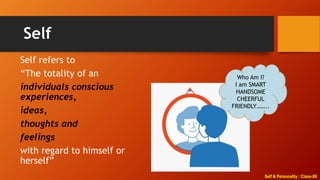
Who Am I?
I am SMART
HANDSOME
CHEERFUL
FRIENDLY……..
Self & Personality : Class-XII
How Self Develops?
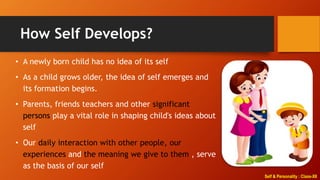
• A newly born child has no idea of its self
• As a child grows older, the idea of self emerges and
its formation begins.
• Parents, friends teachers and other significant
persons play a vital role in shaping child's ideas about
self
• Our daily interaction with other people, our
experiences and the meaning we give to them , serve
as the basis of our self
Self & Personality : Class-XII
Personal Identity
Personal identity refers to those attributes of a person
that make him or her different from others
• When a person describes himself or herself by telling
her name ( I am Urmila )
• Based on the qualities or characteristics ( I am honest
or hardworking person )
• Potentialities or capabilities ( I am a dancer )
• Beliefs ( I am a believer of God )
I am Urmila, I am sincere ,
hardworking and a dancer
Self & Personality : Class-XII
Social identity
• Social identity refers to those aspects social
of a person that link him/her to a social or
cultural group or are derived from it
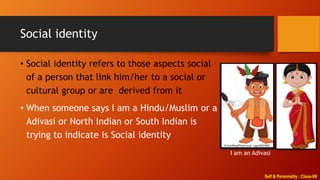
• When someone says I am a Hindu/Muslim or a
Adivasi or North Indian or South Indian is
trying to indicate is Social identity
I am an Adivasi
Self & Personality : Class-XII
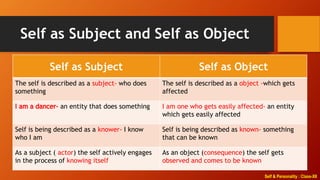
Self as Subject and Self as Object
Self as Subject Self as Object
The self is described as a subject- who does
something
The self is described as a object -which gets
affected
an entity that does something I am one who gets easily affected- an entity
which gets easily affected
Self is being described as a knower- I know
who I am
Self is being described as known- something
that can be known
As a subject ( actor) the self actively engages
in the process of knowing itself
As an object (consequence) the self gets
observed and comes to be known
Self & Personality : Class-XII
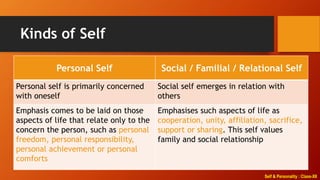
Kinds of Self
Personal Self Social / Familial / Relational Self
Personal self is primarily concerned
with oneself
Social self emerges in relation with
others
Emphasis comes to be laid on those
aspects of life that relate only to the
concern the person, such as personal
freedom, personal responsibility,
personal achievement or personal
comforts
Emphasises such aspects of life as
cooperation, unity, affiliation, sacrifice,
support or sharing. This self values
family and social relationship
Self & Personality : Class-XII
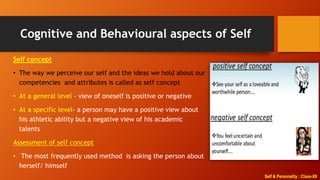
Cognitive and Behavioural aspects of Self
Self concept
• The way we perceive our self and the ideas we hold about our
competencies and attributes is called as self concept
• At a general level – view of oneself is positive or negative
• At a specific level- a person may have a positive view about
his athletic ability but a negative view of his academic
talents
Assessment of self concept
• The most frequently used method is asking the person about
herself/ himself
Self & Personality : Class-XII
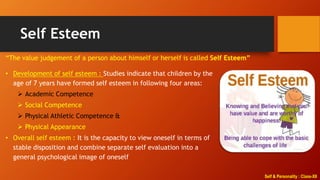
Self Esteem
“The value judgement of a person about himself or herself is called Self Esteem”
• Development of self esteem : Studies indicate that children by the
age of 7 years have formed self esteem in following four areas:
 Academic Competence
 Social Competence
 Physical Athletic Competence &
 Physical Appearance
• Overall self esteem : It is the capacity to view oneself in terms of
stable disposition and combine separate self evaluation into a
general psychological image of oneself
Self & Personality : Class-XII
Self Esteem
• Self esteem shows a strong relationship with our everyday
behaviour
• Children with high academic self esteem perform better in
schools than those with low academic self esteem
• Studies reveal that warm and positive parenting helps in
developing high self esteem in children because they feel they
are accepted ,competent and worthwhile. When parents help or
make decisions for them when they do not need assistance suffer
from low self esteem.
• Children with low self esteem in all area shows anxiety,
depression and increasing anti social behaviour
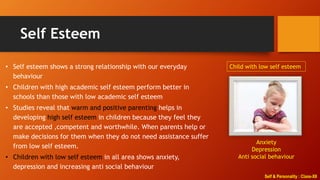
Child with low self esteem
Anxiety
Depression
Anti social behaviour
Self & Personality : Class-XII
Assessment of Self Esteem
Assessment of self esteem:
• A variety of statements are presented to a person and ask him to indicate the extent to
which the statements are true for her or him.
• Ex : I am highly liked by my peers - True
I am good at homework - True
• If a child repots these statements are true for him/her there self esteem is high in
comparison to someone who says no.
Self & Personality : Class-XII
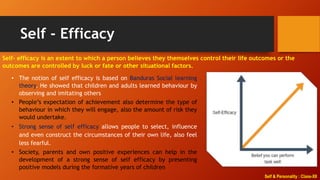
Self - Efficacy
Self- efficacy is an extent to which a person believes they themselves control their life outcomes or the
outcomes are controlled by luck or fate or other situational factors.
• The notion of self efficacy is based on Banduras Social learning
theory. He showed that children and adults learned behaviour by
observing and imitating others
• People’s expectation of achievement also determine the type of
behaviour in which they will engage, also the amount of risk they
would undertake.
• Strong sense of self efficacy allows people to select, influence
and even construct the circumstances of their own life, also feel
less fearful.
• Society, parents and own positive experiences can help in the
development of a strong sense of self efficacy by presenting
positive models during the formative years of children
Self & Personality : Class-XII
Self Regulation
Self Regulation refers to our ability to organise and monitor our own behaviour
• People, who are able to change their behaviour according to the demands of external
environment are high on self monitoring.
Self Control
• Self control is learning to delay or defer the gratification of needs.
• Self control plays a key role in fulfilment of long-term goals
• Psychological Techniques of Self Control
1. Observation of own behaviour is one which provides us with necessary information that
may be used to change, modify or strengthen certain aspects of self
2. Self Instruction: Instructs our self to do something and behave the way we want to.
Such instructions are quiet effective in self regulation
3. Self Reinforcement : this involves rewarding behaviours that have pleasant outcomes.
Self & Personality : Class-XII
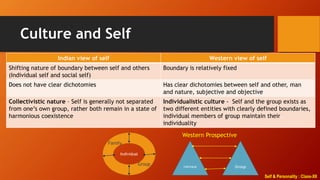
Culture and Self
Indian view of self Western view of self
Shifting nature of boundary between self and others
(Individual self and social self)
Boundary is relatively fixed
Does not have clear dichotomies Has clear dichotomies between self and other, man
and nature, subjective and objective
Collectivistic nature – Self is generally not separated
from one’s own group, rather both remain in a state of
harmonious coexistence
Individualistic culture - Self and the group exists as
two different entities with clearly defined boundaries,
individual members of group maintain their
individuality
Individual Group
Western Prospective
Individual
Group
Family
Self & Personality : Class-XII
Personality
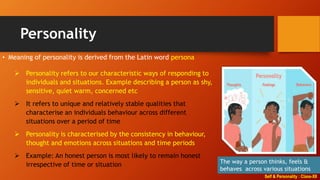
• Meaning of personality is derived from the Latin word persona
The way a person thinks, feels &
behaves across various situations
 Personality refers to our characteristic ways of responding to
individuals and situations. Example describing a person as shy,
sensitive, quiet warm, concerned etc
 It refers to unique and relatively stable qualities that
characterise an individuals behaviour across different
situations over a period of time
 Personality is characterised by the consistency in behaviour,
thought and emotions across situations and time periods
 Example: An honest person is most likely to remain honest
irrespective of time or situation
Self & Personality : Class-XII
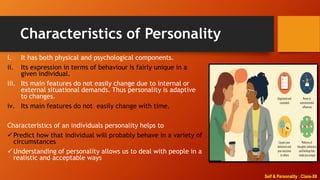
Characteristics of Personality
i. It has both physical and psychological components.
ii. Its expression in terms of behaviour is fairly unique in a
given individual.
iii. Its main features do not easily change due to internal or
external situational demands. Thus personality is adaptive
to changes.
iv. Its main features do not easily change with time.
Characteristics of an individuals personality helps to
Predict how that individual will probably behave in a variety of
circumstances
Understanding of personality allows us to deal with people in a
realistic and acceptable ways
Self & Personality : Class-XII
Personality : Related Terms
• Temperament : biologically based characteristic way of reacting
Ex: a person emotionally reacting in a irritable, anxious, restless in most of the situations
• Trait: stable, persistent and specific way of being
Ex: introverts being passive, reserved, shy and cautious
• Dispositions: tendency of a person to react to a given situation in a particular way
Ex: an individual having a tendency to argue and get angry when negatively criticized
• Character: the overall pattern of regularly occurring behaviour
• Habit: overlearned modes of behaving
• Values: goals and ideals that are considered important and worthwhile to achieve
Ex: a student values punctuality, hard work, sincerity to achieve in his academics
Self & Personality : Class-XII

Self and Personality Part-I

  • 1.
    Self and Personality Mrs.Navarathina Devakumar, M.Sc., M.Phil. (Psychology) Chapter-2 : Part-I
  • 2.
    Self & Personality: Class-XII Self Self refers to “The totality of an individuals conscious experiences, ideas, thoughts and feelings with regard to himself or herself” Who Am I? I am SMART HANDSOME CHEERFUL FRIENDLY……..
  • 3.
    Self & Personality: Class-XII How Self Develops? • A newly born child has no idea of its self • As a child grows older, the idea of self emerges and its formation begins. • Parents, friends teachers and other significant persons play a vital role in shaping child's ideas about self • Our daily interaction with other people, our experiences and the meaning we give to them , serve as the basis of our self
  • 4.
    Self & Personality: Class-XII Personal Identity Personal identity refers to those attributes of a person that make him or her different from others • When a person describes himself or herself by telling her name ( I am Urmila ) • Based on the qualities or characteristics ( I am honest or hardworking person ) • Potentialities or capabilities ( I am a dancer ) • Beliefs ( I am a believer of God ) I am Urmila, I am sincere , hardworking and a dancer
  • 5.
    Self & Personality: Class-XII Social identity • Social identity refers to those aspects social of a person that link him/her to a social or cultural group or are derived from it • When someone says I am a Hindu/Muslim or a Adivasi or North Indian or South Indian is trying to indicate is Social identity I am an Adivasi
  • 6.
    Self & Personality: Class-XII Self as Subject and Self as Object Self as Subject Self as Object The self is described as a subject- who does something The self is described as a object -which gets affected an entity that does something I am one who gets easily affected- an entity which gets easily affected Self is being described as a knower- I know who I am Self is being described as known- something that can be known As a subject ( actor) the self actively engages in the process of knowing itself As an object (consequence) the self gets observed and comes to be known
  • 7.
    Self & Personality: Class-XII Kinds of Self Personal Self Social / Familial / Relational Self Personal self is primarily concerned with oneself Social self emerges in relation with others Emphasis comes to be laid on those aspects of life that relate only to the concern the person, such as personal freedom, personal responsibility, personal achievement or personal comforts Emphasises such aspects of life as cooperation, unity, affiliation, sacrifice, support or sharing. This self values family and social relationship
  • 8.
    Self & Personality: Class-XII Cognitive and Behavioural aspects of Self Self concept • The way we perceive our self and the ideas we hold about our competencies and attributes is called as self concept • At a general level – view of oneself is positive or negative • At a specific level- a person may have a positive view about his athletic ability but a negative view of his academic talents Assessment of self concept • The most frequently used method is asking the person about herself/ himself
  • 9.
    Self & Personality: Class-XII Self Esteem “The value judgement of a person about himself or herself is called Self Esteem” • Development of self esteem : Studies indicate that children by the age of 7 years have formed self esteem in following four areas:  Academic Competence  Social Competence  Physical Athletic Competence &  Physical Appearance • Overall self esteem : It is the capacity to view oneself in terms of stable disposition and combine separate self evaluation into a general psychological image of oneself
  • 10.
    Self & Personality: Class-XII Self Esteem • Self esteem shows a strong relationship with our everyday behaviour • Children with high academic self esteem perform better in schools than those with low academic self esteem • Studies reveal that warm and positive parenting helps in developing high self esteem in children because they feel they are accepted ,competent and worthwhile. When parents help or make decisions for them when they do not need assistance suffer from low self esteem. • Children with low self esteem in all area shows anxiety, depression and increasing anti social behaviour Child with low self esteem Anxiety Depression Anti social behaviour
  • 11.
    Self & Personality: Class-XII Assessment of Self Esteem Assessment of self esteem: • A variety of statements are presented to a person and ask him to indicate the extent to which the statements are true for her or him. • Ex : I am highly liked by my peers - True I am good at homework - True • If a child repots these statements are true for him/her there self esteem is high in comparison to someone who says no.
  • 12.
    Self & Personality: Class-XII Self - Efficacy Self- efficacy is an extent to which a person believes they themselves control their life outcomes or the outcomes are controlled by luck or fate or other situational factors. • The notion of self efficacy is based on Banduras Social learning theory. He showed that children and adults learned behaviour by observing and imitating others • People’s expectation of achievement also determine the type of behaviour in which they will engage, also the amount of risk they would undertake. • Strong sense of self efficacy allows people to select, influence and even construct the circumstances of their own life, also feel less fearful. • Society, parents and own positive experiences can help in the development of a strong sense of self efficacy by presenting positive models during the formative years of children
  • 13.
    Self & Personality: Class-XII Self Regulation Self Regulation refers to our ability to organise and monitor our own behaviour • People, who are able to change their behaviour according to the demands of external environment are high on self monitoring. Self Control • Self control is learning to delay or defer the gratification of needs. • Self control plays a key role in fulfilment of long-term goals • Psychological Techniques of Self Control 1. Observation of own behaviour is one which provides us with necessary information that may be used to change, modify or strengthen certain aspects of self 2. Self Instruction: Instructs our self to do something and behave the way we want to. Such instructions are quiet effective in self regulation 3. Self Reinforcement : this involves rewarding behaviours that have pleasant outcomes.
  • 14.
    Self & Personality: Class-XII Culture and Self Indian view of self Western view of self Shifting nature of boundary between self and others (Individual self and social self) Boundary is relatively fixed Does not have clear dichotomies Has clear dichotomies between self and other, man and nature, subjective and objective Collectivistic nature – Self is generally not separated from one’s own group, rather both remain in a state of harmonious coexistence Individualistic culture - Self and the group exists as two different entities with clearly defined boundaries, individual members of group maintain their individuality Individual Group Western Prospective Individual Group Family
  • 15.
    Self & Personality: Class-XII Personality • Meaning of personality is derived from the Latin word persona The way a person thinks, feels & behaves across various situations  Personality refers to our characteristic ways of responding to individuals and situations. Example describing a person as shy, sensitive, quiet warm, concerned etc  It refers to unique and relatively stable qualities that characterise an individuals behaviour across different situations over a period of time  Personality is characterised by the consistency in behaviour, thought and emotions across situations and time periods  Example: An honest person is most likely to remain honest irrespective of time or situation
  • 16.
    Self & Personality: Class-XII Characteristics of Personality i. It has both physical and psychological components. ii. Its expression in terms of behaviour is fairly unique in a given individual. iii. Its main features do not easily change due to internal or external situational demands. Thus personality is adaptive to changes. iv. Its main features do not easily change with time. Characteristics of an individuals personality helps to Predict how that individual will probably behave in a variety of circumstances Understanding of personality allows us to deal with people in a realistic and acceptable ways
  • 17.
    Self & Personality: Class-XII Personality : Related Terms • Temperament : biologically based characteristic way of reacting Ex: a person emotionally reacting in a irritable, anxious, restless in most of the situations • Trait: stable, persistent and specific way of being Ex: introverts being passive, reserved, shy and cautious • Dispositions: tendency of a person to react to a given situation in a particular way Ex: an individual having a tendency to argue and get angry when negatively criticized • Character: the overall pattern of regularly occurring behaviour • Habit: overlearned modes of behaving • Values: goals and ideals that are considered important and worthwhile to achieve Ex: a student values punctuality, hard work, sincerity to achieve in his academics
  • 18.
    Self & Personality: Class-XII