1 
PSYCHOLOGY 
(9th Edition) 
David Myers 
PowerPoint Slides 
Aneeq Ahmad 
Henderson State University 
Worth Publishers, © 2010
2 
Learning 
Chapter 7
3 
Learning 
How Do We Learn? 
Classical Conditioning 
 Pavlov’s Experiments 
 Extending Pavlov’s 
Understanding 
 Pavlov’s Legacy
4 
Operant Conditioning 
 Skinner’s Experiments 
 Extending Skinner’s 
Understanding 
 Skinner’s Legacy 
 Contrasting Classical & Operant 
Conditioning
5 
Learning by Observation 
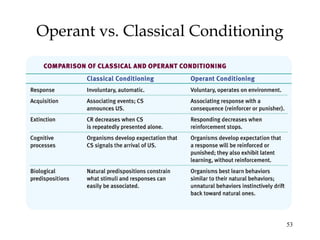
 Bandura’s Experiments 
 Applications of Observational 
Learning
6 
Chapter 8: Learning 
Definition 
Learning is a relatively permanent change in an 
organism’s behavior due to experience. 
Learning is more flexible in comparison to the 
genetically-programmed behaviors of Chinooks, 
for example.
7 
How Do We Learn? 
We learn by association. Our minds 
naturally connect events that occur in 
sequence. 
2000 years ago, Aristotle suggested this 
law of association. Then 200 years ago 
Locke and Hume reiterated this law.
8 
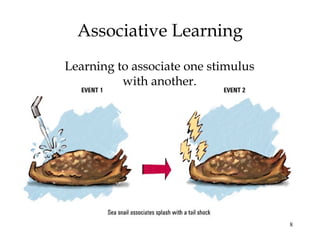
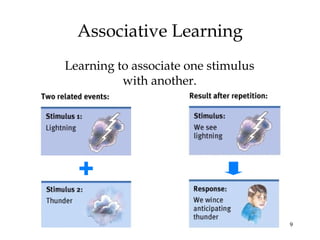
Associative Learning 
Learning to associate one stimulus 
with another.
9 
Associative Learning 
Learning to associate one stimulus 
with another.
10 
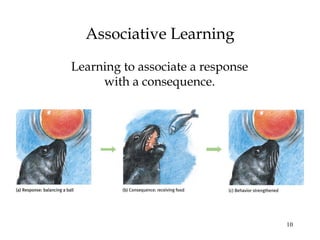
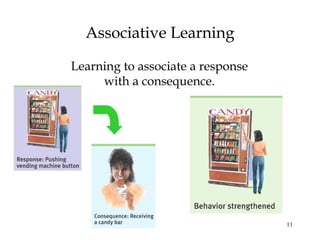
Associative Learning 
Learning to associate a response 
with a consequence.
11 
Associative Learning 
Learning to associate a response 
with a consequence.
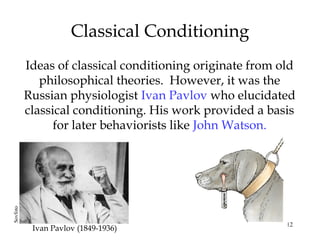
Classical Conditioning 
Ideas of classical conditioning originate from old 
philosophical theories. However, it was the 
Russian physiologist Ivan Pavlov who elucidated 
classical conditioning. His work provided a basis 
12 
for later behaviorists like John Watson. 
Ivan Pavlov (1849-1936) Sovfoto
13 
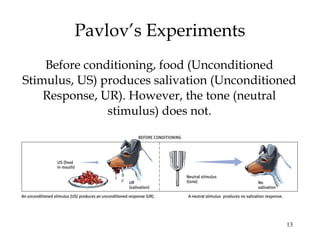
Pavlov’s Experiments 
Before conditioning, food (Unconditioned 
Stimulus, US) produces salivation (Unconditioned 
Response, UR). However, the tone (neutral 
stimulus) does not.
14 
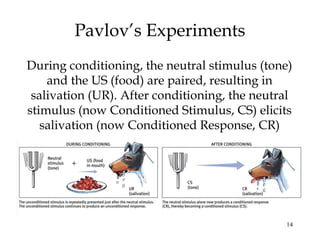
Pavlov’s Experiments 
During conditioning, the neutral stimulus (tone) 
and the US (food) are paired, resulting in 
salivation (UR). After conditioning, the neutral 
stimulus (now Conditioned Stimulus, CS) elicits 
salivation (now Conditioned Response, CR)
15 
Acquisition 
Acquisition is the initial learning stage in 
classical conditioning in which an association 
between a neutral stimulus and an 
unconditioned stimulus takes place. 
1. In most cases, for conditioning to occur, the 
neutral stimulus needs to come before the 
unconditioned stimulus. 
2. The time in between the two stimuli should 
be about half a second.
16 
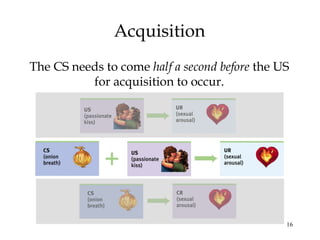
Acquisition 
The CS needs to come half a second before the US 
for acquisition to occur.
17 
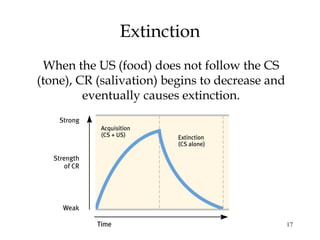
Extinction 
When the US (food) does not follow the CS 
(tone), CR (salivation) begins to decrease and 
eventually causes extinction.
18 
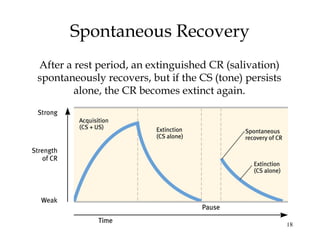
Spontaneous Recovery 
After a rest period, an extinguished CR (salivation) 
spontaneously recovers, but if the CS (tone) persists 
alone, the CR becomes extinct again.
19 
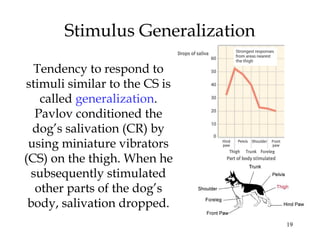
Stimulus Generalization 
Tendency to respond to 
stimuli similar to the CS is 
called generalization. 
Pavlov conditioned the 
dog’s salivation (CR) by 
using miniature vibrators 
(CS) on the thigh. When he 
subsequently stimulated 
other parts of the dog’s 
body, salivation dropped.
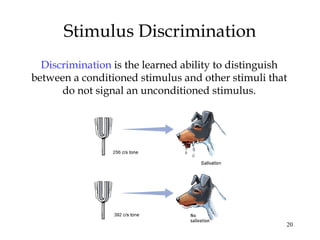
20 
Stimulus Discrimination 
Discrimination is the learned ability to distinguish 
between a conditioned stimulus and other stimuli that 
do not signal an unconditioned stimulus.
21 
Extending Pavlov’s Understanding 
Pavlov and Watson considered consciousness, 
or mind, unfit for the scientific study of 
psychology. However, they underestimated 
the importance of cognitive processes and 
biological constraints.
22 
Cognitive Processes 
Early behaviorists believed that learned 
behaviors of various animals could be reduced 
to mindless mechanisms. 
However, later behaviorists suggested that 
animals learn the predictability of a stimulus, 
meaning they learn expectancy or awareness of a 
stimulus (Rescorla & Wagner, 1972).
23 
Biological Predispositions 
Pavlov and Watson believed that laws of 
learning were similar for all animals. 
Therefore, a pigeon and a person do not differ 
in their learning. 
However, behaviorists later suggested that 
learning is constrained by an animal’s biology.
24 
Biological Predispositions 
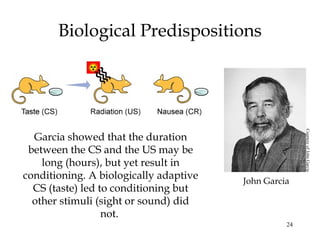
John Garcia 
Garcia showed that the duration 
between the CS and the US may be 
long (hours), but yet result in 
conditioning. A biologically adaptive 
CS (taste) led to conditioning but 
other stimuli (sight or sound) did 
not. 
Courtesy of John Garcia
25 
Biological Predispositions 
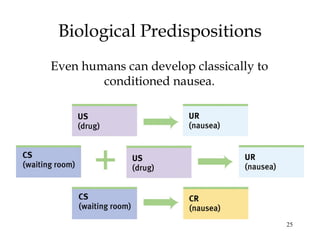
Even humans can develop classically to 
conditioned nausea.
26 
Pavlov’s Legacy 
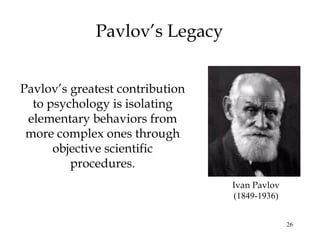
Pavlov’s greatest contribution 
to psychology is isolating 
elementary behaviors from 
more complex ones through 
objective scientific 
procedures. 
Ivan Pavlov 
(1849-1936)
27 
Applications of Classical 
Conditioning 
1. Former crack cocaine users should avoid 
cues (people, places) associated with 
previous drug use. 
2. Through classical conditioning, a drug (plus 
its taste) that affects the immune response 
may cause the taste of the drug to invoke the 
immune response.
28 
Applications of Classical 
Conditioning 
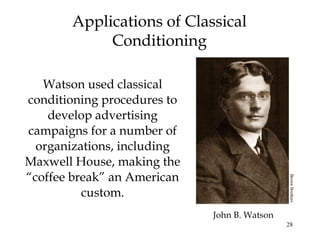
Watson used classical 
conditioning procedures to 
develop advertising 
campaigns for a number of 
organizations, including 
Maxwell House, making the 
“coffee break” an American 
custom. 
John B. Watson 
Brown Brothers
29 
Operant & Classical Conditioning 
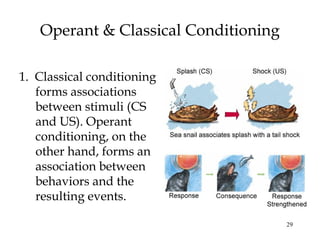
1. Classical conditioning 
forms associations 
between stimuli (CS 
and US). Operant 
conditioning, on the 
other hand, forms an 
association between 
behaviors and the 
resulting events.
30 
Operant & Classical Conditioning 
2. Classical conditioning involves respondent 
behavior that occurs as an automatic 
response to a certain stimulus. Operant 
conditioning involves operant behavior, a 
behavior that operates on the environment, 
producing rewarding or punishing stimuli.
31 
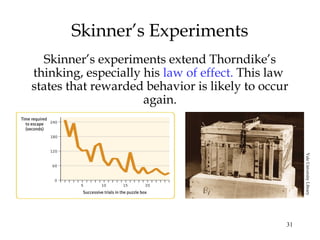
Skinner’s Experiments 
Skinner’s experiments extend Thorndike’s 
thinking, especially his law of effect. This law 
states that rewarded behavior is likely to occur 
again. 
Yale University Library
32 
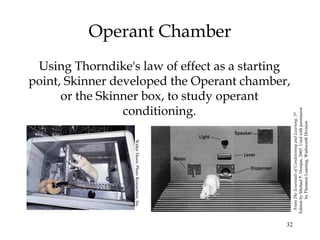
Operant Chamber 
Using Thorndike's law of effect as a starting 
point, Skinner developed the Operant chamber, 
or the Skinner box, to study operant 
conditioning. 
Walter Dawn/ Photo Researchers, Inc. 
From The Essentials of Conditioning and Learning, 3rd 
Edition by Michael P. Domjan, 2005. Used with permission 
by Thomson Learning, Wadsworth Division
33 
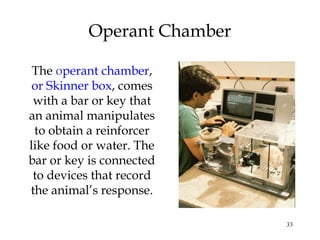
Operant Chamber 
The operant chamber, 
or Skinner box, comes 
with a bar or key that 
an animal manipulates 
to obtain a reinforcer 
like food or water. The 
bar or key is connected 
to devices that record 
the animal’s response.
34 
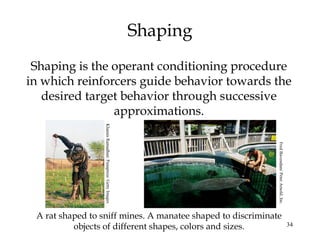
Shaping 
Shaping is the operant conditioning procedure 
in which reinforcers guide behavior towards the 
desired target behavior through successive 
approximations. 
Khamis Ramadhan/ Panapress/ Getty Images 
A rat shaped to sniff mines. A manatee shaped to discriminate 
objects of different shapes, colors and sizes. 
Fred Bavendam/ Peter Arnold, Inc.
35 
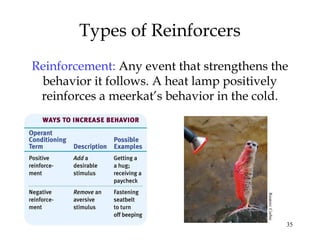
Types of Reinforcers 
Reinforcement: Any event that strengthens the 
behavior it follows. A heat lamp positively 
reinforces a meerkat’s behavior in the cold. 
Reuters/ Corbis
Primary & Secondary Reinforcers 
1. Primary Reinforcer: An innately reinforcing 
36 
stimulus like food or drink. 
2. Conditioned Reinforcer: A learned 
reinforcer that gets its reinforcing power 
through association with the primary 
reinforcer.
37 
Immediate & Delayed Reinforcers 
1. Immediate Reinforcer: A reinforcer that 
occurs instantly after a behavior. A rat gets 
a food pellet for a bar press. 
2. Delayed Reinforcer: A reinforcer that is 
delayed in time for a certain behavior. A 
paycheck that comes at the end of a week. 
We may be inclined to engage in small immediate 
reinforcers (watching TV) rather than large delayed 
reinforcers (getting an A in a course) which require 
consistent study.
38 
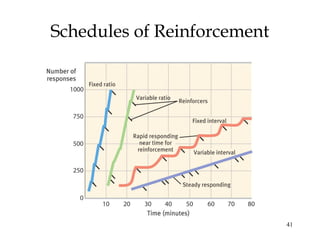
Reinforcement Schedules 
1. Continuous Reinforcement: Reinforces the 
desired response each time it occurs. 
2. Partial Reinforcement: Reinforces a 
response only part of the time. Though this 
results in slower acquisition in the 
beginning, it shows greater resistance to 
extinction later on.
39 
Ratio Schedules 
1. Fixed-ratio schedule: Reinforces a response 
only after a specified number of responses. 
e.g., piecework pay. 
2. Variable-ratio schedule: Reinforces a 
response after an unpredictable number of 
responses. This is hard to extinguish because 
of the unpredictability. (e.g., behaviors like 
gambling, fishing.)
40 
Interval Schedules 
1. Fixed-interval schedule: Reinforces a 
response only after a specified time has 
elapsed. (e.g., preparing for an exam 
only when the exam draws close.) 
2. Variable-interval schedule: Reinforces a 
response at unpredictable time 
intervals, which produces slow, steady 
responses. (e.g., pop quiz.)
41 
Schedules of Reinforcement
42 
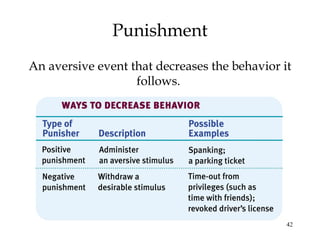
Punishment 
An aversive event that decreases the behavior it 
follows.
43 
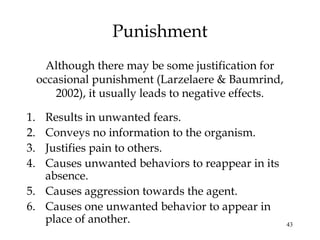
Punishment 
Although there may be some justification for 
occasional punishment (Larzelaere & Baumrind, 
2002), it usually leads to negative effects. 
1. Results in unwanted fears. 
2. Conveys no information to the organism. 
3. Justifies pain to others. 
4. Causes unwanted behaviors to reappear in its 
absence. 
5. Causes aggression towards the agent. 
6. Causes one unwanted behavior to appear in 
place of another.
Extending Skinner’s Understanding 
Skinner believed in inner thought processes and 
44 
biological underpinnings, but many 
psychologists criticize him for discounting 
them.
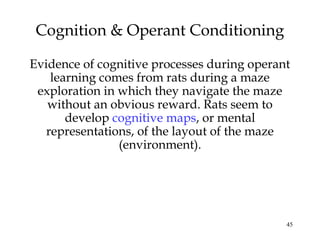
Cognition & Operant Conditioning 
Evidence of cognitive processes during operant 
45 
learning comes from rats during a maze 
exploration in which they navigate the maze 
without an obvious reward. Rats seem to 
develop cognitive maps, or mental 
representations, of the layout of the maze 
(environment).
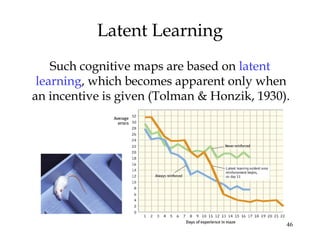
46 
Latent Learning 
Such cognitive maps are based on latent 
learning, which becomes apparent only when 
an incentive is given (Tolman & Honzik, 1930).
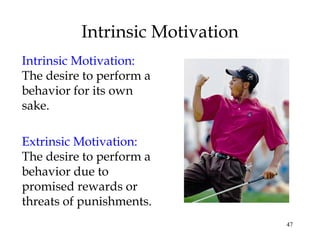
47 
Intrinsic Motivation 
Intrinsic Motivation: 
The desire to perform a 
behavior for its own 
sake. 
Extrinsic Motivation: 
The desire to perform a 
behavior due to 
promised rewards or 
threats of punishments.
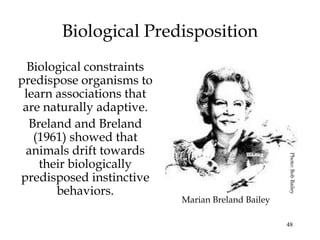
48 
Biological Predisposition 
Biological constraints 
predispose organisms to 
learn associations that 
are naturally adaptive. 
Breland and Breland 
(1961) showed that 
animals drift towards 
their biologically 
predisposed instinctive 
behaviors. 
Marian Breland Bailey 
Photo: Bob Bailey
49 
Skinner’s Legacy 
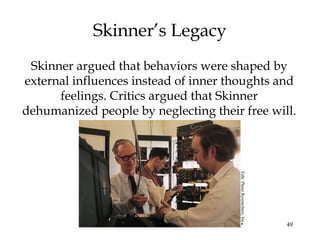
Skinner argued that behaviors were shaped by 
external influences instead of inner thoughts and 
feelings. Critics argued that Skinner 
dehumanized people by neglecting their free will. 
Falk/ Photo Researchers, Inc.
50 
Applications of Operant 
Conditioning 
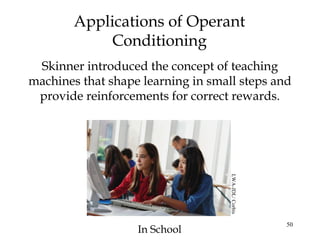
Skinner introduced the concept of teaching 
machines that shape learning in small steps and 
provide reinforcements for correct rewards. 
In School 
LWA-JDL/ Corbis
51 
Applications of Operant 
Conditioning 
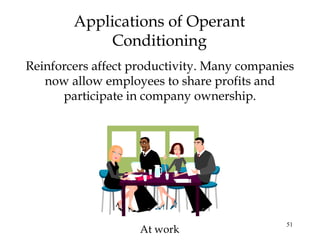
Reinforcers affect productivity. Many companies 
now allow employees to share profits and 
participate in company ownership. 
At work
52 
Applications of Operant 
Conditioning 
At Home 
In children, reinforcing good behavior increases 
the occurrence of these behaviors. Ignoring 
unwanted behavior decreases their occurrence.
53 
Operant vs. Classical Conditioning
54 
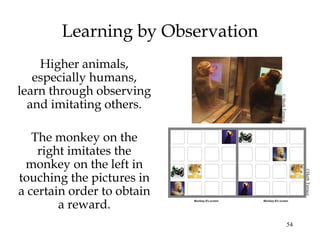
Learning by Observation 
Higher animals, 
especially humans, 
learn through observing 
and imitating others. 
The monkey on the 
right imitates the 
monkey on the left in 
touching the pictures in 
a certain order to obtain 
a reward. 
© Herb Terrace 
©Herb Terrace
55 
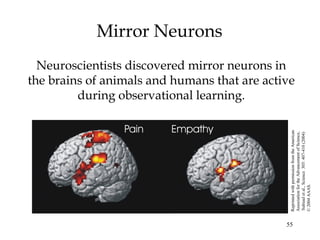
Mirror Neurons 
Neuroscientists discovered mirror neurons in 
the brains of animals and humans that are active 
during observational learning. 
Reprinted with permission from the American 
Association for the Advancement of Science, 
Subiaul et al., Science 305: 407-410 (2004) 
© 2004 AAAS.
56 
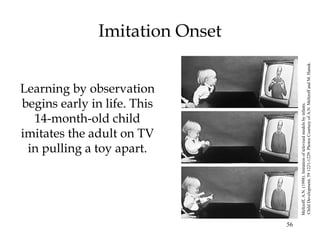
Imitation Onset 
Learning by observation 
begins early in life. This 
14-month-old child 
imitates the adult on TV 
in pulling a toy apart. 
Meltzoff, A.N. (1998). Imitation of televised models by infants. 
Child Development, 59 1221-1229. Photos Courtesy of A.N. Meltzoff and M. Hanuk.
57 
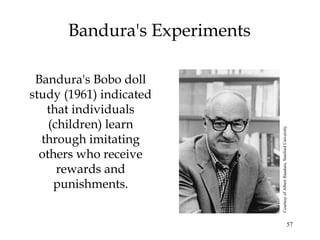
Bandura's Experiments 
Bandura's Bobo doll 
study (1961) indicated 
that individuals 
(children) learn 
through imitating 
others who receive 
rewards and 
punishments. 
Courtesy of Albert Bandura, Stanford University
58 
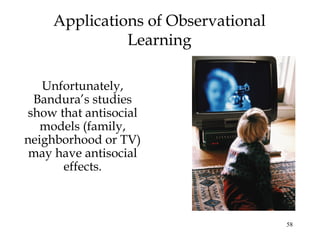
Applications of Observational 
Learning 
Unfortunately, 
Bandura’s studies 
show that antisocial 
models (family, 
neighborhood or TV) 
may have antisocial 
effects.
59 
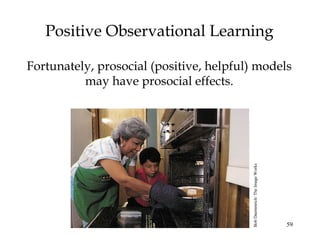
Positive Observational Learning 
Fortunately, prosocial (positive, helpful) models 
may have prosocial effects. 
Bob Daemmrich/ The Image Works
60 
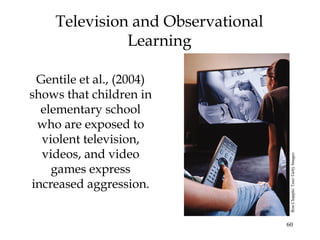
Television and Observational 
Learning 
Gentile et al., (2004) 
shows that children in 
elementary school 
who are exposed to 
violent television, 
videos, and video 
games express 
increased aggression. 
Ron Chapple/ Taxi/ Getty Images
61 
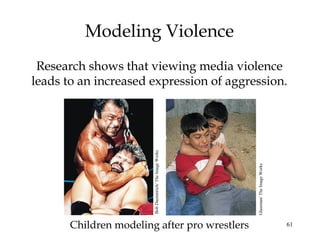
Modeling Violence 
Research shows that viewing media violence 
leads to an increased expression of aggression. 
Bob Daemmrich/ The Image Works 
Children modeling after pro wrestlers 
Glassman/ The Image Works

AP Psyc ch 07

  • 1.
    1 PSYCHOLOGY (9thEdition) David Myers PowerPoint Slides Aneeq Ahmad Henderson State University Worth Publishers, © 2010
  • 2.
  • 3.
    3 Learning HowDo We Learn? Classical Conditioning  Pavlov’s Experiments  Extending Pavlov’s Understanding  Pavlov’s Legacy
  • 4.
    4 Operant Conditioning  Skinner’s Experiments  Extending Skinner’s Understanding  Skinner’s Legacy  Contrasting Classical & Operant Conditioning
  • 5.
    5 Learning byObservation  Bandura’s Experiments  Applications of Observational Learning
  • 6.
    6 Chapter 8:Learning Definition Learning is a relatively permanent change in an organism’s behavior due to experience. Learning is more flexible in comparison to the genetically-programmed behaviors of Chinooks, for example.
  • 7.
    7 How DoWe Learn? We learn by association. Our minds naturally connect events that occur in sequence. 2000 years ago, Aristotle suggested this law of association. Then 200 years ago Locke and Hume reiterated this law.
  • 8.
    8 Associative Learning Learning to associate one stimulus with another.
  • 9.
    9 Associative Learning Learning to associate one stimulus with another.
  • 10.
    10 Associative Learning Learning to associate a response with a consequence.
  • 11.
    11 Associative Learning Learning to associate a response with a consequence.
  • 12.
    Classical Conditioning Ideasof classical conditioning originate from old philosophical theories. However, it was the Russian physiologist Ivan Pavlov who elucidated classical conditioning. His work provided a basis 12 for later behaviorists like John Watson. Ivan Pavlov (1849-1936) Sovfoto
  • 13.
    13 Pavlov’s Experiments Before conditioning, food (Unconditioned Stimulus, US) produces salivation (Unconditioned Response, UR). However, the tone (neutral stimulus) does not.
  • 14.
    14 Pavlov’s Experiments During conditioning, the neutral stimulus (tone) and the US (food) are paired, resulting in salivation (UR). After conditioning, the neutral stimulus (now Conditioned Stimulus, CS) elicits salivation (now Conditioned Response, CR)
  • 15.
    15 Acquisition Acquisitionis the initial learning stage in classical conditioning in which an association between a neutral stimulus and an unconditioned stimulus takes place. 1. In most cases, for conditioning to occur, the neutral stimulus needs to come before the unconditioned stimulus. 2. The time in between the two stimuli should be about half a second.
  • 16.
    16 Acquisition TheCS needs to come half a second before the US for acquisition to occur.
  • 17.
    17 Extinction Whenthe US (food) does not follow the CS (tone), CR (salivation) begins to decrease and eventually causes extinction.
  • 18.
    18 Spontaneous Recovery After a rest period, an extinguished CR (salivation) spontaneously recovers, but if the CS (tone) persists alone, the CR becomes extinct again.
  • 19.
    19 Stimulus Generalization Tendency to respond to stimuli similar to the CS is called generalization. Pavlov conditioned the dog’s salivation (CR) by using miniature vibrators (CS) on the thigh. When he subsequently stimulated other parts of the dog’s body, salivation dropped.
  • 20.
    20 Stimulus Discrimination Discrimination is the learned ability to distinguish between a conditioned stimulus and other stimuli that do not signal an unconditioned stimulus.
  • 21.
    21 Extending Pavlov’sUnderstanding Pavlov and Watson considered consciousness, or mind, unfit for the scientific study of psychology. However, they underestimated the importance of cognitive processes and biological constraints.
  • 22.
    22 Cognitive Processes Early behaviorists believed that learned behaviors of various animals could be reduced to mindless mechanisms. However, later behaviorists suggested that animals learn the predictability of a stimulus, meaning they learn expectancy or awareness of a stimulus (Rescorla & Wagner, 1972).
  • 23.
    23 Biological Predispositions Pavlov and Watson believed that laws of learning were similar for all animals. Therefore, a pigeon and a person do not differ in their learning. However, behaviorists later suggested that learning is constrained by an animal’s biology.
  • 24.
    24 Biological Predispositions John Garcia Garcia showed that the duration between the CS and the US may be long (hours), but yet result in conditioning. A biologically adaptive CS (taste) led to conditioning but other stimuli (sight or sound) did not. Courtesy of John Garcia
  • 25.
    25 Biological Predispositions Even humans can develop classically to conditioned nausea.
  • 26.
    26 Pavlov’s Legacy Pavlov’s greatest contribution to psychology is isolating elementary behaviors from more complex ones through objective scientific procedures. Ivan Pavlov (1849-1936)
  • 27.
    27 Applications ofClassical Conditioning 1. Former crack cocaine users should avoid cues (people, places) associated with previous drug use. 2. Through classical conditioning, a drug (plus its taste) that affects the immune response may cause the taste of the drug to invoke the immune response.
  • 28.
    28 Applications ofClassical Conditioning Watson used classical conditioning procedures to develop advertising campaigns for a number of organizations, including Maxwell House, making the “coffee break” an American custom. John B. Watson Brown Brothers
  • 29.
    29 Operant &Classical Conditioning 1. Classical conditioning forms associations between stimuli (CS and US). Operant conditioning, on the other hand, forms an association between behaviors and the resulting events.
  • 30.
    30 Operant &Classical Conditioning 2. Classical conditioning involves respondent behavior that occurs as an automatic response to a certain stimulus. Operant conditioning involves operant behavior, a behavior that operates on the environment, producing rewarding or punishing stimuli.
  • 31.
    31 Skinner’s Experiments Skinner’s experiments extend Thorndike’s thinking, especially his law of effect. This law states that rewarded behavior is likely to occur again. Yale University Library
  • 32.
    32 Operant Chamber Using Thorndike's law of effect as a starting point, Skinner developed the Operant chamber, or the Skinner box, to study operant conditioning. Walter Dawn/ Photo Researchers, Inc. From The Essentials of Conditioning and Learning, 3rd Edition by Michael P. Domjan, 2005. Used with permission by Thomson Learning, Wadsworth Division
  • 33.
    33 Operant Chamber The operant chamber, or Skinner box, comes with a bar or key that an animal manipulates to obtain a reinforcer like food or water. The bar or key is connected to devices that record the animal’s response.
  • 34.
    34 Shaping Shapingis the operant conditioning procedure in which reinforcers guide behavior towards the desired target behavior through successive approximations. Khamis Ramadhan/ Panapress/ Getty Images A rat shaped to sniff mines. A manatee shaped to discriminate objects of different shapes, colors and sizes. Fred Bavendam/ Peter Arnold, Inc.
  • 35.
    35 Types ofReinforcers Reinforcement: Any event that strengthens the behavior it follows. A heat lamp positively reinforces a meerkat’s behavior in the cold. Reuters/ Corbis
  • 36.
    Primary & SecondaryReinforcers 1. Primary Reinforcer: An innately reinforcing 36 stimulus like food or drink. 2. Conditioned Reinforcer: A learned reinforcer that gets its reinforcing power through association with the primary reinforcer.
  • 37.
    37 Immediate &Delayed Reinforcers 1. Immediate Reinforcer: A reinforcer that occurs instantly after a behavior. A rat gets a food pellet for a bar press. 2. Delayed Reinforcer: A reinforcer that is delayed in time for a certain behavior. A paycheck that comes at the end of a week. We may be inclined to engage in small immediate reinforcers (watching TV) rather than large delayed reinforcers (getting an A in a course) which require consistent study.
  • 38.
    38 Reinforcement Schedules 1. Continuous Reinforcement: Reinforces the desired response each time it occurs. 2. Partial Reinforcement: Reinforces a response only part of the time. Though this results in slower acquisition in the beginning, it shows greater resistance to extinction later on.
  • 39.
    39 Ratio Schedules 1. Fixed-ratio schedule: Reinforces a response only after a specified number of responses. e.g., piecework pay. 2. Variable-ratio schedule: Reinforces a response after an unpredictable number of responses. This is hard to extinguish because of the unpredictability. (e.g., behaviors like gambling, fishing.)
  • 40.
    40 Interval Schedules 1. Fixed-interval schedule: Reinforces a response only after a specified time has elapsed. (e.g., preparing for an exam only when the exam draws close.) 2. Variable-interval schedule: Reinforces a response at unpredictable time intervals, which produces slow, steady responses. (e.g., pop quiz.)
  • 41.
    41 Schedules ofReinforcement
  • 42.
    42 Punishment Anaversive event that decreases the behavior it follows.
  • 43.
    43 Punishment Althoughthere may be some justification for occasional punishment (Larzelaere & Baumrind, 2002), it usually leads to negative effects. 1. Results in unwanted fears. 2. Conveys no information to the organism. 3. Justifies pain to others. 4. Causes unwanted behaviors to reappear in its absence. 5. Causes aggression towards the agent. 6. Causes one unwanted behavior to appear in place of another.
  • 44.
    Extending Skinner’s Understanding Skinner believed in inner thought processes and 44 biological underpinnings, but many psychologists criticize him for discounting them.
  • 45.
    Cognition & OperantConditioning Evidence of cognitive processes during operant 45 learning comes from rats during a maze exploration in which they navigate the maze without an obvious reward. Rats seem to develop cognitive maps, or mental representations, of the layout of the maze (environment).
  • 46.
    46 Latent Learning Such cognitive maps are based on latent learning, which becomes apparent only when an incentive is given (Tolman & Honzik, 1930).
  • 47.
    47 Intrinsic Motivation Intrinsic Motivation: The desire to perform a behavior for its own sake. Extrinsic Motivation: The desire to perform a behavior due to promised rewards or threats of punishments.
  • 48.
    48 Biological Predisposition Biological constraints predispose organisms to learn associations that are naturally adaptive. Breland and Breland (1961) showed that animals drift towards their biologically predisposed instinctive behaviors. Marian Breland Bailey Photo: Bob Bailey
  • 49.
    49 Skinner’s Legacy Skinner argued that behaviors were shaped by external influences instead of inner thoughts and feelings. Critics argued that Skinner dehumanized people by neglecting their free will. Falk/ Photo Researchers, Inc.
  • 50.
    50 Applications ofOperant Conditioning Skinner introduced the concept of teaching machines that shape learning in small steps and provide reinforcements for correct rewards. In School LWA-JDL/ Corbis
  • 51.
    51 Applications ofOperant Conditioning Reinforcers affect productivity. Many companies now allow employees to share profits and participate in company ownership. At work
  • 52.
    52 Applications ofOperant Conditioning At Home In children, reinforcing good behavior increases the occurrence of these behaviors. Ignoring unwanted behavior decreases their occurrence.
  • 53.
    53 Operant vs.Classical Conditioning
  • 54.
    54 Learning byObservation Higher animals, especially humans, learn through observing and imitating others. The monkey on the right imitates the monkey on the left in touching the pictures in a certain order to obtain a reward. © Herb Terrace ©Herb Terrace
  • 55.
    55 Mirror Neurons Neuroscientists discovered mirror neurons in the brains of animals and humans that are active during observational learning. Reprinted with permission from the American Association for the Advancement of Science, Subiaul et al., Science 305: 407-410 (2004) © 2004 AAAS.
  • 56.
    56 Imitation Onset Learning by observation begins early in life. This 14-month-old child imitates the adult on TV in pulling a toy apart. Meltzoff, A.N. (1998). Imitation of televised models by infants. Child Development, 59 1221-1229. Photos Courtesy of A.N. Meltzoff and M. Hanuk.
  • 57.
    57 Bandura's Experiments Bandura's Bobo doll study (1961) indicated that individuals (children) learn through imitating others who receive rewards and punishments. Courtesy of Albert Bandura, Stanford University
  • 58.
    58 Applications ofObservational Learning Unfortunately, Bandura’s studies show that antisocial models (family, neighborhood or TV) may have antisocial effects.
  • 59.
    59 Positive ObservationalLearning Fortunately, prosocial (positive, helpful) models may have prosocial effects. Bob Daemmrich/ The Image Works
  • 60.
    60 Television andObservational Learning Gentile et al., (2004) shows that children in elementary school who are exposed to violent television, videos, and video games express increased aggression. Ron Chapple/ Taxi/ Getty Images
  • 61.
    61 Modeling Violence Research shows that viewing media violence leads to an increased expression of aggression. Bob Daemmrich/ The Image Works Children modeling after pro wrestlers Glassman/ The Image Works

Editor's Notes

  • #7 Preview Question 1: What are some basic forms of learning?
  • #13 Preview Question 2: What is classical conditioning, and how did Pavlov’s work influence behaviorism?
  • #14 Preview Question 3: How does a neutral stimulus become a CS, and what are the processes of acquisition, extinction, spontaneous recovery, generalization, and discrimination in classical conditioning?
  • #17 Preview Question 4: In classical conditioning, what are the processes of acquisition, extinction, spontaneous recovery, generalization, and discrimination?
  • #22 Preview Question 5: Do cognitive processes and biological constraints affect classical conditioning?
  • #27 Preview Question 6: Why is Pavlov’s work important?
  • #28 Preview Question 7: What have been some applications of classical conditioning?
  • #30 Preview Question 8: What is operant conditioning, and how does it differ from classical conditioning?
  • #36 Preview Question 9: What are the basic types of reinforcers?
  • #39 Preview Question 10: How do different reinforcement schedules affect behavior?
  • #43 Preview Question 11: How does punishment affect behavior?
  • #46 Preview Question 12: Do cognitive processes and biological constraints affect operant conditioning?
  • #51 Preview Question 13: How might operant conditioning principles be applied at school, in sports, at work, and at home?
  • #55 Preview Question 14: What is observational learning, and how is it enabled by mirror neurons?
  • #60 Preview Question 15: What is the impact of prosocial modeling and of antisocial modeling?