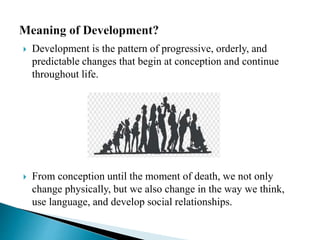
 Development is the pattern of progressive, orderly, and
predictable changes that begin at conception and continue
throughout life.
 From conception until the moment of death, we not only
change physically, but we also change in the way we think,
use language, and develop social relationships.
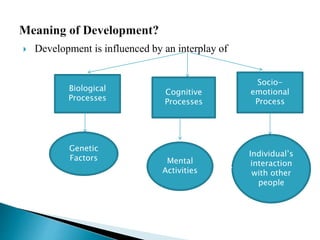
 Development is influenced by an interplay of
Biological
Processes
Cognitive
Processes
Socio-
emotional
Process
Genetic
Factors Mental
Activities
Individual’s
interaction
with other
people
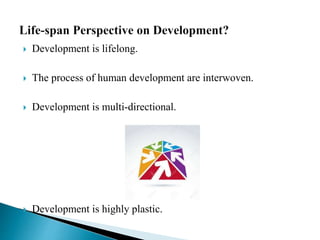
 Development is lifelong.
 The process of human development are interwoven.
 Development is multi-directional.
 Development is highly plastic.
 Development is influenced by historical conditions.
 Development is the concern of a number of disciplines.
 An individual responds and acts on contexts, which include
what was inherited, the physical environment, social, historical
and cultural context.
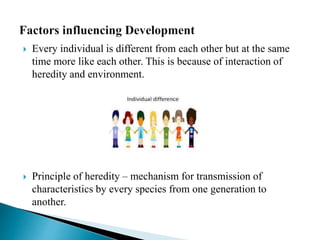
 Every individual is different from each other but at the same
time more like each other. This is because of interaction of
heredity and environment.
 Principle of heredity – mechanism for transmission of
characteristics by every species from one generation to
another.
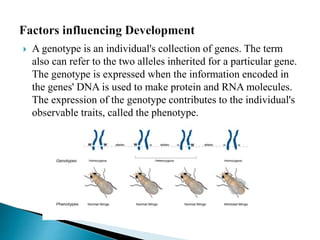
 A genotype is an individual's collection of genes. The term
also can refer to the two alleles inherited for a particular gene.
The genotype is expressed when the information encoded in
the genes' DNA is used to make protein and RNA molecules.
The expression of the genotype contributes to the individual's
observable traits, called the phenotype.
 The observable characteristics of an individual are result of
interaction between the person’s inherited traits and
environment.
 Genes set the limit and within that limit the environment
influences development.
 .
 The type of environment parents provide for their children
depends to some extent on their own genetic predisposition.
 Environmental influences are as complex as the genes people
inherit.
 Development does not take place in vacuum, It is always
embedded in a particular socio-cultural context.
 Urie Bronfenbrenner believed that a person's development was
affected by everything in their surrounding environment.
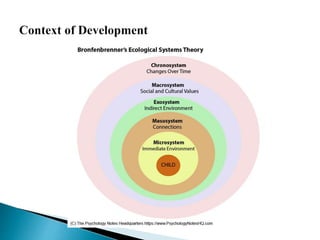
 He divided the person's environment into five different levels:
the microsystems, the mesosystem, the exosystem, the
macrosystem, and the chronosystem
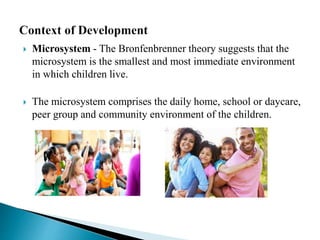
 Microsystem - The Bronfenbrenner theory suggests that the
microsystem is the smallest and most immediate environment
in which children live.
 The microsystem comprises the daily home, school or daycare,
peer group and community environment of the children.
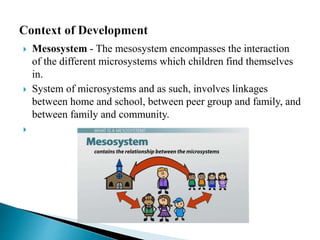
 Mesosystem - The mesosystem encompasses the interaction
of the different microsystems which children find themselves
in.
 System of microsystems and as such, involves linkages
between home and school, between peer group and family, and
between family and community.

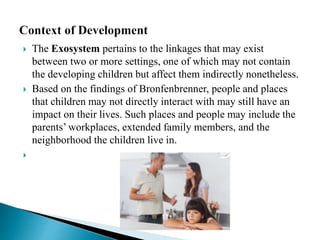
 The Exosystem pertains to the linkages that may exist
between two or more settings, one of which may not contain
the developing children but affect them indirectly nonetheless.
 Based on the findings of Bronfenbrenner, people and places
that children may not directly interact with may still have an
impact on their lives. Such places and people may include the
parents’ workplaces, extended family members, and the
neighborhood the children live in.

 The Macrosystem is the largest and most distant collection of
people and places to the children that still have significant
influences on them.
 This ecological system is composed of the children’s cultural
patterns and values, specifically their dominant beliefs and
ideas, as well as political and economic systems.

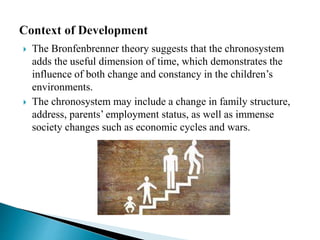
 The Bronfenbrenner theory suggests that the chronosystem
adds the useful dimension of time, which demonstrates the
influence of both change and constancy in the children’s
environments.
 The chronosystem may include a change in family structure,
address, parents’ employment status, as well as immense
society changes such as economic cycles and wars.
 Durganand Sinha (1977) has presented an ecological model for
understanding the development of children in Indian context.
Ecology of the child could be viewed in terms of two concentric
layers. The “upper and the more visible layers” consist of home,
school, peer groups, and so on.
The most important ecological factors influencing development of
the child in the visible upper layer constitute the:
 (i) home, its conditions in terms of overcrowding, space available
to each member, toys, technological devices used, etc.,
 (ii) nature and quality of schooling, facilities to which the child is
exposed, and
 (iii) nature of interactions and activities undertaken with peer groups
from childhood onward.
 These factors do not operate independently but constantly interact
with one another. Since these are also embedded in a larger and a
more pervasive setting, the “surrounding layers” of the child’s
ecology constantly influence the “upper layer” factors. However,
their influences are not always clearly visible.
The elements of the surrounding layer of ecology constitute the:
 (i) general geographical environment. It includes space and facilities
for play and other activities available outside the home including
general congestion of the locality and density of population,
 (ii) institutional setting provided by caste, class, and other factors,
and
 (iii) general amenities available to the child like drinking water,
electricity, means of entertainment and so on.
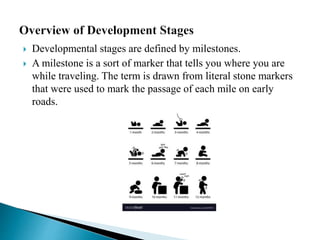
 Developmental stages are defined by milestones.
 A milestone is a sort of marker that tells you where you are
while traveling. The term is drawn from literal stone markers
that were used to mark the passage of each mile on early
roads.
 Developmental stages are assumed to be temporary and are
often characterized by a dominant feature or a leading
characteristic.
 During a particular stage, individual progresses towards an
assumed goal – a state or ability that s/he must achieve in the
same order as other persons before progressing to the next
stage in the sequence.
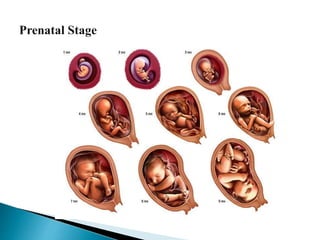
 The period from conception to birth.
 It last about for 40 weeks.
 Prenatal development is also affected by maternal
characteristics like mother’s age, nutrition and emotional state.
 Teratogens are environmental stages that causes deviation in
normal development that could lead to serious abnormalities
or death.
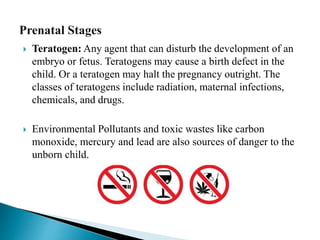
 Teratogen: Any agent that can disturb the development of an
embryo or fetus. Teratogens may cause a birth defect in the
child. Or a teratogen may halt the pregnancy outright. The
classes of teratogens include radiation, maternal infections,
chemicals, and drugs.
 Environmental Pollutants and toxic wastes like carbon
monoxide, mercury and lead are also sources of danger to the
unborn child.
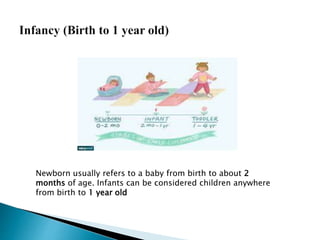
Newborn usually refers to a baby from birth to about 2
months of age. Infants can be considered children anywhere
from birth to 1 year old
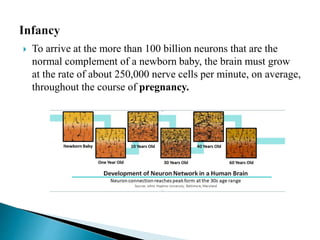
 To arrive at the more than 100 billion neurons that are the
normal complement of a newborn baby, the brain must grow
at the rate of about 250,000 nerve cells per minute, on average,
throughout the course of pregnancy.
 Just before birth the newborns have most but not all brain
cells. The neural connections among these cells develop at a
rapid rate.
 Most of the neurons in brain gets created before the child is
born. But some areas of the brain make new neurons after
birth in a process called Postnatal Neurogenesis. A few areas,
including the cerebellum and the prefrontal cortex, continue
adding new neurons in infancy.
 The activities needed to sustain life functions are present in
newborn – it breathes, sucks, swallows and discharges the
bodily waste.
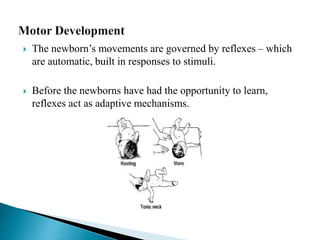
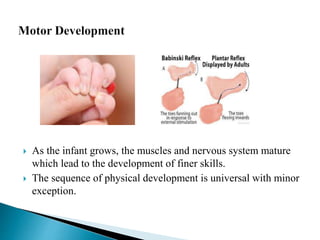
 The newborn’s movements are governed by reflexes – which
are automatic, built in responses to stimuli.
 Before the newborns have had the opportunity to learn,
reflexes act as adaptive mechanisms.
 As the infant grows, the muscles and nervous system mature
which lead to the development of finer skills.
 The sequence of physical development is universal with minor
exception.
 Babies are born with all 5 senses—sight, hearing, smell, taste,
and touch. Some of the senses are not fully developed.
 Babies are born with the ability to focus only at close range.
This is about 8 to 10 inches, or the distance between a
mother's face to the baby in her arms.
 Hearing is fully developed in newborns.
 Studies have found that newborns have a strong sense of
smell. Newborns prefer the smell of their own mother,
especially her breast milk.
 Babies prefer sweet tastes over sour or bitter tastes. Babies
also show a strong preference for human milk and
breastfeeding.
 Babies are comforted by touch. Placing a hand on your baby's
belly or cuddling close can help him or her feel more secure.
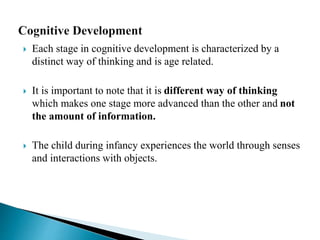
 Each stage in cognitive development is characterized by a
distinct way of thinking and is age related.
 It is important to note that it is different way of thinking
which makes one stage more advanced than the other and not
the amount of information.
 The child during infancy experiences the world through senses
and interactions with objects.
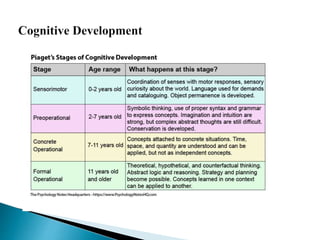
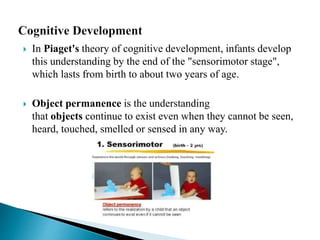
 In Piaget's theory of cognitive development, infants develop
this understanding by the end of the "sensorimotor stage",
which lasts from birth to about two years of age.
 Object permanence is the understanding
that objects continue to exist even when they cannot be seen,
heard, touched, smelled or sensed in any way.
 Emotional well-being during the early years has a powerful
impact on social relationships.
 Children who are emotionally healthy are better able to
establish and maintain positive relationships with adults as
well as with peers.
 Their first relationships help shape who they are, who they
become, and their understanding of the world.
 A six months old infant shows following characteristics-
 Knows familiar faces and begins to know if someone is a stranger
 Likes to play with others, especially parents
 Responds to other people’s emotions and often seems happy
 Likes to look at self in mirror
 The close emotional bond of affection that develop between
infants and their parents (caregivers) is called attachment.
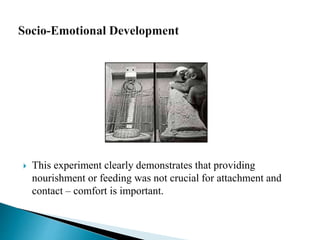
 Harlow and Harlow conducted an experiment on baby
monkeys to see the level of attachment.
 This experiment clearly demonstrates that providing
nourishment or feeding was not crucial for attachment and
contact – comfort is important.
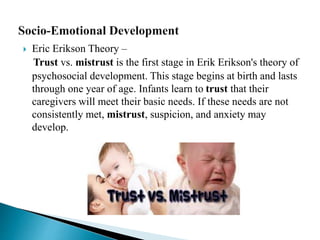
 Eric Erikson Theory –
Trust vs. mistrust is the first stage in Erik Erikson's theory of
psychosocial development. This stage begins at birth and lasts
through one year of age. Infants learn to trust that their
caregivers will meet their basic needs. If these needs are not
consistently met, mistrust, suspicion, and anxiety may
develop.
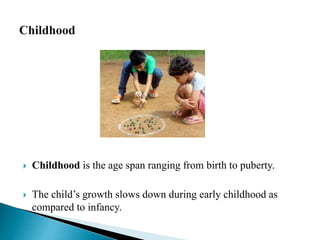
 Childhood is the age span ranging from birth to puberty.
 The child’s growth slows down during early childhood as
compared to infancy.
 Physical development refers to the advancements and
refinements of motor skills, or, in other
words, children's abilities to use and control their bodies.
 The child develops physically, gains height, weight, learns to
walk, run, jump and play.
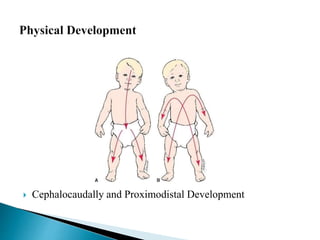
 Cephalocaudally and Proximodistal Development
 Cephalocaudally Development –
 During Cephalocaudal development, the infant will learn to
control over their neck muscles first, which allows them to
hold their head upright and eventually look around.
Afterwards, they gain control over their shoulder muscles
allowing them to roll over.
 Lastly, control over the muscles in their torso allows them to
sit. The size of the head of an infant in relation to the rest of
the body during this development is always larger than the rest
of the body.
 Proximodistal Development –
 During Cephalocaudal development, the infant will learn to
control over their neck muscles first, which allows them to
hold their head upright and eventually look around.
Afterwards, they gain control over their shoulder muscles
allowing them to roll over.
 Lastly, control over the muscles in their torso allows them to
sit. The size of the head of an infant in relation to the rest of
the body during this development is always larger than the rest
of the body.
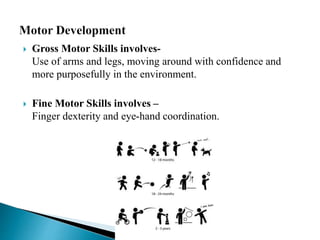
 Gross Motor Skills involves-
Use of arms and legs, moving around with confidence and
more purposefully in the environment.
 Fine Motor Skills involves –
Finger dexterity and eye-hand coordination.
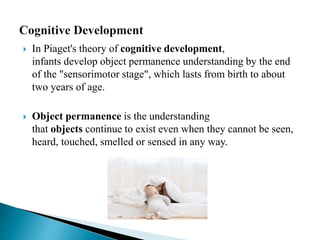
 In Piaget's theory of cognitive development,
infants develop object permanence understanding by the end
of the "sensorimotor stage", which lasts from birth to about
two years of age.
 Object permanence is the understanding
that objects continue to exist even when they cannot be seen,
heard, touched, smelled or sensed in any way.
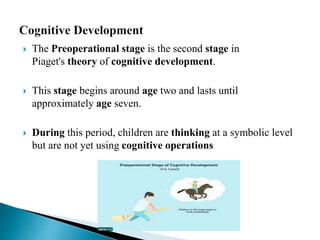
 The Preoperational stage is the second stage in
Piaget's theory of cognitive development.
 This stage begins around age two and lasts until
approximately age seven.
 During this period, children are thinking at a symbolic level
but are not yet using cognitive operations
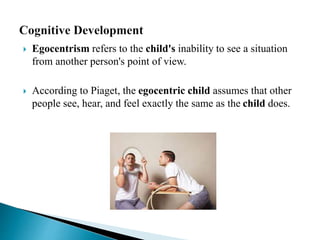
 Egocentrism refers to the child's inability to see a situation
from another person's point of view.
 According to Piaget, the egocentric child assumes that other
people see, hear, and feel exactly the same as the child does.
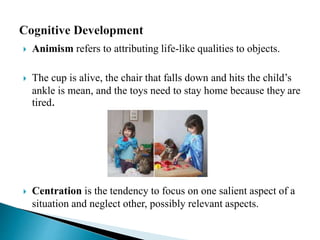
 Animism refers to attributing life-like qualities to objects.
 The cup is alive, the chair that falls down and hits the child’s
ankle is mean, and the toys need to stay home because they are
tired.
 Centration is the tendency to focus on one salient aspect of a
situation and neglect other, possibly relevant aspects.
 The Concrete Operational Thought lasts around seven to
eleven years of age, and is characterized by the development
of organized and rational thinking.
 Piaget considered the concrete stage a major turning point in
the child's cognitive development, because it marks the
beginning of logical or operational thought.
 The child is now mature enough to use logical thought or
operations (i.e. rules) but can only apply logic to physical
objects (hence concrete operational).
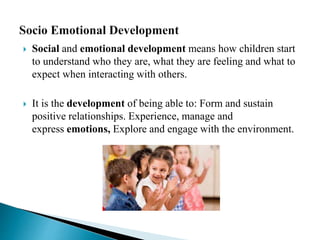
 Social and emotional development means how children start
to understand who they are, what they are feeling and what to
expect when interacting with others.
 It is the development of being able to: Form and sustain
positive relationships. Experience, manage and
express emotions, Explore and engage with the environment.
 This development influences a child’s self-confidence,
empathy, the ability to develop meaningful and lasting
friendships and partnerships, and a sense of importance and
value to those around him/her.
 Parents and caregivers play the biggest role in
social/emotional development because they offer the most
consistent relationships for their child. Consistent experiences
with family members, teachers and other adults help children
learn about relationships and explore emotions in predictable
interactions.
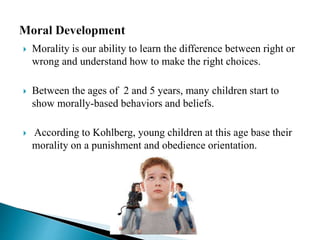
 Morality is our ability to learn the difference between right or
wrong and understand how to make the right choices.
 Between the ages of 2 and 5 years, many children start to
show morally-based behaviors and beliefs.
 According to Kohlberg, young children at this age base their
morality on a punishment and obedience orientation.
 Much like Piaget, Kohlberg believed that young children
behave morally because they fear authority and try to avoid
punishment. In other words, little kids follow the rules because
they don't want to get in trouble.
 Language develops and the child can reason logically.
 Socially the child has become more involved in the social
systems.
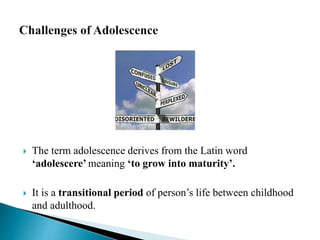
 The term adolescence derives from the Latin word
‘adolescere’ meaning ‘to grow into maturity’.
 It is a transitional period of person’s life between childhood
and adulthood.
 Adolescence is defined as the stage of life that begins at the
onset of puberty, when sexual maturity, or the ability to
reproduce is attained.
 The social and psychological dimensions of the adolescent
experiences depends on the cultural context.
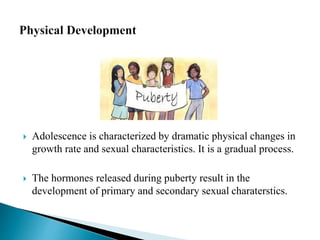
 Adolescence is characterized by dramatic physical changes in
growth rate and sexual characteristics. It is a gradual process.
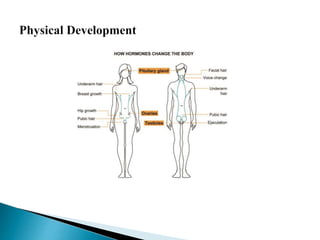
 The hormones released during puberty result in the
development of primary and secondary sexual charaterstics.
 Physical development is accompanied by a number of
psychological changes.
 Around puberty adolescents show an increase in interest in
members of the opposite sex and in sexual matters and a new
awareness of sexual feelings develops.
 The development of a sexual identity defines the sexual
orientation and guides sexual behaviour.
 Another important developmental task during adolescence is
accepting one’s physical self/ maturity.
 Cognitive development refers to the development of the ability
to think and reason.
 Adolescence marks the beginning development of more
complex thinking processes (also called formal logical
operations) including abstract thinking (thinking about
possibilities), the ability to reason from known principles
(form own new ideas or questions), the ability to consider
many points of view according to varying criteria (compare or
debate ideas or opinions), and the ability to consider the
process of thinking.
 Adolescent begin to think about ideal characteristics for
themselves and others and compare themselves and others
with these ideal standards.
 Hypothetical Deductive Reasoning is the ability to think
scientifically through generating predictions, or hypotheses,
about the world to answer questions. The individual will
approach problems in a systematic and organized manner,
rather than through trial-and-error.
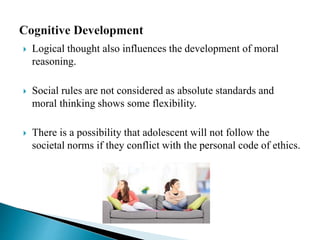
 Logical thought also influences the development of moral
reasoning.
 Social rules are not considered as absolute standards and
moral thinking shows some flexibility.
 There is a possibility that adolescent will not follow the
societal norms if they conflict with the personal code of ethics.
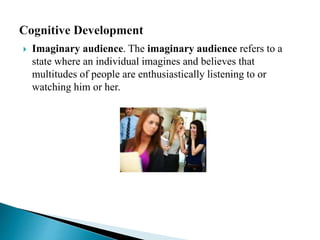
 Imaginary audience. The imaginary audience refers to a
state where an individual imagines and believes that
multitudes of people are enthusiastically listening to or
watching him or her.
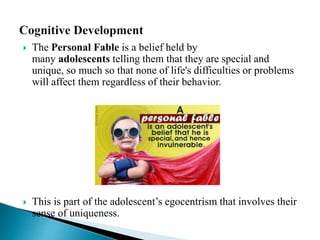
 The Personal Fable is a belief held by
many adolescents telling them that they are special and
unique, so much so that none of life's difficulties or problems
will affect them regardless of their behavior.
 This is part of the adolescent’s egocentrism that involves their
sense of uniqueness.
 The Identity versus Role confusion (or diffusion) stage is
characterized by the adolescent question of “Who am I,”
during which time they are conflicted with dozens of values
and ideas of who they should be and what they should think.
 The formation of identity during adolescence is influenced by
several factors. The cultural background, and socio-economic
status, ethnic background etc.
 Family relation becomes less important as the adolescent
spends more time outside the home and develops a strong need
for peer support and acceptance.
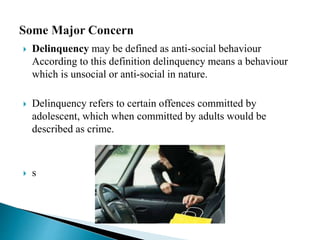
 Delinquency may be defined as anti-social behaviour
According to this definition delinquency means a behaviour
which is unsocial or anti-social in nature.
 Delinquency refers to certain offences committed by
adolescent, which when committed by adults would be
described as crime.
 s
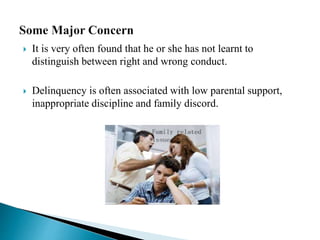
 It is very often found that he or she has not learnt to
distinguish between right and wrong conduct.
 Delinquency is often associated with low parental support,
inappropriate discipline and family discord.
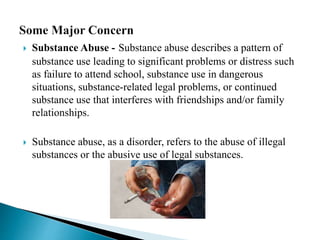
 Substance Abuse - Substance abuse describes a pattern of
substance use leading to significant problems or distress such
as failure to attend school, substance use in dangerous
situations, substance-related legal problems, or continued
substance use that interferes with friendships and/or family
relationships.
 Substance abuse, as a disorder, refers to the abuse of illegal
substances or the abusive use of legal substances.
 Eating Disorder
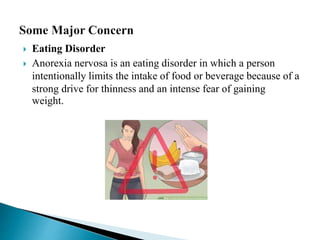
 Anorexia nervosa is an eating disorder in which a person
intentionally limits the intake of food or beverage because of a
strong drive for thinness and an intense fear of gaining
weight.
 Eating Disorder
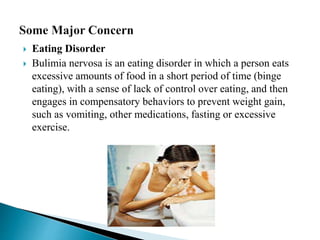
 Bulimia nervosa is an eating disorder in which a person eats
excessive amounts of food in a short period of time (binge
eating), with a sense of lack of control over eating, and then
engages in compensatory behaviors to prevent weight gain,
such as vomiting, other medications, fasting or excessive
exercise.
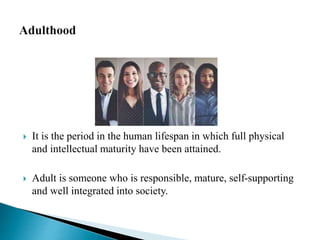
 It is the period in the human lifespan in which full physical
and intellectual maturity have been attained.
 Adult is someone who is responsible, mature, self-supporting
and well integrated into society.
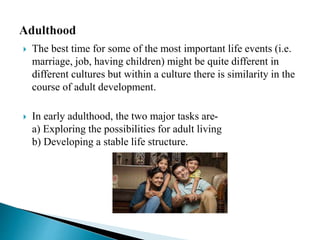
 The best time for some of the most important life events (i.e.
marriage, job, having children) might be quite different in
different cultures but within a culture there is similarity in the
course of adult development.
 In early adulthood, the two major tasks are-
a) Exploring the possibilities for adult living
b) Developing a stable life structure.
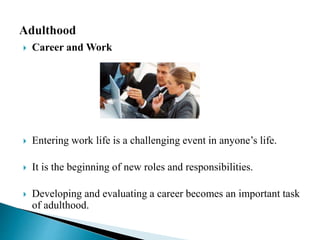
 Career and Work
 Entering work life is a challenging event in anyone’s life.
 It is the beginning of new roles and responsibilities.
 Developing and evaluating a career becomes an important task
of adulthood.
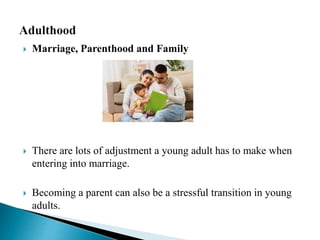
 Marriage, Parenthood and Family
 There are lots of adjustment a young adult has to make when
entering into marriage.
 Becoming a parent can also be a stressful transition in young
adults.
 Despite the stresses associated with parenting, it provides a
unique opportunity for growth and satisfaction and is
perceived as a way of establishing concern and guiding the
next generation.
 Physical changes in middle adulthood are caused by
maturational changes in the body. They are-
a) decline in vision
b) sensitivity to glare
c) hearing loss
 d) changes in physical appearance.
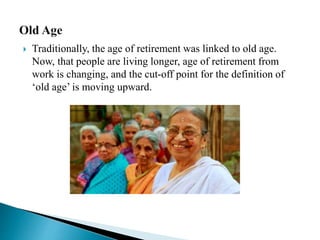
 Traditionally, the age of retirement was linked to old age.
Now, that people are living longer, age of retirement from
work is changing, and the cut-off point for the definition of
‘old age’ is moving upward.
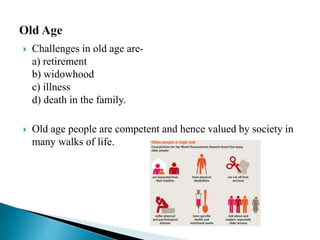
 Challenges in old age are-
a) retirement
b) widowhood
c) illness
d) death in the family.
 Old age people are competent and hence valued by society in
many walks of life.
 In old age feeling of loss of energy and dwindling of health
and financial assets, lead to insecurity and dependency.
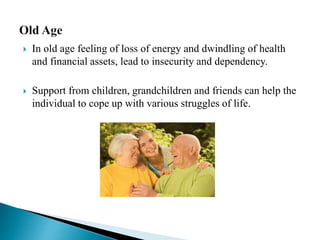
 Support from children, grandchildren and friends can help the
individual to cope up with various struggles of life.

Psychology class 11_Chapter 4 - Development

  • 2.
     Development isthe pattern of progressive, orderly, and predictable changes that begin at conception and continue throughout life.  From conception until the moment of death, we not only change physically, but we also change in the way we think, use language, and develop social relationships.
  • 3.
     Development isinfluenced by an interplay of Biological Processes Cognitive Processes Socio- emotional Process Genetic Factors Mental Activities Individual’s interaction with other people
  • 4.
     Development islifelong.  The process of human development are interwoven.  Development is multi-directional.  Development is highly plastic.
  • 5.
     Development isinfluenced by historical conditions.  Development is the concern of a number of disciplines.  An individual responds and acts on contexts, which include what was inherited, the physical environment, social, historical and cultural context.
  • 6.
     Every individualis different from each other but at the same time more like each other. This is because of interaction of heredity and environment.  Principle of heredity – mechanism for transmission of characteristics by every species from one generation to another.
  • 7.
     A genotypeis an individual's collection of genes. The term also can refer to the two alleles inherited for a particular gene. The genotype is expressed when the information encoded in the genes' DNA is used to make protein and RNA molecules. The expression of the genotype contributes to the individual's observable traits, called the phenotype.
  • 8.
     The observablecharacteristics of an individual are result of interaction between the person’s inherited traits and environment.  Genes set the limit and within that limit the environment influences development.  .
  • 9.
     The typeof environment parents provide for their children depends to some extent on their own genetic predisposition.  Environmental influences are as complex as the genes people inherit.
  • 11.
     Development doesnot take place in vacuum, It is always embedded in a particular socio-cultural context.  Urie Bronfenbrenner believed that a person's development was affected by everything in their surrounding environment.  He divided the person's environment into five different levels: the microsystems, the mesosystem, the exosystem, the macrosystem, and the chronosystem
  • 13.
     Microsystem -The Bronfenbrenner theory suggests that the microsystem is the smallest and most immediate environment in which children live.  The microsystem comprises the daily home, school or daycare, peer group and community environment of the children.
  • 14.
     Mesosystem -The mesosystem encompasses the interaction of the different microsystems which children find themselves in.  System of microsystems and as such, involves linkages between home and school, between peer group and family, and between family and community. 
  • 15.
     The Exosystempertains to the linkages that may exist between two or more settings, one of which may not contain the developing children but affect them indirectly nonetheless.  Based on the findings of Bronfenbrenner, people and places that children may not directly interact with may still have an impact on their lives. Such places and people may include the parents’ workplaces, extended family members, and the neighborhood the children live in. 
  • 16.
     The Macrosystemis the largest and most distant collection of people and places to the children that still have significant influences on them.  This ecological system is composed of the children’s cultural patterns and values, specifically their dominant beliefs and ideas, as well as political and economic systems. 
  • 17.
     The Bronfenbrennertheory suggests that the chronosystem adds the useful dimension of time, which demonstrates the influence of both change and constancy in the children’s environments.  The chronosystem may include a change in family structure, address, parents’ employment status, as well as immense society changes such as economic cycles and wars.
  • 18.
     Durganand Sinha(1977) has presented an ecological model for understanding the development of children in Indian context. Ecology of the child could be viewed in terms of two concentric layers. The “upper and the more visible layers” consist of home, school, peer groups, and so on. The most important ecological factors influencing development of the child in the visible upper layer constitute the:  (i) home, its conditions in terms of overcrowding, space available to each member, toys, technological devices used, etc.,  (ii) nature and quality of schooling, facilities to which the child is exposed, and  (iii) nature of interactions and activities undertaken with peer groups from childhood onward.
  • 19.
     These factorsdo not operate independently but constantly interact with one another. Since these are also embedded in a larger and a more pervasive setting, the “surrounding layers” of the child’s ecology constantly influence the “upper layer” factors. However, their influences are not always clearly visible. The elements of the surrounding layer of ecology constitute the:  (i) general geographical environment. It includes space and facilities for play and other activities available outside the home including general congestion of the locality and density of population,  (ii) institutional setting provided by caste, class, and other factors, and  (iii) general amenities available to the child like drinking water, electricity, means of entertainment and so on.
  • 21.
     Developmental stagesare defined by milestones.  A milestone is a sort of marker that tells you where you are while traveling. The term is drawn from literal stone markers that were used to mark the passage of each mile on early roads.
  • 22.
     Developmental stagesare assumed to be temporary and are often characterized by a dominant feature or a leading characteristic.  During a particular stage, individual progresses towards an assumed goal – a state or ability that s/he must achieve in the same order as other persons before progressing to the next stage in the sequence.
  • 24.
     The periodfrom conception to birth.  It last about for 40 weeks.  Prenatal development is also affected by maternal characteristics like mother’s age, nutrition and emotional state.  Teratogens are environmental stages that causes deviation in normal development that could lead to serious abnormalities or death.
  • 25.
     Teratogen: Anyagent that can disturb the development of an embryo or fetus. Teratogens may cause a birth defect in the child. Or a teratogen may halt the pregnancy outright. The classes of teratogens include radiation, maternal infections, chemicals, and drugs.  Environmental Pollutants and toxic wastes like carbon monoxide, mercury and lead are also sources of danger to the unborn child.
  • 26.
    Newborn usually refersto a baby from birth to about 2 months of age. Infants can be considered children anywhere from birth to 1 year old
  • 27.
     To arriveat the more than 100 billion neurons that are the normal complement of a newborn baby, the brain must grow at the rate of about 250,000 nerve cells per minute, on average, throughout the course of pregnancy.
  • 28.
     Just beforebirth the newborns have most but not all brain cells. The neural connections among these cells develop at a rapid rate.  Most of the neurons in brain gets created before the child is born. But some areas of the brain make new neurons after birth in a process called Postnatal Neurogenesis. A few areas, including the cerebellum and the prefrontal cortex, continue adding new neurons in infancy.  The activities needed to sustain life functions are present in newborn – it breathes, sucks, swallows and discharges the bodily waste.
  • 29.
     The newborn’smovements are governed by reflexes – which are automatic, built in responses to stimuli.  Before the newborns have had the opportunity to learn, reflexes act as adaptive mechanisms.
  • 30.
     As theinfant grows, the muscles and nervous system mature which lead to the development of finer skills.  The sequence of physical development is universal with minor exception.
  • 31.
     Babies areborn with all 5 senses—sight, hearing, smell, taste, and touch. Some of the senses are not fully developed.  Babies are born with the ability to focus only at close range. This is about 8 to 10 inches, or the distance between a mother's face to the baby in her arms.  Hearing is fully developed in newborns.  Studies have found that newborns have a strong sense of smell. Newborns prefer the smell of their own mother, especially her breast milk.
  • 32.
     Babies prefersweet tastes over sour or bitter tastes. Babies also show a strong preference for human milk and breastfeeding.  Babies are comforted by touch. Placing a hand on your baby's belly or cuddling close can help him or her feel more secure.
  • 33.
     Each stagein cognitive development is characterized by a distinct way of thinking and is age related.  It is important to note that it is different way of thinking which makes one stage more advanced than the other and not the amount of information.  The child during infancy experiences the world through senses and interactions with objects.
  • 35.
     In Piaget'stheory of cognitive development, infants develop this understanding by the end of the "sensorimotor stage", which lasts from birth to about two years of age.  Object permanence is the understanding that objects continue to exist even when they cannot be seen, heard, touched, smelled or sensed in any way.
  • 36.
     Emotional well-beingduring the early years has a powerful impact on social relationships.  Children who are emotionally healthy are better able to establish and maintain positive relationships with adults as well as with peers.  Their first relationships help shape who they are, who they become, and their understanding of the world.
  • 37.
     A sixmonths old infant shows following characteristics-  Knows familiar faces and begins to know if someone is a stranger  Likes to play with others, especially parents  Responds to other people’s emotions and often seems happy  Likes to look at self in mirror  The close emotional bond of affection that develop between infants and their parents (caregivers) is called attachment.  Harlow and Harlow conducted an experiment on baby monkeys to see the level of attachment.
  • 38.
     This experimentclearly demonstrates that providing nourishment or feeding was not crucial for attachment and contact – comfort is important.
  • 39.
     Eric EriksonTheory – Trust vs. mistrust is the first stage in Erik Erikson's theory of psychosocial development. This stage begins at birth and lasts through one year of age. Infants learn to trust that their caregivers will meet their basic needs. If these needs are not consistently met, mistrust, suspicion, and anxiety may develop.
  • 40.
     Childhood isthe age span ranging from birth to puberty.  The child’s growth slows down during early childhood as compared to infancy.
  • 41.
     Physical developmentrefers to the advancements and refinements of motor skills, or, in other words, children's abilities to use and control their bodies.  The child develops physically, gains height, weight, learns to walk, run, jump and play.
  • 42.
     Cephalocaudally andProximodistal Development
  • 43.
     Cephalocaudally Development–  During Cephalocaudal development, the infant will learn to control over their neck muscles first, which allows them to hold their head upright and eventually look around. Afterwards, they gain control over their shoulder muscles allowing them to roll over.  Lastly, control over the muscles in their torso allows them to sit. The size of the head of an infant in relation to the rest of the body during this development is always larger than the rest of the body.
  • 44.
     Proximodistal Development–  During Cephalocaudal development, the infant will learn to control over their neck muscles first, which allows them to hold their head upright and eventually look around. Afterwards, they gain control over their shoulder muscles allowing them to roll over.  Lastly, control over the muscles in their torso allows them to sit. The size of the head of an infant in relation to the rest of the body during this development is always larger than the rest of the body.
  • 45.
     Gross MotorSkills involves- Use of arms and legs, moving around with confidence and more purposefully in the environment.  Fine Motor Skills involves – Finger dexterity and eye-hand coordination.
  • 46.
     In Piaget'stheory of cognitive development, infants develop object permanence understanding by the end of the "sensorimotor stage", which lasts from birth to about two years of age.  Object permanence is the understanding that objects continue to exist even when they cannot be seen, heard, touched, smelled or sensed in any way.
  • 47.
     The Preoperationalstage is the second stage in Piaget's theory of cognitive development.  This stage begins around age two and lasts until approximately age seven.  During this period, children are thinking at a symbolic level but are not yet using cognitive operations
  • 48.
     Egocentrism refersto the child's inability to see a situation from another person's point of view.  According to Piaget, the egocentric child assumes that other people see, hear, and feel exactly the same as the child does.
  • 49.
     Animism refersto attributing life-like qualities to objects.  The cup is alive, the chair that falls down and hits the child’s ankle is mean, and the toys need to stay home because they are tired.  Centration is the tendency to focus on one salient aspect of a situation and neglect other, possibly relevant aspects.
  • 50.
     The ConcreteOperational Thought lasts around seven to eleven years of age, and is characterized by the development of organized and rational thinking.  Piaget considered the concrete stage a major turning point in the child's cognitive development, because it marks the beginning of logical or operational thought.  The child is now mature enough to use logical thought or operations (i.e. rules) but can only apply logic to physical objects (hence concrete operational).
  • 51.
     Social andemotional development means how children start to understand who they are, what they are feeling and what to expect when interacting with others.  It is the development of being able to: Form and sustain positive relationships. Experience, manage and express emotions, Explore and engage with the environment.
  • 52.
     This developmentinfluences a child’s self-confidence, empathy, the ability to develop meaningful and lasting friendships and partnerships, and a sense of importance and value to those around him/her.  Parents and caregivers play the biggest role in social/emotional development because they offer the most consistent relationships for their child. Consistent experiences with family members, teachers and other adults help children learn about relationships and explore emotions in predictable interactions.
  • 53.
     Morality isour ability to learn the difference between right or wrong and understand how to make the right choices.  Between the ages of 2 and 5 years, many children start to show morally-based behaviors and beliefs.  According to Kohlberg, young children at this age base their morality on a punishment and obedience orientation.
  • 54.
     Much likePiaget, Kohlberg believed that young children behave morally because they fear authority and try to avoid punishment. In other words, little kids follow the rules because they don't want to get in trouble.  Language develops and the child can reason logically.  Socially the child has become more involved in the social systems.
  • 55.
     The termadolescence derives from the Latin word ‘adolescere’ meaning ‘to grow into maturity’.  It is a transitional period of person’s life between childhood and adulthood.
  • 56.
     Adolescence isdefined as the stage of life that begins at the onset of puberty, when sexual maturity, or the ability to reproduce is attained.  The social and psychological dimensions of the adolescent experiences depends on the cultural context.
  • 57.
     Adolescence ischaracterized by dramatic physical changes in growth rate and sexual characteristics. It is a gradual process.  The hormones released during puberty result in the development of primary and secondary sexual charaterstics.
  • 59.
     Physical developmentis accompanied by a number of psychological changes.  Around puberty adolescents show an increase in interest in members of the opposite sex and in sexual matters and a new awareness of sexual feelings develops.  The development of a sexual identity defines the sexual orientation and guides sexual behaviour.  Another important developmental task during adolescence is accepting one’s physical self/ maturity.
  • 60.
     Cognitive developmentrefers to the development of the ability to think and reason.  Adolescence marks the beginning development of more complex thinking processes (also called formal logical operations) including abstract thinking (thinking about possibilities), the ability to reason from known principles (form own new ideas or questions), the ability to consider many points of view according to varying criteria (compare or debate ideas or opinions), and the ability to consider the process of thinking.
  • 61.
     Adolescent beginto think about ideal characteristics for themselves and others and compare themselves and others with these ideal standards.  Hypothetical Deductive Reasoning is the ability to think scientifically through generating predictions, or hypotheses, about the world to answer questions. The individual will approach problems in a systematic and organized manner, rather than through trial-and-error.
  • 62.
     Logical thoughtalso influences the development of moral reasoning.  Social rules are not considered as absolute standards and moral thinking shows some flexibility.  There is a possibility that adolescent will not follow the societal norms if they conflict with the personal code of ethics.
  • 63.
     Imaginary audience.The imaginary audience refers to a state where an individual imagines and believes that multitudes of people are enthusiastically listening to or watching him or her.
  • 64.
     The PersonalFable is a belief held by many adolescents telling them that they are special and unique, so much so that none of life's difficulties or problems will affect them regardless of their behavior.  This is part of the adolescent’s egocentrism that involves their sense of uniqueness.
  • 65.
     The Identityversus Role confusion (or diffusion) stage is characterized by the adolescent question of “Who am I,” during which time they are conflicted with dozens of values and ideas of who they should be and what they should think.  The formation of identity during adolescence is influenced by several factors. The cultural background, and socio-economic status, ethnic background etc.  Family relation becomes less important as the adolescent spends more time outside the home and develops a strong need for peer support and acceptance.
  • 66.
     Delinquency maybe defined as anti-social behaviour According to this definition delinquency means a behaviour which is unsocial or anti-social in nature.  Delinquency refers to certain offences committed by adolescent, which when committed by adults would be described as crime.  s
  • 67.
     It isvery often found that he or she has not learnt to distinguish between right and wrong conduct.  Delinquency is often associated with low parental support, inappropriate discipline and family discord.
  • 68.
     Substance Abuse- Substance abuse describes a pattern of substance use leading to significant problems or distress such as failure to attend school, substance use in dangerous situations, substance-related legal problems, or continued substance use that interferes with friendships and/or family relationships.  Substance abuse, as a disorder, refers to the abuse of illegal substances or the abusive use of legal substances.
  • 69.
     Eating Disorder Anorexia nervosa is an eating disorder in which a person intentionally limits the intake of food or beverage because of a strong drive for thinness and an intense fear of gaining weight.
  • 70.
     Eating Disorder Bulimia nervosa is an eating disorder in which a person eats excessive amounts of food in a short period of time (binge eating), with a sense of lack of control over eating, and then engages in compensatory behaviors to prevent weight gain, such as vomiting, other medications, fasting or excessive exercise.
  • 71.
     It isthe period in the human lifespan in which full physical and intellectual maturity have been attained.  Adult is someone who is responsible, mature, self-supporting and well integrated into society.
  • 72.
     The besttime for some of the most important life events (i.e. marriage, job, having children) might be quite different in different cultures but within a culture there is similarity in the course of adult development.  In early adulthood, the two major tasks are- a) Exploring the possibilities for adult living b) Developing a stable life structure.
  • 73.
     Career andWork  Entering work life is a challenging event in anyone’s life.  It is the beginning of new roles and responsibilities.  Developing and evaluating a career becomes an important task of adulthood.
  • 74.
     Marriage, Parenthoodand Family  There are lots of adjustment a young adult has to make when entering into marriage.  Becoming a parent can also be a stressful transition in young adults.
  • 75.
     Despite thestresses associated with parenting, it provides a unique opportunity for growth and satisfaction and is perceived as a way of establishing concern and guiding the next generation.  Physical changes in middle adulthood are caused by maturational changes in the body. They are- a) decline in vision b) sensitivity to glare c) hearing loss  d) changes in physical appearance.
  • 76.
     Traditionally, theage of retirement was linked to old age. Now, that people are living longer, age of retirement from work is changing, and the cut-off point for the definition of ‘old age’ is moving upward.
  • 77.
     Challenges inold age are- a) retirement b) widowhood c) illness d) death in the family.  Old age people are competent and hence valued by society in many walks of life.
  • 78.
     In oldage feeling of loss of energy and dwindling of health and financial assets, lead to insecurity and dependency.  Support from children, grandchildren and friends can help the individual to cope up with various struggles of life.