PSORIASIS
By: Ms. DORJEE DOLKAR
M.Sc NURSING
INTRODUCTION
Psoriasis is a chronic skin disease result in
patches of thick red skin covered with the
silvery scales.
These patches are referred as plaque which
usually occur on the elbow, knees, legs,
scalp, lower back, face, palm and sole of
the feet, nails too.
HISTORY
The word psoriasis is derive from greek
word ‘psora’ means ‘itching’.
The greek physician Galen of perganon
(130-200 BC) use the term Psoriasis
vulgaris to refer all dermo and
epidermopathies accompanied by pruiritis.
Since 1950 local application and systemic
medications are used for the psoriasis.
DEFINITION
According to www.mayoclinic.com, “
psoriasis is defined as a persistent skin
disease causes cell to build rapidly on the
surface of the skin, forming thick silvery
scales, itchy,dry and red patches.”
ANATOMY AND PHYSIOLOGY
INCIDENCE
• 1-3% and in America and western
• Lower rates are found in Japanese
and psoriasis is rare in West Africans
• Psoriasis first appears during 2 peak age
ranges:The first peak occurs in persons aged
16-22 years, and the second occurs in persons
aged 57-60 years
ETIOLOGY
Idiopathic cause
Some of the factors that may trigger
psoriasis are:
Genetic
Autoimmune reaction
Infection
Injury to skin
Cont….
Medication:
lithium, antimalarial medications, inderal,
indomethacin
Stress
Obesity
smoking
PATHOPHYSIOLOGY
STRESS, GENECTIC, AUTOIMMUNE REACTION AND MEDICATION CAUSE
HYPERACTIVE OF T-CELLS
EPIDERMIS INFILTRATION AND KERATINOCYTE PROLIFERATION
DEREGULATED INFLAMMATORY PROCESS
LARGE PRODUCTION OF VARIOUS
CYTOKINES ( INTEFERRON, INTERLEUKIN-12)
SUPERFICIAL BLOOD VESSEL DILATED AND
VASCULAR ENGORGEMENT
EPIDERMAL HYPERPLASIA AND IMPROPER CELL
MATURATION
FAILS TO RELEASE ADEQUATE LIPIDS WHICH LEAD TO
FLAKING, SCALING PRESENTATION OF PSORIASIS LESION
SILVER SCALING OF SKIN
CLASSIFICATION
There are several types of psoriasis include:
-Plaque psoiasis
-Guttate psoriasis
-Inverse psoriasis
-Pustular psoriasis
-Erythrodermic psoriasis
-Nail psoriasis
-Psoriatic arthritis
PLAQUE PSORIASIS
-It is the most common type of
psoriasis.
-It is also known as psoriasis
vulgaris.
-It is appear as raised, inflammed,
red skin covered by silvery
patches or scales.
-Sites :Elbows, Knees, sacrum,
Scalp, loer back, Hands and
Feet.
GUTTATE PSORIASIS
(Latin Gutta=drop)
• Characterized by eruption
of small (0.5 to 1.5 cm in
diameter) papules over the
upper trunk and proximal
extremities
• Manifests at an early age
• Streptococcal throat
infection frequently
precedes or is concomitant
with the onset or flare
INVERSE PSORIASIS
• Localized in the major skin
folds, such as the axilla, the
inguinal and inflammatory
areas and sweating areas
• Scaling is usually minimal
or absent, and the lesions
appear glossy, smooth and
bright red.
• Its is commonly seen in
obese client.
PUSTULAR PSORIASIS
• It is usually uncommon but
mostly appear in adult.
• It appear as pus filled
lesion surrounded by red
skin.
• It appear mostly at hands
and feet.
• It is the serious condition
so immediate medical
attention is required.
ERYTHRODERMIC
PSORIASIS
• The disease affects all
body sites
• Erythema is the most
prominent feature with
superficial scaling /
peeling that may appear
like burning
• Causes: sun burn, allergic
reaction, strong coal
product use
NAIL PSORIASIS
-Commonly seen along with
psoriatic arthritis.
-It appear as a pitting –small
bit nail, yellow-brown nail,
tender and painful nail with
chalk like debris build up
under nails.
-Keep the mail short and
trimmed.
-Treated by steroid injected
into nail or light therapy
PSORIATIC ARTHRITIS
This is the condition
which involve both
psoriasis and joint
inflammation.
•The blue arrow = a normal joint space
• Red arrow = “cup and saucer” effect of the
fourth metatarsal bone being jammed into the
base of the fourth toe
•The yellow circle = “Pencil appearance”
destruction characteristic of the disease
PSORIATIC ARTHRITIS
The most distinctive features of psoriatic
arthritis are
• Distal interphalangeal joint arthritis
• Dactylitis
COMMON CLINICAL
MANIFESTATIONS:
It will vary according to types of at psoriasis.Intially
the first sign of psoriasis is often red spots on
the body.
The patches of skin:
Dry, swollen and inflammed
Covered with silver white flakes
Raised and thick skin
Other symptoms of psoriasis includes:
Pain, itching and burning
Restricted joint motion or pain
Cracked and bleeding skin
Dandruff on scalp
Pus filled blisters
Genital lesions in males.
Pitting, small depression on the
surface of the nail
Yellow, dicsolored nail
Koebner phenomenon
Arthritis
DIAGNOSTIC
INVESTIGATIONS
-Collect history
-Physical examinations
-Skin biopsy : under local
anesthesia
-Blood and radiography
test was done to rule out
psoriatic arthritis
MEDICAL MANAGEMENT
AIM:
-Interrupt the cycle that cause an
increased production of skin cells
thereby reducing inflammation
and plaque formation.
-Remove scales and smooth skin,
which is particularly remove by
topical treatment.
Cont….
Psoriasis treatment is divided
into three main type:
-Topical treatment
-Light therapy
-systemic medications
1-Topical corticosteroids
• They are commonly first-line therapy in
mild to moderate psoriasis and in sites
such as the flexures and genitalia, where
other topical treatments can induce
irritation and skin folds.
• Improvement is usually achieved within 2
to 4 weeks.
• They slows the cells turnover by
suppressing the immune system which
reduce inflammation and relieves
associated itching
• Strong corticosteroids use for smaller area
of skin like hands and feet.
• Long term use may cause thinning of skin
and resistance too.
• Low potency steroids are usually
recommended for sensitive area and
treating wide spread patches damage skin.
TOPICAL STEROIDS
• To avoid systemic effects of class I
glucocorticoid, a maximum of 50 g
ointment may be used per week
• For small plaques (< 4cm), triamcinolone
acetonide aqueous suspension 10 mg/mL
diluted with normal saline is injected into
the lesion
2- Vitamin D Analogues
Calcipotriene (calcipotriol)”Betdaivonex”
• Potent topical corticosteroids are superior
to calcipotriene. But calcipotriene was
more effective than coal tar or anthralin
• The efficacy of calcipotriene is not
reduced with long-term treatment
• Calcipotriene is applied twice daily
• Salicylic acid inactivates calcipotriene
• Hypercalcemia is the only major concern
• When the amount used does not exceed
the recommended 100 g/week,
calcipotriene can be used with a great
margin of safety
• It is often used in combination with or in
rotation with topical corticosteroids in an
effort to maximize therapeutic
effectiveness while minimizing steroid-
related skin atrophy.
• Other vitamin D analogues
are tacalcitol and
maxacalcitol
• In view of their efficacy,
cosmetic acceptability and
relative safety, they may
accepted as first-choice
therapies in the topical
treatment of mild to
moderate psoriasis.
3-Coal Tar
• The use of tar to treat skin diseases dates
back nearly 2000 years
• Tar is the dry distillation product of organic
matter heated in the absence of oxygen
• In 1925, Goeckerman introduced “The
Goekerman technique” which uses crude
coal tar and UV light for the treatment of
psoriasis
Cont….
• Coal tar, in concentrations 5- 20% can
be compounded in creams, ointments,
shampoos and in pastes.
• It is often combined with salicylic acid
(2-5% ), which by its keratolytic
action leads to better absorption of the
coal tar
• Disadvantages include: allergic
reactions, folliculitis, it has foul smell
and appearance and can stain
clothing and other items. Coal tar is
carcinogenic
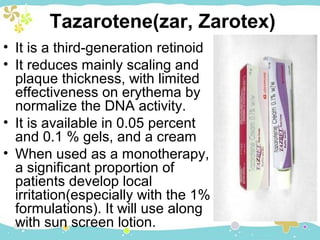
Tazarotene(zar, Zarotex)
• It is a third-generation retinoid
• It reduces mainly scaling and
plaque thickness, with limited
effectiveness on erythema by
normalize the DNA activity.
• It is available in 0.05 percent
and 0.1 % gels, and a cream
• When used as a monotherapy,
a significant proportion of
patients develop local
irritation(especially with the 1%
formulations). It will use along
with sun screen lotion.
5-Topical Calcineurin Inhibitors
(Tacrolimus”Tarolimus” &
Pimecrolimus ”Elidel” )
• They inhibit activation of T-
cells which inturn reduces
inflammation and plaque
build up.
• They are not effective in
plaque psoriasis. However,
for treatment of inverse and
facial psoriasis, these agents
appear to provide effective
treatment
6-Emollients
• Between treatment periods, skin care with
emollients should be performed to avoid
dryness
• Emollients reduce scaling, may limit painful
fissuring, and can help control pruritus
• They are best applied immediately after
bathing or showering
• The use emollients in combination with
topical treatments improves hydration while
minimizing treatment costs
PHOTOTHERAPY
Determination of the minimal
erythema dose (MED)
1-The patient wears a
thick cotton shirt which
has 10 small, vertical
holes on its back
2-The patient is
exposed to 50 mj of UV
on the back while all
the holes are opened
3-The first hole is closed and another exposure is
given By that time the skin under the first hole was
exposed to 50 mj of UV while the skin under the
second hole was exposed to 100 mj
4-The second hole is closed and the procedure is
repeated in the same way (closing an hole and
giving a dose) for all the holes
5-After 24-72 hours the skin of the back is examined
and the first skin area showing well-defined
erythema is determined and the amount of UV
causing it is called "the minimal erythema dose"
SUN LIGHT:
-Ultraviolet light is a wavelength of light in
a range too short for human eye to see.
-When exposed to the UV light ,the
activated t –cells in the skin are destroy
which lead reduces scaling and
inflammation.
-Sun exposure should be for brief
duration of time to improve psoriasis.
ULTRAVIOLET BOARDBAND
PHOTOTHERAPY
-Control dose of UVB light from an artificial
light source may improve mild to moderate
psoriasis symptoms.
-UVB phototherapy is also called
“Broadband UVB” can be use to treat to
single patches and psoriasis resistant to
topical treatment.
-Side effect: reddness, dryness and itching
which can be minimize by using
moisturizer.
PHOTOCHEMOTHERAPHY /
PSORAIEN PLUS ULTRAVIOLET-A
-Photochemotherapy involves taking light
sensitizing medication (psoralen) before
exposure to UVA light.
-UVA light penetrate deeper in skin and
psoralen make more responsive to UVA
exposure
-Side effect: nausea, headache, burning
and itching, wrinkle skin or skin cancer.
EXIMER LASER
A controlled beam of UVB light of a
specific wavelength is directed to the
psoriasis plaque to control scaling and
inflammation.
It does not harm healthy skin
More powerful UVB light is used
Side effect : redness and blistering
PULSE DYE LASER
Pulse dye laser used different form of light to destroy the
tiny blood vessel that contribute to psoriasis plaque.
Side effect : bruising, scarring,
COMBINATION LIGHT THERAPY
Combine UV light with other treatment such as retinoids
frequently improve phototherapy effectiveness.
Devices used
SYSTEMIC THERAPY
Cyclosporin A
Neoral 100mg/ml Suspension & 100 mg capsules
Action
Binds cyclo-philin producing a complex that blocks calci-
neurin, reducing the effect of the NF-AT in T cells,
resulting in inhibition of interleukin 2
Dosage
High-dose method: 5 mg/kg daily, then tapered
Low-dose method: 2.5 mg/kg daily, increased every 2-4
wk up to 5 mg/kg daily, then tapered
Side effect
Nephrotoxicity
Hypertension
Immuno-suppression
Neurotoxicity
Increased risk of malignancy
Contraindication
Prior bone marrow depression
Pregnancy
Lactation
Renal abnormalities
METHOTREXATE
Methotrexate 2.5 mg tab & 50 mg/lm vial
Action
Blocks dihydrofolate reductase leading to inhibition of
purine and pyrimidine synthesis. Leading to
accumulation of anti-inflammatory adenosine
Dosage
Start with a test dose of 2.5 mg and then gradually
increase dose until a therapeutic level is achieved
(average range, 10-15 mg weekly; maximum, 25-
30 mg weekly
Side effect
Chronic use may lead to hepatic
fibrosis
Fetal abnormalities or death
Pulmonary fibrosis
Contraindication
Liver toxicity
Pregnancy
ACITRETIN
Acitretin 25 mg cap
Action
Binds to retinoic acid receptors. May
contribute to improvement by
normalizing keratinization and
proliferation of the epidermis
Dosage
Initiate at 25-50 mg daily.
Side effect
Hepatotoxicity
Lipid abnormalities
Fetal abnormalities or death
Alopecia,
Contraindication
Severe infections
Malignancy
NURSING DIAGNOSIS
Impaired skin integrity r/t lesion and inflammatory
response as evidence by itching all over body.
Risk for infection r/t hypoprotenimia as evidence
by lost of protein and fluid from psoraisis lesion.
Acute pain r/t inflammation as evidence by
verbalisation.
Ineffective tissue perfusion r/t decrease oxygen
and blood supply to peripherial as evidence by
peripheral cyanosis.
COMPLICATIONS
Infection
Fluid and electrolyte imbalance
Low self esteem
Depression
Stress
Metabolic syndrome
Hypertension
Joint damage
HEALTH EDUCATION
Take daily bath
Use moisturizer
Expose small amount of skin to sunlight
Cover the affected area over night
Apply medication cream or ointment
Avoid drinking alcohol and smoking
Eat healthy diet
SUMMARY
Psoriasis
Psoriasis

Psoriasis

  • 1.
    PSORIASIS By: Ms. DORJEEDOLKAR M.Sc NURSING
  • 2.
    INTRODUCTION Psoriasis is achronic skin disease result in patches of thick red skin covered with the silvery scales. These patches are referred as plaque which usually occur on the elbow, knees, legs, scalp, lower back, face, palm and sole of the feet, nails too.
  • 3.
    HISTORY The word psoriasisis derive from greek word ‘psora’ means ‘itching’. The greek physician Galen of perganon (130-200 BC) use the term Psoriasis vulgaris to refer all dermo and epidermopathies accompanied by pruiritis. Since 1950 local application and systemic medications are used for the psoriasis.
  • 4.
    DEFINITION According to www.mayoclinic.com,“ psoriasis is defined as a persistent skin disease causes cell to build rapidly on the surface of the skin, forming thick silvery scales, itchy,dry and red patches.”
  • 5.
  • 6.
    INCIDENCE • 1-3% andin America and western • Lower rates are found in Japanese and psoriasis is rare in West Africans • Psoriasis first appears during 2 peak age ranges:The first peak occurs in persons aged 16-22 years, and the second occurs in persons aged 57-60 years
  • 7.
    ETIOLOGY Idiopathic cause Some ofthe factors that may trigger psoriasis are: Genetic Autoimmune reaction Infection Injury to skin
  • 8.
    Cont…. Medication: lithium, antimalarial medications,inderal, indomethacin Stress Obesity smoking
  • 9.
    PATHOPHYSIOLOGY STRESS, GENECTIC, AUTOIMMUNEREACTION AND MEDICATION CAUSE HYPERACTIVE OF T-CELLS EPIDERMIS INFILTRATION AND KERATINOCYTE PROLIFERATION DEREGULATED INFLAMMATORY PROCESS
  • 10.
    LARGE PRODUCTION OFVARIOUS CYTOKINES ( INTEFERRON, INTERLEUKIN-12) SUPERFICIAL BLOOD VESSEL DILATED AND VASCULAR ENGORGEMENT EPIDERMAL HYPERPLASIA AND IMPROPER CELL MATURATION FAILS TO RELEASE ADEQUATE LIPIDS WHICH LEAD TO FLAKING, SCALING PRESENTATION OF PSORIASIS LESION SILVER SCALING OF SKIN
  • 11.
    CLASSIFICATION There are severaltypes of psoriasis include: -Plaque psoiasis -Guttate psoriasis -Inverse psoriasis -Pustular psoriasis -Erythrodermic psoriasis -Nail psoriasis -Psoriatic arthritis
  • 12.
    PLAQUE PSORIASIS -It isthe most common type of psoriasis. -It is also known as psoriasis vulgaris. -It is appear as raised, inflammed, red skin covered by silvery patches or scales. -Sites :Elbows, Knees, sacrum, Scalp, loer back, Hands and Feet.
  • 13.
    GUTTATE PSORIASIS (Latin Gutta=drop) •Characterized by eruption of small (0.5 to 1.5 cm in diameter) papules over the upper trunk and proximal extremities • Manifests at an early age • Streptococcal throat infection frequently precedes or is concomitant with the onset or flare
  • 14.
    INVERSE PSORIASIS • Localizedin the major skin folds, such as the axilla, the inguinal and inflammatory areas and sweating areas • Scaling is usually minimal or absent, and the lesions appear glossy, smooth and bright red. • Its is commonly seen in obese client.
  • 15.
    PUSTULAR PSORIASIS • Itis usually uncommon but mostly appear in adult. • It appear as pus filled lesion surrounded by red skin. • It appear mostly at hands and feet. • It is the serious condition so immediate medical attention is required.
  • 16.
    ERYTHRODERMIC PSORIASIS • The diseaseaffects all body sites • Erythema is the most prominent feature with superficial scaling / peeling that may appear like burning • Causes: sun burn, allergic reaction, strong coal product use
  • 17.
    NAIL PSORIASIS -Commonly seenalong with psoriatic arthritis. -It appear as a pitting –small bit nail, yellow-brown nail, tender and painful nail with chalk like debris build up under nails. -Keep the mail short and trimmed. -Treated by steroid injected into nail or light therapy
  • 18.
    PSORIATIC ARTHRITIS This isthe condition which involve both psoriasis and joint inflammation. •The blue arrow = a normal joint space • Red arrow = “cup and saucer” effect of the fourth metatarsal bone being jammed into the base of the fourth toe •The yellow circle = “Pencil appearance” destruction characteristic of the disease
  • 19.
    PSORIATIC ARTHRITIS The mostdistinctive features of psoriatic arthritis are • Distal interphalangeal joint arthritis • Dactylitis
  • 21.
    COMMON CLINICAL MANIFESTATIONS: It willvary according to types of at psoriasis.Intially the first sign of psoriasis is often red spots on the body. The patches of skin: Dry, swollen and inflammed Covered with silver white flakes Raised and thick skin Other symptoms of psoriasis includes: Pain, itching and burning
  • 22.
    Restricted joint motionor pain Cracked and bleeding skin Dandruff on scalp Pus filled blisters Genital lesions in males. Pitting, small depression on the surface of the nail Yellow, dicsolored nail Koebner phenomenon Arthritis
  • 23.
    DIAGNOSTIC INVESTIGATIONS -Collect history -Physical examinations -Skinbiopsy : under local anesthesia -Blood and radiography test was done to rule out psoriatic arthritis
  • 24.
    MEDICAL MANAGEMENT AIM: -Interrupt thecycle that cause an increased production of skin cells thereby reducing inflammation and plaque formation. -Remove scales and smooth skin, which is particularly remove by topical treatment.
  • 25.
    Cont…. Psoriasis treatment isdivided into three main type: -Topical treatment -Light therapy -systemic medications
  • 27.
    1-Topical corticosteroids • Theyare commonly first-line therapy in mild to moderate psoriasis and in sites such as the flexures and genitalia, where other topical treatments can induce irritation and skin folds. • Improvement is usually achieved within 2 to 4 weeks. • They slows the cells turnover by suppressing the immune system which reduce inflammation and relieves associated itching
  • 28.
    • Strong corticosteroidsuse for smaller area of skin like hands and feet. • Long term use may cause thinning of skin and resistance too. • Low potency steroids are usually recommended for sensitive area and treating wide spread patches damage skin.
  • 29.
    TOPICAL STEROIDS • Toavoid systemic effects of class I glucocorticoid, a maximum of 50 g ointment may be used per week • For small plaques (< 4cm), triamcinolone acetonide aqueous suspension 10 mg/mL diluted with normal saline is injected into the lesion
  • 30.
    2- Vitamin DAnalogues Calcipotriene (calcipotriol)”Betdaivonex” • Potent topical corticosteroids are superior to calcipotriene. But calcipotriene was more effective than coal tar or anthralin • The efficacy of calcipotriene is not reduced with long-term treatment • Calcipotriene is applied twice daily • Salicylic acid inactivates calcipotriene
  • 31.
    • Hypercalcemia isthe only major concern • When the amount used does not exceed the recommended 100 g/week, calcipotriene can be used with a great margin of safety • It is often used in combination with or in rotation with topical corticosteroids in an effort to maximize therapeutic effectiveness while minimizing steroid- related skin atrophy.
  • 32.
    • Other vitaminD analogues are tacalcitol and maxacalcitol • In view of their efficacy, cosmetic acceptability and relative safety, they may accepted as first-choice therapies in the topical treatment of mild to moderate psoriasis.
  • 33.
    3-Coal Tar • Theuse of tar to treat skin diseases dates back nearly 2000 years • Tar is the dry distillation product of organic matter heated in the absence of oxygen • In 1925, Goeckerman introduced “The Goekerman technique” which uses crude coal tar and UV light for the treatment of psoriasis
  • 34.
    Cont…. • Coal tar,in concentrations 5- 20% can be compounded in creams, ointments, shampoos and in pastes. • It is often combined with salicylic acid (2-5% ), which by its keratolytic action leads to better absorption of the coal tar • Disadvantages include: allergic reactions, folliculitis, it has foul smell and appearance and can stain clothing and other items. Coal tar is carcinogenic
  • 35.
    Tazarotene(zar, Zarotex) • Itis a third-generation retinoid • It reduces mainly scaling and plaque thickness, with limited effectiveness on erythema by normalize the DNA activity. • It is available in 0.05 percent and 0.1 % gels, and a cream • When used as a monotherapy, a significant proportion of patients develop local irritation(especially with the 1% formulations). It will use along with sun screen lotion.
  • 36.
    5-Topical Calcineurin Inhibitors (Tacrolimus”Tarolimus”& Pimecrolimus ”Elidel” ) • They inhibit activation of T- cells which inturn reduces inflammation and plaque build up. • They are not effective in plaque psoriasis. However, for treatment of inverse and facial psoriasis, these agents appear to provide effective treatment
  • 37.
    6-Emollients • Between treatmentperiods, skin care with emollients should be performed to avoid dryness • Emollients reduce scaling, may limit painful fissuring, and can help control pruritus • They are best applied immediately after bathing or showering • The use emollients in combination with topical treatments improves hydration while minimizing treatment costs
  • 38.
  • 39.
    Determination of theminimal erythema dose (MED) 1-The patient wears a thick cotton shirt which has 10 small, vertical holes on its back 2-The patient is exposed to 50 mj of UV on the back while all the holes are opened
  • 40.
    3-The first holeis closed and another exposure is given By that time the skin under the first hole was exposed to 50 mj of UV while the skin under the second hole was exposed to 100 mj 4-The second hole is closed and the procedure is repeated in the same way (closing an hole and giving a dose) for all the holes 5-After 24-72 hours the skin of the back is examined and the first skin area showing well-defined erythema is determined and the amount of UV causing it is called "the minimal erythema dose"
  • 41.
    SUN LIGHT: -Ultraviolet lightis a wavelength of light in a range too short for human eye to see. -When exposed to the UV light ,the activated t –cells in the skin are destroy which lead reduces scaling and inflammation. -Sun exposure should be for brief duration of time to improve psoriasis.
  • 42.
    ULTRAVIOLET BOARDBAND PHOTOTHERAPY -Control doseof UVB light from an artificial light source may improve mild to moderate psoriasis symptoms. -UVB phototherapy is also called “Broadband UVB” can be use to treat to single patches and psoriasis resistant to topical treatment. -Side effect: reddness, dryness and itching which can be minimize by using moisturizer.
  • 43.
    PHOTOCHEMOTHERAPHY / PSORAIEN PLUSULTRAVIOLET-A -Photochemotherapy involves taking light sensitizing medication (psoralen) before exposure to UVA light. -UVA light penetrate deeper in skin and psoralen make more responsive to UVA exposure -Side effect: nausea, headache, burning and itching, wrinkle skin or skin cancer.
  • 44.
    EXIMER LASER A controlledbeam of UVB light of a specific wavelength is directed to the psoriasis plaque to control scaling and inflammation. It does not harm healthy skin More powerful UVB light is used Side effect : redness and blistering
  • 45.
    PULSE DYE LASER Pulsedye laser used different form of light to destroy the tiny blood vessel that contribute to psoriasis plaque. Side effect : bruising, scarring, COMBINATION LIGHT THERAPY Combine UV light with other treatment such as retinoids frequently improve phototherapy effectiveness.
  • 46.
  • 47.
  • 48.
    Cyclosporin A Neoral 100mg/mlSuspension & 100 mg capsules Action Binds cyclo-philin producing a complex that blocks calci- neurin, reducing the effect of the NF-AT in T cells, resulting in inhibition of interleukin 2 Dosage High-dose method: 5 mg/kg daily, then tapered Low-dose method: 2.5 mg/kg daily, increased every 2-4 wk up to 5 mg/kg daily, then tapered
  • 49.
    Side effect Nephrotoxicity Hypertension Immuno-suppression Neurotoxicity Increased riskof malignancy Contraindication Prior bone marrow depression Pregnancy Lactation Renal abnormalities
  • 50.
    METHOTREXATE Methotrexate 2.5 mgtab & 50 mg/lm vial Action Blocks dihydrofolate reductase leading to inhibition of purine and pyrimidine synthesis. Leading to accumulation of anti-inflammatory adenosine Dosage Start with a test dose of 2.5 mg and then gradually increase dose until a therapeutic level is achieved (average range, 10-15 mg weekly; maximum, 25- 30 mg weekly
  • 51.
    Side effect Chronic usemay lead to hepatic fibrosis Fetal abnormalities or death Pulmonary fibrosis Contraindication Liver toxicity Pregnancy
  • 52.
    ACITRETIN Acitretin 25 mgcap Action Binds to retinoic acid receptors. May contribute to improvement by normalizing keratinization and proliferation of the epidermis Dosage Initiate at 25-50 mg daily.
  • 53.
    Side effect Hepatotoxicity Lipid abnormalities Fetalabnormalities or death Alopecia, Contraindication Severe infections Malignancy
  • 54.
    NURSING DIAGNOSIS Impaired skinintegrity r/t lesion and inflammatory response as evidence by itching all over body. Risk for infection r/t hypoprotenimia as evidence by lost of protein and fluid from psoraisis lesion. Acute pain r/t inflammation as evidence by verbalisation. Ineffective tissue perfusion r/t decrease oxygen and blood supply to peripherial as evidence by peripheral cyanosis.
  • 55.
    COMPLICATIONS Infection Fluid and electrolyteimbalance Low self esteem Depression Stress Metabolic syndrome Hypertension Joint damage
  • 56.
    HEALTH EDUCATION Take dailybath Use moisturizer Expose small amount of skin to sunlight Cover the affected area over night Apply medication cream or ointment Avoid drinking alcohol and smoking Eat healthy diet
  • 57.