
SKIN AILMENT
PSORIASIS
Dr. Darbha Aneeta
Yizhar Anae
Yizhar Academia Of Noesis And
Eupheus
draaradhya15@rediffmail.com / yizharanae@rediffmail.com
+91 8454075171 / +91 9730933851
 An Auto – immune disorder
 Results of body’s own immune / defence
system turning against it self
 Affects the skin and joints.
 External Manifestation of Internal Tumult
.
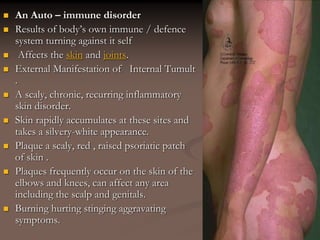
 A scaly, chronic, recurring inflammatory
skin disorder.
 Skin rapidly accumulates at these sites and
takes a silvery-white appearance.
 Plaque a scaly, red , raised psoriatic patch
of skin .
 Plaques frequently occur on the skin of the
elbows and knees, can affect any area
including the scalp and genitals.
 Burning hurting stinging aggravating
symptoms.
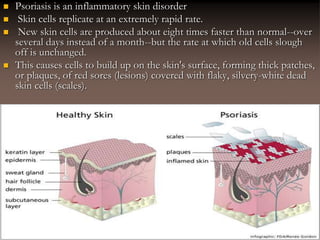
 Psoriasis is an inflammatory skin disorder
 Skin cells replicate at an extremely rapid rate.
 New skin cells are produced about eight times faster than normal--over
several days instead of a month--but the rate at which old cells slough
off is unchanged.
 This causes cells to build up on the skin's surface, forming thick patches,
or plaques, of red sores (lesions) covered with flaky, silvery-white dead
skin cells (scales).
Spread
 The disorder is a chronic recurring condition
 Varies in severity from minor localized patch to
complete body coverage.
 Fingernails and toenails frequently affected
(psoriatic nail dystrophy) - and can be seen as an
isolated finding.
 Psoriasis can also cause inflammation of the
joints, which is known as psoriatic arthritis.
 The cause of psoriasis is not known, but it is believed
to have a genetic component.
 Several factors are thought to aggravate psoriasis.
These include stress, excessive alcohol consumption,
and smoking.
 Individuals with psoriasis may suffer from depression
and loss of self-esteem.
 As such, quality of life is an important factor in
evaluating the severity of the disease.
 Certain medicines, including lithium salt and beta
blockers, have been reported to trigger or aggravate the
disease.
 Two main hypotheses
 1. Psoriasis as primarily a disorder of excessive growth and
reproduction of skin cells. The problem is simply seen as a
fault of the epidermis and its keratinocytes.
 2. an immune-mediated disorder in which the excessive
reproduction of skin cells is secondary to factors produced by
the immune system.
 T cells (which normally help protect the body against
infection) become active, migrate to the dermis and trigger the
release of cytokines (tumor necrosis factor-alpha TNFα, in
particular) which cause inflammation and the rapid production
of skin cells. It is not known what initiates the activation of
the T cells.
 The immune-mediated model of psoriasis has been supported
by the observation that immunosuppressant medications can
clear psoriasis plaques.
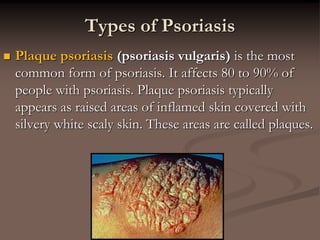
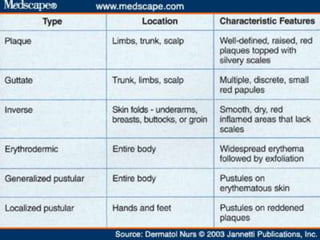
 Plaque psoriasis (psoriasis vulgaris) is the most
common form of psoriasis. It affects 80 to 90% of
people with psoriasis. Plaque psoriasis typically
appears as raised areas of inflamed skin covered with
silvery white scaly skin. These areas are called plaques.
Types of Psoriasis
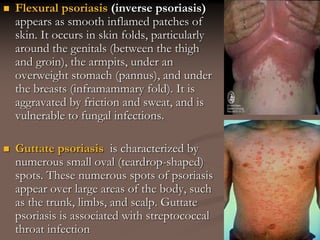
 Flexural psoriasis (inverse psoriasis)
appears as smooth inflamed patches of
skin. It occurs in skin folds, particularly
around the genitals (between the thigh
and groin), the armpits, under an
overweight stomach (pannus), and under
the breasts (inframammary fold). It is
aggravated by friction and sweat, and is
vulnerable to fungal infections.
 Guttate psoriasis is characterized by
numerous small oval (teardrop-shaped)
spots. These numerous spots of psoriasis
appear over large areas of the body, such
as the trunk, limbs, and scalp. Guttate
psoriasis is associated with streptococcal
throat infection
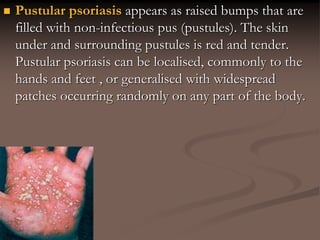
 Pustular psoriasis appears as raised bumps that are
filled with non-infectious pus (pustules). The skin
under and surrounding pustules is red and tender.
Pustular psoriasis can be localised, commonly to the
hands and feet , or generalised with widespread
patches occurring randomly on any part of the body.
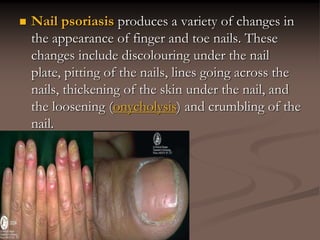
 Nail psoriasis produces a variety of changes in
the appearance of finger and toe nails. These
changes include discolouring under the nail
plate, pitting of the nails, lines going across the
nails, thickening of the skin under the nail, and
the loosening (onycholysis) and crumbling of the
nail.
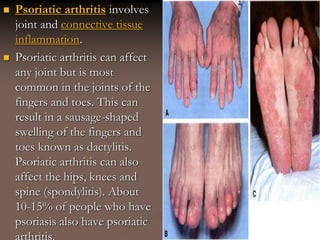
 Psoriatic arthritis involves
joint and connective tissue
inflammation.
 Psoriatic arthritis can affect
any joint but is most
common in the joints of the
fingers and toes. This can
result in a sausage-shaped
swelling of the fingers and
toes known as dactylitis.
Psoriatic arthritis can also
affect the hips, knees and
spine (spondylitis). About
10-15% of people who have
psoriasis also have psoriatic
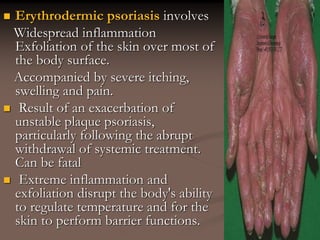
 Erythrodermic psoriasis involves
Widespread inflammation
Exfoliation of the skin over most of
the body surface.
Accompanied by severe itching,
swelling and pain.
 Result of an exacerbation of
unstable plaque psoriasis,
particularly following the abrupt
withdrawal of systemic treatment.
Can be fatal
 Extreme inflammation and
exfoliation disrupt the body's ability
to regulate temperature and for the
skin to perform barrier functions.
Life’s Lessons
 Anxiety
 Fear
 Old buried guck
 I am being Threatened
 Fear of being hurt
 Deadening the sense of self
 Refusing to accept responsibility for one’s own
feeling
 Psycho – Sociological Problems
 A diagnosis of psoriasis is usually based on
the appearance of the skin. There are no
special blood tests or diagnostic procedures
for psoriasis. Sometimes a skin biopsy, or
scraping, may be needed to rule out other
disorders and to confirm the diagnosis. Skin
from a biopsy will show clubbed pegs if
positive for psoriasis.
 Another sign of psoriasis is that when the
plaques are scraped, one can see pinpoint
bleeding from the skin below (Auspitz's
sign).
Other Triggering Factors
 Stress and Emotional Distress
 Climate and Temperature Changes
 Skin Injury – Cuts, Bruises
 Conventional Medicines -- Non – Steroidal anti –
inflammatory Drugs – Nimesulide/Diazepam/ Chloroquine/
Anti – hypertensives
 Alcohol
 Tobacco
 Poor general health
 Exposure to Ultra Violet Light
 Infection
 Puberty, Menopause and Pregnancy – changes hormonal level
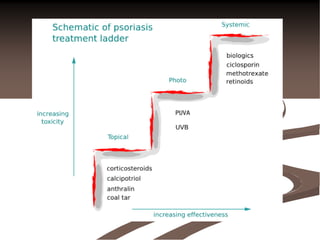
 Medications with the least potential for adverse
reactions are preferentially employed.
 As a first step, medicated ointments or cream
application to the skin.
 Exposur of the skin to ultraviolet (UV) radiation.
This type of treatment is called phototherapy.
 The third step involves the use of medications which
are taken internally by pill or injection : systemic
treatment.
 Over time, psoriasis can become resistant to a specific
therapy. Treatments may be periodically changed to
prevent resistance developing (tachyphylaxis) and to
reduce the chance of adverse reactions occurring:
treatment rotation.
Topical treatment
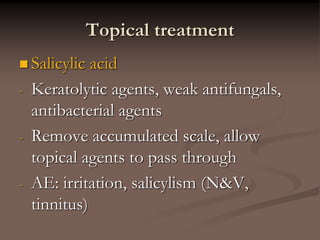
 Salicylic acid
- Keratolytic agents, weak antifungals,
antibacterial agents
- Remove accumulated scale, allow
topical agents to pass through
- AE: irritation, salicylism (N&V,
tinnitus)
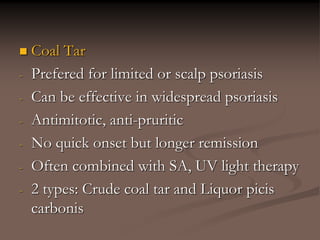
 Coal Tar
- Prefered for limited or scalp psoriasis
- Can be effective in widespread psoriasis
- Antimitotic, anti-pruritic
- No quick onset but longer remission
- Often combined with SA, UV light therapy
- 2 types: Crude coal tar and Liquor picis
carbonis
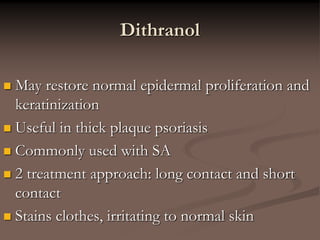
Dithranol
 May restore normal epidermal proliferation and
keratinization
 Useful in thick plaque psoriasis
 Commonly used with SA
 2 treatment approach: long contact and short
contact
 Stains clothes, irritating to normal skin
Topical CS
 Anti-inflammatory, immunosuppressive
 Quick onset than coal tar and dithranol
 Tachyphylaxis can occur
 High potent agents used in severe cases, thick
plaques
 AE local and systemic
 Should not be stopped abruptly – rebound
psoriasis
Phototherapy
 UVA, UVB, PUVA
 UVB prefered
 Administered by lamp, sunlight exposure alone
or in combo with another topical agent
 PUVA (methoxsalen) given PO 2 hours before
UVA or lotion applied 30mins before exposure
 AE: itch, edema
Systemic Therapy
Immunomodulators
- Cyclosporin, methotrexate
commonly used
- Antibiotics in case of secondary
bacterial infections
Systemic agents are generally
recommended for patients with
moderate-to-severe disease.
Moderate disease is defined as
greater than 5% body-surface
area involvement; severe disease
is defined by greater than 10%
 Take in Sun – Light – Climatotherapy
 Moisturize your skin
 Reduce Weight
 Relax
 Up your fibre intake – Flaxseeds / Evening Primrose
Oil
 Quit Smoking / Avoid Alcohol
 Eat a Healthy diet – 4-5 helpings of fruits /
vegetables/ cooked dried beans / peas/ Nuts and
seeds
 Reduce / Remove – red meat / animal fat/ sugar
 Omega – 3 Supplement / Teaspoon of flaxseeds
SELF HELP
Skin Ailments Psoriasis

Skin Ailments Psoriasis

  • 1.
    SKIN AILMENT PSORIASIS Dr. DarbhaAneeta Yizhar Anae Yizhar Academia Of Noesis And Eupheus draaradhya15@rediffmail.com / yizharanae@rediffmail.com +91 8454075171 / +91 9730933851
  • 2.
     An Auto– immune disorder  Results of body’s own immune / defence system turning against it self  Affects the skin and joints.  External Manifestation of Internal Tumult .  A scaly, chronic, recurring inflammatory skin disorder.  Skin rapidly accumulates at these sites and takes a silvery-white appearance.  Plaque a scaly, red , raised psoriatic patch of skin .  Plaques frequently occur on the skin of the elbows and knees, can affect any area including the scalp and genitals.  Burning hurting stinging aggravating symptoms.
  • 3.
     Psoriasis isan inflammatory skin disorder  Skin cells replicate at an extremely rapid rate.  New skin cells are produced about eight times faster than normal--over several days instead of a month--but the rate at which old cells slough off is unchanged.  This causes cells to build up on the skin's surface, forming thick patches, or plaques, of red sores (lesions) covered with flaky, silvery-white dead skin cells (scales).
  • 4.
    Spread  The disorderis a chronic recurring condition  Varies in severity from minor localized patch to complete body coverage.  Fingernails and toenails frequently affected (psoriatic nail dystrophy) - and can be seen as an isolated finding.  Psoriasis can also cause inflammation of the joints, which is known as psoriatic arthritis.
  • 5.
     The causeof psoriasis is not known, but it is believed to have a genetic component.  Several factors are thought to aggravate psoriasis. These include stress, excessive alcohol consumption, and smoking.  Individuals with psoriasis may suffer from depression and loss of self-esteem.  As such, quality of life is an important factor in evaluating the severity of the disease.  Certain medicines, including lithium salt and beta blockers, have been reported to trigger or aggravate the disease.
  • 6.
     Two mainhypotheses  1. Psoriasis as primarily a disorder of excessive growth and reproduction of skin cells. The problem is simply seen as a fault of the epidermis and its keratinocytes.  2. an immune-mediated disorder in which the excessive reproduction of skin cells is secondary to factors produced by the immune system.  T cells (which normally help protect the body against infection) become active, migrate to the dermis and trigger the release of cytokines (tumor necrosis factor-alpha TNFα, in particular) which cause inflammation and the rapid production of skin cells. It is not known what initiates the activation of the T cells.  The immune-mediated model of psoriasis has been supported by the observation that immunosuppressant medications can clear psoriasis plaques.
  • 7.
     Plaque psoriasis(psoriasis vulgaris) is the most common form of psoriasis. It affects 80 to 90% of people with psoriasis. Plaque psoriasis typically appears as raised areas of inflamed skin covered with silvery white scaly skin. These areas are called plaques. Types of Psoriasis
  • 8.
     Flexural psoriasis(inverse psoriasis) appears as smooth inflamed patches of skin. It occurs in skin folds, particularly around the genitals (between the thigh and groin), the armpits, under an overweight stomach (pannus), and under the breasts (inframammary fold). It is aggravated by friction and sweat, and is vulnerable to fungal infections.  Guttate psoriasis is characterized by numerous small oval (teardrop-shaped) spots. These numerous spots of psoriasis appear over large areas of the body, such as the trunk, limbs, and scalp. Guttate psoriasis is associated with streptococcal throat infection
  • 9.
     Pustular psoriasisappears as raised bumps that are filled with non-infectious pus (pustules). The skin under and surrounding pustules is red and tender. Pustular psoriasis can be localised, commonly to the hands and feet , or generalised with widespread patches occurring randomly on any part of the body.
  • 10.
     Nail psoriasisproduces a variety of changes in the appearance of finger and toe nails. These changes include discolouring under the nail plate, pitting of the nails, lines going across the nails, thickening of the skin under the nail, and the loosening (onycholysis) and crumbling of the nail.
  • 11.
     Psoriatic arthritisinvolves joint and connective tissue inflammation.  Psoriatic arthritis can affect any joint but is most common in the joints of the fingers and toes. This can result in a sausage-shaped swelling of the fingers and toes known as dactylitis. Psoriatic arthritis can also affect the hips, knees and spine (spondylitis). About 10-15% of people who have psoriasis also have psoriatic
  • 12.
     Erythrodermic psoriasisinvolves Widespread inflammation Exfoliation of the skin over most of the body surface. Accompanied by severe itching, swelling and pain.  Result of an exacerbation of unstable plaque psoriasis, particularly following the abrupt withdrawal of systemic treatment. Can be fatal  Extreme inflammation and exfoliation disrupt the body's ability to regulate temperature and for the skin to perform barrier functions.
  • 13.
    Life’s Lessons  Anxiety Fear  Old buried guck  I am being Threatened  Fear of being hurt  Deadening the sense of self  Refusing to accept responsibility for one’s own feeling  Psycho – Sociological Problems
  • 14.
     A diagnosisof psoriasis is usually based on the appearance of the skin. There are no special blood tests or diagnostic procedures for psoriasis. Sometimes a skin biopsy, or scraping, may be needed to rule out other disorders and to confirm the diagnosis. Skin from a biopsy will show clubbed pegs if positive for psoriasis.  Another sign of psoriasis is that when the plaques are scraped, one can see pinpoint bleeding from the skin below (Auspitz's sign).
  • 16.
    Other Triggering Factors Stress and Emotional Distress  Climate and Temperature Changes  Skin Injury – Cuts, Bruises  Conventional Medicines -- Non – Steroidal anti – inflammatory Drugs – Nimesulide/Diazepam/ Chloroquine/ Anti – hypertensives  Alcohol  Tobacco  Poor general health  Exposure to Ultra Violet Light  Infection  Puberty, Menopause and Pregnancy – changes hormonal level
  • 17.
     Medications withthe least potential for adverse reactions are preferentially employed.  As a first step, medicated ointments or cream application to the skin.  Exposur of the skin to ultraviolet (UV) radiation. This type of treatment is called phototherapy.  The third step involves the use of medications which are taken internally by pill or injection : systemic treatment.  Over time, psoriasis can become resistant to a specific therapy. Treatments may be periodically changed to prevent resistance developing (tachyphylaxis) and to reduce the chance of adverse reactions occurring: treatment rotation.
  • 19.
    Topical treatment  Salicylicacid - Keratolytic agents, weak antifungals, antibacterial agents - Remove accumulated scale, allow topical agents to pass through - AE: irritation, salicylism (N&V, tinnitus)
  • 20.
     Coal Tar -Prefered for limited or scalp psoriasis - Can be effective in widespread psoriasis - Antimitotic, anti-pruritic - No quick onset but longer remission - Often combined with SA, UV light therapy - 2 types: Crude coal tar and Liquor picis carbonis
  • 21.
    Dithranol  May restorenormal epidermal proliferation and keratinization  Useful in thick plaque psoriasis  Commonly used with SA  2 treatment approach: long contact and short contact  Stains clothes, irritating to normal skin
  • 22.
    Topical CS  Anti-inflammatory,immunosuppressive  Quick onset than coal tar and dithranol  Tachyphylaxis can occur  High potent agents used in severe cases, thick plaques  AE local and systemic  Should not be stopped abruptly – rebound psoriasis
  • 23.
    Phototherapy  UVA, UVB,PUVA  UVB prefered  Administered by lamp, sunlight exposure alone or in combo with another topical agent  PUVA (methoxsalen) given PO 2 hours before UVA or lotion applied 30mins before exposure  AE: itch, edema
  • 24.
    Systemic Therapy Immunomodulators - Cyclosporin,methotrexate commonly used - Antibiotics in case of secondary bacterial infections
  • 25.
    Systemic agents aregenerally recommended for patients with moderate-to-severe disease. Moderate disease is defined as greater than 5% body-surface area involvement; severe disease is defined by greater than 10%
  • 26.
     Take inSun – Light – Climatotherapy  Moisturize your skin  Reduce Weight  Relax  Up your fibre intake – Flaxseeds / Evening Primrose Oil  Quit Smoking / Avoid Alcohol  Eat a Healthy diet – 4-5 helpings of fruits / vegetables/ cooked dried beans / peas/ Nuts and seeds  Reduce / Remove – red meat / animal fat/ sugar  Omega – 3 Supplement / Teaspoon of flaxseeds SELF HELP