PSORIASIS MANAGEMENT IN
THE COMMUNITY
BY
DR U.B.BUHARI
GPwER
FRCGP
MHA
What is psoriasis?
Classic definition
– Primary Care Dermatology Society (UK)
PCDS Psoriasis Guideline. Available from: http://www.pcds.org.uk/clinical-guidance/psoriasis-an-overview. Last accessed: September 2018.
Psoriasis is a common, genetically
determined, inflammatory and proliferative
disorder of the skin, the most characteristic
lesions consisting of chronic, sharply
demarcated, dull-red, scaly plaques,
particularly on the
extensor prominences and in the scalp.
What is psoriasis?
Modern definition –
Not just a skin disease
Reich K et al. J Eur Acad Dermatol Venereol 2012;26 (Suppl 2):3–11.
Psoriasis is a systemic, immune-mediated
disorder, characterised by inflammatory
skin and joint manifestations. Psoriasis is
associated with a range of comorbidities
including metabolic diseases, such as
diabetes, and psychological disorders.
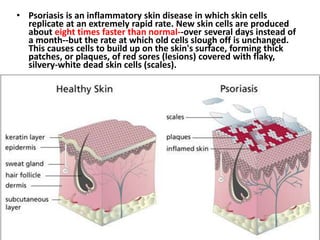
• Psoriasis is an inflammatory skin disease in which skin cells
replicate at an extremely rapid rate. New skin cells are produced
about eight times faster than normal--over several days instead of
a month--but the rate at which old cells slough off is unchanged.
This causes cells to build up on the skin's surface, forming thick
patches, or plaques, of red sores (lesions) covered with flaky,
silvery-white dead skin cells (scales).
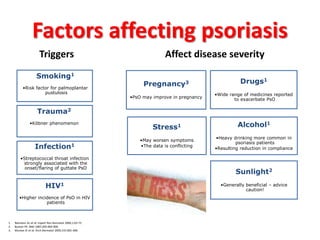
Factors affecting psoriasis
Triggers Affect disease severity
Trauma2
•Köbner phenomenon
Infection1
•Streptococcal throat infection
strongly associated with the
onset/flaring of guttate PsO
Smoking1
•Risk factor for palmoplantar
pustulosis
Pregnancy3
•PsO may improve in pregnancy
Drugs1
•Wide range of medicines reported
to exacerbate PsO
Stress1
•May worsen symptoms
•The data is conflicting
Alcohol1
•Heavy drinking more common in
psoriasis patients
•Resulting reduction in compliance
HIV1
•Higher incidence of PsO in HIV
patients
Sunlight2
•Generally beneficial – advice
caution!
1. Neimann AL et al. Expert Rev Dermatol 2006;1:63-75
2. Buxton PK. BMJ 1987;295:904-906.
3. Murase JE et al. Arch Dermatol 2005;141:601-606.
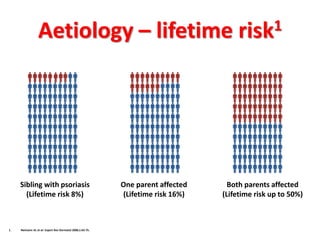
Aetiology – lifetime risk1
1. Neimann AL et al. Expert Rev Dermatol 2006;1:63-75.
Sibling with psoriasis
(Lifetime risk 8%)
One parent affected
(Lifetime risk 16%)
Both parents affected
(Lifetime risk up to 50%)
Epidemiology
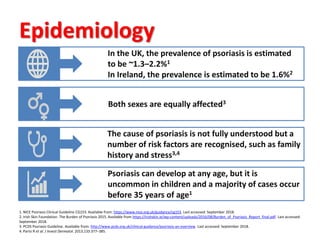
In the UK, the prevalence of psoriasis is estimated
to be ~1.3–2.2%1
In Ireland, the prevalence is estimated to be 1.6%2
The cause of psoriasis is not fully understood but a
number of risk factors are recognised, such as family
history and stress3,4
Psoriasis can develop at any age, but it is
uncommon in children and a majority of cases occur
before 35 years of age1
Both sexes are equally affected3
1. NICE Psoriasis Clinical Guideline CG153. Available from: https://www.nice.org.uk/guidance/cg153. Last accessed: September 2018.
2. Irish Skin Foundation. The Burden of Psoriasis 2015. Available from https://irishskin.ie/wp-content/uploads/2016/08/Burden_of_Psoriasis_Report_final.pdf. Last accessed:
September 2018.
3. PCDS Psoriasis Guideline. Available from: http://www.pcds.org.uk/clinical-guidance/psoriasis-an-overview. Last accessed: September 2018.
4. Parisi R et al. J Invest Dermatol. 2013;133:377–385.
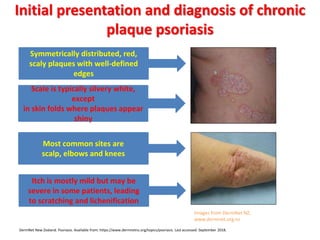
Initial presentation and diagnosis of chronic
plaque psoriasis
Symmetrically distributed, red,
scaly plaques with well-defined
edges
Scale is typically silvery white,
except
in skin folds where plaques appear
shiny
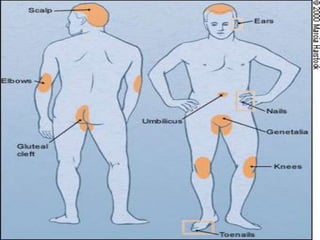
Most common sites are
scalp, elbows and knees
Itch is mostly mild but may be
severe in some patients, leading
to scratching and lichenification
DermNet New Zealand. Psoriasis. Available from: https://www.dermnetnz.org/topics/psoriasis. Last accessed: September 2018.
Images from DermNet NZ,
www.dermnet.org.nz
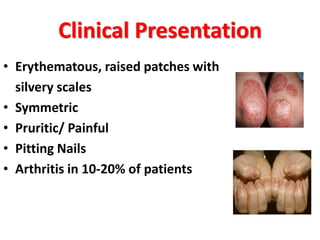
Clinical Presentation
• Erythematous, raised patches with
silvery scales
• Symmetric
• Pruritic/ Painful
• Pitting Nails
• Arthritis in 10-20% of patients
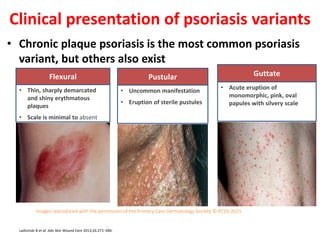
• Chronic plaque psoriasis is the most common psoriasis
variant, but others also exist
Clinical presentation of psoriasis variants
Flexural
• Thin, sharply demarcated
and shiny erythmatous
plaques
• Scale is minimal to absent
Pustular
• Uncommon manifestation
• Eruption of sterile pustules
Guttate
• Acute eruption of
monomorphic, pink, oval
papules with silvery scale
Ladizinski B et al. Adv Skin Wound Care 2013;26:271–284.
Images reproduced with the permission of the Primary Care Dermatology Society © PCDS 2015
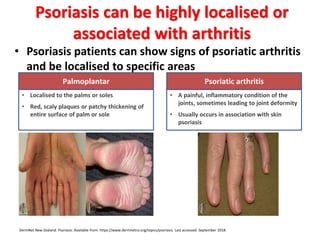
• Psoriasis patients can show signs of psoriatic arthritis
and be localised to specific areas
Psoriasis can be highly localised or
associated with arthritis
Palmoplantar
• Localised to the palms or soles
• Red, scaly plaques or patchy thickening of
entire surface of palm or sole
Psoriatic arthritis
• A painful, inflammatory condition of the
joints, sometimes leading to joint deformity
• Usually occurs in association with skin
psoriasis
DermNet New Zealand. Psoriasis. Available from: https://www.dermnetnz.org/topics/psoriasis. Last accessed: September 2018.
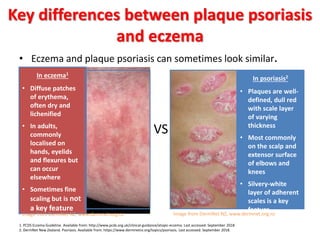
• Eczema and plaque psoriasis can sometimes look similar.
Key differences between plaque psoriasis
and eczema
In eczema1
• Diffuse patches
of erythema,
often dry and
lichenified
• In adults,
commonly
localised on
hands, eyelids
and flexures but
can occur
elsewhere
• Sometimes fine
scaling but is not
a key feature
In psoriasis2
• Plaques are well-
defined, dull red
with scale layer
of varying
thickness
• Most commonly
on the scalp and
extensor surface
of elbows and
knees
• Silvery-white
layer of adherent
scales is a key
feature
VS
1. PCDS Eczema Guideline. Available from: http://www.pcds.org.uk/clinical-guidance/atopic-eczema. Last accessed: September 2018.
2. DermNet New Zealand. Psoriasis. Available from: https://www.dermnetnz.org/topics/psoriasis. Last accessed: September 2018.
Image from DermNet NZ, www.dermnet.org.nz Image from DermNet NZ, www.dermnet.org.nz
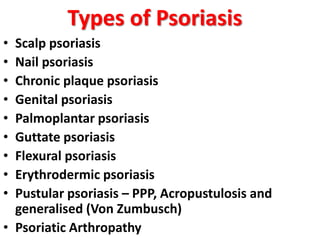
Types of Psoriasis
• Scalp psoriasis
• Nail psoriasis
• Chronic plaque psoriasis
• Genital psoriasis
• Palmoplantar psoriasis
• Guttate psoriasis
• Flexural psoriasis
• Erythrodermic psoriasis
• Pustular psoriasis – PPP, Acropustulosis and
generalised (Von Zumbusch)
• Psoriatic Arthropathy
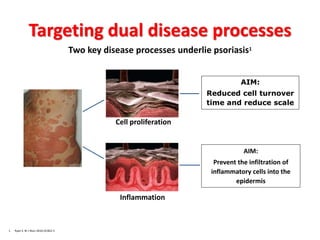
Targeting dual disease processes
1. Ryan S. Br J Nurs 2010;19:822-5
Two key disease processes underlie psoriasis1
Cell proliferation
AIM:
Prevent the infiltration of
inflammatory cells into the
epidermis
AIM:
Reduced cell turnover
time and reduce scale
Inflammation
Management of Psoriasis
• Reinforce the fact that whilst we cannot cure the
problem, we can at least manage it.
• As a general rule in treating psoriasis; mild-to-
moderate psoriasis can often be managed with
topical agents, while moderate-to-severe disease
may need phototherapy or systemic therapy.
• NICE defined severe disease as a PASI ≥10 with a
DLQI > 10; where PASI is not applicable, a BSA
≥10% or a disease associated with significant
functional or psychological morbidity (acral, facial,
palmoplanter, head, neck and genital psoriasis.
Treatment options
• There can be substantial variation between individuals in
the effectiveness of specific psoriasis treatments. Because
of this, dermatologists often use a trial-and-error
approach to finding the most appropriate treatment for
their patient.
• The decision to employ a particular treatment is based on
the type of psoriasis, its location, extent and severity. The
patient’s age, gender, quality of life, comorbidities, and
attitude toward risks associated with the treatment are
also taken into consideration.
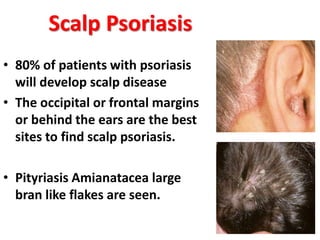
• 80% of patients with psoriasis
will develop scalp disease
• The occipital or frontal margins
or behind the ears are the best
sites to find scalp psoriasis.
• Pityriasis Amianatacea large
bran like flakes are seen.
Scalp Psoriasis
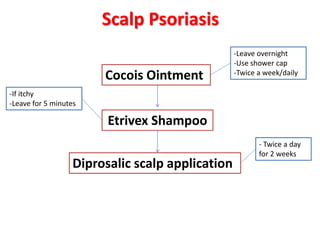
Scalp Psoriasis
Cocois Ointment
Etrivex Shampoo
Diprosalic scalp application
-Leave overnight
-Use shower cap
-Twice a week/daily
-If itchy
-Leave for 5 minutes
- Twice a day
for 2 weeks
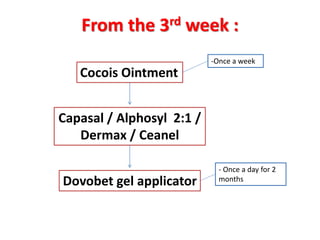
From the 3rd week :
Cocois Ointment
Capasal / Alphosyl 2:1 /
Dermax / Ceanel
Dovobet gel applicator
- Once a day for 2
months
-Once a week
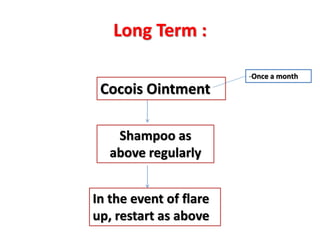
Long Term :
Cocois Ointment
Shampoo as
above regularly
-Once a month
In the event of flare
up, restart as above
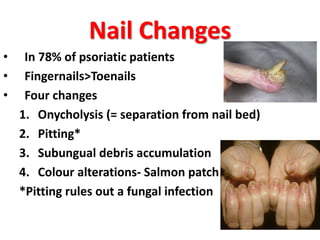
Nail Changes
• In 78% of psoriatic patients
• Fingernails>Toenails
• Four changes
1. Onycholysis (= separation from nail bed)
2. Pitting*
3. Subungual debris accumulation
4. Colour alterations- Salmon patch
*Pitting rules out a fungal infection
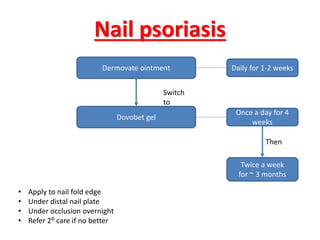
Nail psoriasis
Daily for 1-2 weeksDermovate ointment
Dovobet gel
Once a day for 4
weeks
Twice a week
for ~ 3 months
• Apply to nail fold edge
• Under distal nail plate
• Under occlusion overnight
• Refer 2⁰ care if no better
Switch
to
Then
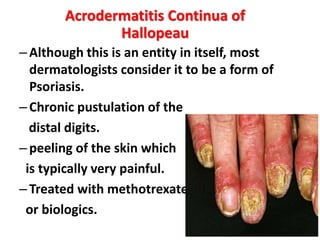
Acrodermatitis Continua of
Hallopeau
–Although this is an entity in itself, most
dermatologists consider it to be a form of
Psoriasis.
–Chronic pustulation of the
distal digits.
–peeling of the skin which
is typically very painful.
–Treated with methotrexate
or biologics.
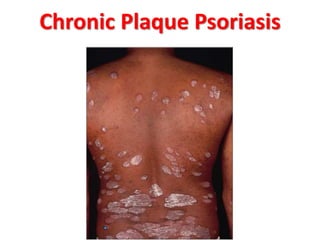
Chronic Plaque Psoriasis
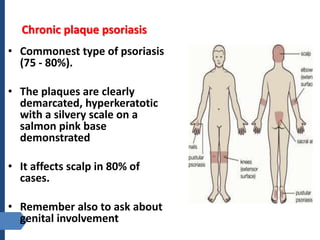
Chronic plaque psoriasis
• Commonest type of psoriasis
(75 - 80%).
• The plaques are clearly
demarcated, hyperkeratotic
with a silvery scale on a
salmon pink base
demonstrated
• It affects scalp in 80% of
cases.
• Remember also to ask about
genital involvement
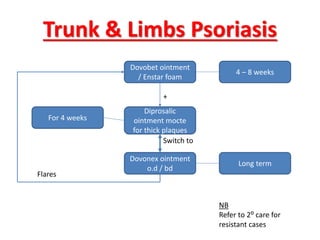
Trunk & Limbs Psoriasis
Dovobet ointment
/ Enstar foam
Diprosalic
ointment mocte
for thick plaques
Dovonex ointment
o.d / bd
NB
Refer to 2⁰ care for
resistant cases
4 – 8 weeks
For 4 weeks
Long term
+
Switch to
Flares
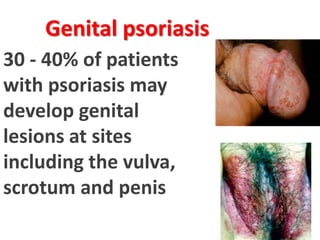
Genital psoriasis
30 - 40% of patients
with psoriasis may
develop genital
lesions at sites
including the vulva,
scrotum and penis
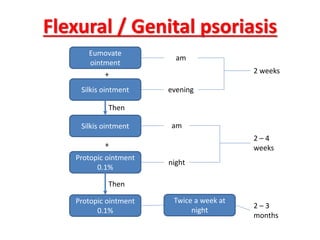
Flexural / Genital psoriasis
Eumovate
ointment
Silkis ointment
Protopic ointment
0.1%
Silkis ointment
Protopic ointment
0.1%
am
evening
night
am
Twice a week at
night
2 – 3
months
2 – 4
weeks
2 weeks
Then
Then
+
+
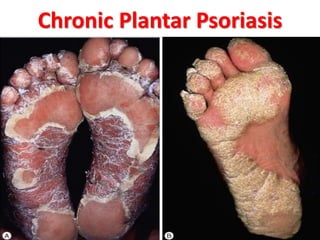
Chronic Plantar Psoriasis
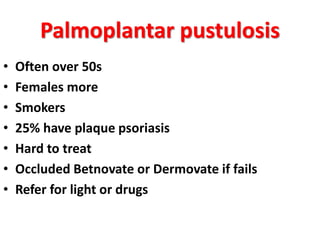
Palmoplantar pustulosis
• Often over 50s
• Females more
• Smokers
• 25% have plaque psoriasis
• Hard to treat
• Occluded Betnovate or Dermovate if fails
• Refer for light or drugs
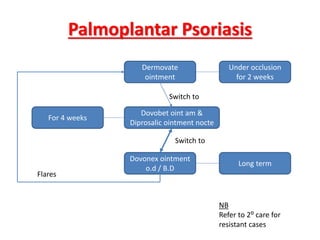
Palmoplantar Psoriasis
Dermovate
ointment
Dovobet oint am &
Diprosalic ointment nocte
Dovonex ointment
o.d / B.D
NB
Refer to 2⁰ care for
resistant cases
Under occlusion
for 2 weeks
For 4 weeks
Long term
Switch to
Switch to
Flares
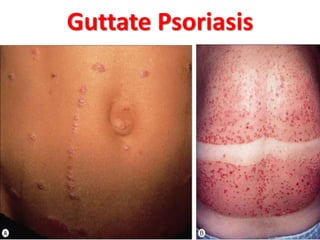
Guttate Psoriasis
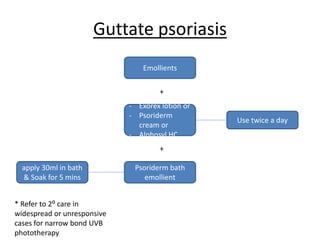
Guttate psoriasis
Use twice a day
Emollients
apply 30ml in bath
& Soak for 5 mins
- Exorex lotion or
- Psoriderm
cream or
- Alphosyl HC
Psoriderm bath
emollient
* Refer to 2⁰ care in
widespread or unresponsive
cases for narrow bond UVB
phototherapy
+
+
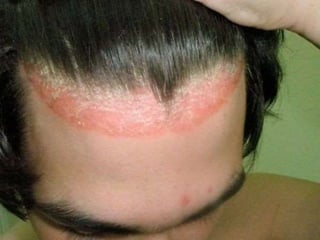
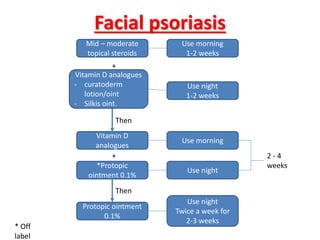
Facial psoriasis
Mid – moderate
topical steroids
Use morning
1-2 weeks
Use night
1-2 weeks
Vitamin D analogues
- curatoderm
lotion/oint
- Silkis oint.
Use morning
Vitamin D
analogues
Use night
Twice a week for
2-3 weeks
Use night
Protopic ointment
0.1%
*Protopic
ointment 0.1%
2 - 4
weeks
+
+
Then
Then
* Off
label
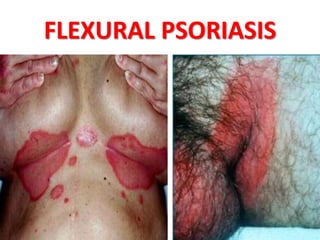
FLEXURAL PSORIASIS
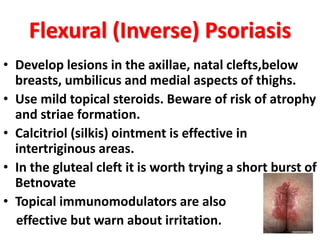
Flexural (Inverse) Psoriasis
• Develop lesions in the axillae, natal clefts,below
breasts, umbilicus and medial aspects of thighs.
• Use mild topical steroids. Beware of risk of atrophy
and striae formation.
• Calcitriol (silkis) ointment is effective in
intertriginous areas.
• In the gluteal cleft it is worth trying a short burst of
Betnovate
• Topical immunomodulators are also
effective but warn about irritation.
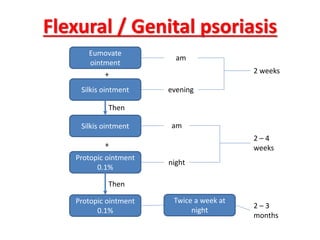
Flexural / Genital psoriasis
Eumovate
ointment
Silkis ointment
Protopic ointment
0.1%
Silkis ointment
Protopic ointment
0.1%
am
evening
night
am
Twice a week at
night
2 – 3
months
2 – 4
weeks
2 weeks
Then
Then
+
+
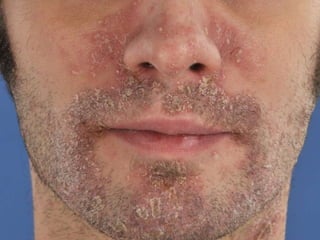
Sebopsoriasis
• Overlap between two separate conditions -
seborrhoeic dermatitis and psoriasis.
• Most common in childhood/adolescence and then
increases in patients older than 50 years of age.
• Associated with - Immunosuppression
(eg chronic liver disease, HIV/AIDS, medication)
• Neurological and psychiatric diseases, including
Parkinson disease
• Disseminated malignant disease (cancer)
Sebopsoriasis - Mx
• Emollient – Act as a topical keratolytics.
• Topical Antifungal - Combination therapy
of topical corticosteroid and ketoconazole
shampoo is more effective than
ketoconazole shampoo alone.
• Oral antifungal agents
such as itraconazole may help some patients
with sebopsoriasis.
43
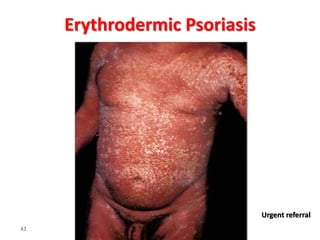
Erythrodermic Psoriasis
Urgent referral
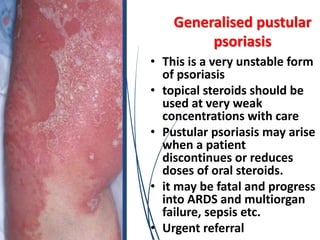
Generalised pustular
psoriasis
• This is a very unstable form
of psoriasis
• topical steroids should be
used at very weak
concentrations with care
• Pustular psoriasis may arise
when a patient
discontinues or reduces
doses of oral steroids.
• it may be fatal and progress
into ARDS and multiorgan
failure, sepsis etc.
• Urgent referral
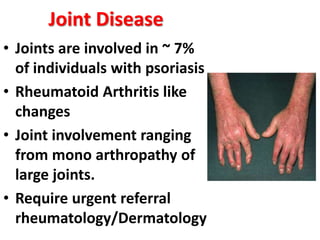
• Joints are involved in ~ 7%
of individuals with psoriasis
• Rheumatoid Arthritis like
changes
• Joint involvement ranging
from mono arthropathy of
large joints.
• Require urgent referral
rheumatology/Dermatology
Joint Disease
Outcomes
• Outcomes can be difficult to quantify as they need
to take into account patient satisfaction and QOL
improvements
• DLQI forms – Derm life quality index used as
standard
Never forget psychological impact of this disease ….
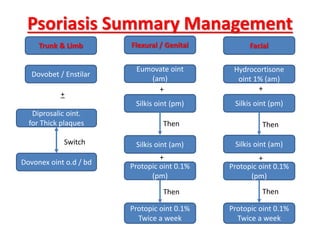
Psoriasis Summary Management
Flexural / Genital Facial
Silkis oint (pm)
Trunk & Limb
Protopic oint 0.1%
(pm)
Hydrocortisone
oint 1% (am)
Dovobet / Enstilar
Diprosalic oint.
for Thick plaques
Dovonex oint o.d / bd
Protopic oint 0.1%
Twice a week
Eumovate oint
(am)
Silkis oint (am)
Silkis oint (pm)
Protopic oint 0.1%
(pm)
Protopic oint 0.1%
Twice a week
+
Switch
+
Silkis oint (am)
+
+
+
Then
Then
Then
Then
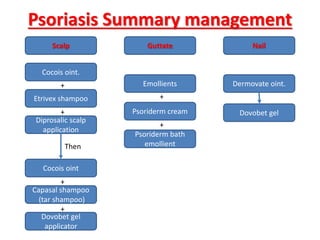
Psoriasis Summary management
Guttate Nail
Psoriderm cream
Scalp
Psoriderm bath
emollient
Dermovate oint.
Cocois oint.
Etrivex shampoo
Diprosalic scalp
application
Cocois oint
Capasal shampoo
(tar shampoo)
Dovobet gel
applicator
Emollients
Dovobet gel
+
+
Then
+
+
+
+
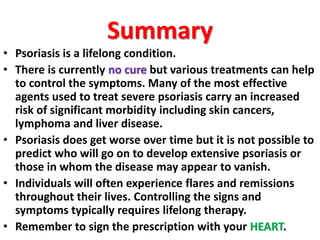
• Psoriasis is a lifelong condition.
• There is currently no cure but various treatments can help
to control the symptoms. Many of the most effective
agents used to treat severe psoriasis carry an increased
risk of significant morbidity including skin cancers,
lymphoma and liver disease.
• Psoriasis does get worse over time but it is not possible to
predict who will go on to develop extensive psoriasis or
those in whom the disease may appear to vanish.
• Individuals will often experience flares and remissions
throughout their lives. Controlling the signs and
symptoms typically requires lifelong therapy.
• Remember to sign the prescription with your HEART.
Summary
Psoriasis management in the community

Psoriasis management in the community

  • 1.
    PSORIASIS MANAGEMENT IN THECOMMUNITY BY DR U.B.BUHARI GPwER FRCGP MHA
  • 2.
    What is psoriasis? Classicdefinition – Primary Care Dermatology Society (UK) PCDS Psoriasis Guideline. Available from: http://www.pcds.org.uk/clinical-guidance/psoriasis-an-overview. Last accessed: September 2018. Psoriasis is a common, genetically determined, inflammatory and proliferative disorder of the skin, the most characteristic lesions consisting of chronic, sharply demarcated, dull-red, scaly plaques, particularly on the extensor prominences and in the scalp.
  • 3.
    What is psoriasis? Moderndefinition – Not just a skin disease Reich K et al. J Eur Acad Dermatol Venereol 2012;26 (Suppl 2):3–11. Psoriasis is a systemic, immune-mediated disorder, characterised by inflammatory skin and joint manifestations. Psoriasis is associated with a range of comorbidities including metabolic diseases, such as diabetes, and psychological disorders.
  • 4.
    • Psoriasis isan inflammatory skin disease in which skin cells replicate at an extremely rapid rate. New skin cells are produced about eight times faster than normal--over several days instead of a month--but the rate at which old cells slough off is unchanged. This causes cells to build up on the skin's surface, forming thick patches, or plaques, of red sores (lesions) covered with flaky, silvery-white dead skin cells (scales).
  • 5.
    Factors affecting psoriasis TriggersAffect disease severity Trauma2 •Köbner phenomenon Infection1 •Streptococcal throat infection strongly associated with the onset/flaring of guttate PsO Smoking1 •Risk factor for palmoplantar pustulosis Pregnancy3 •PsO may improve in pregnancy Drugs1 •Wide range of medicines reported to exacerbate PsO Stress1 •May worsen symptoms •The data is conflicting Alcohol1 •Heavy drinking more common in psoriasis patients •Resulting reduction in compliance HIV1 •Higher incidence of PsO in HIV patients Sunlight2 •Generally beneficial – advice caution! 1. Neimann AL et al. Expert Rev Dermatol 2006;1:63-75 2. Buxton PK. BMJ 1987;295:904-906. 3. Murase JE et al. Arch Dermatol 2005;141:601-606.
  • 6.
    Aetiology – lifetimerisk1 1. Neimann AL et al. Expert Rev Dermatol 2006;1:63-75. Sibling with psoriasis (Lifetime risk 8%) One parent affected (Lifetime risk 16%) Both parents affected (Lifetime risk up to 50%)
  • 7.
    Epidemiology In the UK,the prevalence of psoriasis is estimated to be ~1.3–2.2%1 In Ireland, the prevalence is estimated to be 1.6%2 The cause of psoriasis is not fully understood but a number of risk factors are recognised, such as family history and stress3,4 Psoriasis can develop at any age, but it is uncommon in children and a majority of cases occur before 35 years of age1 Both sexes are equally affected3 1. NICE Psoriasis Clinical Guideline CG153. Available from: https://www.nice.org.uk/guidance/cg153. Last accessed: September 2018. 2. Irish Skin Foundation. The Burden of Psoriasis 2015. Available from https://irishskin.ie/wp-content/uploads/2016/08/Burden_of_Psoriasis_Report_final.pdf. Last accessed: September 2018. 3. PCDS Psoriasis Guideline. Available from: http://www.pcds.org.uk/clinical-guidance/psoriasis-an-overview. Last accessed: September 2018. 4. Parisi R et al. J Invest Dermatol. 2013;133:377–385.
  • 8.
    Initial presentation anddiagnosis of chronic plaque psoriasis Symmetrically distributed, red, scaly plaques with well-defined edges Scale is typically silvery white, except in skin folds where plaques appear shiny Most common sites are scalp, elbows and knees Itch is mostly mild but may be severe in some patients, leading to scratching and lichenification DermNet New Zealand. Psoriasis. Available from: https://www.dermnetnz.org/topics/psoriasis. Last accessed: September 2018. Images from DermNet NZ, www.dermnet.org.nz
  • 9.
    Clinical Presentation • Erythematous,raised patches with silvery scales • Symmetric • Pruritic/ Painful • Pitting Nails • Arthritis in 10-20% of patients
  • 10.
    • Chronic plaquepsoriasis is the most common psoriasis variant, but others also exist Clinical presentation of psoriasis variants Flexural • Thin, sharply demarcated and shiny erythmatous plaques • Scale is minimal to absent Pustular • Uncommon manifestation • Eruption of sterile pustules Guttate • Acute eruption of monomorphic, pink, oval papules with silvery scale Ladizinski B et al. Adv Skin Wound Care 2013;26:271–284. Images reproduced with the permission of the Primary Care Dermatology Society © PCDS 2015
  • 11.
    • Psoriasis patientscan show signs of psoriatic arthritis and be localised to specific areas Psoriasis can be highly localised or associated with arthritis Palmoplantar • Localised to the palms or soles • Red, scaly plaques or patchy thickening of entire surface of palm or sole Psoriatic arthritis • A painful, inflammatory condition of the joints, sometimes leading to joint deformity • Usually occurs in association with skin psoriasis DermNet New Zealand. Psoriasis. Available from: https://www.dermnetnz.org/topics/psoriasis. Last accessed: September 2018.
  • 12.
    • Eczema andplaque psoriasis can sometimes look similar. Key differences between plaque psoriasis and eczema In eczema1 • Diffuse patches of erythema, often dry and lichenified • In adults, commonly localised on hands, eyelids and flexures but can occur elsewhere • Sometimes fine scaling but is not a key feature In psoriasis2 • Plaques are well- defined, dull red with scale layer of varying thickness • Most commonly on the scalp and extensor surface of elbows and knees • Silvery-white layer of adherent scales is a key feature VS 1. PCDS Eczema Guideline. Available from: http://www.pcds.org.uk/clinical-guidance/atopic-eczema. Last accessed: September 2018. 2. DermNet New Zealand. Psoriasis. Available from: https://www.dermnetnz.org/topics/psoriasis. Last accessed: September 2018. Image from DermNet NZ, www.dermnet.org.nz Image from DermNet NZ, www.dermnet.org.nz
  • 14.
    Types of Psoriasis •Scalp psoriasis • Nail psoriasis • Chronic plaque psoriasis • Genital psoriasis • Palmoplantar psoriasis • Guttate psoriasis • Flexural psoriasis • Erythrodermic psoriasis • Pustular psoriasis – PPP, Acropustulosis and generalised (Von Zumbusch) • Psoriatic Arthropathy
  • 15.
    Targeting dual diseaseprocesses 1. Ryan S. Br J Nurs 2010;19:822-5 Two key disease processes underlie psoriasis1 Cell proliferation AIM: Prevent the infiltration of inflammatory cells into the epidermis AIM: Reduced cell turnover time and reduce scale Inflammation
  • 16.
    Management of Psoriasis •Reinforce the fact that whilst we cannot cure the problem, we can at least manage it. • As a general rule in treating psoriasis; mild-to- moderate psoriasis can often be managed with topical agents, while moderate-to-severe disease may need phototherapy or systemic therapy. • NICE defined severe disease as a PASI ≥10 with a DLQI > 10; where PASI is not applicable, a BSA ≥10% or a disease associated with significant functional or psychological morbidity (acral, facial, palmoplanter, head, neck and genital psoriasis.
  • 17.
    Treatment options • Therecan be substantial variation between individuals in the effectiveness of specific psoriasis treatments. Because of this, dermatologists often use a trial-and-error approach to finding the most appropriate treatment for their patient. • The decision to employ a particular treatment is based on the type of psoriasis, its location, extent and severity. The patient’s age, gender, quality of life, comorbidities, and attitude toward risks associated with the treatment are also taken into consideration.
  • 18.
    • 80% ofpatients with psoriasis will develop scalp disease • The occipital or frontal margins or behind the ears are the best sites to find scalp psoriasis. • Pityriasis Amianatacea large bran like flakes are seen. Scalp Psoriasis
  • 19.
    Scalp Psoriasis Cocois Ointment EtrivexShampoo Diprosalic scalp application -Leave overnight -Use shower cap -Twice a week/daily -If itchy -Leave for 5 minutes - Twice a day for 2 weeks
  • 20.
    From the 3rdweek : Cocois Ointment Capasal / Alphosyl 2:1 / Dermax / Ceanel Dovobet gel applicator - Once a day for 2 months -Once a week
  • 21.
    Long Term : CocoisOintment Shampoo as above regularly -Once a month In the event of flare up, restart as above
  • 22.
    Nail Changes • In78% of psoriatic patients • Fingernails>Toenails • Four changes 1. Onycholysis (= separation from nail bed) 2. Pitting* 3. Subungual debris accumulation 4. Colour alterations- Salmon patch *Pitting rules out a fungal infection
  • 23.
    Nail psoriasis Daily for1-2 weeksDermovate ointment Dovobet gel Once a day for 4 weeks Twice a week for ~ 3 months • Apply to nail fold edge • Under distal nail plate • Under occlusion overnight • Refer 2⁰ care if no better Switch to Then
  • 24.
    Acrodermatitis Continua of Hallopeau –Althoughthis is an entity in itself, most dermatologists consider it to be a form of Psoriasis. –Chronic pustulation of the distal digits. –peeling of the skin which is typically very painful. –Treated with methotrexate or biologics.
  • 25.
  • 26.
    Chronic plaque psoriasis •Commonest type of psoriasis (75 - 80%). • The plaques are clearly demarcated, hyperkeratotic with a silvery scale on a salmon pink base demonstrated • It affects scalp in 80% of cases. • Remember also to ask about genital involvement
  • 27.
    Trunk & LimbsPsoriasis Dovobet ointment / Enstar foam Diprosalic ointment mocte for thick plaques Dovonex ointment o.d / bd NB Refer to 2⁰ care for resistant cases 4 – 8 weeks For 4 weeks Long term + Switch to Flares
  • 28.
    Genital psoriasis 30 -40% of patients with psoriasis may develop genital lesions at sites including the vulva, scrotum and penis
  • 29.
    Flexural / Genitalpsoriasis Eumovate ointment Silkis ointment Protopic ointment 0.1% Silkis ointment Protopic ointment 0.1% am evening night am Twice a week at night 2 – 3 months 2 – 4 weeks 2 weeks Then Then + +
  • 30.
  • 31.
    Palmoplantar pustulosis • Oftenover 50s • Females more • Smokers • 25% have plaque psoriasis • Hard to treat • Occluded Betnovate or Dermovate if fails • Refer for light or drugs
  • 32.
    Palmoplantar Psoriasis Dermovate ointment Dovobet ointam & Diprosalic ointment nocte Dovonex ointment o.d / B.D NB Refer to 2⁰ care for resistant cases Under occlusion for 2 weeks For 4 weeks Long term Switch to Switch to Flares
  • 33.
  • 34.
    Guttate psoriasis Use twicea day Emollients apply 30ml in bath & Soak for 5 mins - Exorex lotion or - Psoriderm cream or - Alphosyl HC Psoriderm bath emollient * Refer to 2⁰ care in widespread or unresponsive cases for narrow bond UVB phototherapy + +
  • 36.
    Facial psoriasis Mid –moderate topical steroids Use morning 1-2 weeks Use night 1-2 weeks Vitamin D analogues - curatoderm lotion/oint - Silkis oint. Use morning Vitamin D analogues Use night Twice a week for 2-3 weeks Use night Protopic ointment 0.1% *Protopic ointment 0.1% 2 - 4 weeks + + Then Then * Off label
  • 37.
  • 38.
    Flexural (Inverse) Psoriasis •Develop lesions in the axillae, natal clefts,below breasts, umbilicus and medial aspects of thighs. • Use mild topical steroids. Beware of risk of atrophy and striae formation. • Calcitriol (silkis) ointment is effective in intertriginous areas. • In the gluteal cleft it is worth trying a short burst of Betnovate • Topical immunomodulators are also effective but warn about irritation.
  • 39.
    Flexural / Genitalpsoriasis Eumovate ointment Silkis ointment Protopic ointment 0.1% Silkis ointment Protopic ointment 0.1% am evening night am Twice a week at night 2 – 3 months 2 – 4 weeks 2 weeks Then Then + +
  • 41.
    Sebopsoriasis • Overlap betweentwo separate conditions - seborrhoeic dermatitis and psoriasis. • Most common in childhood/adolescence and then increases in patients older than 50 years of age. • Associated with - Immunosuppression (eg chronic liver disease, HIV/AIDS, medication) • Neurological and psychiatric diseases, including Parkinson disease • Disseminated malignant disease (cancer)
  • 42.
    Sebopsoriasis - Mx •Emollient – Act as a topical keratolytics. • Topical Antifungal - Combination therapy of topical corticosteroid and ketoconazole shampoo is more effective than ketoconazole shampoo alone. • Oral antifungal agents such as itraconazole may help some patients with sebopsoriasis.
  • 43.
  • 44.
    Generalised pustular psoriasis • Thisis a very unstable form of psoriasis • topical steroids should be used at very weak concentrations with care • Pustular psoriasis may arise when a patient discontinues or reduces doses of oral steroids. • it may be fatal and progress into ARDS and multiorgan failure, sepsis etc. • Urgent referral
  • 45.
    • Joints areinvolved in ~ 7% of individuals with psoriasis • Rheumatoid Arthritis like changes • Joint involvement ranging from mono arthropathy of large joints. • Require urgent referral rheumatology/Dermatology Joint Disease
  • 46.
    Outcomes • Outcomes canbe difficult to quantify as they need to take into account patient satisfaction and QOL improvements • DLQI forms – Derm life quality index used as standard Never forget psychological impact of this disease ….
  • 47.
    Psoriasis Summary Management Flexural/ Genital Facial Silkis oint (pm) Trunk & Limb Protopic oint 0.1% (pm) Hydrocortisone oint 1% (am) Dovobet / Enstilar Diprosalic oint. for Thick plaques Dovonex oint o.d / bd Protopic oint 0.1% Twice a week Eumovate oint (am) Silkis oint (am) Silkis oint (pm) Protopic oint 0.1% (pm) Protopic oint 0.1% Twice a week + Switch + Silkis oint (am) + + + Then Then Then Then
  • 48.
    Psoriasis Summary management GuttateNail Psoriderm cream Scalp Psoriderm bath emollient Dermovate oint. Cocois oint. Etrivex shampoo Diprosalic scalp application Cocois oint Capasal shampoo (tar shampoo) Dovobet gel applicator Emollients Dovobet gel + + Then + + + +
  • 49.
    • Psoriasis isa lifelong condition. • There is currently no cure but various treatments can help to control the symptoms. Many of the most effective agents used to treat severe psoriasis carry an increased risk of significant morbidity including skin cancers, lymphoma and liver disease. • Psoriasis does get worse over time but it is not possible to predict who will go on to develop extensive psoriasis or those in whom the disease may appear to vanish. • Individuals will often experience flares and remissions throughout their lives. Controlling the signs and symptoms typically requires lifelong therapy. • Remember to sign the prescription with your HEART. Summary