Photosynthesis: Photosystem II
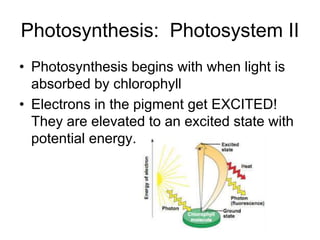
• Photosynthesis begins with when light is
absorbed by chlorophyll
• Electrons in the pigment get EXCITED!
They are elevated to an excited state with
potential energy.
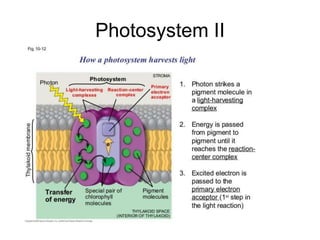
Photosystem II
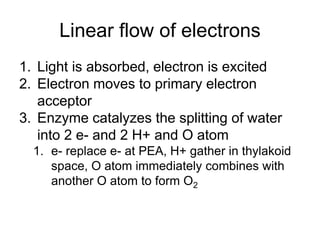
Linear flow of electrons
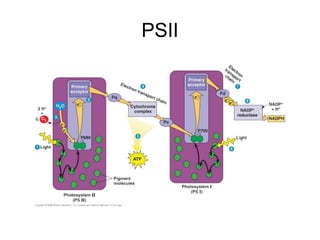
1. Light is absorbed, electron is excited
2. Electron moves to primary electron
acceptor
3. Enzyme catalyzes the splitting of water
into 2 e- and 2 H+ and O atom
1. e- replace e- at PEA, H+ gather in thylakoid
space, O atom immediately combines with
another O atom to form O2
PSII
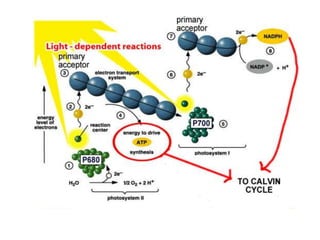
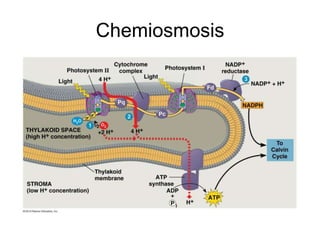
Making of ATP
• Excited e- passes from PSII to PSI via the
Electron Transport chain (ETC)
– Series of protein complexes
• E- lose energy as they pass, provides
energy for ATP to be made in PSII
– H+ are pumped into thylakoid space, creating
H+ gradient
– Chemiosmosis
PSI – making of NADPH
• Light excites e-, moves to PEA
– Low energy e- from PSII replaces e-
• E- passes through ETC membrane
• Enzyme NADP+ reductase catalyzes the
transfer of 2 e- to reduction to NADPH
– Takes H+ from stroma
Light Reactions
• Input: Light, H2O
• Output: ATP, NADPH, O2
• Takes place along the thylakoid
membrane
• O2 released for us to breath
• ATP and NADPH in stroma to be used in
Calvin cycle
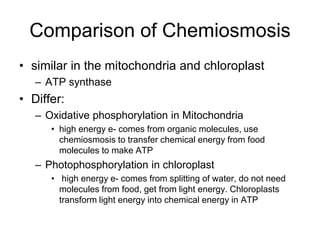
Comparison of Chemiosmosis
• similar in the mitochondria and chloroplast
– ATP synthase
• Differ:
– Oxidative phosphorylation in Mitochondria
• high energy e- comes from organic molecules, use
chemiosmosis to transfer chemical energy from food
molecules to make ATP
– Photophosphorylation in chloroplast
• high energy e- comes from splitting of water, do not need
molecules from food, get from light energy. Chloroplasts
transform light energy into chemical energy in ATP
Chemiosmosis

PSII and PSI.ppt

  • 2.
    Photosynthesis: Photosystem II •Photosynthesis begins with when light is absorbed by chlorophyll • Electrons in the pigment get EXCITED! They are elevated to an excited state with potential energy.
  • 3.
  • 4.
    Linear flow ofelectrons 1. Light is absorbed, electron is excited 2. Electron moves to primary electron acceptor 3. Enzyme catalyzes the splitting of water into 2 e- and 2 H+ and O atom 1. e- replace e- at PEA, H+ gather in thylakoid space, O atom immediately combines with another O atom to form O2
  • 5.
  • 6.
    Making of ATP •Excited e- passes from PSII to PSI via the Electron Transport chain (ETC) – Series of protein complexes • E- lose energy as they pass, provides energy for ATP to be made in PSII – H+ are pumped into thylakoid space, creating H+ gradient – Chemiosmosis
  • 7.
    PSI – makingof NADPH • Light excites e-, moves to PEA – Low energy e- from PSII replaces e- • E- passes through ETC membrane • Enzyme NADP+ reductase catalyzes the transfer of 2 e- to reduction to NADPH – Takes H+ from stroma
  • 8.
    Light Reactions • Input:Light, H2O • Output: ATP, NADPH, O2 • Takes place along the thylakoid membrane • O2 released for us to breath • ATP and NADPH in stroma to be used in Calvin cycle
  • 9.
    Comparison of Chemiosmosis •similar in the mitochondria and chloroplast – ATP synthase • Differ: – Oxidative phosphorylation in Mitochondria • high energy e- comes from organic molecules, use chemiosmosis to transfer chemical energy from food molecules to make ATP – Photophosphorylation in chloroplast • high energy e- comes from splitting of water, do not need molecules from food, get from light energy. Chloroplasts transform light energy into chemical energy in ATP
  • 10.