Media Formulation:-
By
NAME:-Rajalaxmi Sar
REGD.No.:-220705180043
BRANCH:- M.Sc. Zoology
SCHOOL:- School of Applied Sciences
(Department of Zoology)
SUBJECT:- Microbiology
GUIDED BY :-Dr. Sunita Satapathy
Content:-
• Introduction
• Characteristics
• Components of Media
• References
• Acknowledgements
Introduction
Media Formulation:-
Chemically defined cell culture media is a complex mixture of
molecules used for cellular metabolism and growth.
Media formulation addresses improvement of the nutritional and chemical
environment of cells in a bioreactor and represent a significant cast and
time factor in bioprocess development.
Media formulation can be understand by the formula:-
Carbon sources +energy sources+ Nitrogen sources+O2=
Biomass+Product + CO2+ H2O + Heat .
Required Characteristics for formulating Media:-
• It should give maximum yield with maximum product values.
• It should be formulated by changing one of its variable e.g.- Nutrient ,pH,
temperature, Nitrogen source etc.
• It should not expensive.
• They should not support contamination.
Components of Media:-
Water:- Chief constituents of energy fermentation medium is water and it is
required in rinsing, cooling and heating.
Energy Sources:- Light or medium components of oxidation are main source of
energy which is required for growth. As industrial microbes are chemo organ
troths, so their sources of energy is carbon source in form of lipids, protein and
carbohydrates.
-Light or medium components of oxidation are main source of energy which is
required for growth.
Carbohydrates:- Starch obtained from cereals, potatoes and maize is easily
available as a source of carbohydrates and are extensively used in fermentation of
alcohol.
Fats and Oils:-
Oils were firstly used as antifoaming agents in antibiotic processes . Oil
provide maximum energy per weight than sugars.
Nitrogen sources:- Industrial used to microorganisms have ability to use
organic as well as inorganic means of nitrogen.
Inorganic Sources:- Ammonium,Salts, Ammonia gas and nitrates
Organic Sources:- Urea
Minerals:- Essential minerals which are used in all Media formulation
include Potassium, sulphur, chlorine, phosphorus, magnesium and
calcium.
Chelators:- Metal precipitation is avoided by addition of chelating
agents. In large scale fermentation chelating agents are not necessary.
Growth Factors:-
Growth factors includes amino acids, vitamins, sterols and fatty acids,
some natural sources such as nitrogen and carbon are used in growth
medium formulation having required growth factors.
Buffers:- pH of the growth media can be maintained by addition of buffer
that would resist pH changes.
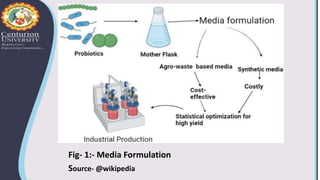
Fig- 1:- Media Formulation
Source- @wikipedia
REFERENCES
• Hughes, M. N., & Poole, R. K. Metal specification and microbial
growth – the hard (and soft) facts, Microbiology, 1991; 137(4):725-
734.
• Zhang, J., & Greasham, R. Chemically defined Media for commercial
fermentations. Applied microbiology and biotechnology, 1999; 51(4):
407-421.
ACKNOWLEDGEMENT:-
• Special thanks to my subject teacher , Dr. Sunita Satapathy School of
Applied Sciences, CUTM, Bhubaneswar .
• All the faculty members of Department of zoology, School of Applied
Sciences, CUTM, Bhubaneswar.
220705180043Media Formulation.pptx

220705180043Media Formulation.pptx

  • 1.
    Media Formulation:- By NAME:-Rajalaxmi Sar REGD.No.:-220705180043 BRANCH:-M.Sc. Zoology SCHOOL:- School of Applied Sciences (Department of Zoology) SUBJECT:- Microbiology GUIDED BY :-Dr. Sunita Satapathy
  • 2.
    Content:- • Introduction • Characteristics •Components of Media • References • Acknowledgements
  • 3.
    Introduction Media Formulation:- Chemically definedcell culture media is a complex mixture of molecules used for cellular metabolism and growth. Media formulation addresses improvement of the nutritional and chemical environment of cells in a bioreactor and represent a significant cast and time factor in bioprocess development. Media formulation can be understand by the formula:- Carbon sources +energy sources+ Nitrogen sources+O2= Biomass+Product + CO2+ H2O + Heat .
  • 4.
    Required Characteristics forformulating Media:- • It should give maximum yield with maximum product values. • It should be formulated by changing one of its variable e.g.- Nutrient ,pH, temperature, Nitrogen source etc. • It should not expensive. • They should not support contamination. Components of Media:- Water:- Chief constituents of energy fermentation medium is water and it is required in rinsing, cooling and heating. Energy Sources:- Light or medium components of oxidation are main source of energy which is required for growth. As industrial microbes are chemo organ troths, so their sources of energy is carbon source in form of lipids, protein and carbohydrates. -Light or medium components of oxidation are main source of energy which is required for growth. Carbohydrates:- Starch obtained from cereals, potatoes and maize is easily available as a source of carbohydrates and are extensively used in fermentation of alcohol.
  • 5.
    Fats and Oils:- Oilswere firstly used as antifoaming agents in antibiotic processes . Oil provide maximum energy per weight than sugars. Nitrogen sources:- Industrial used to microorganisms have ability to use organic as well as inorganic means of nitrogen. Inorganic Sources:- Ammonium,Salts, Ammonia gas and nitrates Organic Sources:- Urea Minerals:- Essential minerals which are used in all Media formulation include Potassium, sulphur, chlorine, phosphorus, magnesium and calcium. Chelators:- Metal precipitation is avoided by addition of chelating agents. In large scale fermentation chelating agents are not necessary.
  • 6.
    Growth Factors:- Growth factorsincludes amino acids, vitamins, sterols and fatty acids, some natural sources such as nitrogen and carbon are used in growth medium formulation having required growth factors. Buffers:- pH of the growth media can be maintained by addition of buffer that would resist pH changes.
  • 7.
    Fig- 1:- MediaFormulation Source- @wikipedia
  • 8.
    REFERENCES • Hughes, M.N., & Poole, R. K. Metal specification and microbial growth – the hard (and soft) facts, Microbiology, 1991; 137(4):725- 734. • Zhang, J., & Greasham, R. Chemically defined Media for commercial fermentations. Applied microbiology and biotechnology, 1999; 51(4): 407-421.
  • 9.
    ACKNOWLEDGEMENT:- • Special thanksto my subject teacher , Dr. Sunita Satapathy School of Applied Sciences, CUTM, Bhubaneswar . • All the faculty members of Department of zoology, School of Applied Sciences, CUTM, Bhubaneswar.