1
Power State Coordination
Interface
Update and what next
2
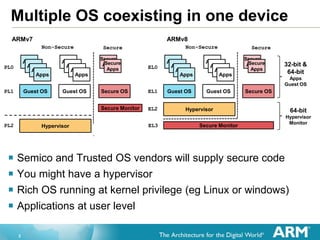
Multiple OS coexisting in one device
 Semico and Trusted OS vendors will supply secure code
 You might have a hypervisor
 Rich OS running at kernel privilege (eg Linux or windows)
 Applications at user level
Apps
Apps
Apps
Apps
Guest OS
Apps
Apps
Apps
Apps
Guest OS
Hypervisor
Secure
AppsSecure
Apps
Secure OS
Secure Monitor
EL0
EL1
EL2
EL3
Non-Secure Secure
32-bit &
64-bit
Apps
Guest OS
64-bit
Hypervisor
Monitor
Apps
Apps
Apps
Apps
Guest OS
Apps
Apps
Apps
Apps
Guest OS
Hypervisor
Secure
AppsSecure
Apps
Secure OS
Secure Monitor
PL0
PL1
PL2
Non-Secure
ARMv7 ARMv8
Secure
3
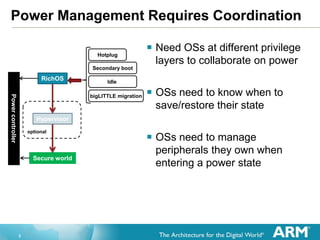
Power Management Requires Coordination
 Need OSs at different privilege
layers to collaborate on power
 OSs need to know when to
save/restore their state
 OSs need to manage
peripherals they own when
entering a power state
RichOS
Hypervisor
Secure world
Hotplug
Secondary boot
Idle
Powercontroller
optional
bigLITTLE migration
4
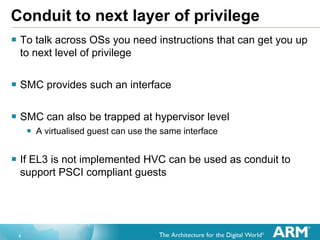
Conduit to next layer of privilege
 To talk across OSs you need instructions that can get you up
to next level of privilege
 SMC provides such an interface
 SMC can also be trapped at hypervisor level
 A virtualised guest can use the same interface
 If EL3 is not implemented HVC can be used as conduit to
support PSCI compliant guests
5
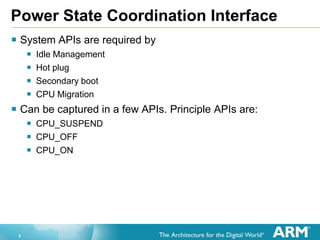
Power State Coordination Interface
 System APIs are required by
 Idle Management
 Hot plug
 Secondary boot
 CPU Migration
 Can be captured in a few APIs. Principle APIs are:
 CPU_SUSPEND
 CPU_OFF
 CPU_ON
6
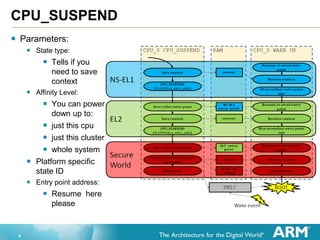
CPU_SUSPEND
 Parameters:
 State type:
 Tells if you
need to save
context
 Affinity Level:
 You can power
down up to:
 just this cpu
 just this cluster
 whole system
 Platform specific
state ID
 Entry point address:
 Resume here
please
7
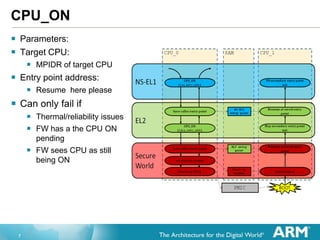
CPU_ON
 Parameters:
 Target CPU:
 MPIDR of target CPU
 Entry point address:
 Resume here please
 Can only fail if
 Thermal/reliability issues
 FW has a the CPU ON
pending
 FW sees CPU as still
being ON
8
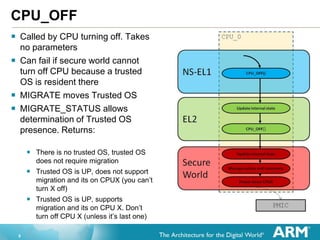
CPU_OFF
 Called by CPU turning off. Takes
no parameters
 Can fail if secure world cannot
turn off CPU because a trusted
OS is resident there
 MIGRATE moves Trusted OS
 MIGRATE_STATUS allows
determination of Trusted OS
presence. Returns:
 There is no trusted OS, trusted OS
does not require migration
 Trusted OS is UP, does not support
migration and its on CPUX (you can’t
turn X off)
 Trusted OS is UP, supports
migration and its on CPU X. Don’t
turn off CPU X (unless it’s last one)
9
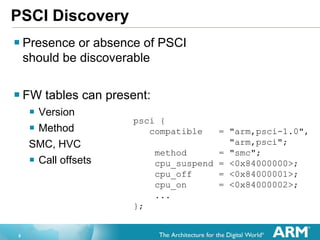
PSCI Discovery
Presence or absence of PSCI
should be discoverable
FW tables can present:
 Version
 Method
SMC, HVC
 Call offsets
psci {
compatible = "arm,psci-1.0",
"arm,psci";
method = "smc";
cpu_suspend = <0x84000000>;
cpu_off = <0x84000001>;
cpu_on = <0x84000002>;
...
};
10
PSCI-next
 New version of the spec in the works.
 Spec to appear beginning of Q2
 Key deltas:
 Clarified reset state and starting point for
CPU_ON/CPU_SUSPEND
 Clarifications of responsibilities for callers and
implementers
 Clarifications on CPU_ON/OFF races
11
PSCI-next
 Key deltas continued:
 MIGRATE_STATUS: use at boot time to understand migration and
hot-plug related requirements of a Trusted OS, where it is, and if it is
 AFFINITY_STATUS: tells you if a CPU is on or off, or if a cluster has
CPUs on or off
 Considering RESET
12
PSCI-next
 PSCI on it’s own doesn’t buy that much
 PSCI is a step towards standardising power management
 We are now looking at :
 Idle management
 Many core boot
 Hot plug
13
PSCI-next Idle Management
 What could you represent in FDT (per state):
 Book keeping stuff
 Latency information
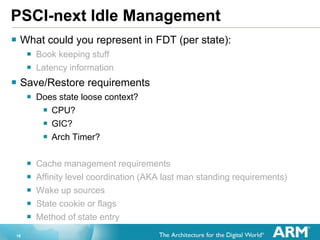
 Save/Restore requirements
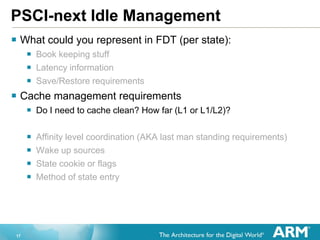
 Cache management requirements
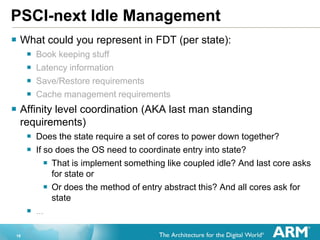
 Affinity level coordination (AKA last man standing requirements)
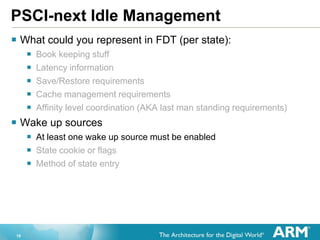
 Wake up sources
 State cookie or flags
 Method of state entry
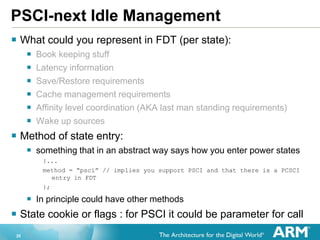
14
PSCI-next Idle Management
 What could you represent in FDT (per state):
 Book keeping stuff
 Name of state
 Description
 Approximate power consumption
 Latency information
 Save/Restore requirements
 Cache management requirements
 Affinity level coordination (AKA last man standing requirements)
 Wake up sources
 State cookie or flags
 Method of state entry
15
PSCI-next Idle Management
 What could you represent in FDT (per state):
 Book keeping stuff
 Latency information
 Entry/exit latencies (do we need both? Aggregate is probably fine)
 Break even time for state (AKA target residency)
 Save/Restore requirements
 Cache management requirements
 Affinity level coordination (AKA last man standing requirements)
 Wake up sources
 State cookie or flags
 Method of state entry
16
PSCI-next Idle Management
 What could you represent in FDT (per state):
 Book keeping stuff
 Latency information
 Save/Restore requirements
 Does state loose context?
 CPU?
 GIC?
 Arch Timer?
 Cache management requirements
 Affinity level coordination (AKA last man standing requirements)
 Wake up sources
 State cookie or flags
 Method of state entry
17
PSCI-next Idle Management
 What could you represent in FDT (per state):
 Book keeping stuff
 Latency information
 Save/Restore requirements
 Cache management requirements
 Do I need to cache clean? How far (L1 or L1/L2)?
 Affinity level coordination (AKA last man standing requirements)
 Wake up sources
 State cookie or flags
 Method of state entry
18
PSCI-next Idle Management
 What could you represent in FDT (per state):
 Book keeping stuff
 Latency information
 Save/Restore requirements
 Cache management requirements
 Affinity level coordination (AKA last man standing
requirements)
 Does the state require a set of cores to power down together?
 If so does the OS need to coordinate entry into state?
 That is implement something like coupled idle? And last core asks
for state or
 Or does the method of entry abstract this? And all cores ask for
state
 ...
19
PSCI-next Idle Management
 What could you represent in FDT (per state):
 Book keeping stuff
 Latency information
 Save/Restore requirements
 Cache management requirements
 Affinity level coordination (AKA last man standing requirements)
 Wake up sources
 At least one wake up source must be enabled
 State cookie or flags
 Method of state entry
20
PSCI-next Idle Management
 What could you represent in FDT (per state):
 Book keeping stuff
 Latency information
 Save/Restore requirements
 Cache management requirements
 Affinity level coordination (AKA last man standing requirements)
 Wake up sources
 Method of state entry:
 something that in an abstract way says how you enter power states
{...
method = “psci” // implies you support PSCI and that there is a PCSCI
entry in FDT
};
 In principle could have other methods
 State cookie or flags : for PSCI it could be parameter for call
21
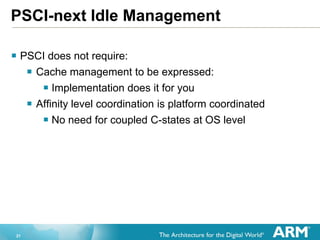
PSCI-next Idle Management
 PSCI does not require:
 Cache management to be expressed:
 Implementation does it for you
 Affinity level coordination is platform coordinated
 No need for coupled C-states at OS level
22
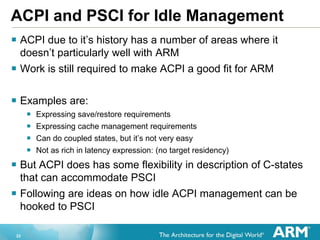
ACPI and PSCI for Idle Management
 ACPI due to it’s history has a number of areas where it
doesn’t particularly well with ARM
 Work is still required to make ACPI a good fit for ARM
 Examples are:
 Expressing save/restore requirements
 Expressing cache management requirements
 Can do coupled states, but it’s not very easy
 Not as rich in latency expression: (no target residency)
 But ACPI does has some flexibility in description of C-states
that can accommodate PSCI
 Following are ideas on how idle ACPI management can be
hooked to PSCI
23
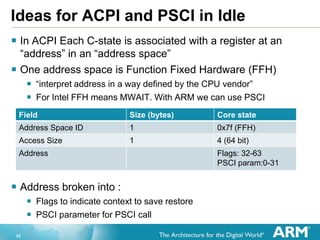
Ideas for ACPI and PSCI in Idle
 In ACPI Each C-state is associated with a register at an
“address” in an “address space”
 One address space is Function Fixed Hardware (FFH)
 “interpret address in a way defined by the CPU vendor”
 For Intel FFH means MWAIT. With ARM we can use PSCI
 Address broken into :
 Flags to indicate context to save restore
 PSCI parameter for PSCI call
Field Size (bytes) Core state
Address Space ID 1 0x7f (FFH)
Access Size 1 4 (64 bit)
Address Flags: 32-63
PSCI param:0-31
24
Ideas for ACPI and PSCI in Idle
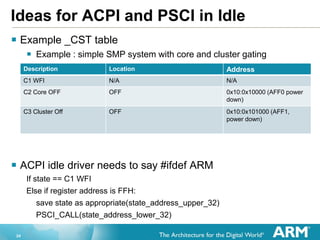
 Example _CST table
 Example : simple SMP system with core and cluster gating
 ACPI idle driver needs to say #ifdef ARM
If state == C1 WFI
Else if register address is FFH:
save state as appropriate(state_address_upper_32)
PSCI_CALL(state_address_lower_32)
Description Location Address
C1 WFI N/A N/A
C2 Core OFF OFF 0x10:0x10000 (AFF0 power
down)
C3 Cluster Off OFF 0x10:0x101000 (AFF1,
power down)
25
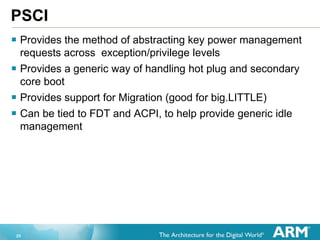
PSCI
 Provides the method of abstracting key power management
requests across exception/privilege levels
 Provides a generic way of handling hot plug and secondary
core boot
 Provides support for Migration (good for big.LITTLE)
 Can be tied to FDT and ACPI, to help provide generic idle
management
26
Questions
?? ?

LCA13: Power State Coordination Interface

  • 1.
  • 2.
    2 Multiple OS coexistingin one device  Semico and Trusted OS vendors will supply secure code  You might have a hypervisor  Rich OS running at kernel privilege (eg Linux or windows)  Applications at user level Apps Apps Apps Apps Guest OS Apps Apps Apps Apps Guest OS Hypervisor Secure AppsSecure Apps Secure OS Secure Monitor EL0 EL1 EL2 EL3 Non-Secure Secure 32-bit & 64-bit Apps Guest OS 64-bit Hypervisor Monitor Apps Apps Apps Apps Guest OS Apps Apps Apps Apps Guest OS Hypervisor Secure AppsSecure Apps Secure OS Secure Monitor PL0 PL1 PL2 Non-Secure ARMv7 ARMv8 Secure
  • 3.
    3 Power Management RequiresCoordination  Need OSs at different privilege layers to collaborate on power  OSs need to know when to save/restore their state  OSs need to manage peripherals they own when entering a power state RichOS Hypervisor Secure world Hotplug Secondary boot Idle Powercontroller optional bigLITTLE migration
  • 4.
    4 Conduit to nextlayer of privilege  To talk across OSs you need instructions that can get you up to next level of privilege  SMC provides such an interface  SMC can also be trapped at hypervisor level  A virtualised guest can use the same interface  If EL3 is not implemented HVC can be used as conduit to support PSCI compliant guests
  • 5.
    5 Power State CoordinationInterface  System APIs are required by  Idle Management  Hot plug  Secondary boot  CPU Migration  Can be captured in a few APIs. Principle APIs are:  CPU_SUSPEND  CPU_OFF  CPU_ON
  • 6.
    6 CPU_SUSPEND  Parameters:  Statetype:  Tells if you need to save context  Affinity Level:  You can power down up to:  just this cpu  just this cluster  whole system  Platform specific state ID  Entry point address:  Resume here please
  • 7.
    7 CPU_ON  Parameters:  TargetCPU:  MPIDR of target CPU  Entry point address:  Resume here please  Can only fail if  Thermal/reliability issues  FW has a the CPU ON pending  FW sees CPU as still being ON
  • 8.
    8 CPU_OFF  Called byCPU turning off. Takes no parameters  Can fail if secure world cannot turn off CPU because a trusted OS is resident there  MIGRATE moves Trusted OS  MIGRATE_STATUS allows determination of Trusted OS presence. Returns:  There is no trusted OS, trusted OS does not require migration  Trusted OS is UP, does not support migration and its on CPUX (you can’t turn X off)  Trusted OS is UP, supports migration and its on CPU X. Don’t turn off CPU X (unless it’s last one)
  • 9.
    9 PSCI Discovery Presence orabsence of PSCI should be discoverable FW tables can present:  Version  Method SMC, HVC  Call offsets psci { compatible = "arm,psci-1.0", "arm,psci"; method = "smc"; cpu_suspend = <0x84000000>; cpu_off = <0x84000001>; cpu_on = <0x84000002>; ... };
  • 10.
    10 PSCI-next  New versionof the spec in the works.  Spec to appear beginning of Q2  Key deltas:  Clarified reset state and starting point for CPU_ON/CPU_SUSPEND  Clarifications of responsibilities for callers and implementers  Clarifications on CPU_ON/OFF races
  • 11.
    11 PSCI-next  Key deltascontinued:  MIGRATE_STATUS: use at boot time to understand migration and hot-plug related requirements of a Trusted OS, where it is, and if it is  AFFINITY_STATUS: tells you if a CPU is on or off, or if a cluster has CPUs on or off  Considering RESET
  • 12.
    12 PSCI-next  PSCI onit’s own doesn’t buy that much  PSCI is a step towards standardising power management  We are now looking at :  Idle management  Many core boot  Hot plug
  • 13.
    13 PSCI-next Idle Management What could you represent in FDT (per state):  Book keeping stuff  Latency information  Save/Restore requirements  Cache management requirements  Affinity level coordination (AKA last man standing requirements)  Wake up sources  State cookie or flags  Method of state entry
  • 14.
    14 PSCI-next Idle Management What could you represent in FDT (per state):  Book keeping stuff  Name of state  Description  Approximate power consumption  Latency information  Save/Restore requirements  Cache management requirements  Affinity level coordination (AKA last man standing requirements)  Wake up sources  State cookie or flags  Method of state entry
  • 15.
    15 PSCI-next Idle Management What could you represent in FDT (per state):  Book keeping stuff  Latency information  Entry/exit latencies (do we need both? Aggregate is probably fine)  Break even time for state (AKA target residency)  Save/Restore requirements  Cache management requirements  Affinity level coordination (AKA last man standing requirements)  Wake up sources  State cookie or flags  Method of state entry
  • 16.
    16 PSCI-next Idle Management What could you represent in FDT (per state):  Book keeping stuff  Latency information  Save/Restore requirements  Does state loose context?  CPU?  GIC?  Arch Timer?  Cache management requirements  Affinity level coordination (AKA last man standing requirements)  Wake up sources  State cookie or flags  Method of state entry
  • 17.
    17 PSCI-next Idle Management What could you represent in FDT (per state):  Book keeping stuff  Latency information  Save/Restore requirements  Cache management requirements  Do I need to cache clean? How far (L1 or L1/L2)?  Affinity level coordination (AKA last man standing requirements)  Wake up sources  State cookie or flags  Method of state entry
  • 18.
    18 PSCI-next Idle Management What could you represent in FDT (per state):  Book keeping stuff  Latency information  Save/Restore requirements  Cache management requirements  Affinity level coordination (AKA last man standing requirements)  Does the state require a set of cores to power down together?  If so does the OS need to coordinate entry into state?  That is implement something like coupled idle? And last core asks for state or  Or does the method of entry abstract this? And all cores ask for state  ...
  • 19.
    19 PSCI-next Idle Management What could you represent in FDT (per state):  Book keeping stuff  Latency information  Save/Restore requirements  Cache management requirements  Affinity level coordination (AKA last man standing requirements)  Wake up sources  At least one wake up source must be enabled  State cookie or flags  Method of state entry
  • 20.
    20 PSCI-next Idle Management What could you represent in FDT (per state):  Book keeping stuff  Latency information  Save/Restore requirements  Cache management requirements  Affinity level coordination (AKA last man standing requirements)  Wake up sources  Method of state entry:  something that in an abstract way says how you enter power states {... method = “psci” // implies you support PSCI and that there is a PCSCI entry in FDT };  In principle could have other methods  State cookie or flags : for PSCI it could be parameter for call
  • 21.
    21 PSCI-next Idle Management PSCI does not require:  Cache management to be expressed:  Implementation does it for you  Affinity level coordination is platform coordinated  No need for coupled C-states at OS level
  • 22.
    22 ACPI and PSCIfor Idle Management  ACPI due to it’s history has a number of areas where it doesn’t particularly well with ARM  Work is still required to make ACPI a good fit for ARM  Examples are:  Expressing save/restore requirements  Expressing cache management requirements  Can do coupled states, but it’s not very easy  Not as rich in latency expression: (no target residency)  But ACPI does has some flexibility in description of C-states that can accommodate PSCI  Following are ideas on how idle ACPI management can be hooked to PSCI
  • 23.
    23 Ideas for ACPIand PSCI in Idle  In ACPI Each C-state is associated with a register at an “address” in an “address space”  One address space is Function Fixed Hardware (FFH)  “interpret address in a way defined by the CPU vendor”  For Intel FFH means MWAIT. With ARM we can use PSCI  Address broken into :  Flags to indicate context to save restore  PSCI parameter for PSCI call Field Size (bytes) Core state Address Space ID 1 0x7f (FFH) Access Size 1 4 (64 bit) Address Flags: 32-63 PSCI param:0-31
  • 24.
    24 Ideas for ACPIand PSCI in Idle  Example _CST table  Example : simple SMP system with core and cluster gating  ACPI idle driver needs to say #ifdef ARM If state == C1 WFI Else if register address is FFH: save state as appropriate(state_address_upper_32) PSCI_CALL(state_address_lower_32) Description Location Address C1 WFI N/A N/A C2 Core OFF OFF 0x10:0x10000 (AFF0 power down) C3 Cluster Off OFF 0x10:0x101000 (AFF1, power down)
  • 25.
    25 PSCI  Provides themethod of abstracting key power management requests across exception/privilege levels  Provides a generic way of handling hot plug and secondary core boot  Provides support for Migration (good for big.LITTLE)  Can be tied to FDT and ACPI, to help provide generic idle management
  • 26.