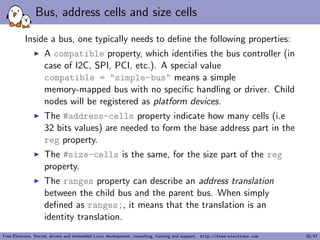
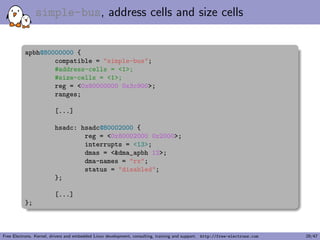
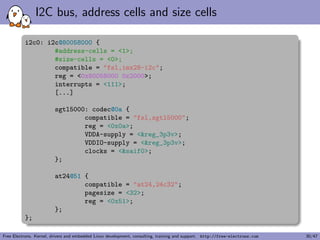
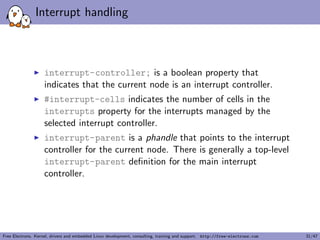
Free Electrons. Kernel, drivers and embedded Linux development, consulting, training and support. http://free-electrons.com 1/47
Thomas Petazzoni 
I CTO and Embedded Linux engineer at Free Electrons 
I Embedded Linux development: kernel and driver 
development, system integration, boot time and power 
consumption optimization, consulting, etc. 
I Embedded Linux training, Linux driver development training 
and Android system development training, with materials 
freely available under a Creative Commons license. 
I http://free-electrons.com 
I Contributions 
I Kernel support for the Marvell Armada ARM SoCs from 
Marvell 
I Major contributor to Buildroot, an open-source, simple and 
fast embedded Linux build system 
I Living in Toulouse, south west of France 
Free Electrons. Kernel, drivers and embedded Linux development, consulting, training and support. http://free-electrons.com 2/47
Agenda 
I User perspective: booting with the Device Tree 
I Basic Device Tree syntax and compilation 
I Simple example of Device Tree fragment 
I Overall organization of a Device Tree 
I Examples of Device Tree usage 
I General considerations about the Device Tree in Linux 
Free Electrons. Kernel, drivers and embedded Linux development, consulting, training and support. http://free-electrons.com 3/47
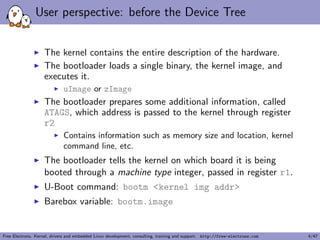
User perspective: before the Device Tree 
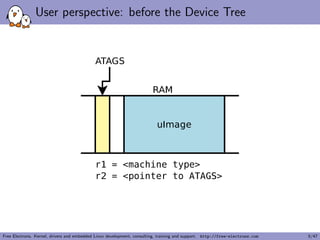
I The kernel contains the entire description of the hardware. 
I The bootloader loads a single binary, the kernel image, and 
executes it. 
I uImage or zImage 
I The bootloader prepares some additional information, called 
ATAGS, which address is passed to the kernel through register 
r2 
I Contains information such as memory size and location, kernel 
command line, etc. 
I The bootloader tells the kernel on which board it is being 
booted through a machine type integer, passed in register r1. 
I U-Boot command: bootm <kernel img addr> 
I Barebox variable: bootm.image 
Free Electrons. Kernel, drivers and embedded Linux development, consulting, training and support. http://free-electrons.com 4/47
User perspective: before the Device Tree 
Free Electrons. Kernel, drivers and embedded Linux development, consulting, training and support. http://free-electrons.com 5/47
User perspective: booting with a Device Tree 
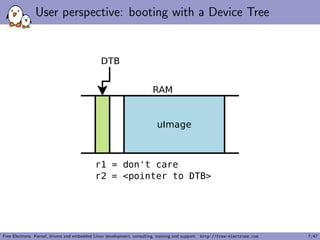
I The kernel no longer contains the description of the hardware, 
it is located in a separate binary: the device tree blob 
I The bootloader loads two binaries: the kernel image and the 
DTB 
I Kernel image remains uImage or zImage 
I DTB located in arch/arm/boot/dts, one per board 
I The bootloader passes the DTB address through r2. It is 
supposed to adjust the DTB with memory information, kernel 
command line, and potentially other info. 
I No more machine type. 
I U-Boot command: 
boot[mz] <kernel img addr> - <dtb addr> 
I Barebox variables: bootm.image, bootm.oftree 
Free Electrons. Kernel, drivers and embedded Linux development, consulting, training and support. http://free-electrons.com 6/47
User perspective: booting with a Device Tree 
Free Electrons. Kernel, drivers and embedded Linux development, consulting, training and support. http://free-electrons.com 7/47
User perspective: compatibility mode for DT booting 
I Some bootloaders have no speci
c support for the Device 
Tree, or the version used on a particular device is too old to 
have this support. 
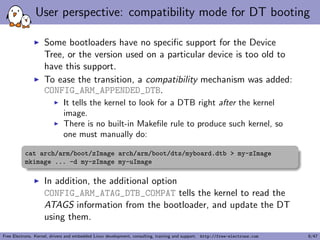
I To ease the transition, a compatibility mechanism was added: 
CONFIG_ARM_APPENDED_DTB. 
I It tells the kernel to look for a DTB right after the kernel 
image. 
I There is no built-in Make
le rule to produce such kernel, so 
one must manually do: 
cat arch/arm/boot/zImage arch/arm/boot/dts/myboard.dtb > my-zImage 
mkimage ... -d my-zImage my-uImage 
I In addition, the additional option 
CONFIG_ARM_ATAG_DTB_COMPAT tells the kernel to read the 
ATAGS information from the bootloader, and update the DT 
using them. 
Free Electrons. Kernel, drivers and embedded Linux development, consulting, training and support. http://free-electrons.com 8/47
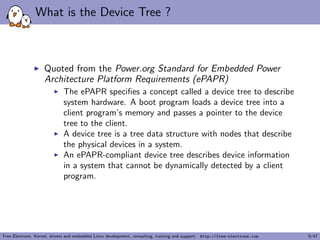
What is the Device Tree ? 
I Quoted from the Power.org Standard for Embedded Power 
Architecture Platform Requirements (ePAPR) 
I The ePAPR speci
es a concept called a device tree to describe 
system hardware. A boot program loads a device tree into a 
client program's memory and passes a pointer to the device 
tree to the client. 
I A device tree is a tree data structure with nodes that describe 
the physical devices in a system. 
I An ePAPR-compliant device tree describes device information 
in a system that cannot be dynamically detected by a client 
program. 
Free Electrons. Kernel, drivers and embedded Linux development, consulting, training and support. http://free-electrons.com 9/47
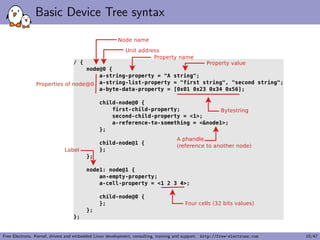
Basic Device Tree syntax 
Free Electrons. Kernel, drivers and embedded Linux development, consulting, training and support. http://free-electrons.com 10/47
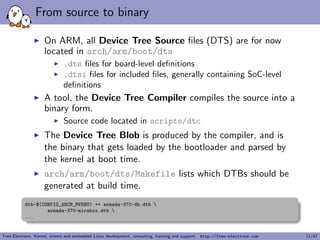
From source to binary 
I On ARM, all Device Tree Source
les (DTS) are for now 
located in arch/arm/boot/dts 
I .dts
les for board-level de
nitions 
I .dtsi
les for included
les, generally containing SoC-level 
de
nitions 
I A tool, the Device Tree Compiler compiles the source into a 
binary form. 
I Source code located in scripts/dtc 
I The Device Tree Blob is produced by the compiler, and is 
the binary that gets loaded by the bootloader and parsed by 
the kernel at boot time. 
I arch/arm/boot/dts/Makefile lists which DTBs should be 
generated at build time. 
dtb-$(CONFIG_ARCH_MVEBU) += armada-370-db.dtb  
armada-370-mirabox.dtb  
... 
Free Electrons. Kernel, drivers and embedded Linux development, consulting, training and support. http://free-electrons.com 11/47
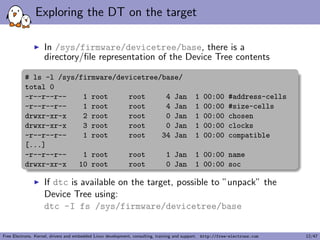
Exploring the DT on the target 
I In /sys/firmware/devicetree/base, there is a 
directory/
le representation of the Device Tree contents 
# ls -l /sys/firmware/devicetree/base/ 
total 0 
-r--r--r-- 1 root root 4 Jan 1 00:00 #address-cells 
-r--r--r-- 1 root root 4 Jan 1 00:00 #size-cells 
drwxr-xr-x 2 root root 0 Jan 1 00:00 chosen 
drwxr-xr-x 3 root root 0 Jan 1 00:00 clocks 
-r--r--r-- 1 root root 34 Jan 1 00:00 compatible 
[...] 
-r--r--r-- 1 root root 1 Jan 1 00:00 name 
drwxr-xr-x 10 root root 0 Jan 1 00:00 soc 
I If dtc is available on the target, possible to "unpack" the 
Device Tree using: 
dtc -I fs /sys/firmware/devicetree/base 
Free Electrons. Kernel, drivers and embedded Linux development, consulting, training and support. http://free-electrons.com 12/47
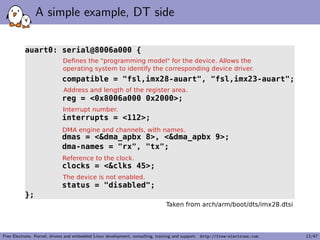
A simple example, DT side 
Free Electrons. Kernel, drivers and embedded Linux development, consulting, training and support. http://free-electrons.com 13/47
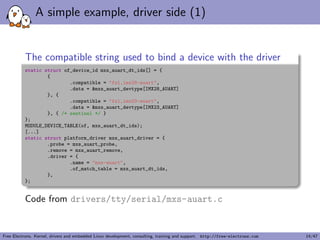
A simple example, driver side (1) 
The compatible string used to bind a device with the driver 
static struct of_device_id mxs_auart_dt_ids[] = { 
{ 
.compatible = "fsl,imx28-auart", 
.data = &mxs_auart_devtype[IMX28_AUART] 
}, { 
.compatible = "fsl,imx23-auart", 
.data = &mxs_auart_devtype[IMX23_AUART] 
}, { /* sentinel */ } 
}; 
MODULE_DEVICE_TABLE(of, mxs_auart_dt_ids); 
[...] 
static struct platform_driver mxs_auart_driver = { 
.probe = mxs_auart_probe, 
.remove = mxs_auart_remove, 
.driver = { 
.name = "mxs-auart", 
.of_match_table = mxs_auart_dt_ids, 
}, 
}; 
Code from drivers/tty/serial/mxs-auart.c 
Free Electrons. Kernel, drivers and embedded Linux development, consulting, training and support. http://free-electrons.com 14/47
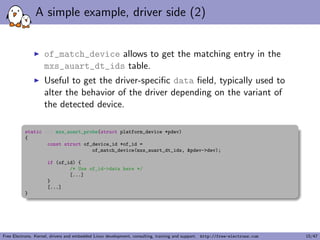
A simple example, driver side (2) 
I of_match_device allows to get the matching entry in the 
mxs_auart_dt_ids table. 
I Useful to get the driver-speci
c data
eld, typically used to 
alter the behavior of the driver depending on the variant of 
the detected device. 
static int mxs_auart_probe(struct platform_device *pdev) 
{ 
const struct of_device_id *of_id = 
of_match_device(mxs_auart_dt_ids, &pdev->dev); 
if (of_id) { 
/* Use of_id->data here */ 
[...] 
} 
[...] 
} 
Free Electrons. Kernel, drivers and embedded Linux development, consulting, training and support. http://free-electrons.com 15/47
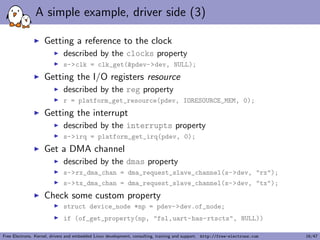
A simple example, driver side (3) 
I Getting a reference to the clock 
I described by the clocks property 
I s->clk = clk_get(&pdev->dev, NULL); 
I Getting the I/O registers resource 
I described by the reg property 
I r = platform_get_resource(pdev, IORESOURCE_MEM, 0); 
I Getting the interrupt 
I described by the interrupts property 
I s->irq = platform_get_irq(pdev, 0); 
I Get a DMA channel 
I described by the dmas property 
I s->rx_dma_chan = dma_request_slave_channel(s->dev, "rx"); 
I s->tx_dma_chan = dma_request_slave_channel(s->dev, "tx"); 
I Check some custom property 
I struct device_node *np = pdev->dev.of_node; 
I if (of_get_property(np, "fsl,uart-has-rtscts", NULL)) 
Free Electrons. Kernel, drivers and embedded Linux development, consulting, training and support. http://free-electrons.com 16/47
Device Tree inclusion 
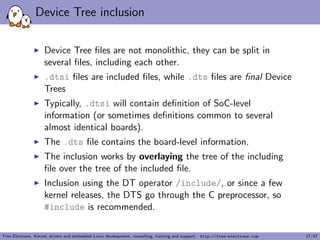
I Device Tree
les are not monolithic, they can be split in 
several
les, including each other. 
I .dtsi
les are included
les, while .dts
les are
nal Device 
Trees 
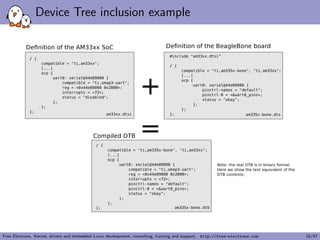
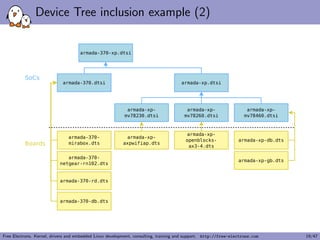
I Typically, .dtsi will contain de
nition of SoC-level 
information (or sometimes de
nitions common to several 
almost identical boards). 
I The .dts
le contains the board-level information. 
I The inclusion works by overlaying the tree of the including
le over the tree of the included
le. 
I Inclusion using the DT operator /include/, or since a few 
kernel releases, the DTS go through the C preprocessor, so 
#include is recommended. 
Free Electrons. Kernel, drivers and embedded Linux development, consulting, training and support. http://free-electrons.com 17/47
Device Tree inclusion example 
Free Electrons. Kernel, drivers and embedded Linux development, consulting, training and support. http://free-electrons.com 18/47
Device Tree inclusion example (2) 
Free Electrons. Kernel, drivers and embedded Linux development, consulting, training and support. http://free-electrons.com 19/47
Concept of Device Tree binding 
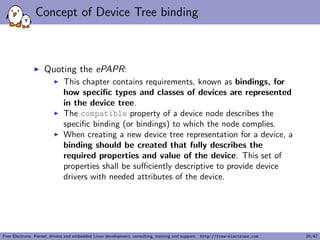
I Quoting the ePAPR: 
I This chapter contains requirements, known as bindings, for 
how speci
c types and classes of devices are represented 
in the device tree. 
I The compatible property of a device node describes the 
speci
c binding (or bindings) to which the node complies. 
I When creating a new device tree representation for a device, a 
binding should be created that fully describes the 
required properties and value of the device. This set of 
properties shall be suciently descriptive to provide device 
drivers with needed attributes of the device. 
Free Electrons. Kernel, drivers and embedded Linux development, consulting, training and support. http://free-electrons.com 20/47
Documentation of Device Tree bindings 
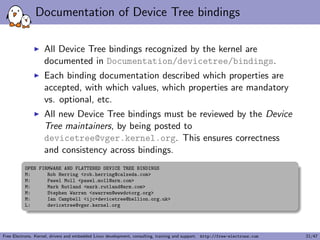
I All Device Tree bindings recognized by the kernel are 
documented in Documentation/devicetree/bindings. 
I Each binding documentation described which properties are 
accepted, with which values, which properties are mandatory 
vs. optional, etc. 
I All new Device Tree bindings must be reviewed by the Device 
Tree maintainers, by being posted to 
devicetree@vger.kernel.org. This ensures correctness 
and consistency across bindings. 
OPEN FIRMWARE AND FLATTENED DEVICE TREE BINDINGS 
M: Rob Herring rob.herring@calxeda.com 
M: Pawel Moll pawel.moll@arm.com 
M: Mark Rutland mark.rutland@arm.com 
M: Stephen Warren swarren@wwwdotorg.org 
M: Ian Campbell ijc+devicetree@hellion.org.uk 
L: devicetree@vger.kernel.org 
Free Electrons. Kernel, drivers and embedded Linux development, consulting, training and support. http://free-electrons.com 21/47
Device Tree binding documentation example 
* Freescale MXS Application UART (AUART) 
Required properties: 
- compatible : Should be fsl,soc-auart. The supported SoCs include 
imx23 and imx28. 
- reg : Address and length of the register set for the device 
- interrupts : Should contain the auart interrupt numbers 
- dmas: DMA specifier, consisting of a phandle to DMA controller node 
and AUART DMA channel ID. 
Refer to dma.txt and fsl-mxs-dma.txt for details. 
- dma-names: rx for RX channel, tx for TX channel. 
Example: 
auart0: serial@8006a000 { 
compatible = fsl,imx28-auart, fsl,imx23-auart; 
reg = 0x8006a000 0x2000; 
interrupts = 112; 
dmas = dma_apbx 8, dma_apbx 9; 
dma-names = rx, tx; 
}; 
Note: Each auart port should have an alias correctly numbered in aliases 
node. 
Example: 
[...] 
Documentation/devicetree/bindings/tty/serial/fsl-mxs-auart.txt 
Free Electrons. Kernel, drivers and embedded Linux development, consulting, training and support. http://free-electrons.com 22/47

Device Tree for Dummies (ELC 2014)

  • 1.
    Free Electrons. Kernel,drivers and embedded Linux development, consulting, training and support. http://free-electrons.com 1/47
  • 2.
    Thomas Petazzoni ICTO and Embedded Linux engineer at Free Electrons I Embedded Linux development: kernel and driver development, system integration, boot time and power consumption optimization, consulting, etc. I Embedded Linux training, Linux driver development training and Android system development training, with materials freely available under a Creative Commons license. I http://free-electrons.com I Contributions I Kernel support for the Marvell Armada ARM SoCs from Marvell I Major contributor to Buildroot, an open-source, simple and fast embedded Linux build system I Living in Toulouse, south west of France Free Electrons. Kernel, drivers and embedded Linux development, consulting, training and support. http://free-electrons.com 2/47
  • 3.
    Agenda I Userperspective: booting with the Device Tree I Basic Device Tree syntax and compilation I Simple example of Device Tree fragment I Overall organization of a Device Tree I Examples of Device Tree usage I General considerations about the Device Tree in Linux Free Electrons. Kernel, drivers and embedded Linux development, consulting, training and support. http://free-electrons.com 3/47
  • 4.
    User perspective: beforethe Device Tree I The kernel contains the entire description of the hardware. I The bootloader loads a single binary, the kernel image, and executes it. I uImage or zImage I The bootloader prepares some additional information, called ATAGS, which address is passed to the kernel through register r2 I Contains information such as memory size and location, kernel command line, etc. I The bootloader tells the kernel on which board it is being booted through a machine type integer, passed in register r1. I U-Boot command: bootm <kernel img addr> I Barebox variable: bootm.image Free Electrons. Kernel, drivers and embedded Linux development, consulting, training and support. http://free-electrons.com 4/47
  • 5.
    User perspective: beforethe Device Tree Free Electrons. Kernel, drivers and embedded Linux development, consulting, training and support. http://free-electrons.com 5/47
  • 6.
    User perspective: bootingwith a Device Tree I The kernel no longer contains the description of the hardware, it is located in a separate binary: the device tree blob I The bootloader loads two binaries: the kernel image and the DTB I Kernel image remains uImage or zImage I DTB located in arch/arm/boot/dts, one per board I The bootloader passes the DTB address through r2. It is supposed to adjust the DTB with memory information, kernel command line, and potentially other info. I No more machine type. I U-Boot command: boot[mz] <kernel img addr> - <dtb addr> I Barebox variables: bootm.image, bootm.oftree Free Electrons. Kernel, drivers and embedded Linux development, consulting, training and support. http://free-electrons.com 6/47
  • 7.
    User perspective: bootingwith a Device Tree Free Electrons. Kernel, drivers and embedded Linux development, consulting, training and support. http://free-electrons.com 7/47
  • 8.
    User perspective: compatibilitymode for DT booting I Some bootloaders have no speci
  • 9.
    c support forthe Device Tree, or the version used on a particular device is too old to have this support. I To ease the transition, a compatibility mechanism was added: CONFIG_ARM_APPENDED_DTB. I It tells the kernel to look for a DTB right after the kernel image. I There is no built-in Make
  • 10.
    le rule toproduce such kernel, so one must manually do: cat arch/arm/boot/zImage arch/arm/boot/dts/myboard.dtb > my-zImage mkimage ... -d my-zImage my-uImage I In addition, the additional option CONFIG_ARM_ATAG_DTB_COMPAT tells the kernel to read the ATAGS information from the bootloader, and update the DT using them. Free Electrons. Kernel, drivers and embedded Linux development, consulting, training and support. http://free-electrons.com 8/47
  • 11.
    What is theDevice Tree ? I Quoted from the Power.org Standard for Embedded Power Architecture Platform Requirements (ePAPR) I The ePAPR speci
  • 12.
    es a conceptcalled a device tree to describe system hardware. A boot program loads a device tree into a client program's memory and passes a pointer to the device tree to the client. I A device tree is a tree data structure with nodes that describe the physical devices in a system. I An ePAPR-compliant device tree describes device information in a system that cannot be dynamically detected by a client program. Free Electrons. Kernel, drivers and embedded Linux development, consulting, training and support. http://free-electrons.com 9/47
  • 13.
    Basic Device Treesyntax Free Electrons. Kernel, drivers and embedded Linux development, consulting, training and support. http://free-electrons.com 10/47
  • 14.
    From source tobinary I On ARM, all Device Tree Source
  • 15.
    les (DTS) arefor now located in arch/arm/boot/dts I .dts
  • 16.
  • 17.
  • 18.
  • 19.
  • 20.
    nitions I Atool, the Device Tree Compiler compiles the source into a binary form. I Source code located in scripts/dtc I The Device Tree Blob is produced by the compiler, and is the binary that gets loaded by the bootloader and parsed by the kernel at boot time. I arch/arm/boot/dts/Makefile lists which DTBs should be generated at build time. dtb-$(CONFIG_ARCH_MVEBU) += armada-370-db.dtb armada-370-mirabox.dtb ... Free Electrons. Kernel, drivers and embedded Linux development, consulting, training and support. http://free-electrons.com 11/47
  • 21.
    Exploring the DTon the target I In /sys/firmware/devicetree/base, there is a directory/
  • 22.
    le representation ofthe Device Tree contents # ls -l /sys/firmware/devicetree/base/ total 0 -r--r--r-- 1 root root 4 Jan 1 00:00 #address-cells -r--r--r-- 1 root root 4 Jan 1 00:00 #size-cells drwxr-xr-x 2 root root 0 Jan 1 00:00 chosen drwxr-xr-x 3 root root 0 Jan 1 00:00 clocks -r--r--r-- 1 root root 34 Jan 1 00:00 compatible [...] -r--r--r-- 1 root root 1 Jan 1 00:00 name drwxr-xr-x 10 root root 0 Jan 1 00:00 soc I If dtc is available on the target, possible to "unpack" the Device Tree using: dtc -I fs /sys/firmware/devicetree/base Free Electrons. Kernel, drivers and embedded Linux development, consulting, training and support. http://free-electrons.com 12/47
  • 23.
    A simple example,DT side Free Electrons. Kernel, drivers and embedded Linux development, consulting, training and support. http://free-electrons.com 13/47
  • 24.
    A simple example,driver side (1) The compatible string used to bind a device with the driver static struct of_device_id mxs_auart_dt_ids[] = { { .compatible = "fsl,imx28-auart", .data = &mxs_auart_devtype[IMX28_AUART] }, { .compatible = "fsl,imx23-auart", .data = &mxs_auart_devtype[IMX23_AUART] }, { /* sentinel */ } }; MODULE_DEVICE_TABLE(of, mxs_auart_dt_ids); [...] static struct platform_driver mxs_auart_driver = { .probe = mxs_auart_probe, .remove = mxs_auart_remove, .driver = { .name = "mxs-auart", .of_match_table = mxs_auart_dt_ids, }, }; Code from drivers/tty/serial/mxs-auart.c Free Electrons. Kernel, drivers and embedded Linux development, consulting, training and support. http://free-electrons.com 14/47
  • 25.
    A simple example,driver side (2) I of_match_device allows to get the matching entry in the mxs_auart_dt_ids table. I Useful to get the driver-speci
  • 26.
  • 27.
    eld, typically usedto alter the behavior of the driver depending on the variant of the detected device. static int mxs_auart_probe(struct platform_device *pdev) { const struct of_device_id *of_id = of_match_device(mxs_auart_dt_ids, &pdev->dev); if (of_id) { /* Use of_id->data here */ [...] } [...] } Free Electrons. Kernel, drivers and embedded Linux development, consulting, training and support. http://free-electrons.com 15/47
  • 28.
    A simple example,driver side (3) I Getting a reference to the clock I described by the clocks property I s->clk = clk_get(&pdev->dev, NULL); I Getting the I/O registers resource I described by the reg property I r = platform_get_resource(pdev, IORESOURCE_MEM, 0); I Getting the interrupt I described by the interrupts property I s->irq = platform_get_irq(pdev, 0); I Get a DMA channel I described by the dmas property I s->rx_dma_chan = dma_request_slave_channel(s->dev, "rx"); I s->tx_dma_chan = dma_request_slave_channel(s->dev, "tx"); I Check some custom property I struct device_node *np = pdev->dev.of_node; I if (of_get_property(np, "fsl,uart-has-rtscts", NULL)) Free Electrons. Kernel, drivers and embedded Linux development, consulting, training and support. http://free-electrons.com 16/47
  • 29.
    Device Tree inclusion I Device Tree
  • 30.
    les are notmonolithic, they can be split in several
  • 31.
    les, including eachother. I .dtsi
  • 32.
  • 33.
  • 34.
  • 35.
    nal Device Trees I Typically, .dtsi will contain de
  • 36.
    nition of SoC-level information (or sometimes de
  • 37.
    nitions common toseveral almost identical boards). I The .dts
  • 38.
    le contains theboard-level information. I The inclusion works by overlaying the tree of the including
  • 39.
    le over thetree of the included
  • 40.
    le. I Inclusionusing the DT operator /include/, or since a few kernel releases, the DTS go through the C preprocessor, so #include is recommended. Free Electrons. Kernel, drivers and embedded Linux development, consulting, training and support. http://free-electrons.com 17/47
  • 41.
    Device Tree inclusionexample Free Electrons. Kernel, drivers and embedded Linux development, consulting, training and support. http://free-electrons.com 18/47
  • 42.
    Device Tree inclusionexample (2) Free Electrons. Kernel, drivers and embedded Linux development, consulting, training and support. http://free-electrons.com 19/47
  • 43.
    Concept of DeviceTree binding I Quoting the ePAPR: I This chapter contains requirements, known as bindings, for how speci
  • 44.
    c types andclasses of devices are represented in the device tree. I The compatible property of a device node describes the speci
  • 45.
    c binding (orbindings) to which the node complies. I When creating a new device tree representation for a device, a binding should be created that fully describes the required properties and value of the device. This set of properties shall be suciently descriptive to provide device drivers with needed attributes of the device. Free Electrons. Kernel, drivers and embedded Linux development, consulting, training and support. http://free-electrons.com 20/47
  • 46.
    Documentation of DeviceTree bindings I All Device Tree bindings recognized by the kernel are documented in Documentation/devicetree/bindings. I Each binding documentation described which properties are accepted, with which values, which properties are mandatory vs. optional, etc. I All new Device Tree bindings must be reviewed by the Device Tree maintainers, by being posted to devicetree@vger.kernel.org. This ensures correctness and consistency across bindings. OPEN FIRMWARE AND FLATTENED DEVICE TREE BINDINGS M: Rob Herring rob.herring@calxeda.com M: Pawel Moll pawel.moll@arm.com M: Mark Rutland mark.rutland@arm.com M: Stephen Warren swarren@wwwdotorg.org M: Ian Campbell ijc+devicetree@hellion.org.uk L: devicetree@vger.kernel.org Free Electrons. Kernel, drivers and embedded Linux development, consulting, training and support. http://free-electrons.com 21/47
  • 47.
    Device Tree bindingdocumentation example * Freescale MXS Application UART (AUART) Required properties: - compatible : Should be fsl,soc-auart. The supported SoCs include imx23 and imx28. - reg : Address and length of the register set for the device - interrupts : Should contain the auart interrupt numbers - dmas: DMA specifier, consisting of a phandle to DMA controller node and AUART DMA channel ID. Refer to dma.txt and fsl-mxs-dma.txt for details. - dma-names: rx for RX channel, tx for TX channel. Example: auart0: serial@8006a000 { compatible = fsl,imx28-auart, fsl,imx23-auart; reg = 0x8006a000 0x2000; interrupts = 112; dmas = dma_apbx 8, dma_apbx 9; dma-names = rx, tx; }; Note: Each auart port should have an alias correctly numbered in aliases node. Example: [...] Documentation/devicetree/bindings/tty/serial/fsl-mxs-auart.txt Free Electrons. Kernel, drivers and embedded Linux development, consulting, training and support. http://free-electrons.com 22/47