1
Idle Power States
Nomenclature
charles.garcia-tobin@arm.com
2
ARM Systems
 SoC vendors differentiate on power
 Power modes supported will differ from one device to another, in number
and type
 However there are a lots of commonalities
 Some states retain context and others require context saving
 Large proportion of the context is given by the ARM architecture and its
implementation
 Some states require cache management
 Can require wake up after a period of time
 States require communication with an external power controller
A15
L2
CCI-400 Cache Coherent Interconnect
Auxiliary
Interfaces
A15
A15
A15
L2
A7A7
A7A7
GIC-400 Interrupt control ARM systems are increasingly complex and
hierarchical
 Low power states can require cooperation
between affected cores
 Introduction of clusters gives rise to new
levels of hierarchy in power states
3
What do you need to do to enter a state?
Choose state
Latencies
Available?
Save arch contextBSP hooks
Clean cache(s)
Will CPU be
Shutdown?
Use BSP timer
program Arch Timer
Can Arch Timer
be used?
Cache in Shutdown?
Need to
place cache in
Memory ret?
Enter state
Place cache in
Memory ret.
Last man?
Generic
Arch Impl
BSP
Yes
No
Yes
No
No
Yes
Yes
No
Do I need to a
Timed wakeup?
No
Yes
4
ACPI – For better or for worse
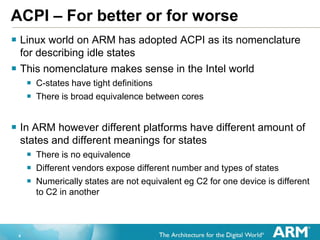
 Linux world on ARM has adopted ACPI as its nomenclature
for describing idle states
 This nomenclature makes sense in the Intel world
 C-states have tight definitions
 There is broad equivalence between cores
 In ARM however different platforms have different amount of
states and different meanings for states
 There is no equivalence
 Different vendors expose different number and types of states
 Numerically states are not equivalent eg C2 for one device is different
to C2 in another
5
ACPI – For better or for worse
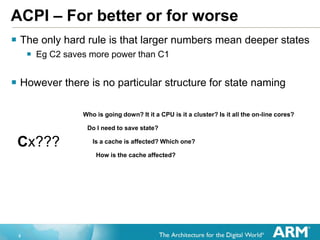
 The only hard rule is that larger numbers mean deeper states
 Eg C2 saves more power than C1
 However there is no particular structure for state naming
Cx???
Who is going down? It it a CPU is it a cluster? Is it all the on-line cores?
Is a cache is affected? Which one?
How is the cache affected?
Do I need to save state?
6
Idle nomenclature aims and motivations
 Give common definitions that can be used across systems
from different providers. Allowing comparisons to take place
 Aims to provide enough flexibility to allow differentiation
 Aim to drive further code abstraction in OS, or CPU
architectural layers of OSs
 Encapsulating common OS operations
 Which CPUs in system will be switched off -> a single core, a cluster,
all cores?
 Which caches are affected
 When is state going to be lost? What state will be lost?
 CPU state
 Cache state
 do caches need cleaning, invalidating, do they retain content
 GIC
7
Proposal - Hierarchy Levels
 A hierarchy level is bounded by a either:
 A cache or a coherent interconnect
 Proposal is to talk about power states affecting different hierarchy
levels
 With topology knowledge this combines affinity and cache level
System C
System A
A9
L2
DDR
L1
System B
A9
SCU
DDR
L1
A9
L1
A15 cluster
A15
SCU/L2
L1
A15
L1
A7 cluster
A7
SCU/L2
L1
A7
L1
Cache Coherent Interconnect
DDR
H0
H1
H2
H3
8
States of Execution - Running
 For a CPU (H0)
 The CPU is executing code, higher hierarchy levels (eg caches and
interconnects requires to support this CPU) are also running
 For a cache or interconnect (Hx>0)
 The cache or interconnect at the hierarchy level is fully operational
9
States of Execution - Waiting
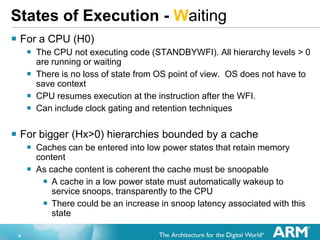
 For a CPU (H0)
 The CPU not executing code (STANDBYWFI). All hierarchy levels > 0
are running or waiting
 There is no loss of state from OS point of view. OS does not have to
save context
 CPU resumes execution at the instruction after the WFI.
 Can include clock gating and retention techniques
 For bigger (Hx>0) hierarchies bounded by a cache
 Caches can be entered into low power states that retain memory
content
 As cache content is coherent the cache must be snoopable
 A cache in a low power state must automatically wakeup to
service snoops, transparently to the CPU
 There could be an increase in snoop latency associated with this
state
10
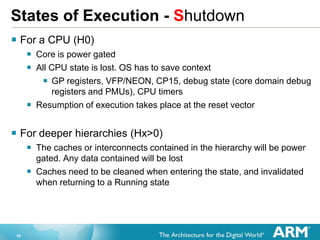
States of Execution - Shutdown
 For a CPU (H0)
 Core is power gated
 All CPU state is lost. OS has to save context
 GP registers, VFP/NEON, CP15, debug state (core domain debug
registers and PMUs), CPU timers
 Resumption of execution takes place at the reset vector
 For deeper hierarchies (Hx>0)
 The caches or interconnects contained in the hierarchy will be power
gated. Any data contained will be lost
 Caches need to be cleaned when entering the state, and invalidated
when returning to a Running state
11
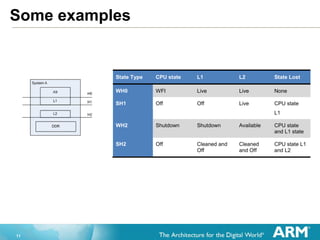
Some examples
State Type CPU state L1 L2 State Lost
WH0 WFI Live Live None
SH1 Off Off Live CPU state
L1
WH2 Shutdown Shutdown Available CPU state
and L1 state
SH2 Off Cleaned and
Off
Cleaned
and Off
CPU state L1
and L2
12
Some examples
State Type State of
CPUs
L1 State Lost
CPU affinity
level 0
WH0 WFI Live None
SH1 Off Cleaned and
Off
CPU state
L1 state
System
affinity level 1
SH2 Off Cleaned and
Off
CPU state
L1
13
Some examples
State
Type
CPU or
cluster
state
L1 L2 State Lost
CPU
affinity
level 0
WH0 WFI Live Live None
SH1 Off Off Live All CPU state
and L1 state
Cluster
affinity
level 1
WH2 Shutdown Shutdown Available CPU state
L1 state
SH2 Off Cleaned
and Off
Cleaned and
Off
CPU state
L1 and L2 state
System
Affinity
level 2
SH3 Off Off Off CPU state
L1 and L2 state
14
Some examples
A15 cluster SH2
A7 CPU0L1 in SH1
A7 CPU1L1 in RH1
WH0
WH2
Shutdown
Running
Waiting
15
State ID
 Different HW platforms may support several states of each
type
 It is proposed that states can have individual IDs appended to
the name of the state eg:
[R/W/S][Hierarchy level]_[StateID]
16
Additional properties
 An architected framework for idle power management needs
to track a number of additional properties per state
 GIC state
 Latencies
 Wake up timer
 Availability
 Other
17
Additional properties - GIC
 In some shutdown states at higher levels, it is possible to
loose GIC state
 Needs to be saved
 A flag needs to be associated with the appropriate system
shutdown states
A15
L2
CCI-400 Cache Coherent Interconnect
Auxiliary
Interfaces
A15
A15
A15
L2
A7A7
A7A7
GIC-400 Interrupt control
18
Additional properties - Latencies
 Entry/Exit: OSPM needs to know the aggregate time to:
 Enter the state
 Move the hierarchy level back into execution
 Memory Latencies:
 When a cache is in waiting, there will be a snoop latency
associated with that state:
 The OSPM should not use a cache waiting state if:
 there are other bus masters which are active that can
snoop into the cache AND their memory quality of service
requirements cannot be satisfied due to the snoop latency
19
Additional properties – Wakeup Timer
 ARMv7 provides architectural timers, generic timer, that can
be used to wake up cores from waiting states
 Generic Timer cannot be used in all Shutdown states
 Software standardisation could work round this problem
 Per state we need to represent a flag to indicate if external
timer wake up is required
 If not the OSPM programs the architectural timer
 Otherwise it calls out to the BSP to program a timer
20
Additional properties - Availability
 Availability of a power state is not just determined by latency
 Current mode of other components in the system can
determine availability of states:
 E.g. GPU is running, or use of some clocks
 Device power management within the OS can be used to gate states
 big.LITTLE Migration models also introduce the concept of
per CPU idle states
21
Additional properties – Other
 Last Man
 In some systems (mainly owing to affinitised trustedOS) only one
specific CPU can take the cluster/system down
 Target residency
 Power consumed by state
22
Putting it all together
Choose state
Latencies
Available?
Save arch contextBSP hooks
Clean cache(s)
Will CPU be
Shutdown?
Use BSP timer
program Arch Timer
Can Arch Timer
be used?
Cache in Shutdown?
Need to
place cache in
Memory ret?
Enter state
Place cache in
Memory ret.
Last man?
OS Generic
Arch Impl
BSP
Yes
No
Yes
No
No
Yes
Yes
No
Do I need to a
Timed wakeup?
No
Yes
23
Questions?

Q2.12: Idle Power States Nomenclature

  • 1.
  • 2.
    2 ARM Systems  SoCvendors differentiate on power  Power modes supported will differ from one device to another, in number and type  However there are a lots of commonalities  Some states retain context and others require context saving  Large proportion of the context is given by the ARM architecture and its implementation  Some states require cache management  Can require wake up after a period of time  States require communication with an external power controller A15 L2 CCI-400 Cache Coherent Interconnect Auxiliary Interfaces A15 A15 A15 L2 A7A7 A7A7 GIC-400 Interrupt control ARM systems are increasingly complex and hierarchical  Low power states can require cooperation between affected cores  Introduction of clusters gives rise to new levels of hierarchy in power states
  • 3.
    3 What do youneed to do to enter a state? Choose state Latencies Available? Save arch contextBSP hooks Clean cache(s) Will CPU be Shutdown? Use BSP timer program Arch Timer Can Arch Timer be used? Cache in Shutdown? Need to place cache in Memory ret? Enter state Place cache in Memory ret. Last man? Generic Arch Impl BSP Yes No Yes No No Yes Yes No Do I need to a Timed wakeup? No Yes
  • 4.
    4 ACPI – Forbetter or for worse  Linux world on ARM has adopted ACPI as its nomenclature for describing idle states  This nomenclature makes sense in the Intel world  C-states have tight definitions  There is broad equivalence between cores  In ARM however different platforms have different amount of states and different meanings for states  There is no equivalence  Different vendors expose different number and types of states  Numerically states are not equivalent eg C2 for one device is different to C2 in another
  • 5.
    5 ACPI – Forbetter or for worse  The only hard rule is that larger numbers mean deeper states  Eg C2 saves more power than C1  However there is no particular structure for state naming Cx??? Who is going down? It it a CPU is it a cluster? Is it all the on-line cores? Is a cache is affected? Which one? How is the cache affected? Do I need to save state?
  • 6.
    6 Idle nomenclature aimsand motivations  Give common definitions that can be used across systems from different providers. Allowing comparisons to take place  Aims to provide enough flexibility to allow differentiation  Aim to drive further code abstraction in OS, or CPU architectural layers of OSs  Encapsulating common OS operations  Which CPUs in system will be switched off -> a single core, a cluster, all cores?  Which caches are affected  When is state going to be lost? What state will be lost?  CPU state  Cache state  do caches need cleaning, invalidating, do they retain content  GIC
  • 7.
    7 Proposal - HierarchyLevels  A hierarchy level is bounded by a either:  A cache or a coherent interconnect  Proposal is to talk about power states affecting different hierarchy levels  With topology knowledge this combines affinity and cache level System C System A A9 L2 DDR L1 System B A9 SCU DDR L1 A9 L1 A15 cluster A15 SCU/L2 L1 A15 L1 A7 cluster A7 SCU/L2 L1 A7 L1 Cache Coherent Interconnect DDR H0 H1 H2 H3
  • 8.
    8 States of Execution- Running  For a CPU (H0)  The CPU is executing code, higher hierarchy levels (eg caches and interconnects requires to support this CPU) are also running  For a cache or interconnect (Hx>0)  The cache or interconnect at the hierarchy level is fully operational
  • 9.
    9 States of Execution- Waiting  For a CPU (H0)  The CPU not executing code (STANDBYWFI). All hierarchy levels > 0 are running or waiting  There is no loss of state from OS point of view. OS does not have to save context  CPU resumes execution at the instruction after the WFI.  Can include clock gating and retention techniques  For bigger (Hx>0) hierarchies bounded by a cache  Caches can be entered into low power states that retain memory content  As cache content is coherent the cache must be snoopable  A cache in a low power state must automatically wakeup to service snoops, transparently to the CPU  There could be an increase in snoop latency associated with this state
  • 10.
    10 States of Execution- Shutdown  For a CPU (H0)  Core is power gated  All CPU state is lost. OS has to save context  GP registers, VFP/NEON, CP15, debug state (core domain debug registers and PMUs), CPU timers  Resumption of execution takes place at the reset vector  For deeper hierarchies (Hx>0)  The caches or interconnects contained in the hierarchy will be power gated. Any data contained will be lost  Caches need to be cleaned when entering the state, and invalidated when returning to a Running state
  • 11.
    11 Some examples State TypeCPU state L1 L2 State Lost WH0 WFI Live Live None SH1 Off Off Live CPU state L1 WH2 Shutdown Shutdown Available CPU state and L1 state SH2 Off Cleaned and Off Cleaned and Off CPU state L1 and L2
  • 12.
    12 Some examples State TypeState of CPUs L1 State Lost CPU affinity level 0 WH0 WFI Live None SH1 Off Cleaned and Off CPU state L1 state System affinity level 1 SH2 Off Cleaned and Off CPU state L1
  • 13.
    13 Some examples State Type CPU or cluster state L1L2 State Lost CPU affinity level 0 WH0 WFI Live Live None SH1 Off Off Live All CPU state and L1 state Cluster affinity level 1 WH2 Shutdown Shutdown Available CPU state L1 state SH2 Off Cleaned and Off Cleaned and Off CPU state L1 and L2 state System Affinity level 2 SH3 Off Off Off CPU state L1 and L2 state
  • 14.
    14 Some examples A15 clusterSH2 A7 CPU0L1 in SH1 A7 CPU1L1 in RH1 WH0 WH2 Shutdown Running Waiting
  • 15.
    15 State ID  DifferentHW platforms may support several states of each type  It is proposed that states can have individual IDs appended to the name of the state eg: [R/W/S][Hierarchy level]_[StateID]
  • 16.
    16 Additional properties  Anarchitected framework for idle power management needs to track a number of additional properties per state  GIC state  Latencies  Wake up timer  Availability  Other
  • 17.
    17 Additional properties -GIC  In some shutdown states at higher levels, it is possible to loose GIC state  Needs to be saved  A flag needs to be associated with the appropriate system shutdown states A15 L2 CCI-400 Cache Coherent Interconnect Auxiliary Interfaces A15 A15 A15 L2 A7A7 A7A7 GIC-400 Interrupt control
  • 18.
    18 Additional properties -Latencies  Entry/Exit: OSPM needs to know the aggregate time to:  Enter the state  Move the hierarchy level back into execution  Memory Latencies:  When a cache is in waiting, there will be a snoop latency associated with that state:  The OSPM should not use a cache waiting state if:  there are other bus masters which are active that can snoop into the cache AND their memory quality of service requirements cannot be satisfied due to the snoop latency
  • 19.
    19 Additional properties –Wakeup Timer  ARMv7 provides architectural timers, generic timer, that can be used to wake up cores from waiting states  Generic Timer cannot be used in all Shutdown states  Software standardisation could work round this problem  Per state we need to represent a flag to indicate if external timer wake up is required  If not the OSPM programs the architectural timer  Otherwise it calls out to the BSP to program a timer
  • 20.
    20 Additional properties -Availability  Availability of a power state is not just determined by latency  Current mode of other components in the system can determine availability of states:  E.g. GPU is running, or use of some clocks  Device power management within the OS can be used to gate states  big.LITTLE Migration models also introduce the concept of per CPU idle states
  • 21.
    21 Additional properties –Other  Last Man  In some systems (mainly owing to affinitised trustedOS) only one specific CPU can take the cluster/system down  Target residency  Power consumed by state
  • 22.
    22 Putting it alltogether Choose state Latencies Available? Save arch contextBSP hooks Clean cache(s) Will CPU be Shutdown? Use BSP timer program Arch Timer Can Arch Timer be used? Cache in Shutdown? Need to place cache in Memory ret? Enter state Place cache in Memory ret. Last man? OS Generic Arch Impl BSP Yes No Yes No No Yes Yes No Do I need to a Timed wakeup? No Yes
  • 23.