1
Implications of Per CPU switching in
a big.LITTLE system
Achin Gupta
ARM Ltd.
achin.gupta@arm.com
2
Agenda
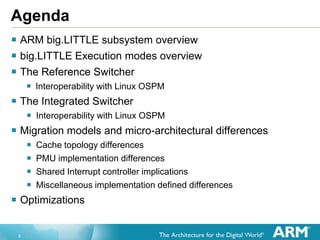
 ARM big.LITTLE subsystem overview
 big.LITTLE Execution modes overview
 The Reference Switcher
 Interoperability with Linux OSPM
 The Integrated Switcher
 Interoperability with Linux OSPM
 Migration models and micro-architectural differences
 Cache topology differences
 PMU implementation differences
 Shared Interrupt controller implications
 Miscellaneous implementation defined differences
 Optimizations
3
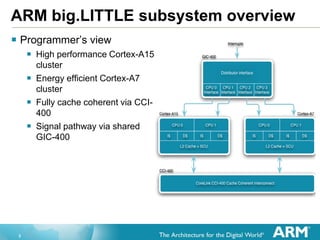
ARM big.LITTLE subsystem overview
 Programmer’s view
 High performance Cortex-A15
cluster
 Energy efficient Cortex-A7
cluster
 Fully cache coherent via CCI-
400
 Signal pathway via shared
GIC-400
4
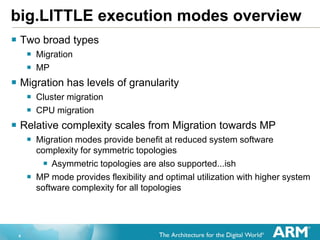
big.LITTLE execution modes overview
 Two broad types
 Migration
 MP
 Migration has levels of granularity
 Cluster migration
 CPU migration
 Relative complexity scales from Migration towards MP
 Migration modes provide benefit at reduced system software
complexity for symmetric topologies
 Asymmetric topologies are also supported...ish
 MP mode provides flexibility and optimal utilization with higher system
software complexity for all topologies
5
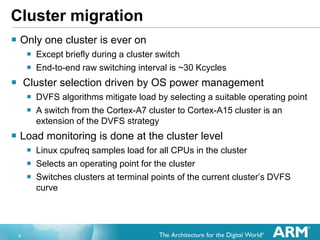
 Only one cluster is ever on
 Except briefly during a cluster switch
 End-to-end raw switching interval is ~30 Kcycles
 Cluster selection driven by OS power management
 DVFS algorithms mitigate load by selecting a suitable operating point
 A switch from the Cortex-A7 cluster to Cortex-A15 cluster is an
extension of the DVFS strategy
 Load monitoring is done at the cluster level
 Linux cpufreq samples load for all CPUs in the cluster
 Selects an operating point for the cluster
 Switches clusters at terminal points of the current cluster’s DVFS
curve
Cluster migration
6
CPU migration
 Paired little and big CPU operation
 Each little CPU can switch to its big counterpart
 Each CPU switches independently of other CPUs
 CPU selection is driven by OS power management
 DVFS algorithm monitors per-CPU load
 Operating point selection is done independently per-CPU
 When a little CPU cannot service the incumbent load a switch to its
big counterpart is performed
 The little processor is switched off at this point
 The big processors are used opportunistically in this manner
7
The Reference Switcher
 Description
 Uses ARM Virtualization Extensions to run an SMP OS on a
big.LITTLE system
 Adopted the simplest approach to use a big.LITTLE system in an OS
agnostic way
 Switches payload software execution synch/asynchronously between
clusters in an optimized way
 Masks micro-architectural differences between Cortex-A15 and
Cortex-A7
 Integrated with Linux DVFS susbsytem to demonstrate
 Load driven cluster migration
 Switching hysteresis control algorithms
 Still the fastest way to use a big.LITTLE system.......or find if the
system is usable
8
Reference Switcher
 Tradeoffs
 Good at implementing mechanics not policy
 Would need to rely on heuristics in absence of Linux support
 Hard to perform a cluster switch in HYP mode while Linux
might be idling/hotplugging cpus
 No way to virtualise Idle & OPP tables. Expected to be
provided by the Power controller each time they need to be
used
 Works best with a symmetric big.LITTLE topology (same number of
cores)
 Asymmetric topologies can be used but require scheduler
involvement
 Relies on payload software to 'auto detect' features to hide micro-
architectural differences
 Needs intelligence to efficiently use CCI
9
Reference Switcher
 Interoperability with Linux OSPM
 Needs Linux to implement the policy and initiate a cluster migration
 DVFS framework needs cluster awareness
 Idle framework needs the same
 Notifiers are needed to switch between OPP and Idle tables
 Interoperability with idle & hotplug is a big policy dilemma
 Unpredictable behaviour if in-flight cache maintainence operations
are migrated
 Can switch only when other cpus are in a known stable state
 Migration policy difficult to implement if clock and voltage domains are
per-cpu
10
Reference Switcher
 Hotplug policy
 Offline cpus should be left as they are
 In-flight hotplug operations should be allowed to complete
 Further hotplug operations should be disabled till the cluster migration
does not complete
 Notifiers should be used to implement this
contd....
11
Reference Switcher
 Idle Policy
1. Preserve idle state of as many cpus as possible
 Needs help from the Power controller to keep idle cpus idle
 Send an IPI to running cpus to either:
 Begin a cluster migration
 Enter a “quiet” state and let the reference switcher take over
 Inflight idle operations would be redundant
 Complicated protocol to preserve idleness
 Power controller prevents idle cpu wakeup temporarily
12
Reference Switcher
 Idle Policy
2. Wakeup all idle cpus
 Needs Linux to wakeup all idle cpus and make them either initiate
a cluster switch or enter the “quiet” state
 Simpler & Fast to implement. Could have a detrimental effect on
power savings as cpus in possibly deeper c-states will need to be
woken up
13
Reference Switcher
 To sum up.....
 Reference Switcher helps in providing the mechanics of performing a
cluster switch & maintaining the illusion of an SMP system
 Needs help from the OS to get even the mechanics of power
management working
 Has lower impact on policies but greater impact on mechanics.
 Works well if the DVFS plane spans the cluster. Things get interesting
when the clock and voltage domains are per-cpu
 Policy implications on power and performance costs not
benchmarked
 Needs further optimizations to keep inbound caches warm by utilizing
the CCI. This is critical to make cluster migration practical
14
Integrated Switcher
 Why migrate a cluster when a cpu will do!
 Do load calculation on a per-cpu basis
 Migrate only the cpu as per its needs (power/performance)
 No need to worry about other cpus for mechanical bits
 cpuidle and cpufreq drivers still need to be cluster aware
 Inbound caches are kept warm implicitly
 Simple and efficient implementation. A cpu switch can be
thought of as a combination of cpu hotplug and idle
 Outbound cpu needs to be hotplugged
 Inbound cpu needs to be resumed from a suspend
 Critical to keep track of cpus
 Common layer is needed for tracking cpu migration, hotplug & idle
 Export this common view to Linux OSPM framework & GIC driver
15
Integrated Switcher
 Re-uses Linux code to save/restore architectural state and
interrupt controller context
 Warm reset path needs to be cluster aware
 Lots of policy options.
 A cpu might be shutdown or hotplugged on one cluster but it might
make sense to wake it up on the other
 Amongst other metrics that cpuidle needs to worry about before
deciding the target c-state, it will have to look out for cpu migration as
well
 A cpu switches in response to a per-cpu load calculation which is
perfect when it is in its own voltage plane driven by a per-core clock
 Things get interesting when the clock and voltage domain spans
the cluster
 A hotplug operation could result in a cluster shutdown
16
Micro-architectural differences
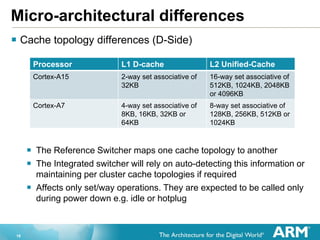
 Cache topology differences (D-Side)
 The Reference Switcher maps one cache topology to another
 The Integrated switcher will rely on auto-detecting this information or
maintaining per cluster cache topologies if required
 Affects only set/way operations. They are expected to be called only
during power down e.g. idle or hotplug
Processor L1 D-cache L2 Unified-Cache
Cortex-A15 2-way set associative of
32KB
16-way set associative of
512KB, 1024KB, 2048KB
or 4096KB
Cortex-A7 4-way set associative of
8KB, 16KB, 32KB or
64KB
8-way set associative of
128KB, 256KB, 512KB or
1024KB
17
Micro-architectural differences
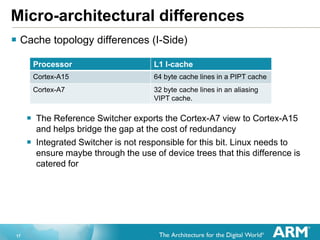
 Cache topology differences (I-Side)
 The Reference Switcher exports the Cortex-A7 view to Cortex-A15
and helps bridge the gap at the cost of redundancy
 Integrated Switcher is not responsible for this bit. Linux needs to
ensure maybe through the use of device trees that this difference is
catered for
Processor L1 I-cache
Cortex-A15 64 byte cache lines in a PIPT cache
Cortex-A7 32 byte cache lines in an aliasing
VIPT cache.
18
Micro-architectural differences
 PMU differences
 Cortex-A15 implements 6 event counters compared to 4 implemented
by Cortex-A7
 There are numerous differences in implementation defined events
 Reference switcher uses Virtualization extensions to allow use of the
PMU across both clusters
 Perf sees and uses events that it detects on the boot cluster
 Events are saved and restored across a cluster switch. Perf is
responsible for using only the events which are common across
the two clusters
 HVC api is available to use both PMUs. Each PMU's state is
preserved across a cluster switch
19
Micro-architectural differences
 PMU differences contd..
 Integrated switcher needs the perf backend to maintain seperate
event "buckets" for each cluster
 Count events available on Cortex-A15 only on it and ditto for
Cortex-A7
 Seperate counts for common events e.g. cycle counter
 Scales well for big.LITTLE MP as well
20
Micro-architectural differences
 Implementation defined register differences
 Common registers with different bit implementations e.g ACTLR,
L2CTLR
 Registers present on one and not on the other
 L2ACTLR, L2PMRR etc in Cortex-A15
 Copy TLB RAM to registers (CDBGTD) in Cortex-A7
 These registers are not used by Linux but need to be preserved if
required across a migration
21
Micro-architectural differences
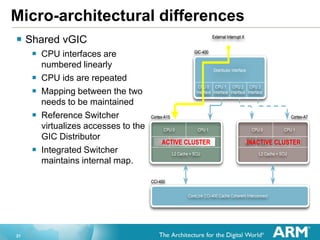
 Shared vGIC
 CPU interfaces are
numbered linearly
 CPU ids are repeated
 Mapping between the two
needs to be maintained
 Reference Switcher
virtualizes accesses to the
GIC Distributor
 Integrated Switcher
maintains internal map.
Cortex-A15 Cortex-A7
CCI-400
CPU 1CPU 0 CPU 0 CPU 1
I$ I$ I$ I$D$ D$ D$ D$
L2 Cache + SCU L2 Cache + SCU
GIC-400
Distributor interface
CPU 0
Interface
CPU 1
Interface
CPU 2
Interface
CPU 3
Interface
CoreLink CCI-400 Cache Coherent Interconnect
External Interrupt X
ACTIVE CLUSTER INACTIVE CLUSTER
22
Optimizations
 Pipelining
 Bring the inbound core out of reset beforehand
 Secure firmware setup completes while context is saved
 Device, Coherency and MMU setup is costly
 Power down outbound cpu while inbound restores context
 Allows the inbound to tap into the warm outbound caches
 Especially important when the last cpu in a cluster migrates
causing an outbound cluster shutdown
 Turn on MMU & I caches asap after a reset
 CCI snoops can be turned on later
 Use DSBs only when required
 A Data Synchronization barrier spans the inner shareability domain
 Waits for outstanding transactions to complete and can cause stalls
23
Optimizations
 Enable XN bit for pages which do not contain instructions
Pre-fetching can be counter productive
 Avoid accesses to literal pools. Replaced with MOV/MOVT
for loading constants
 Use of virtual GIC interfaces can be avoided if Linux can
trigger a cluster switch
 Target Interrupts to both clusters to avoid GIC s&r overhead
 Burst accesses to Device memory are better than word
accesses
24
Thank You!
Questions.....??

Q2.12: Implications of Per CPU switching in a big.LITTLE system

  • 1.
    1 Implications of PerCPU switching in a big.LITTLE system Achin Gupta ARM Ltd. achin.gupta@arm.com
  • 2.
    2 Agenda  ARM big.LITTLEsubsystem overview  big.LITTLE Execution modes overview  The Reference Switcher  Interoperability with Linux OSPM  The Integrated Switcher  Interoperability with Linux OSPM  Migration models and micro-architectural differences  Cache topology differences  PMU implementation differences  Shared Interrupt controller implications  Miscellaneous implementation defined differences  Optimizations
  • 3.
    3 ARM big.LITTLE subsystemoverview  Programmer’s view  High performance Cortex-A15 cluster  Energy efficient Cortex-A7 cluster  Fully cache coherent via CCI- 400  Signal pathway via shared GIC-400
  • 4.
    4 big.LITTLE execution modesoverview  Two broad types  Migration  MP  Migration has levels of granularity  Cluster migration  CPU migration  Relative complexity scales from Migration towards MP  Migration modes provide benefit at reduced system software complexity for symmetric topologies  Asymmetric topologies are also supported...ish  MP mode provides flexibility and optimal utilization with higher system software complexity for all topologies
  • 5.
    5  Only onecluster is ever on  Except briefly during a cluster switch  End-to-end raw switching interval is ~30 Kcycles  Cluster selection driven by OS power management  DVFS algorithms mitigate load by selecting a suitable operating point  A switch from the Cortex-A7 cluster to Cortex-A15 cluster is an extension of the DVFS strategy  Load monitoring is done at the cluster level  Linux cpufreq samples load for all CPUs in the cluster  Selects an operating point for the cluster  Switches clusters at terminal points of the current cluster’s DVFS curve Cluster migration
  • 6.
    6 CPU migration  Pairedlittle and big CPU operation  Each little CPU can switch to its big counterpart  Each CPU switches independently of other CPUs  CPU selection is driven by OS power management  DVFS algorithm monitors per-CPU load  Operating point selection is done independently per-CPU  When a little CPU cannot service the incumbent load a switch to its big counterpart is performed  The little processor is switched off at this point  The big processors are used opportunistically in this manner
  • 7.
    7 The Reference Switcher Description  Uses ARM Virtualization Extensions to run an SMP OS on a big.LITTLE system  Adopted the simplest approach to use a big.LITTLE system in an OS agnostic way  Switches payload software execution synch/asynchronously between clusters in an optimized way  Masks micro-architectural differences between Cortex-A15 and Cortex-A7  Integrated with Linux DVFS susbsytem to demonstrate  Load driven cluster migration  Switching hysteresis control algorithms  Still the fastest way to use a big.LITTLE system.......or find if the system is usable
  • 8.
    8 Reference Switcher  Tradeoffs Good at implementing mechanics not policy  Would need to rely on heuristics in absence of Linux support  Hard to perform a cluster switch in HYP mode while Linux might be idling/hotplugging cpus  No way to virtualise Idle & OPP tables. Expected to be provided by the Power controller each time they need to be used  Works best with a symmetric big.LITTLE topology (same number of cores)  Asymmetric topologies can be used but require scheduler involvement  Relies on payload software to 'auto detect' features to hide micro- architectural differences  Needs intelligence to efficiently use CCI
  • 9.
    9 Reference Switcher  Interoperabilitywith Linux OSPM  Needs Linux to implement the policy and initiate a cluster migration  DVFS framework needs cluster awareness  Idle framework needs the same  Notifiers are needed to switch between OPP and Idle tables  Interoperability with idle & hotplug is a big policy dilemma  Unpredictable behaviour if in-flight cache maintainence operations are migrated  Can switch only when other cpus are in a known stable state  Migration policy difficult to implement if clock and voltage domains are per-cpu
  • 10.
    10 Reference Switcher  Hotplugpolicy  Offline cpus should be left as they are  In-flight hotplug operations should be allowed to complete  Further hotplug operations should be disabled till the cluster migration does not complete  Notifiers should be used to implement this contd....
  • 11.
    11 Reference Switcher  IdlePolicy 1. Preserve idle state of as many cpus as possible  Needs help from the Power controller to keep idle cpus idle  Send an IPI to running cpus to either:  Begin a cluster migration  Enter a “quiet” state and let the reference switcher take over  Inflight idle operations would be redundant  Complicated protocol to preserve idleness  Power controller prevents idle cpu wakeup temporarily
  • 12.
    12 Reference Switcher  IdlePolicy 2. Wakeup all idle cpus  Needs Linux to wakeup all idle cpus and make them either initiate a cluster switch or enter the “quiet” state  Simpler & Fast to implement. Could have a detrimental effect on power savings as cpus in possibly deeper c-states will need to be woken up
  • 13.
    13 Reference Switcher  Tosum up.....  Reference Switcher helps in providing the mechanics of performing a cluster switch & maintaining the illusion of an SMP system  Needs help from the OS to get even the mechanics of power management working  Has lower impact on policies but greater impact on mechanics.  Works well if the DVFS plane spans the cluster. Things get interesting when the clock and voltage domains are per-cpu  Policy implications on power and performance costs not benchmarked  Needs further optimizations to keep inbound caches warm by utilizing the CCI. This is critical to make cluster migration practical
  • 14.
    14 Integrated Switcher  Whymigrate a cluster when a cpu will do!  Do load calculation on a per-cpu basis  Migrate only the cpu as per its needs (power/performance)  No need to worry about other cpus for mechanical bits  cpuidle and cpufreq drivers still need to be cluster aware  Inbound caches are kept warm implicitly  Simple and efficient implementation. A cpu switch can be thought of as a combination of cpu hotplug and idle  Outbound cpu needs to be hotplugged  Inbound cpu needs to be resumed from a suspend  Critical to keep track of cpus  Common layer is needed for tracking cpu migration, hotplug & idle  Export this common view to Linux OSPM framework & GIC driver
  • 15.
    15 Integrated Switcher  Re-usesLinux code to save/restore architectural state and interrupt controller context  Warm reset path needs to be cluster aware  Lots of policy options.  A cpu might be shutdown or hotplugged on one cluster but it might make sense to wake it up on the other  Amongst other metrics that cpuidle needs to worry about before deciding the target c-state, it will have to look out for cpu migration as well  A cpu switches in response to a per-cpu load calculation which is perfect when it is in its own voltage plane driven by a per-core clock  Things get interesting when the clock and voltage domain spans the cluster  A hotplug operation could result in a cluster shutdown
  • 16.
    16 Micro-architectural differences  Cachetopology differences (D-Side)  The Reference Switcher maps one cache topology to another  The Integrated switcher will rely on auto-detecting this information or maintaining per cluster cache topologies if required  Affects only set/way operations. They are expected to be called only during power down e.g. idle or hotplug Processor L1 D-cache L2 Unified-Cache Cortex-A15 2-way set associative of 32KB 16-way set associative of 512KB, 1024KB, 2048KB or 4096KB Cortex-A7 4-way set associative of 8KB, 16KB, 32KB or 64KB 8-way set associative of 128KB, 256KB, 512KB or 1024KB
  • 17.
    17 Micro-architectural differences  Cachetopology differences (I-Side)  The Reference Switcher exports the Cortex-A7 view to Cortex-A15 and helps bridge the gap at the cost of redundancy  Integrated Switcher is not responsible for this bit. Linux needs to ensure maybe through the use of device trees that this difference is catered for Processor L1 I-cache Cortex-A15 64 byte cache lines in a PIPT cache Cortex-A7 32 byte cache lines in an aliasing VIPT cache.
  • 18.
    18 Micro-architectural differences  PMUdifferences  Cortex-A15 implements 6 event counters compared to 4 implemented by Cortex-A7  There are numerous differences in implementation defined events  Reference switcher uses Virtualization extensions to allow use of the PMU across both clusters  Perf sees and uses events that it detects on the boot cluster  Events are saved and restored across a cluster switch. Perf is responsible for using only the events which are common across the two clusters  HVC api is available to use both PMUs. Each PMU's state is preserved across a cluster switch
  • 19.
    19 Micro-architectural differences  PMUdifferences contd..  Integrated switcher needs the perf backend to maintain seperate event "buckets" for each cluster  Count events available on Cortex-A15 only on it and ditto for Cortex-A7  Seperate counts for common events e.g. cycle counter  Scales well for big.LITTLE MP as well
  • 20.
    20 Micro-architectural differences  Implementationdefined register differences  Common registers with different bit implementations e.g ACTLR, L2CTLR  Registers present on one and not on the other  L2ACTLR, L2PMRR etc in Cortex-A15  Copy TLB RAM to registers (CDBGTD) in Cortex-A7  These registers are not used by Linux but need to be preserved if required across a migration
  • 21.
    21 Micro-architectural differences  SharedvGIC  CPU interfaces are numbered linearly  CPU ids are repeated  Mapping between the two needs to be maintained  Reference Switcher virtualizes accesses to the GIC Distributor  Integrated Switcher maintains internal map. Cortex-A15 Cortex-A7 CCI-400 CPU 1CPU 0 CPU 0 CPU 1 I$ I$ I$ I$D$ D$ D$ D$ L2 Cache + SCU L2 Cache + SCU GIC-400 Distributor interface CPU 0 Interface CPU 1 Interface CPU 2 Interface CPU 3 Interface CoreLink CCI-400 Cache Coherent Interconnect External Interrupt X ACTIVE CLUSTER INACTIVE CLUSTER
  • 22.
    22 Optimizations  Pipelining  Bringthe inbound core out of reset beforehand  Secure firmware setup completes while context is saved  Device, Coherency and MMU setup is costly  Power down outbound cpu while inbound restores context  Allows the inbound to tap into the warm outbound caches  Especially important when the last cpu in a cluster migrates causing an outbound cluster shutdown  Turn on MMU & I caches asap after a reset  CCI snoops can be turned on later  Use DSBs only when required  A Data Synchronization barrier spans the inner shareability domain  Waits for outstanding transactions to complete and can cause stalls
  • 23.
    23 Optimizations  Enable XNbit for pages which do not contain instructions Pre-fetching can be counter productive  Avoid accesses to literal pools. Replaced with MOV/MOVT for loading constants  Use of virtual GIC interfaces can be avoided if Linux can trigger a cluster switch  Target Interrupts to both clusters to avoid GIC s&r overhead  Burst accesses to Device memory are better than word accesses
  • 24.