Presented by
Date
Event
Sched idle
Next irq event predictionDaniel Lezcano
BKK16-203 March 8, 2016
Linaro Connect BKK16
Introduction
● Idle mechanism
● Limitations
● New approach
Introduction
● Idle does not work if the break even is not
reached
○ Consumes more energy
○ Worst performance
● Target residency is the break even
○ https://wiki.linaro.org/WorkingGroups/PowerManagement/Doc/ComputingTargetResidency
● Idle duration prediction is the key
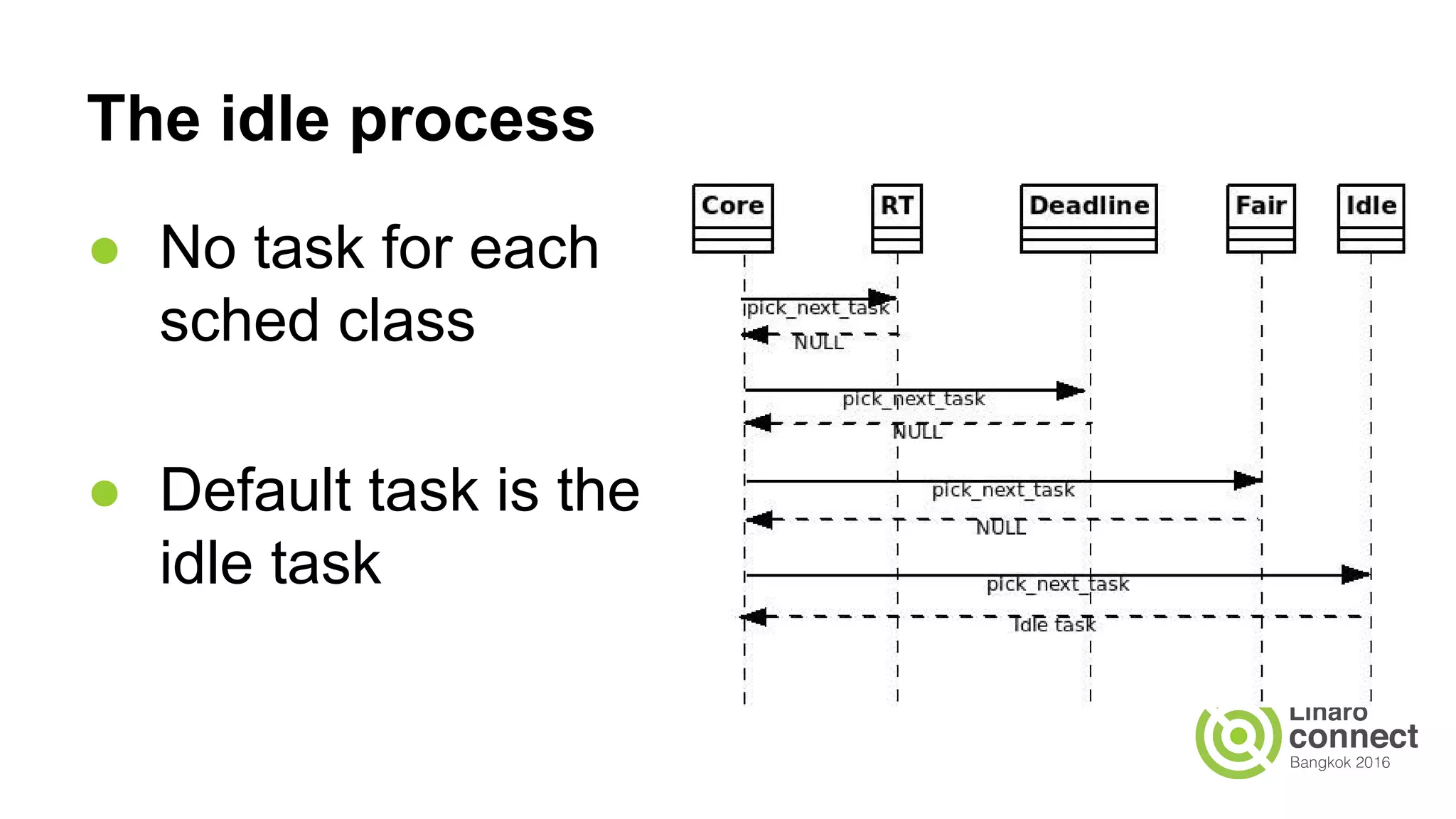
The idle process
● No task for each
sched class
● Default task is the
idle task
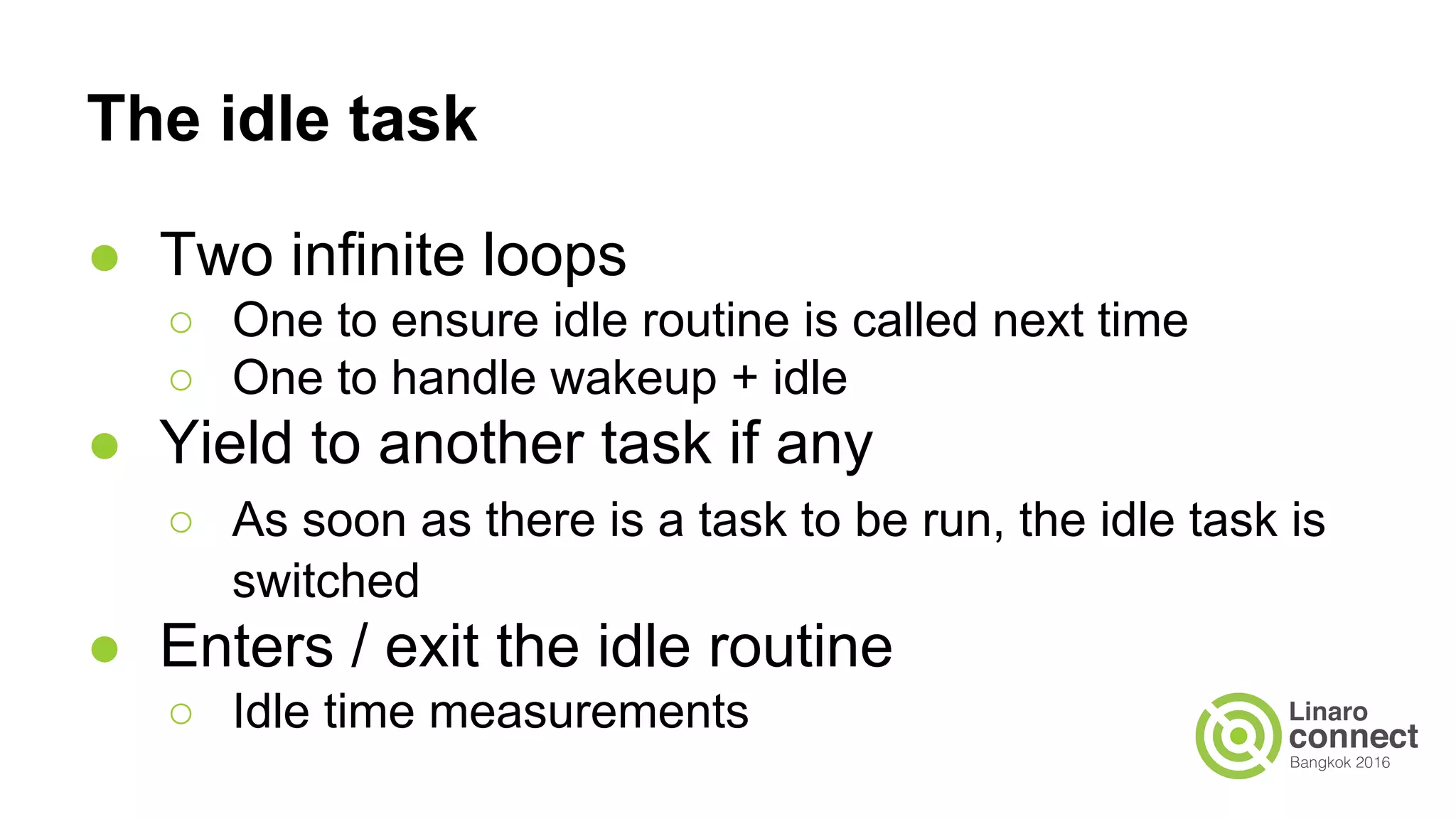
The idle task
● Two infinite loops
○ One to ensure idle routine is called next time
○ One to handle wakeup + idle
● Yield to another task if any
○ As soon as there is a task to be run, the idle task is
switched
● Enters / exit the idle routine
○ Idle time measurements
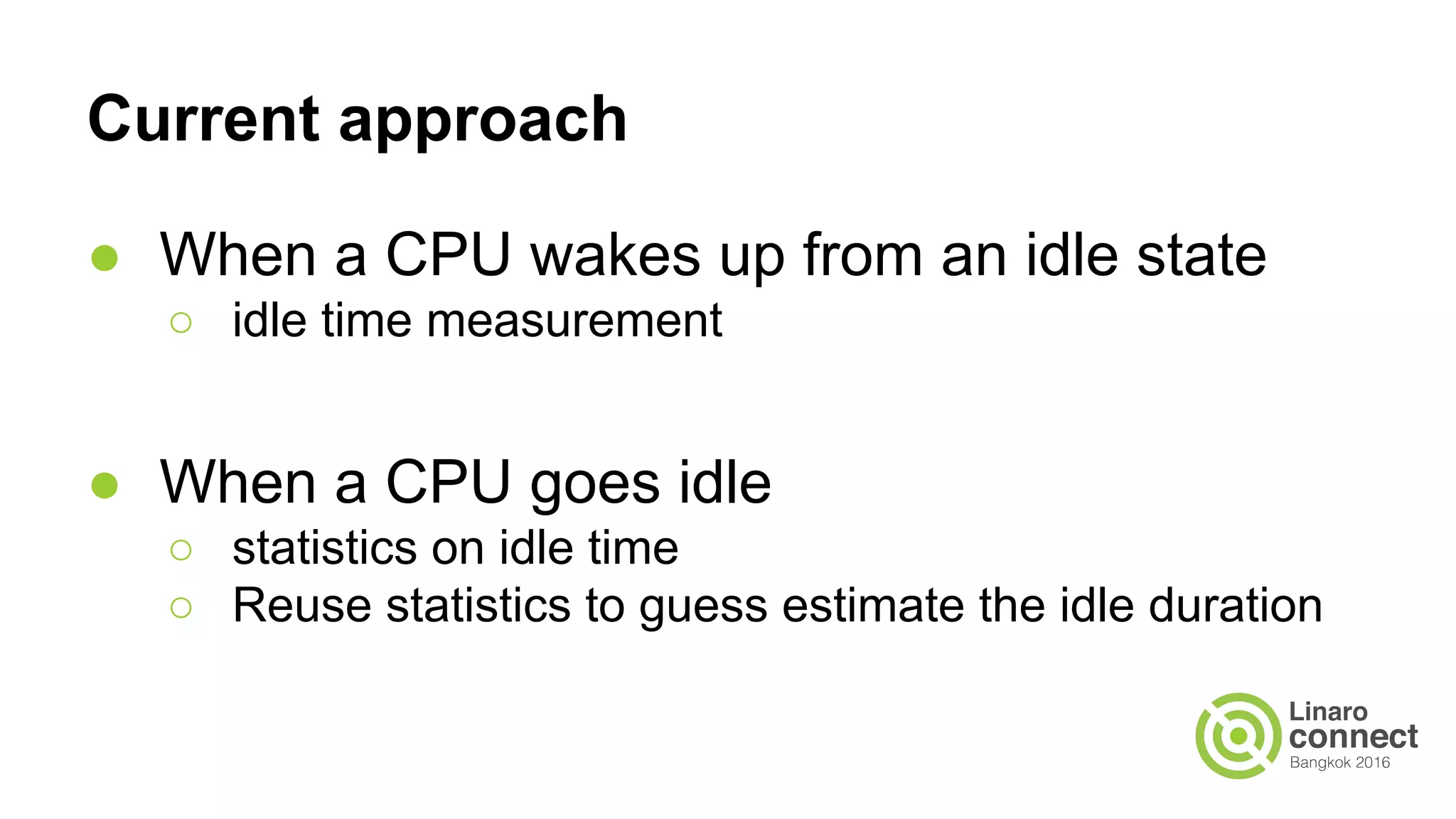
Current approach
● When a CPU wakes up from an idle state
○ idle time measurement
● When a CPU goes idle
○ statistics on idle time
○ Reuse statistics to guess estimate the idle duration
Current approach
● What woke up the CPU ?
○ a timer ? an IO device ? an IPI ?
■ https://wiki.linaro.org/WorkingGroups/PowerManagement/Doc/WakeUpSources
● It is not possible to know. It results to:
○ statistics on timers but they are deterministic
○ statistics on IPI, thus on the scheduler behavior
Current approach
● This wake up sources soup leads to some
complex re-adjustments in the statistics
○ empiric
○ platform specific (x86)
○ monolithic
● It is hard to tell if the prediction was correct
Current approach
● Prediction and governor are tied
○ CPUidle is a standalone subsystem
○ No interaction with the scheduler
● Scheduler can’t use the prediction value to
anticipate anything
○ Hard to integrate the power subsystems
What do we want ?
● The scheduler to act:
○ as a governor
○ pro actively
○ with knowledge of future events
What do we need ?
● Split prediction and idle state selection
● Increase the prediction accuracy
● Let the scheduler to have access to the
prediction
How do we do that ?
● Track the interrupts independently
○ measure their intervals
○ apply a simple mathematical formula for their
behavior
○ guess estimate the next event per interrupt
● Timers and IPI are out of the equation
● Full view of what is happening on the system
Analysis
● A network trafic + console output
○ kernelshark trace-net.dat
● A SSD random read
○ kernelshark trace-ssd.dat
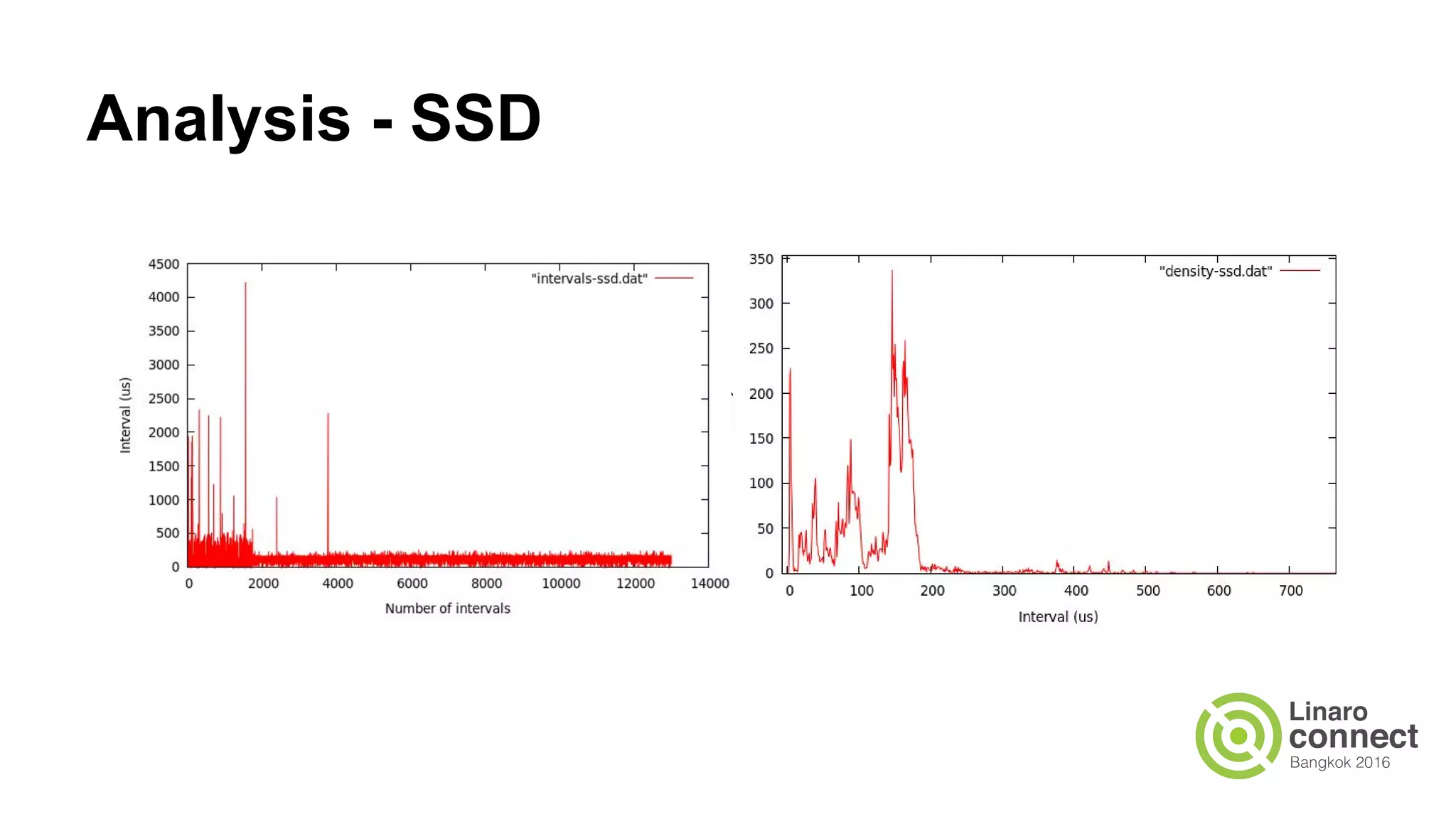
Analysis - SSD
Analysis - SSD
● Beginning of the measurement => writing a
big file
● Rest of the measurement => random read
● Write is hard to predict
● Read is stable
Analysis - Network
Analysis - Network
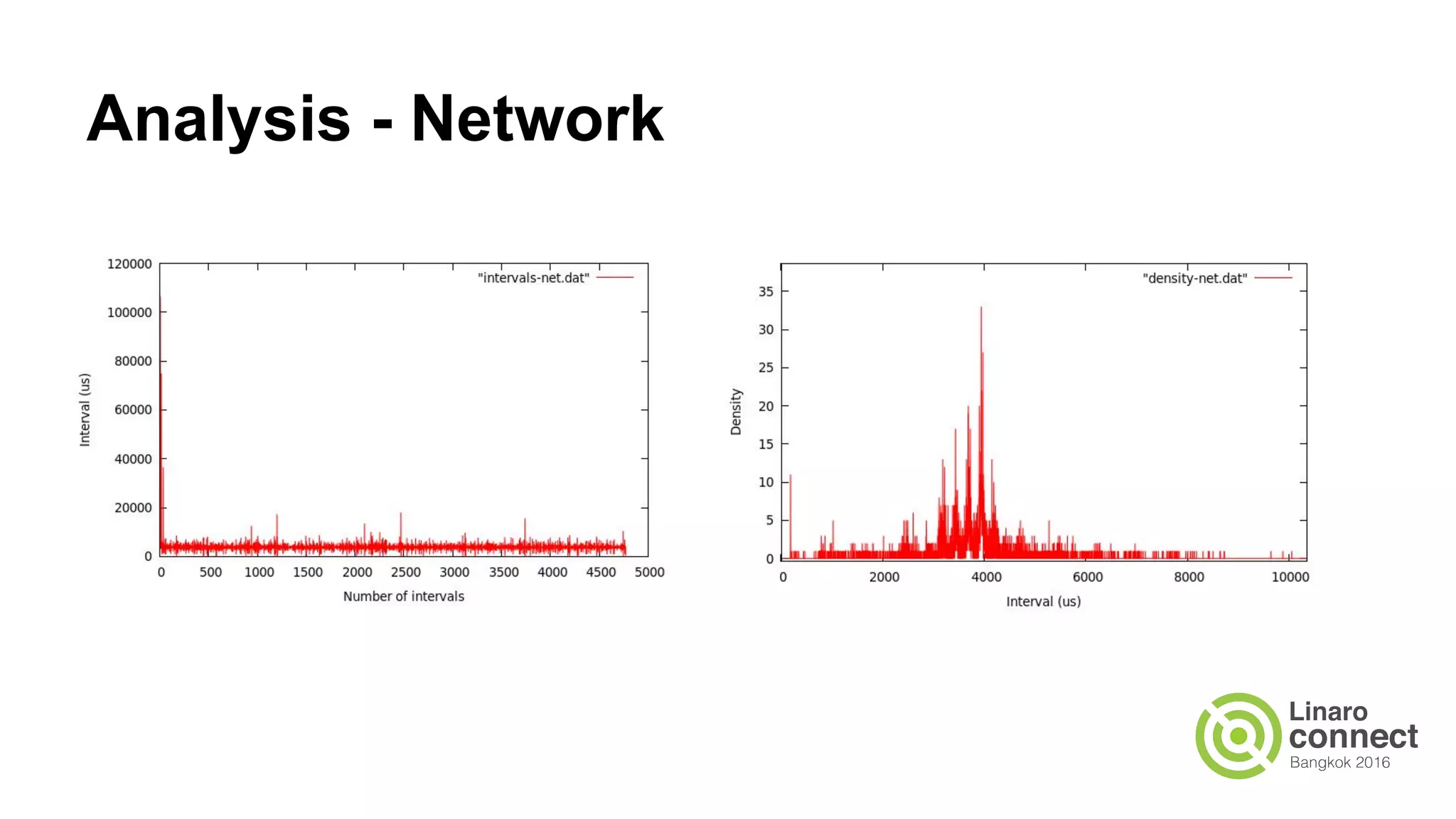
● Intervals are stable
● Repeating patterns
○ Four values
○ Looks like gaussian => normal law ?
Analysis - Serial console
Analysis - serial
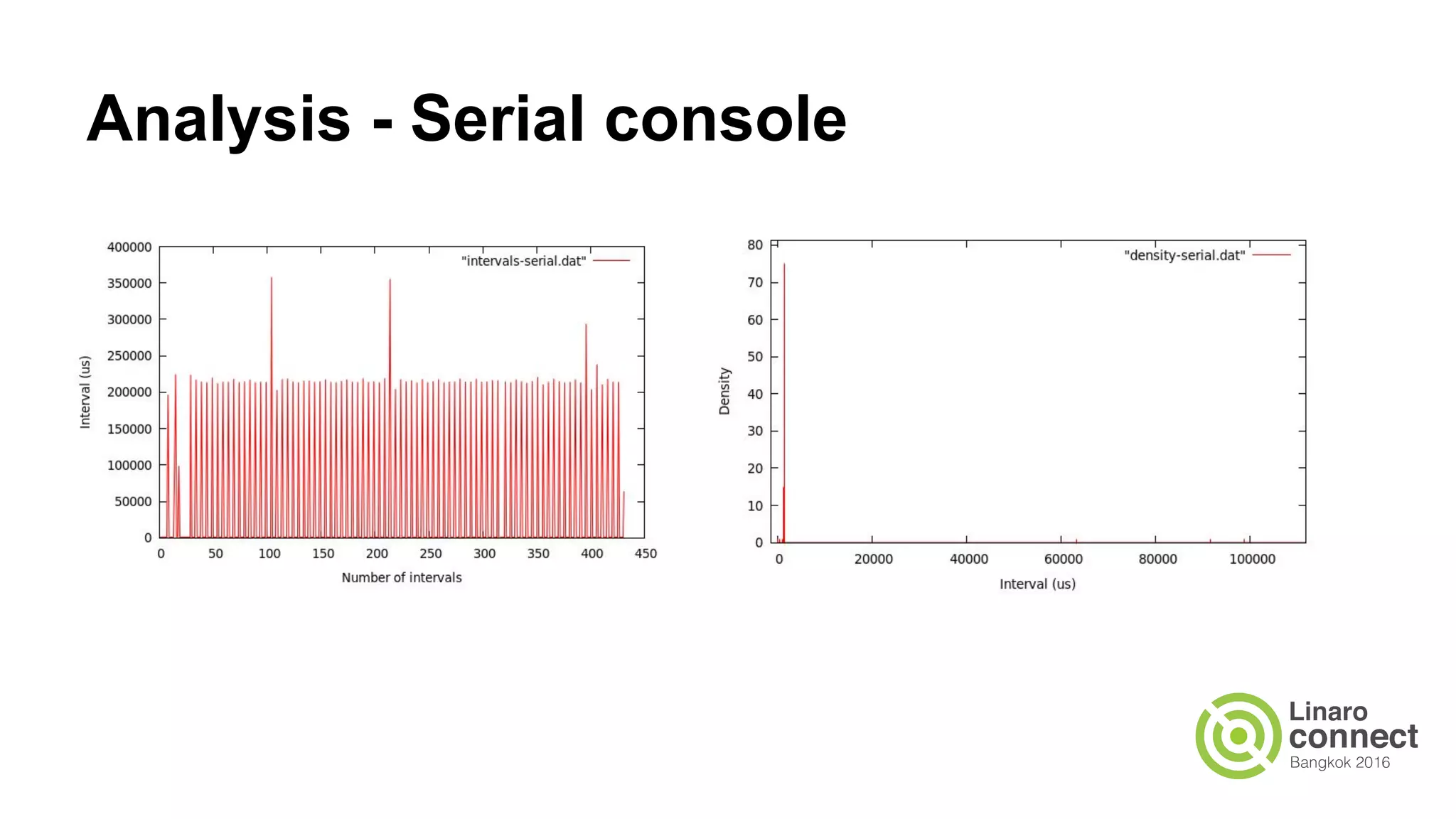
● Very stable interrupt
● Repeating pattern easily predictable
○ ~1ms x 5 + ~210ms
Analysis
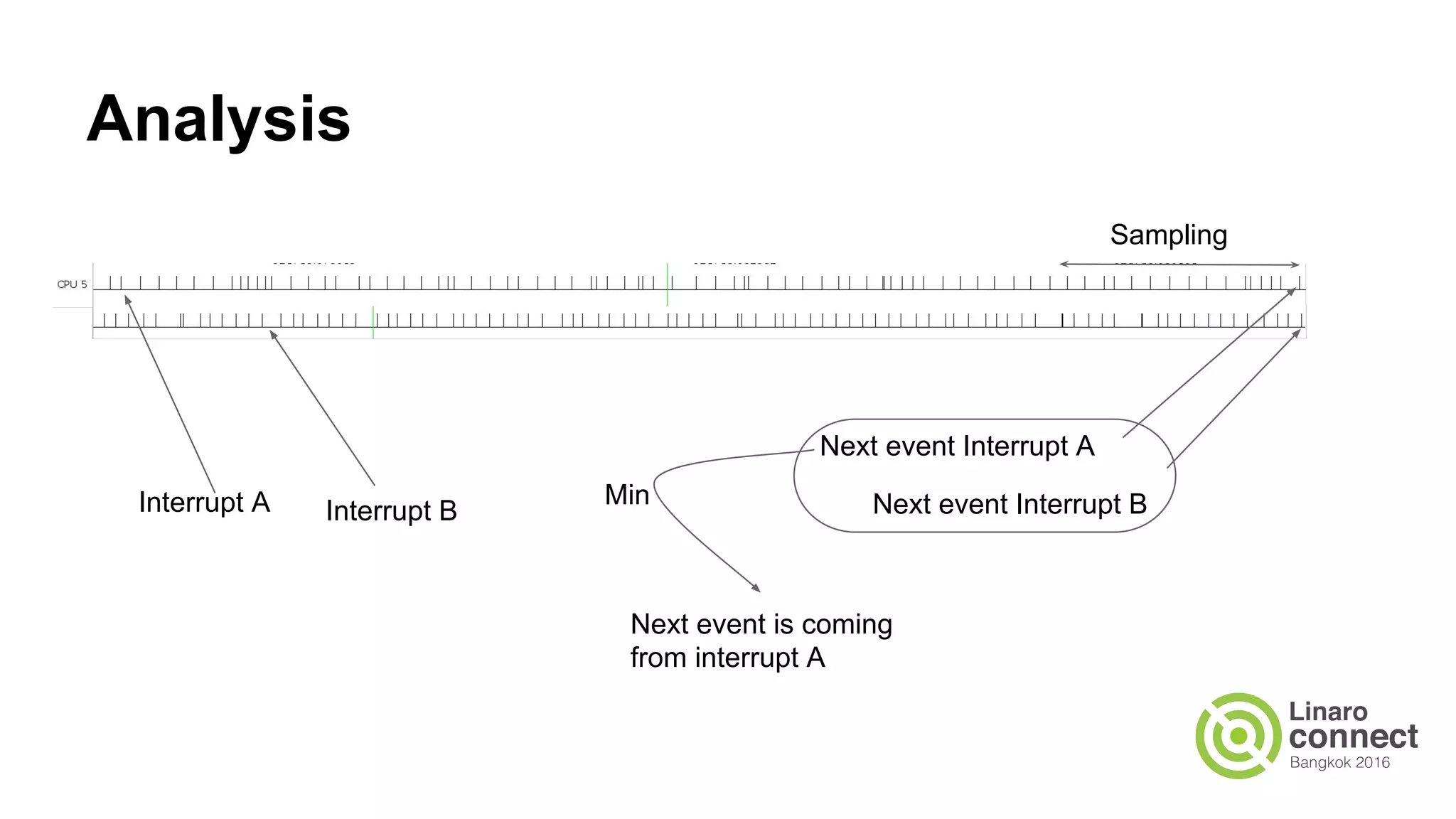
Interrupt A Interrupt B
Sampling
Next event Interrupt A
Next event Interrupt BMin
Next event is coming
from interrupt A
Analysis - Conclusion
● With a correct prediction for each interrupt
○ increase of the accuracy for the next event
● Mixing all interrupts, we can choose the
earliest one
Analysis - Conclusion
● Risk ?
○ Cumulative error on each irq prediction
○ Mathematical model vs performance in kernel
○ Different behavior for each irq
● Challenge ?
○ Solve the above
○ Find the right mathematical model
● Approach ?
○ Incremental
IRQ based next event status
● Submitted upstream as RFC
○ https://lwn.net/Articles/670505/
● Positive feedbacks and article in LWN
○ https://lwn.net/Articles/673641/
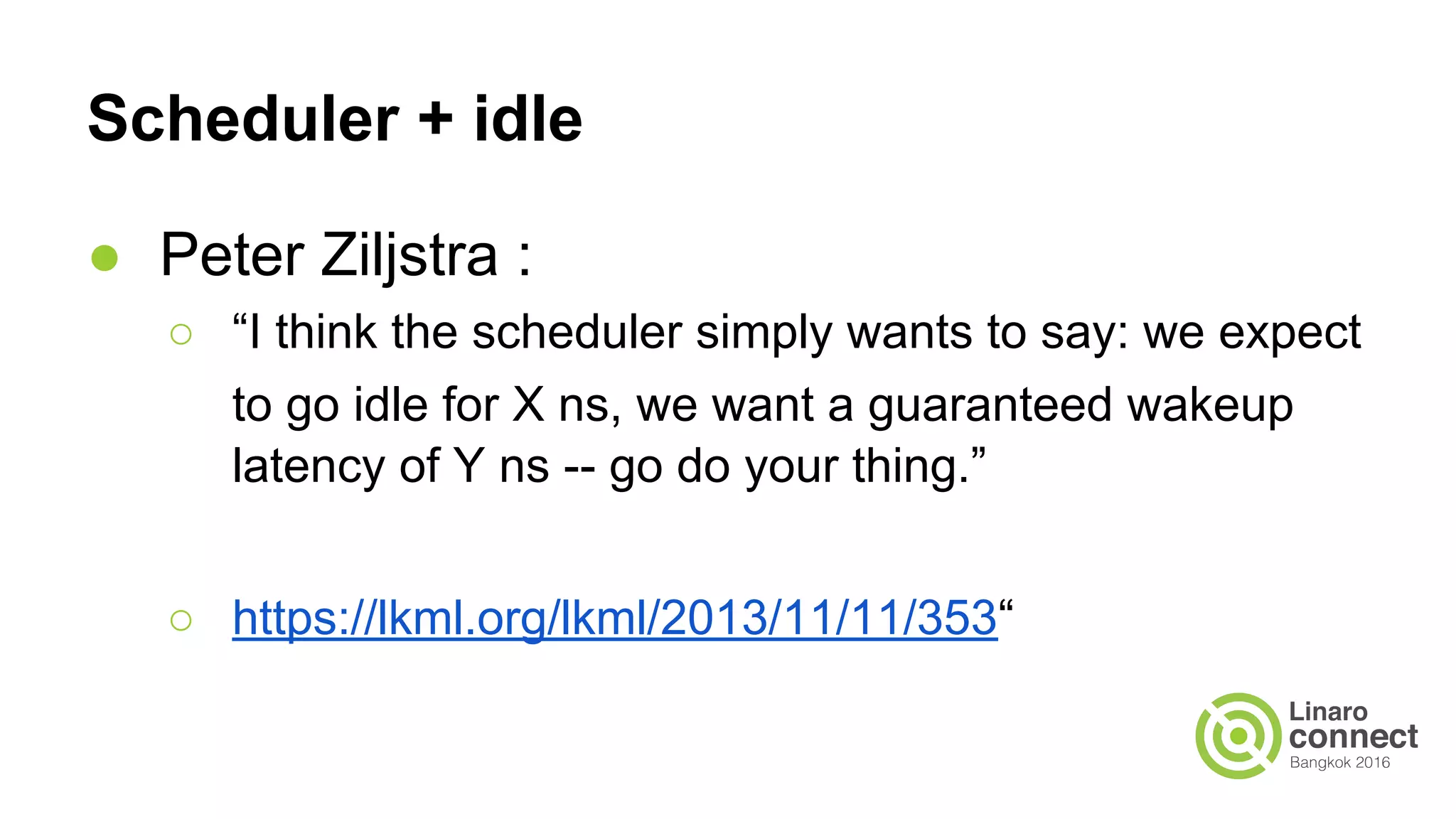
Scheduler + idle
● Peter Ziljstra :
○ “I think the scheduler simply wants to say: we expect
to go idle for X ns, we want a guaranteed wakeup
latency of Y ns -- go do your thing.”
○ https://lkml.org/lkml/2013/11/11/353“
Scheduler + idle
● Two new APIs:
○ s64 sched_idle_next_wakeup(void);
■ “[ … ] we expect to go idle for X ns [ … ]”
○ int sched_idle(s64 duration, unsigned int latency);
■ “[ …] go do your thing [ …]”
○ (Latency API is already there)
Scheduler + idle
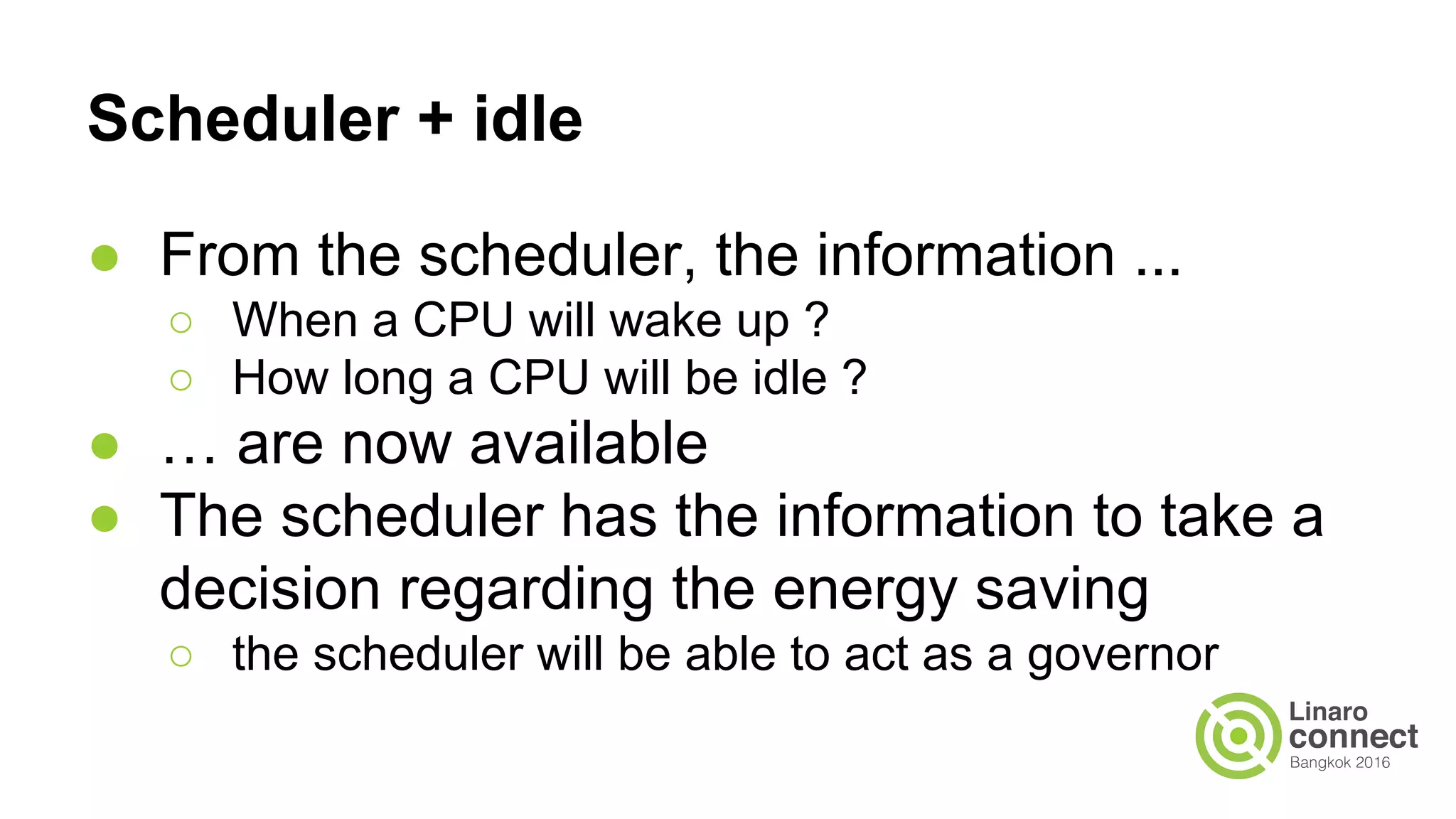
● From the scheduler, the information ...
○ When a CPU will wake up ?
○ How long a CPU will be idle ?
● … are now available
● The scheduler has the information to take a
decision regarding the energy saving
○ the scheduler will be able to act as a governor
Scheduler + idle
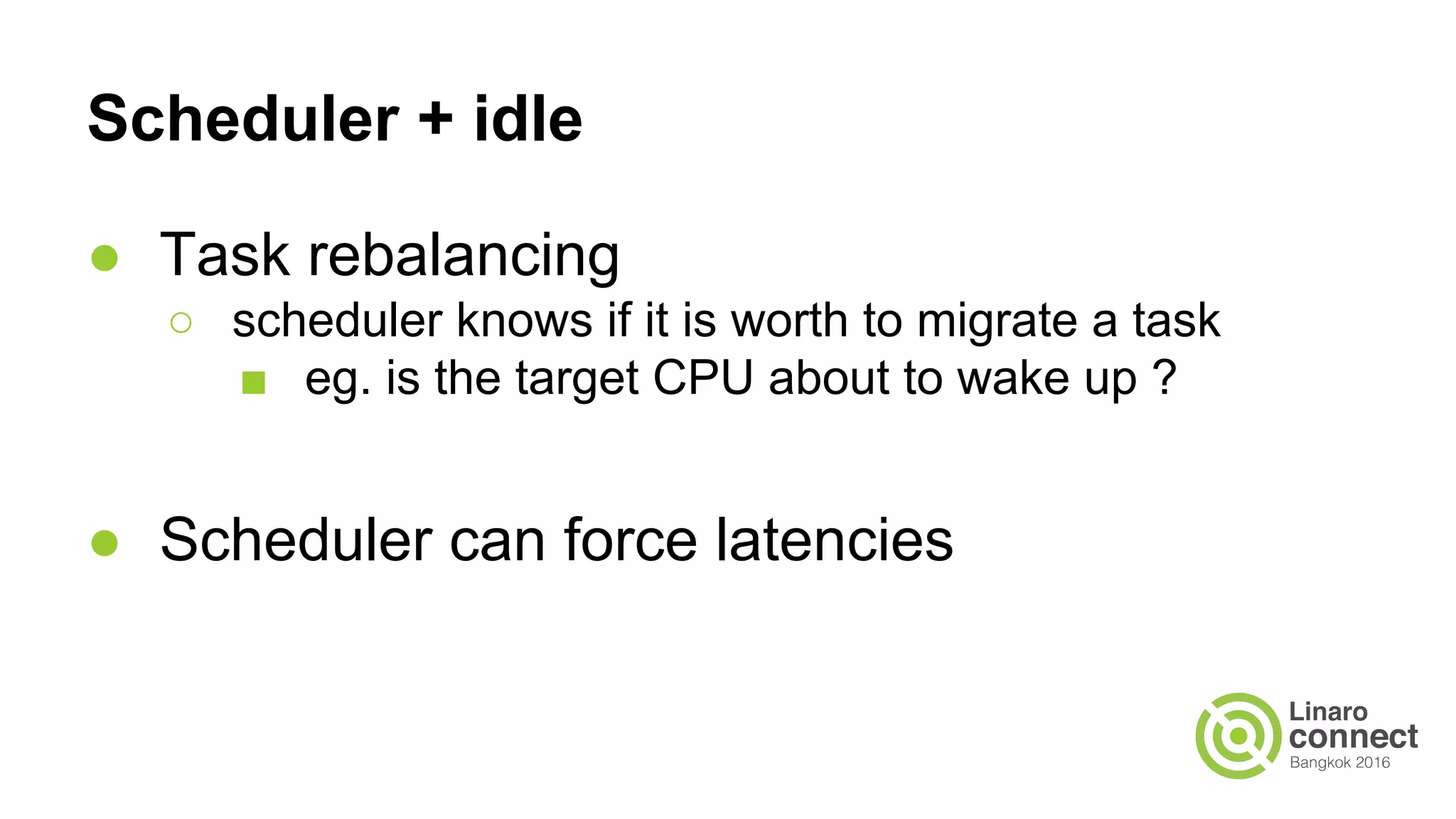
● Task rebalancing
○ scheduler knows if it is worth to migrate a task
■ eg. is the target CPU about to wake up ?
● Scheduler can force latencies
Scheduler + idle
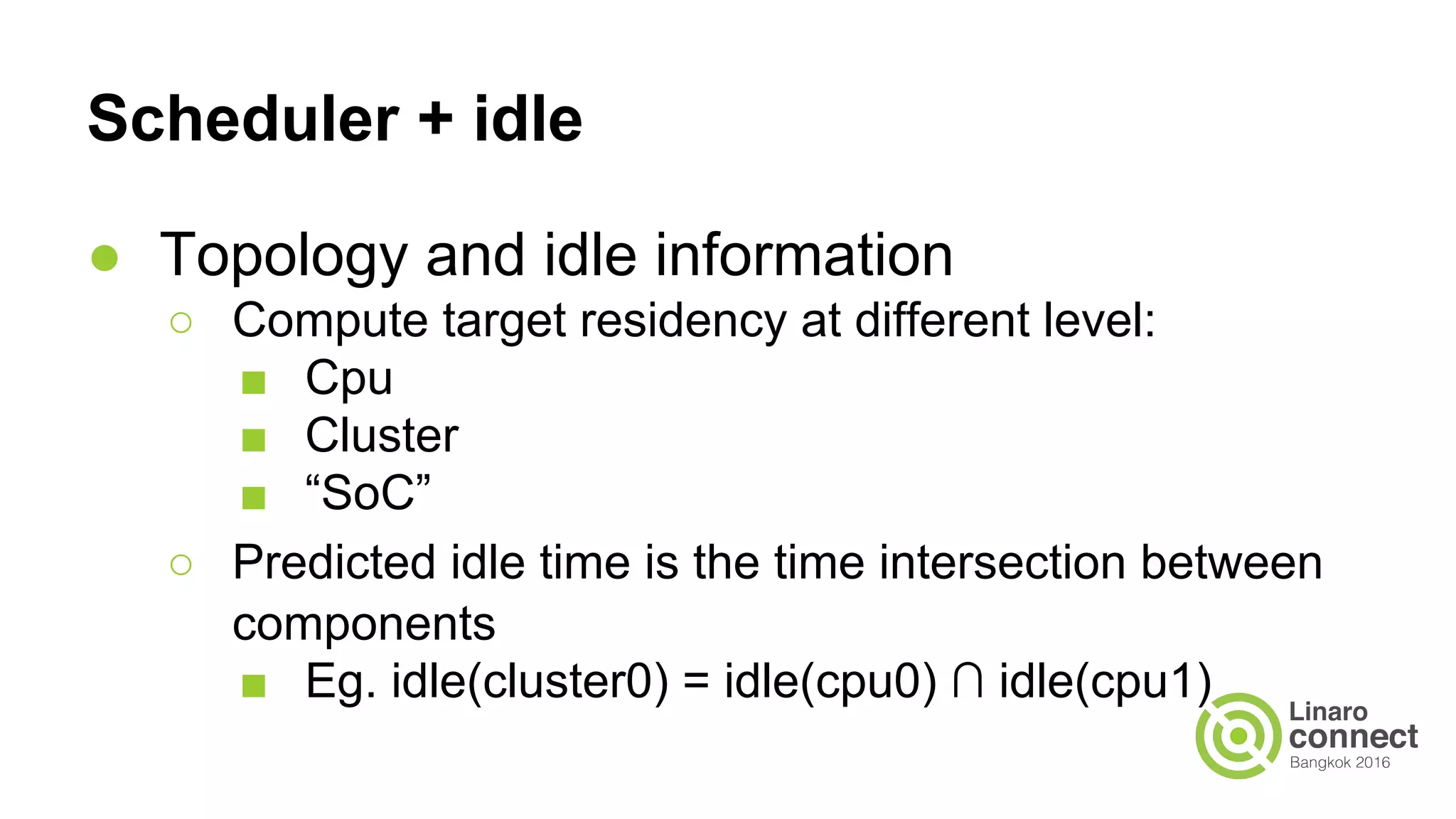
● Topology and idle information
○ Compute target residency at different level:
■ Cpu
■ Cluster
■ “SoC”
○ Predicted idle time is the time intersection between
components
■ Eg. idle(cluster0) = idle(cpu0) ∩ idle(cpu1)
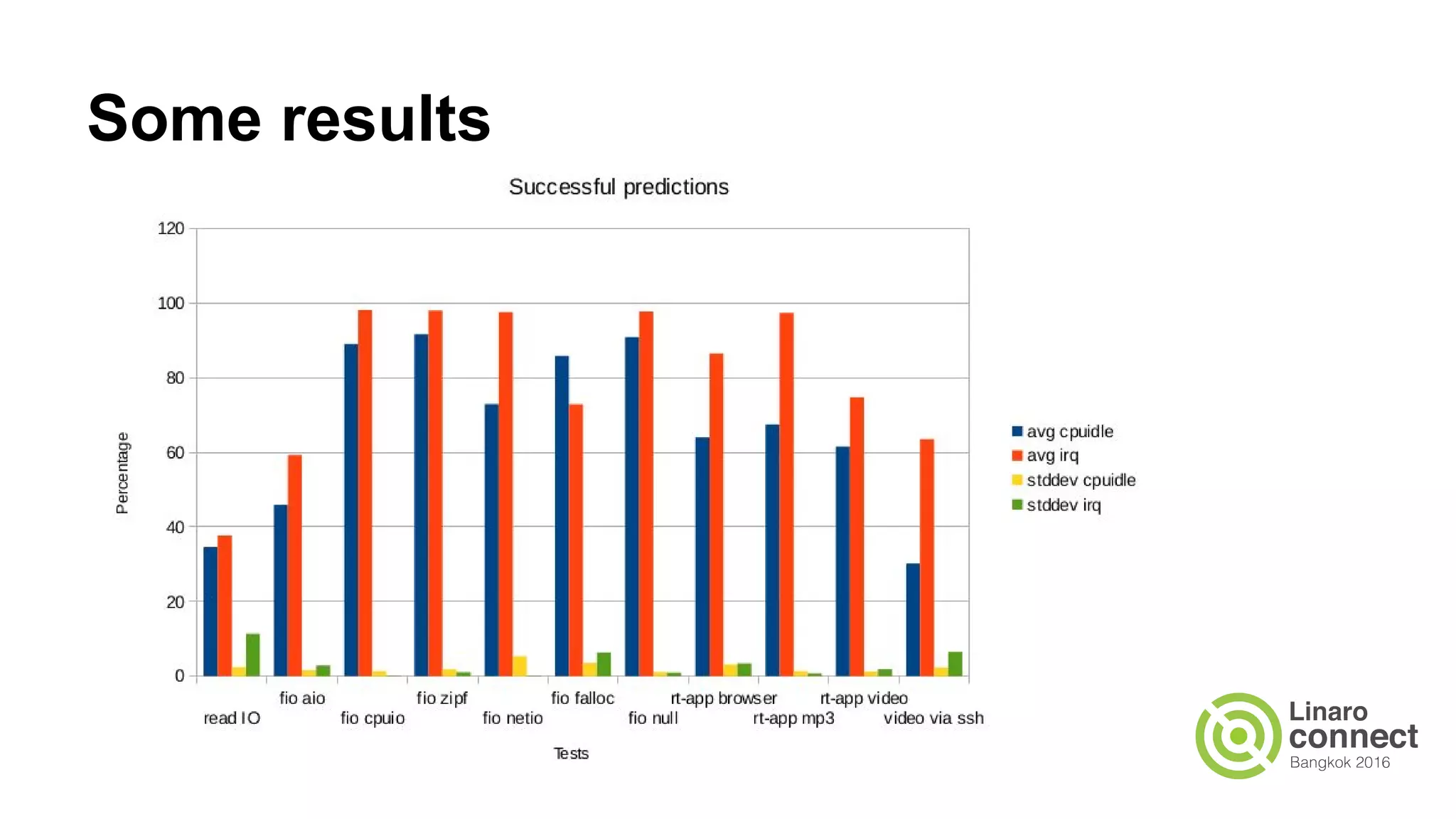
Some results
● Simple approach but better results in some
cases
● SMP is much better but UP worst
Some results
Next steps
● Instrumentation
● Improve the model
○ Bayesian network (TBS)
● Upstream the first bits
○ Approach is accepted
● Enlarge community (very important)
○ More testing and validation
● Scheduler tuning

BKK16-203 Irq prediction or how to better estimate idle time

  • 1.
    Presented by Date Event Sched idle Nextirq event predictionDaniel Lezcano BKK16-203 March 8, 2016 Linaro Connect BKK16
  • 2.
    Introduction ● Idle mechanism ●Limitations ● New approach
  • 3.
    Introduction ● Idle doesnot work if the break even is not reached ○ Consumes more energy ○ Worst performance ● Target residency is the break even ○ https://wiki.linaro.org/WorkingGroups/PowerManagement/Doc/ComputingTargetResidency ● Idle duration prediction is the key
  • 4.
    The idle process ●No task for each sched class ● Default task is the idle task
  • 5.
    The idle task ●Two infinite loops ○ One to ensure idle routine is called next time ○ One to handle wakeup + idle ● Yield to another task if any ○ As soon as there is a task to be run, the idle task is switched ● Enters / exit the idle routine ○ Idle time measurements
  • 6.
    Current approach ● Whena CPU wakes up from an idle state ○ idle time measurement ● When a CPU goes idle ○ statistics on idle time ○ Reuse statistics to guess estimate the idle duration
  • 7.
    Current approach ● Whatwoke up the CPU ? ○ a timer ? an IO device ? an IPI ? ■ https://wiki.linaro.org/WorkingGroups/PowerManagement/Doc/WakeUpSources ● It is not possible to know. It results to: ○ statistics on timers but they are deterministic ○ statistics on IPI, thus on the scheduler behavior
  • 8.
    Current approach ● Thiswake up sources soup leads to some complex re-adjustments in the statistics ○ empiric ○ platform specific (x86) ○ monolithic ● It is hard to tell if the prediction was correct
  • 9.
    Current approach ● Predictionand governor are tied ○ CPUidle is a standalone subsystem ○ No interaction with the scheduler ● Scheduler can’t use the prediction value to anticipate anything ○ Hard to integrate the power subsystems
  • 10.
    What do wewant ? ● The scheduler to act: ○ as a governor ○ pro actively ○ with knowledge of future events
  • 11.
    What do weneed ? ● Split prediction and idle state selection ● Increase the prediction accuracy ● Let the scheduler to have access to the prediction
  • 12.
    How do wedo that ? ● Track the interrupts independently ○ measure their intervals ○ apply a simple mathematical formula for their behavior ○ guess estimate the next event per interrupt ● Timers and IPI are out of the equation ● Full view of what is happening on the system
  • 13.
    Analysis ● A networktrafic + console output ○ kernelshark trace-net.dat ● A SSD random read ○ kernelshark trace-ssd.dat
  • 14.
  • 15.
    Analysis - SSD ●Beginning of the measurement => writing a big file ● Rest of the measurement => random read ● Write is hard to predict ● Read is stable
  • 16.
  • 17.
    Analysis - Network ●Intervals are stable ● Repeating patterns ○ Four values ○ Looks like gaussian => normal law ?
  • 18.
  • 19.
    Analysis - serial ●Very stable interrupt ● Repeating pattern easily predictable ○ ~1ms x 5 + ~210ms
  • 20.
    Analysis Interrupt A InterruptB Sampling Next event Interrupt A Next event Interrupt BMin Next event is coming from interrupt A
  • 21.
    Analysis - Conclusion ●With a correct prediction for each interrupt ○ increase of the accuracy for the next event ● Mixing all interrupts, we can choose the earliest one
  • 22.
    Analysis - Conclusion ●Risk ? ○ Cumulative error on each irq prediction ○ Mathematical model vs performance in kernel ○ Different behavior for each irq ● Challenge ? ○ Solve the above ○ Find the right mathematical model ● Approach ? ○ Incremental
  • 23.
    IRQ based nextevent status ● Submitted upstream as RFC ○ https://lwn.net/Articles/670505/ ● Positive feedbacks and article in LWN ○ https://lwn.net/Articles/673641/
  • 24.
    Scheduler + idle ●Peter Ziljstra : ○ “I think the scheduler simply wants to say: we expect to go idle for X ns, we want a guaranteed wakeup latency of Y ns -- go do your thing.” ○ https://lkml.org/lkml/2013/11/11/353“
  • 25.
    Scheduler + idle ●Two new APIs: ○ s64 sched_idle_next_wakeup(void); ■ “[ … ] we expect to go idle for X ns [ … ]” ○ int sched_idle(s64 duration, unsigned int latency); ■ “[ …] go do your thing [ …]” ○ (Latency API is already there)
  • 26.
    Scheduler + idle ●From the scheduler, the information ... ○ When a CPU will wake up ? ○ How long a CPU will be idle ? ● … are now available ● The scheduler has the information to take a decision regarding the energy saving ○ the scheduler will be able to act as a governor
  • 27.
    Scheduler + idle ●Task rebalancing ○ scheduler knows if it is worth to migrate a task ■ eg. is the target CPU about to wake up ? ● Scheduler can force latencies
  • 28.
    Scheduler + idle ●Topology and idle information ○ Compute target residency at different level: ■ Cpu ■ Cluster ■ “SoC” ○ Predicted idle time is the time intersection between components ■ Eg. idle(cluster0) = idle(cpu0) ∩ idle(cpu1)
  • 29.
    Some results ● Simpleapproach but better results in some cases ● SMP is much better but UP worst
  • 30.
  • 31.
    Next steps ● Instrumentation ●Improve the model ○ Bayesian network (TBS) ● Upstream the first bits ○ Approach is accepted ● Enlarge community (very important) ○ More testing and validation ● Scheduler tuning