 Provide consistent I/O abstraction to
applications.
 Provide a framework to do the following.
◦ Dynamic loading/unloading of drivers.
◦ Support for power management so that the system
or individual devices can enter low power states.
◦ Driver layering.
◦ Asynchronous I/O.
◦ Uniform enforcement of security.
 All I/O requests to drivers are sent as I/O
request packets (IRPs).
 I/O operations are layered
 The I/O manager defines a set of standard
routines, some required and others optional,
that drivers can support
 With each user-mode request for I/O, the I/O Manager
allocates an IRP from nonpaged system memory. Based on
the file handle and I/O function requested by the user, the
I/O Manager passes the IRP to the appropriate driver
dispatch routine.
 The dispatch routine checks the parameters of the
request, and if valid, passes the IRP to the driver's Start I/O
routine.
 The Start I/O routine uses the contents of the IRP to begin
a device operation.
 When the operation is complete, the driver's DpcForIsr
routine stores a final status code in the IRP and returns it
to the I/O Manager.
 The I/O Manager uses the information in the IRP to
complete the request and send the user the final status
 Major function
IRP_MJ_CLOSE,IRP_MJ_CREATE,IRP_MJ_DEVICE_C
ONTROL,IRP_MJ_INTERNAL_DEVICE_CONTROL,I
RP_MJ_PNP,IRP_MJ_POWER,IRP_MJ_READ..
 Minor Function
IRP_MN_START_DEVICE,IRP_MN_QUERY_ID,IRP_
MN_EJECT....
IO priority
User plugs a new device into a Bus
The Bus driver
◦ Notices the new device’s arrival
◦ Enumerates the device
◦ Retrieves identification information for the device
◦ Passes information to Plug and Play
 driver must implement a Plug and Play
dispatch routine, a power management
dispatch routine
 Need to handle both add and removal of
device
 devnode is made up of at least two, and sometimes more,
device objects[PDO and FDO]
 A physical device object (PDO) that the PnP manager instructs
a bus driver to create when the bus driver reports the
presence of a device on its bus during enumeration A
functional device object (FDO) that is created by the driver,
which is called a function driver, that the PnP manager loads
to manage a detected device.
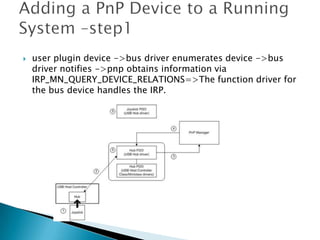
 user plugin device ->bus driver enumerates device ->bus
driver notifies ->pnp obtains information via
IRP_MN_QUERY_DEVICE_RELATIONS=>The function driver for
the bus device handles the IRP.
 PnP manager creates devnodes ->PnP manager gathers
information via IRP
 _MN_QUERY_ID ->store them in registry
 PnP manager coordinates with the user-mode PnP manager
and user-mode Setup PnP manager ->user-mode Setup
components direct the kernel-mode PnP manager to load the
function and filter drivers.
 Require hardware that complies with the Advanced
Configuration and Power Interface (ACPI) specification
Power Management split into:
S-states, representing the entire system
 S0: Working state, S1 – S3: Sleeping states
 S4: Hibernated state, S5: Soft-off state
D-states, representing single devices
 D0: Working state, D1 – D2: Low power states, D3: Off
state
 This can vary based on architecture and device manufacturer
and corresponding drivers
 Devices can be in any Dx state while the machine
itself is in the S0 state
S0-D0: Device is powered on and fully active
S0-D(1-3): Device is in a low power state, but
the machine is still running. The user may not
even be aware that the device is not in D0
Devices in D(1-3) may be armed for wakeup,
even though the machine is awake
 Machine appears to be off
 RAM context is maintained
 All clocks are stopped, except for RTC
 Devices may or may not have power
 Some devices may have trickle current, but not
main power source
 Power in S1 >= S2 >= S3
 Differences between S1, S2 and S3 are machine
specific
 RAM context is written to disk
 Machine is powered off
 All devices are in the D3 state, unless they have external
power sources
 Machine execution resumes through NTLDR, which restores
RAM context
 BIOS has a chance to reprogram devices
S5 State:
 All context is lost
 Machine is powered off
 Resume from S5 == booting
 Hybrid sleep
a user request to put the computer to sleep will actually be a
combination of both the S3 state and the S4 state: while the
computer is put to sleep, an emergency hibernation file will also
be written to disk
Connected standby:
<<to be filled>>
 The WDM Power Manager sends S IRPs:
 IRP_MN_QUERY_POWER, IRP_MN_SET_POWER
 Each device stack has a “Power Policy Owner” who converts S
IRPs to D IRPs
 The Power Policy Owner is typically the FDO
 The mapping comes from the S  D array stored in the
IRP_MN_QUERY_CAPABILITIES structure
 Each entry calls out the lightest possible D state for
a given S state
 Mappings can be rounded down (deeper)
 The Power Policy Owner then uses PoRequestPowerIrp to
request the appropriate D IRP
 Windbg Command:
 !thread – to get the test status of thread and corresponding
irp detail
 !drvobj,!devobj –to det driver and device object detail
 !irpfind – displays information about all I/O request packets
(IRP) currently allocated in the target system
 !irp <addres of irp> - to get etails of particular irp.
 Enable Verifier option for IRP Logging to trace irp
All Question are welcomed 
Thank You 

Window IO

  • 3.
     Provide consistentI/O abstraction to applications.  Provide a framework to do the following. ◦ Dynamic loading/unloading of drivers. ◦ Support for power management so that the system or individual devices can enter low power states. ◦ Driver layering. ◦ Asynchronous I/O. ◦ Uniform enforcement of security.
  • 4.
     All I/Orequests to drivers are sent as I/O request packets (IRPs).  I/O operations are layered  The I/O manager defines a set of standard routines, some required and others optional, that drivers can support
  • 5.
     With eachuser-mode request for I/O, the I/O Manager allocates an IRP from nonpaged system memory. Based on the file handle and I/O function requested by the user, the I/O Manager passes the IRP to the appropriate driver dispatch routine.  The dispatch routine checks the parameters of the request, and if valid, passes the IRP to the driver's Start I/O routine.  The Start I/O routine uses the contents of the IRP to begin a device operation.  When the operation is complete, the driver's DpcForIsr routine stores a final status code in the IRP and returns it to the I/O Manager.  The I/O Manager uses the information in the IRP to complete the request and send the user the final status
  • 7.
  • 11.
  • 12.
    User plugs anew device into a Bus The Bus driver ◦ Notices the new device’s arrival ◦ Enumerates the device ◦ Retrieves identification information for the device ◦ Passes information to Plug and Play
  • 13.
     driver mustimplement a Plug and Play dispatch routine, a power management dispatch routine  Need to handle both add and removal of device
  • 14.
     devnode ismade up of at least two, and sometimes more, device objects[PDO and FDO]  A physical device object (PDO) that the PnP manager instructs a bus driver to create when the bus driver reports the presence of a device on its bus during enumeration A functional device object (FDO) that is created by the driver, which is called a function driver, that the PnP manager loads to manage a detected device.
  • 18.
     user plugindevice ->bus driver enumerates device ->bus driver notifies ->pnp obtains information via IRP_MN_QUERY_DEVICE_RELATIONS=>The function driver for the bus device handles the IRP.
  • 19.
     PnP managercreates devnodes ->PnP manager gathers information via IRP  _MN_QUERY_ID ->store them in registry
  • 20.
     PnP managercoordinates with the user-mode PnP manager and user-mode Setup PnP manager ->user-mode Setup components direct the kernel-mode PnP manager to load the function and filter drivers.
  • 21.
     Require hardwarethat complies with the Advanced Configuration and Power Interface (ACPI) specification Power Management split into: S-states, representing the entire system  S0: Working state, S1 – S3: Sleeping states  S4: Hibernated state, S5: Soft-off state D-states, representing single devices  D0: Working state, D1 – D2: Low power states, D3: Off state
  • 22.
     This canvary based on architecture and device manufacturer and corresponding drivers
  • 23.
     Devices canbe in any Dx state while the machine itself is in the S0 state S0-D0: Device is powered on and fully active S0-D(1-3): Device is in a low power state, but the machine is still running. The user may not even be aware that the device is not in D0 Devices in D(1-3) may be armed for wakeup, even though the machine is awake
  • 24.
     Machine appearsto be off  RAM context is maintained  All clocks are stopped, except for RTC  Devices may or may not have power  Some devices may have trickle current, but not main power source  Power in S1 >= S2 >= S3  Differences between S1, S2 and S3 are machine specific
  • 25.
     RAM contextis written to disk  Machine is powered off  All devices are in the D3 state, unless they have external power sources  Machine execution resumes through NTLDR, which restores RAM context  BIOS has a chance to reprogram devices S5 State:  All context is lost  Machine is powered off  Resume from S5 == booting
  • 26.
     Hybrid sleep auser request to put the computer to sleep will actually be a combination of both the S3 state and the S4 state: while the computer is put to sleep, an emergency hibernation file will also be written to disk Connected standby: <<to be filled>>
  • 27.
     The WDMPower Manager sends S IRPs:  IRP_MN_QUERY_POWER, IRP_MN_SET_POWER  Each device stack has a “Power Policy Owner” who converts S IRPs to D IRPs  The Power Policy Owner is typically the FDO  The mapping comes from the S  D array stored in the IRP_MN_QUERY_CAPABILITIES structure  Each entry calls out the lightest possible D state for a given S state  Mappings can be rounded down (deeper)  The Power Policy Owner then uses PoRequestPowerIrp to request the appropriate D IRP
  • 28.
     Windbg Command: !thread – to get the test status of thread and corresponding irp detail  !drvobj,!devobj –to det driver and device object detail  !irpfind – displays information about all I/O request packets (IRP) currently allocated in the target system  !irp <addres of irp> - to get etails of particular irp.  Enable Verifier option for IRP Logging to trace irp
  • 29.
    All Question arewelcomed  Thank You 