Basic Environmental
                                                                 Engineering & Elementary Biolo


Department of Electronics & Designed by Soujanya Roy, Sanjoy Moitra, Monalisa, Mayurima and
Communication Engineering Krishanu
AGENDA
     Introduction to the Basic concept of
    Eutrophication
    -Basic Idea
    -Definition
     Types of Eutrophication
    - Natural Eutrophication
    - Cultural Eutrophication
     Sources
    - Point sources
    - Non-point sources
    - A brief outline
     Effects of Eutrophication
     Remedial Measures/Monitoring
     Bibliography
Introduction- Basic Concepts

   Whats actually
    Eutrophication?
BASIC IDEA:
 - originated from greek words: eu=‘well’ and
    trophes=‘fed’. Thus it means ‘well fed’ or ‘nutrient
    rich’
 - It alters the dynamics of a number of plant, animal and
     bacterial populations; thus, bringing about changes in
     community structure.
 - It is a form of water pollution and like all other forms of pollution is
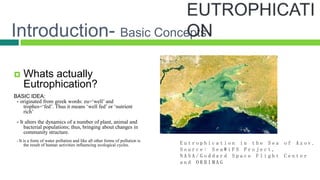
    the result of human activities influencing ecological cycles.             Eutrophication in the Sea of Azov.
                                                                              Source: SeaWiFS Project,
                                                                              NASA/Goddard Space Flight Center
                                                                              and ORBIMAG
Introduction- Basic Concepts
     Defining Eutrophication
       Can be defined as excessive nutrient load in a water body that
      support a dense growth of algae and other organisms, the decay of
      which depletes the shallow waters of oxygen in summer.

      eutrophication may be defined as an increase in the
      rate of supply of organic matter to an ecosystem.
     It means ‘enhanced nourishment’ and refers to
      the stimulation of aquatic plant growth by
      mineral nutrients, particularly the combined
      forms of phosphorus or nitrogen
Getting into:
 Types   of Eutrophication


                   Lets Browse through the different types of Eutrophication
Types of Eutrophication
 Two   types of Eutrophication are:
 √

                 √
 √
                 √

 √
Two types : A comparison
    Natural Eutrophication                  Cultural Eutrophication

√

√


 a process that occurs as a lake or river   a process that occurs when humans
 ages over a period of hundreds or          release excessive amounts of nutrients;
 thousands of years.                        it shortens the rate of aging to decades.
Getting into- Sources
 Sources    of Eutrophication
 √


 √


 √Point sources are directly attributable to one influence. In
  point sources the nutrient waste travels directly from source to
  water. Point sources are relatively easy to regulate.
Getting into- Sources
 Sources     of Eutrophication
 √


 √
  Nonpoint source pollution (also known as 'diffuse' or 'runoff' pollution) is that
  which comes from ill-defined and diffuse sources. Nonpoint sources are
 √difficult to regulate and usually vary spatially and temporally (with season,
  precipitation, and other irregular events).
  It has been shown that nitrogen transport is correlated with various indices
  of human activity in watersheds, including the amount of development.
  Ploughing in agriculture and development are activities that contribute most
  to nutrient loading.
SOURCES- point & non point
   Point Sources                             Non-point Sources

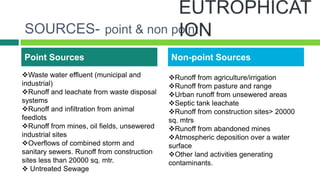
√Waste water effluent (municipal and        Runoff from agriculture/irrigation
 industrial)                                 Runoff from pasture and range
 Runoff and leachate from waste disposal    Urban runoff from unsewered areas
√systems
                                             Septic tank leachate
 Runoff and infiltration from animal        Runoff from construction sites> 20000
 feedlots                                    sq. mtrs
 Runoff from mines, oil fields, unsewered   Runoff from abandoned mines
 industrial sites                            Atmospheric deposition over a water
 Overflows of combined storm and            surface
 sanitary sewers. Runoff from construction   Other land activities generating
 sites less than 20000 sq. mtr.              contaminants.
  Untreated Sewage
SOURCES
 Major   Sources of Eutrophication
 √
             Major sources of excess nutrients
              are agricultural fertilizers, domestic
 √            sewage and livestock wastes.
             Agricultural fertilizers provide
              inorganic nutrients.
 √           Sewage and wastes provide both
              inorganic and organic nutrients.
PICTORIAL SUMMARY OF SOURCES OF
Cultural Eutrophication EUTROPHICATION
Impact- Effects on Environment
 Effects   of Eutrophication
 on
 the Environment
           Decrease in the transparency of water
           Development of anoxic conditions (low oxygen levels)
           Increased algal blooms
           Loss of habitat (e.g. Sea grass beds)
           Change in dominant biota (e.g. Changes in plankton and
            macrophyte community structure or changes in fish composition)
           Decrease in species diversity
           Change in the aesthetic value of the water body
Impact- Effects on Society
   Socio-economic
    Consequences of
    Eutrophication
            Increased vegetation may impede water flow and the movement of boats
             The water may become unsuitable for drinking even after treatment
            Decrease in the amenity value of the water (e.g. it may become unsuitable
             f or water sports such as sailing)
            Disappearance of commercially important species (such as trout)
            Loss of tourism/recreation (swimming, boating)
            Loss of aesthetic value: visual disamenity of algal blooms in lakes
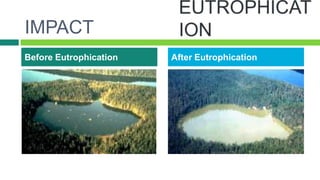
IMPACT
    Before Eutrophication   After Eutrophication

√

√
Algal bloom in a lake   EFFECTS OF EUTROPHICATION
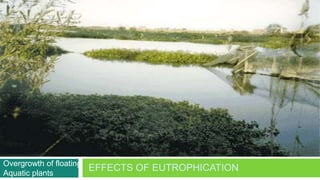
Overgrowth of floating
Aquatic plants
                         EFFECTS OF EUTROPHICATION
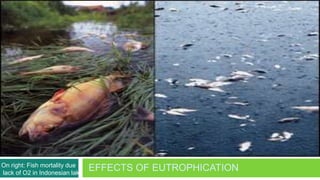
On right: Fish mortality due
lack of O2 in Indonesian lake
                                EFFECTS OF EUTROPHICATION
NOW
   PLAYING         Getting Real- Video footage
CREDITS:           Lets understand the process SIMPLY…!
Piotr Sokolowski
Source:
www.youtube.com
REMEDIAL MEASURES
        Reduction in the use of phosphates as builders in detergents
        Reduction in the use of nitrate containing fertilisers
        Implementation of tertiary sewage treatment methods which
         remove phosphate and nitrate
        Improvements in agricultural practices (economising on
         fertiliser use and improving land use)
        Aeration of lakes and reservoirs to prevent oxygen depletion
         particularly during algal blooms
        Restoration of natural wetlands, efficient in nutrient removal
        Removing phosphate-rich plant material from affected lakes
        Removing phosphate-rich sediments by dredging
Bibliography- References
 Thanks   to the sources…!!!
 √
  √


   √
   √
   √
THE END…


√
 √
 √
 √
 √

Eutrophication

  • 1.
    Basic Environmental Engineering & Elementary Biolo Department of Electronics & Designed by Soujanya Roy, Sanjoy Moitra, Monalisa, Mayurima and Communication Engineering Krishanu
  • 2.
    AGENDA  Introduction to the Basic concept of Eutrophication -Basic Idea -Definition  Types of Eutrophication - Natural Eutrophication - Cultural Eutrophication  Sources - Point sources - Non-point sources - A brief outline  Effects of Eutrophication  Remedial Measures/Monitoring  Bibliography
  • 3.
    Introduction- Basic Concepts  Whats actually Eutrophication? BASIC IDEA: - originated from greek words: eu=‘well’ and trophes=‘fed’. Thus it means ‘well fed’ or ‘nutrient rich’ - It alters the dynamics of a number of plant, animal and bacterial populations; thus, bringing about changes in community structure. - It is a form of water pollution and like all other forms of pollution is the result of human activities influencing ecological cycles. Eutrophication in the Sea of Azov. Source: SeaWiFS Project, NASA/Goddard Space Flight Center and ORBIMAG
  • 4.
    Introduction- Basic Concepts  Defining Eutrophication  Can be defined as excessive nutrient load in a water body that support a dense growth of algae and other organisms, the decay of which depletes the shallow waters of oxygen in summer.  eutrophication may be defined as an increase in the rate of supply of organic matter to an ecosystem.  It means ‘enhanced nourishment’ and refers to the stimulation of aquatic plant growth by mineral nutrients, particularly the combined forms of phosphorus or nitrogen
  • 5.
    Getting into:  Types of Eutrophication Lets Browse through the different types of Eutrophication
  • 6.
    Types of Eutrophication Two types of Eutrophication are: √ √ √ √ √
  • 7.
    Two types :A comparison Natural Eutrophication Cultural Eutrophication √ √ a process that occurs as a lake or river a process that occurs when humans ages over a period of hundreds or release excessive amounts of nutrients; thousands of years. it shortens the rate of aging to decades.
  • 8.
    Getting into- Sources Sources of Eutrophication √ √ √Point sources are directly attributable to one influence. In point sources the nutrient waste travels directly from source to water. Point sources are relatively easy to regulate.
  • 9.
    Getting into- Sources Sources of Eutrophication √ √ Nonpoint source pollution (also known as 'diffuse' or 'runoff' pollution) is that which comes from ill-defined and diffuse sources. Nonpoint sources are √difficult to regulate and usually vary spatially and temporally (with season, precipitation, and other irregular events). It has been shown that nitrogen transport is correlated with various indices of human activity in watersheds, including the amount of development. Ploughing in agriculture and development are activities that contribute most to nutrient loading.
  • 10.
    SOURCES- point &non point Point Sources Non-point Sources √Waste water effluent (municipal and Runoff from agriculture/irrigation industrial) Runoff from pasture and range Runoff and leachate from waste disposal Urban runoff from unsewered areas √systems Septic tank leachate Runoff and infiltration from animal Runoff from construction sites> 20000 feedlots sq. mtrs Runoff from mines, oil fields, unsewered Runoff from abandoned mines industrial sites Atmospheric deposition over a water Overflows of combined storm and surface sanitary sewers. Runoff from construction Other land activities generating sites less than 20000 sq. mtr. contaminants.  Untreated Sewage
  • 11.
    SOURCES  Major Sources of Eutrophication √  Major sources of excess nutrients are agricultural fertilizers, domestic √ sewage and livestock wastes.  Agricultural fertilizers provide inorganic nutrients. √  Sewage and wastes provide both inorganic and organic nutrients.
  • 12.
    PICTORIAL SUMMARY OFSOURCES OF Cultural Eutrophication EUTROPHICATION
  • 13.
    Impact- Effects onEnvironment  Effects of Eutrophication on the Environment  Decrease in the transparency of water  Development of anoxic conditions (low oxygen levels)  Increased algal blooms  Loss of habitat (e.g. Sea grass beds)  Change in dominant biota (e.g. Changes in plankton and macrophyte community structure or changes in fish composition)  Decrease in species diversity  Change in the aesthetic value of the water body
  • 14.
    Impact- Effects onSociety  Socio-economic Consequences of Eutrophication  Increased vegetation may impede water flow and the movement of boats  The water may become unsuitable for drinking even after treatment  Decrease in the amenity value of the water (e.g. it may become unsuitable f or water sports such as sailing)  Disappearance of commercially important species (such as trout)  Loss of tourism/recreation (swimming, boating)  Loss of aesthetic value: visual disamenity of algal blooms in lakes
  • 15.
    IMPACT Before Eutrophication After Eutrophication √ √
  • 16.
    Algal bloom ina lake EFFECTS OF EUTROPHICATION
  • 17.
    Overgrowth of floating Aquaticplants EFFECTS OF EUTROPHICATION
  • 18.
    On right: Fishmortality due lack of O2 in Indonesian lake EFFECTS OF EUTROPHICATION
  • 19.
    NOW PLAYING Getting Real- Video footage CREDITS: Lets understand the process SIMPLY…! Piotr Sokolowski Source: www.youtube.com
  • 20.
    REMEDIAL MEASURES  Reduction in the use of phosphates as builders in detergents  Reduction in the use of nitrate containing fertilisers  Implementation of tertiary sewage treatment methods which remove phosphate and nitrate  Improvements in agricultural practices (economising on fertiliser use and improving land use)  Aeration of lakes and reservoirs to prevent oxygen depletion particularly during algal blooms  Restoration of natural wetlands, efficient in nutrient removal  Removing phosphate-rich plant material from affected lakes  Removing phosphate-rich sediments by dredging
  • 21.
    Bibliography- References  Thanks to the sources…!!! √ √ √ √ √
  • 22.