Stephanie A. Smith, Ph.D.
Stephanie.Smith@Xyleminc.com
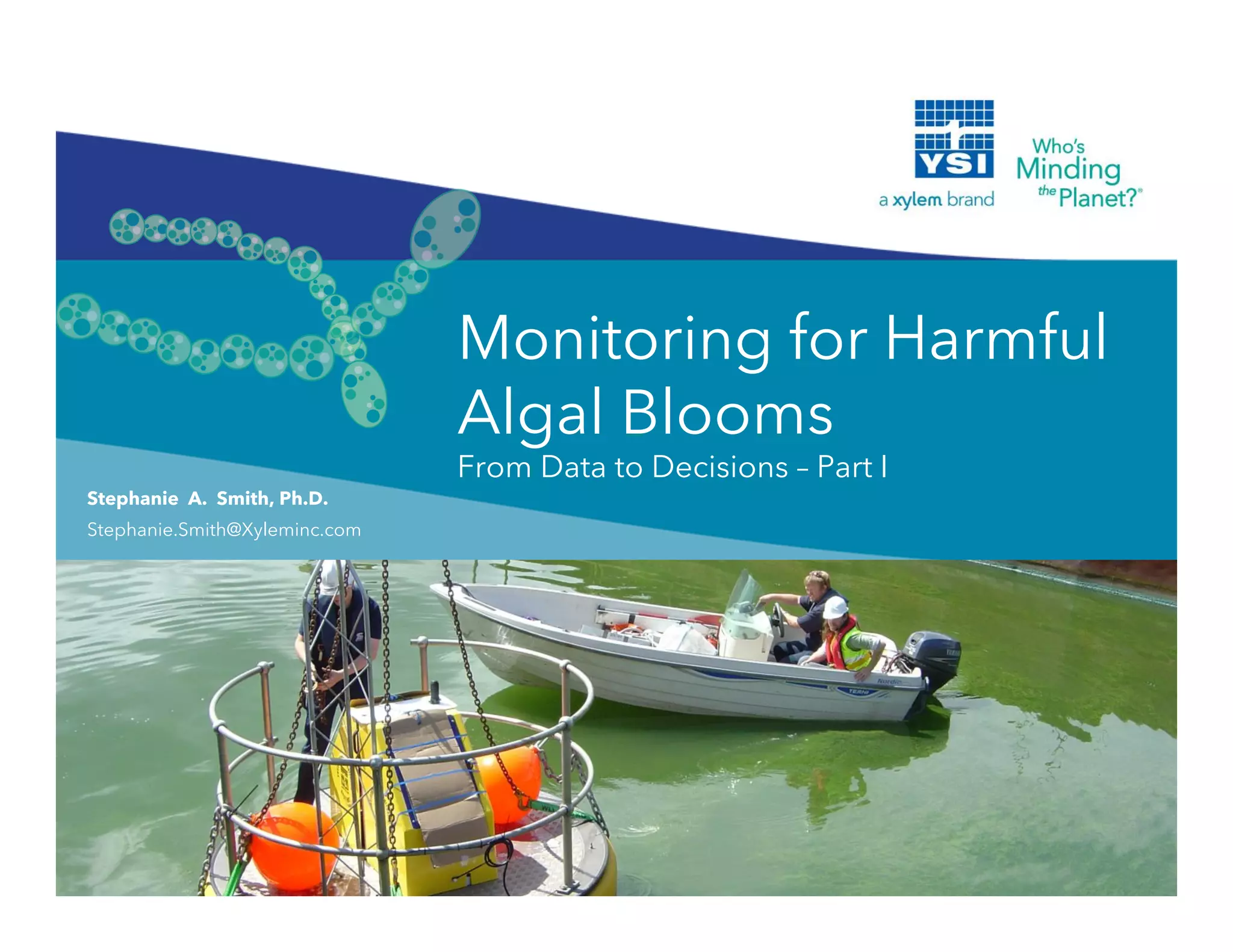
Monitoring for Harmful
Algal Blooms
From Data to Decisions – Part I
Today’s Agenda
Introductions
Defining “Harmful” Algal Blooms (HABs)
•  Factors that contribute to HABs & why they are problematic
Monitoring Water Quality for HABs
•  Parameters that lead to or result from blooms
Understanding Algal Pigments & Fluorescence-Based Sensing
•  From satellites to handheld devices
Leveraging Pigment Data to Mitigate Blooms
Q&A
2
Our Featured Speaker
Dr. Stephanie A. Smith
3
BACKGROUND
Ph.D. in Microbiology
The Ohio State University
§  Assistant Professor
§  Senior Scientist
§  Entrepreneur
§  Product Manager
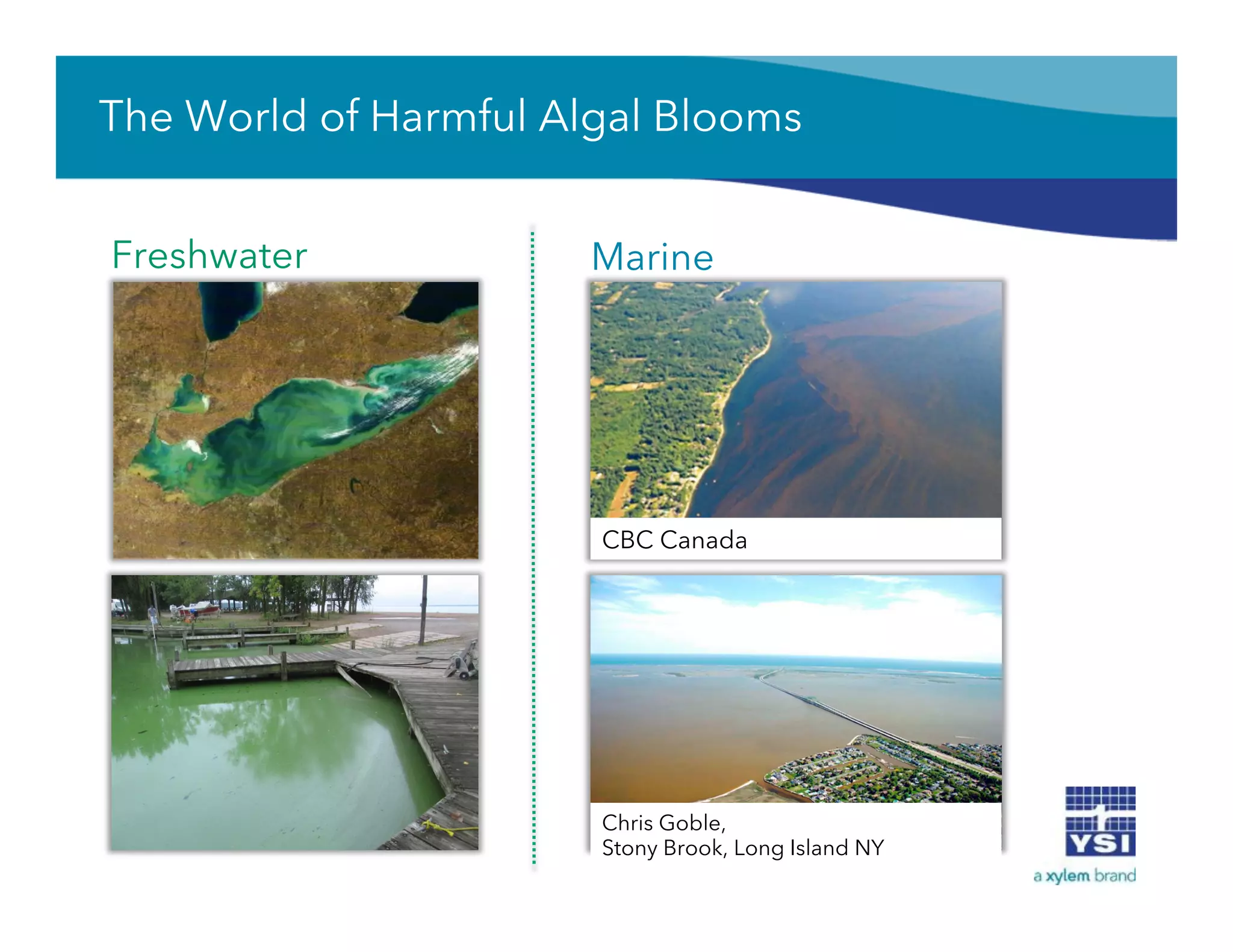
The World of Harmful Algal Blooms
Freshwater Marine
Chris Goble,
Stony Brook, Long Island NY
CBC Canada
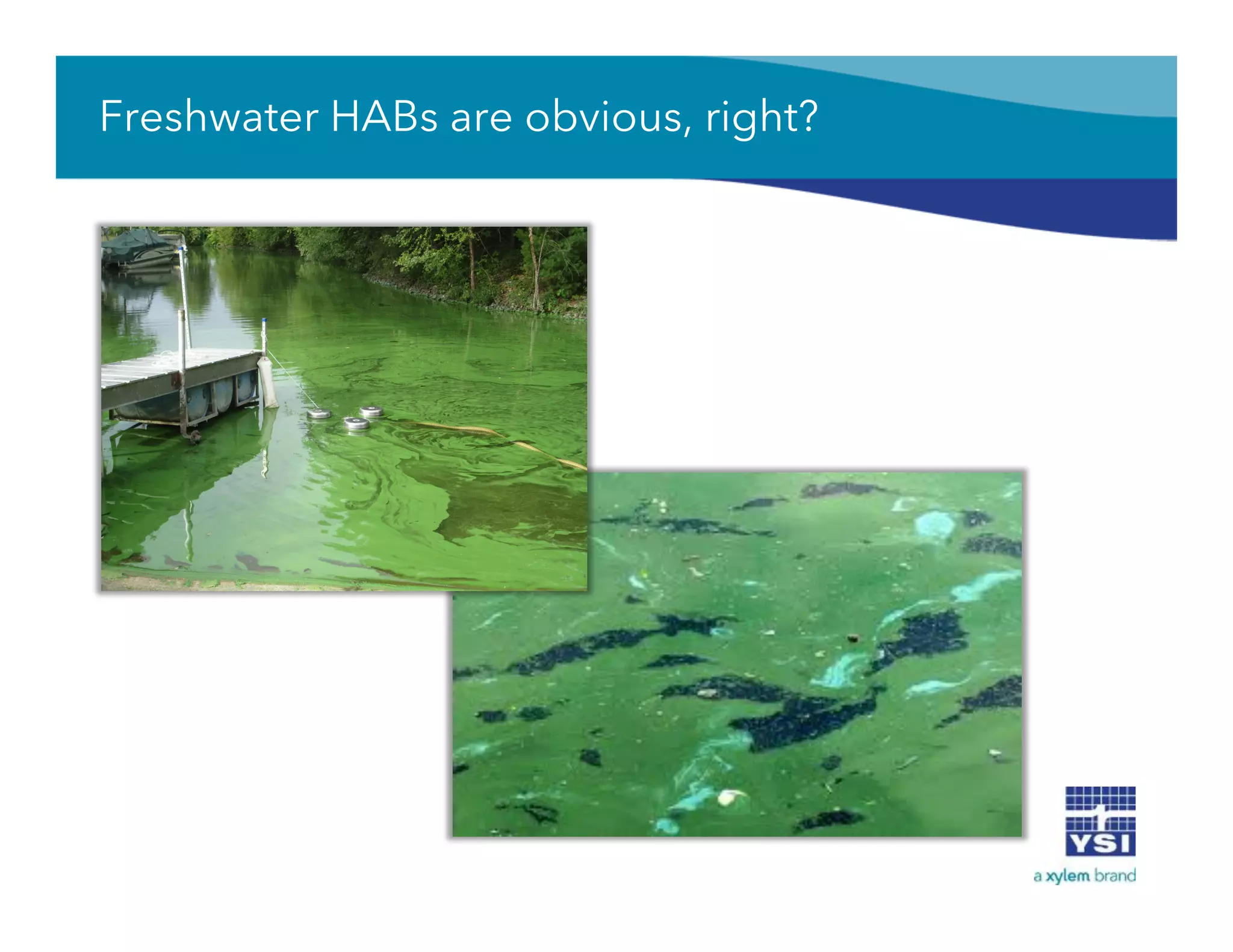
Freshwater HABs are obvious, right?
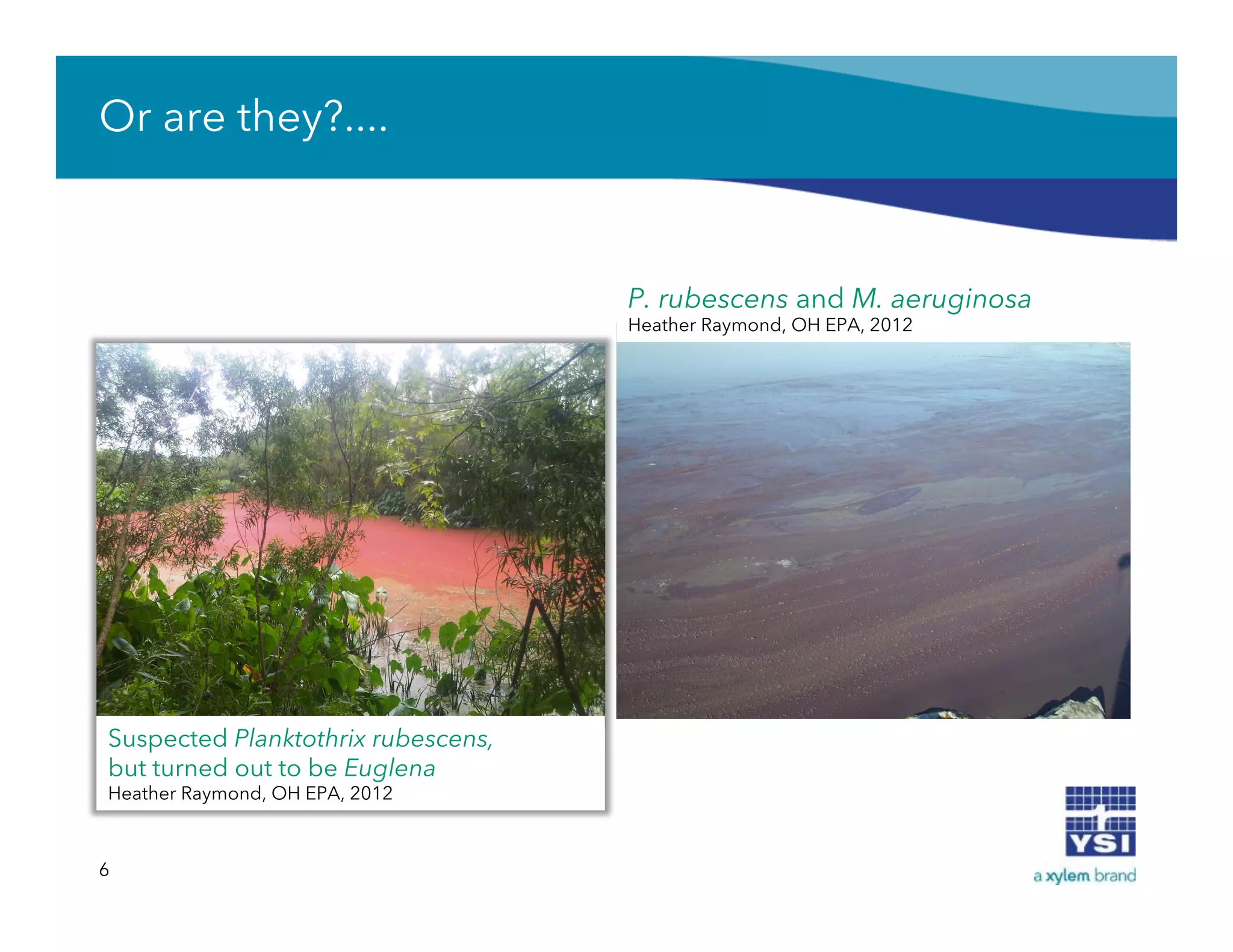
Or are they?....
6
P. rubescens and M. aeruginosa
Heather Raymond, OH EPA, 2012
Suspected Planktothrix rubescens,
but turned out to be Euglena
Heather Raymond, OH EPA, 2012
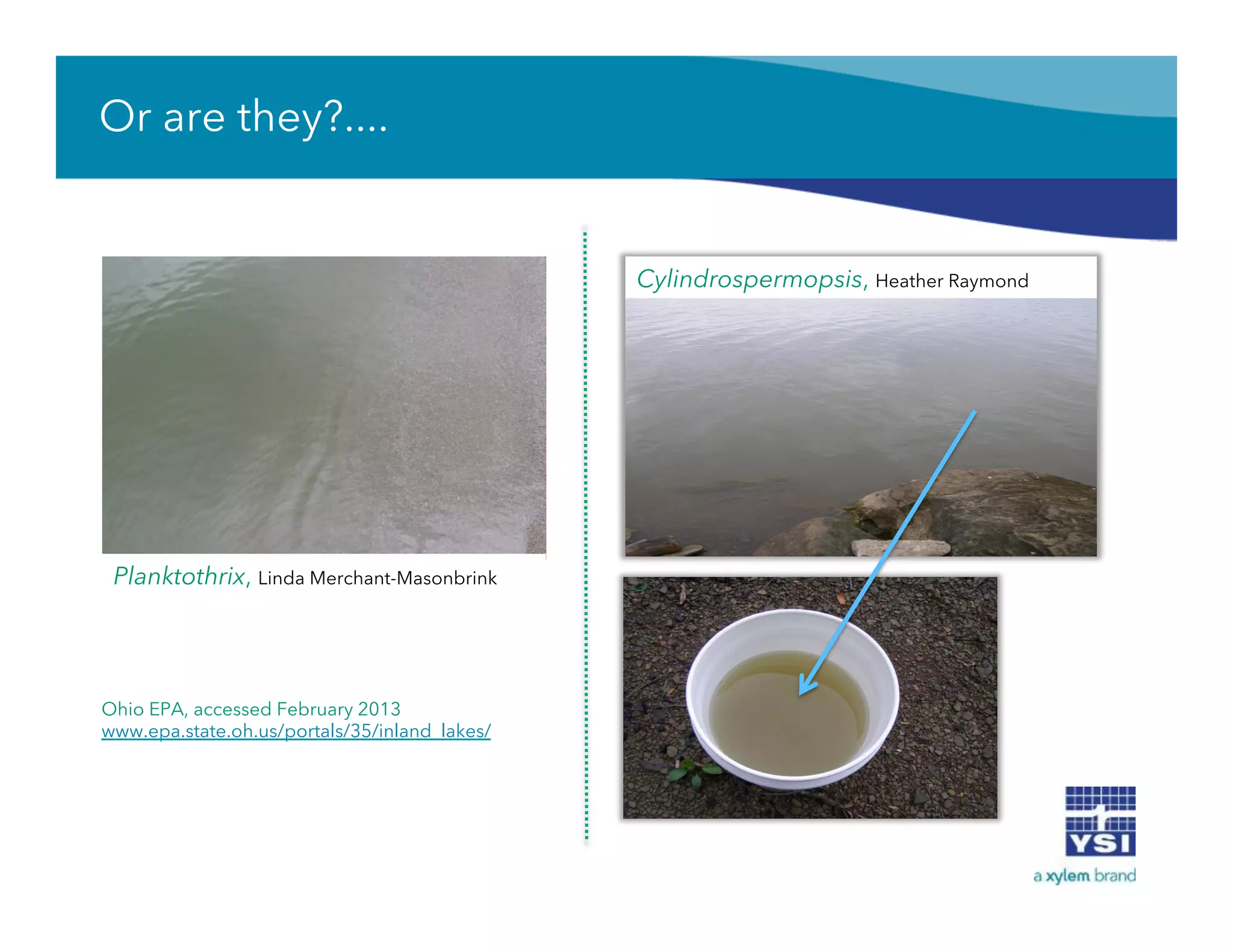
Or are they?....
Ohio EPA, accessed February 2013
www.epa.state.oh.us/portals/35/inland_lakes/
Planktothrix, Linda Merchant-Masonbrink
Cylindrospermopsis, Heather Raymond
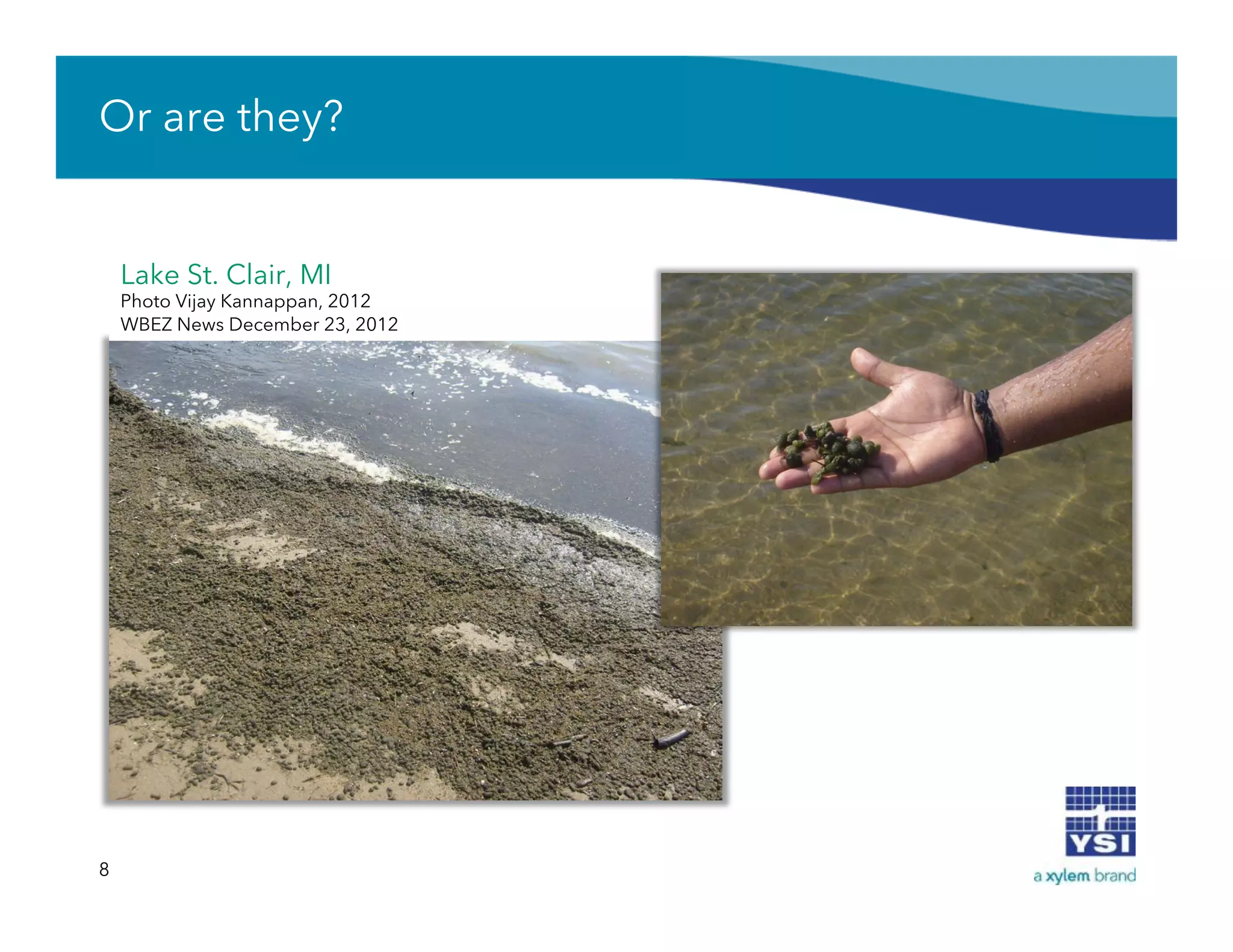
Or are they?
8
Lake St. Clair, MI
Photo Vijay Kannappan, 2012
WBEZ News December 23, 2012
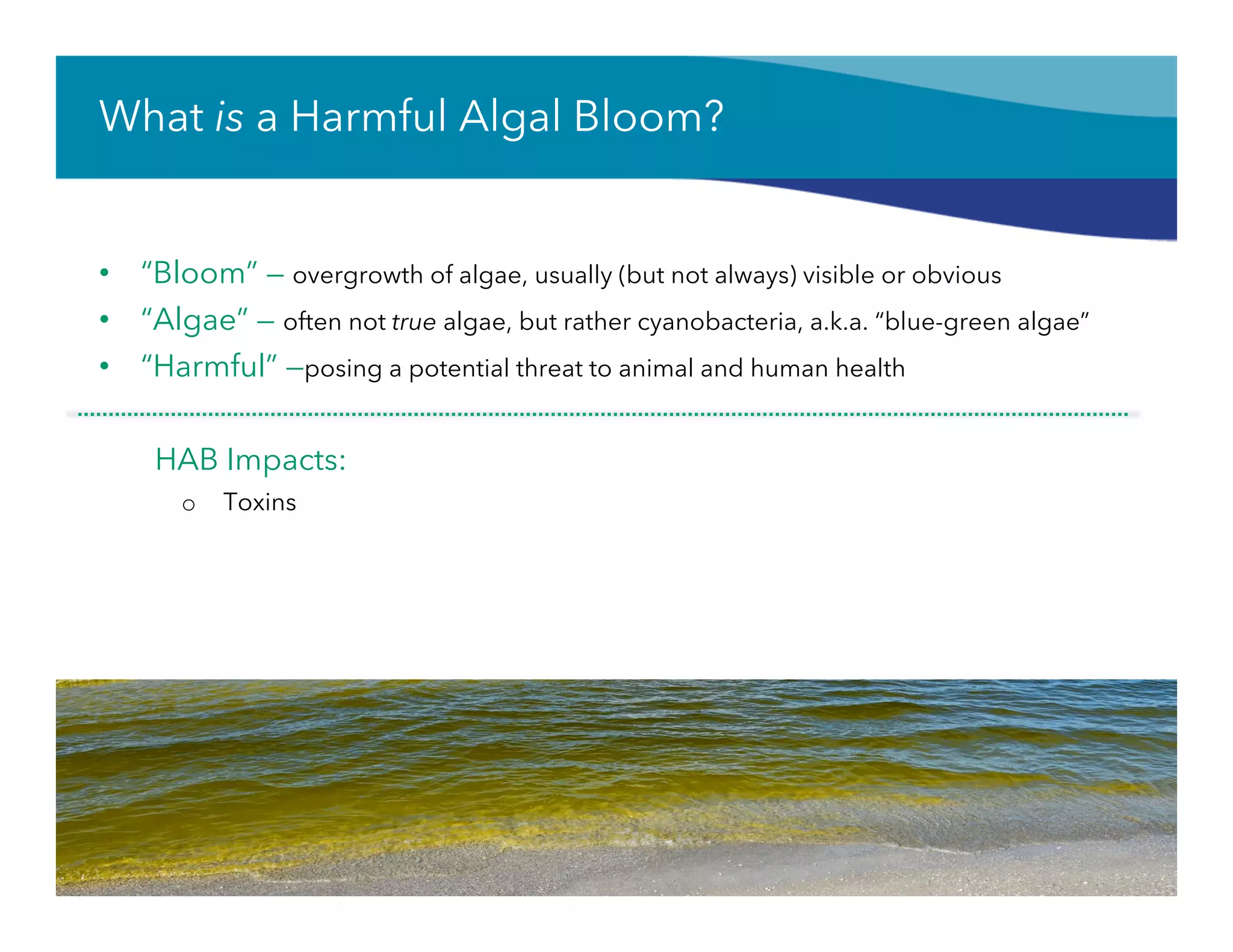
What is a Harmful Algal Bloom?
•  “Bloom” — overgrowth of algae, usually (but not always) visible or obvious
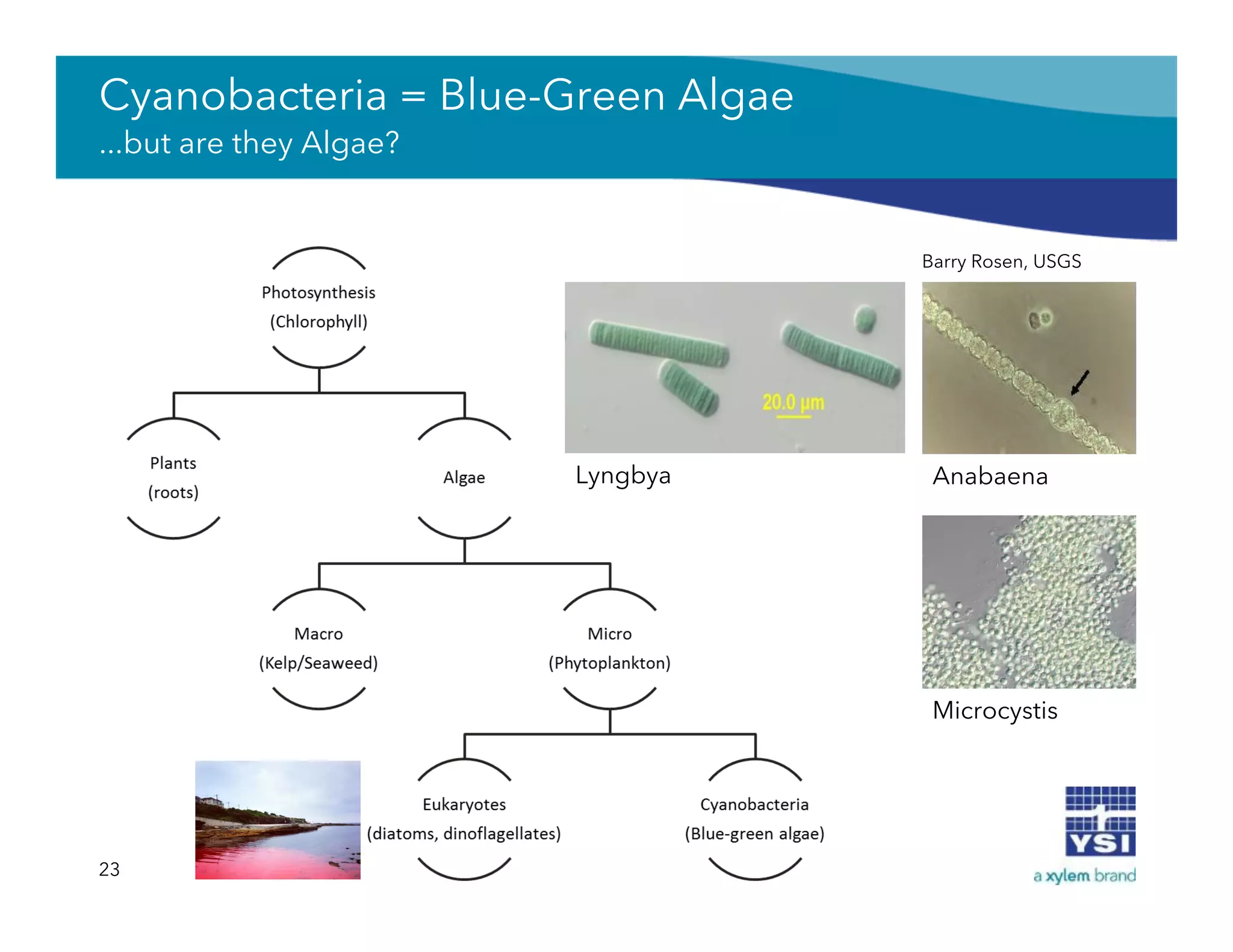
•  “Algae” — often not true algae, but rather cyanobacteria, a.k.a. “blue-green algae”
•  “Harmful” —posing a potential threat to animal and human health
HAB Impacts:
o  Toxins
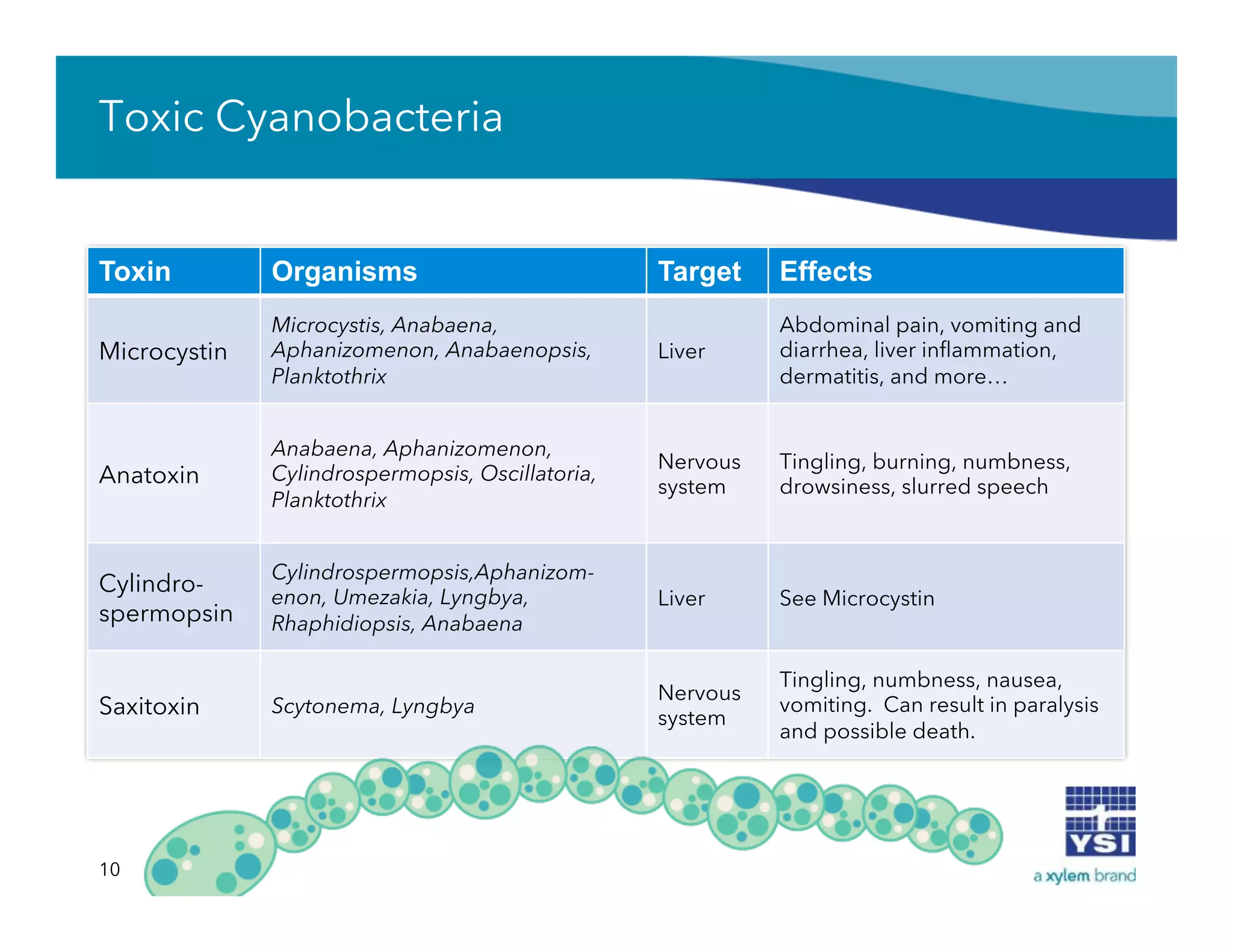
Toxic Cyanobacteria
10
Toxin Organisms Target Effects
Microcystin
Microcystis, Anabaena,
Aphanizomenon, Anabaenopsis,
Planktothrix
Liver
Abdominal pain, vomiting and
diarrhea, liver inflammation,
dermatitis, and more…
Anatoxin
Anabaena, Aphanizomenon,
Cylindrospermopsis, Oscillatoria,
Planktothrix
Nervous
system
Tingling, burning, numbness,
drowsiness, slurred speech
Cylindro-
spermopsin
Cylindrospermopsis,Aphanizom-
enon, Umezakia, Lyngbya,
Rhaphidiopsis, Anabaena
Liver See Microcystin
Saxitoxin Scytonema, Lyngbya
Nervous
system
Tingling, numbness, nausea,
vomiting. Can result in paralysis
and possible death.
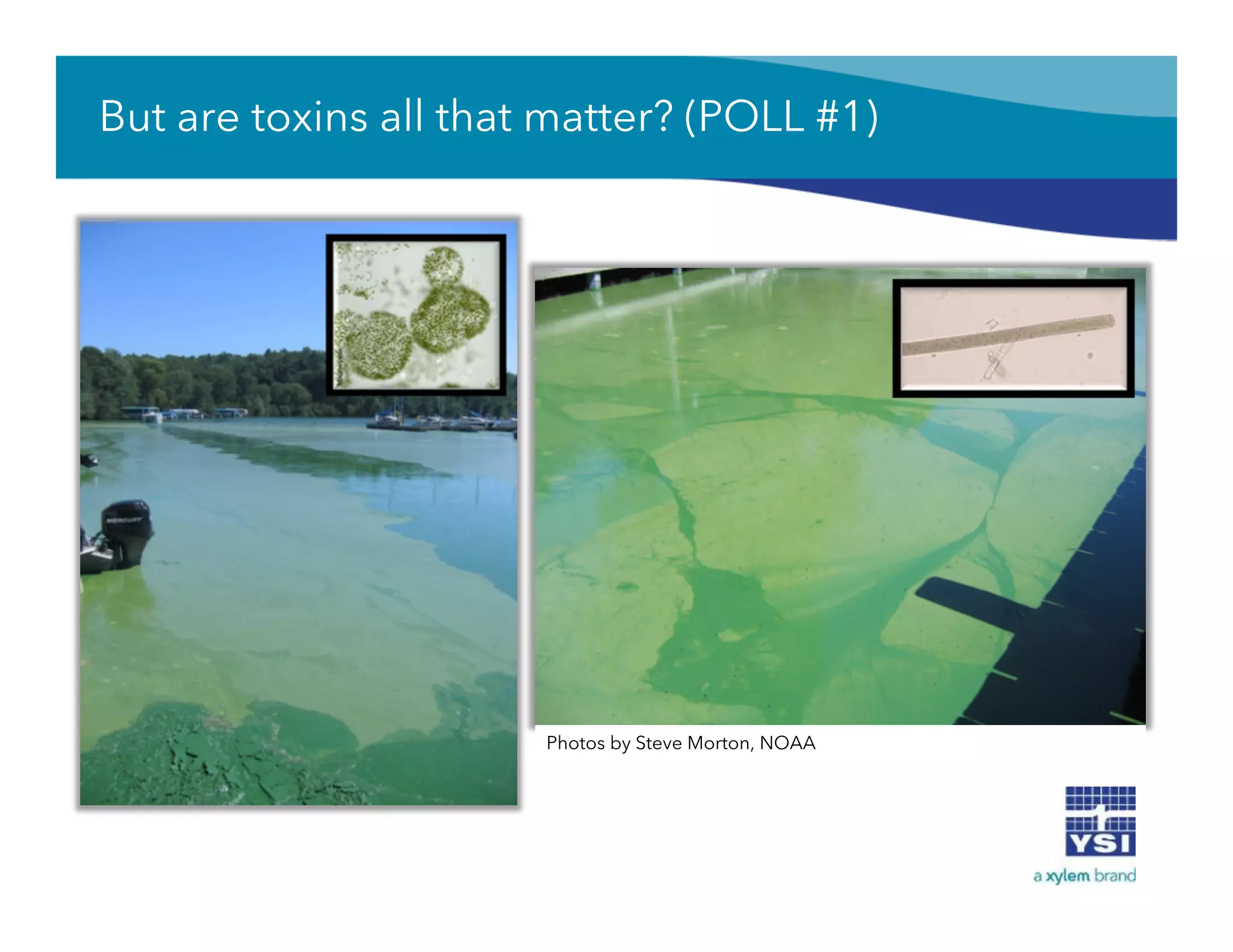
But are toxins all that matter? (POLL #1)
Photos by Steve Morton, NOAA
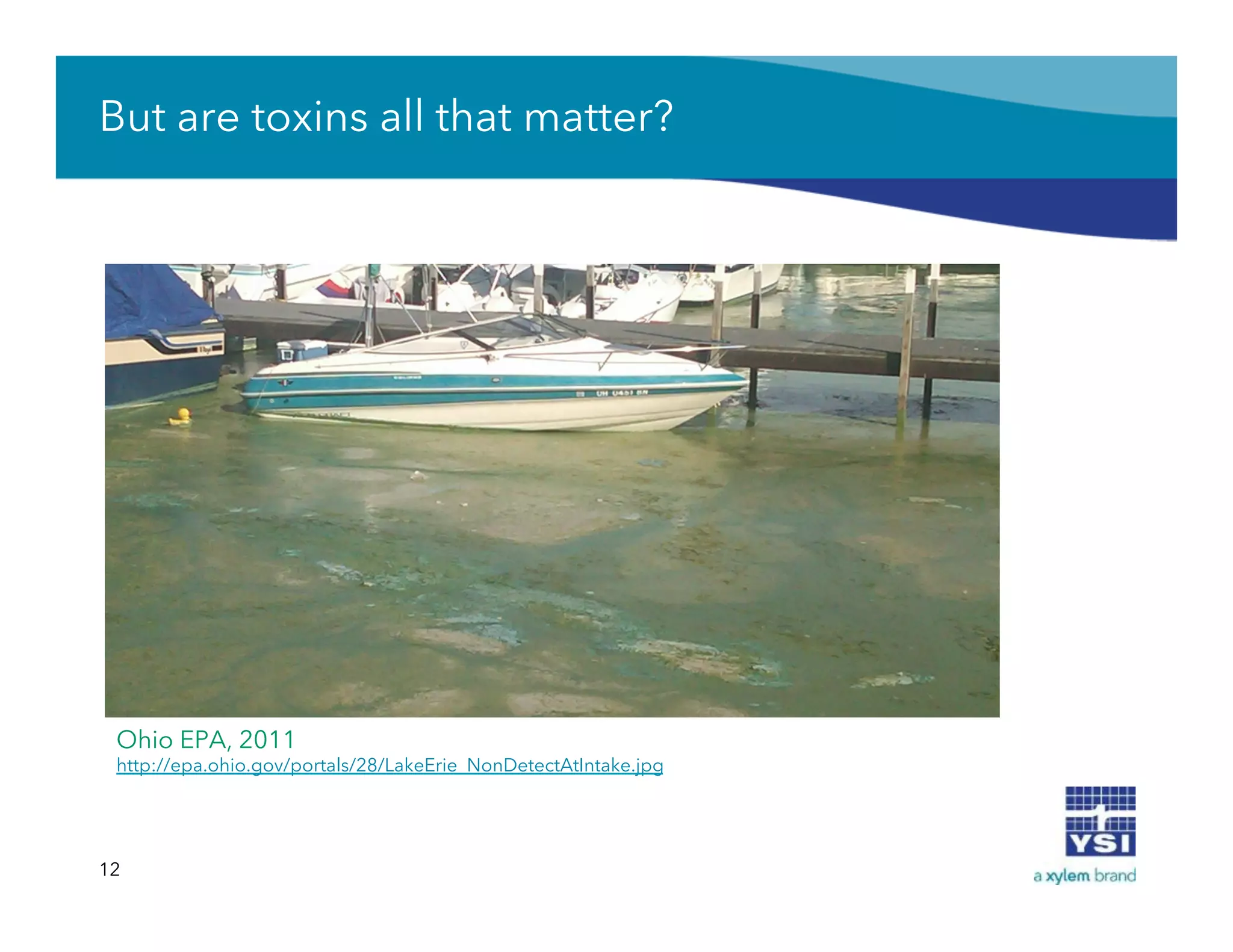
But are toxins all that matter?
12
Ohio EPA, 2011
http://epa.ohio.gov/portals/28/LakeErie_NonDetectAtIntake.jpg
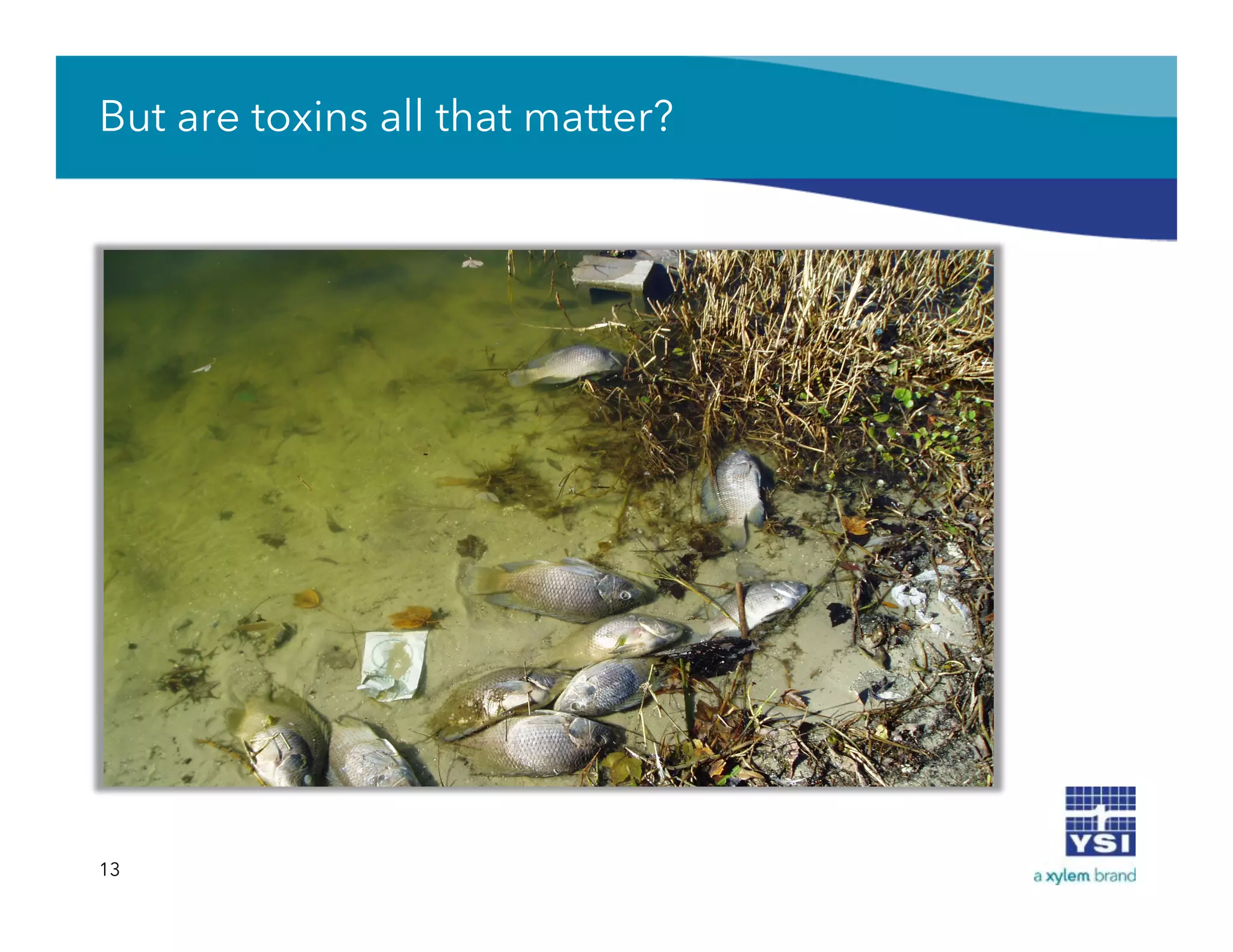
But are toxins all that matter?
13
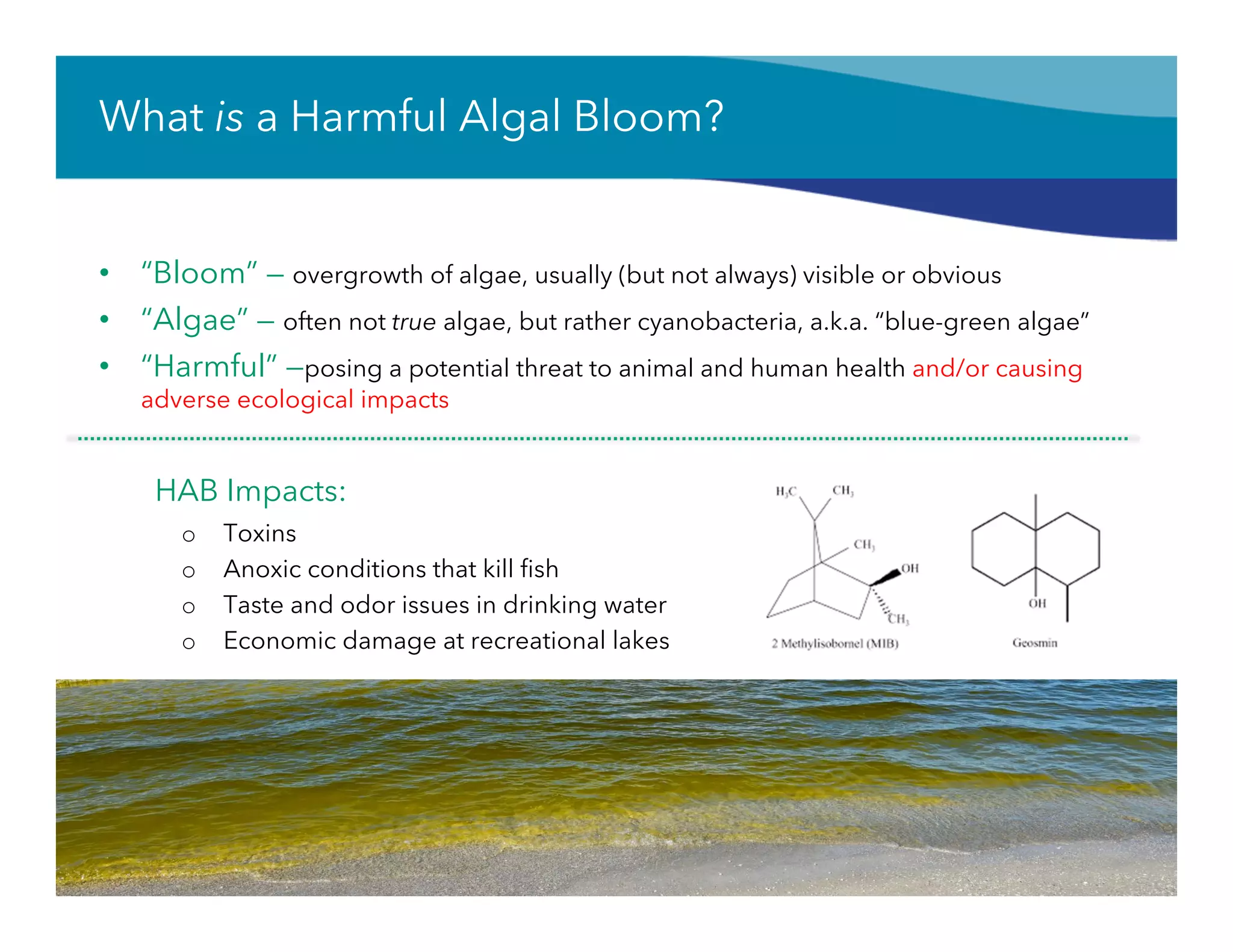
What is a Harmful Algal Bloom?
•  “Bloom” — overgrowth of algae, usually (but not always) visible or obvious
•  “Algae” — often not true algae, but rather cyanobacteria, a.k.a. “blue-green algae”
•  “Harmful” —posing a potential threat to animal and human health and/or causing
adverse ecological impacts
HAB Impacts:
o  Toxins
o  Anoxic conditions that kill fish
o  Taste and odor issues in drinking water
o  Economic damage at recreational lakes
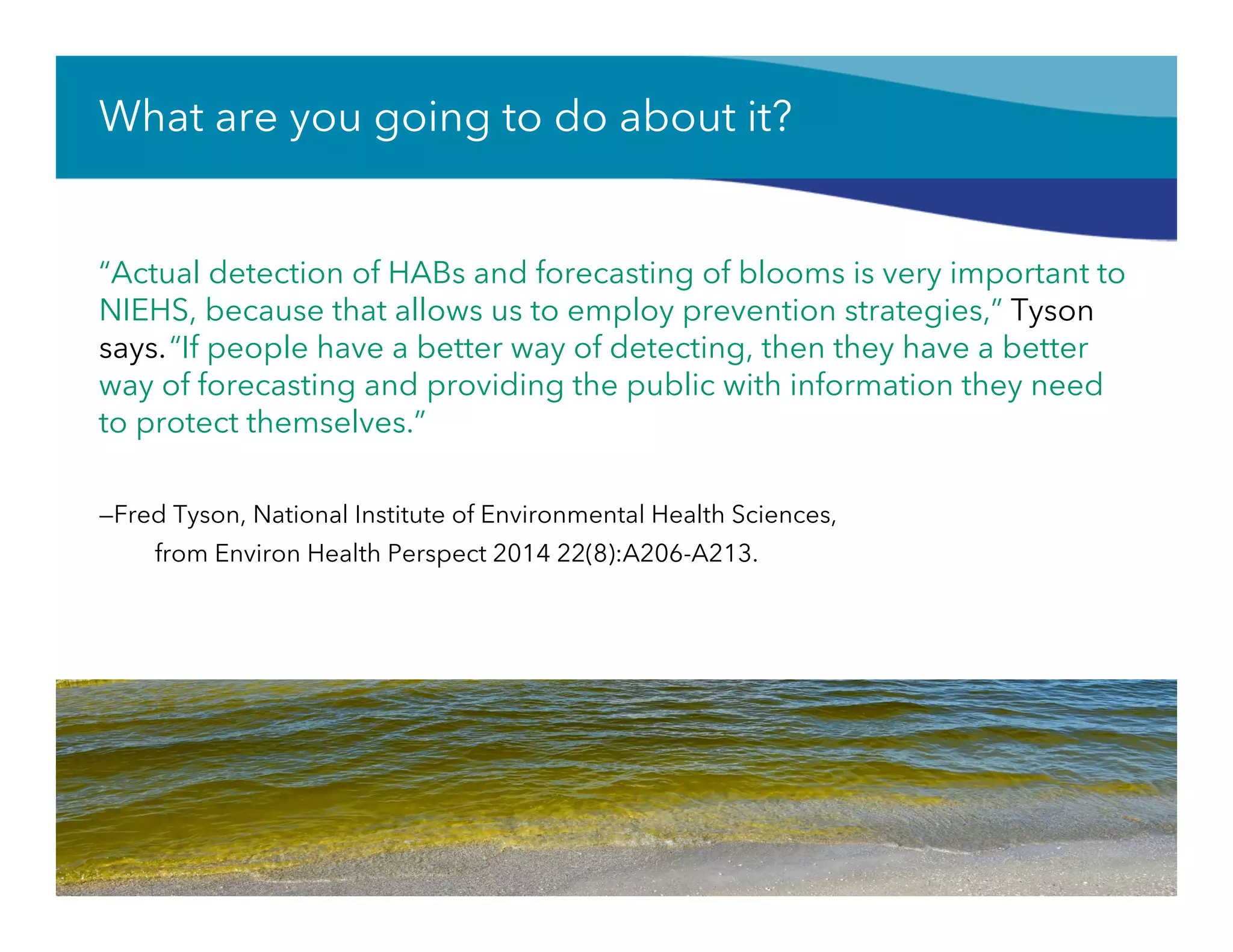
What are you going to do about it?
“Actual detection of HABs and forecasting of blooms is very important to
NIEHS, because that allows us to employ prevention strategies,” Tyson
says.“If people have a better way of detecting, then they have a better
way of forecasting and providing the public with information they need
to protect themselves.”
—Fred Tyson, National Institute of Environmental Health Sciences,
from Environ Health Perspect 2014 22(8):A206-A213.
15
What are you going to do about it?
16
But what are you going to detect?
17
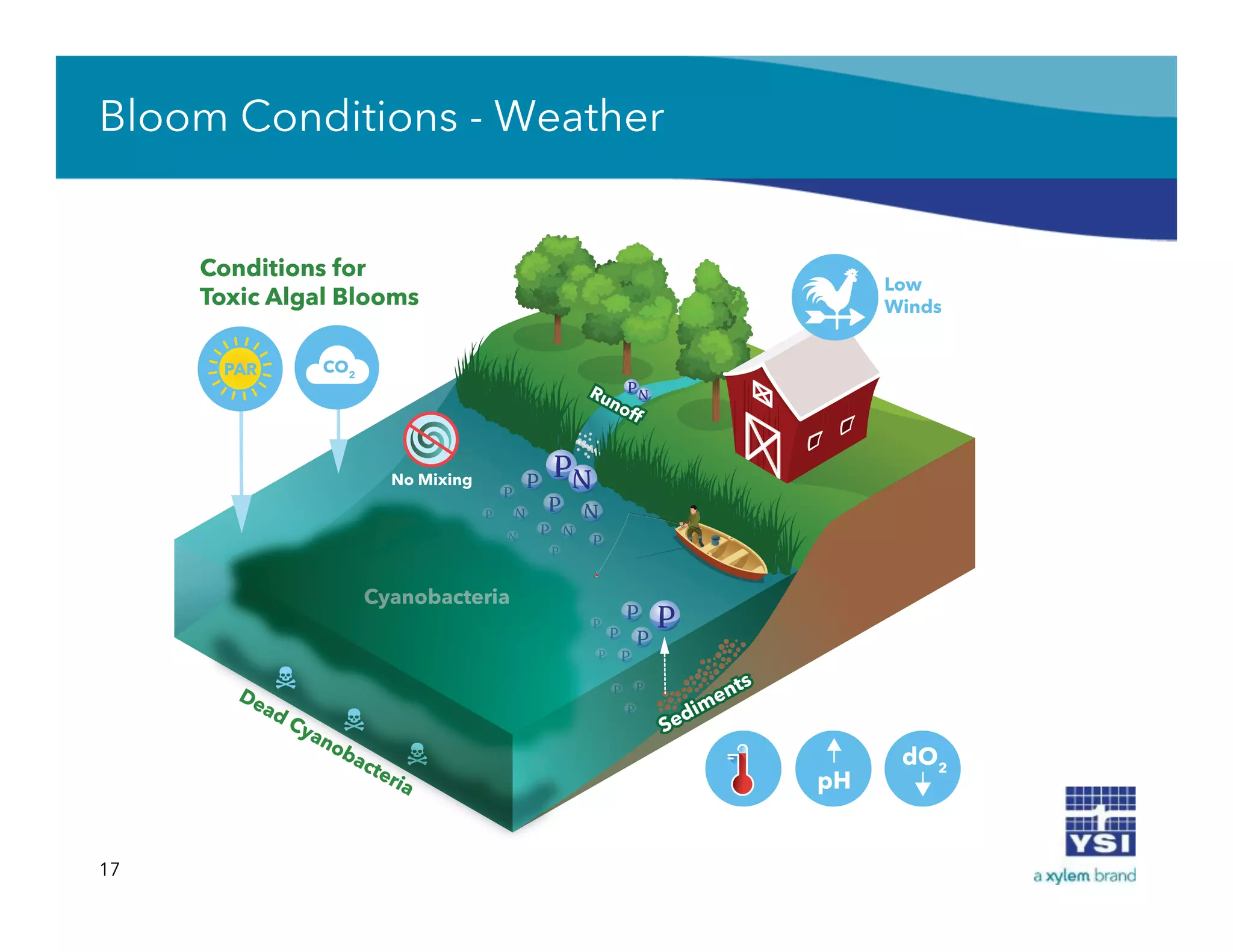
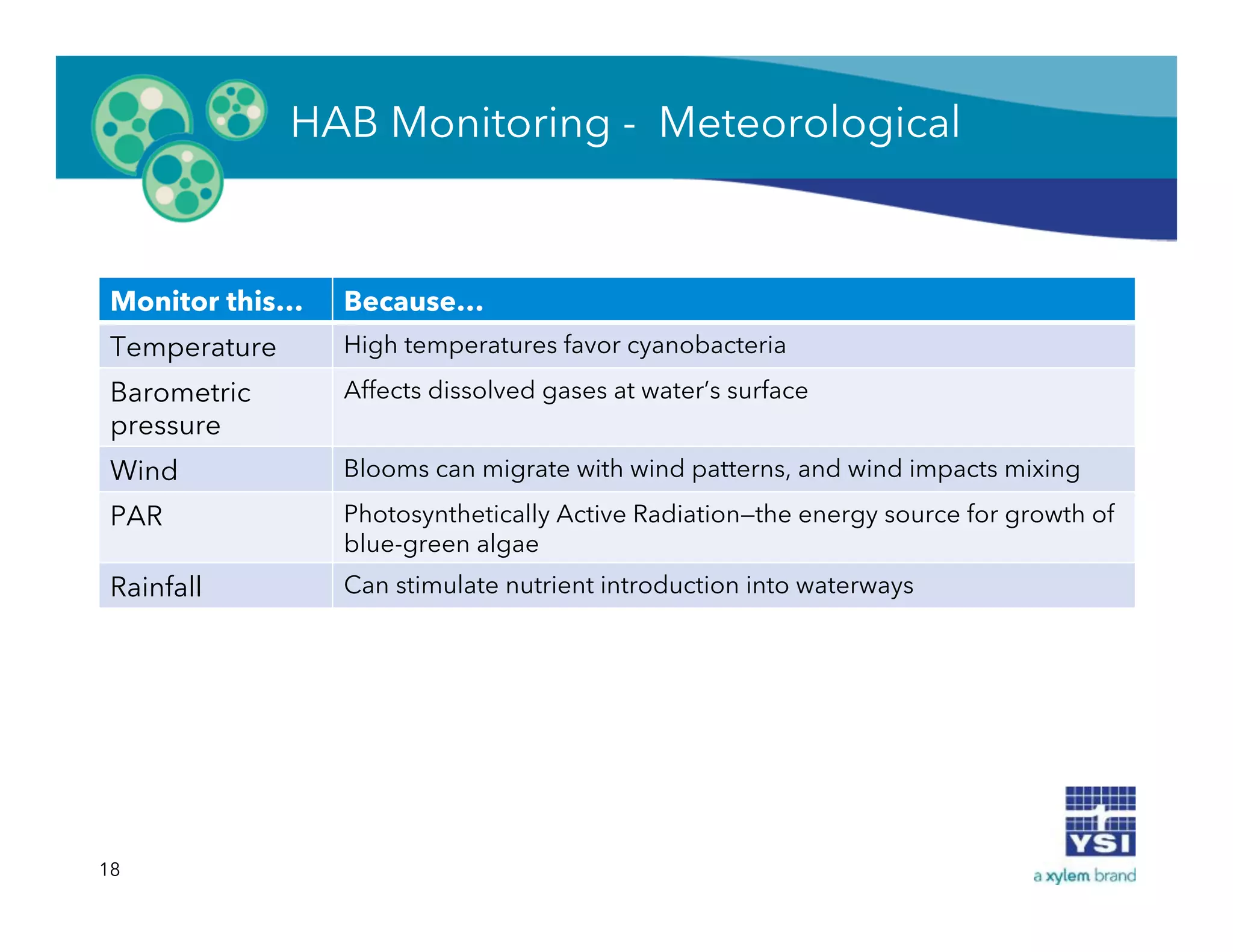
Bloom Conditions - Weather
Monitor this… Because…
Temperature High temperatures favor cyanobacteria
Barometric
pressure
Affects dissolved gases at water’s surface
Wind Blooms can migrate with wind patterns, and wind impacts mixing
PAR Photosynthetically Active Radiation—the energy source for growth of
blue-green algae
Rainfall Can stimulate nutrient introduction into waterways
18
HAB Monitoring - Meteorological
19
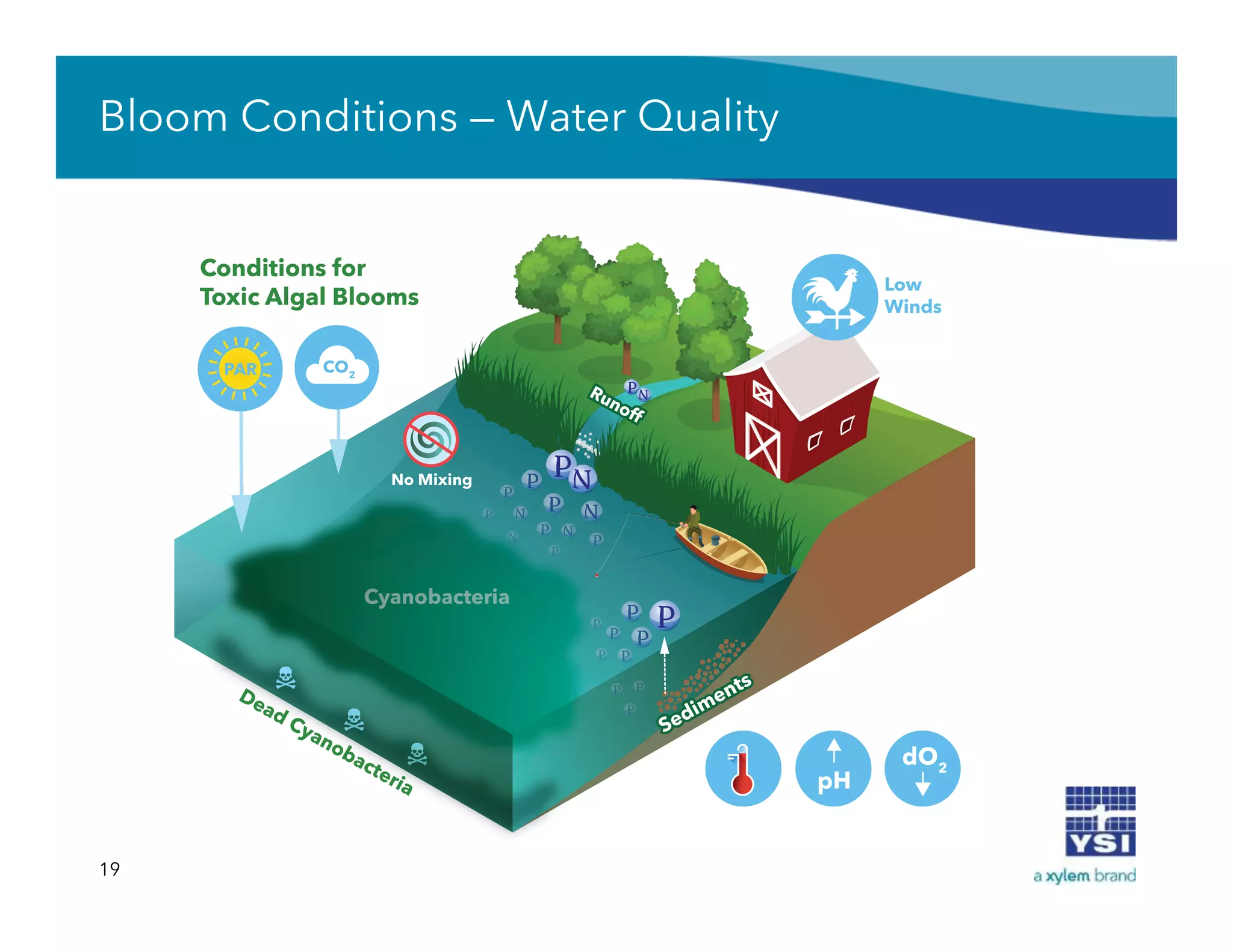
Bloom Conditions — Water Quality
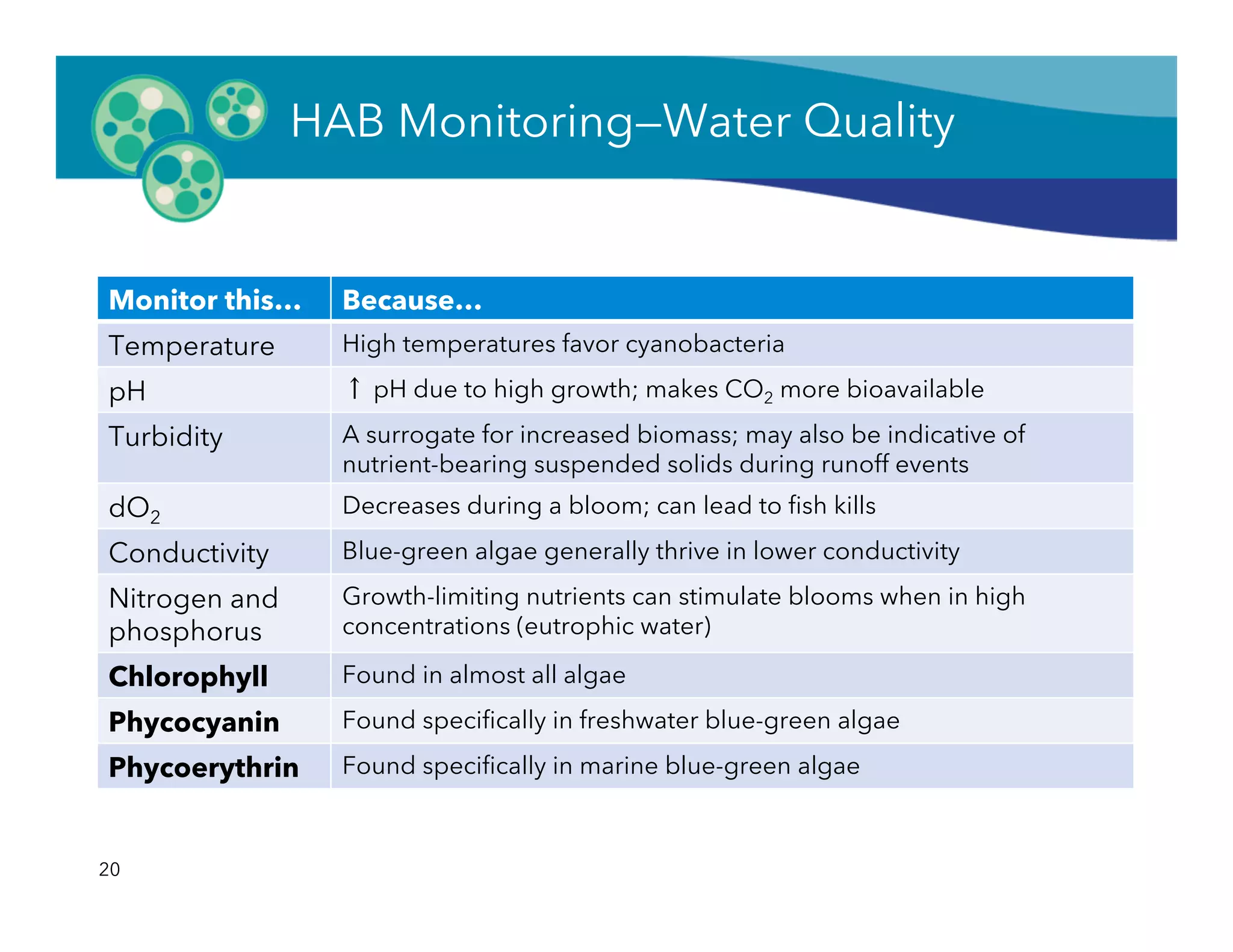
Monitor this… Because…
Temperature High temperatures favor cyanobacteria
pH ↑ pH due to high growth; makes CO2 more bioavailable
Turbidity A surrogate for increased biomass; may also be indicative of
nutrient-bearing suspended solids during runoff events
dO2
Decreases during a bloom; can lead to fish kills
Conductivity Blue-green algae generally thrive in lower conductivity
Nitrogen and
phosphorus
Growth-limiting nutrients can stimulate blooms when in high
concentrations (eutrophic water)
Chlorophyll Found in almost all algae
Phycocyanin Found specifically in freshwater blue-green algae
Phycoerythrin Found specifically in marine blue-green algae
20
HAB Monitoring—Water Quality
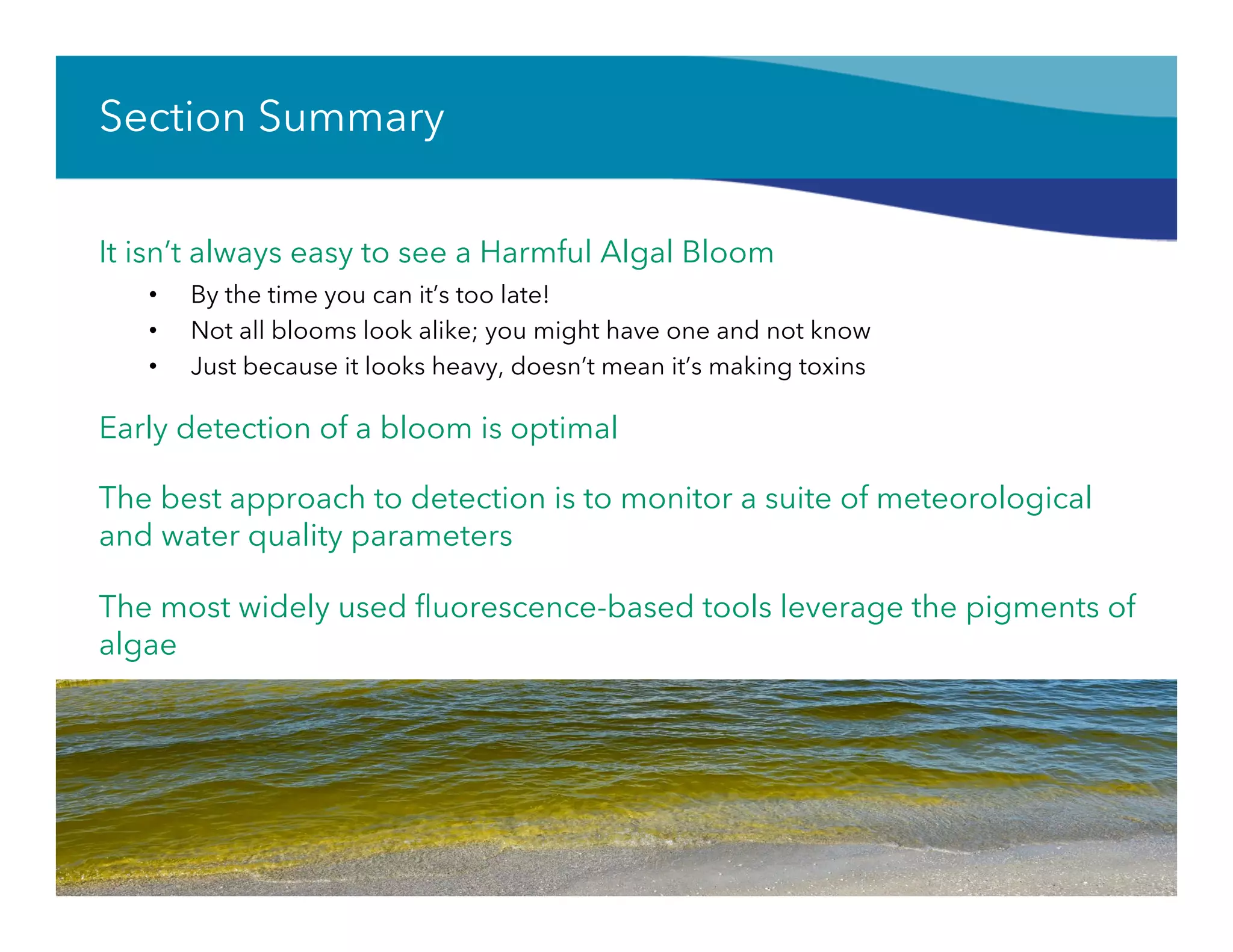
Section Summary
It isn’t always easy to see a Harmful Algal Bloom
•  By the time you can it’s too late!
•  Not all blooms look alike; you might have one and not know
•  Just because it looks heavy, doesn’t mean it’s making toxins
Early detection of a bloom is optimal
The best approach to detection is to monitor a suite of meteorological
and water quality parameters
The most widely used fluorescence-based tools leverage the pigments of
algae
Understanding
Algal Pigments
22
Cyanobacteria = Blue-Green Algae
...but are they Algae?
23
Barry Rosen, USGS
AnabaenaLyngbya
Microcystis
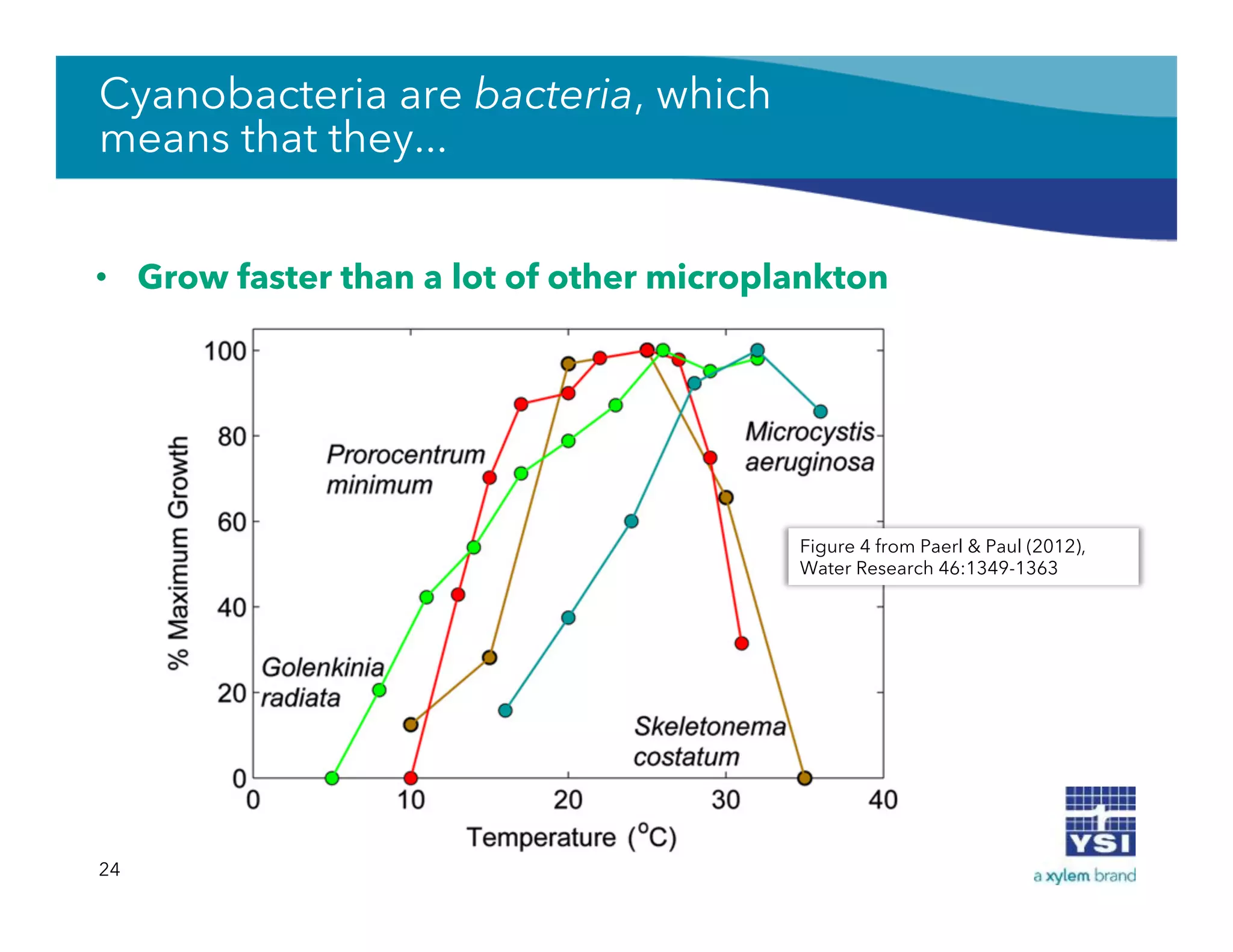
Cyanobacteria are bacteria, which
means that they...
•  Grow faster than a lot of other microplankton
24
Figure 4 from Paerl & Paul (2012),
Water Research 46:1349-1363
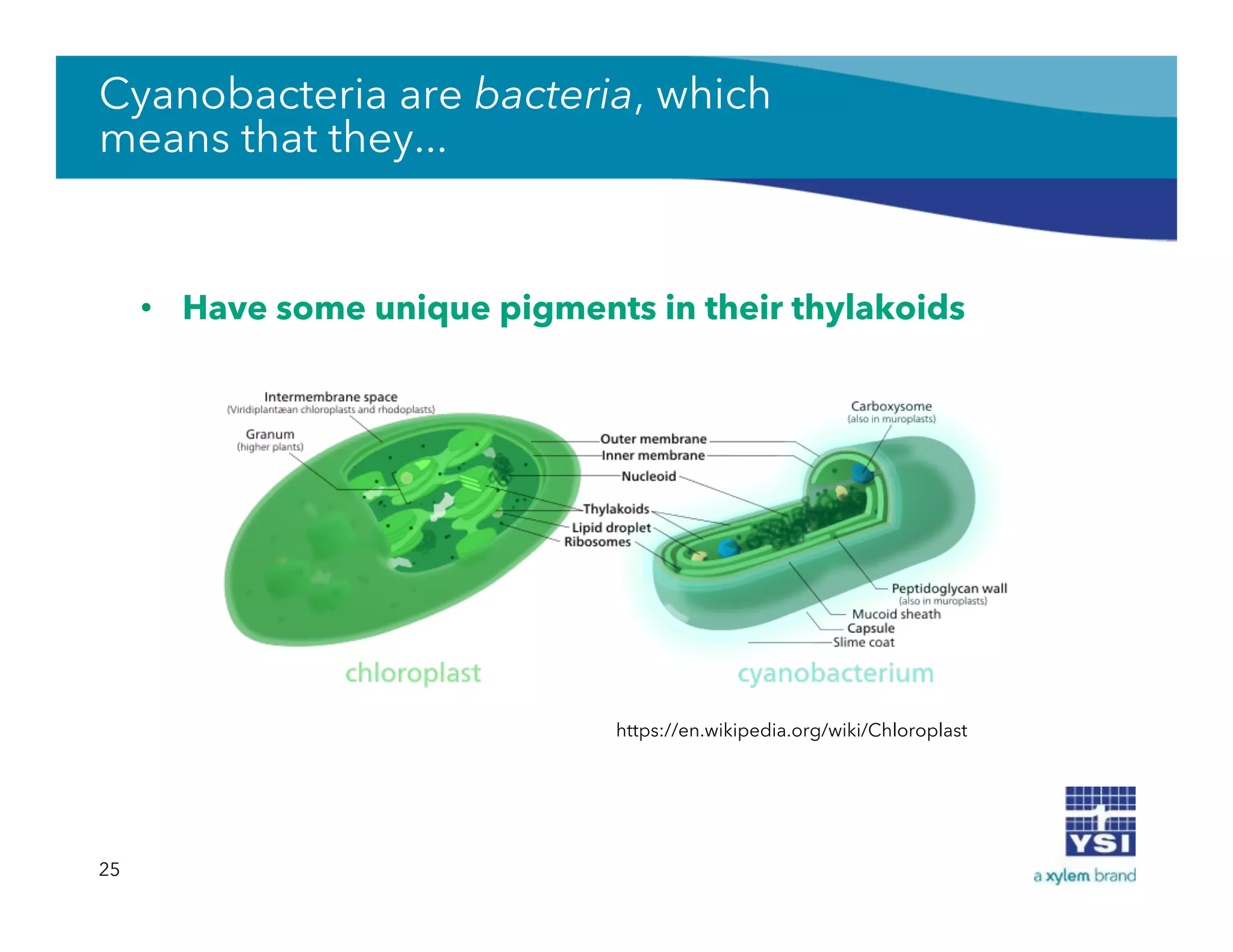
25
https://en.wikipedia.org/wiki/Chloroplast
Cyanobacteria are bacteria, which
means that they...
•  Have some unique pigments in their thylakoids
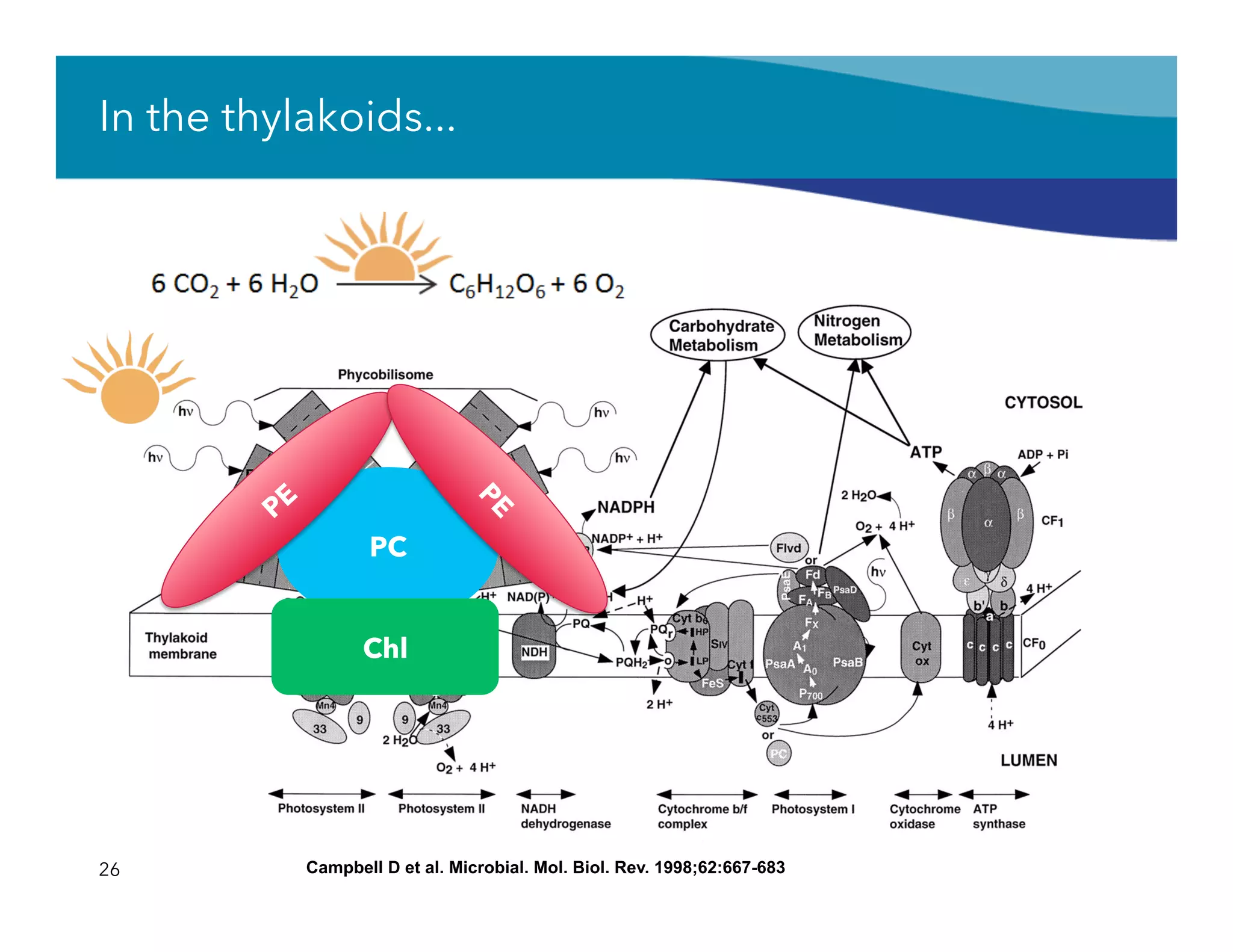
In the thylakoids...
26 Campbell D et al. Microbial. Mol. Biol. Rev. 1998;62:667-683
PC
Chl
27
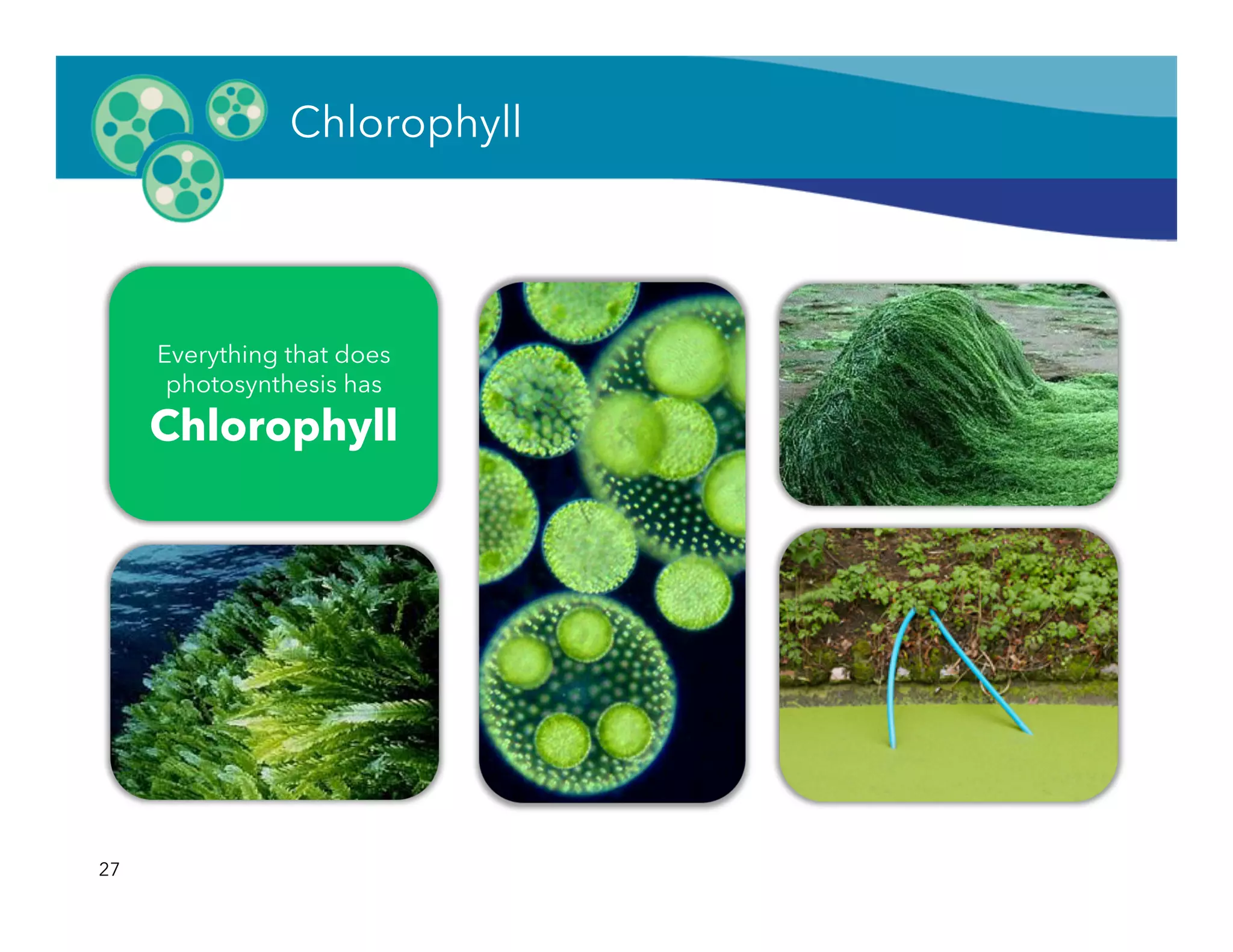
Everything that does
photosynthesis has
Chlorophyll
Chlorophyll
28
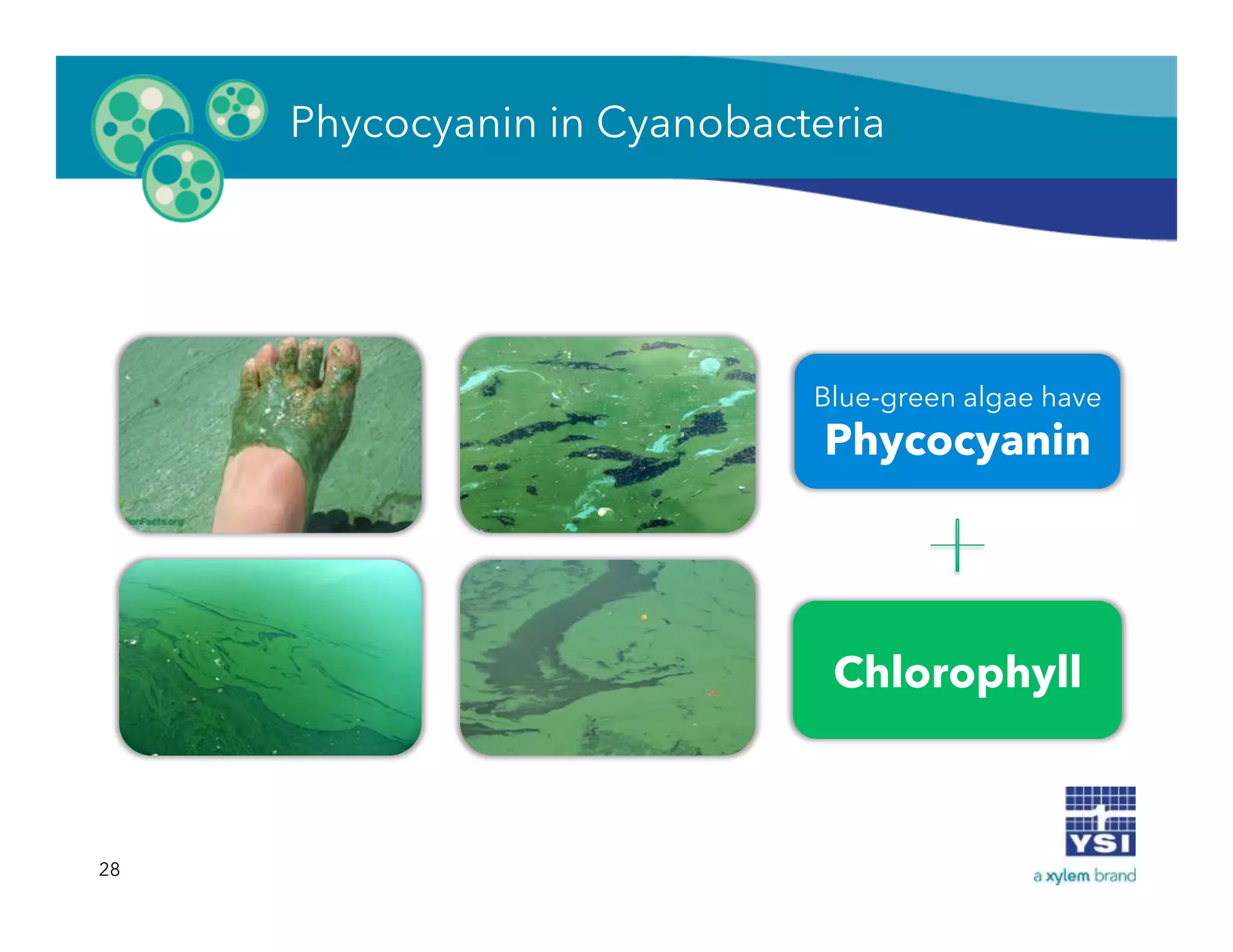
Chlorophyll
Blue-green algae have
Phycocyanin
Phycocyanin in Cyanobacteria
29
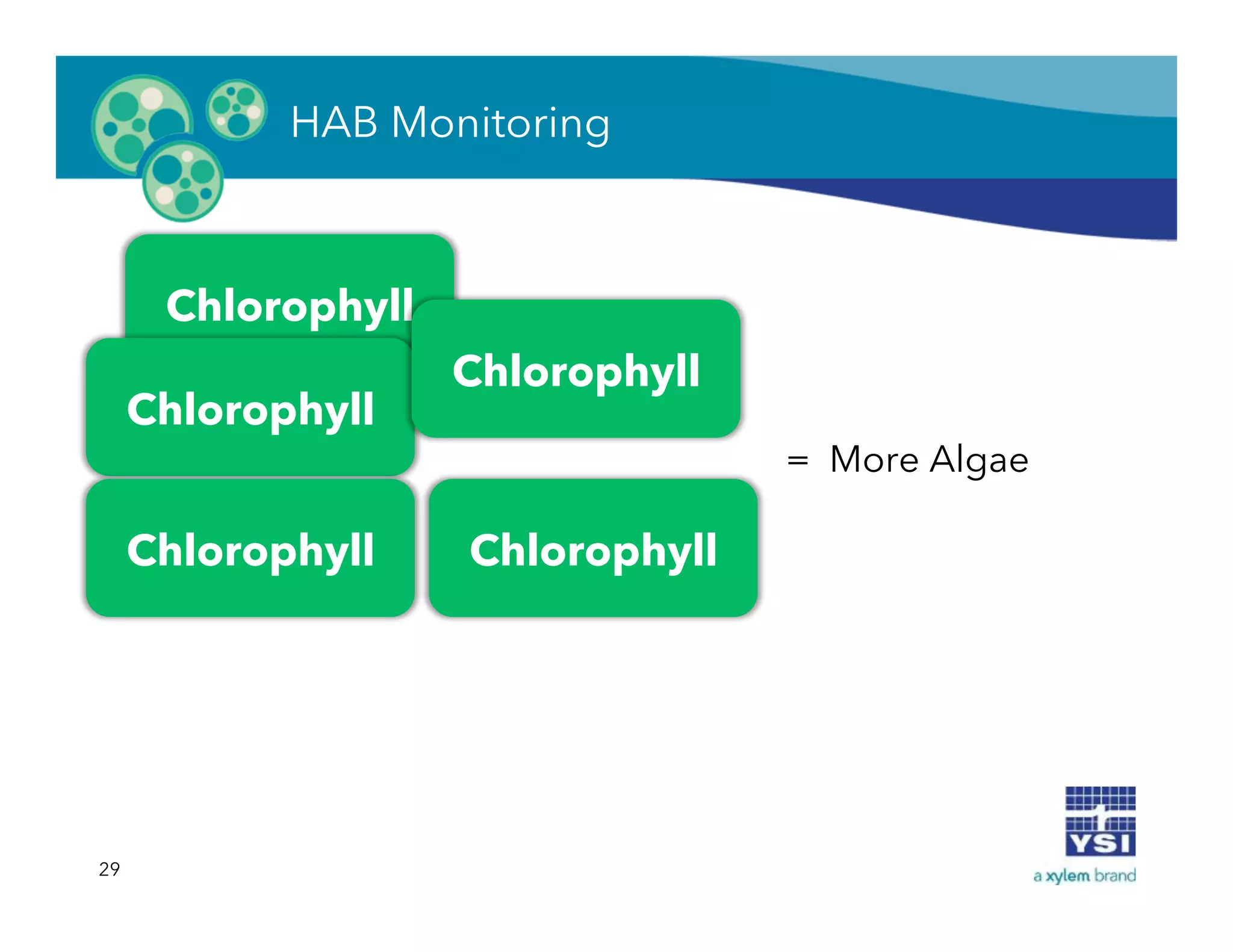
HAB Monitoring
Chlorophyll
Chlorophyll
Chlorophyll
ChlorophyllChlorophyll
= More Algae
30
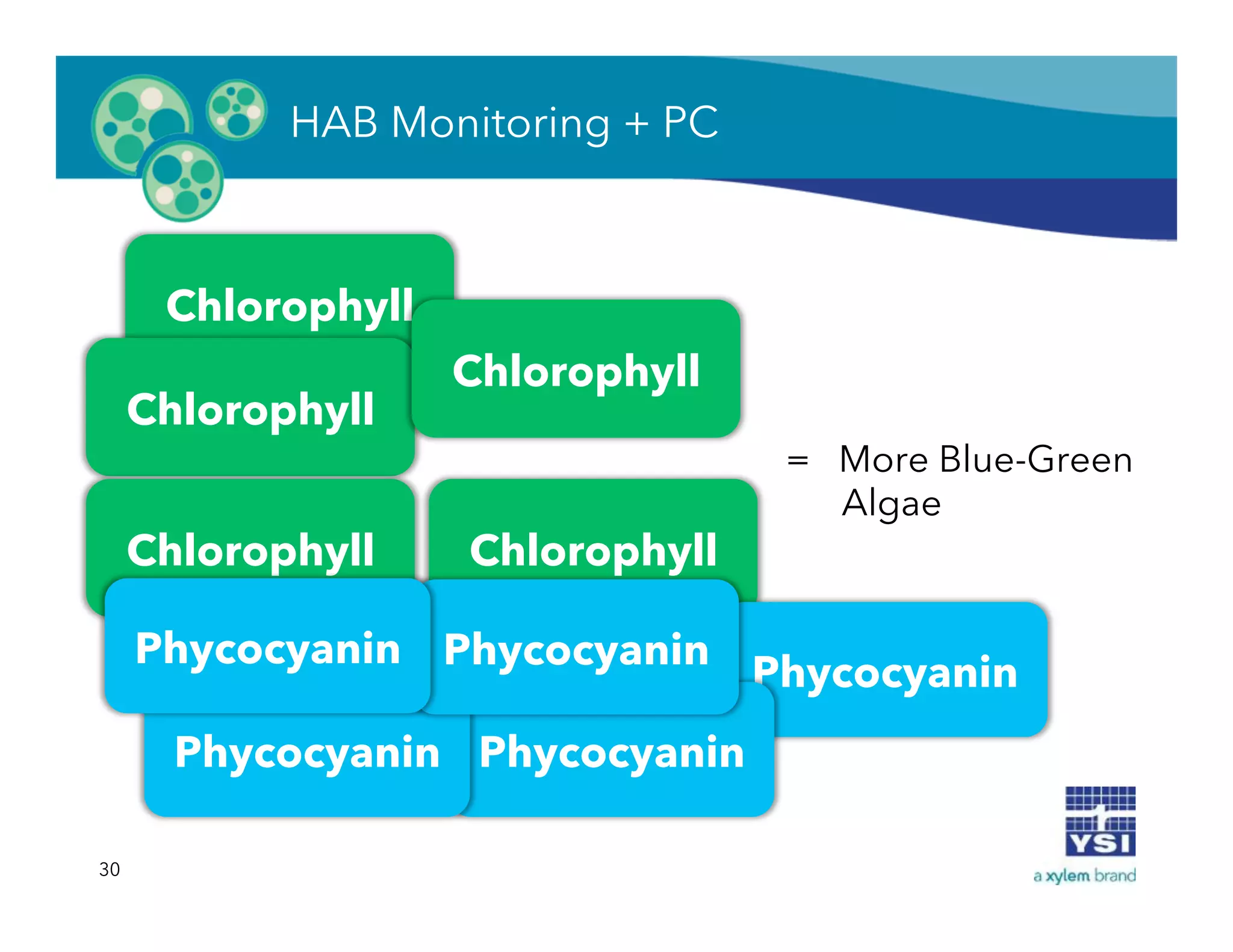
HAB Monitoring + PC
Chlorophyll
Chlorophyll
Chlorophyll
ChlorophyllChlorophyll
= More Blue-Green
Algae
Phycocyanin
PhycocyaninPhycocyanin
31
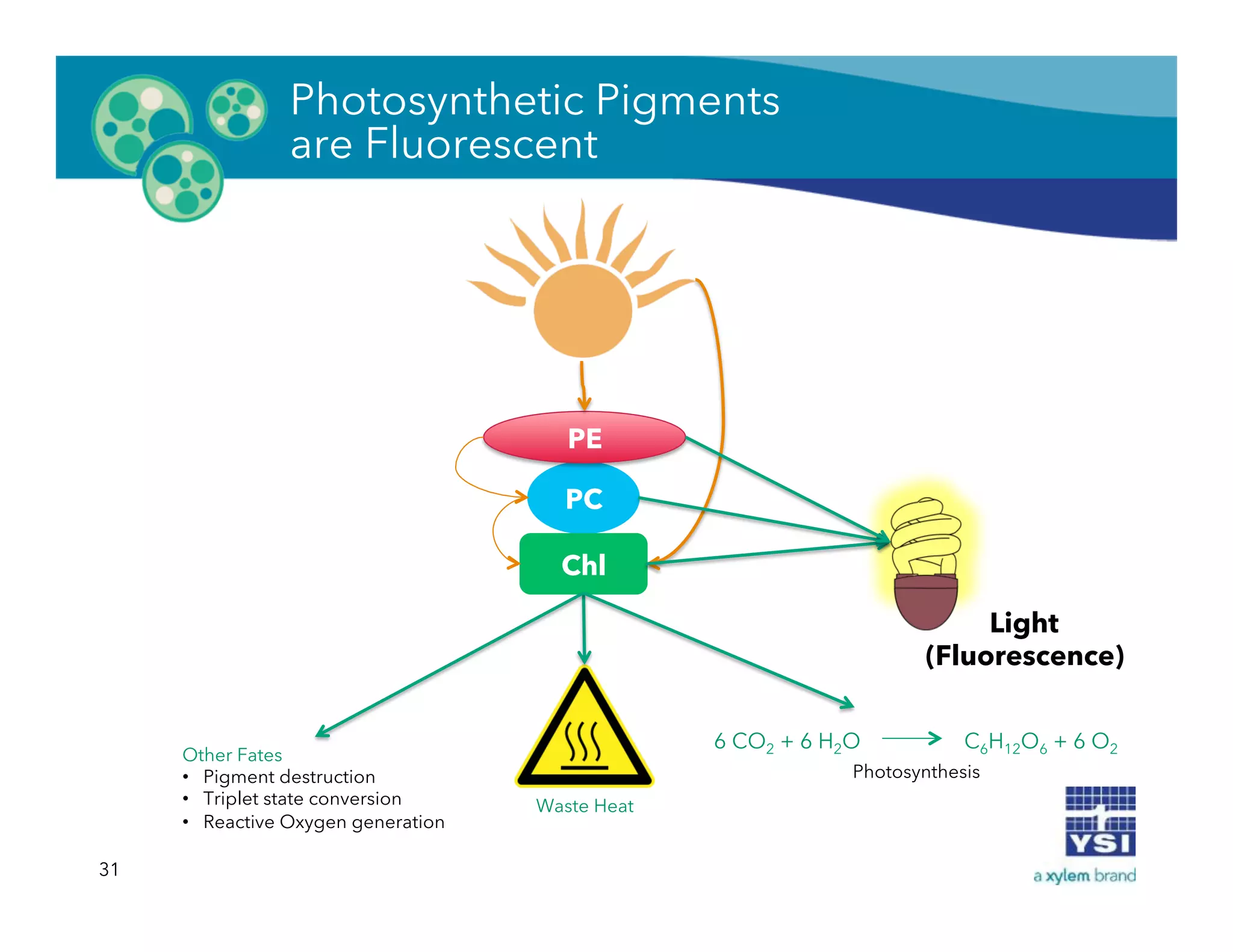
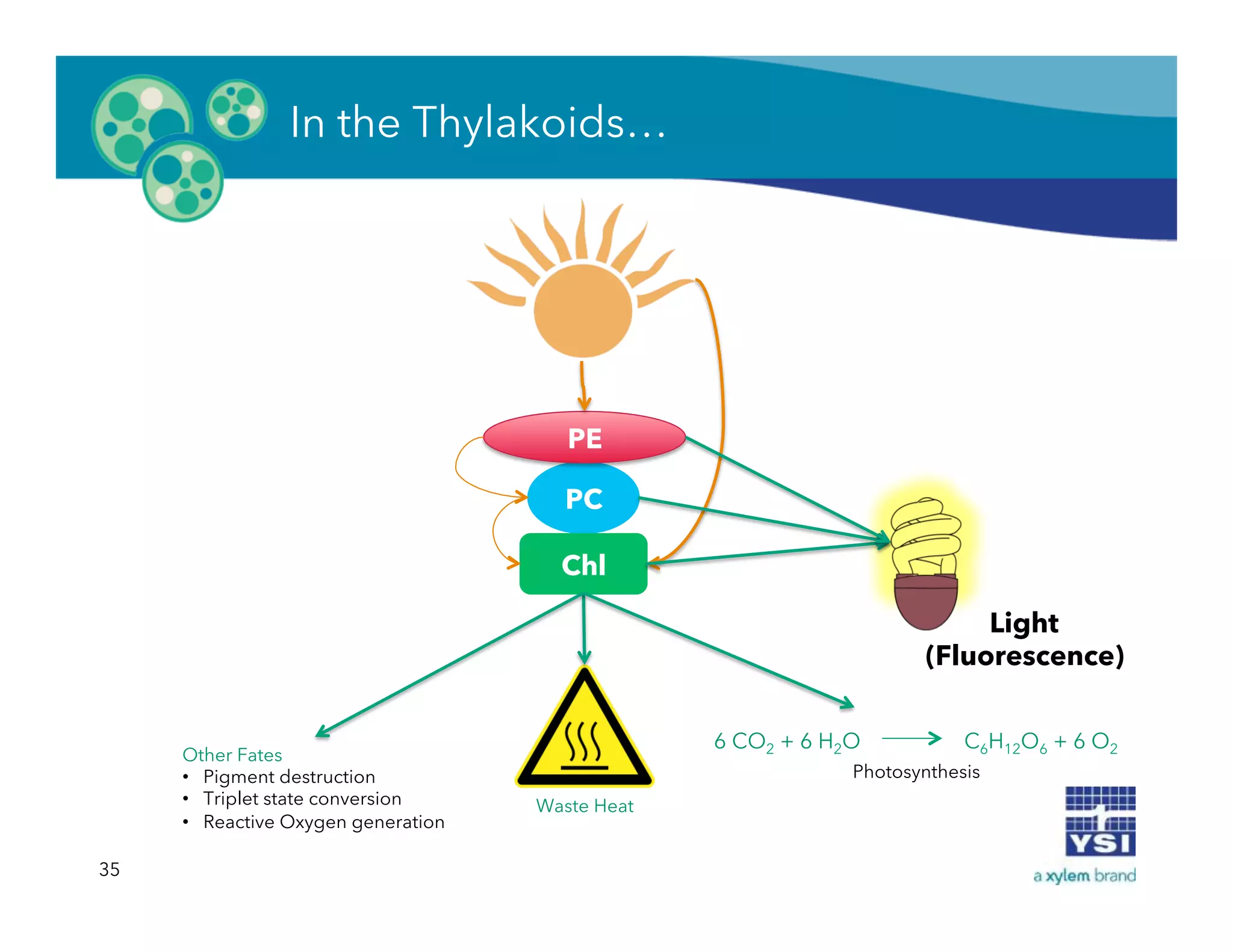
Waste Heat
6 CO2 + 6 H2O C6H12O6 + 6 O2
Photosynthesis
Other Fates
•  Pigment destruction
•  Triplet state conversion
•  Reactive Oxygen generation
Light
(Fluorescence)
Photosynthetic Pigments
are Fluorescent
PC
Chl
PE
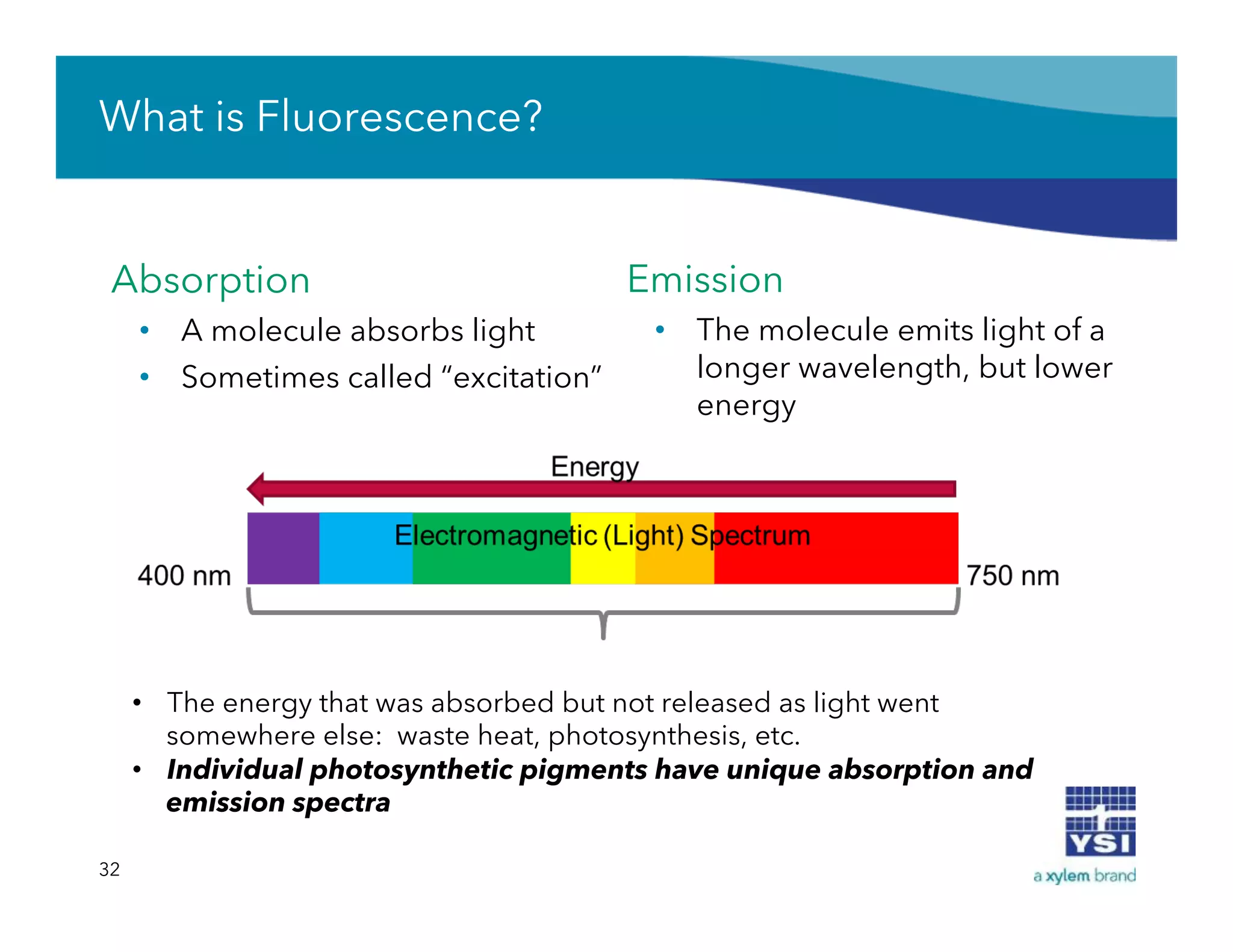
What is Fluorescence?
Absorption
•  A molecule absorbs light
•  Sometimes called “excitation”
32
Emission
•  The molecule emits light of a
longer wavelength, but lower
energy
•  The energy that was absorbed but not released as light went
somewhere else: waste heat, photosynthesis, etc.
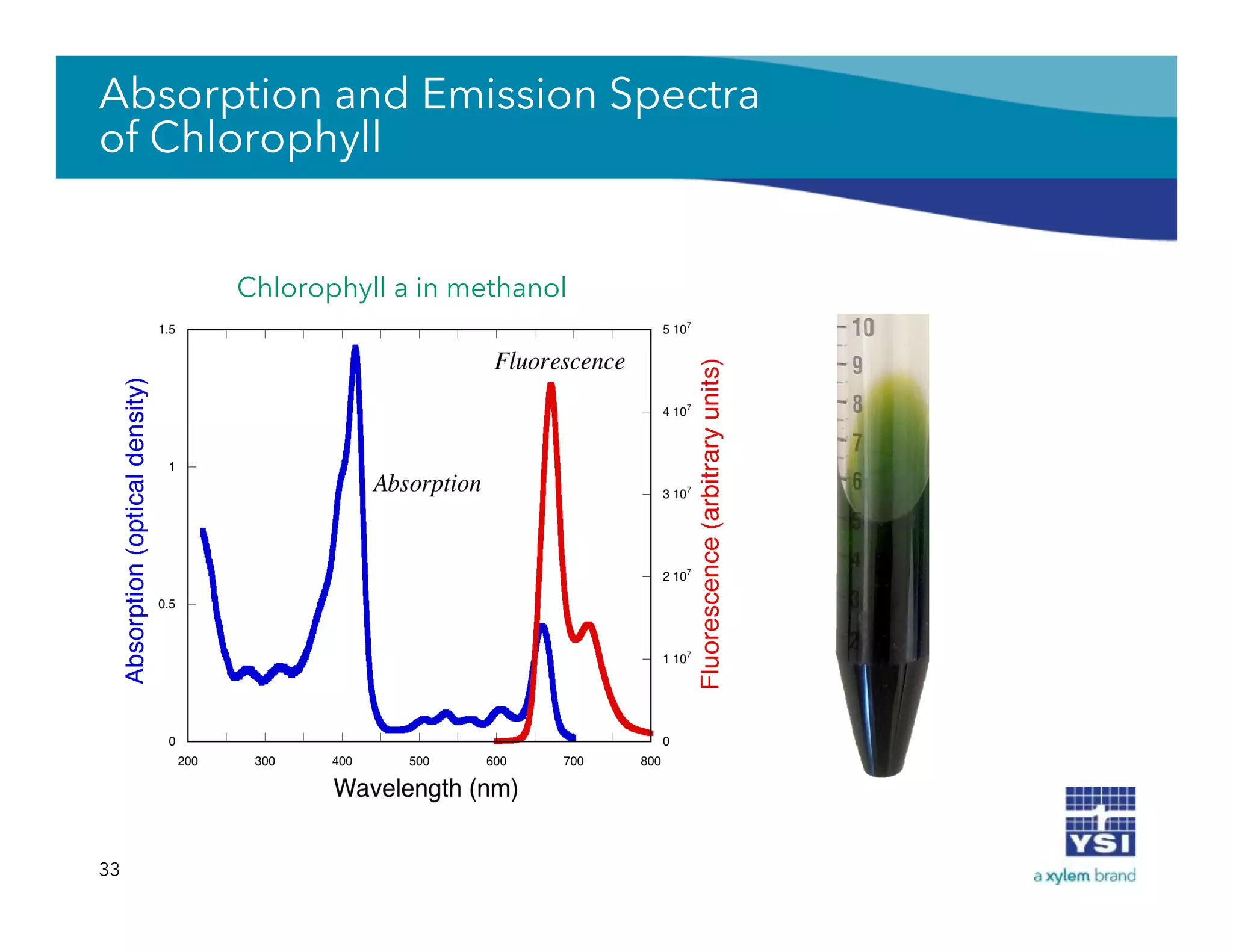
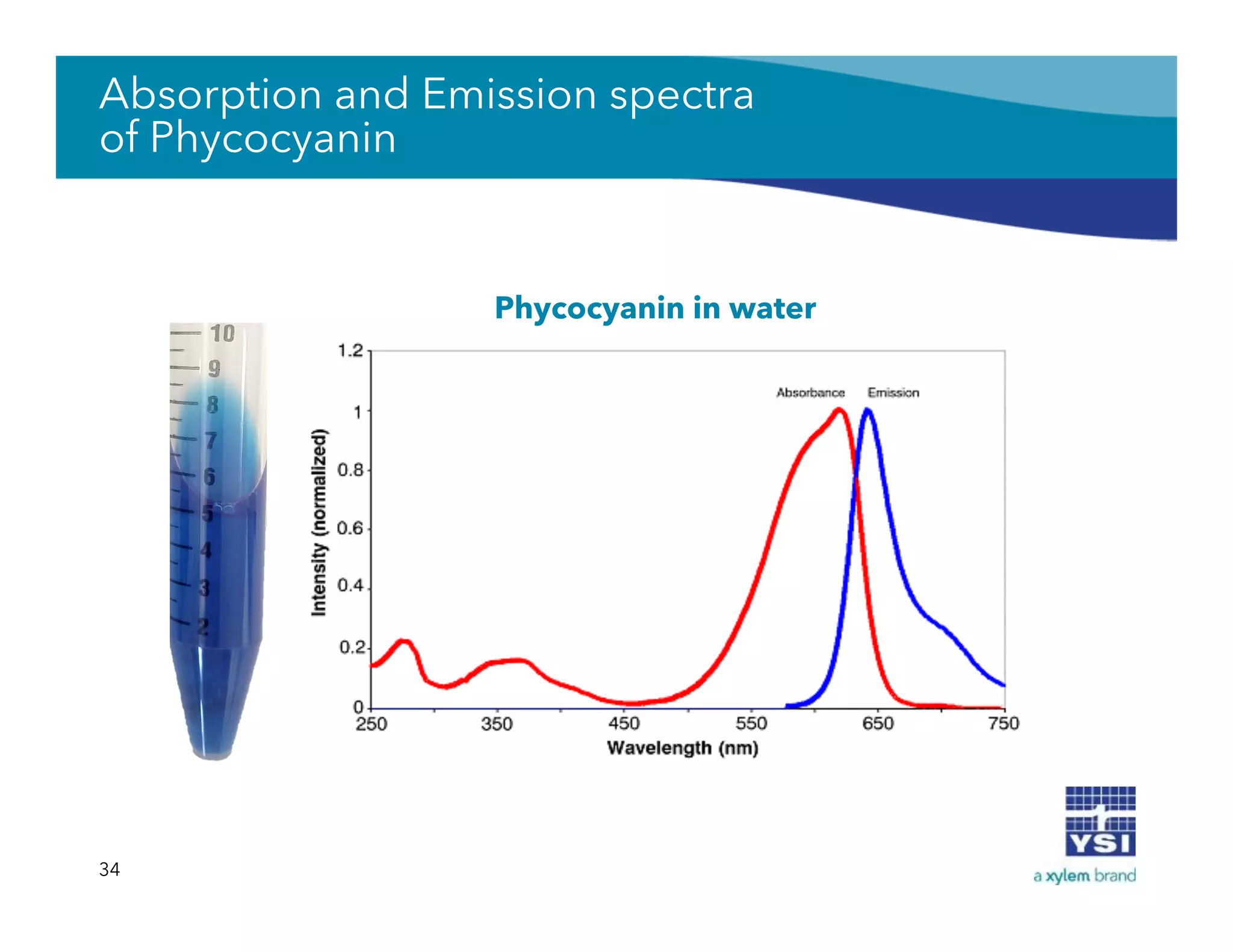
•  Individual photosynthetic pigments have unique absorption and
emission spectra
Absorption and Emission Spectra
of Chlorophyll
33
Chlorophyll a in methanol
Absorption and Emission spectra
of Phycocyanin
34
Phycocyanin in water
35
Waste Heat
6 CO2 + 6 H2O C6H12O6 + 6 O2
Photosynthesis
Other Fates
•  Pigment destruction
•  Triplet state conversion
•  Reactive Oxygen generation
Light
(Fluorescence)
In the Thylakoids…
PC
Chl
PE
36
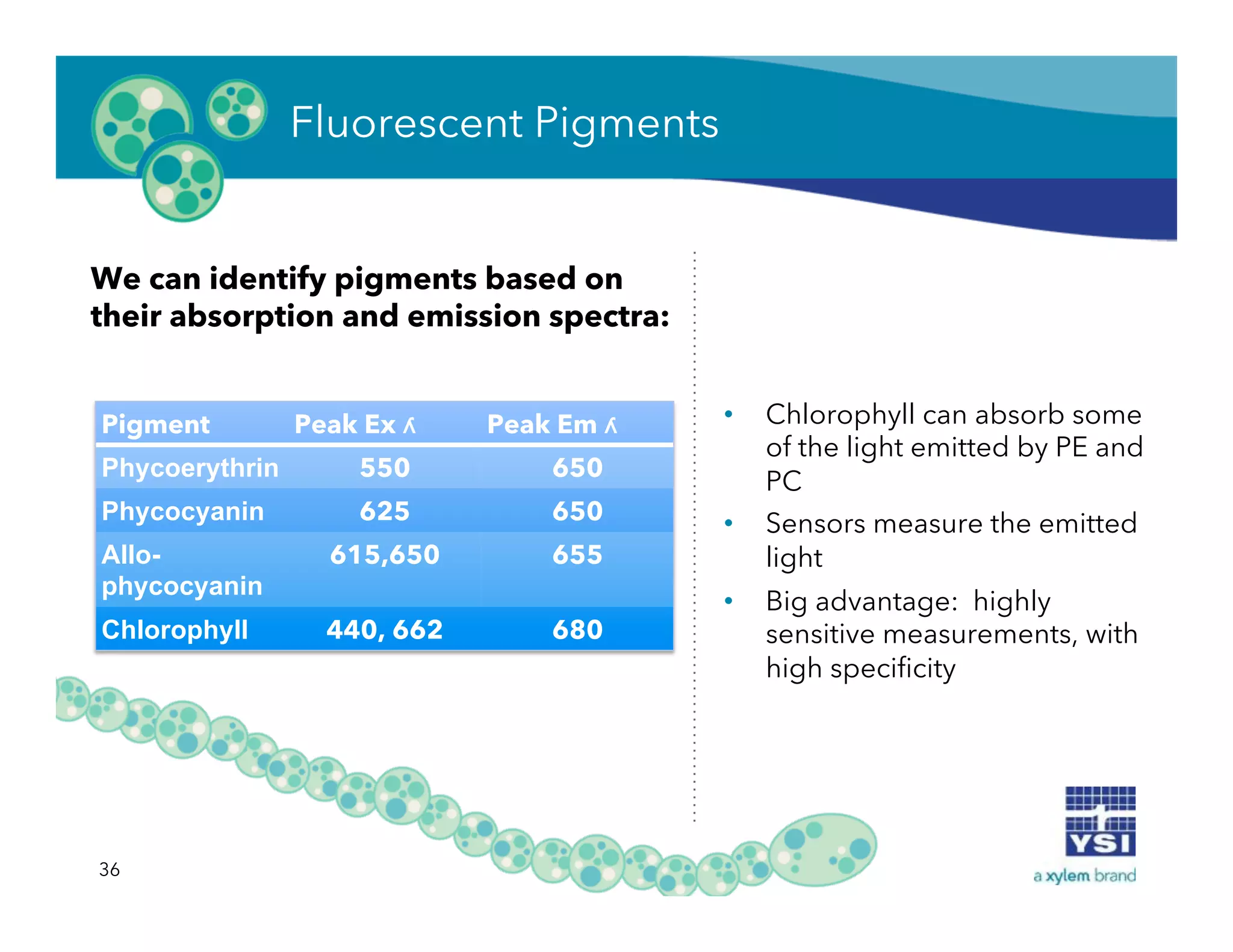
Pigment Peak Ex ʎ Peak Em ʎ
Phycoerythrin 550 650
Phycocyanin 625 650
Allo-
phycocyanin
615,650 655
Chlorophyll 440, 662 680
•  Chlorophyll can absorb some
of the light emitted by PE and
PC
•  Sensors measure the emitted
light
•  Big advantage: highly
sensitive measurements, with
high specificity
Fluorescent Pigments
We can identify pigments based on
their absorption and emission spectra:
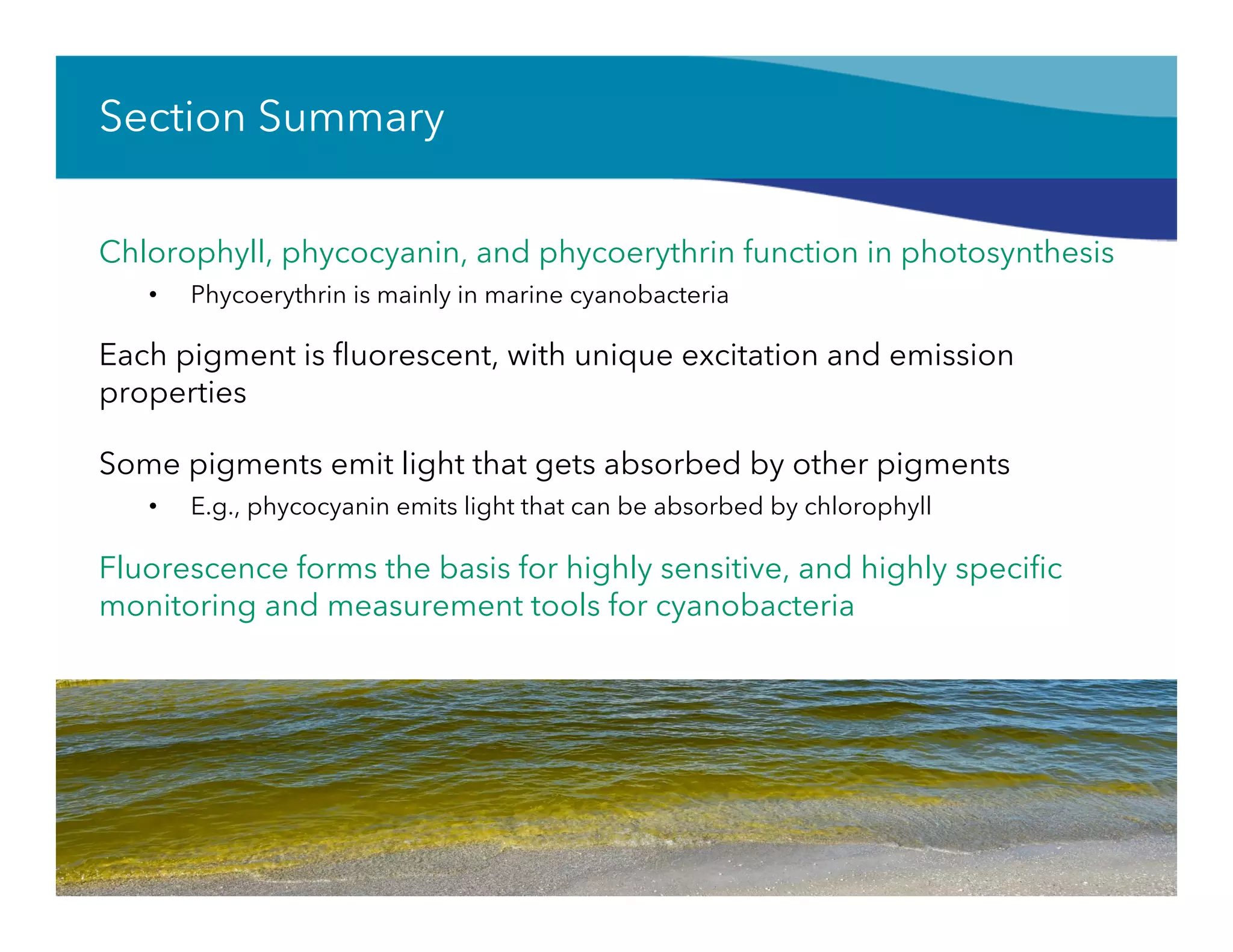
Section Summary
Chlorophyll, phycocyanin, and phycoerythrin function in photosynthesis
•  Phycoerythrin is mainly in marine cyanobacteria
Each pigment is fluorescent, with unique excitation and emission
properties
Some pigments emit light that gets absorbed by other pigments
•  E.g., phycocyanin emits light that can be absorbed by chlorophyll
Fluorescence forms the basis for highly sensitive, and highly specific
monitoring and measurement tools for cyanobacteria
Water Quality Monitoring for HABs: How
to Monitor Using Pigments
38
39
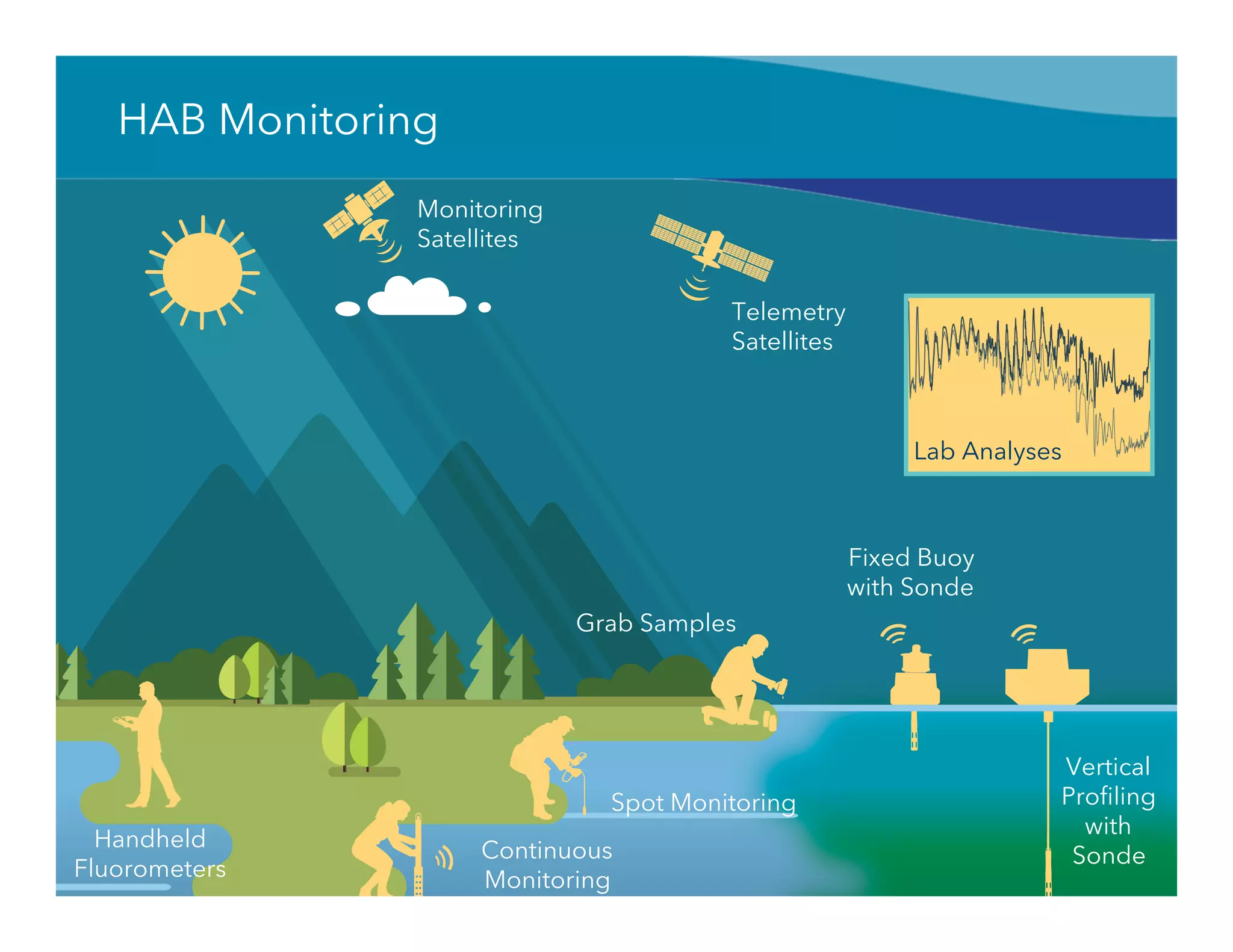
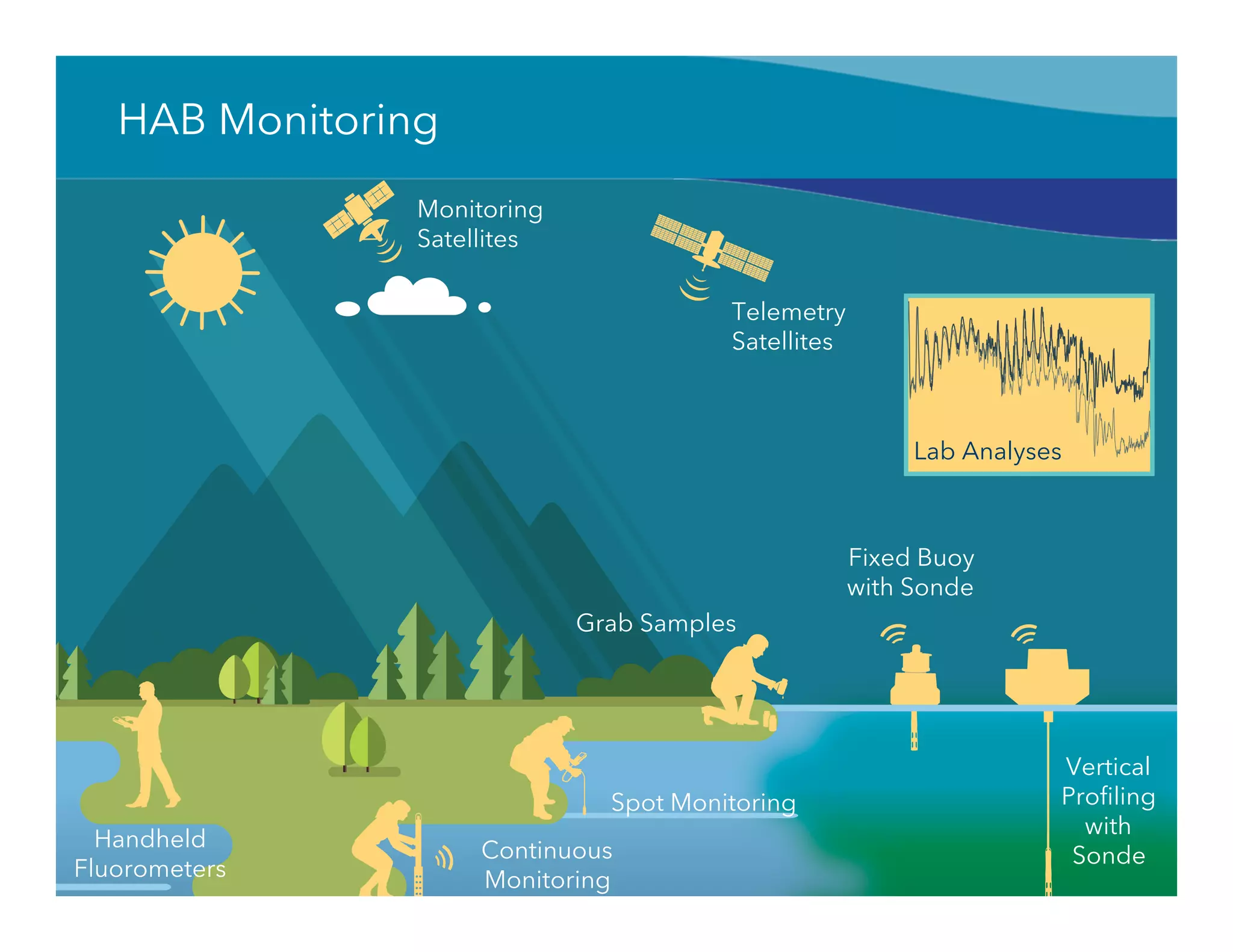
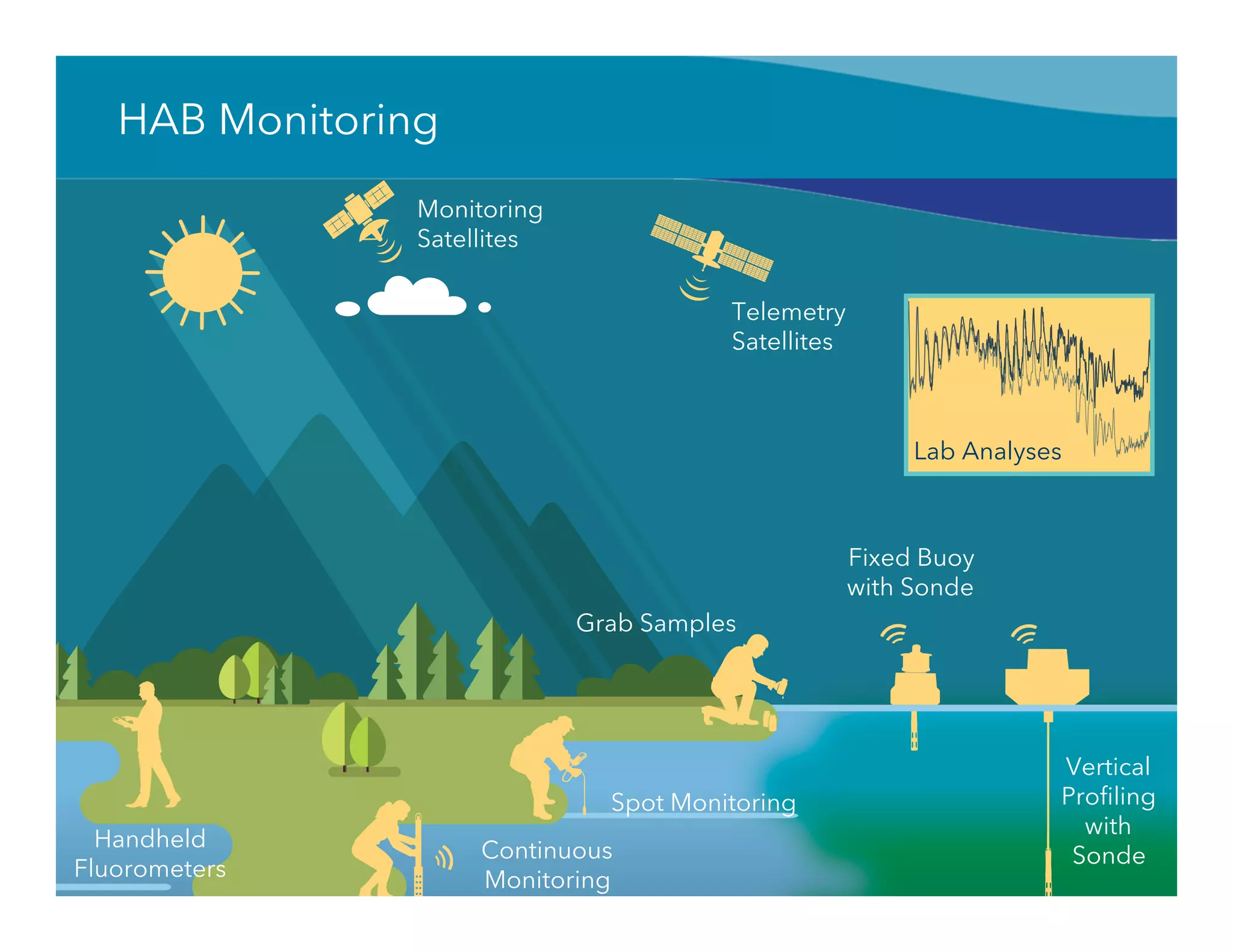
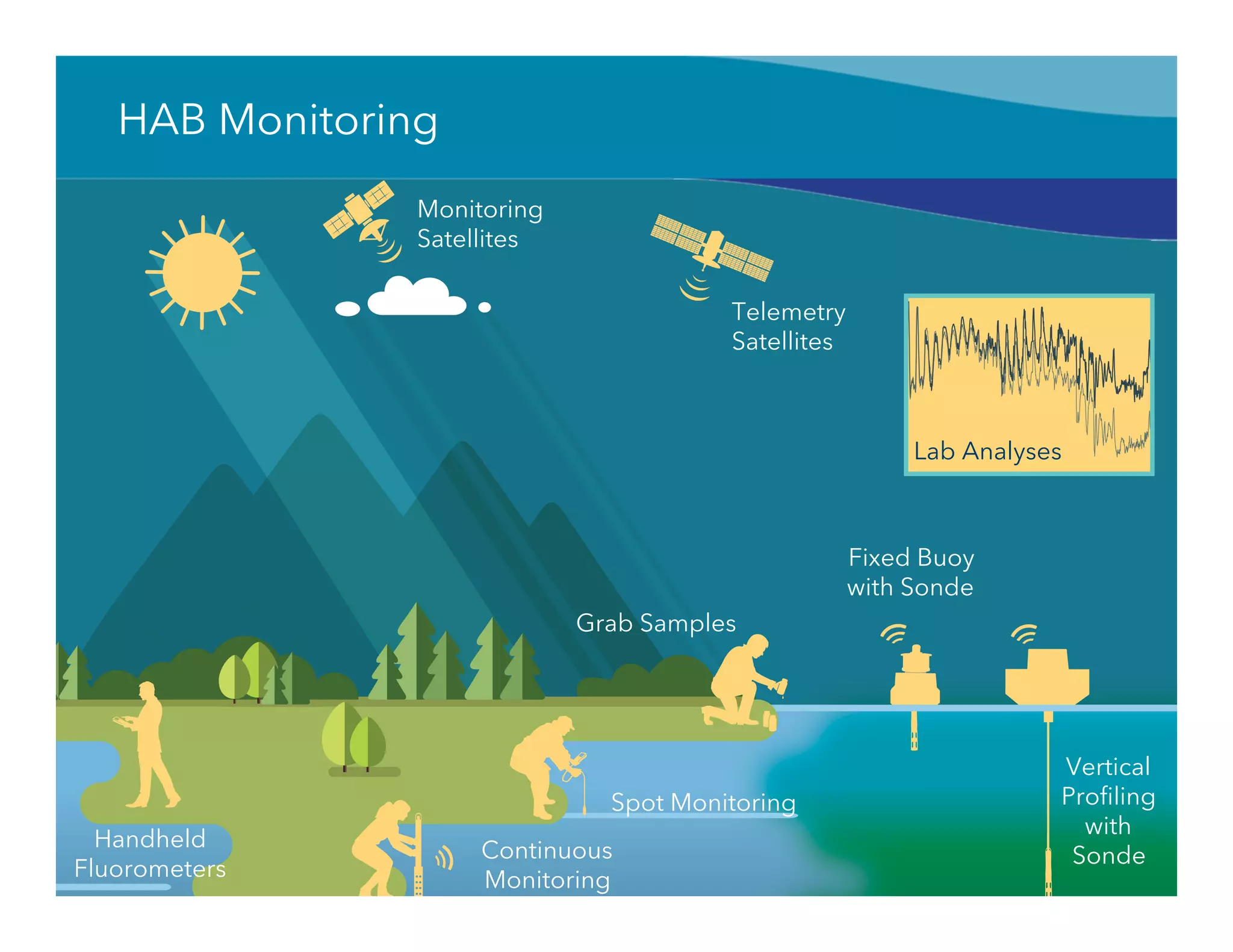
HAB Monitoring
Monitoring
Satellites
Handheld
Fluorometers
Continuous
Monitoring
Grab Samples
Fixed Buoy
with Sonde
Spot Monitoring
Vertical
Profiling
with
Sonde
Lab Analyses
Telemetry
Satellites
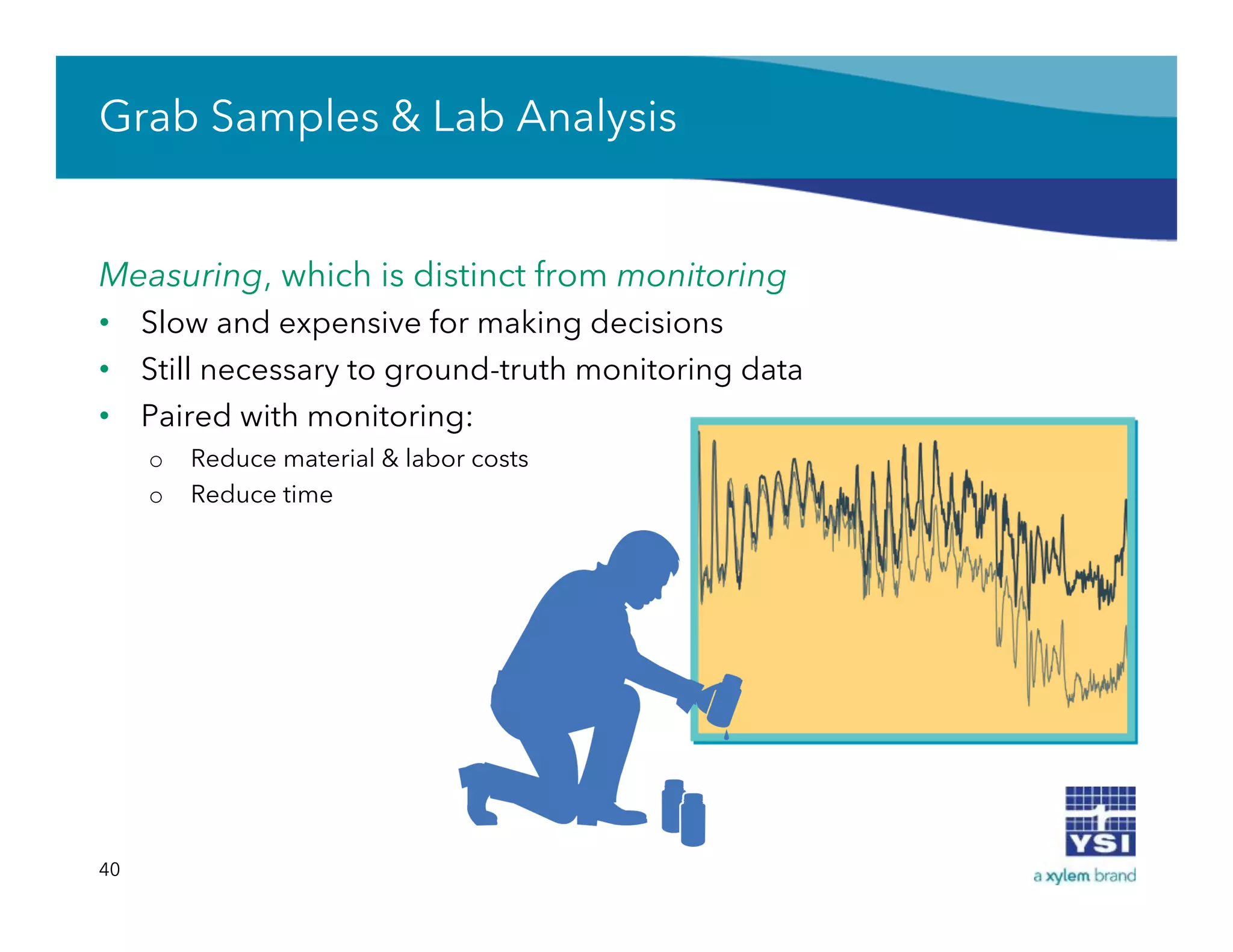
Grab Samples & Lab Analysis
Measuring, which is distinct from monitoring
•  Slow and expensive for making decisions
•  Still necessary to ground-truth monitoring data
•  Paired with monitoring:
o  Reduce material & labor costs
o  Reduce time
40
41
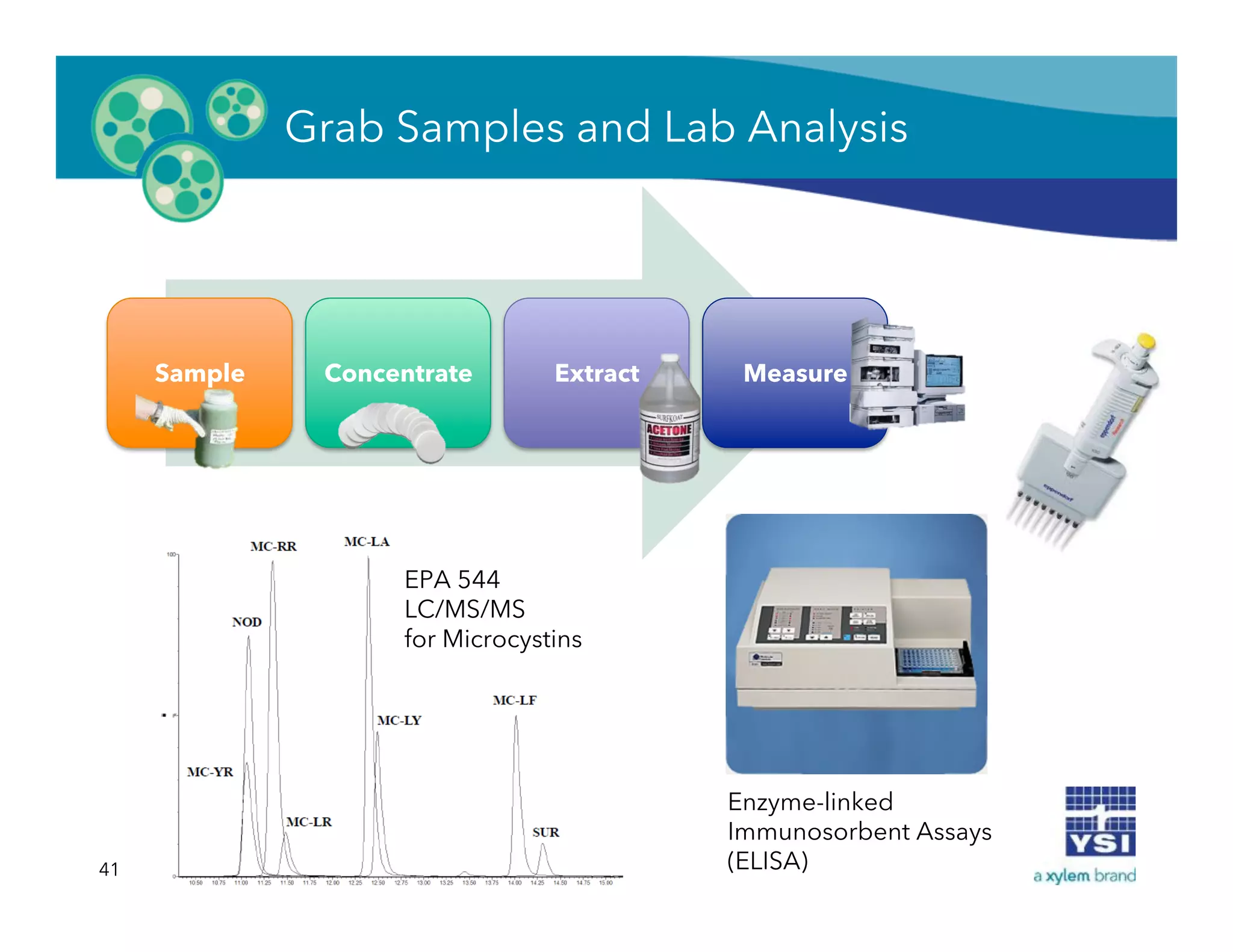
Sample Concentrate Extract Measure
Grab Samples and Lab Analysis
EPA 544
LC/MS/MS
for Microcystins
Enzyme-linked
Immunosorbent Assays
(ELISA)
42
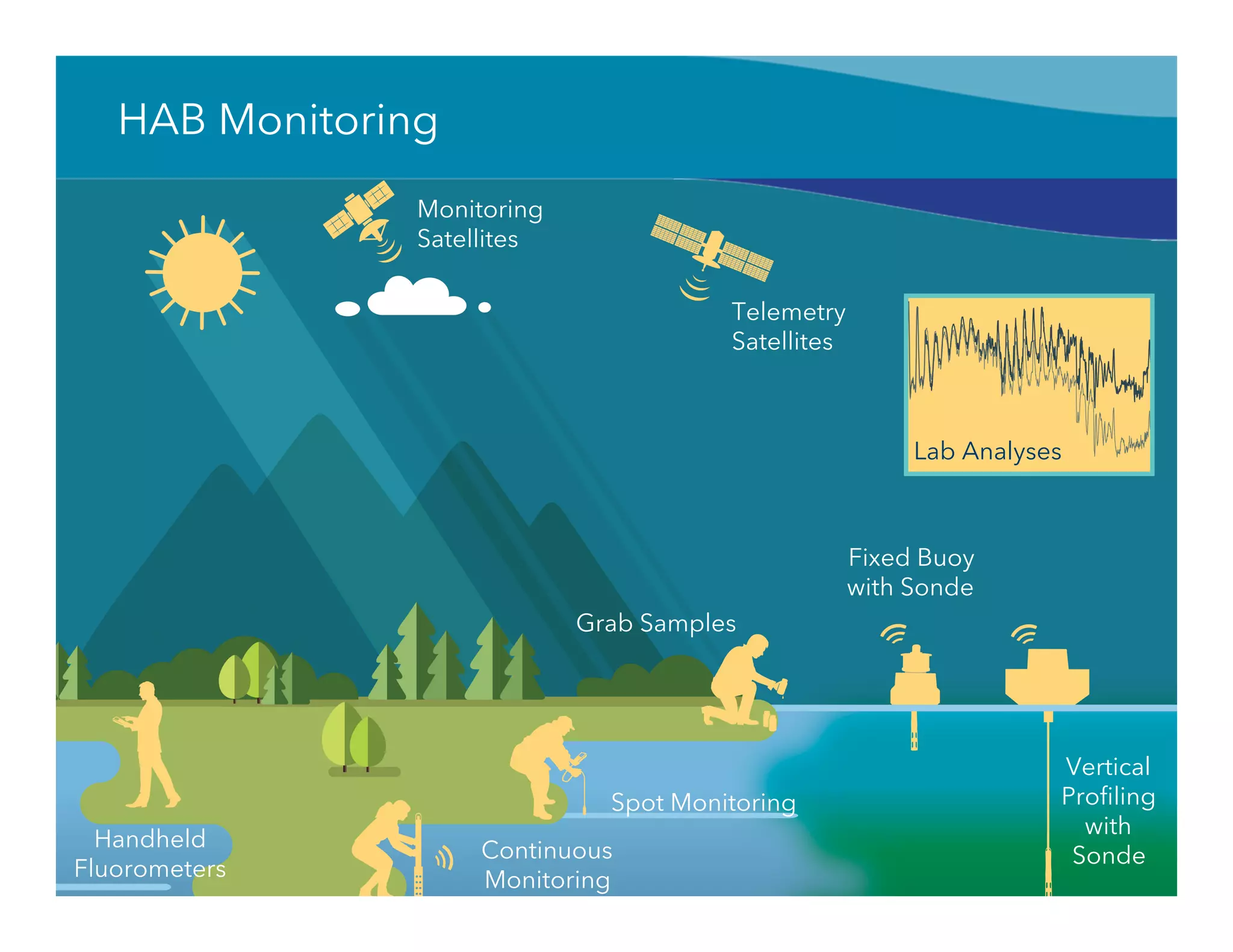
HAB Monitoring
Monitoring
Satellites
Handheld
Fluorometers
Continuous
Monitoring
Grab Samples
Fixed Buoy
with Sonde
Spot Monitoring
Vertical
Profiling
with
Sonde
Lab Analyses
Telemetry
Satellites
Satellite Monitoring
•  Spectral analysis of fluorescent pigments
•  Moderate Resolution Imaging Spectroradiometer
(MODIS) sensors aboard the Terra and Aqua satellites
and the Ocean and Land Color Instrument (OLCI) sensor
aboard the Sentinel-3 satellite
•  Gulf of Mexico and Lake Erie Monitoring by NOAA
43
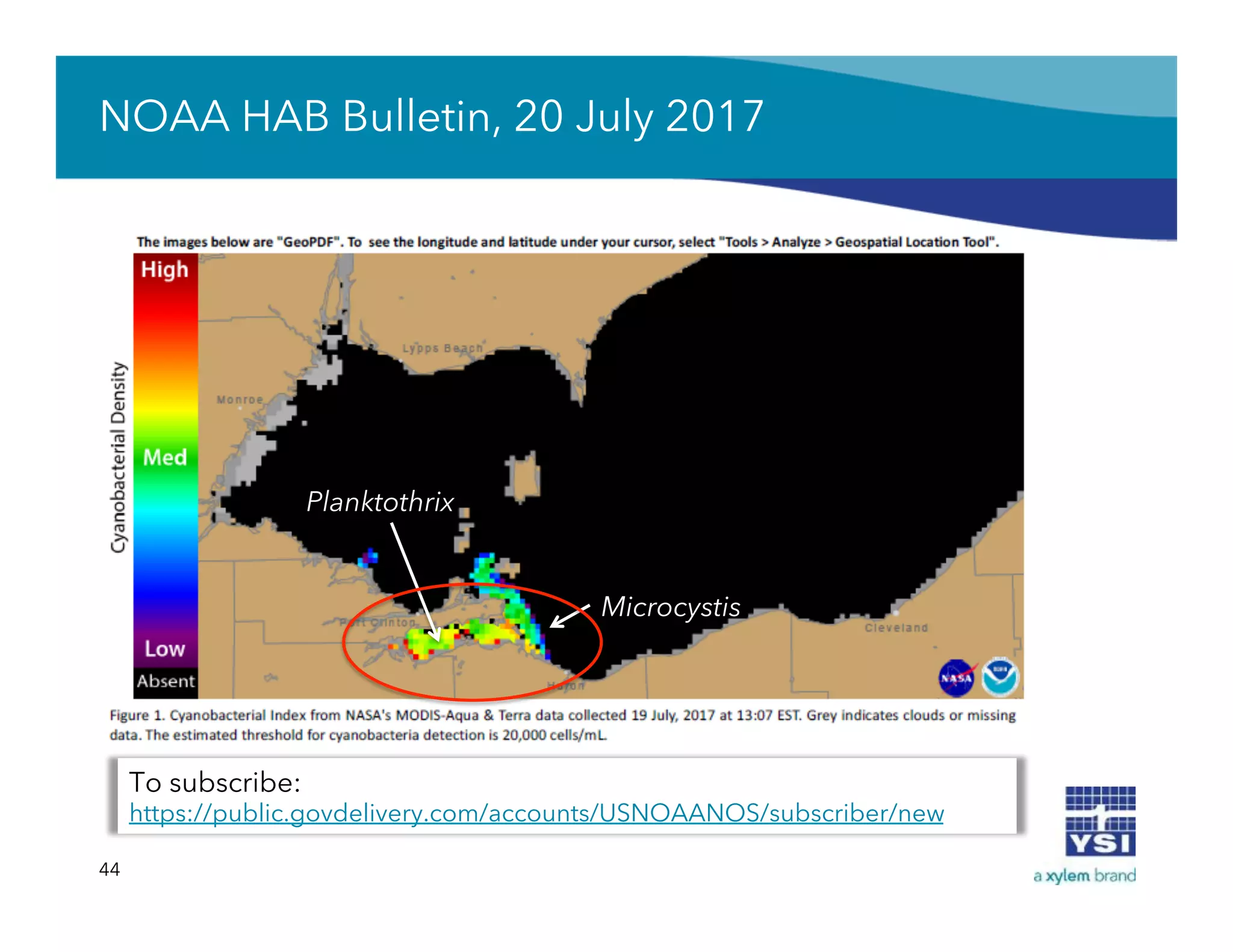
NOAA HAB Bulletin, 20 July 2017
44
Planktothrix
Microcystis
To subscribe:
https://public.govdelivery.com/accounts/USNOAANOS/subscriber/new
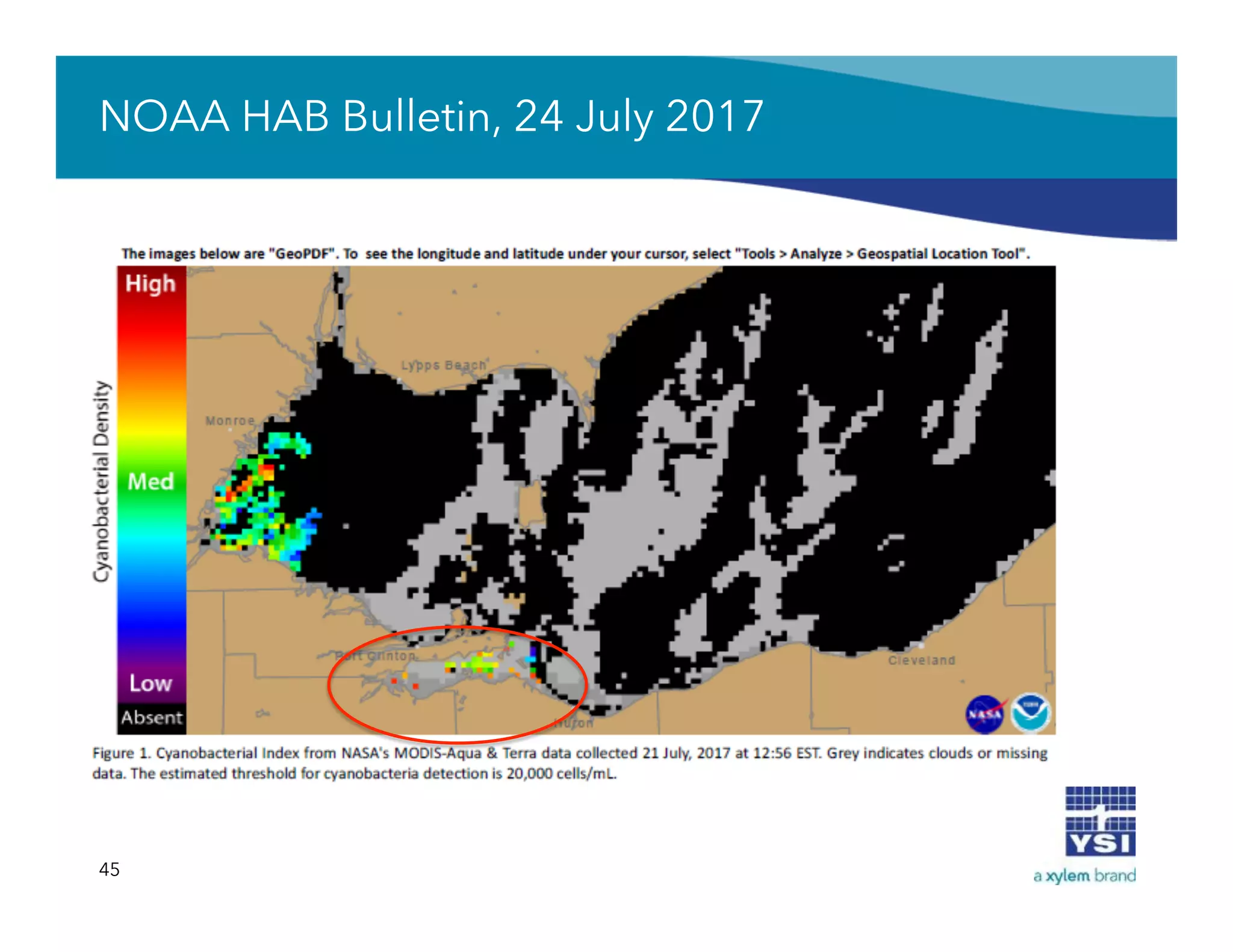
NOAA HAB Bulletin, 24 July 2017
45
Satellite Monitoring
Data to Decisions: Are conditions similar in
your area?
•  Often when things are happening in Erie,
they’re heating up in the Midwest!
Limited to major bodies of water for now
•  Commercial offerings are emerging
Some occlusion from cloud cover
Only uses pigments—no other parameters
at this time
46
47
HAB Monitoring
Monitoring
Satellites
Handheld
Fluorometers
Continuous
Monitoring
Grab Samples
Fixed Buoy
with Sonde
Spot Monitoring
Vertical
Profiling
with
Sonde
Lab Analyses
Telemetry
Satellites
48
HAB Monitoring
Monitoring
Satellites
Handheld
Fluorometers
Continuous
Monitoring
Grab Samples
Fixed Buoy
with Sonde
Spot Monitoring
Vertical
Profiling
with
Sonde
Lab Analyses
Telemetry
Satellites
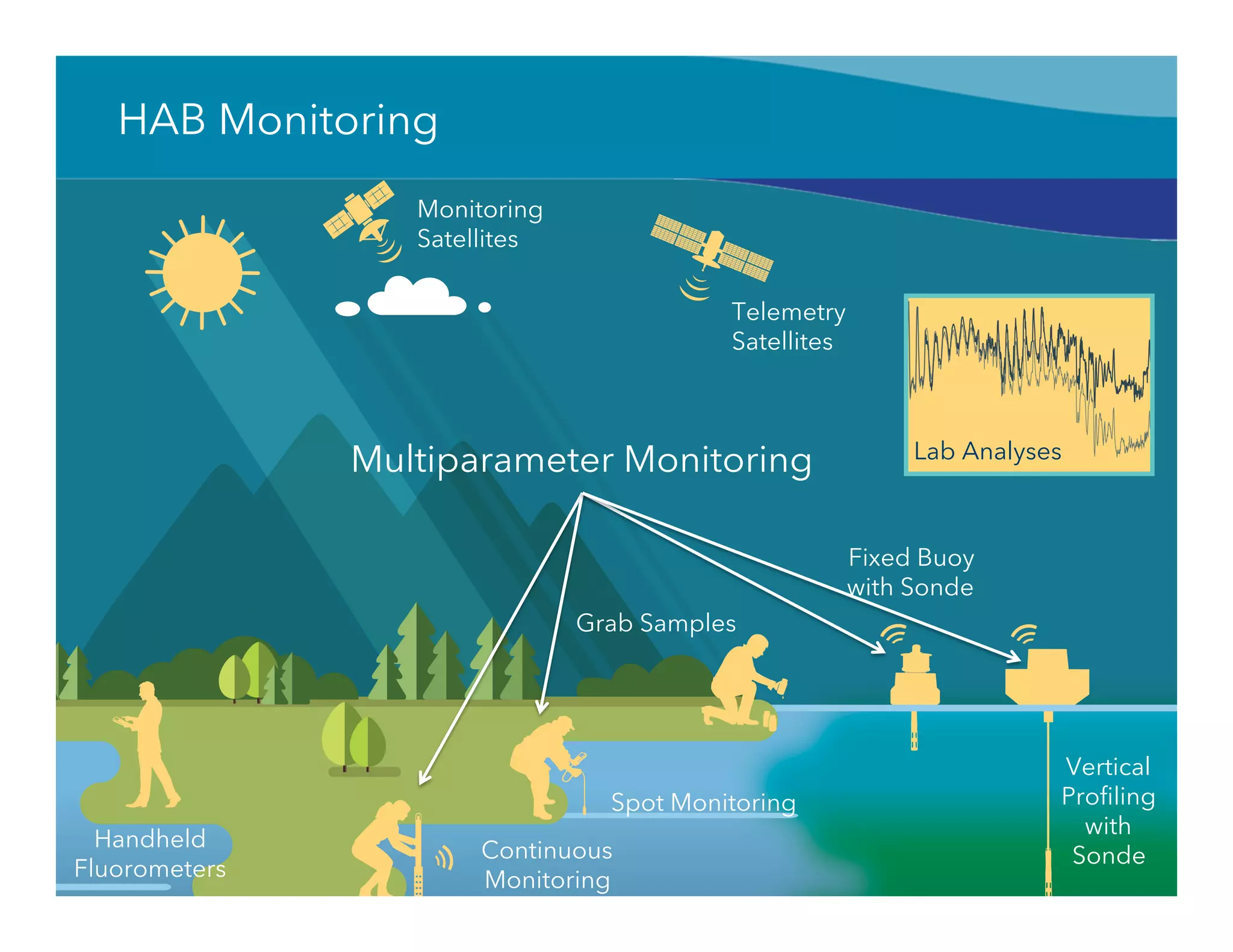
Multiparameter Monitoring
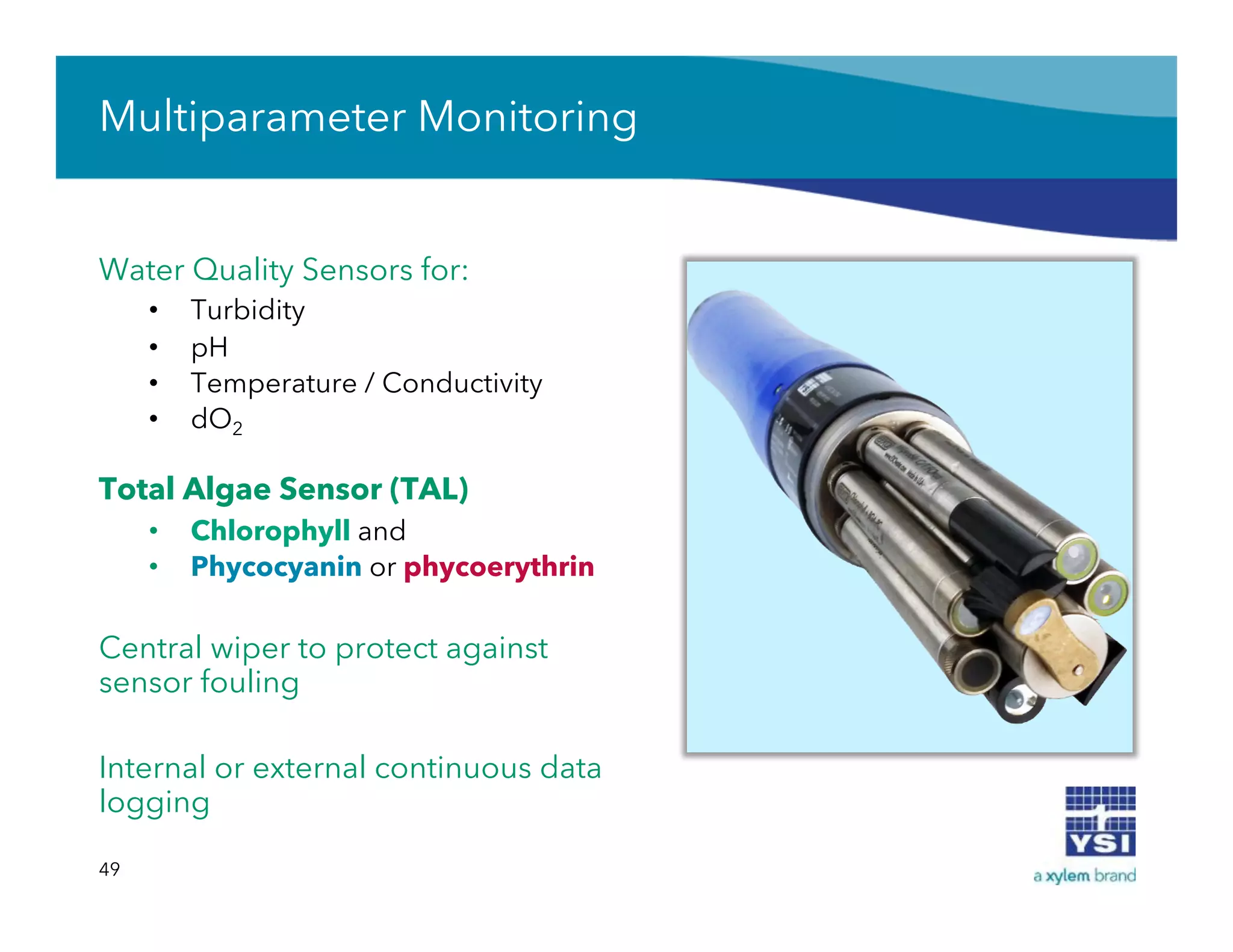
Water Quality Sensors for:
•  Turbidity
•  pH
•  Temperature / Conductivity
•  dO2
Total Algae Sensor (TAL)
•  Chlorophyll and
•  Phycocyanin or phycoerythrin
Central wiper to protect against
sensor fouling
Internal or external continuous data
logging
49
Multiparameter Monitoring
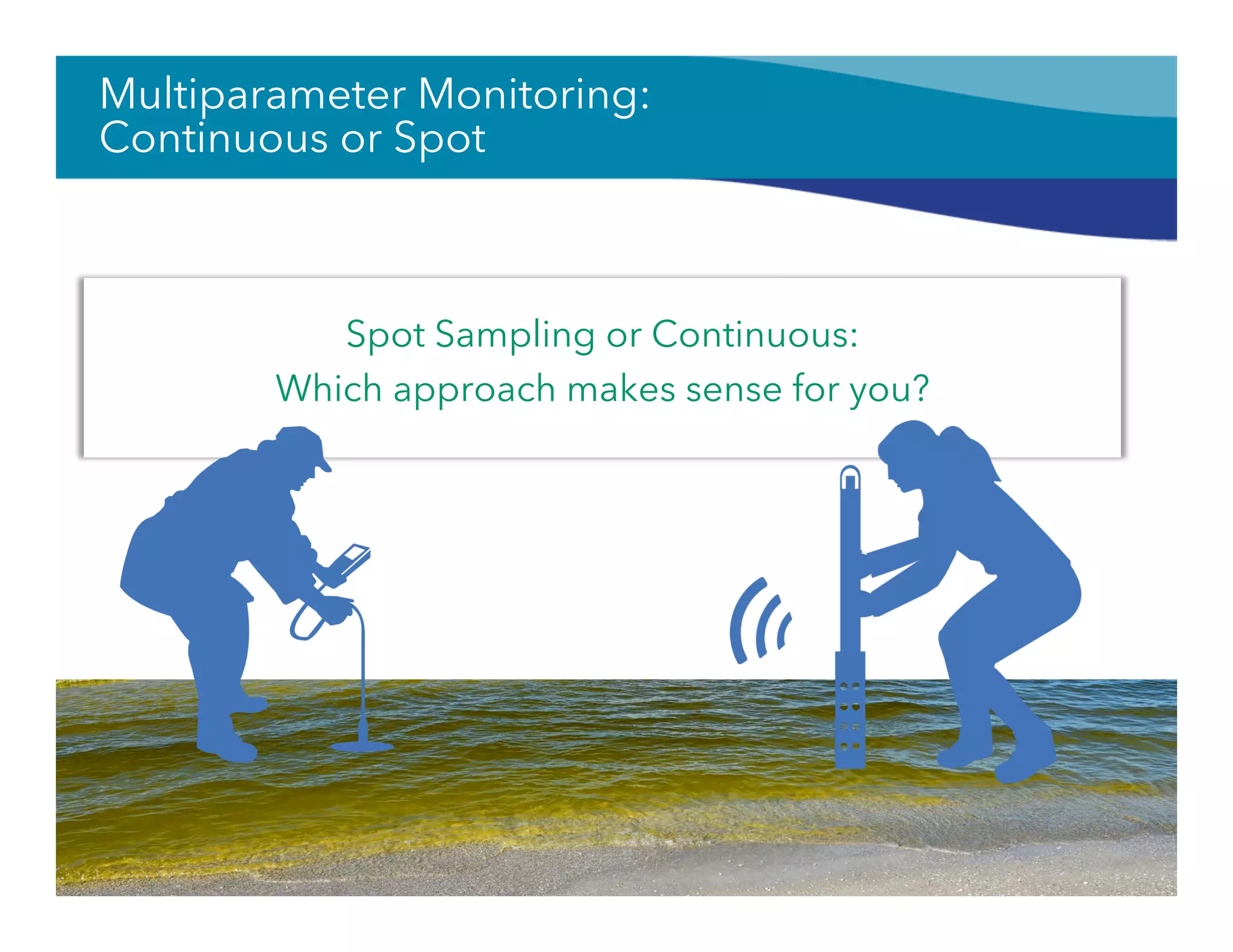
Multiparameter Monitoring:
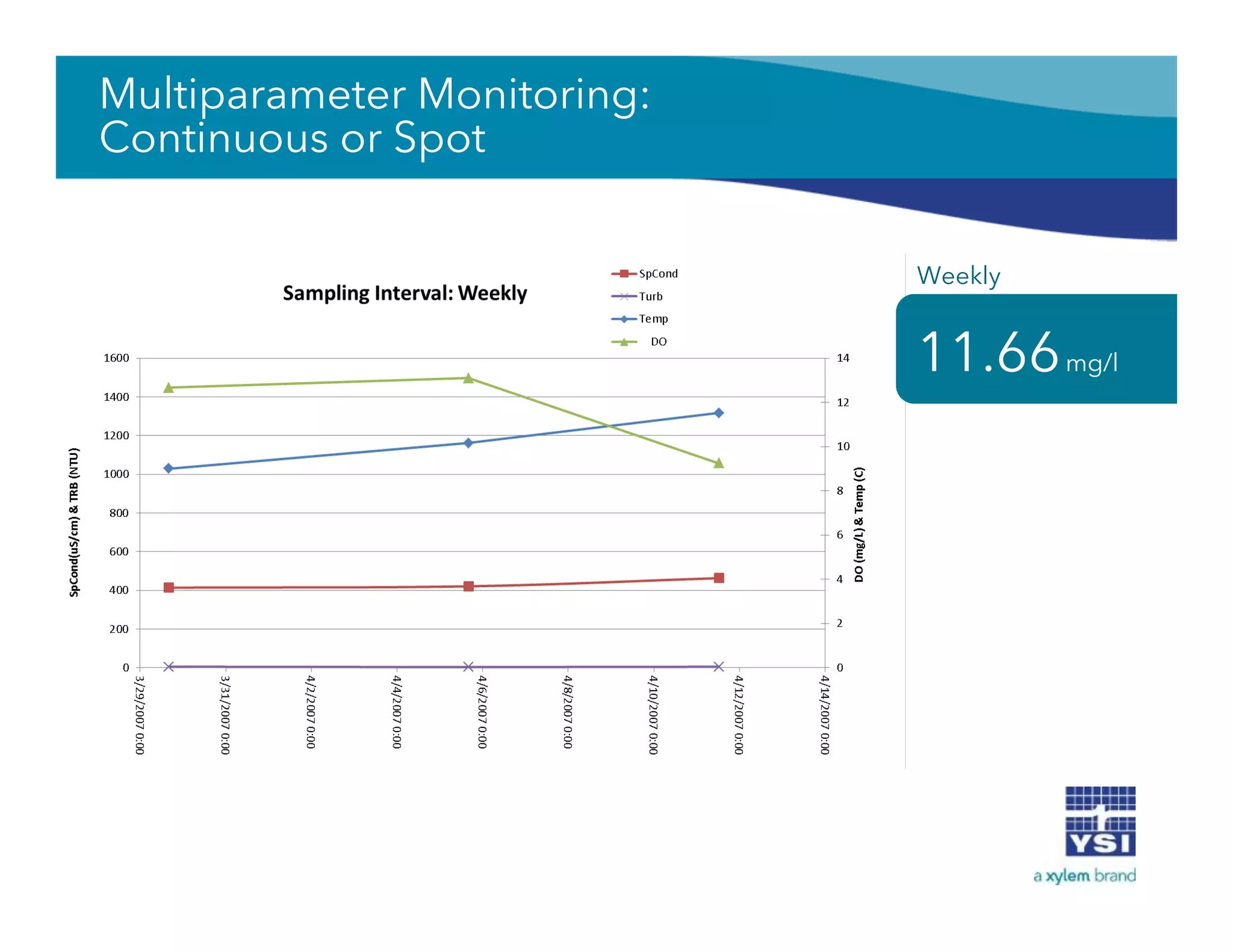
Continuous or Spot
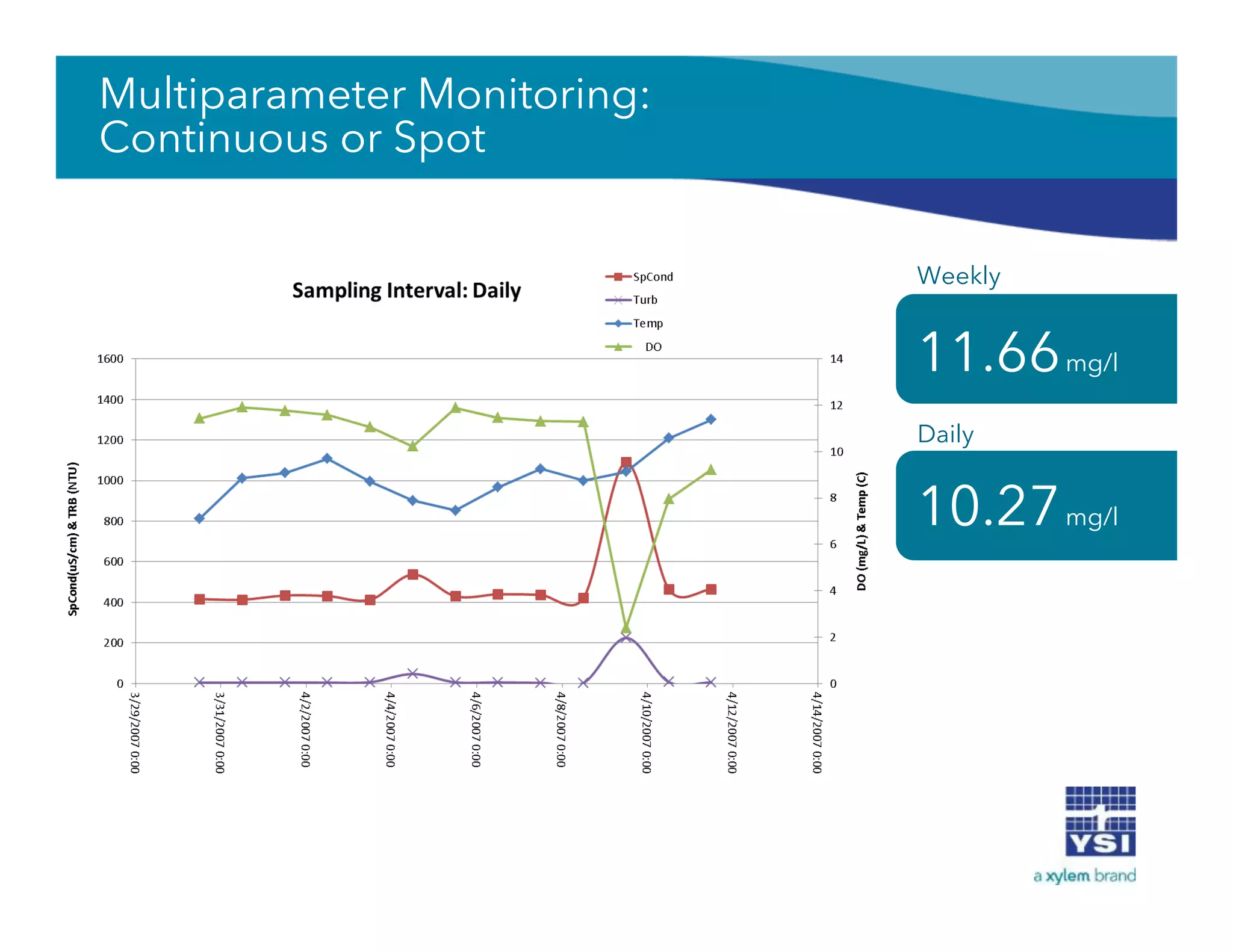
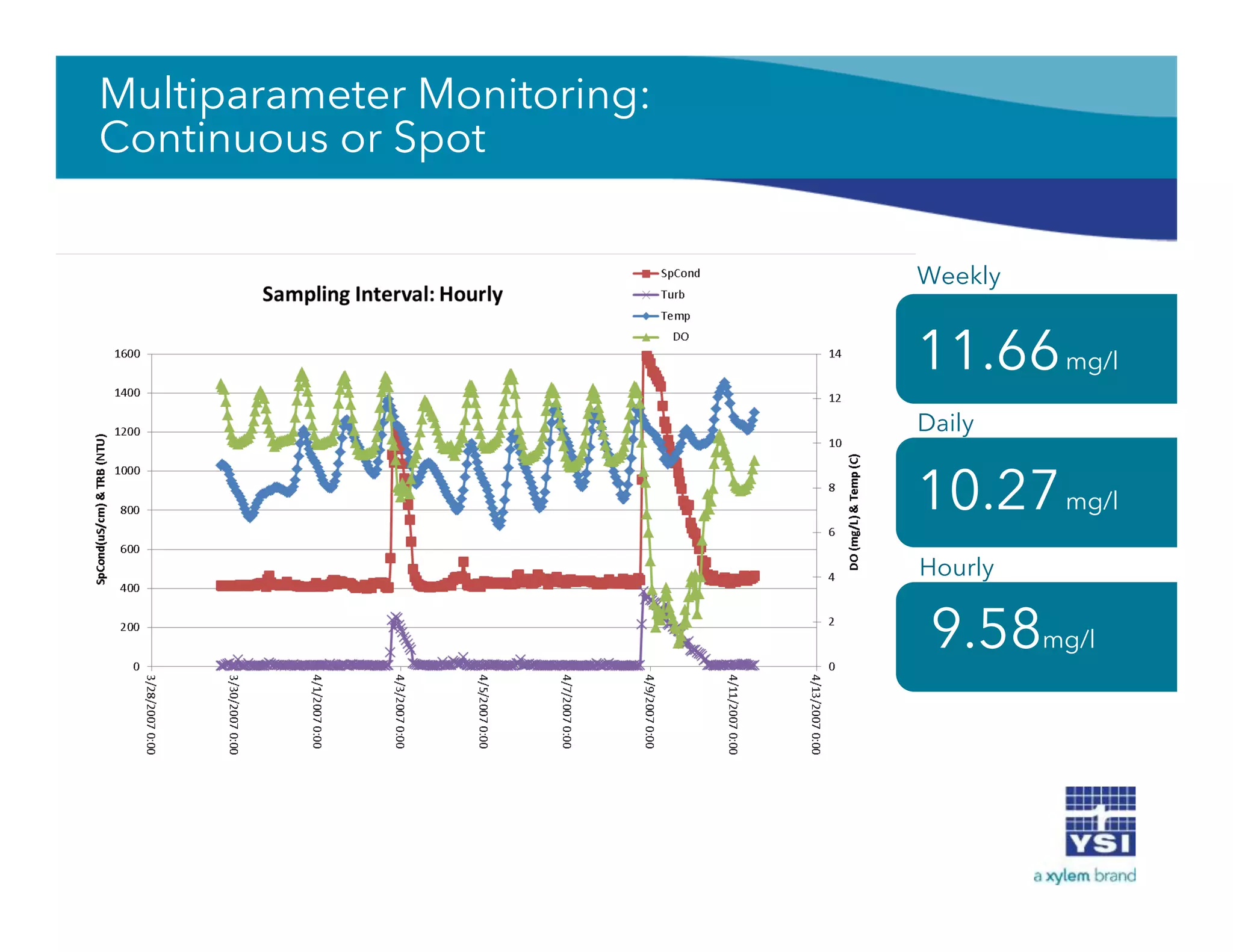
Spot Sampling or Continuous:
Which approach makes sense for you?
50
11.66mg/l
10.27
mg/l
9.58mg/l
Weekly
Multiparameter Monitoring:
Continuous or Spot
11.66mg/l
10.27mg/l
9.58mg/l
Weekly
Daily
Multiparameter Monitoring:
Continuous or Spot
11.66mg/l
10.27mg/l
9.58mg/l
Weekly
Daily
Hourly
Multiparameter Monitoring:
Continuous or Spot
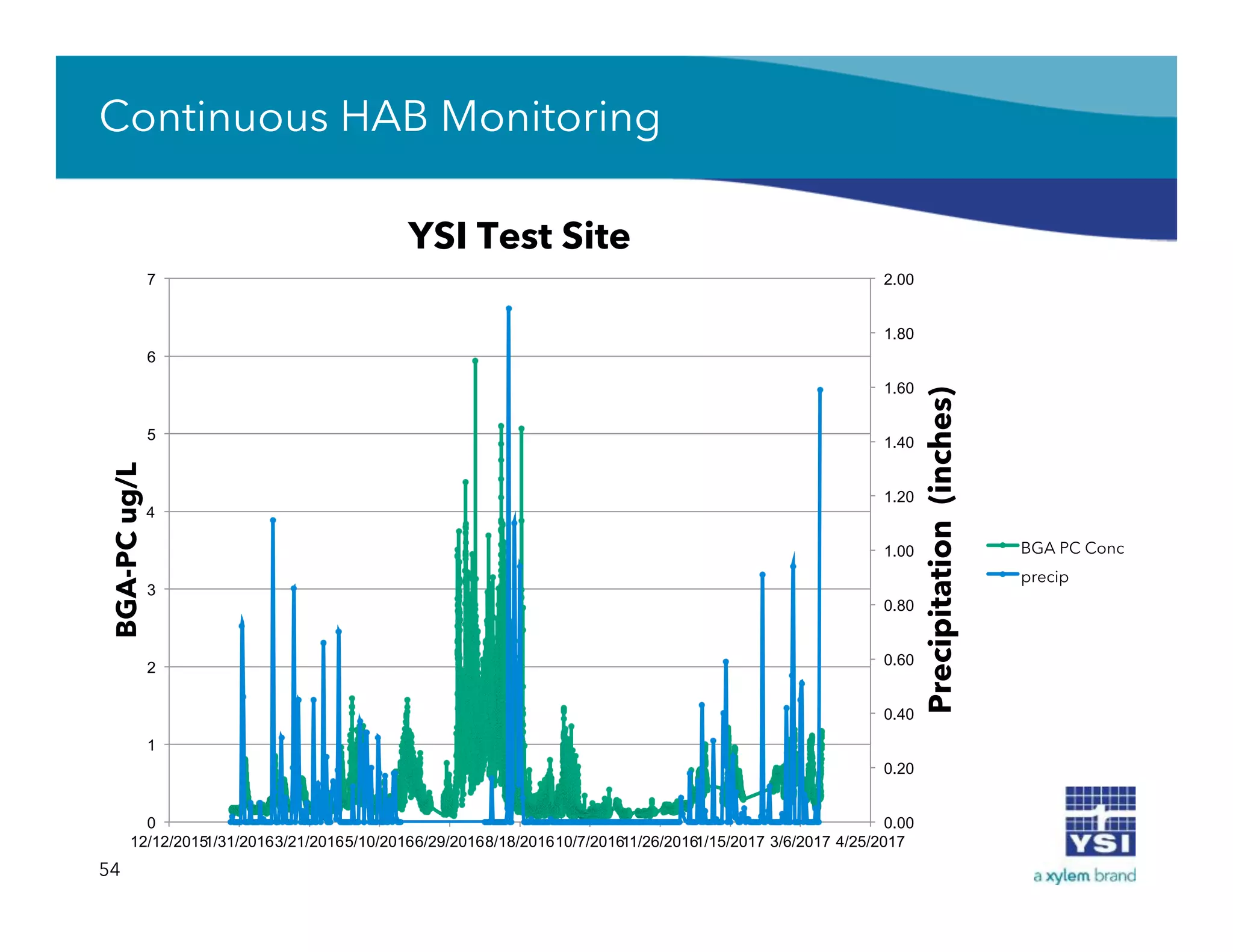
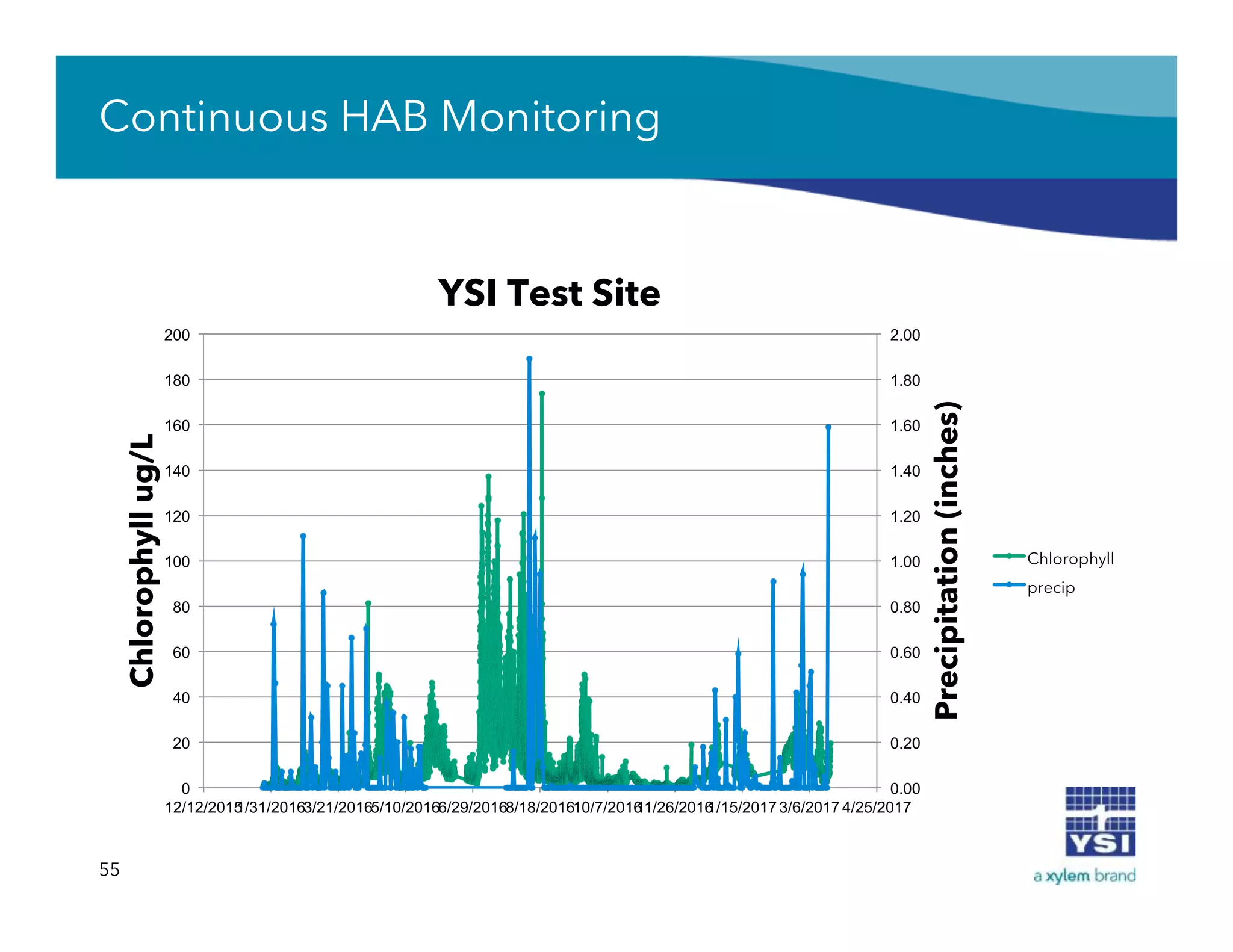
Continuous HAB Monitoring
54
0.00
0.20
0.40
0.60
0.80
1.00
1.20
1.40
1.60
1.80
2.00
0
1
2
3
4
5
6
7
12/12/20151/31/20163/21/20165/10/20166/29/20168/18/201610/7/201611/26/20161/15/2017 3/6/2017 4/25/2017
Precipitation(inches)
BGA-PCug/L
YSI Test Site
BGA PC Conc
precip
Continuous HAB Monitoring
55
0.00
0.20
0.40
0.60
0.80
1.00
1.20
1.40
1.60
1.80
2.00
0
20
40
60
80
100
120
140
160
180
200
12/12/20151/31/20163/21/20165/10/20166/29/20168/18/201610/7/201611/26/20161/15/2017 3/6/2017 4/25/2017
Precipitation(inches)
Chlorophyllug/L
YSI Test Site
Chlorophyll
precip
Multiparameter Monitoring:
Continuous or Spot
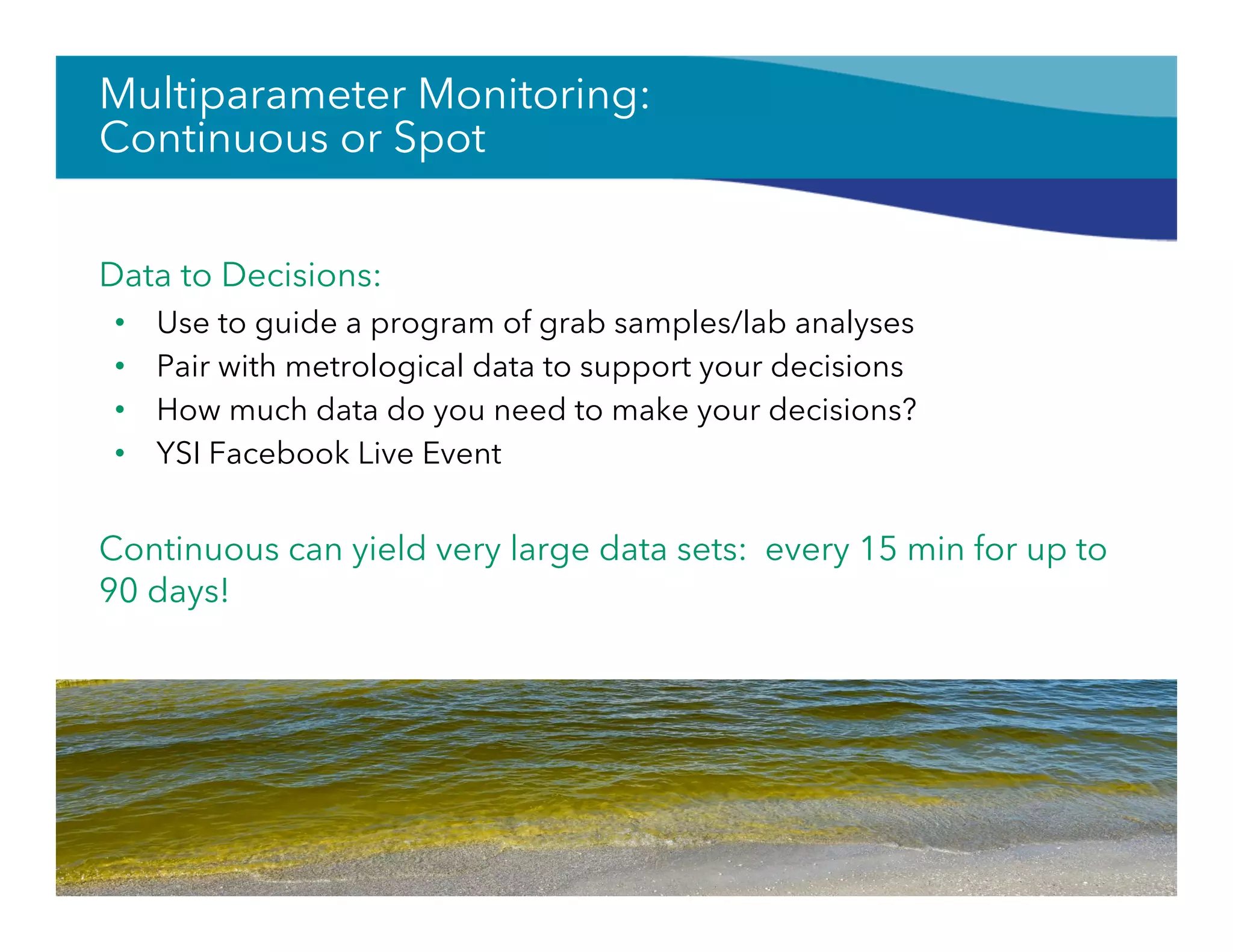
Data to Decisions:
•  Use to guide a program of grab samples/lab analyses
•  Pair with metrological data to support your decisions
•  How much data do you need to make your decisions?
•  YSI Facebook Live Event
Continuous can yield very large data sets: every 15 min for up to
90 days!
56
57
HAB Monitoring
Monitoring
Satellites
Handheld
Fluorometers
Continuous
Monitoring
Grab Samples
Fixed Buoy
with Sonde
Spot Monitoring
Vertical
Profiling
with
Sonde
Lab Analyses
Telemetry
Satellites
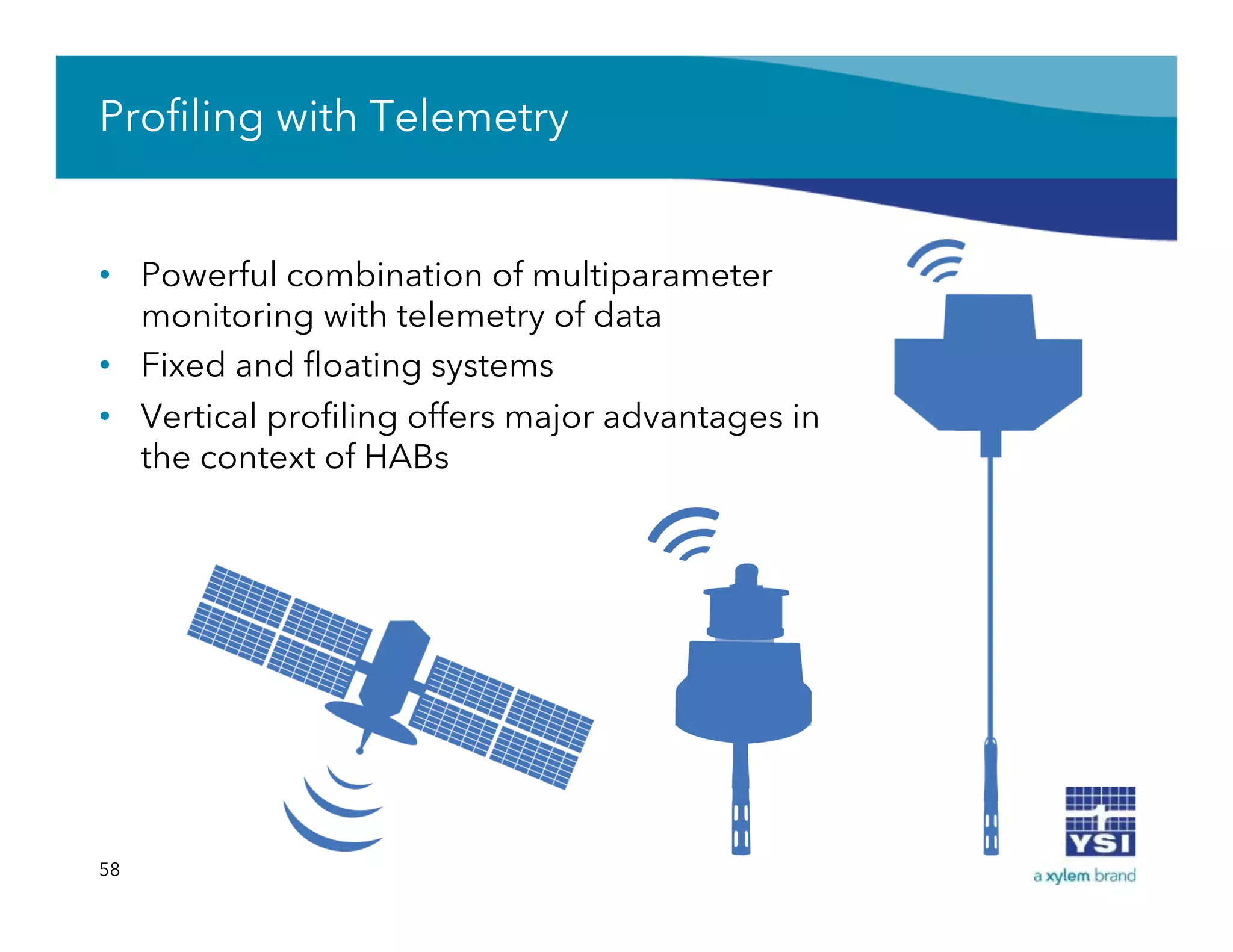
Profiling with Telemetry
•  Powerful combination of multiparameter
monitoring with telemetry of data
•  Fixed and floating systems
•  Vertical profiling offers major advantages in
the context of HABs
58
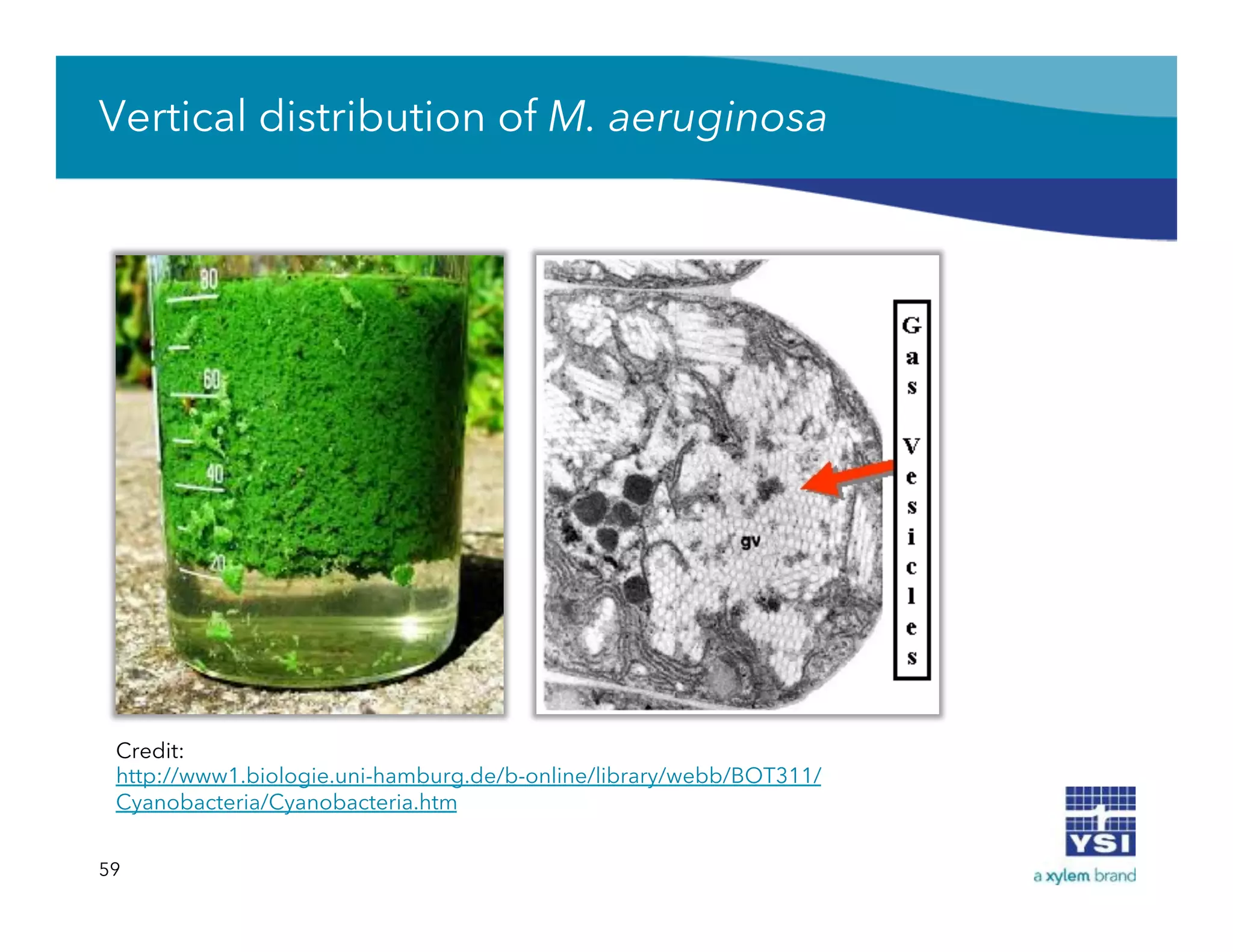
Vertical distribution of M. aeruginosa
59
Credit:
http://www1.biologie.uni-hamburg.de/b-online/library/webb/BOT311/
Cyanobacteria/Cyanobacteria.htm
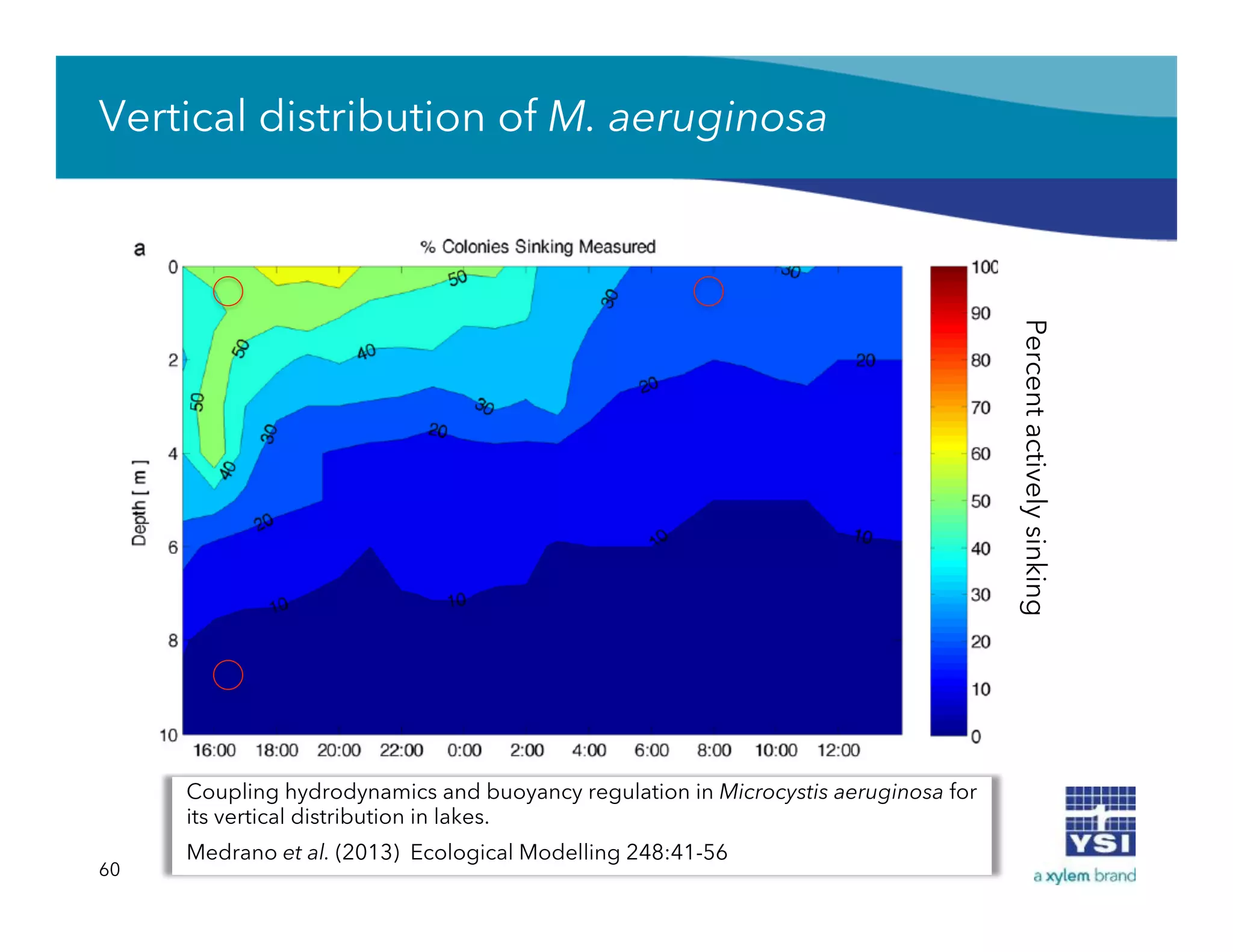
Vertical distribution of M. aeruginosa
Coupling hydrodynamics and buoyancy regulation in Microcystis aeruginosa for
its vertical distribution in lakes.
Medrano et al. (2013) Ecological Modelling 248:41-56
60
Percentactivelysinking
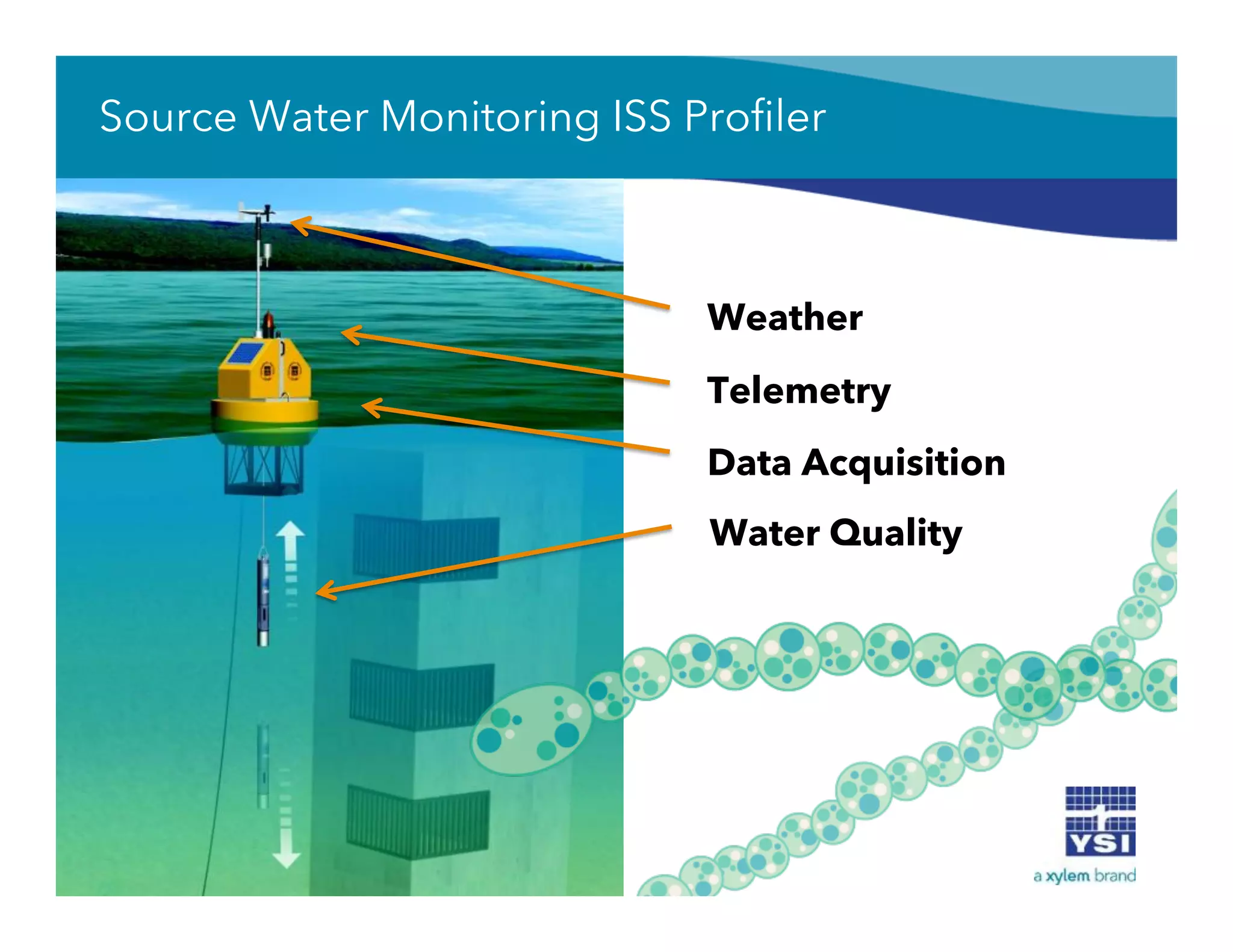
Source Water Monitoring ISS Profiler
Weather
Telemetry
Data Acquisition
Water Quality
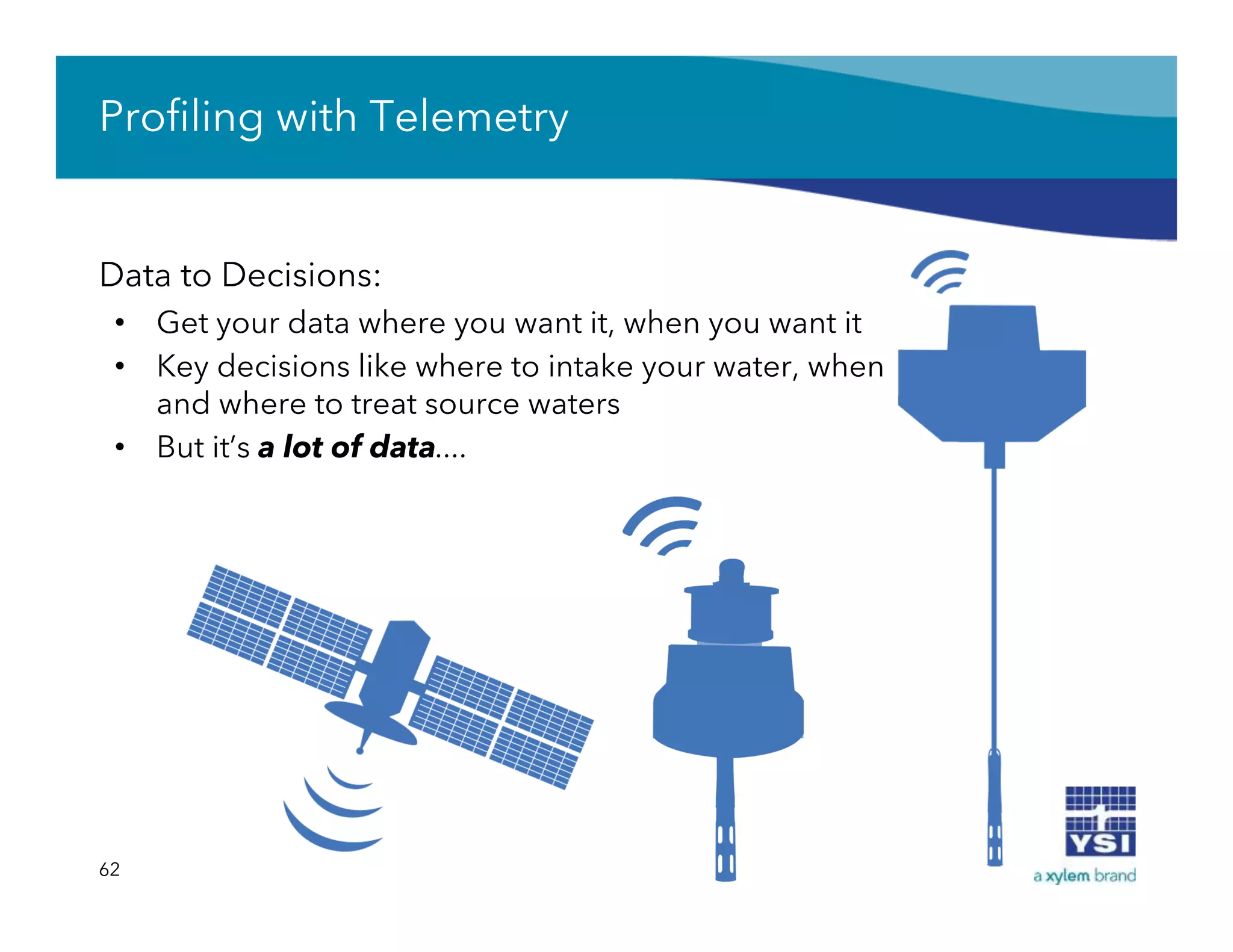
Profiling with Telemetry
Data to Decisions:
•  Get your data where you want it, when you want it
•  Key decisions like where to intake your water, when
and where to treat source waters
•  But it’s a lot of data....
62
63
HAB Monitoring
Monitoring
Satellites
Handheld
Fluorometers
Continuous
Monitoring
Grab Samples
Fixed Buoy
with Sonde
Spot Monitoring
Vertical
Profiling
with
Sonde
Lab Analyses
Telemetry
Satellites
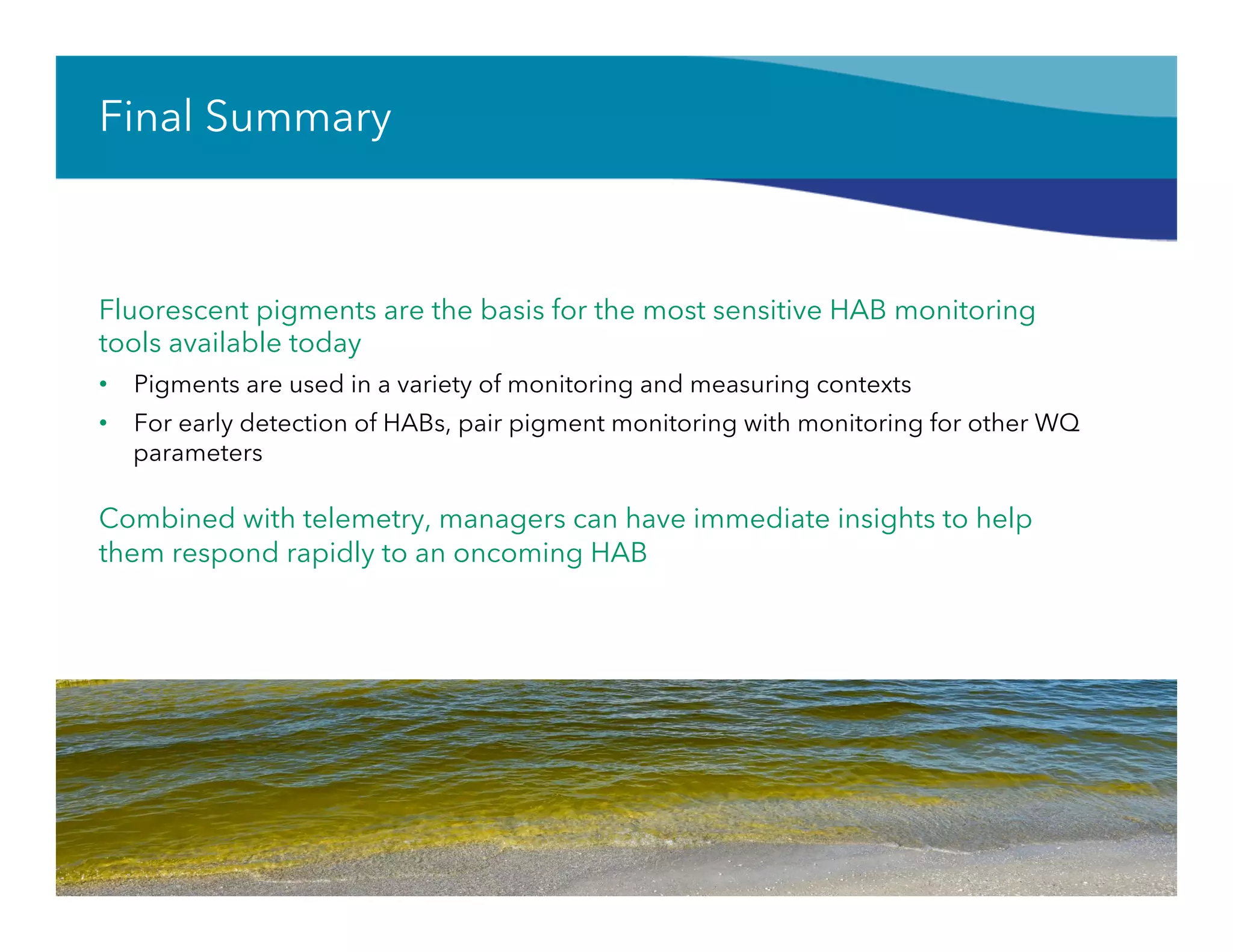
Final Summary
Fluorescent pigments are the basis for the most sensitive HAB monitoring
tools available today
•  Pigments are used in a variety of monitoring and measuring contexts
•  For early detection of HABs, pair pigment monitoring with monitoring for other WQ
parameters
Combined with telemetry, managers can have immediate insights to help
them respond rapidly to an oncoming HAB
64
Available (and Upcoming)
HAB Resources
65
Future Webinar
Data to Decisions Part II: Handling the Data
•  Interest in a deeper dive on the sensor technologies?
•  Upcoming partnership with Aquatic Informatics
66
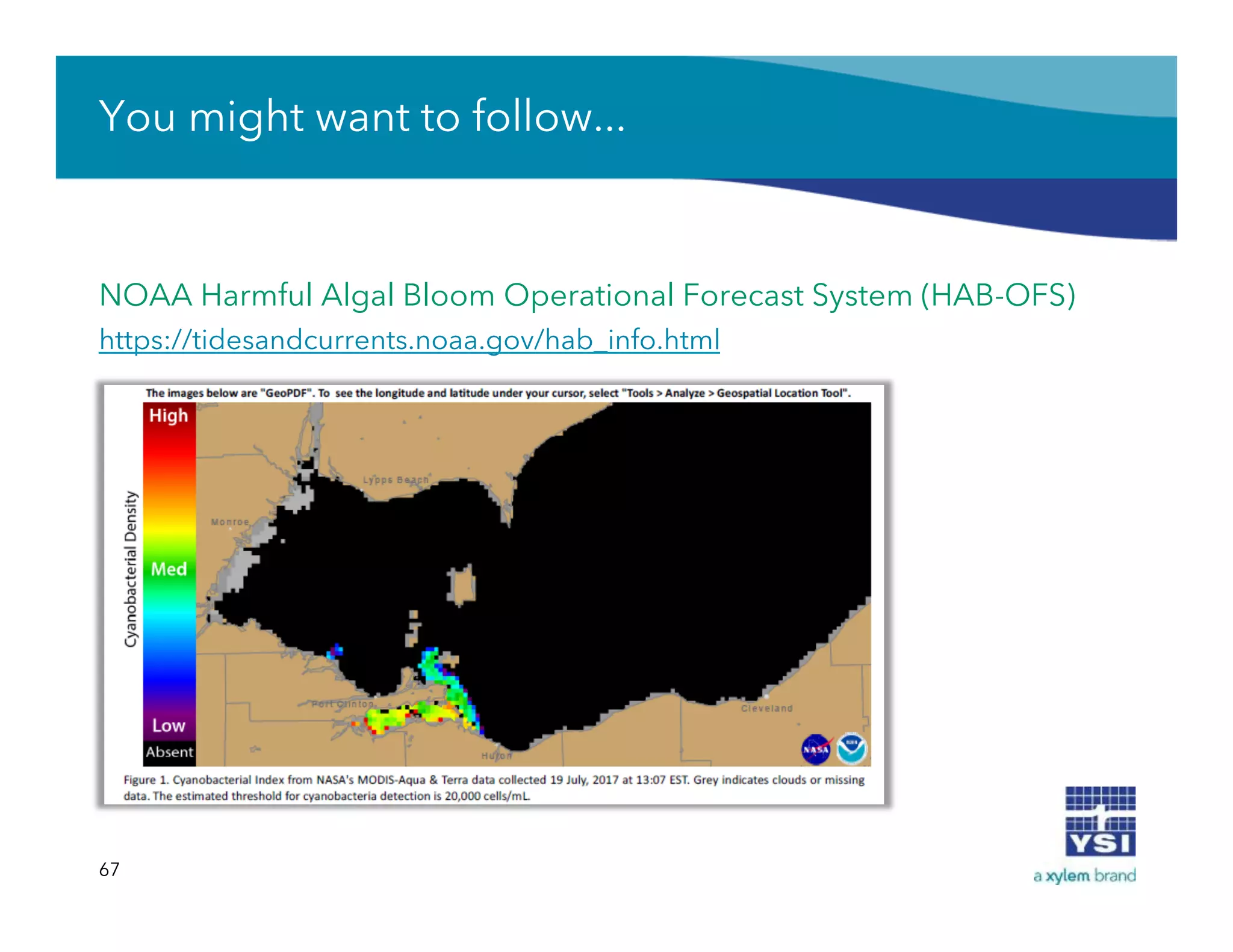
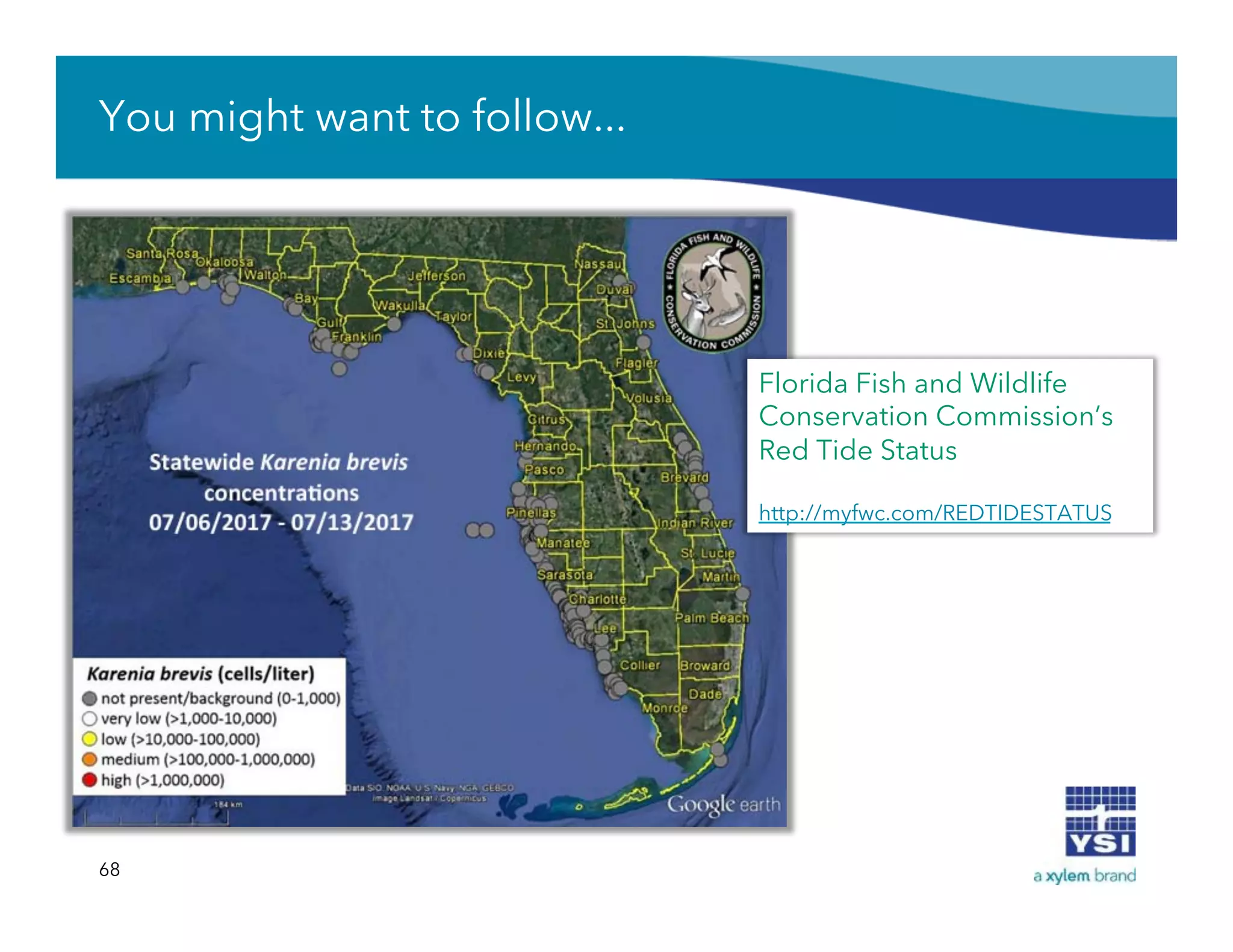
You might want to follow...
NOAA Harmful Algal Bloom Operational Forecast System (HAB-OFS)
https://tidesandcurrents.noaa.gov/hab_info.html
67
You might want to follow...
68
Florida Fish and Wildlife
Conservation Commission’s
Red Tide Status
http://myfwc.com/REDTIDESTATUS
Mission: Water Magazine | Issue No. 3
69
Q&A with
Dr. Stephanie A. Smith info@ysi.com
+1 (937) 767-2762
Contact us:

Monitoring for Harmful Algal Blooms | From Data to Decisions

  • 1.
    Stephanie A. Smith,Ph.D. Stephanie.Smith@Xyleminc.com Monitoring for Harmful Algal Blooms From Data to Decisions – Part I
  • 2.
    Today’s Agenda Introductions Defining “Harmful”Algal Blooms (HABs) •  Factors that contribute to HABs & why they are problematic Monitoring Water Quality for HABs •  Parameters that lead to or result from blooms Understanding Algal Pigments & Fluorescence-Based Sensing •  From satellites to handheld devices Leveraging Pigment Data to Mitigate Blooms Q&A 2
  • 3.
    Our Featured Speaker Dr.Stephanie A. Smith 3 BACKGROUND Ph.D. in Microbiology The Ohio State University §  Assistant Professor §  Senior Scientist §  Entrepreneur §  Product Manager
  • 4.
    The World ofHarmful Algal Blooms Freshwater Marine Chris Goble, Stony Brook, Long Island NY CBC Canada
  • 5.
    Freshwater HABs areobvious, right?
  • 6.
    Or are they?.... 6 P.rubescens and M. aeruginosa Heather Raymond, OH EPA, 2012 Suspected Planktothrix rubescens, but turned out to be Euglena Heather Raymond, OH EPA, 2012
  • 7.
    Or are they?.... OhioEPA, accessed February 2013 www.epa.state.oh.us/portals/35/inland_lakes/ Planktothrix, Linda Merchant-Masonbrink Cylindrospermopsis, Heather Raymond
  • 8.
    Or are they? 8 LakeSt. Clair, MI Photo Vijay Kannappan, 2012 WBEZ News December 23, 2012
  • 9.
    What is aHarmful Algal Bloom? •  “Bloom” — overgrowth of algae, usually (but not always) visible or obvious •  “Algae” — often not true algae, but rather cyanobacteria, a.k.a. “blue-green algae” •  “Harmful” —posing a potential threat to animal and human health HAB Impacts: o  Toxins
  • 10.
    Toxic Cyanobacteria 10 Toxin OrganismsTarget Effects Microcystin Microcystis, Anabaena, Aphanizomenon, Anabaenopsis, Planktothrix Liver Abdominal pain, vomiting and diarrhea, liver inflammation, dermatitis, and more… Anatoxin Anabaena, Aphanizomenon, Cylindrospermopsis, Oscillatoria, Planktothrix Nervous system Tingling, burning, numbness, drowsiness, slurred speech Cylindro- spermopsin Cylindrospermopsis,Aphanizom- enon, Umezakia, Lyngbya, Rhaphidiopsis, Anabaena Liver See Microcystin Saxitoxin Scytonema, Lyngbya Nervous system Tingling, numbness, nausea, vomiting. Can result in paralysis and possible death.
  • 11.
    But are toxinsall that matter? (POLL #1) Photos by Steve Morton, NOAA
  • 12.
    But are toxinsall that matter? 12 Ohio EPA, 2011 http://epa.ohio.gov/portals/28/LakeErie_NonDetectAtIntake.jpg
  • 13.
    But are toxinsall that matter? 13
  • 14.
    What is aHarmful Algal Bloom? •  “Bloom” — overgrowth of algae, usually (but not always) visible or obvious •  “Algae” — often not true algae, but rather cyanobacteria, a.k.a. “blue-green algae” •  “Harmful” —posing a potential threat to animal and human health and/or causing adverse ecological impacts HAB Impacts: o  Toxins o  Anoxic conditions that kill fish o  Taste and odor issues in drinking water o  Economic damage at recreational lakes
  • 15.
    What are yougoing to do about it? “Actual detection of HABs and forecasting of blooms is very important to NIEHS, because that allows us to employ prevention strategies,” Tyson says.“If people have a better way of detecting, then they have a better way of forecasting and providing the public with information they need to protect themselves.” —Fred Tyson, National Institute of Environmental Health Sciences, from Environ Health Perspect 2014 22(8):A206-A213. 15
  • 16.
    What are yougoing to do about it? 16 But what are you going to detect?
  • 17.
  • 18.
    Monitor this… Because… TemperatureHigh temperatures favor cyanobacteria Barometric pressure Affects dissolved gases at water’s surface Wind Blooms can migrate with wind patterns, and wind impacts mixing PAR Photosynthetically Active Radiation—the energy source for growth of blue-green algae Rainfall Can stimulate nutrient introduction into waterways 18 HAB Monitoring - Meteorological
  • 19.
  • 20.
    Monitor this… Because… TemperatureHigh temperatures favor cyanobacteria pH ↑ pH due to high growth; makes CO2 more bioavailable Turbidity A surrogate for increased biomass; may also be indicative of nutrient-bearing suspended solids during runoff events dO2 Decreases during a bloom; can lead to fish kills Conductivity Blue-green algae generally thrive in lower conductivity Nitrogen and phosphorus Growth-limiting nutrients can stimulate blooms when in high concentrations (eutrophic water) Chlorophyll Found in almost all algae Phycocyanin Found specifically in freshwater blue-green algae Phycoerythrin Found specifically in marine blue-green algae 20 HAB Monitoring—Water Quality
  • 21.
    Section Summary It isn’talways easy to see a Harmful Algal Bloom •  By the time you can it’s too late! •  Not all blooms look alike; you might have one and not know •  Just because it looks heavy, doesn’t mean it’s making toxins Early detection of a bloom is optimal The best approach to detection is to monitor a suite of meteorological and water quality parameters The most widely used fluorescence-based tools leverage the pigments of algae
  • 22.
  • 23.
    Cyanobacteria = Blue-GreenAlgae ...but are they Algae? 23 Barry Rosen, USGS AnabaenaLyngbya Microcystis
  • 24.
    Cyanobacteria are bacteria,which means that they... •  Grow faster than a lot of other microplankton 24 Figure 4 from Paerl & Paul (2012), Water Research 46:1349-1363
  • 25.
    25 https://en.wikipedia.org/wiki/Chloroplast Cyanobacteria are bacteria,which means that they... •  Have some unique pigments in their thylakoids
  • 26.
    In the thylakoids... 26Campbell D et al. Microbial. Mol. Biol. Rev. 1998;62:667-683 PC Chl
  • 27.
    27 Everything that does photosynthesishas Chlorophyll Chlorophyll
  • 28.
  • 29.
  • 30.
    30 HAB Monitoring +PC Chlorophyll Chlorophyll Chlorophyll ChlorophyllChlorophyll = More Blue-Green Algae Phycocyanin PhycocyaninPhycocyanin PhycocyaninPhycocyanin
  • 31.
    31 Waste Heat 6 CO2+ 6 H2O C6H12O6 + 6 O2 Photosynthesis Other Fates •  Pigment destruction •  Triplet state conversion •  Reactive Oxygen generation Light (Fluorescence) Photosynthetic Pigments are Fluorescent PC Chl PE
  • 32.
    What is Fluorescence? Absorption • A molecule absorbs light •  Sometimes called “excitation” 32 Emission •  The molecule emits light of a longer wavelength, but lower energy •  The energy that was absorbed but not released as light went somewhere else: waste heat, photosynthesis, etc. •  Individual photosynthetic pigments have unique absorption and emission spectra
  • 33.
    Absorption and EmissionSpectra of Chlorophyll 33 Chlorophyll a in methanol
  • 34.
    Absorption and Emissionspectra of Phycocyanin 34 Phycocyanin in water
  • 35.
    35 Waste Heat 6 CO2+ 6 H2O C6H12O6 + 6 O2 Photosynthesis Other Fates •  Pigment destruction •  Triplet state conversion •  Reactive Oxygen generation Light (Fluorescence) In the Thylakoids… PC Chl PE
  • 36.
    36 Pigment Peak Exʎ Peak Em ʎ Phycoerythrin 550 650 Phycocyanin 625 650 Allo- phycocyanin 615,650 655 Chlorophyll 440, 662 680 •  Chlorophyll can absorb some of the light emitted by PE and PC •  Sensors measure the emitted light •  Big advantage: highly sensitive measurements, with high specificity Fluorescent Pigments We can identify pigments based on their absorption and emission spectra:
  • 37.
    Section Summary Chlorophyll, phycocyanin,and phycoerythrin function in photosynthesis •  Phycoerythrin is mainly in marine cyanobacteria Each pigment is fluorescent, with unique excitation and emission properties Some pigments emit light that gets absorbed by other pigments •  E.g., phycocyanin emits light that can be absorbed by chlorophyll Fluorescence forms the basis for highly sensitive, and highly specific monitoring and measurement tools for cyanobacteria
  • 38.
    Water Quality Monitoringfor HABs: How to Monitor Using Pigments 38
  • 39.
    39 HAB Monitoring Monitoring Satellites Handheld Fluorometers Continuous Monitoring Grab Samples FixedBuoy with Sonde Spot Monitoring Vertical Profiling with Sonde Lab Analyses Telemetry Satellites
  • 40.
    Grab Samples &Lab Analysis Measuring, which is distinct from monitoring •  Slow and expensive for making decisions •  Still necessary to ground-truth monitoring data •  Paired with monitoring: o  Reduce material & labor costs o  Reduce time 40
  • 41.
    41 Sample Concentrate ExtractMeasure Grab Samples and Lab Analysis EPA 544 LC/MS/MS for Microcystins Enzyme-linked Immunosorbent Assays (ELISA)
  • 42.
    42 HAB Monitoring Monitoring Satellites Handheld Fluorometers Continuous Monitoring Grab Samples FixedBuoy with Sonde Spot Monitoring Vertical Profiling with Sonde Lab Analyses Telemetry Satellites
  • 43.
    Satellite Monitoring •  Spectralanalysis of fluorescent pigments •  Moderate Resolution Imaging Spectroradiometer (MODIS) sensors aboard the Terra and Aqua satellites and the Ocean and Land Color Instrument (OLCI) sensor aboard the Sentinel-3 satellite •  Gulf of Mexico and Lake Erie Monitoring by NOAA 43
  • 44.
    NOAA HAB Bulletin,20 July 2017 44 Planktothrix Microcystis To subscribe: https://public.govdelivery.com/accounts/USNOAANOS/subscriber/new
  • 45.
    NOAA HAB Bulletin,24 July 2017 45
  • 46.
    Satellite Monitoring Data toDecisions: Are conditions similar in your area? •  Often when things are happening in Erie, they’re heating up in the Midwest! Limited to major bodies of water for now •  Commercial offerings are emerging Some occlusion from cloud cover Only uses pigments—no other parameters at this time 46
  • 47.
    47 HAB Monitoring Monitoring Satellites Handheld Fluorometers Continuous Monitoring Grab Samples FixedBuoy with Sonde Spot Monitoring Vertical Profiling with Sonde Lab Analyses Telemetry Satellites
  • 48.
    48 HAB Monitoring Monitoring Satellites Handheld Fluorometers Continuous Monitoring Grab Samples FixedBuoy with Sonde Spot Monitoring Vertical Profiling with Sonde Lab Analyses Telemetry Satellites Multiparameter Monitoring
  • 49.
    Water Quality Sensorsfor: •  Turbidity •  pH •  Temperature / Conductivity •  dO2 Total Algae Sensor (TAL) •  Chlorophyll and •  Phycocyanin or phycoerythrin Central wiper to protect against sensor fouling Internal or external continuous data logging 49 Multiparameter Monitoring
  • 50.
    Multiparameter Monitoring: Continuous orSpot Spot Sampling or Continuous: Which approach makes sense for you? 50
  • 51.
  • 52.
  • 53.
  • 54.
  • 55.
  • 56.
    Multiparameter Monitoring: Continuous orSpot Data to Decisions: •  Use to guide a program of grab samples/lab analyses •  Pair with metrological data to support your decisions •  How much data do you need to make your decisions? •  YSI Facebook Live Event Continuous can yield very large data sets: every 15 min for up to 90 days! 56
  • 57.
    57 HAB Monitoring Monitoring Satellites Handheld Fluorometers Continuous Monitoring Grab Samples FixedBuoy with Sonde Spot Monitoring Vertical Profiling with Sonde Lab Analyses Telemetry Satellites
  • 58.
    Profiling with Telemetry • Powerful combination of multiparameter monitoring with telemetry of data •  Fixed and floating systems •  Vertical profiling offers major advantages in the context of HABs 58
  • 59.
    Vertical distribution ofM. aeruginosa 59 Credit: http://www1.biologie.uni-hamburg.de/b-online/library/webb/BOT311/ Cyanobacteria/Cyanobacteria.htm
  • 60.
    Vertical distribution ofM. aeruginosa Coupling hydrodynamics and buoyancy regulation in Microcystis aeruginosa for its vertical distribution in lakes. Medrano et al. (2013) Ecological Modelling 248:41-56 60 Percentactivelysinking
  • 61.
    Source Water MonitoringISS Profiler Weather Telemetry Data Acquisition Water Quality
  • 62.
    Profiling with Telemetry Datato Decisions: •  Get your data where you want it, when you want it •  Key decisions like where to intake your water, when and where to treat source waters •  But it’s a lot of data.... 62
  • 63.
    63 HAB Monitoring Monitoring Satellites Handheld Fluorometers Continuous Monitoring Grab Samples FixedBuoy with Sonde Spot Monitoring Vertical Profiling with Sonde Lab Analyses Telemetry Satellites
  • 64.
    Final Summary Fluorescent pigmentsare the basis for the most sensitive HAB monitoring tools available today •  Pigments are used in a variety of monitoring and measuring contexts •  For early detection of HABs, pair pigment monitoring with monitoring for other WQ parameters Combined with telemetry, managers can have immediate insights to help them respond rapidly to an oncoming HAB 64
  • 65.
  • 66.
    Future Webinar Data toDecisions Part II: Handling the Data •  Interest in a deeper dive on the sensor technologies? •  Upcoming partnership with Aquatic Informatics 66
  • 67.
    You might wantto follow... NOAA Harmful Algal Bloom Operational Forecast System (HAB-OFS) https://tidesandcurrents.noaa.gov/hab_info.html 67
  • 68.
    You might wantto follow... 68 Florida Fish and Wildlife Conservation Commission’s Red Tide Status http://myfwc.com/REDTIDESTATUS
  • 69.
    Mission: Water Magazine| Issue No. 3 69
  • 70.
    Q&A with Dr. StephanieA. Smith info@ysi.com +1 (937) 767-2762 Contact us: