
Parental care in fishes By TANZEEBA AMIN
•Download as PPTX, PDF•
32 likes•15,999 views

Parental care in fishes By TANZEEBA AMIN

More Related Content
What's hot
What's hot (20)
Viewers also liked
Viewers also liked (20)
Similar to Parental care in fishes By TANZEEBA AMIN
Similar to Parental care in fishes By TANZEEBA AMIN (20)
More from SYED ASSIM HAQ
More from SYED ASSIM HAQ (12)
Recently uploaded
Recently uploaded (20)
Parental care in fishes By TANZEEBA AMIN
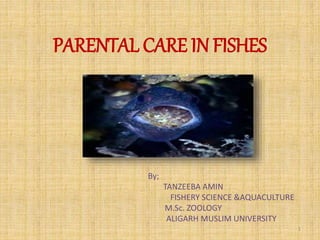
- 1. PARENTAL CARE IN FISHES By; TANZEEBA AMIN FISHERY SCIENCE &AQUACULTURE M.Sc. ZOOLOGY ALIGARH MUSLIM UNIVERSITY 1
- 2. Introduction The term ‘parental care’ in used to describe any behavior performed by parents that appears likely to improve the survival of the young ones. In simple words, looking after the eggs or the youngones until they are independent, to defend them from enemies and predators. This phenomenon is well developed in several groups of fishes. It is actually very important for perpetuation of race. Role of male and female in parental care was studied in five species of clown fishes in captive conditions (T.T. Ajith kumar et al,2012). 2
- 3. Patterns and diversity of parental care in fishes Four main categories:- 1. Fish species which build nest 2. Fish species which do not build nest 3. Viviparity in fishes 4. Care of young ones 3
- 4. Fish species which build nest Circular nest Male Amia calva construct a circular nest among aquatic plants. One or more female attend the nest for laying the eggs. Then the male fertilizes and guard the eggs till hatching. Fig. Circular nest 4
- 5. Basin shaped nest Darter fish during spawning season chooses a proper place known as DOMAIN. Any female darter can enter it and construct a basin like depression to release the eggs Fig. Basin like nest 5
- 6. Barrel shaped nest The male three-spined stickleback fish construct nest of dead aquatic plants by using sticky secretion from his kidneys. Male drags a female to lay eggs then fertilizes them and takes care of them. Fig. Barrel shaped nest 6
- 7. Burrow or hole nest The male of African lung fish (Protopterus), digs oval pits or holes at the base of tall swamp grasses. Several females laid eggs in a single hole. Floating nest:- The male of Gymnarchus builds a floating nest by using aquatic vegetation. Fig. Burrow or hole nest 7
- 8. Foamy nest The male fighting fish (Betta) builds the nest by producing small bubbles in his mouth. The blowing bubbles with sticky mucous adheres together & form floating mass of dome shaped foam. Fig. Foamy nest 8
- 9. Fish species which do not build nest 1) Deposition of eggs at suitable places:- Depositing eggs in masses of definite forms:- example- Perca flavescen (yellow perch) Deposition of eggs in the cervices of the rocks:- example- Cyclopterus. Deposition of eggs in dead shells of molluscs:- example- Gobies, bull head fish & Rhodeus. Fig. Deposited eggs on shell of molluscs 9
- 10. 2) Deposition of eggs in fish body • Mouth cavity as a shelter for eggs:- • e.g. female cichlids (Tilapia) . • Males of Arius & Loricaria. Fig. mouth brooding fish with eggs in mouth 10
- 11. Courtship behaviour and parental care was observed in laboratory conditions in Oreochromis mossambicus. It was observed that after fertilization female kept all eggs in mouth showing mouth brooding (Sudha patel et al ,2016) . 11 Fig. mouth brooding fish with young in mouth
- 12. Attachment of eggs with bony hooks The male of Australian Kurtus attaches the mass of eggs on a hook like projection on forehead until hatching. Formation of integumentary cups:- e.g, Platystacus fig. male Australian Kurtus with bony hooks on forehead 12
- 13. Placement of eggs in brood pouches In the sea horse and pipe fish male cares the eggs till hatching. In sea horse females transfer eggs into brood pouch of male. Male keep them till hatching & also carries the young for sometimes. The male pipe fish grows flaps of skin underside which form a pouch. 13 Male Hippocampus with brood pouch
- 14. Formation of mermaid’s purses Sharks and rays forms mermaid’s purses which are secreted by the shell glands of oviduct. They vary in shapes but perform same function i.e. protection. These are anchored to sea weeds by their long tendrils. Development occurs in them & young hatches out. Fig. mermaid’s purses of elasmobranchs 14
- 15. 3)Viviparity in fishes Some fishes are viviparous such as Scoliodon, Cymatogaster etc. In them fertilization & development both are internal. 4) Care of young ones:- families such as Gasterosteidae, Ictaluridae & Centrarchidae does not stop with the caring of eggs but also defend their young ones. 15 Fig. Cymatogaster giving birth to young
- 16. Merits & demerits of parental care in fishes Merits of parental care :- • Improves survival of young ones • Improves development of young ones Demerits of parental care:- • Decreased parental survival • Increased time until the next breeding attempt • Reduced future fecundity 16
- 17. Conclusion Parental care is an inborn instinctive behavior shown by different species of fish. A number of fishes provide parental care to their eggs and young, provide protection for their survival against struggle for existence. Many fish species do not care for their eggs, but lay their eggs in sufficiently safer places in large number e.g. – some carps. Great diversity of parental care is found in fishes. Formation of basin shaped simple nest to viviparity and few take care of hatchlings.
- 18. References • Ichthyology handbook by B G Kapoor and Bhavna khanna • Biology of fishes by Quentin Bone and Richard H. Moore • The biology of fishes by M. Harry Kyle • fundamentals of Ichthiology by S P Biswas • www.slideshare.net/BhavyaVashisht/parental-care-in-fishes • www.yourarticlelililibraryy.com/fish/anatomy- and.../9...parental-care...fishes/88416/ • rspb.royalsocietypublishing.org • T.T Ajith kumar et al 2012, determining the level of parental care in 5 species of amphiron,Indian journal of geo marine science,vol41(5),430-441. • Susha patel and Dr Mangala nayak 2016,courtship and parental care in oreochromis in lab conditions,IJIRAS ,vol 3 issue 10,230-234. 18
- 19. THANK YOU…. 19