Bacterial food poisoning
Dr. Mahadi Hassan Mahmoud
Assistant Professor of Microbiology
Bacterial food poisoning
Definition:
Intestinal disturbance usually in form of
diarrhea and/or vomiting due to
consumption of food contaminated with
bacteria or its toxin.
Causative agents :
• S. aureus, Bacillus cereus, Salmonella spp,
C. perfringens, V. parahaemolyticus, C.
botulinum.
• Rarely can be caused by some strains of E.
coli, some stains of Campylobacter and
Yesinia enterocolitica.
Types of food poisoning:
There are two types
• Infective food poisoning:
Happen due to consumption of food
containing life bacteria. As a result of
multiplication of organism in GIT, food
poisoning occurs. The main causative agents
are Salmonella spp and V. parahaemolyticus,
the symptoms occur with 8 to 24 up to 48 hrs.
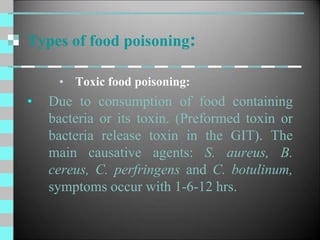
Types of food poisoning:
• Toxic food poisoning:
• Due to consumption of food containing
bacteria or its toxin. (Preformed toxin or
bacteria release toxin in the GIT). The
main causative agents: S. aureus, B.
cereus, C. perfringens and C. botulinum,
symptoms occur with 1-6-12 hrs.
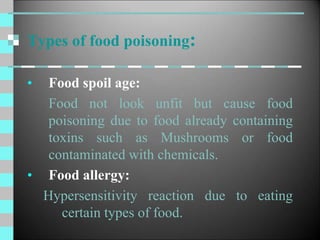
Types of food poisoning:
• Food spoil age:
Food not look unfit but cause food
poisoning due to food already containing
toxins such as Mushrooms or food
contaminated with chemicals.
• Food allergy:
Hypersensitivity reaction due to eating
certain types of food.
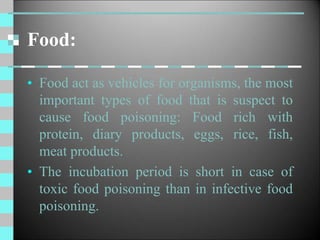
Food:
• Food act as vehicles for organisms, the most
important types of food that is suspect to
cause food poisoning: Food rich with
protein, diary products, eggs, rice, fish,
meat products.
• The incubation period is short in case of
toxic food poisoning than in infective food
poisoning.
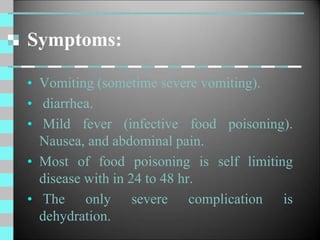
Symptoms:
• Vomiting (sometime severe vomiting).
• diarrhea.
• Mild fever (infective food poisoning).
Nausea, and abdominal pain.
• Most of food poisoning is self limiting
disease with in 24 to 48 hr.
• The only severe complication is
dehydration.
Treatment:
• Rehydration.
LAB diagnosis
• Information:
1. Type of food.
2. Number of people who eat from food
(in clusters)
3. Number of people who get
symptoms (according to dose, degree
of immunity)
4. Incubation period
5. Symptoms.
Staph-food poisoning
More happen in developing countries.
Caused by S. aureus (produce exotoxin
(enterotoxin) 6 types the most important
are A & B, phage type group 3). The toxin
resistant to heat (100°C up to 30 min).
Staph-food poisoning
• Food: diary products, pastries & cheese
(salt).
• Incubation period: 1-6 hrs.
• Symptoms:
• Vomiting (severe).
• Nausea.
• Diarrhea.
LAB diagnosis
Specimen:
• food
• vomits
• Stool
• Identification depends on:
Isolation: (Culture in selective media MSA
& BIRD-PARKER), Biochemical test.
LAB diagnosis
• Toxin detection: sometime there is no
organism in food so make suspension
from food for direct agglutination test.
• Phage typing:
Confirm it is phage type3.
B. cereus food poisoning
From cereals specially rice. Due to
consumption of food contaminated with
B. cereus toxin.
Incubation period:
1-6 hrs can continue to 12 hrs.
B. cereus food poisoning
• Symptoms:
Diarrhea, sometime toxin produced in
stomach so it causes vomiting more than
diarrhea.
• Type of food:
Rice.
Vegetable (potatoes).
LAB diagnosis
• Specimen: food, vomits, stools.
• Media:
B. cereus selective media (Baker's
selective media) [phenol red egg yolk
polymyxin agar].
• Colonial morphology:
non-manitol fermenter, produce opacity.
Salmonella- food poisoning
• Most spp can caused food poisoning and
most of them from animal sources. S.
typhimurium cause more than 50% of
Salmonella food poisoning, (group B).
• Food: meat, chickens, eggs (birds egg,
turkey).
• Symptoms: diarrhea, abdominal pain, mild
fever.
• Incubation period: 12 - 24 - 48 hrs.
LAB diagnosis
• Specimen:
Food.
Stool.
• Media:
XLS.
DCA.
Brilliant green Agar. (Best selective
media for S. paratyphi B & S.
typhimurium).
Clostridia perfringens
• C. perfringens serotype A (Produce heat
resistant toxin [in the stomach] (non.
haemolytic).
• Food: meat & meat products, diary products
& chicken.
• Symptom: diarrhea, Nausea, Abdominal
pain.
• Incubation period: 8-12 hrs can be up to
24 hrs.
LAB diagnosis
• Specimen:
Food, stool.
• Media:
1. Neomycin B.A
2. Selective cooked meat media (CMM)
[by adding Neomycin].
• Incubation:
Anaerobic.
Vibrio parahaemolyticus
• Non V. cholera (no cholera toxin, non
agglutinated with 0-1 & 0-139 antisera).
• Food: seafood especially shells fish.
(Japan).
• Symptom: diarrhea, abdominal pain and
sometime mild fever.
• Incubation period: 8-12 hrs rarely rich 24
hrs.
LAB diagnosis
• Specimen:
Food.
Stool.
• Media:
TCBS, Alkaline peptone water.
• Identification:
Colonial morphology, Biochemical
serological test.
Clostridia botulinum
Do not cause food poisoning but when eat
food contain its toxin (exotoxin). The toxin
act on CNS and cause paralysis.
• Symptom: double vision, paralysis (no GIT
symptoms).
• Food: sausage & conned food (anaerobic
condition).
• Incubation period: 2 hrs -6-8 up to 12 hrs.
LAB diagnosis
• Food (toxin detection).
• Animal inoculation.
• Cultural methods are not used.
The end

Food poisoning by Dr. Mahadi H Abdallah

  • 1.
    Bacterial food poisoning Dr.Mahadi Hassan Mahmoud Assistant Professor of Microbiology
  • 2.
    Bacterial food poisoning Definition: Intestinaldisturbance usually in form of diarrhea and/or vomiting due to consumption of food contaminated with bacteria or its toxin.
  • 3.
    Causative agents : •S. aureus, Bacillus cereus, Salmonella spp, C. perfringens, V. parahaemolyticus, C. botulinum. • Rarely can be caused by some strains of E. coli, some stains of Campylobacter and Yesinia enterocolitica.
  • 4.
    Types of foodpoisoning: There are two types • Infective food poisoning: Happen due to consumption of food containing life bacteria. As a result of multiplication of organism in GIT, food poisoning occurs. The main causative agents are Salmonella spp and V. parahaemolyticus, the symptoms occur with 8 to 24 up to 48 hrs.
  • 5.
    Types of foodpoisoning: • Toxic food poisoning: • Due to consumption of food containing bacteria or its toxin. (Preformed toxin or bacteria release toxin in the GIT). The main causative agents: S. aureus, B. cereus, C. perfringens and C. botulinum, symptoms occur with 1-6-12 hrs.
  • 6.
    Types of foodpoisoning: • Food spoil age: Food not look unfit but cause food poisoning due to food already containing toxins such as Mushrooms or food contaminated with chemicals. • Food allergy: Hypersensitivity reaction due to eating certain types of food.
  • 7.
    Food: • Food actas vehicles for organisms, the most important types of food that is suspect to cause food poisoning: Food rich with protein, diary products, eggs, rice, fish, meat products. • The incubation period is short in case of toxic food poisoning than in infective food poisoning.
  • 8.
    Symptoms: • Vomiting (sometimesevere vomiting). • diarrhea. • Mild fever (infective food poisoning). Nausea, and abdominal pain. • Most of food poisoning is self limiting disease with in 24 to 48 hr. • The only severe complication is dehydration.
  • 9.
  • 10.
    LAB diagnosis • Information: 1.Type of food. 2. Number of people who eat from food (in clusters) 3. Number of people who get symptoms (according to dose, degree of immunity) 4. Incubation period 5. Symptoms.
  • 11.
    Staph-food poisoning More happenin developing countries. Caused by S. aureus (produce exotoxin (enterotoxin) 6 types the most important are A & B, phage type group 3). The toxin resistant to heat (100°C up to 30 min).
  • 12.
    Staph-food poisoning • Food:diary products, pastries & cheese (salt). • Incubation period: 1-6 hrs. • Symptoms: • Vomiting (severe). • Nausea. • Diarrhea.
  • 13.
    LAB diagnosis Specimen: • food •vomits • Stool • Identification depends on: Isolation: (Culture in selective media MSA & BIRD-PARKER), Biochemical test.
  • 14.
    LAB diagnosis • Toxindetection: sometime there is no organism in food so make suspension from food for direct agglutination test. • Phage typing: Confirm it is phage type3.
  • 15.
    B. cereus foodpoisoning From cereals specially rice. Due to consumption of food contaminated with B. cereus toxin. Incubation period: 1-6 hrs can continue to 12 hrs.
  • 16.
    B. cereus foodpoisoning • Symptoms: Diarrhea, sometime toxin produced in stomach so it causes vomiting more than diarrhea. • Type of food: Rice. Vegetable (potatoes).
  • 17.
    LAB diagnosis • Specimen:food, vomits, stools. • Media: B. cereus selective media (Baker's selective media) [phenol red egg yolk polymyxin agar]. • Colonial morphology: non-manitol fermenter, produce opacity.
  • 18.
    Salmonella- food poisoning •Most spp can caused food poisoning and most of them from animal sources. S. typhimurium cause more than 50% of Salmonella food poisoning, (group B). • Food: meat, chickens, eggs (birds egg, turkey). • Symptoms: diarrhea, abdominal pain, mild fever. • Incubation period: 12 - 24 - 48 hrs.
  • 19.
    LAB diagnosis • Specimen: Food. Stool. •Media: XLS. DCA. Brilliant green Agar. (Best selective media for S. paratyphi B & S. typhimurium).
  • 20.
    Clostridia perfringens • C.perfringens serotype A (Produce heat resistant toxin [in the stomach] (non. haemolytic). • Food: meat & meat products, diary products & chicken. • Symptom: diarrhea, Nausea, Abdominal pain. • Incubation period: 8-12 hrs can be up to 24 hrs.
  • 21.
    LAB diagnosis • Specimen: Food,stool. • Media: 1. Neomycin B.A 2. Selective cooked meat media (CMM) [by adding Neomycin]. • Incubation: Anaerobic.
  • 22.
    Vibrio parahaemolyticus • NonV. cholera (no cholera toxin, non agglutinated with 0-1 & 0-139 antisera). • Food: seafood especially shells fish. (Japan). • Symptom: diarrhea, abdominal pain and sometime mild fever. • Incubation period: 8-12 hrs rarely rich 24 hrs.
  • 23.
    LAB diagnosis • Specimen: Food. Stool. •Media: TCBS, Alkaline peptone water. • Identification: Colonial morphology, Biochemical serological test.
  • 24.
    Clostridia botulinum Do notcause food poisoning but when eat food contain its toxin (exotoxin). The toxin act on CNS and cause paralysis. • Symptom: double vision, paralysis (no GIT symptoms). • Food: sausage & conned food (anaerobic condition). • Incubation period: 2 hrs -6-8 up to 12 hrs.
  • 25.
    LAB diagnosis • Food(toxin detection). • Animal inoculation. • Cultural methods are not used.
  • 26.