
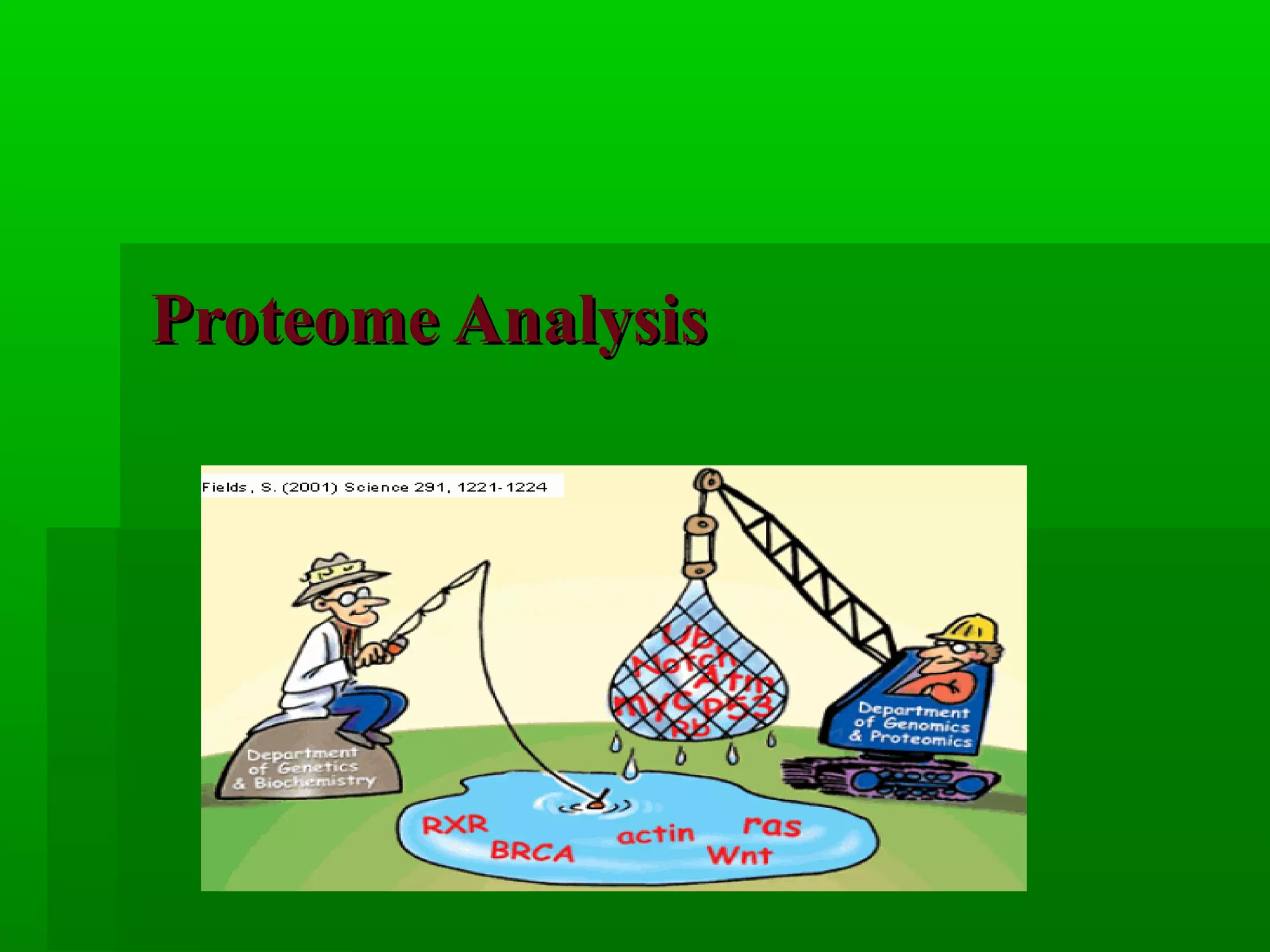

Proteome AnalysisProteome Analysis
Proteins are the final products manufactured in living
cells according to the ‘blueprint’ contained in the
genome. The proteome represents the array of proteins
that are expressed in a biological compartment
(cell, tissue, organ) at a particular time, under a
particular set of conditions.
Why Proteome Analysis?Why Proteome Analysis?
Systems biology - understand cell-pathways, network,
and complex interacting.
Biological processes - characterize sub-proteomes
such as protein complexes, cellular machines,
organelles
Biomarkers - discovery of disease (serological, urine,
other biological fluids) - diagnostics, treat patients,
monitor therapies
Drug targets - evaluate toxicity & other biological or
pharmaceutical parameters associated with drug
treatment
Factors stimulates the development ofFactors stimulates the development of
Proteome AnalysisProteome Analysis
1. 2DE has evolved into a robust method to rapidly
separate the many proteins contained in a proteome.
2. MS methods were developed for ready and accurate
analysis of 2DEseparated proteins with a high degree
of sensitivity.
3. Large-scale genome research has produced a
constantly increasing number of sequences that were
catalogued in several databases, which could be
accessed over the Internet, and search engines and
other bioinformatics tools were developed to query
these databases.
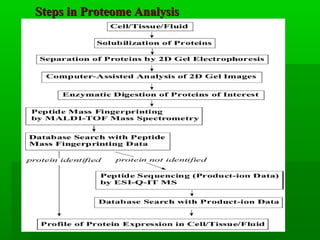
Steps in Proteome AnalysisSteps in Proteome Analysis
Proteome AnalysisProteome Analysis
MALDI-ToF-MS is commonly used for peptide-mass
fingerprinting. The method is user-friendly, fast (3^5
min per analysis), sensitive (fmol peptide levels), and
it measures peptide masses with accuracy better than
50 ppm.
However, MALDI-ToF-MS is impractical for the
sequencing peptides in proteolytic digests, unless the
peptides are derivatized prior to analysis
Proteome AnalysisProteome Analysis
To obtain peptide-sequence data (product-ion
spectra), ESI-Q-IT-MS is usually employed;typically,
peptide mixtures are first separated by liquid
chromatography, which is coupled on-line to the ESI-
Q-IT mass spectrometer.
This method requires about 1h per analysis, but good-
quality product-ion data are a very specific attribute
for protein identification.
Thank youThank you

Proteome analysis

  • 1.
  • 2.
    Proteome AnalysisProteome Analysis Proteinsare the final products manufactured in living cells according to the ‘blueprint’ contained in the genome. The proteome represents the array of proteins that are expressed in a biological compartment (cell, tissue, organ) at a particular time, under a particular set of conditions.
  • 3.
    Why Proteome Analysis?WhyProteome Analysis? Systems biology - understand cell-pathways, network, and complex interacting. Biological processes - characterize sub-proteomes such as protein complexes, cellular machines, organelles Biomarkers - discovery of disease (serological, urine, other biological fluids) - diagnostics, treat patients, monitor therapies Drug targets - evaluate toxicity & other biological or pharmaceutical parameters associated with drug treatment
  • 4.
    Factors stimulates thedevelopment ofFactors stimulates the development of Proteome AnalysisProteome Analysis 1. 2DE has evolved into a robust method to rapidly separate the many proteins contained in a proteome. 2. MS methods were developed for ready and accurate analysis of 2DEseparated proteins with a high degree of sensitivity. 3. Large-scale genome research has produced a constantly increasing number of sequences that were catalogued in several databases, which could be accessed over the Internet, and search engines and other bioinformatics tools were developed to query these databases.
  • 5.
    Steps in ProteomeAnalysisSteps in Proteome Analysis
  • 6.
    Proteome AnalysisProteome Analysis MALDI-ToF-MSis commonly used for peptide-mass fingerprinting. The method is user-friendly, fast (3^5 min per analysis), sensitive (fmol peptide levels), and it measures peptide masses with accuracy better than 50 ppm. However, MALDI-ToF-MS is impractical for the sequencing peptides in proteolytic digests, unless the peptides are derivatized prior to analysis
  • 7.
    Proteome AnalysisProteome Analysis Toobtain peptide-sequence data (product-ion spectra), ESI-Q-IT-MS is usually employed;typically, peptide mixtures are first separated by liquid chromatography, which is coupled on-line to the ESI- Q-IT mass spectrometer. This method requires about 1h per analysis, but good- quality product-ion data are a very specific attribute for protein identification.
  • 8.