Proteomics Methods and Protocols 1st Edition
Friedrich Lottspeich (Auth.) download pdf
https://ebookfinal.com/download/proteomics-methods-and-protocols-1st-
edition-friedrich-lottspeich-auth/
Visit ebookfinal.com today to download the complete set of
ebook or textbook!
Here are some recommended products that we believe you will be
interested in. You can click the link to download.
Membrane Proteomics Methods and Protocols 1st Edition
Henry Bigelow
https://ebookfinal.com/download/membrane-proteomics-methods-and-
protocols-1st-edition-henry-bigelow/
Clinical Proteomics Methods and Protocols 2nd Edition
Antonia Vlahou
https://ebookfinal.com/download/clinical-proteomics-methods-and-
protocols-2nd-edition-antonia-vlahou/
Renal and Urinary Proteomics Methods and Protocols 1st
Edition Visith Thongboonkerd
https://ebookfinal.com/download/renal-and-urinary-proteomics-methods-
and-protocols-1st-edition-visith-thongboonkerd/
Cancer Genomics and Proteomics Methods and Protocols 1st
Edition Narendra Wajapeyee (Eds.)
https://ebookfinal.com/download/cancer-genomics-and-proteomics-
methods-and-protocols-1st-edition-narendra-wajapeyee-eds/
Plant Proteomics Methods and Protocols 1st Edition Valérie
Méchin
https://ebookfinal.com/download/plant-proteomics-methods-and-
protocols-1st-edition-valerie-mechin/
Quantitative Methods in Proteomics 1st Edition Katharina
Podwojski
https://ebookfinal.com/download/quantitative-methods-in-
proteomics-1st-edition-katharina-podwojski/
Vagabond Vol 29 29 Inoue
https://ebookfinal.com/download/vagabond-vol-29-29-inoue/
Dengue Methods and Protocols 1st Edition Radhakrishnan
Padmanabhan
https://ebookfinal.com/download/dengue-methods-and-protocols-1st-
edition-radhakrishnan-padmanabhan/
Immunoproteomics Methods and Protocols 1st Edition Scott
Mccomb
https://ebookfinal.com/download/immunoproteomics-methods-and-
protocols-1st-edition-scott-mccomb/
Proteomics Methods and Protocols 1st Edition Friedrich
Lottspeich (Auth.) Digital Instant Download
Author(s): Friedrich Lottspeich (auth.), Jörg Reinders, Albert Sickmann
(eds.)
ISBN(s): 9781607611561, 1607611562
Edition: 1
File Details: PDF, 5.52 MB
Year: 2009
Language: english
For other titles published in this series, go to
www.springer.com/series/7651
ME T H O D S I N MO L E C U L A R BI O L O G Y ™
Series Editor
John M. Walker
School of Life Sciences
University of Hertfordshire
Hatfield, Hertfordshire, AL10 9AB, UK
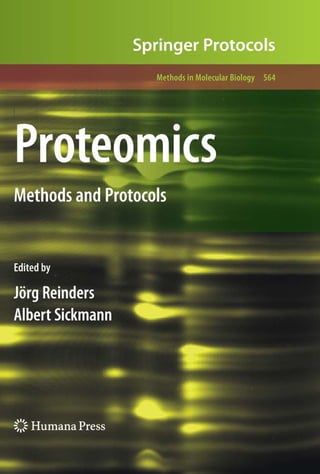
Proteomics
Methods and Protocols
Edited by
Jörg Reinders* and Albert Sickmann†
*UniversityofRegensburg,InstituteofFunctionalGenomics,Joseph-EngertStrasse993053
Regensburg,Germany
†
InstitutfϋrSpektrochemieundAngewandteSpektroskopie(ISAS),Bunsen-KirchoffStr.1144139
Dortmund,Germany
ISSN: 1064-3745 e-ISSN: 1940-6029
ISBN: 978-1-60761-156-1 e-ISBN: 978-1-60761-157-8
DOI: 10.1007/978-1-60761-157-8
Springer Dordrecht Heidelberg London New York
Library of Congress Control Number: 2009927501
© Humana Press, a part of Springer Science+Business Media, LLC 2009
All rights reserved. This work may not be translated or copied in whole or in part without the written permission of
the publisher (Humana Press, c/o Springer Science+Business Media, LLC, 233 Spring Street, New York, NY 10013,
USA), except for brief excerpts in connection with reviews or scholarly analysis. Use in connection with any form of
information storage and retrieval, electronic adaptation, computer software, or by similar or dissimilar methodology
now known or hereafter developed is for-bidden.
The use in this publication of trade names, trademarks, service marks, and similar terms, even if they are not identified
as such, is not to be taken as an expression of opinion as to whether or not they are subject to proprietary rights.
Printed on acid-free paper
Springer is part of Springer Science+Business Media (www.springer.com)
Editors
Jörg Reinders
University of Regensburg
Institute of Functional
Genomics
Joseph-Engert-Strasse 9
93053 Regensburg
Germany
Albert Sickmann
Institut für Spektrochemie und
Angewandte Spektroskopie
(ISAS)
Bunsen-Kirchoff Str. 11
44139 Dortmund
Germany
v
Preface
Proteins are essential players in all cellular processes, facilitating various functions as
enzymes and structure-forming or signal-transducing molecules. Their enormous versa-
tility in primary structure, folding, and modification enables a complex, highly dynamic,
but nevertheless robust, network carrying out all the necessary tasks to ensure proper
function of each cell and concerted activity of cellular associations up to complex organ-
isms. Therefore, proteins have always been, and presumably will always be, the target of
all kinds of studies in biological sciences.
Protein purification and separation methods have a longstanding record as they were
a prerequisite for enzymological studies and chemical protein identification methods such
as Edman-sequencing. Thus, various elaborate and mostly time-consuming techniques for
the isolation of distinct proteins have been developed often based on chromatography or
electrophoresis, and the identification of the protein’s primary structure was accomplished
afterwards by no less intricate methods. However, the relatively recent development of
MALDI- and ESI-ionization techniques for mass spectrometric analysis of large and frag-
ile biomolecules enabled protein identification in an automated fashion, thereby speeding
up protein identification by a multiple. This turned out to be a major breakthrough in
protein analysis enabling high-throughput protein identification on a global scale, leading
to approaches to study the entirety of all proteins of a cell, tissue, organ, etc.
In 1995, the term “Proteome” was introduced by Marc Wilkins and Keith Wil-
liams as the entirety of all proteins encoded in a single genome expressed under distinct
conditions representing the turning point in the journey from studying genes to studying
proteins, from “Genomics” to “Proteomics.” Since then, great efforts have been under-
taken to characterize a “healthy” or a “diseased” proteome, but it soon turned out that a
proteome is far too complex and dynamic to be defined by such simple terms. The enor-
mous progress that has been accomplished both technically and biologically has not only
granted deeper insight into the cellular network but has also raised further questions and
set further challenges to proteomic research.
The enormous range of protein abundance, dynamics, and interactions as well as the
spatio-temporal distribution of a proteome gave rise to the evolution of several new fields
like phospho-, glyco-, subcellular, and membrane proteomics, etc. Many techniques have
been developed or significantly increased in these fields and will contribute to the under-
standing of the cellular networks in the future.
Leading scientists have contributed to this volume, which is intended to give an over-
view of the contemporary challenges and possibilities in the various areas of proteomics
and to offer some detailed protocols as examples for successful analysis in proteomics
studies. Therefore, we hope that this book can raise your interest in proteomics and be a
valuable reference book for your laboratory work.
v
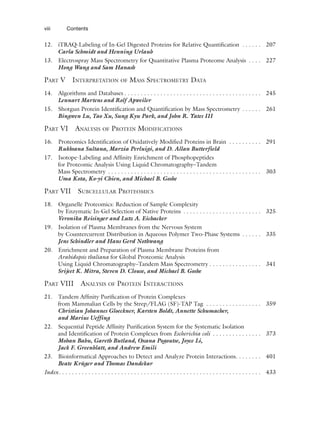
vii
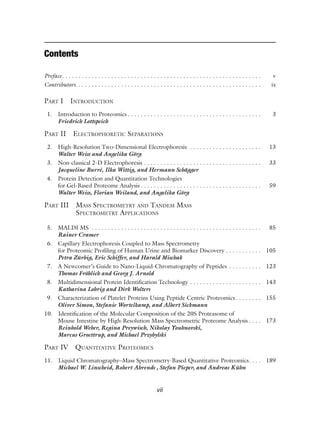
Contents
Preface. . . . . . . . . . . . . . . . . . . . . . . . . . . . . . . . . . . . . . . . . . . . . . . . . . . . . . . . . . . . . v
Contributors. . . . . . . . . . . . . . . . . . . . . . . . . . . . . . . . . . . . . . . . . . . . . . . . . . . . . . . . . ix
PART I INTRODUCTION
1. Introduction to Proteomics . . . . . . . . . . . . . . . . . . . . . . . . . . . . . . . . . . . . . . . . . 3
Friedrich Lottspeich
PART II ELECTROPHORETIC SEPARATIONS
2. High-Resolution Two-Dimensional Electrophoresis . . . . . . . . . . . . . . . . . . . . . . 13
Walter Weiss and Angelika Görg
3. Non-classical 2-D Electrophoresis . . . . . . . . . . . . . . . . . . . . . . . . . . . . . . . . . . . . 33
Jacqueline Burré, Ilka Wittig, and Hermann Schägger
4. Protein Detection and Quantitation Technologies
for Gel-Based Proteome Analysis . . . . . . . . . . . . . . . . . . . . . . . . . . . . . . . . . . . . . 59
Walter Weiss, Florian Weiland, and Angelika Görg
PART III MASS SPECTROMETRY AND TANDEM MASS
SPECTROMETRY APPLICATIONS
5. MALDI MS . . . . . . . . . . . . . . . . . . . . . . . . . . . . . . . . . . . . . . . . . . . . . . . . . . . . 85
Rainer Cramer
6. Capillary Electrophoresis Coupled to Mass Spectrometry
for Proteomic Profiling of Human Urine and Biomarker Discovery . . . . . . . . . . . 105
Petra Zürbig, Eric Schiffer, and Harald Mischak
7. A Newcomer’s Guide to Nano-Liquid-Chromatography of Peptides . . . . . . . . . . 123
Thomas Fröhlich and Georg J. Arnold
8. Multidimensional Protein Identification Technology . . . . . . . . . . . . . . . . . . . . . . 143
Katharina Lohrig and Dirk Wolters
9. Characterization of Platelet Proteins Using Peptide Centric Proteomics . . . . . . . . 155
Oliver Simon, Stefanie Wortelkamp, and Albert Sickmann
10. Identification of the Molecular Composition of the 20S Proteasome of
Mouse Intestine by High-Resolution Mass Spectrometric Proteome Analysis . . . . 173
Reinhold Weber, Regina Preywisch, Nikolay Youhnovski,
Marcus Groettrup, and Michael Przybylski
PART IV QUANTITATIVE PROTEOMICS
11. Liquid Chromatography–Mass Spectrometry-Based Quantitative Proteomics. . . . 189
Michael W. Linscheid, Robert Ahrends , Stefan Pieper, and Andreas Kühn
12. iTRAQ-Labeling of In-Gel Digested Proteins for Relative Quantification . . . . . . 207
Carla Schmidt and Henning Urlaub
13. Electrospray Mass Spectrometry for Quantitative Plasma Proteome Analysis . . . . 227
Hong Wang and Sam Hanash
PART V INTERPRETATION OF MASS SPECTROMETRY DATA
14. Algorithms and Databases . . . . . . . . . . . . . . . . . . . . . . . . . . . . . . . . . . . . . . . . . . 245
Lennart Martens and Rolf Apweiler
15. Shotgun Protein Identification and Quantification by Mass Spectrometry . . . . . . 261
Bingwen Lu, Tao Xu, Sung Kyu Park, and John R. Yates III
PART VI ANALYSIS OF PROTEIN MODIFICATIONS
16. Proteomics Identification of Oxidatively Modified Proteins in Brain . . . . . . . . . . 291
Rukhsana Sultana, Marzia Perluigi, and D. Allan Butterfield
17. Isotope-Labeling and Affinity Enrichment of Phosphopeptides
for Proteomic Analysis Using Liquid Chromatography–Tandem
Mass Spectrometry . . . . . . . . . . . . . . . . . . . . . . . . . . . . . . . . . . . . . . . . . . . . . . . 303
Uma Kota, Ko-yi Chien, and Michael B. Goshe
PART VII SUBCELLULAR PROTEOMICS
18. Organelle Proteomics: Reduction of Sample Complexity
by Enzymatic In-Gel Selection of Native Proteins . . . . . . . . . . . . . . . . . . . . . . . . 325
Veronika Reisinger and Lutz A. Eichacker
19. Isolation of Plasma Membranes from the Nervous System
by Countercurrent Distribution in Aqueous Polymer Two-Phase Systems . . . . . . 335
Jens Schindler and Hans Gerd Nothwang
20. Enrichment and Preparation of Plasma Membrane Proteins from
Arabidopsis thaliana for Global Proteomic Analysis
Using Liquid Chromatography–Tandem Mass Spectrometry . . . . . . . . . . . . . . . . 341
Srijeet K. Mitra, Steven D. Clouse, and Michael B. Goshe
PART VIII ANALYSIS OF PROTEIN INTERACTIONS
21. Tandem Affinity Purification of Protein Complexes
from Mammalian Cells by the Strep/FLAG (SF)-TAP Tag . . . . . . . . . . . . . . . . . 359
Christian Johannes Gloeckner, Karsten Boldt, Annette Schumacher,
and Marius Ueffing
22. Sequential Peptide Affinity Purification System for the Systematic Isolation
and Identification of Protein Complexes from Escherichia coli . . . . . . . . . . . . . . . 373
Mohan Babu, Gareth Butland, Oxana Pogoutse, Joyce Li,
Jack F. Greenblatt, and Andrew Emili
23. Bioinformatical Approaches to Detect and Analyze Protein Interactions. . . . . . . . 401
Beate Krüger and Thomas Dandekar
Index. . . . . . . . . . . . . . . . . . . . . . . . . . . . . . . . . . . . . . . . . . . . . . . . . . . . . . . . . . . . . . 433
viii Contents
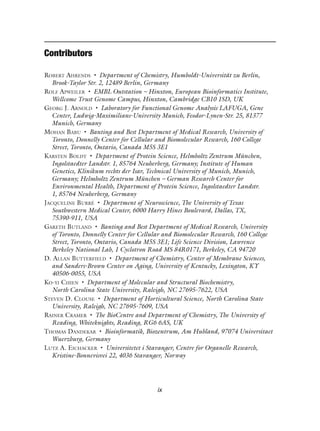
Contributors
ROBERT AHRENDS • Department of Chemistry, Humboldt-Universität zu Berlin,
Brook-Taylor Str. 2, 12489 Berlin, Germany
ROLF APWEILER • EMBL Outstation – Hinxton, European Bioinformatics Institute,
Wellcome Trust Genome Campus, Hinxton, Cambridge CB10 1SD, UK
GEORG J. ARNOLD • Laboratory for Functional Genome Analysis LAFUGA, Gene
Center, Ludwig-Maximilians-University Munich, Feodor-Lynen-Str. 25, 81377
Munich, Germany
MOHAN BABU • Banting and Best Department of Medical Research, University of
Toronto, Donnelly Center for Cellular and Biomolecular Research, 160 College
Street, Toronto, Ontario, Canada M5S 3E1
KARSTEN BOLDT • Department of Protein Science, Helmholtz Zentrum München,
Ingolstaedter Landstr. 1, 85764 Neuherberg, Germany; Institute of Human
Genetics, Klinikum rechts der Isar, Technical University of Munich, Munich,
Germany; Helmholtz Zentrum München – German Research Center for
Environmental Health, Department of Protein Science, Ingolstaedter Landstr.
1, 85764 Neuherberg, Germany
JACQUELINE BURRÉ • Department of Neuroscience, The University of Texas
Southwestern Medical Center, 6000 Harry Hines Boulevard, Dallas, TX,
75390-911, USA
GARETH BUTLAND • Banting and Best Department of Medical Research, University
of Toronto, Donnelly Center for Cellular and Biomolecular Research, 160 College
Street, Toronto, Ontario, Canada M5S 3E1; Life Science Division, Lawrence
Berkeley National Lab, 1 Cyclotron Road MS 84R0171, Berkeley, CA 94720
D. ALLAN BUTTERFIELD • Department of Chemistry, Center of Membrane Sciences,
and Sanders-Brown Center on Aging, University of Kentucky, Lexington, KY
40506-0055, USA
KO-YI CHIEN • Department of Molecular and Structural Biochemistry,
North Carolina State University, Raleigh, NC 27695-7622, USA
STEVEN D. CLOUSE • Department of Horticultural Science, North Carolina State
University, Raleigh, NC 27695-7609, USA
RAINER CRAMER • The BioCentre and Department of Chemistry, The University of
Reading, Whiteknights, Reading, RG6 6AS, UK
THOMAS DANDEKAR • Bioinformatik, Biozentrum, Am Hubland, 97074 Universitaet
Wuerzburg, Germany
LUTZ A. EICHACKER • Universitetet i Stavanger, Centre for Organelle Research,
Kristine-Bonnevisvei 22, 4036 Stavanger, Norway
ix
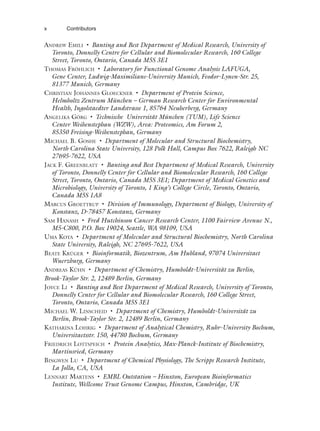
ANDREW EMILI • Banting and Best Department of Medical Research, University of
Toronto, Donnelly Centre for Cellular and Biomolecular Research, 160 College
Street, Toronto, Ontario, Canada M5S 3E1
THOMAS FRÖHLICH • Laboratory for Functional Genome Analysis LAFUGA,
Gene Center, Ludwig-Maximilians-University Munich, Feodor-Lynen-Str. 25,
81377 Munich, Germany
CHRISTIAN JOHANNES GLOECKNER • Department of Protein Science,
Helmholtz Zentrum München – German Research Center for Environmental
Health, Ingolstaedter Landstrasse 1, 85764 Neuherberg, Germany
ANGELIKA GÖRG • Technische Universität München (TUM), Life Science
Center Weihenstephan (WZW), Area: Proteomics, Am Forum 2,
85350 Freising-Weihenstephan, Germany
MICHAEL B. GOSHE • Department of Molecular and Structural Biochemistry,
North Carolina State University, 128 Polk Hall, Campus Box 7622, Raleigh NC
27695-7622, USA
JACK F. GREENBLATT • Banting and Best Department of Medical Research, University
of Toronto, Donnelly Center for Cellular and Biomolecular Research, 160 College
Street, Toronto, Ontario, Canada M5S 3E1; Department of Medical Genetics and
Microbiology, University of Toronto, 1 King’s College Circle, Toronto, Ontario,
Canada M5S 1A8
MARCUS GROETTRUP • Division of Immunology, Department of Biology, University of
Konstanz, D-78457 Konstanz, Germany
SAM HANASH • Fred Hutchinson Cancer Research Center, 1100 Fairview Avenue N.,
M5-C800, P.O. Box 19024, Seattle, WA 98109, USA
UMA KOTA • Department of Molecular and Structural Biochemistry, North Carolina
State University, Raleigh, NC 27695-7622, USA
BEATE KRÜGER • Bioinformatik, Biozentrum, Am Hubland, 97074 Universitaet
Wuerzburg, Germany
ANDREAS KÜHN • Department of Chemistry, Humboldt-Universität zu Berlin,
Brook-Taylor Str. 2, 12489 Berlin, Germany
JOYCE LI • Banting and Best Department of Medical Research, University of Toronto,
Donnelly Center for Cellular and Biomolecular Research, 160 College Street,
Toronto, Ontario, Canada M5S 3E1
MICHAEL W. LINSCHEID • Department of Chemistry, Humboldt-Universität zu
Berlin, Brook-Taylor Str. 2, 12489 Berlin, Germany
KATHARINA LOHRIG • Department of Analytical Chemistry, Ruhr-University Bochum,
Universitaetsstr. 150, 44780 Bochum, Germany
FRIEDRICH LOTTSPEICH • Protein Analytics, Max-Planck-Institute of Biochemistry,
Martinsried, Germany
BINGWEN LU • Department of Chemical Physiology, The Scripps Research Institute,
La Jolla, CA, USA
LENNART MARTENS • EMBL Outstation – Hinxton, European Bioinformatics
Institute, Wellcome Trust Genome Campus, Hinxton, Cambridge, UK
x Contributors
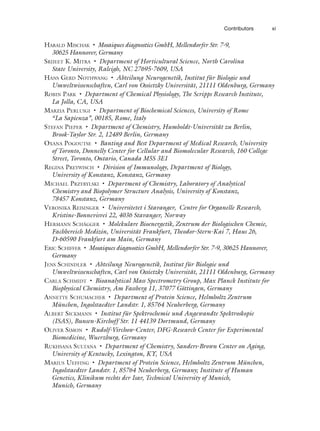
Contributors xi
HARALD MISCHAK • Mosaiques diagnostics GmbH, Mellendorfer Str. 7-9,
30625 Hannover, Germany
SRIJEET K. MITRA • Department of Horticultural Science, North Carolina
State University, Raleigh, NC 27695-7609, USA
HANS GERD NOTHWANG • Abteilung Neurogenetik, Institut für Biologie und
Umweltwissenschaften, Carl von Ossietzky Universität, 21111 Oldenburg, Germany
ROBIN PARK • Department of Chemical Physiology, The Scripps Research Institute,
La Jolla, CA, USA
MARZIA PERLUIGI • Department of Biochemical Sciences, University of Rome
“La Sapienza”, 00185, Rome, Italy
STEFAN PIEPER • Department of Chemistry, Humboldt-Universität zu Berlin,
Brook-Taylor Str. 2, 12489 Berlin, Germany
OXANA POGOUTSE • Banting and Best Department of Medical Research, University
of Toronto, Donnelly Center for Cellular and Biomolecular Research, 160 College
Street, Toronto, Ontario, Canada M5S 3E1
REGINA PREYWISCH • Division of Immunology, Department of Biology,
University of Konstanz, Konstanz, Germany
MICHAEL PRZYBYLSKI • Department of Chemistry, Laboratory of Analytical
Chemistry and Biopolymer Structure Analysis, University of Konstanz,
78457 Konstanz, Germany
VERONIKA REISINGER • Universitetet i Stavanger, Centre for Organelle Research,
Kristine-Bonnevisvei 22, 4036 Stavanger, Norway
HERMANN SCHÄGGER • Molekulare Bioenergetik, Zentrum der Biologischen Chemie,
Fachbereich Medizin, Universität Frankfurt, Theodor-Stern-Kai 7, Haus 26,
D-60590 Frankfurt am Main, Germany
ERIC SCHIFFER • Mosaiques diagnostics GmbH, Mellendorfer Str. 7-9, 30625 Hannover,
Germany
JENS SCHINDLER • Abteilung Neurogenetik, Institut für Biologie und
Umweltwissenschaften, Carl von Ossietzky Universität, 21111 Oldenburg, Germany
CARLA SCHMIDT • Bioanalytical Mass Spectrometry Group, Max Planck Institute for
Biophysical Chemistry, Am Fassberg 11, 37077 Göttingen, Germany
ANNETTE SCHUMACHER • Department of Protein Science, Helmholtz Zentrum
München, Ingolstaedter Landstr. 1, 85764 Neuherberg, Germany
ALBERT SICKMANN • Institut für Spektrochemie und Angewandte Spektroskopie
(ISAS), Bunsen-Kirchoff Str. 11 44139 Dortmund, Germany
OLIVER SIMON • Rudolf-Virchow-Center, DFG-Research Center for Experimental
Biomedicine, Wuerzburg, Germany
RUKHSANA SULTANA • Department of Chemistry, Sanders-Brown Center on Aging,
University of Kentucky, Lexington, KY, USA
MARIUS UEFFING • Department of Protein Science, Helmholtz Zentrum München,
Ingolstaedter Landstr. 1, 85764 Neuherberg, Germany; Institute of Human
Genetics, Klinikum rechts der Isar, Technical University of Munich,
Munich, Germany
HENNING URLAUB • Bioanalytical Mass Spectrometry Group, Max Planck
Institute for Biophysical Chemistry, Am Fassberg 11, 37077 Göttingen, Germany
HONG WANG • Fred Hutchinson Cancer Research Center, Seattle, WA 98109, USA
REINHOLD WEBER • Laboratory of Analytical Chemistry and Biopolymer Structure
Analysis, Department of Chemistry, University of Konstanz, Konstanz, Germany
FLORIAN WEILAND • Fachgebiet Proteomik, Technische Universität München,
Freising-Weihenstephan, Germany
WALTER WEISS • Technische Universität München, Fachgebiet Proteomik, Am Forum
2, D-85350 Freising-Weihenstephan, Germany
ILKA WITTIG • Molekulare Bioenergetik, Zentrum der Biologischen Chemie, Centre of
Excellence “Macromolecular Complexes”, Fachbereich Medizin, Johann Wolfgang
Goethe-Universität Frankfurt, Theodor-Stern-Kai 7, D-60590 Frankfurt am Main,
Germany
DIRK WOLTERS • Department of Analytical Chemistry, Ruhr-University Bochum,
Universitaetsstr. 150, 44780 Bochum, Germany
STEFANIE WORTELKAMP • Institut für Spektrochemie und Angewandte Spektroskopie
(ISAS), Bunsen-Kirchoff Str. 11 44139 Dortmund, Germany
TAO XU • Department of Chemical Physiology, The Scripps Research Institute,
La Jolla, CA, USA
JOHN R. YATES III • Department of Chemical Physiology, The Scripps Research
Institute, SR11, 10550 North Torrey Pines Rd., La Jolla, CA 92037, USA
NIKOLAY YOUHNOVSKI • Laboratory of Analytical Chemistry and Biopolymer Structure
Analysis, Department of Chemistry, University of Konstanz, Konstanz, Germany;
Algorithme Pharma Inc., Montreal, Montreal H7V 4B4, Canada
PETRA ZÜRBIG • Mosaiques diagnostics GmbH, Mellendorfer-Str. 7-9, 30625 Hannover,
Germany
xii Contributors
Chapter 1
Introduction to Proteomics
Friedrich Lottspeich
Summary
In this chapter, the evolvement of proteomics from classical protein chemistry is depicted. The challenges
of complexity and dynamics led to several new approaches and to the firm belief that a valuable proteomics
technique has to be quantitative. Protein-based vs. peptide-based techniques, gel-based vs. non-gel-based
proteomics, targeted vs. general proteomics, isotopic labeling vs. label-free techniques, and the importance
of informatics are summarized and compared. A short outlook into the near future is given at the end
of the chapter.
Key words: History, Quantitative proteomics, Targeted proteomics, Isotopic labeling, Protein-based
proteomics, Peptide-based proteomics
In the end of the last century, a change of paradigm from the
pure function driven biosciences to systematic and holistic
approaches has taken place. Following the successful genomics
projects, classical protein chemistry has evolved into a high
throughput and systematic science, called proteomics. Starting
in 1995, the first attempts to deliver a “protein complement
of the genome” used the established high-resolving separation
techniques like two-dimensional (2D) gel electrophoresis and
almost exclusively identified the proteins by the increasingly
powerful mass spectrometry. Soon, fundamental and technical
challenges were recognized. Unlike the genome, the proteome is
dynamic, responding to any change in genetic and environmental
parameters. Furthermore, the proteome appears to be orders of
magnitude more complex than a genome owing to splicing and
1. The History
and the Challenge
Jörg Reinders and Albert Sickmann (eds.), Proteomics, Methods in Molecular Biology, Vol. 564
DOI: 10.1007/978-1-60761-157-8_1, © Humana Press, a part of Springer Science+Business Media, LLC 2009
3
4 Lottspeich
editing processes at the RNA level and owing to all the post-
translational events on the protein level, like limited processing,
post-translational modifications, and degradation. The situation
is even more difficult, since many important proteins are only
present in a few copies/cells and have to be identified and
quantified in the presence of a large excess of many other proteins.
The dynamic range of the abundant and the minor proteins often
exceeds the capabilities of all analytical methods.
So far, only few solutions are available to handle the com-
plexity and dynamic range. One is to reduce the complexity of
the proteome and to separate the low abundant proteins from
the more abundant ones. This, for example, can be achieved
by multidimensional separation steps. But, unpredictable losses
of proteins and a large number of resulting fractions make this
approach time-consuming and thus also very costly. Alternatively,
the proteome to be investigated can be simplified by starting with
a specific biological compartment or by reducing the complexity
using a suitable sample preparation (e.g. enzyme ligand chips,
functionalized surface chips, class-specific antibodies). Successful
examples are the analysis of functional complexes or most inter-
action proteomics approaches. In another approach, a selective
detection is performed, which visualizes only a certain number
of proteins that exhibit specific common properties. This can be
achieved by antibodies, selective staining protocols, protein lig-
ands, or selective mass spectrometry techniques like MRM (mul-
tiple reaction monitoring) or SRM (single reaction monitoring)
(1). The most straightforward application of this approach is
“targeted proteomics,” which monitors a small set of well-known
proteins/peptides.
However, in the later years of the past century, the main
focus of proteomics projects was to decipher the constituents of
a proteome. It was realized only slowly that for solving biological
problems and realizing the potential of holistic approaches, the
changes and the dynamics of changes on the protein level have to
be monitored quantitatively.
Since 1975 by their introduction in by O’Farrel (2) and Klose
(3), 2D gels have fascinated many scientists owing to their sep-
aration power. The combination of a concentrating technique,
i.e. isoelectric focusing, with a separation according to molecular
mass, i.e. SDS gel electrophoresis, provides a space for resolving
more than 10,000 different compounds. Consequently, 2D gels
were the method of choice when dealing with very complex protein
2. Gel-Based
Proteomics
Introduction to Proteomics 5
mixtures like proteomes. Unfortunately, gel-based proteomics
had inherent limitations in reproducibility and dynamic range.
Standard operating procedures had to be carefully followed to
get almost reproducible results even within one lab. Results pro-
duced from identical samples in different labs were hardly com-
parable on a quantitative level. A significant improvement was the
introduction of the DIGE technique (GE Healthcare), a multi-
plexed fluorescent Cy-Dye staining of different proteome states,
which eliminated to a large extent the technical irreproducibility
(4). With the cysteine-modifying “DIGE saturation labeling,”
impressive proteome visualization can be achieved with only a
few micrograms of starting material (5). A disadvantage is that
only two different fluorescent reagents are commercially available
for “complete DIGE” and the costs of the reagents are rather
prohibitive for larger proteomics projects. Additionally, limita-
tions in load capacity, quantitative reproducibility, difficulties in
handling, and interfacing problems to mass spectrometry limited
the analysis depth and comprehensiveness of the gel-based pro-
teomics studies.
How to overcome the limitations of gels and at the same time
keep the advantages of a concentrating separation mode like
iso-electric focusing? Several instruments were developed that
are able to separate proteins in solution but nevertheless use a
focusing technique. Probably, the most recognized realizations
of these concepts are free-flow electrophoresis instruments like
“Octopus” (Becton Dickinson) and the “Off-Gel” system (Agi-
lent). Undoubtedly, when these rather new systems are compared
with 2D gels, distinct advantages in recovery and improvements
in the amount that can be applied have been realized, but inter-
facing to a further separation dimension is hampered by rather
large volumes and buffer constituents. Thus, the resolution of
2D gels had not been reached so far. In the near future, technical
and applicative improvements are to be expected to partly over-
come some of the limitations.
In the limited landscape of separation methods, chromatography
seemed to have the potential as an alternative tool for in-depth
proteome analysis. However, from classical protein chemistry, it
was well known that proteins did not give quantitative recovery
in many chromatographic modes. So far, only one non-gel mul-
tidimensional approach based on chromatographic methods was
commercially realized. In the “ProteomeLabTM
PF-2D” system
3. Seeking
Alternatives
3.1. Non-Gel-Based
Electrophoresis
3.2. Chromatography
6 Lottspeich
(Beckman), a chromatofocusing column coupled with a reversed
phase chromatography fractionates the sample into more than
1,000 fractions. However, here also the advantage to keep the
proteins in solution is compromised with the fact that the resolu-
tion of the fully chromatographic solution is considerably lower
than that with 2D gels.
Thus, since obviously quantitative multidimensional separations
of proteins proved to be notoriously difficult, other alternatives
were searched for. One conceptual new idea was to transfer the
separation and quantification problem from the protein to the
peptide level. If this could be achieved, a new dimension of speed,
automation, and reproducibility can be obtained. Thus, new
peptide-based strategies, e.g. MudPIT (6), were developed where
after cleaving the proteome into peptides, highly automated mul-
tidimensional liquid chromatography separations were followed
by identification of the peptides using tandem mass spectro-
metry. Mainly owing to this switch to peptide-based proteomics,
chromatography experienced a new boom, and miniaturiztion
of peptide separation columns to diameters below 100 µm and
introduction of instruments that were capable to deliver nano-
liter flow rates became available. Nano-LC with online or off-line
mass spectrometric detection became routine. However, in mul-
tidimensional mode, nano-LC is still on the border of technical
practicability and it still suffers from lack of robustness and ease
of handling.
With the application of the peptide-based proteomics strate-
gies, several severe disadvantages became obvious. By cleaving the
proteins into peptides, not only the complexity of the proteome
was increased by tenfold, but important information concerning
the protein identification was also destroyed. Many peptides are
identically found in functionally completely different proteins.
Thus, from a peptide, the progenitor usually cannot be deduced
unequivocally. Furthermore, different isoforms, post-translationally
modified proteins, or processing and degradation products of a
protein, all produce a large set of identical peptides. As a result,
the quantitative information for a certain protein becomes quite
uncertain. Amounts of a peptide that are present in more than
one protein species do not reflect the quantity of a single protein
species, but rather the quantity of the sum of all protein species
that contain this peptide.
Due to the complexity and the necessity to analyze and iden-
tify each peptide by tandem mass spectrometry, proteome analysis
time and costs increased markedly. Strictly speaking, today even
the most rapid mass spectrometers are not able to analyze in detail
all the masses present in one LC run. Therefore, often especially
minor peptides are not analyzed. This so-called “undersampling”
is certainly one of the reasons for the usually bad reproducibility
3.3. Peptide-Based
Proteomics
Introduction to Proteomics 7
of proteome studies, where often a simple repetition of the analy-
sis gives only 20%–30% of overlapping data.
As a consequence of all these aspects, reduction of complexity
in quantitative proteomics should be done at protein level.
The behavior of a protein during a separation is a characteristic
parameter and should also be used for detailed identification and
discrimination of single protein species.
To improve the quantitative proteomics results, “isotope labe-
ling” techniques were introduced. These “isotopic dilution”
strategies were already well known for the analysis of small mole-
cules, drugs, and metabolites. The pioneering work to introduce
this technique into the proteomics field was done by the Aeber-
sold group, where the cysteine residues in all proteins of two pro-
teomic states were modified with a biotin-containing either heavy
or light version of a reagent (isotope coding affinity tag, ICAT®
)
(7). Then, the labeled proteomes were combined and cleaved
into peptides. Only the cysteine-containing peptides carrying
the label are isolated by affinity purification using streptavidin.
Peptide separation and mass analysis revealed the identity of the
peptides and at the same time determined by the signal intensity
of the isotopic peptide pair the quantitative ratio of the peptides
in the original proteomes. Improved versions of isotopic reagents
were developed, e.g. isotope coding protein label, ICPL®
(Serva),
small amino group reactive reagents, which gave better reaction
yields and increased sequence coverage (8).
Of course, an introduction of the isotopic label as early as
possible is desirable, since all the steps performed without the
isotopic control may contribute to quantitatively wrong results.
Therefore, introducing the isotopic label at an even earlier stage
of a proteome analysis was developed. Culture media enriched
with N15
isotopes or stable isotope labeling of amino acids in
cell culture (SILAC) was used in proteomics experiments, espe-
cially in cell culture or with microorganisms (9). However, with
a remarkable effort, a “SILAC mouse” was also generated and
used in proteomics experiments (10). The metabolic labeling
approaches are usually restricted to cell culture experiments and
are not applicable to samples from higher organisms (e.g. body
fluids, tissues, etc.)
Also, for peptide-based approaches, a number of isotopic rea-
gents were proposed. The most popular is iTRAQ (ABI), a family
of eight isobaric amino group reactive reagents (11). Because of
the identical mass of all variants of the reagent, a certain peptide
4. Quantitative
Proteomics Using
Stable Isotopic
Labeling
8 Lottspeich
derived from different proteome states will appear with the identical
mass and thus - in contrast to non-isobaric isotopic reagents –
the labeling does not increase the complexity in the mass spec-
trum. However, with a simple, cheap, and rapid MS analysis, no
quantitative data can be obtained. Only during MS/MS analysis,
specific reporter ions for the different reagents will be liberated
and can be quantified. To produce quantitative correct results,
the mass selected for MS/MS analysis has to be rather pure. This
often is not the case in crowded chromatograms. Consequently,
the advantages of high multiplexing with isobaric reagents are
somewhat diminished by the limitation to rather low complex
peptide mixtures and by the task to analyze each derivatized pep-
tide by MS/MS analysis to disclose quantitative results.
One of the major difficulties in larger proteomics projects is
the enormous amount of data that will be produced. Tens of
thousands of mass spectra from each proteomic state can be
analyzed only by using automated software solutions. Because
of demanding peak detection in overcrowded spectra and
challenging peptide/protein identification and the mere amount
of data to be processed today, data analysis and data evaluation
is by far the most time-consuming part of a proteome analysis.
Software for automatically detecting the interesting proteins that
change from one proteome state to another and filtering such
proteins out of the complex proteome data can be expected in
the near future.
However, So far many proteomics experiments published did not
really deliver solid and valuable scientific content. This partly is
connected with the idea of holistic approaches per se, that the
observation of the reactions of a perturbed system does not neces-
sarily provide a simple and clear answer, but rather is a hypothesis
generating concept. Unfortunately, the technical ability to cope
with proteome complexity is still very limited despite the amaz-
ing technical progresses in mass spectrometry and nanosepara-
tions. Consequently, it is often tried to analyze a proteome with
significant effort, time, and money, though with today’s analyt-
ics, most of the existing proteins are out of reach. Only a fraction
of the proteome can be explored and to judge the significance
5. Informatics and
Data Mining
6. State of the Art
and Future
Introduction to Proteomics 9
and validity of the results, biological and statistical repetitions of
the experiments are scientifically required. However, because of
the large effort and high costs, this is often ignored. The danger
is that in the long run, by ignoring good scientific praxis, the reli-
ability of proteomics as an analytical technique may be queried.
Therefore, we are forced to elaborate intelligent and sophisti-
cated strategies to obtain valid and valuable biological information
with the existing technologies in sample preparation, separation
sciences, mass spectrometry, and informatics. Closest to this goal
is probably “targeted proteomics.” Already today, this approach
is able to monitor hundreds of known proteins quantitatively and
sensitively and it will gain increasing acceptance and eventually
enter routine clinical diagnostics.
With general comparative proteomics in attempting the
holistic concept, the situation is more complicated with general
comparative proteomics. Neither analysis depth nor quantitative
accuracy is satisfactory today. Post-translational modifications
and analysis of many different protein species originating from
the same gene present major difficulties in high throughput
approaches and require innovative strategies. Isotopic labeling
techniquesareincompetitionwithlabel-freetechniques.Although
label-free approaches have demonstrated amazingly good results
with simple protein mixtures, they have to substantiate this at
the proteomics level and after multidimensional separation steps
also. Most of the problems and shortcomings are recognized and
many scientists are working on their solutions. After one dec-
ade of rapid improvements in analysis techniques and only slight
improvement in the separation field, the acute pressure is now
on the further development in separation sciences. Integrated,
well–designed, and highly automated workflows using both
chromatography and electrophoresis will be necessary to solve
the ambitious proteomics separation problem. Novel separation
strategies and interfacing solutions of highly automated multidi-
mensional fractionation schemes are a challenging research area
and will, to a large extent, determine the success of proteomics as
a holistic approach in the future.
References
1. Anderson L., Hunter C.L. (2006) Quantitative
mass spectrometric multiple reaction monitor-
ing assays for major plasma proteins. Mol. Cell.
Proteomics 5, 573–588.
2. O’Farrell P.H. (1975) High resolution two-
dimensional electrophoresis of proteins. J. Biol.
Chem. 250, 4007–4021.
3. Klose J. (1975) Protein mapping by combined
isoelectric focusing and electrophoresis of
mouse tissues A novel approach to testing for
induced point mutations in mammals. Human-
genetik 26, 231–243.
4. Unlue M., Morgan M.E., Minden J.S. (1997)
Difference gel electrophoresis: A single gel
method for detecting changes in protein
extracts. Electrophoresis 18, 2071–2077.
5. Sitek B., Luettges J., Marcus K., Kloeppel G.,
Schmiegel W., Meyer H.E., Hahn S.A., Stuehler K.
(2005) Application of fluorescence difference
gel electrophoresis saturation labelling for the
analysis of microdissected precursor lesions of
pancreatic ductal adenocarcinoma. Proteomics
5(10), 2665–2679.
6. Washburn M.P., Wolters D., Yates J.R.
3rd (2001) Large-scale analysis of the yeast
10 Lottspeich
proteome by multidimensional protein identifi-
cation technology. Nat.Biotechnol. Mar; 19(3),
242–277.
7. Gygi S.P., Rist B., Gerber S.A., Turecek F.,
Gelb H.M., Aebersold R. (1999) Quantita-
tive analysis of complex protein mixtures using
isotope-coded affinity tags. Nat.Biotechnol. 17,
994–999.
8. Schmidt A., Kellermann J., Lottspeich F. (2005)
A novel strategy for quantitative proteomics
using isotope-coded protein labels. Proteomics
5, 4–15.
9. Ong S.E., Blagoev B., Kratchmarova I., Kris-
tensen D.B., Steen H., Pandey A., Mann M.
(2002) Stable isotope labeling by amino acids
in cell culture, SILAC, as a simple and accurate
approach to expression proteomics. Mol. Cell.
Proteomics 1, 376–386.
10. Krueger M., Moser M., Ussar S., Thievessen
I., Luber C., Forner F., Schmidt S., Zaniva S.,
Fässler R., Mann M. (2008) SILAC-mouse
for quantitative proteome analysis uncovers
Kindlin-3 as an essential factor for red blood
cell function. Cell. Jul 25; 134(2), 353–364.
11. Ross P.L., Huang Y.N., Marchese J.N., Wil-
liamson B., Parker K., Hattan S., Khainovski
N., Pillai S., Dey S., Daniels S., Purkayastha S.,
Juhasz P., Martin S., Bartlet-Jones M., He F.,
Jacobson A., Pappin D.J. (2004) Multiplexed
protein quantitation in Saccharomyces cerevisiae
using amine-reactive isobaric tagging reagents.
Mol. Cell. Proteomics 3, 1154–1169.
Chapter 2
High-Resolution Two-Dimensional Electrophoresis
Walter Weiss and Angelika Görg
Summary
Two-dimensional gel electrophoresis (2-DE) with immobilized pH gradients (IPGs) combined with
protein identification by mass spectrometry is currently the workhorse for the majority of ongoing
proteome projects. Although alternative/complementary technologies, such as MudPIT, ICAT, or
protein arrays, have emerged recently, there is up to now no technology that matches 2-DE in its ability
for routine parallel expression profiling of large sets of complex protein mixtures. 2-DE delivers a map
of intact proteins, which reflects changes in protein expression level, isoforms, or post-translational
modifications. High-resolution 2-DE can resolve up to 5,000 proteins simultaneously (∼2,000 proteins
routinely), and detect and quantify <1 ng of protein per spot. Today’s 2-DE technology with IPGs has
largely overcome the former limitations of carrier ampholyte-based 2-DE with respect to reproducibility,
handling, resolution, and separation of very acidic or basic proteins. Current research to further advance
2-DE technology has focused on improved solubilization/separation of hydrophobic proteins, display
of low abundance proteins, and reliable protein quantitation by fluorescent dye technologies. Here,
we provide a comprehensive protocol of the current high-resolution 2-DE technology with IPGs for
proteome analysis and describe in detail the individual steps of this technique, i.e., sample preparation
and protein solubilization, isoelectric focusing in IPG strips, IPG strip equilibration, and casting and
running of multiple SDS gels. Last but not the least, a section on how to circumvent the major pitfalls
is included.
Key words: Immobilized pH gradient, Proteome, Two-dimensional electrophoresis
Two-dimensional electrophoresis (2-DE) couples isoelectric
focusing (IEF) in the first dimension and sodium dodecyl sulfate
polyacrylamide gel electrophoresis (SDS-PAGE) in the second
dimension to separate proteins according to two independent
parameters, i.e., isoelectric point (pI) in the first dimension and
1. Introduction
Jörg Reinders and Albert Sickmann (eds.), Proteomics, Methods in Molecular Biology, Vol. 564
DOI: 10.1007/978-1-60761-157-8_2, © Humana Press, a part of Springer Science+Business Media, LLC 2009
13
Random documents with unrelated
content Scribd suggests to you:
Types, 6, 12, 22, 26, 56
Vellum books, 20, 125
Wife, 20
Woodcuts, 12, 13, 15, 16, 17, 21, 22, 27, 33, 142
Charles the Great, Caxton, 16
Chasteleyn, George. See Castellain, George
Chastising of God’s Children, W. de Worde, 24, 25
Chatsworth Library, 81, 88
Chaucer, G., Works, Pynson, 1526, 165;
Godfray, 1532, 156, 157;
Canterbury Tales, Caxton, 8, 15;
Pynson, 57, 58;
W. de Worde, 30;
Hous of Fame, Caxton, 15;
Mars and Venus, Notary, 39;
Troilus and Cressida, Caxton, 15
Chepman, Walter, 115
Chevallon, Claude, 205
Cholmondeley, Ralph, 176
Chorle and the Bird, 10, 16
Christmas Carolles, W. de Worde, 1521, 137
Chronicles of England, Caxton, 13;
Leeu, 88, 90;
Machlinia, 52, 60;
Notary, 142-144
Cicero, Paradoxes, Redman, 177;
De officiis, Mainz, 1466, 4;
Pro Milone, Oxford, 66
Claudin, A., 17
Cluen, Gerard, 217
Coblentz, Jean de, 198
Cock, Simon, 231
Cockes, John, 227
Colet, John, 148
Cologne printing, 4, 65, 73, 79, 142, 219
Combe, Dr Charles, 73
Commemoratio lamentationis beate Marie, Caxton, 21
Commendations of Matrimony, J. Skot, 1528, 150
Complaint of the too soon maryed, W. de Worde, 138
Confluentinus, Joannes, 198
Congregational Library, London, 61
Consolation of timorouse and fearfull consciencys, 172
Constable, John, Epigrammata, Pynson, 1520, 124
Contemplacyon or meditacyon of the shedynge of the blood, W. de
Worde, 35
Conversion of Swearers, W. de Worde, 135;
J. Butler, 152
Conway, Sir W. M., 88
Copenhagen printing, 30
Copland, Robert, 7, 139, 146-7, 154, 172
Copland, William, 147
Corsellis, Frederick, 2
Cotton, Henry, 19
Cousin, Jacques, 205, 206
Couvelance, Philippus de, 199
Coverdale, Miles, 208, 209, 225
Cowlance, Jean de, 198
Cox, Leonard, 153
Cranmer, Thomas, 159
Crawford, Earl of, 194
Criblée engravings, 142
Crom, Matthew, 231
Cromwell, Thomas, 149, 154, 157, 185, 203, 209
Croppe, Gerard, 23
Cuthbert, St, 101
Darby, Robert, 139
Dating, method of: Berthelet, 179;
Notary, 135, 141;
Pynson, 68, 159, 160;
Redman, 175;
W. de Worde, 31, 135
Davidson, Thomas, 115
Day, John, 191
De veteri et novo Deo, J. Byddell, 1535, 203
Debate and stryfe betwene Somer and Wynter, L. Andrewe, 156
Defence of Peace, 1535, 203
Demaundes Joyous, W. de Worde, 1511, 136
Determinations of the most famous Universities, Berthelet, 179
Deventer printing, 79
Devonshire, Duke of, 16, 74.
See also Chatsworth Library
Dewes, G., Introductorie for to lerne French, T. Berthelet, 157;
J. Reynes, 200
Dialogue betwixte two englyshe men, T. Berthelet, 180
Dibdin, T. F., 8, 27, 46, 53
Dictes or sayengis of the Philosophres, Caxton, 6, 7
Dictionary of National Biography, 22, 131
Directorium sacerdotum. See Maydeston, C.
Directory of the conscience, L. Andrewe, 156
Diurnale, Sarum, W. Hopyl, 1512, 195
Dives and Pauper, Pynson, 54, 61
Division of the Spiritualty and the Temporalty, 175, 180
Dockwray, Thomas, 148, 149
Doctrinal of Sapience, Caxton, 20
Doctrynale of good servantes, J. Butler, 152
Doesborch, Jan van, 91, 130, 155, 214, 220-222
Donate and accidence, Paris, 1515, 198
Donatus, P. Violette, 206
Donatus Melior, Caxton, 17, 125
Dorne, John, 98
Dorp, R. van den, 220
Dotier, Martin, 235
Douce, Francis, 10, 25, 221
Douglas, Gavin, 20
Draper, Richard, 202
Drunkardes, The IX, R. Bankes, 154
Dublin: Marsh Library, 143, 234;
Trinity College Library, 84, 86, 88, 89, 217
Duff, E. Gordon, 60, 115, 116
Du Pré, Jean, 206
Durham bindings, 102, 104
Durham Cathedral Library, 34, 102
Dying Creature, W. de Worde, 1514, 146
Eckert van Homberg, Henri, 226
Eckius, J., Enchiridion, 1531, 148
Edinburgh printing, 151
Edinburgh, Advocates’ Library, 37
Signet Library, 67
University Library, 81
Edwards, bookseller, 161
Egmond, Count of, 67
Egmont, Frederick, 66, 67, 91-94, 97, 207;
bindings, 114-5
Elegantiarum viginti praecepta, Pynson, 67
Elyot, Sir T., Book named the Governour, T. Berthelet, 180
Endhoven, C. van. See Ruremond, C. van
Eneydos, Caxton, 20
Epitaph of Jasper, Duke of Bedford, Pynson, 63
Erasmus, D., Christiani hominis institutum, H. Pepwell, 148;
Colloquiorum formulae, De copia verborum, Enchiridion militis
christiani, W. de Worde, 138;
Exposition of the commune crede, Redman, 203;
Good manners for children, W. de Worde, 138;
Treatise upon the pater noster, Berthelet, 178
Esteney, John, 130
Eurialus and Lucrece, J. van Doesborch, 220
Every Man, J. Skot, 150
Exposicions des epistres et evangiles, Verard, 1511-2, 212
Expositio hymnorum, A. Bocard for J. Boudins, 97, 193;
H. Quentell, 65;
Pynson’s Supplement, 65
Expositiones terminorum legum Anglorum, 1527, 152
Faques, Richard, 170-172, 234
Faques, Wm, 158, 162, 169-171
Far, Richard, 172
Farmer, Richard, 10, 39, 132
Fawkes, Michael, 172
Fawkes. See also Faques
Faxe, Amelyne, 172
Faxe, Richard, 172
Ferreboue, James, 212
Festum nominis Jesu, Pynson, 61, 65
Festum transfigurationis, Caxton, 61;
Machlinia, 54;
Pynson, 65
Festum visitationis, Machlinia, 54
Fewterer, J., Myrrour of Christes Passion, R. Redman, 175
Ficinus, M., Epistolae, 1495, 103
Fifteen Joys of Marriage, W. de Worde, 135
Fifteen Oes, Caxton, 21, 22, 27
Fifteen Tokens, J. van Doesborch, 220
Fisher, John, Sermon, W. de Worde, 1508, 134
Fitzherbert, Sir A., Diversite de courtz, R. Redman, 1523, 172;
Great Abridgement, J. Rastell, 184
Fitzjames, R., Sermo die lune, W. de Worde, 28
Fletewode sale, 35
Foreign book-trade with England, 72-100, 187-8, 205-213, 214-
231, 235-240
Foundation of Our Lady’s Chapel at Walsingham, Pynson, 63, 64
Four Sons of Aymon, Caxton, 19, 20
Frankenberg, Henry, 77
Frankfurt fair, 192
Frederyke of Jennen, J. van Doesborch, 220, 221
Freeling, Sir F., 61
Froissart, J., Chronicle, Pynson, 164
Froschover, Christopher, 218
Frute of Redemption, R. Redman, 175
Fryth, John, Disputation of Purgatory, 184
G., E., engraver, 172
G., G., bookbinder, 233
G., I., bookbinder, 234
G., W., bookbinder, 49, 109, 234
Gachet, John, 212
Galfridus Anglicus, 79
Game and Playe of the Chesse, Caxton, 6, 12
Garlandia, J. de, 63, 79
Gaver, James, 107, 139-141
Gavere, Ioris de, 112
Ghent binding, 112
Ghent University Library, 21
Gibkerken, 227
Gift of Constantine, T. Godfray, 157, 203
Gloucester Cathedral Library, 82
Godfray, Thomas, 156, 157, 203
Golden Legend. See Voragine, J. de
Golden Litany, J. Skot, 151
Göttingen University Library, 9
Gouda printing, 30
Gough, John, 139, 184, 203, 204
Gough, Richard, 92, 199
Gourmont, Egidius, 196
Governayle of Health, Caxton, 90
Gower, J., Confessio amantis, Caxton, 15
Gradual, Sarum, 1527, 199, 205
Gradus comparationum, J. Toy, 1531, 150, 153
Graf, Urs, woodcuts by, 211
Grafton, Richard, 155, 181, 208, 209
Gray, William, 154, 155
Greek type, 235
Grenville Library, 61
Gringore, P., Castle of Labour, Verard, 206
Growte, John, 204
Groyat, John, 204
Gryphus, P., Oratio, Pynson, 163
Gueldres, Duke of, 67
Guilford, Sir Richard, 163
Guilibert, John, 112
Gulielmus de Saliceto, Salus corporis salus anime, R. Faques,
171
Guy of Warwick (Pynson), 70
Gybken, John, 227
H., A., bookbinder, 121, 233
H., I., printer, 37, 38
Hackett, John, 224
Haghe, Ingelbert, 82
Hain, L., Repertorium Bibliographicum, 39
Halberstadt Library, 14
Hampole, Richard de, Devout Meditacions, 134;
Speculum Spiritualium, 194
Hardouyn, Gilles, 205
Haukins, John, 158, 166, 167, 168
Havy, Noël, 139, 140, 235
Hawes, S., Pastime of Pleasure, W. de Worde, 1509, 135
Hazlitt, W. C., 136
Heber sale, 35, 40
Heerstraten, E. vander, 77
Helias, Knight of the Swan, W. de Worde, 1512, 136
Henry VII., 55, 68, 212
Henry VIII., 68, 164, 165, 212
Herbal, The Grete Herball, 1529, 156
Herbert, William, 35, 39, 114, 143, 152, 169, 174, 178, 204, 207
Hereford bookseller, 82, 83
Herford, John, 149
Herolt, John, Sermones discipuli, J. Notary, 1510, 143
Heron, John, 184
Hertzog de Landoia, Joh., 91-93
Heywood, J., Gentleness and Nobility, J. Rastell, 185;
Johan the Husband, Pardoner and the Friar, Play of Love, Play
of the Weather, W. Rastell, 186
Hieronymus de Sancto Marcho, De universali mundi machina,
Pynson, 161
Higden, R., Polycronicon, Caxton, 13;
Treveris for Reynes, 1527, 199
Higman, J., 18, 205
Higman and Hopyl, 87
Hillenius, Michael, 148, 176
Hilton, W., Scala perfectionis, J. Notary, 1508, 143
History of Jacob, J. Skot, 150
Hoe, Robert, 16, 136
Hoff, Upright, 228
Holder, Robert, 201
Holkham Library, 26
Hollybush, John, 225
Holt, J., Lac Puerorum, A. van Berghen, 91, 216;
J. van Doesborch, 220
Holwarde, Thomas, 201
Homiliarius (? Cologne, ab. 1475), 73
Hopyl, Wolfgang, 84, 87, 95, 96, 194-196, 205, 218
Horae, Paris editions, 84-86;
undated editions, 85;
J. Poitevin, 86
Horae, Sarum:
number of editions, 85;
Caxton, 17, 21, 33;
Leeu, 80;
Machlinia, 48, 49, 109;
Notary, 38, 39;
C. van Ruremond, 226;
W. de Worde, 27;
Venice, 1494, 91;
Paris, 1498, 96; 1506, 232;
1507, 194;
Paris, 1510, 194;
Paris, 1532, 1533, 1534, 204;
Rouen, 1536, 204;
Antwerp, 1530, 223
Horologium Devotionis, Zel, 142
Horse the Shepe and the Goose, Caxton, 10;
W. de Worde, 22
Howleglas, 89; J. van Doesborch, 220
Hundred mery tales, J. Rastell, 184
Hunte, Thomas, 98
Hunterian Museum, Glasgow, 19, 64, 155
Huvin, Jean, 37, 38
Hylton, W., Scala perfeccionis, W. de Worde, 26
Hymni cum notis, C. van Ruremond, 226
Hymns and sequences, J. Notary, 143
Imitatio Christi, Pynson, 114, 160
Imposition, wrong, instance of, 50
Indulgences, 104, 106;
Caxton, 12, 19;
Lettou, 12, 43, 108
Infancia Salvatoris, Caxton, 9
Informatio Puerorum, Pynson, 69
Information for Pilgrims, W. de Worde, 28
Initial letters, 93, 142;
filled in by hand, 51
Inner Temple Library, 39
Innocent VIII., 55
Institution of a Christian Man, T. Berthelet, 1537, 180
Interlude of the four elements, J. Rastell, 185
Interlude of women, J. Rastell, 185
Introductorium linguae latinae, W. de Worde, 28
Ipswich, 228
Jacobi, Henry, 105, 108, 148, 194-199, 232;
bindings, 119, 197, 198
Jacobus, illuminator, 112
Jean le Bourgeois, 169
Jeaste of Sir Gawayne, J. Butler, 152
Jehannot, Jean, 96
Jerome of Brunswick, Boke of Distillacyon, Andrewe, 155, 221
Joannes de Lorraine, 82
John of Aix-la-Chapelle, 98
John Rylands Library, 26, 30, 53, 55, 68, 84, 161, 162.
See also Althorp Library
Johnson, Maurice, 152
Joye, G., 229, 230
Justice of Peace, R. Copland, 1515, 147
Kaetz, Petor, 222, 226-7
Kalendar of Shephardes, Pynson, 1506, 161
Kamitus, Treatise of the Pestilence, Machlinia, 53
Katherine of Aragon, 159
Kay, J., trans. Siege of Rhodes, 45
Kele, Thomas, 184
Kempe, Adriaen, 231
Kempe, Margerie, 132
Kendale, John, 43
Kerver, Thielman, 171, 205
Kerver, Thielman, Widow of, 204
Keyser, Martin de, 153
King Apolyn of Tyre, W. de Worde, 1510, 7, 136, 146
King’s bookbinder, 181
King’s printers, 133, 158, 162, 169, 170, 171, 175, 177, 178, 181
King’s stationer, 169
Kinnaird Castle Library, 81
Knight Paris and Fair Vienne, Caxton, 16
Knoblouch, Johann, 211
L., R., bookbinder, 233
Lambertus de Insula, 111
Lambeth Palace Library, 4, 61, 92, 162
Landen, John, 142
Langton, William, 110
Langwyth, Agnes, 177
Lant, Richard, 155, 233
Lauret, Giles, 235
Laurentius of Savona, Rhetorica Nova, Caxton, 10
Lauxius, David, 96
Lecomte, Nicholas, 95-97;
bindings, 116
Leeu, Gerard, 36, 78, 80, 88-91, 215
Lefèvre, R., History of Jason, 88
Legenda Francisci, Barbier for Jacobi, 195
Legenda, Sarum, 18
Legrand, J., Book of good manners, W. de Worde, 36
Leicester, Earl of, 26
Leland, John, 156
Le Roux, Nicolaus, 204
Le Talleur, G., 55, 57, 59
Lettou, John, 11, 41-44, 130;
bindings, 108;
with Machlinia, 44-47, 51
Levet, Pierre, 84
Lewis, J., Life of Caxton, 39
Liber Assisarum, J. Rastell, 184
Liber Equivocorum, Baligault, 84;
Paffroed, 79;
Pynson, 63
Liber Festivalis. See Mirk, J.
Liber Synonymorum, Martens, 1493, 79;
Hopyl, 1494, 84, 95;
Pynson, 1496, 63
Lidgate, J., Assembly of the Gods, 15;
Chorle and the Birde, 10, 16;
Falle of Princes, Pynson, 1494, 62;
Horse, Shepe, & Ghoos, Caxton, 10;
W. de Worde, 32, 37;
Life of our Lady, Caxton, 14;
Sege and Destruccyon of Troye, Pynson, 1513, 163
Life of ... Charles the Great, Caxton, 16
Life of Christ, R. Redman, 175
Life of Hyldebrande, W. de Worde, 138
Life of Petronylla, Pynson, 64
Life of St Katherine, W. de Worde, 24
Life of St Margaret, Pynson, 61
Life of St Wenefrede, Caxton, 15
Life of Virgilius, J. van Doesborch, 220, 221
Lily & Erasmus, De octo orationis partium constructione,
Cambridge, 125
Lily, W., Grammar, H. Pepwell, 1539, 149
Lily, W., Introduction of the Eight parts of Speech, T. Berthelet, 181
Lincoln Cathedral Library, 49, 132
Linton, W. J., 13
Litill, Clement, 81
Littleton, Sir T., Tenores Novelli, Letton and Machlinia, 44, 46;
Tenures, Machlinia, 48;
Pynson, 57, 173;
Redman, 173
London: introduction of printing, 11, 41;
bindings, 102
Louvain: printing, 5, 77, 80, 219;
binding, 111
Lucianus, Necromantia, J. Rastell, 184
Luft, Hans, 228
Lugo, Peregrinus de, Principia, Pynson, 1506, 69, 161
Lumley, Lord, 14
Lyndewode, W., Constitutiones Provinciales, W. Hopyl, 1506, 194,
197, 205;
Constitutions, R. Redman, 1534, 176
M., I., border-piece, 176
Maas, Robert, 139
MacCarthy, Count Justin, 73, 74, 162
Macé, Robert, 206
Machlinia, W. de: with Lettou, 44-47;
alone, 47-56, 77, 109, 130;
bindings, 108
Machyn, Henry, 183
Madan, F., 2, 98
Madden, J. P. A., 95
Magdalen College School, 79
Magna Charta, R. Redman, 1525, 173
Malory, Sir T., Morte d’Arthur, Caxton, 16;
W. de Worde, 30
Manchester. See John Rylands Library
Maudeville, Sir J., Travels, W. de Worde, 1499, 32;
Pynson, 64
Manipulus Curatorum, W. de Worde, 1502, 132
Mansion, Colard, 5, 6
Manual, Sarum, B. Rembolt, Paris, 86;
Rouen, 1500, 82;
Pynson, 1506, 161;
C. van Ruremond, 1523, 222, 226;
for M. Dotier, 1543, 235
Manual, York, W. de Worde, 1509, 136, 212
Marcant, Nicole, 84
Marchant, John, 204
Marsh Library, Dublin, 143, 234
Marshall, William, 203, 204
Martens, Thierry, 79
Martinus de Predio, 112
Martynson, Simon, 139
Mary of Nemmegen, J. van Doesborch, 220
“Master of St Erasmus,” engraver, 142
Maydeston, C., Directorium sacerdotum, Caxton, 9;
Leeu, 80;
Pynson, 70, 71, 159, 161
Maynyal, George, 17
Maynyal, William, 17, 18
Medwall, H., Interlude of Nature, W. Rastell, 186
Merry gest ... Johan Splynter, J. Notary, 144
Merry jests, J. Rastell, 184
Mery geste of a Sergeaunt and Frere, J. Notary, 145
Meslier, Hugo, 161
Metal engravings, 26, 65, 142
Middleton, William, 124, 125, 176
Miraculous work ... at Court of Strete in Kent, 151
Mirk, J., Liber Festivalis, Caxton, 14, 105;
Hopyl, 96;
Morin, 80, 82;
Notary, 38;
Pynson, 61, 62;
Ravynell, 83;
W. de Worde, 25, 62, 83
Mirror of Christes Passion, R. Redman, 175
Mirror of Consolation, W. de Worde, 28
Mirror of Golde, 1522, 137, 150
Mirror of the Life of Christ, Pynson, 1503, 161
Mirror of the World, Caxton, 12;
L. Andrewe, 140, 156
Mirrour of Our Lady, R. Faques, 1530, 172
Missal, Sarum (? Basle, ab. 1486), 78;
Maynyal for Caxton, 1487, 17, 80, 81, 84;
M. Morin, 1492, 80, 81;
Hertzog for Egmont, 1494, 92, 93;
Notary and Barbier, 1498, 38;
Pynson, 1500, 68, 159;
Higman and Hopyl, 1500, 87;
Jean du Pré, 1500, 87, 206;
Birckman and Cluen, 1504, 217;
Pynson, 1504, 161;
Violette, 1509, 207;
W. de Worde and R. Faques, 1511, 171;
C. van Ruremond, 1527, 223;
for W. de Worde and M. de Paule, 207
Missal, York, 1530, 206
Modus tenendi unum hundredum, R. Redman, 174
Montaigne, M. de, 164
Montpellier, Library of Faculty of Medicine, 103
Moore, John, bp of Ely, 8
More, Sir Thomas, 158, 183;
Works, 1557, 186;
Apology, 175, 180;
Debellacyon of Salem and Bizance, 180
Morgan, J. P., 106
Morin, Martin, 80-82, 205-6
Morin, Michael, 206
Morton, Cardinal, 68, 159
Musée Plantin, 80
Music. See Book of Songs, 138
N., H., bookbinder, 233
N., I., border-piece, 176
Natura Brevium, R. Redman, 175
Necessary Doctrine and Erudition, 1543, 180
Necton, Robert, 224
Nele, Richard, 193
Newton, Lord, 17
Nicholson, James, 208
Nicholson, John, 225
Nicodemus Gospel, J. Notary, 142;
J. Skot, 150-1;
W. de Worde, 134
Norwich binding, 108
Notary, Julian, 31, 33, 129, 131, 173;
at Westminster, 37-40;
at London, 141-6;
bindings, 119, 145, 232;
device, 37-8;
method of dating, 135, 141
Nova Festa, Machlinia, 54;
Pynson, 61, 65
Nova Rhetorica, St Alban’s, 1480, 52
Nova Statuta, Machlinia, 48, 51
Novimagio, Reginaldus de, 74
Nowell, bookbinder, 107, 139, 140
Nut-browne Maide, 151, 215
O., R., bookbinder, 233
Of the newe landes, J. van Doesborch, 220
Offor collection, 39
Oliver, Reginald, 233
Oliver of Castile, W. de Worde, 1518, 137
Olivier, Petrus, 82, 205
Orchard of Syon, W. de Worde, 1519, 137
Ordinale, Sarum, Caxton, 9, 22
Ordynaunce ... Kynge’s Eschequier, Middleton, 124
Origen, De beata Maria Magdalena, W. Faques, 170
Ortus Vocabulorum, 194, 197
Os, Govaert van, 30, 33
Osborne, Thomas, 9
Osterley Park Library, 16
Oswen, John, 228
Ovidius, Metamorphoses, 14
Owen, David, 193
Oxford libraries:
Bodleian, 10, 21, 25, 28, 58, 59, 61, 68, 81, 82, 83, 90, 95, 106,
108, 112, 132, 153, 154, 180, 198, 199, 210, 212, 216, 231,
232
Brasenose College, 80
Corpus Christi College, 49, 92, 112, 115, 139
Merton College, 8
New College, 17, 125, 196
Welcome to our website – the ideal destination for book lovers and
knowledge seekers. With a mission to inspire endlessly, we offer a
vast collection of books, ranging from classic literary works to
specialized publications, self-development books, and children's
literature. Each book is a new journey of discovery, expanding
knowledge and enriching the soul of the reade
Our website is not just a platform for buying books, but a bridge
connecting readers to the timeless values of culture and wisdom. With
an elegant, user-friendly interface and an intelligent search system,
we are committed to providing a quick and convenient shopping
experience. Additionally, our special promotions and home delivery
services ensure that you save time and fully enjoy the joy of reading.
Let us accompany you on the journey of exploring knowledge and
personal growth!
ebookfinal.com

Proteomics Methods and Protocols 1st Edition Friedrich Lottspeich (Auth.)

  • 1.
    Proteomics Methods andProtocols 1st Edition Friedrich Lottspeich (Auth.) download pdf https://ebookfinal.com/download/proteomics-methods-and-protocols-1st- edition-friedrich-lottspeich-auth/ Visit ebookfinal.com today to download the complete set of ebook or textbook!
  • 2.
    Here are somerecommended products that we believe you will be interested in. You can click the link to download. Membrane Proteomics Methods and Protocols 1st Edition Henry Bigelow https://ebookfinal.com/download/membrane-proteomics-methods-and- protocols-1st-edition-henry-bigelow/ Clinical Proteomics Methods and Protocols 2nd Edition Antonia Vlahou https://ebookfinal.com/download/clinical-proteomics-methods-and- protocols-2nd-edition-antonia-vlahou/ Renal and Urinary Proteomics Methods and Protocols 1st Edition Visith Thongboonkerd https://ebookfinal.com/download/renal-and-urinary-proteomics-methods- and-protocols-1st-edition-visith-thongboonkerd/ Cancer Genomics and Proteomics Methods and Protocols 1st Edition Narendra Wajapeyee (Eds.) https://ebookfinal.com/download/cancer-genomics-and-proteomics- methods-and-protocols-1st-edition-narendra-wajapeyee-eds/
  • 3.
    Plant Proteomics Methodsand Protocols 1st Edition Valérie Méchin https://ebookfinal.com/download/plant-proteomics-methods-and- protocols-1st-edition-valerie-mechin/ Quantitative Methods in Proteomics 1st Edition Katharina Podwojski https://ebookfinal.com/download/quantitative-methods-in- proteomics-1st-edition-katharina-podwojski/ Vagabond Vol 29 29 Inoue https://ebookfinal.com/download/vagabond-vol-29-29-inoue/ Dengue Methods and Protocols 1st Edition Radhakrishnan Padmanabhan https://ebookfinal.com/download/dengue-methods-and-protocols-1st- edition-radhakrishnan-padmanabhan/ Immunoproteomics Methods and Protocols 1st Edition Scott Mccomb https://ebookfinal.com/download/immunoproteomics-methods-and- protocols-1st-edition-scott-mccomb/
  • 5.
    Proteomics Methods andProtocols 1st Edition Friedrich Lottspeich (Auth.) Digital Instant Download Author(s): Friedrich Lottspeich (auth.), Jörg Reinders, Albert Sickmann (eds.) ISBN(s): 9781607611561, 1607611562 Edition: 1 File Details: PDF, 5.52 MB Year: 2009 Language: english
  • 7.
    For other titlespublished in this series, go to www.springer.com/series/7651 ME T H O D S I N MO L E C U L A R BI O L O G Y ™ Series Editor John M. Walker School of Life Sciences University of Hertfordshire Hatfield, Hertfordshire, AL10 9AB, UK
  • 8.
    Proteomics Methods and Protocols Editedby Jörg Reinders* and Albert Sickmann† *UniversityofRegensburg,InstituteofFunctionalGenomics,Joseph-EngertStrasse993053 Regensburg,Germany † InstitutfϋrSpektrochemieundAngewandteSpektroskopie(ISAS),Bunsen-KirchoffStr.1144139 Dortmund,Germany
  • 9.
    ISSN: 1064-3745 e-ISSN:1940-6029 ISBN: 978-1-60761-156-1 e-ISBN: 978-1-60761-157-8 DOI: 10.1007/978-1-60761-157-8 Springer Dordrecht Heidelberg London New York Library of Congress Control Number: 2009927501 © Humana Press, a part of Springer Science+Business Media, LLC 2009 All rights reserved. This work may not be translated or copied in whole or in part without the written permission of the publisher (Humana Press, c/o Springer Science+Business Media, LLC, 233 Spring Street, New York, NY 10013, USA), except for brief excerpts in connection with reviews or scholarly analysis. Use in connection with any form of information storage and retrieval, electronic adaptation, computer software, or by similar or dissimilar methodology now known or hereafter developed is for-bidden. The use in this publication of trade names, trademarks, service marks, and similar terms, even if they are not identified as such, is not to be taken as an expression of opinion as to whether or not they are subject to proprietary rights. Printed on acid-free paper Springer is part of Springer Science+Business Media (www.springer.com) Editors Jörg Reinders University of Regensburg Institute of Functional Genomics Joseph-Engert-Strasse 9 93053 Regensburg Germany Albert Sickmann Institut für Spektrochemie und Angewandte Spektroskopie (ISAS) Bunsen-Kirchoff Str. 11 44139 Dortmund Germany
  • 10.
    v Preface Proteins are essentialplayers in all cellular processes, facilitating various functions as enzymes and structure-forming or signal-transducing molecules. Their enormous versa- tility in primary structure, folding, and modification enables a complex, highly dynamic, but nevertheless robust, network carrying out all the necessary tasks to ensure proper function of each cell and concerted activity of cellular associations up to complex organ- isms. Therefore, proteins have always been, and presumably will always be, the target of all kinds of studies in biological sciences. Protein purification and separation methods have a longstanding record as they were a prerequisite for enzymological studies and chemical protein identification methods such as Edman-sequencing. Thus, various elaborate and mostly time-consuming techniques for the isolation of distinct proteins have been developed often based on chromatography or electrophoresis, and the identification of the protein’s primary structure was accomplished afterwards by no less intricate methods. However, the relatively recent development of MALDI- and ESI-ionization techniques for mass spectrometric analysis of large and frag- ile biomolecules enabled protein identification in an automated fashion, thereby speeding up protein identification by a multiple. This turned out to be a major breakthrough in protein analysis enabling high-throughput protein identification on a global scale, leading to approaches to study the entirety of all proteins of a cell, tissue, organ, etc. In 1995, the term “Proteome” was introduced by Marc Wilkins and Keith Wil- liams as the entirety of all proteins encoded in a single genome expressed under distinct conditions representing the turning point in the journey from studying genes to studying proteins, from “Genomics” to “Proteomics.” Since then, great efforts have been under- taken to characterize a “healthy” or a “diseased” proteome, but it soon turned out that a proteome is far too complex and dynamic to be defined by such simple terms. The enor- mous progress that has been accomplished both technically and biologically has not only granted deeper insight into the cellular network but has also raised further questions and set further challenges to proteomic research. The enormous range of protein abundance, dynamics, and interactions as well as the spatio-temporal distribution of a proteome gave rise to the evolution of several new fields like phospho-, glyco-, subcellular, and membrane proteomics, etc. Many techniques have been developed or significantly increased in these fields and will contribute to the under- standing of the cellular networks in the future. Leading scientists have contributed to this volume, which is intended to give an over- view of the contemporary challenges and possibilities in the various areas of proteomics and to offer some detailed protocols as examples for successful analysis in proteomics studies. Therefore, we hope that this book can raise your interest in proteomics and be a valuable reference book for your laboratory work. v
  • 11.
    vii Contents Preface. . .. . . . . . . . . . . . . . . . . . . . . . . . . . . . . . . . . . . . . . . . . . . . . . . . . . . . . . . . . . v Contributors. . . . . . . . . . . . . . . . . . . . . . . . . . . . . . . . . . . . . . . . . . . . . . . . . . . . . . . . . ix PART I INTRODUCTION 1. Introduction to Proteomics . . . . . . . . . . . . . . . . . . . . . . . . . . . . . . . . . . . . . . . . . 3 Friedrich Lottspeich PART II ELECTROPHORETIC SEPARATIONS 2. High-Resolution Two-Dimensional Electrophoresis . . . . . . . . . . . . . . . . . . . . . . 13 Walter Weiss and Angelika Görg 3. Non-classical 2-D Electrophoresis . . . . . . . . . . . . . . . . . . . . . . . . . . . . . . . . . . . . 33 Jacqueline Burré, Ilka Wittig, and Hermann Schägger 4. Protein Detection and Quantitation Technologies for Gel-Based Proteome Analysis . . . . . . . . . . . . . . . . . . . . . . . . . . . . . . . . . . . . . 59 Walter Weiss, Florian Weiland, and Angelika Görg PART III MASS SPECTROMETRY AND TANDEM MASS SPECTROMETRY APPLICATIONS 5. MALDI MS . . . . . . . . . . . . . . . . . . . . . . . . . . . . . . . . . . . . . . . . . . . . . . . . . . . . 85 Rainer Cramer 6. Capillary Electrophoresis Coupled to Mass Spectrometry for Proteomic Profiling of Human Urine and Biomarker Discovery . . . . . . . . . . . 105 Petra Zürbig, Eric Schiffer, and Harald Mischak 7. A Newcomer’s Guide to Nano-Liquid-Chromatography of Peptides . . . . . . . . . . 123 Thomas Fröhlich and Georg J. Arnold 8. Multidimensional Protein Identification Technology . . . . . . . . . . . . . . . . . . . . . . 143 Katharina Lohrig and Dirk Wolters 9. Characterization of Platelet Proteins Using Peptide Centric Proteomics . . . . . . . . 155 Oliver Simon, Stefanie Wortelkamp, and Albert Sickmann 10. Identification of the Molecular Composition of the 20S Proteasome of Mouse Intestine by High-Resolution Mass Spectrometric Proteome Analysis . . . . 173 Reinhold Weber, Regina Preywisch, Nikolay Youhnovski, Marcus Groettrup, and Michael Przybylski PART IV QUANTITATIVE PROTEOMICS 11. Liquid Chromatography–Mass Spectrometry-Based Quantitative Proteomics. . . . 189 Michael W. Linscheid, Robert Ahrends , Stefan Pieper, and Andreas Kühn
  • 12.
    12. iTRAQ-Labeling ofIn-Gel Digested Proteins for Relative Quantification . . . . . . 207 Carla Schmidt and Henning Urlaub 13. Electrospray Mass Spectrometry for Quantitative Plasma Proteome Analysis . . . . 227 Hong Wang and Sam Hanash PART V INTERPRETATION OF MASS SPECTROMETRY DATA 14. Algorithms and Databases . . . . . . . . . . . . . . . . . . . . . . . . . . . . . . . . . . . . . . . . . . 245 Lennart Martens and Rolf Apweiler 15. Shotgun Protein Identification and Quantification by Mass Spectrometry . . . . . . 261 Bingwen Lu, Tao Xu, Sung Kyu Park, and John R. Yates III PART VI ANALYSIS OF PROTEIN MODIFICATIONS 16. Proteomics Identification of Oxidatively Modified Proteins in Brain . . . . . . . . . . 291 Rukhsana Sultana, Marzia Perluigi, and D. Allan Butterfield 17. Isotope-Labeling and Affinity Enrichment of Phosphopeptides for Proteomic Analysis Using Liquid Chromatography–Tandem Mass Spectrometry . . . . . . . . . . . . . . . . . . . . . . . . . . . . . . . . . . . . . . . . . . . . . . . 303 Uma Kota, Ko-yi Chien, and Michael B. Goshe PART VII SUBCELLULAR PROTEOMICS 18. Organelle Proteomics: Reduction of Sample Complexity by Enzymatic In-Gel Selection of Native Proteins . . . . . . . . . . . . . . . . . . . . . . . . 325 Veronika Reisinger and Lutz A. Eichacker 19. Isolation of Plasma Membranes from the Nervous System by Countercurrent Distribution in Aqueous Polymer Two-Phase Systems . . . . . . 335 Jens Schindler and Hans Gerd Nothwang 20. Enrichment and Preparation of Plasma Membrane Proteins from Arabidopsis thaliana for Global Proteomic Analysis Using Liquid Chromatography–Tandem Mass Spectrometry . . . . . . . . . . . . . . . . 341 Srijeet K. Mitra, Steven D. Clouse, and Michael B. Goshe PART VIII ANALYSIS OF PROTEIN INTERACTIONS 21. Tandem Affinity Purification of Protein Complexes from Mammalian Cells by the Strep/FLAG (SF)-TAP Tag . . . . . . . . . . . . . . . . . 359 Christian Johannes Gloeckner, Karsten Boldt, Annette Schumacher, and Marius Ueffing 22. Sequential Peptide Affinity Purification System for the Systematic Isolation and Identification of Protein Complexes from Escherichia coli . . . . . . . . . . . . . . . 373 Mohan Babu, Gareth Butland, Oxana Pogoutse, Joyce Li, Jack F. Greenblatt, and Andrew Emili 23. Bioinformatical Approaches to Detect and Analyze Protein Interactions. . . . . . . . 401 Beate Krüger and Thomas Dandekar Index. . . . . . . . . . . . . . . . . . . . . . . . . . . . . . . . . . . . . . . . . . . . . . . . . . . . . . . . . . . . . . 433 viii Contents
  • 13.
    Contributors ROBERT AHRENDS •Department of Chemistry, Humboldt-Universität zu Berlin, Brook-Taylor Str. 2, 12489 Berlin, Germany ROLF APWEILER • EMBL Outstation – Hinxton, European Bioinformatics Institute, Wellcome Trust Genome Campus, Hinxton, Cambridge CB10 1SD, UK GEORG J. ARNOLD • Laboratory for Functional Genome Analysis LAFUGA, Gene Center, Ludwig-Maximilians-University Munich, Feodor-Lynen-Str. 25, 81377 Munich, Germany MOHAN BABU • Banting and Best Department of Medical Research, University of Toronto, Donnelly Center for Cellular and Biomolecular Research, 160 College Street, Toronto, Ontario, Canada M5S 3E1 KARSTEN BOLDT • Department of Protein Science, Helmholtz Zentrum München, Ingolstaedter Landstr. 1, 85764 Neuherberg, Germany; Institute of Human Genetics, Klinikum rechts der Isar, Technical University of Munich, Munich, Germany; Helmholtz Zentrum München – German Research Center for Environmental Health, Department of Protein Science, Ingolstaedter Landstr. 1, 85764 Neuherberg, Germany JACQUELINE BURRÉ • Department of Neuroscience, The University of Texas Southwestern Medical Center, 6000 Harry Hines Boulevard, Dallas, TX, 75390-911, USA GARETH BUTLAND • Banting and Best Department of Medical Research, University of Toronto, Donnelly Center for Cellular and Biomolecular Research, 160 College Street, Toronto, Ontario, Canada M5S 3E1; Life Science Division, Lawrence Berkeley National Lab, 1 Cyclotron Road MS 84R0171, Berkeley, CA 94720 D. ALLAN BUTTERFIELD • Department of Chemistry, Center of Membrane Sciences, and Sanders-Brown Center on Aging, University of Kentucky, Lexington, KY 40506-0055, USA KO-YI CHIEN • Department of Molecular and Structural Biochemistry, North Carolina State University, Raleigh, NC 27695-7622, USA STEVEN D. CLOUSE • Department of Horticultural Science, North Carolina State University, Raleigh, NC 27695-7609, USA RAINER CRAMER • The BioCentre and Department of Chemistry, The University of Reading, Whiteknights, Reading, RG6 6AS, UK THOMAS DANDEKAR • Bioinformatik, Biozentrum, Am Hubland, 97074 Universitaet Wuerzburg, Germany LUTZ A. EICHACKER • Universitetet i Stavanger, Centre for Organelle Research, Kristine-Bonnevisvei 22, 4036 Stavanger, Norway ix
  • 14.
    ANDREW EMILI •Banting and Best Department of Medical Research, University of Toronto, Donnelly Centre for Cellular and Biomolecular Research, 160 College Street, Toronto, Ontario, Canada M5S 3E1 THOMAS FRÖHLICH • Laboratory for Functional Genome Analysis LAFUGA, Gene Center, Ludwig-Maximilians-University Munich, Feodor-Lynen-Str. 25, 81377 Munich, Germany CHRISTIAN JOHANNES GLOECKNER • Department of Protein Science, Helmholtz Zentrum München – German Research Center for Environmental Health, Ingolstaedter Landstrasse 1, 85764 Neuherberg, Germany ANGELIKA GÖRG • Technische Universität München (TUM), Life Science Center Weihenstephan (WZW), Area: Proteomics, Am Forum 2, 85350 Freising-Weihenstephan, Germany MICHAEL B. GOSHE • Department of Molecular and Structural Biochemistry, North Carolina State University, 128 Polk Hall, Campus Box 7622, Raleigh NC 27695-7622, USA JACK F. GREENBLATT • Banting and Best Department of Medical Research, University of Toronto, Donnelly Center for Cellular and Biomolecular Research, 160 College Street, Toronto, Ontario, Canada M5S 3E1; Department of Medical Genetics and Microbiology, University of Toronto, 1 King’s College Circle, Toronto, Ontario, Canada M5S 1A8 MARCUS GROETTRUP • Division of Immunology, Department of Biology, University of Konstanz, D-78457 Konstanz, Germany SAM HANASH • Fred Hutchinson Cancer Research Center, 1100 Fairview Avenue N., M5-C800, P.O. Box 19024, Seattle, WA 98109, USA UMA KOTA • Department of Molecular and Structural Biochemistry, North Carolina State University, Raleigh, NC 27695-7622, USA BEATE KRÜGER • Bioinformatik, Biozentrum, Am Hubland, 97074 Universitaet Wuerzburg, Germany ANDREAS KÜHN • Department of Chemistry, Humboldt-Universität zu Berlin, Brook-Taylor Str. 2, 12489 Berlin, Germany JOYCE LI • Banting and Best Department of Medical Research, University of Toronto, Donnelly Center for Cellular and Biomolecular Research, 160 College Street, Toronto, Ontario, Canada M5S 3E1 MICHAEL W. LINSCHEID • Department of Chemistry, Humboldt-Universität zu Berlin, Brook-Taylor Str. 2, 12489 Berlin, Germany KATHARINA LOHRIG • Department of Analytical Chemistry, Ruhr-University Bochum, Universitaetsstr. 150, 44780 Bochum, Germany FRIEDRICH LOTTSPEICH • Protein Analytics, Max-Planck-Institute of Biochemistry, Martinsried, Germany BINGWEN LU • Department of Chemical Physiology, The Scripps Research Institute, La Jolla, CA, USA LENNART MARTENS • EMBL Outstation – Hinxton, European Bioinformatics Institute, Wellcome Trust Genome Campus, Hinxton, Cambridge, UK x Contributors
  • 15.
    Contributors xi HARALD MISCHAK• Mosaiques diagnostics GmbH, Mellendorfer Str. 7-9, 30625 Hannover, Germany SRIJEET K. MITRA • Department of Horticultural Science, North Carolina State University, Raleigh, NC 27695-7609, USA HANS GERD NOTHWANG • Abteilung Neurogenetik, Institut für Biologie und Umweltwissenschaften, Carl von Ossietzky Universität, 21111 Oldenburg, Germany ROBIN PARK • Department of Chemical Physiology, The Scripps Research Institute, La Jolla, CA, USA MARZIA PERLUIGI • Department of Biochemical Sciences, University of Rome “La Sapienza”, 00185, Rome, Italy STEFAN PIEPER • Department of Chemistry, Humboldt-Universität zu Berlin, Brook-Taylor Str. 2, 12489 Berlin, Germany OXANA POGOUTSE • Banting and Best Department of Medical Research, University of Toronto, Donnelly Center for Cellular and Biomolecular Research, 160 College Street, Toronto, Ontario, Canada M5S 3E1 REGINA PREYWISCH • Division of Immunology, Department of Biology, University of Konstanz, Konstanz, Germany MICHAEL PRZYBYLSKI • Department of Chemistry, Laboratory of Analytical Chemistry and Biopolymer Structure Analysis, University of Konstanz, 78457 Konstanz, Germany VERONIKA REISINGER • Universitetet i Stavanger, Centre for Organelle Research, Kristine-Bonnevisvei 22, 4036 Stavanger, Norway HERMANN SCHÄGGER • Molekulare Bioenergetik, Zentrum der Biologischen Chemie, Fachbereich Medizin, Universität Frankfurt, Theodor-Stern-Kai 7, Haus 26, D-60590 Frankfurt am Main, Germany ERIC SCHIFFER • Mosaiques diagnostics GmbH, Mellendorfer Str. 7-9, 30625 Hannover, Germany JENS SCHINDLER • Abteilung Neurogenetik, Institut für Biologie und Umweltwissenschaften, Carl von Ossietzky Universität, 21111 Oldenburg, Germany CARLA SCHMIDT • Bioanalytical Mass Spectrometry Group, Max Planck Institute for Biophysical Chemistry, Am Fassberg 11, 37077 Göttingen, Germany ANNETTE SCHUMACHER • Department of Protein Science, Helmholtz Zentrum München, Ingolstaedter Landstr. 1, 85764 Neuherberg, Germany ALBERT SICKMANN • Institut für Spektrochemie und Angewandte Spektroskopie (ISAS), Bunsen-Kirchoff Str. 11 44139 Dortmund, Germany OLIVER SIMON • Rudolf-Virchow-Center, DFG-Research Center for Experimental Biomedicine, Wuerzburg, Germany RUKHSANA SULTANA • Department of Chemistry, Sanders-Brown Center on Aging, University of Kentucky, Lexington, KY, USA MARIUS UEFFING • Department of Protein Science, Helmholtz Zentrum München, Ingolstaedter Landstr. 1, 85764 Neuherberg, Germany; Institute of Human Genetics, Klinikum rechts der Isar, Technical University of Munich, Munich, Germany
  • 16.
    HENNING URLAUB •Bioanalytical Mass Spectrometry Group, Max Planck Institute for Biophysical Chemistry, Am Fassberg 11, 37077 Göttingen, Germany HONG WANG • Fred Hutchinson Cancer Research Center, Seattle, WA 98109, USA REINHOLD WEBER • Laboratory of Analytical Chemistry and Biopolymer Structure Analysis, Department of Chemistry, University of Konstanz, Konstanz, Germany FLORIAN WEILAND • Fachgebiet Proteomik, Technische Universität München, Freising-Weihenstephan, Germany WALTER WEISS • Technische Universität München, Fachgebiet Proteomik, Am Forum 2, D-85350 Freising-Weihenstephan, Germany ILKA WITTIG • Molekulare Bioenergetik, Zentrum der Biologischen Chemie, Centre of Excellence “Macromolecular Complexes”, Fachbereich Medizin, Johann Wolfgang Goethe-Universität Frankfurt, Theodor-Stern-Kai 7, D-60590 Frankfurt am Main, Germany DIRK WOLTERS • Department of Analytical Chemistry, Ruhr-University Bochum, Universitaetsstr. 150, 44780 Bochum, Germany STEFANIE WORTELKAMP • Institut für Spektrochemie und Angewandte Spektroskopie (ISAS), Bunsen-Kirchoff Str. 11 44139 Dortmund, Germany TAO XU • Department of Chemical Physiology, The Scripps Research Institute, La Jolla, CA, USA JOHN R. YATES III • Department of Chemical Physiology, The Scripps Research Institute, SR11, 10550 North Torrey Pines Rd., La Jolla, CA 92037, USA NIKOLAY YOUHNOVSKI • Laboratory of Analytical Chemistry and Biopolymer Structure Analysis, Department of Chemistry, University of Konstanz, Konstanz, Germany; Algorithme Pharma Inc., Montreal, Montreal H7V 4B4, Canada PETRA ZÜRBIG • Mosaiques diagnostics GmbH, Mellendorfer-Str. 7-9, 30625 Hannover, Germany xii Contributors
  • 17.
    Chapter 1 Introduction toProteomics Friedrich Lottspeich Summary In this chapter, the evolvement of proteomics from classical protein chemistry is depicted. The challenges of complexity and dynamics led to several new approaches and to the firm belief that a valuable proteomics technique has to be quantitative. Protein-based vs. peptide-based techniques, gel-based vs. non-gel-based proteomics, targeted vs. general proteomics, isotopic labeling vs. label-free techniques, and the importance of informatics are summarized and compared. A short outlook into the near future is given at the end of the chapter. Key words: History, Quantitative proteomics, Targeted proteomics, Isotopic labeling, Protein-based proteomics, Peptide-based proteomics In the end of the last century, a change of paradigm from the pure function driven biosciences to systematic and holistic approaches has taken place. Following the successful genomics projects, classical protein chemistry has evolved into a high throughput and systematic science, called proteomics. Starting in 1995, the first attempts to deliver a “protein complement of the genome” used the established high-resolving separation techniques like two-dimensional (2D) gel electrophoresis and almost exclusively identified the proteins by the increasingly powerful mass spectrometry. Soon, fundamental and technical challenges were recognized. Unlike the genome, the proteome is dynamic, responding to any change in genetic and environmental parameters. Furthermore, the proteome appears to be orders of magnitude more complex than a genome owing to splicing and 1. The History and the Challenge Jörg Reinders and Albert Sickmann (eds.), Proteomics, Methods in Molecular Biology, Vol. 564 DOI: 10.1007/978-1-60761-157-8_1, © Humana Press, a part of Springer Science+Business Media, LLC 2009 3
  • 18.
    4 Lottspeich editing processesat the RNA level and owing to all the post- translational events on the protein level, like limited processing, post-translational modifications, and degradation. The situation is even more difficult, since many important proteins are only present in a few copies/cells and have to be identified and quantified in the presence of a large excess of many other proteins. The dynamic range of the abundant and the minor proteins often exceeds the capabilities of all analytical methods. So far, only few solutions are available to handle the com- plexity and dynamic range. One is to reduce the complexity of the proteome and to separate the low abundant proteins from the more abundant ones. This, for example, can be achieved by multidimensional separation steps. But, unpredictable losses of proteins and a large number of resulting fractions make this approach time-consuming and thus also very costly. Alternatively, the proteome to be investigated can be simplified by starting with a specific biological compartment or by reducing the complexity using a suitable sample preparation (e.g. enzyme ligand chips, functionalized surface chips, class-specific antibodies). Successful examples are the analysis of functional complexes or most inter- action proteomics approaches. In another approach, a selective detection is performed, which visualizes only a certain number of proteins that exhibit specific common properties. This can be achieved by antibodies, selective staining protocols, protein lig- ands, or selective mass spectrometry techniques like MRM (mul- tiple reaction monitoring) or SRM (single reaction monitoring) (1). The most straightforward application of this approach is “targeted proteomics,” which monitors a small set of well-known proteins/peptides. However, in the later years of the past century, the main focus of proteomics projects was to decipher the constituents of a proteome. It was realized only slowly that for solving biological problems and realizing the potential of holistic approaches, the changes and the dynamics of changes on the protein level have to be monitored quantitatively. Since 1975 by their introduction in by O’Farrel (2) and Klose (3), 2D gels have fascinated many scientists owing to their sep- aration power. The combination of a concentrating technique, i.e. isoelectric focusing, with a separation according to molecular mass, i.e. SDS gel electrophoresis, provides a space for resolving more than 10,000 different compounds. Consequently, 2D gels were the method of choice when dealing with very complex protein 2. Gel-Based Proteomics
  • 19.
    Introduction to Proteomics5 mixtures like proteomes. Unfortunately, gel-based proteomics had inherent limitations in reproducibility and dynamic range. Standard operating procedures had to be carefully followed to get almost reproducible results even within one lab. Results pro- duced from identical samples in different labs were hardly com- parable on a quantitative level. A significant improvement was the introduction of the DIGE technique (GE Healthcare), a multi- plexed fluorescent Cy-Dye staining of different proteome states, which eliminated to a large extent the technical irreproducibility (4). With the cysteine-modifying “DIGE saturation labeling,” impressive proteome visualization can be achieved with only a few micrograms of starting material (5). A disadvantage is that only two different fluorescent reagents are commercially available for “complete DIGE” and the costs of the reagents are rather prohibitive for larger proteomics projects. Additionally, limita- tions in load capacity, quantitative reproducibility, difficulties in handling, and interfacing problems to mass spectrometry limited the analysis depth and comprehensiveness of the gel-based pro- teomics studies. How to overcome the limitations of gels and at the same time keep the advantages of a concentrating separation mode like iso-electric focusing? Several instruments were developed that are able to separate proteins in solution but nevertheless use a focusing technique. Probably, the most recognized realizations of these concepts are free-flow electrophoresis instruments like “Octopus” (Becton Dickinson) and the “Off-Gel” system (Agi- lent). Undoubtedly, when these rather new systems are compared with 2D gels, distinct advantages in recovery and improvements in the amount that can be applied have been realized, but inter- facing to a further separation dimension is hampered by rather large volumes and buffer constituents. Thus, the resolution of 2D gels had not been reached so far. In the near future, technical and applicative improvements are to be expected to partly over- come some of the limitations. In the limited landscape of separation methods, chromatography seemed to have the potential as an alternative tool for in-depth proteome analysis. However, from classical protein chemistry, it was well known that proteins did not give quantitative recovery in many chromatographic modes. So far, only one non-gel mul- tidimensional approach based on chromatographic methods was commercially realized. In the “ProteomeLabTM PF-2D” system 3. Seeking Alternatives 3.1. Non-Gel-Based Electrophoresis 3.2. Chromatography
  • 20.
    6 Lottspeich (Beckman), achromatofocusing column coupled with a reversed phase chromatography fractionates the sample into more than 1,000 fractions. However, here also the advantage to keep the proteins in solution is compromised with the fact that the resolu- tion of the fully chromatographic solution is considerably lower than that with 2D gels. Thus, since obviously quantitative multidimensional separations of proteins proved to be notoriously difficult, other alternatives were searched for. One conceptual new idea was to transfer the separation and quantification problem from the protein to the peptide level. If this could be achieved, a new dimension of speed, automation, and reproducibility can be obtained. Thus, new peptide-based strategies, e.g. MudPIT (6), were developed where after cleaving the proteome into peptides, highly automated mul- tidimensional liquid chromatography separations were followed by identification of the peptides using tandem mass spectro- metry. Mainly owing to this switch to peptide-based proteomics, chromatography experienced a new boom, and miniaturiztion of peptide separation columns to diameters below 100 µm and introduction of instruments that were capable to deliver nano- liter flow rates became available. Nano-LC with online or off-line mass spectrometric detection became routine. However, in mul- tidimensional mode, nano-LC is still on the border of technical practicability and it still suffers from lack of robustness and ease of handling. With the application of the peptide-based proteomics strate- gies, several severe disadvantages became obvious. By cleaving the proteins into peptides, not only the complexity of the proteome was increased by tenfold, but important information concerning the protein identification was also destroyed. Many peptides are identically found in functionally completely different proteins. Thus, from a peptide, the progenitor usually cannot be deduced unequivocally. Furthermore, different isoforms, post-translationally modified proteins, or processing and degradation products of a protein, all produce a large set of identical peptides. As a result, the quantitative information for a certain protein becomes quite uncertain. Amounts of a peptide that are present in more than one protein species do not reflect the quantity of a single protein species, but rather the quantity of the sum of all protein species that contain this peptide. Due to the complexity and the necessity to analyze and iden- tify each peptide by tandem mass spectrometry, proteome analysis time and costs increased markedly. Strictly speaking, today even the most rapid mass spectrometers are not able to analyze in detail all the masses present in one LC run. Therefore, often especially minor peptides are not analyzed. This so-called “undersampling” is certainly one of the reasons for the usually bad reproducibility 3.3. Peptide-Based Proteomics
  • 21.
    Introduction to Proteomics7 of proteome studies, where often a simple repetition of the analy- sis gives only 20%–30% of overlapping data. As a consequence of all these aspects, reduction of complexity in quantitative proteomics should be done at protein level. The behavior of a protein during a separation is a characteristic parameter and should also be used for detailed identification and discrimination of single protein species. To improve the quantitative proteomics results, “isotope labe- ling” techniques were introduced. These “isotopic dilution” strategies were already well known for the analysis of small mole- cules, drugs, and metabolites. The pioneering work to introduce this technique into the proteomics field was done by the Aeber- sold group, where the cysteine residues in all proteins of two pro- teomic states were modified with a biotin-containing either heavy or light version of a reagent (isotope coding affinity tag, ICAT® ) (7). Then, the labeled proteomes were combined and cleaved into peptides. Only the cysteine-containing peptides carrying the label are isolated by affinity purification using streptavidin. Peptide separation and mass analysis revealed the identity of the peptides and at the same time determined by the signal intensity of the isotopic peptide pair the quantitative ratio of the peptides in the original proteomes. Improved versions of isotopic reagents were developed, e.g. isotope coding protein label, ICPL® (Serva), small amino group reactive reagents, which gave better reaction yields and increased sequence coverage (8). Of course, an introduction of the isotopic label as early as possible is desirable, since all the steps performed without the isotopic control may contribute to quantitatively wrong results. Therefore, introducing the isotopic label at an even earlier stage of a proteome analysis was developed. Culture media enriched with N15 isotopes or stable isotope labeling of amino acids in cell culture (SILAC) was used in proteomics experiments, espe- cially in cell culture or with microorganisms (9). However, with a remarkable effort, a “SILAC mouse” was also generated and used in proteomics experiments (10). The metabolic labeling approaches are usually restricted to cell culture experiments and are not applicable to samples from higher organisms (e.g. body fluids, tissues, etc.) Also, for peptide-based approaches, a number of isotopic rea- gents were proposed. The most popular is iTRAQ (ABI), a family of eight isobaric amino group reactive reagents (11). Because of the identical mass of all variants of the reagent, a certain peptide 4. Quantitative Proteomics Using Stable Isotopic Labeling
  • 22.
    8 Lottspeich derived fromdifferent proteome states will appear with the identical mass and thus - in contrast to non-isobaric isotopic reagents – the labeling does not increase the complexity in the mass spec- trum. However, with a simple, cheap, and rapid MS analysis, no quantitative data can be obtained. Only during MS/MS analysis, specific reporter ions for the different reagents will be liberated and can be quantified. To produce quantitative correct results, the mass selected for MS/MS analysis has to be rather pure. This often is not the case in crowded chromatograms. Consequently, the advantages of high multiplexing with isobaric reagents are somewhat diminished by the limitation to rather low complex peptide mixtures and by the task to analyze each derivatized pep- tide by MS/MS analysis to disclose quantitative results. One of the major difficulties in larger proteomics projects is the enormous amount of data that will be produced. Tens of thousands of mass spectra from each proteomic state can be analyzed only by using automated software solutions. Because of demanding peak detection in overcrowded spectra and challenging peptide/protein identification and the mere amount of data to be processed today, data analysis and data evaluation is by far the most time-consuming part of a proteome analysis. Software for automatically detecting the interesting proteins that change from one proteome state to another and filtering such proteins out of the complex proteome data can be expected in the near future. However, So far many proteomics experiments published did not really deliver solid and valuable scientific content. This partly is connected with the idea of holistic approaches per se, that the observation of the reactions of a perturbed system does not neces- sarily provide a simple and clear answer, but rather is a hypothesis generating concept. Unfortunately, the technical ability to cope with proteome complexity is still very limited despite the amaz- ing technical progresses in mass spectrometry and nanosepara- tions. Consequently, it is often tried to analyze a proteome with significant effort, time, and money, though with today’s analyt- ics, most of the existing proteins are out of reach. Only a fraction of the proteome can be explored and to judge the significance 5. Informatics and Data Mining 6. State of the Art and Future
  • 23.
    Introduction to Proteomics9 and validity of the results, biological and statistical repetitions of the experiments are scientifically required. However, because of the large effort and high costs, this is often ignored. The danger is that in the long run, by ignoring good scientific praxis, the reli- ability of proteomics as an analytical technique may be queried. Therefore, we are forced to elaborate intelligent and sophisti- cated strategies to obtain valid and valuable biological information with the existing technologies in sample preparation, separation sciences, mass spectrometry, and informatics. Closest to this goal is probably “targeted proteomics.” Already today, this approach is able to monitor hundreds of known proteins quantitatively and sensitively and it will gain increasing acceptance and eventually enter routine clinical diagnostics. With general comparative proteomics in attempting the holistic concept, the situation is more complicated with general comparative proteomics. Neither analysis depth nor quantitative accuracy is satisfactory today. Post-translational modifications and analysis of many different protein species originating from the same gene present major difficulties in high throughput approaches and require innovative strategies. Isotopic labeling techniquesareincompetitionwithlabel-freetechniques.Although label-free approaches have demonstrated amazingly good results with simple protein mixtures, they have to substantiate this at the proteomics level and after multidimensional separation steps also. Most of the problems and shortcomings are recognized and many scientists are working on their solutions. After one dec- ade of rapid improvements in analysis techniques and only slight improvement in the separation field, the acute pressure is now on the further development in separation sciences. Integrated, well–designed, and highly automated workflows using both chromatography and electrophoresis will be necessary to solve the ambitious proteomics separation problem. Novel separation strategies and interfacing solutions of highly automated multidi- mensional fractionation schemes are a challenging research area and will, to a large extent, determine the success of proteomics as a holistic approach in the future. References 1. Anderson L., Hunter C.L. (2006) Quantitative mass spectrometric multiple reaction monitor- ing assays for major plasma proteins. Mol. Cell. Proteomics 5, 573–588. 2. O’Farrell P.H. (1975) High resolution two- dimensional electrophoresis of proteins. J. Biol. Chem. 250, 4007–4021. 3. Klose J. (1975) Protein mapping by combined isoelectric focusing and electrophoresis of mouse tissues A novel approach to testing for induced point mutations in mammals. Human- genetik 26, 231–243. 4. Unlue M., Morgan M.E., Minden J.S. (1997) Difference gel electrophoresis: A single gel method for detecting changes in protein extracts. Electrophoresis 18, 2071–2077. 5. Sitek B., Luettges J., Marcus K., Kloeppel G., Schmiegel W., Meyer H.E., Hahn S.A., Stuehler K. (2005) Application of fluorescence difference gel electrophoresis saturation labelling for the analysis of microdissected precursor lesions of pancreatic ductal adenocarcinoma. Proteomics 5(10), 2665–2679. 6. Washburn M.P., Wolters D., Yates J.R. 3rd (2001) Large-scale analysis of the yeast
  • 24.
    10 Lottspeich proteome bymultidimensional protein identifi- cation technology. Nat.Biotechnol. Mar; 19(3), 242–277. 7. Gygi S.P., Rist B., Gerber S.A., Turecek F., Gelb H.M., Aebersold R. (1999) Quantita- tive analysis of complex protein mixtures using isotope-coded affinity tags. Nat.Biotechnol. 17, 994–999. 8. Schmidt A., Kellermann J., Lottspeich F. (2005) A novel strategy for quantitative proteomics using isotope-coded protein labels. Proteomics 5, 4–15. 9. Ong S.E., Blagoev B., Kratchmarova I., Kris- tensen D.B., Steen H., Pandey A., Mann M. (2002) Stable isotope labeling by amino acids in cell culture, SILAC, as a simple and accurate approach to expression proteomics. Mol. Cell. Proteomics 1, 376–386. 10. Krueger M., Moser M., Ussar S., Thievessen I., Luber C., Forner F., Schmidt S., Zaniva S., Fässler R., Mann M. (2008) SILAC-mouse for quantitative proteome analysis uncovers Kindlin-3 as an essential factor for red blood cell function. Cell. Jul 25; 134(2), 353–364. 11. Ross P.L., Huang Y.N., Marchese J.N., Wil- liamson B., Parker K., Hattan S., Khainovski N., Pillai S., Dey S., Daniels S., Purkayastha S., Juhasz P., Martin S., Bartlet-Jones M., He F., Jacobson A., Pappin D.J. (2004) Multiplexed protein quantitation in Saccharomyces cerevisiae using amine-reactive isobaric tagging reagents. Mol. Cell. Proteomics 3, 1154–1169.
  • 25.
    Chapter 2 High-Resolution Two-DimensionalElectrophoresis Walter Weiss and Angelika Görg Summary Two-dimensional gel electrophoresis (2-DE) with immobilized pH gradients (IPGs) combined with protein identification by mass spectrometry is currently the workhorse for the majority of ongoing proteome projects. Although alternative/complementary technologies, such as MudPIT, ICAT, or protein arrays, have emerged recently, there is up to now no technology that matches 2-DE in its ability for routine parallel expression profiling of large sets of complex protein mixtures. 2-DE delivers a map of intact proteins, which reflects changes in protein expression level, isoforms, or post-translational modifications. High-resolution 2-DE can resolve up to 5,000 proteins simultaneously (∼2,000 proteins routinely), and detect and quantify <1 ng of protein per spot. Today’s 2-DE technology with IPGs has largely overcome the former limitations of carrier ampholyte-based 2-DE with respect to reproducibility, handling, resolution, and separation of very acidic or basic proteins. Current research to further advance 2-DE technology has focused on improved solubilization/separation of hydrophobic proteins, display of low abundance proteins, and reliable protein quantitation by fluorescent dye technologies. Here, we provide a comprehensive protocol of the current high-resolution 2-DE technology with IPGs for proteome analysis and describe in detail the individual steps of this technique, i.e., sample preparation and protein solubilization, isoelectric focusing in IPG strips, IPG strip equilibration, and casting and running of multiple SDS gels. Last but not the least, a section on how to circumvent the major pitfalls is included. Key words: Immobilized pH gradient, Proteome, Two-dimensional electrophoresis Two-dimensional electrophoresis (2-DE) couples isoelectric focusing (IEF) in the first dimension and sodium dodecyl sulfate polyacrylamide gel electrophoresis (SDS-PAGE) in the second dimension to separate proteins according to two independent parameters, i.e., isoelectric point (pI) in the first dimension and 1. Introduction Jörg Reinders and Albert Sickmann (eds.), Proteomics, Methods in Molecular Biology, Vol. 564 DOI: 10.1007/978-1-60761-157-8_2, © Humana Press, a part of Springer Science+Business Media, LLC 2009 13
  • 26.
    Random documents withunrelated content Scribd suggests to you:
  • 27.
    Types, 6, 12,22, 26, 56 Vellum books, 20, 125 Wife, 20 Woodcuts, 12, 13, 15, 16, 17, 21, 22, 27, 33, 142 Charles the Great, Caxton, 16 Chasteleyn, George. See Castellain, George Chastising of God’s Children, W. de Worde, 24, 25 Chatsworth Library, 81, 88 Chaucer, G., Works, Pynson, 1526, 165; Godfray, 1532, 156, 157; Canterbury Tales, Caxton, 8, 15; Pynson, 57, 58; W. de Worde, 30; Hous of Fame, Caxton, 15; Mars and Venus, Notary, 39; Troilus and Cressida, Caxton, 15 Chepman, Walter, 115 Chevallon, Claude, 205 Cholmondeley, Ralph, 176 Chorle and the Bird, 10, 16 Christmas Carolles, W. de Worde, 1521, 137 Chronicles of England, Caxton, 13; Leeu, 88, 90; Machlinia, 52, 60; Notary, 142-144 Cicero, Paradoxes, Redman, 177; De officiis, Mainz, 1466, 4; Pro Milone, Oxford, 66 Claudin, A., 17 Cluen, Gerard, 217 Coblentz, Jean de, 198
  • 28.
    Cock, Simon, 231 Cockes,John, 227 Colet, John, 148 Cologne printing, 4, 65, 73, 79, 142, 219 Combe, Dr Charles, 73 Commemoratio lamentationis beate Marie, Caxton, 21 Commendations of Matrimony, J. Skot, 1528, 150 Complaint of the too soon maryed, W. de Worde, 138 Confluentinus, Joannes, 198 Congregational Library, London, 61 Consolation of timorouse and fearfull consciencys, 172 Constable, John, Epigrammata, Pynson, 1520, 124 Contemplacyon or meditacyon of the shedynge of the blood, W. de Worde, 35 Conversion of Swearers, W. de Worde, 135; J. Butler, 152 Conway, Sir W. M., 88 Copenhagen printing, 30 Copland, Robert, 7, 139, 146-7, 154, 172 Copland, William, 147 Corsellis, Frederick, 2 Cotton, Henry, 19 Cousin, Jacques, 205, 206 Couvelance, Philippus de, 199 Coverdale, Miles, 208, 209, 225 Cowlance, Jean de, 198 Cox, Leonard, 153
  • 29.
    Cranmer, Thomas, 159 Crawford,Earl of, 194 Criblée engravings, 142 Crom, Matthew, 231 Cromwell, Thomas, 149, 154, 157, 185, 203, 209 Croppe, Gerard, 23 Cuthbert, St, 101 Darby, Robert, 139 Dating, method of: Berthelet, 179; Notary, 135, 141; Pynson, 68, 159, 160; Redman, 175; W. de Worde, 31, 135 Davidson, Thomas, 115 Day, John, 191 De veteri et novo Deo, J. Byddell, 1535, 203 Debate and stryfe betwene Somer and Wynter, L. Andrewe, 156 Defence of Peace, 1535, 203 Demaundes Joyous, W. de Worde, 1511, 136 Determinations of the most famous Universities, Berthelet, 179 Deventer printing, 79 Devonshire, Duke of, 16, 74. See also Chatsworth Library Dewes, G., Introductorie for to lerne French, T. Berthelet, 157; J. Reynes, 200 Dialogue betwixte two englyshe men, T. Berthelet, 180 Dibdin, T. F., 8, 27, 46, 53 Dictes or sayengis of the Philosophres, Caxton, 6, 7
  • 30.
    Dictionary of NationalBiography, 22, 131 Directorium sacerdotum. See Maydeston, C. Directory of the conscience, L. Andrewe, 156 Diurnale, Sarum, W. Hopyl, 1512, 195 Dives and Pauper, Pynson, 54, 61 Division of the Spiritualty and the Temporalty, 175, 180 Dockwray, Thomas, 148, 149 Doctrinal of Sapience, Caxton, 20 Doctrynale of good servantes, J. Butler, 152 Doesborch, Jan van, 91, 130, 155, 214, 220-222 Donate and accidence, Paris, 1515, 198 Donatus, P. Violette, 206 Donatus Melior, Caxton, 17, 125 Dorne, John, 98 Dorp, R. van den, 220 Dotier, Martin, 235 Douce, Francis, 10, 25, 221 Douglas, Gavin, 20 Draper, Richard, 202 Drunkardes, The IX, R. Bankes, 154 Dublin: Marsh Library, 143, 234; Trinity College Library, 84, 86, 88, 89, 217 Duff, E. Gordon, 60, 115, 116 Du Pré, Jean, 206 Durham bindings, 102, 104 Durham Cathedral Library, 34, 102
  • 31.
    Dying Creature, W.de Worde, 1514, 146 Eckert van Homberg, Henri, 226 Eckius, J., Enchiridion, 1531, 148 Edinburgh printing, 151 Edinburgh, Advocates’ Library, 37 Signet Library, 67 University Library, 81 Edwards, bookseller, 161 Egmond, Count of, 67 Egmont, Frederick, 66, 67, 91-94, 97, 207; bindings, 114-5 Elegantiarum viginti praecepta, Pynson, 67 Elyot, Sir T., Book named the Governour, T. Berthelet, 180 Endhoven, C. van. See Ruremond, C. van Eneydos, Caxton, 20 Epitaph of Jasper, Duke of Bedford, Pynson, 63 Erasmus, D., Christiani hominis institutum, H. Pepwell, 148; Colloquiorum formulae, De copia verborum, Enchiridion militis christiani, W. de Worde, 138; Exposition of the commune crede, Redman, 203; Good manners for children, W. de Worde, 138; Treatise upon the pater noster, Berthelet, 178 Esteney, John, 130 Eurialus and Lucrece, J. van Doesborch, 220 Every Man, J. Skot, 150 Exposicions des epistres et evangiles, Verard, 1511-2, 212 Expositio hymnorum, A. Bocard for J. Boudins, 97, 193; H. Quentell, 65; Pynson’s Supplement, 65
  • 32.
    Expositiones terminorum legumAnglorum, 1527, 152 Faques, Richard, 170-172, 234 Faques, Wm, 158, 162, 169-171 Far, Richard, 172 Farmer, Richard, 10, 39, 132 Fawkes, Michael, 172 Fawkes. See also Faques Faxe, Amelyne, 172 Faxe, Richard, 172 Ferreboue, James, 212 Festum nominis Jesu, Pynson, 61, 65 Festum transfigurationis, Caxton, 61; Machlinia, 54; Pynson, 65 Festum visitationis, Machlinia, 54 Fewterer, J., Myrrour of Christes Passion, R. Redman, 175 Ficinus, M., Epistolae, 1495, 103 Fifteen Joys of Marriage, W. de Worde, 135 Fifteen Oes, Caxton, 21, 22, 27 Fifteen Tokens, J. van Doesborch, 220 Fisher, John, Sermon, W. de Worde, 1508, 134 Fitzherbert, Sir A., Diversite de courtz, R. Redman, 1523, 172; Great Abridgement, J. Rastell, 184 Fitzjames, R., Sermo die lune, W. de Worde, 28 Fletewode sale, 35 Foreign book-trade with England, 72-100, 187-8, 205-213, 214- 231, 235-240
  • 33.
    Foundation of OurLady’s Chapel at Walsingham, Pynson, 63, 64 Four Sons of Aymon, Caxton, 19, 20 Frankenberg, Henry, 77 Frankfurt fair, 192 Frederyke of Jennen, J. van Doesborch, 220, 221 Freeling, Sir F., 61 Froissart, J., Chronicle, Pynson, 164 Froschover, Christopher, 218 Frute of Redemption, R. Redman, 175 Fryth, John, Disputation of Purgatory, 184 G., E., engraver, 172 G., G., bookbinder, 233 G., I., bookbinder, 234 G., W., bookbinder, 49, 109, 234 Gachet, John, 212 Galfridus Anglicus, 79 Game and Playe of the Chesse, Caxton, 6, 12 Garlandia, J. de, 63, 79 Gaver, James, 107, 139-141 Gavere, Ioris de, 112 Ghent binding, 112 Ghent University Library, 21 Gibkerken, 227 Gift of Constantine, T. Godfray, 157, 203 Gloucester Cathedral Library, 82 Godfray, Thomas, 156, 157, 203
  • 34.
    Golden Legend. SeeVoragine, J. de Golden Litany, J. Skot, 151 Göttingen University Library, 9 Gouda printing, 30 Gough, John, 139, 184, 203, 204 Gough, Richard, 92, 199 Gourmont, Egidius, 196 Governayle of Health, Caxton, 90 Gower, J., Confessio amantis, Caxton, 15 Gradual, Sarum, 1527, 199, 205 Gradus comparationum, J. Toy, 1531, 150, 153 Graf, Urs, woodcuts by, 211 Grafton, Richard, 155, 181, 208, 209 Gray, William, 154, 155 Greek type, 235 Grenville Library, 61 Gringore, P., Castle of Labour, Verard, 206 Growte, John, 204 Groyat, John, 204 Gryphus, P., Oratio, Pynson, 163 Gueldres, Duke of, 67 Guilford, Sir Richard, 163 Guilibert, John, 112 Gulielmus de Saliceto, Salus corporis salus anime, R. Faques, 171 Guy of Warwick (Pynson), 70
  • 35.
    Gybken, John, 227 H.,A., bookbinder, 121, 233 H., I., printer, 37, 38 Hackett, John, 224 Haghe, Ingelbert, 82 Hain, L., Repertorium Bibliographicum, 39 Halberstadt Library, 14 Hampole, Richard de, Devout Meditacions, 134; Speculum Spiritualium, 194 Hardouyn, Gilles, 205 Haukins, John, 158, 166, 167, 168 Havy, Noël, 139, 140, 235 Hawes, S., Pastime of Pleasure, W. de Worde, 1509, 135 Hazlitt, W. C., 136 Heber sale, 35, 40 Heerstraten, E. vander, 77 Helias, Knight of the Swan, W. de Worde, 1512, 136 Henry VII., 55, 68, 212 Henry VIII., 68, 164, 165, 212 Herbal, The Grete Herball, 1529, 156 Herbert, William, 35, 39, 114, 143, 152, 169, 174, 178, 204, 207 Hereford bookseller, 82, 83 Herford, John, 149 Herolt, John, Sermones discipuli, J. Notary, 1510, 143 Heron, John, 184 Hertzog de Landoia, Joh., 91-93
  • 36.
    Heywood, J., Gentlenessand Nobility, J. Rastell, 185; Johan the Husband, Pardoner and the Friar, Play of Love, Play of the Weather, W. Rastell, 186 Hieronymus de Sancto Marcho, De universali mundi machina, Pynson, 161 Higden, R., Polycronicon, Caxton, 13; Treveris for Reynes, 1527, 199 Higman, J., 18, 205 Higman and Hopyl, 87 Hillenius, Michael, 148, 176 Hilton, W., Scala perfectionis, J. Notary, 1508, 143 History of Jacob, J. Skot, 150 Hoe, Robert, 16, 136 Hoff, Upright, 228 Holder, Robert, 201 Holkham Library, 26 Hollybush, John, 225 Holt, J., Lac Puerorum, A. van Berghen, 91, 216; J. van Doesborch, 220 Holwarde, Thomas, 201 Homiliarius (? Cologne, ab. 1475), 73 Hopyl, Wolfgang, 84, 87, 95, 96, 194-196, 205, 218 Horae, Paris editions, 84-86; undated editions, 85; J. Poitevin, 86 Horae, Sarum: number of editions, 85; Caxton, 17, 21, 33; Leeu, 80;
  • 37.
    Machlinia, 48, 49,109; Notary, 38, 39; C. van Ruremond, 226; W. de Worde, 27; Venice, 1494, 91; Paris, 1498, 96; 1506, 232; 1507, 194; Paris, 1510, 194; Paris, 1532, 1533, 1534, 204; Rouen, 1536, 204; Antwerp, 1530, 223 Horologium Devotionis, Zel, 142 Horse the Shepe and the Goose, Caxton, 10; W. de Worde, 22 Howleglas, 89; J. van Doesborch, 220 Hundred mery tales, J. Rastell, 184 Hunte, Thomas, 98 Hunterian Museum, Glasgow, 19, 64, 155 Huvin, Jean, 37, 38 Hylton, W., Scala perfeccionis, W. de Worde, 26 Hymni cum notis, C. van Ruremond, 226 Hymns and sequences, J. Notary, 143 Imitatio Christi, Pynson, 114, 160 Imposition, wrong, instance of, 50 Indulgences, 104, 106; Caxton, 12, 19; Lettou, 12, 43, 108 Infancia Salvatoris, Caxton, 9 Informatio Puerorum, Pynson, 69 Information for Pilgrims, W. de Worde, 28
  • 38.
    Initial letters, 93,142; filled in by hand, 51 Inner Temple Library, 39 Innocent VIII., 55 Institution of a Christian Man, T. Berthelet, 1537, 180 Interlude of the four elements, J. Rastell, 185 Interlude of women, J. Rastell, 185 Introductorium linguae latinae, W. de Worde, 28 Ipswich, 228 Jacobi, Henry, 105, 108, 148, 194-199, 232; bindings, 119, 197, 198 Jacobus, illuminator, 112 Jean le Bourgeois, 169 Jeaste of Sir Gawayne, J. Butler, 152 Jehannot, Jean, 96 Jerome of Brunswick, Boke of Distillacyon, Andrewe, 155, 221 Joannes de Lorraine, 82 John of Aix-la-Chapelle, 98 John Rylands Library, 26, 30, 53, 55, 68, 84, 161, 162. See also Althorp Library Johnson, Maurice, 152 Joye, G., 229, 230 Justice of Peace, R. Copland, 1515, 147 Kaetz, Petor, 222, 226-7 Kalendar of Shephardes, Pynson, 1506, 161 Kamitus, Treatise of the Pestilence, Machlinia, 53 Katherine of Aragon, 159
  • 39.
    Kay, J., trans.Siege of Rhodes, 45 Kele, Thomas, 184 Kempe, Adriaen, 231 Kempe, Margerie, 132 Kendale, John, 43 Kerver, Thielman, 171, 205 Kerver, Thielman, Widow of, 204 Keyser, Martin de, 153 King Apolyn of Tyre, W. de Worde, 1510, 7, 136, 146 King’s bookbinder, 181 King’s printers, 133, 158, 162, 169, 170, 171, 175, 177, 178, 181 King’s stationer, 169 Kinnaird Castle Library, 81 Knight Paris and Fair Vienne, Caxton, 16 Knoblouch, Johann, 211 L., R., bookbinder, 233 Lambertus de Insula, 111 Lambeth Palace Library, 4, 61, 92, 162 Landen, John, 142 Langton, William, 110 Langwyth, Agnes, 177 Lant, Richard, 155, 233 Lauret, Giles, 235 Laurentius of Savona, Rhetorica Nova, Caxton, 10 Lauxius, David, 96 Lecomte, Nicholas, 95-97;
  • 40.
    bindings, 116 Leeu, Gerard,36, 78, 80, 88-91, 215 Lefèvre, R., History of Jason, 88 Legenda Francisci, Barbier for Jacobi, 195 Legenda, Sarum, 18 Legrand, J., Book of good manners, W. de Worde, 36 Leicester, Earl of, 26 Leland, John, 156 Le Roux, Nicolaus, 204 Le Talleur, G., 55, 57, 59 Lettou, John, 11, 41-44, 130; bindings, 108; with Machlinia, 44-47, 51 Levet, Pierre, 84 Lewis, J., Life of Caxton, 39 Liber Assisarum, J. Rastell, 184 Liber Equivocorum, Baligault, 84; Paffroed, 79; Pynson, 63 Liber Festivalis. See Mirk, J. Liber Synonymorum, Martens, 1493, 79; Hopyl, 1494, 84, 95; Pynson, 1496, 63 Lidgate, J., Assembly of the Gods, 15; Chorle and the Birde, 10, 16; Falle of Princes, Pynson, 1494, 62; Horse, Shepe, & Ghoos, Caxton, 10; W. de Worde, 32, 37; Life of our Lady, Caxton, 14; Sege and Destruccyon of Troye, Pynson, 1513, 163
  • 41.
    Life of ...Charles the Great, Caxton, 16 Life of Christ, R. Redman, 175 Life of Hyldebrande, W. de Worde, 138 Life of Petronylla, Pynson, 64 Life of St Katherine, W. de Worde, 24 Life of St Margaret, Pynson, 61 Life of St Wenefrede, Caxton, 15 Life of Virgilius, J. van Doesborch, 220, 221 Lily & Erasmus, De octo orationis partium constructione, Cambridge, 125 Lily, W., Grammar, H. Pepwell, 1539, 149 Lily, W., Introduction of the Eight parts of Speech, T. Berthelet, 181 Lincoln Cathedral Library, 49, 132 Linton, W. J., 13 Litill, Clement, 81 Littleton, Sir T., Tenores Novelli, Letton and Machlinia, 44, 46; Tenures, Machlinia, 48; Pynson, 57, 173; Redman, 173 London: introduction of printing, 11, 41; bindings, 102 Louvain: printing, 5, 77, 80, 219; binding, 111 Lucianus, Necromantia, J. Rastell, 184 Luft, Hans, 228 Lugo, Peregrinus de, Principia, Pynson, 1506, 69, 161 Lumley, Lord, 14
  • 42.
    Lyndewode, W., ConstitutionesProvinciales, W. Hopyl, 1506, 194, 197, 205; Constitutions, R. Redman, 1534, 176 M., I., border-piece, 176 Maas, Robert, 139 MacCarthy, Count Justin, 73, 74, 162 Macé, Robert, 206 Machlinia, W. de: with Lettou, 44-47; alone, 47-56, 77, 109, 130; bindings, 108 Machyn, Henry, 183 Madan, F., 2, 98 Madden, J. P. A., 95 Magdalen College School, 79 Magna Charta, R. Redman, 1525, 173 Malory, Sir T., Morte d’Arthur, Caxton, 16; W. de Worde, 30 Manchester. See John Rylands Library Maudeville, Sir J., Travels, W. de Worde, 1499, 32; Pynson, 64 Manipulus Curatorum, W. de Worde, 1502, 132 Mansion, Colard, 5, 6 Manual, Sarum, B. Rembolt, Paris, 86; Rouen, 1500, 82; Pynson, 1506, 161; C. van Ruremond, 1523, 222, 226; for M. Dotier, 1543, 235 Manual, York, W. de Worde, 1509, 136, 212 Marcant, Nicole, 84
  • 43.
    Marchant, John, 204 MarshLibrary, Dublin, 143, 234 Marshall, William, 203, 204 Martens, Thierry, 79 Martinus de Predio, 112 Martynson, Simon, 139 Mary of Nemmegen, J. van Doesborch, 220 “Master of St Erasmus,” engraver, 142 Maydeston, C., Directorium sacerdotum, Caxton, 9; Leeu, 80; Pynson, 70, 71, 159, 161 Maynyal, George, 17 Maynyal, William, 17, 18 Medwall, H., Interlude of Nature, W. Rastell, 186 Merry gest ... Johan Splynter, J. Notary, 144 Merry jests, J. Rastell, 184 Mery geste of a Sergeaunt and Frere, J. Notary, 145 Meslier, Hugo, 161 Metal engravings, 26, 65, 142 Middleton, William, 124, 125, 176 Miraculous work ... at Court of Strete in Kent, 151 Mirk, J., Liber Festivalis, Caxton, 14, 105; Hopyl, 96; Morin, 80, 82; Notary, 38; Pynson, 61, 62; Ravynell, 83; W. de Worde, 25, 62, 83
  • 44.
    Mirror of ChristesPassion, R. Redman, 175 Mirror of Consolation, W. de Worde, 28 Mirror of Golde, 1522, 137, 150 Mirror of the Life of Christ, Pynson, 1503, 161 Mirror of the World, Caxton, 12; L. Andrewe, 140, 156 Mirrour of Our Lady, R. Faques, 1530, 172 Missal, Sarum (? Basle, ab. 1486), 78; Maynyal for Caxton, 1487, 17, 80, 81, 84; M. Morin, 1492, 80, 81; Hertzog for Egmont, 1494, 92, 93; Notary and Barbier, 1498, 38; Pynson, 1500, 68, 159; Higman and Hopyl, 1500, 87; Jean du Pré, 1500, 87, 206; Birckman and Cluen, 1504, 217; Pynson, 1504, 161; Violette, 1509, 207; W. de Worde and R. Faques, 1511, 171; C. van Ruremond, 1527, 223; for W. de Worde and M. de Paule, 207 Missal, York, 1530, 206 Modus tenendi unum hundredum, R. Redman, 174 Montaigne, M. de, 164 Montpellier, Library of Faculty of Medicine, 103 Moore, John, bp of Ely, 8 More, Sir Thomas, 158, 183; Works, 1557, 186; Apology, 175, 180; Debellacyon of Salem and Bizance, 180 Morgan, J. P., 106
  • 45.
    Morin, Martin, 80-82,205-6 Morin, Michael, 206 Morton, Cardinal, 68, 159 Musée Plantin, 80 Music. See Book of Songs, 138 N., H., bookbinder, 233 N., I., border-piece, 176 Natura Brevium, R. Redman, 175 Necessary Doctrine and Erudition, 1543, 180 Necton, Robert, 224 Nele, Richard, 193 Newton, Lord, 17 Nicholson, James, 208 Nicholson, John, 225 Nicodemus Gospel, J. Notary, 142; J. Skot, 150-1; W. de Worde, 134 Norwich binding, 108 Notary, Julian, 31, 33, 129, 131, 173; at Westminster, 37-40; at London, 141-6; bindings, 119, 145, 232; device, 37-8; method of dating, 135, 141 Nova Festa, Machlinia, 54; Pynson, 61, 65 Nova Rhetorica, St Alban’s, 1480, 52 Nova Statuta, Machlinia, 48, 51
  • 46.
    Novimagio, Reginaldus de,74 Nowell, bookbinder, 107, 139, 140 Nut-browne Maide, 151, 215 O., R., bookbinder, 233 Of the newe landes, J. van Doesborch, 220 Offor collection, 39 Oliver, Reginald, 233 Oliver of Castile, W. de Worde, 1518, 137 Olivier, Petrus, 82, 205 Orchard of Syon, W. de Worde, 1519, 137 Ordinale, Sarum, Caxton, 9, 22 Ordynaunce ... Kynge’s Eschequier, Middleton, 124 Origen, De beata Maria Magdalena, W. Faques, 170 Ortus Vocabulorum, 194, 197 Os, Govaert van, 30, 33 Osborne, Thomas, 9 Osterley Park Library, 16 Oswen, John, 228 Ovidius, Metamorphoses, 14 Owen, David, 193 Oxford libraries: Bodleian, 10, 21, 25, 28, 58, 59, 61, 68, 81, 82, 83, 90, 95, 106, 108, 112, 132, 153, 154, 180, 198, 199, 210, 212, 216, 231, 232 Brasenose College, 80 Corpus Christi College, 49, 92, 112, 115, 139 Merton College, 8 New College, 17, 125, 196
  • 47.
    Welcome to ourwebsite – the ideal destination for book lovers and knowledge seekers. With a mission to inspire endlessly, we offer a vast collection of books, ranging from classic literary works to specialized publications, self-development books, and children's literature. Each book is a new journey of discovery, expanding knowledge and enriching the soul of the reade Our website is not just a platform for buying books, but a bridge connecting readers to the timeless values of culture and wisdom. With an elegant, user-friendly interface and an intelligent search system, we are committed to providing a quick and convenient shopping experience. Additionally, our special promotions and home delivery services ensure that you save time and fully enjoy the joy of reading. Let us accompany you on the journey of exploring knowledge and personal growth! ebookfinal.com