PROTEIN SYNTHESIS
Jigar V. Patel
Lecturer
Department of Zoology
Government Science Collage, Vankal
Ta. Mangrol, Di. Surat-394430
Email. pateljigar1818@gmail.com
Definition
 The construction of protein molecules in the cell by
sequentially arranging amino acids using peptide bond is
called protein synthesis. The amino acids are linked together
in succession to produce a linear polypeptide chain. The
polypeptide chain is a unit of a protein molecule.
 Protein synthesis occurs inside the cytoplasm.
 The following cellular materials are needed to build a protein
molecule:
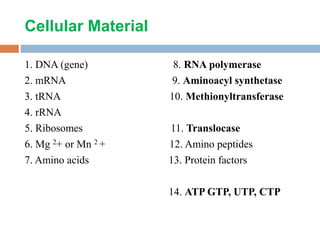
Cellular Material
1. DNA (gene) 8. RNA polymerase
2. mRNA 9. Aminoacyl synthetase
3. tRNA 10. Methionyltransferase
4. rRNA
5. Ribosomes 11. Translocase
6. Mg 2+ or Mn 2 + 12. Amino peptides
7. Amino acids 13. Protein factors
14. ATP GTP, UTP, CTP
In Prokaryotes
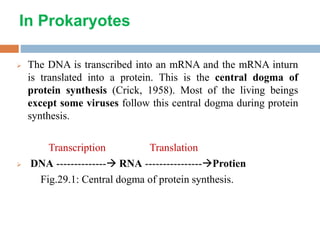
 The DNA is transcribed into an mRNA and the mRNA inturn
is translated into a protein. This is the central dogma of
protein synthesis (Crick, 1958). Most of the living beings
except some viruses follow this central dogma during protein
synthesis.
Transcription Translation
 DNA -------------- RNA ----------------Protien
Fig.29.1: Central dogma of protein synthesis.
Involves following steps:-
 Transcription (formation of RNA from DNA)
 Translation (Formation of Polypeptide)
 Post-translational processing
1. Transcription
 The formation of RNA complementary to a DNA strand is
called transcription. In this process, the RNAs required for
protein synthesis synthesized on DNA strands.
 The three kinds of RNAs, namely mRNA, tRNA and rRNA
are synthesized on different regions of DNA.
 The enzyme, RNA _Polymerase 1,11 and Ill are involved in
the synthesis of rRNA, mRNA and tRNA respectively in the
eukaryotes.
 In prokaryotes, only one type of RNA polymerase is present
to synthesize all the three classes of RNA.
Transcription
 In the DNA double helix, one of the strands serves as a
template to produce RNAs.
 On the template strand, a special region called promoter
region is present. This region contains a set of nucleotide
sequences initiating transcription.
 This region where the initiator sequences are present is called
initiation site. In this region, the transcription is started by
the RNA polymerase.
 RNA polymerase attaches to the initiator site with the help of
Mn2+orMg 2+.
 The RNA polymerase attachment makes a local opening in
the double helix.
 From one of the unwound DNA strands, the polymerization of
new RNA occurs.
 GTP or ATP forms the first synthesized base. To this base
ATP, CTP, GTP UTP are added and the RNA elongates.
 The new RNA strand grows in the 5 ' —> 3’ direction as the
enzyme moves along the DNA.
 The movement of the enzyme along the DNA is altered when
an extended sequence of PolyA3’nucleotide (A A A A A A ) is
encountered.
 This site of halt of the RNA elongation is called pause site.
Protein factors like rho and SF help to terminate transcription.
 The RNA produced by transcription is inactive and is called
preRNA or primary transcript or nascent RNA. It is active
only after processing.
2. Translation
 Translation is a process by which the base sequence of
mRNA is interpreted into amino acid sequence of a
polypeptide chain.
 In short, translation is the synthesis of polypeptide chain.
Translation involves the following steps:
1. Activation of amino acid.
2. Attachment of activated amino acid with tRNA.
3. Initiation of polypeptide chain.
4. Elongation of polypeptide chain.
5. Termination of polypeptide chain.
1. Activation of Amino Acid
 Amino acids, the building blocks of proteins, are present in
the cytoplasm.
 They are activated before they are transported by tRNA.
 The amino acids are activated by ATP with the help of the
enzyme aminoacylsynthetase.
 Aminoacyl synthetase is specific to each in activating each
amino acid.
 The activated amino acid is called aminoacyl adenylate or
aminoacyl AMP.
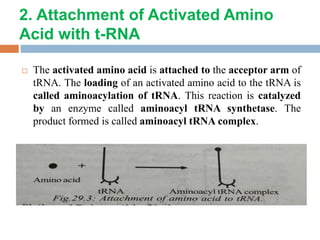
2. Attachment of Activated Amino
Acid with t-RNA
 The activated amino acid is attached to the acceptor arm of
tRNA. The loading of an activated amino acid to the tRNA is
called aminoacylation of tRNA. This reaction is catalyzed
by an enzyme called aminoacyl tRNA synthetase. The
product formed is called aminoacyl tRNA complex.
3. Initiation of Polypeptide Chain
 Protein synthesis is initiated by the selection and transfer of
the first amino acid to ribosomes. This process requires
ribosome sub units, amino acyl-tRNA complex, mRNA and
initiation factors (IF). Initiation of polypeptide chain involves
the following steps:
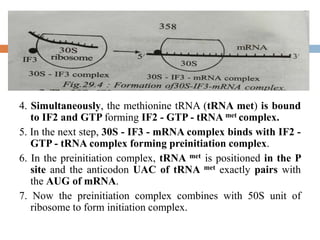
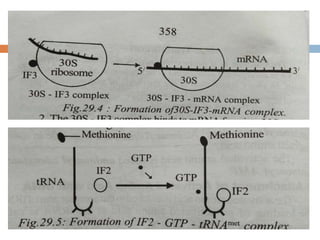
1. The 30 S ribosome binds with the initiation factor-3 (IF-3)
forming 30S - IF3 complex.
2. The 30S - IF3 complex binds to mRNA forming 30s-IF3-
mRNA complex. The IF3 helps the 30S to bind with mRNA .
3. In the 30S - IF3 - mRNA complex, the mRNA is attached to
the 3OS ribosome in such a way that the first codon AUG of
mRNA is inserted in the Psite of ribosome. In prokaryotes,
the first codon of mRNA will be AUG and it codes for the
amino acid methionine
4. Simultaneously, the methionine tRNA (tRNA met) is bound

to IF2 and GTP forming IF2 - GTP - tRNA met complex.
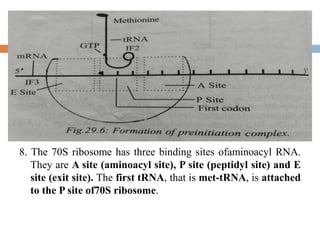
5. In the next step, 30S - IF3 - mRNA complex binds with IF2 -
GTP - tRNA complex forming preinitiation complex.
6. In the preinitiation complex, tRNA met is positioned in the P
site and the anticodon UAC of tRNA met exactly pairs with
the AUG of mRNA.
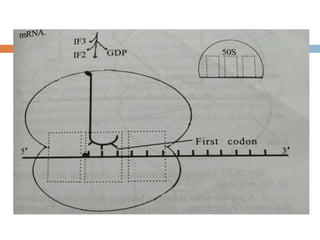
7. Now the preinitiation complex combines with 50S unit of
ribosome to form initiation complex.
8. The 70S ribosome has three binding sites ofaminoacyl RNA.
They are A site (aminoacyl site), P site (peptidyl site) and E
site (exit site). The first tRNA, that is met-tRNA, is attached
to the P site of70S ribosome.
4. Elongation of Polypeptide Chain
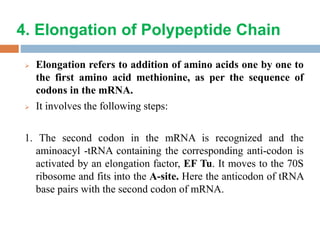
 Elongation refers to addition of amino acids one by one to
the first amino acid methionine, as per the sequence of
codons in the mRNA.
 It involves the following steps:
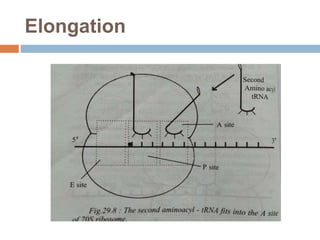
1. The second codon in the mRNA is recognized and the
aminoacyl -tRNA containing the corresponding anti-codon is
activated by an elongation factor, EF Tu. It moves to the 70S
ribosome and fits into the A-site. Here the anticodon of tRNA
base pairs with the second codon of mRNA.
Elongation
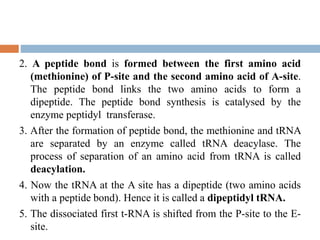
2. A peptide bond is formed between the first amino acid
(methionine) of P-site and the second amino acid of A-site.
The peptide bond links the two amino acids to form a
dipeptide. The peptide bond synthesis is catalysed by the
enzyme peptidyl transferase.
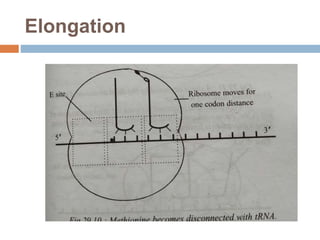
3. After the formation of peptide bond, the methionine and tRNA
are separated by an enzyme called tRNA deacylase. The
process of separation of an amino acid from tRNA is called
deacylation.
4. Now the tRNA at the A site has a dipeptide (two amino acids
with a peptide bond). Hence it is called a dipeptidyl tRNA.
5. The dissociated first t-RNA is shifted from the P-site to the E-
site.
Elongation
6. Now the ribosome moves on the mRNA in the 5’ 3’ direction
for a distance of one codon. This process is called translocation
and it is catalysed by an enzyme called translocase.
7. When the ribosome moves one codon away, the
dipeptidyl tRNA is still attached to the second codon of
mRNA. Hence the movement of ribosome shifts the
dipeptidyl tRNA from the A site to the P site.
8. The deacylated tRNA (first tRNA) is shifted to the next
site Exit site (E site). In eukaryotes, the E-site is absent
and hence the deacylated tRNA leaves the ribosome and
enters the cytosol.
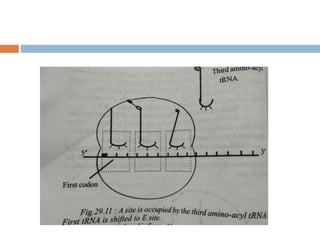
9. Now the third codon comes to lie in the A site and the
second codon is in the P site.
ELONGATION
10. The third codon is recognized and the aminoacyl
tRNA containing the corresponding anticodon moves
to the 70S ribosome and fits into the A site. The
anticodon base pairs with the codon.
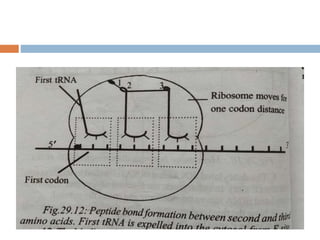
11. A peptide bond is formed between the third amino
acid of site A and the second amino acid of dipeptide
present in the P site. Thus a tripeptide is formed.
12. The binding of a new amino acyltRNA to the
vacant A site induces the release of deacylated tRNA
from the E-site.
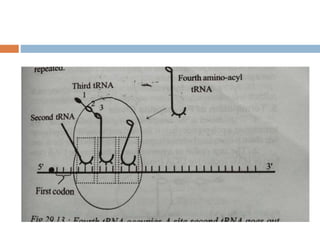
13. Then the ribosome moves in the 5’ 3'direction.
14. The second tRNA and the second amino acid are dissociated.
The second tRNA is shifted from P site into the E-site.
15. The third aminoacyl tRNA is shifted from A site to P site. The
fourth codon occupies the A site and in this way the process is
repeated.
16. The amino acids are added one by one as per the codon in the
mRNA and hence the tripeptide is converted into a polypeptide
chain. The polypeptide chain elongates by the addition of more
and more amino acids.
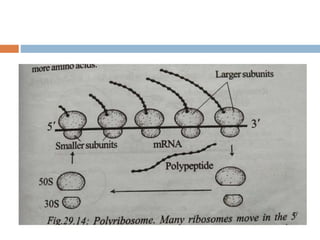
17. As the ribosome reaches about the 25th codon on the mRNA,
a new ribosome gets attached to the initiation and starts
synthesizing another polypeptide chain. In this way, many
ribosomes are moving on an mRNA. The cluster of ribosomes
on an mRNA is called a polyribosome or polyysome. Each
ribosome carries a growing polypeptide chain.
18. As each ribosome synthesizes a polypeptide chain, each
mRNA is used to synthesize many copies of polypeptide
chains.
4. Termination of Polypeptide
Chain
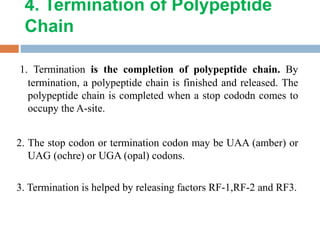
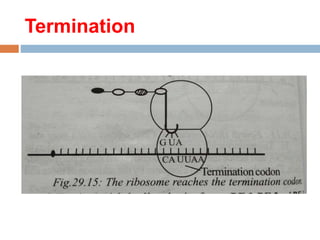
1. Termination is the completion of polypeptide chain. By
termination, a polypeptide chain is finished and released. The
polypeptide chain is completed when a stop cododn comes to
occupy the A-site.
2. The stop codon or termination codon may be UAA (amber) or
UAG (ochre) or UGA (opal) codons.
3. Termination is helped by releasing factors RF-1,RF-2 and RF3.
TERMINATION
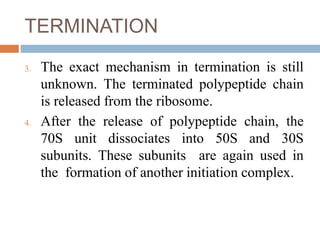
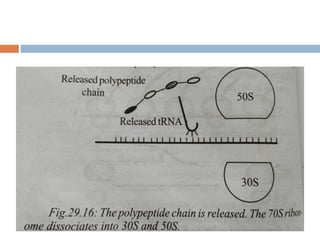
3. The exact mechanism in termination is still
unknown. The terminated polypeptide chain
is released from the ribosome.
4. After the release of polypeptide chain, the
70S unit dissociates into 50S and 30S
subunits. These subunits are again used in
the formation of another initiation complex.
Termination
3. Post Translation
Processing
 The polypeptide chain released after translation is
inactive.
 It is processed to make it active.
 In the processing, the initiating amino acid methionine is
removed.
 Along with methionine, a few more amino acids are removed
fromN-terminal of the polypeptide chain.
 The processing is carried out by deformylase and amino
peptidase.
Reference
 Book of Cell & Molecular Biology, N.
Arumugam Saras Publication.
Thank You

Protein synthesis

  • 1.
    PROTEIN SYNTHESIS Jigar V.Patel Lecturer Department of Zoology Government Science Collage, Vankal Ta. Mangrol, Di. Surat-394430 Email. pateljigar1818@gmail.com
  • 2.
    Definition  The constructionof protein molecules in the cell by sequentially arranging amino acids using peptide bond is called protein synthesis. The amino acids are linked together in succession to produce a linear polypeptide chain. The polypeptide chain is a unit of a protein molecule.  Protein synthesis occurs inside the cytoplasm.  The following cellular materials are needed to build a protein molecule:
  • 3.
    Cellular Material 1. DNA(gene) 8. RNA polymerase 2. mRNA 9. Aminoacyl synthetase 3. tRNA 10. Methionyltransferase 4. rRNA 5. Ribosomes 11. Translocase 6. Mg 2+ or Mn 2 + 12. Amino peptides 7. Amino acids 13. Protein factors 14. ATP GTP, UTP, CTP
  • 4.
    In Prokaryotes  TheDNA is transcribed into an mRNA and the mRNA inturn is translated into a protein. This is the central dogma of protein synthesis (Crick, 1958). Most of the living beings except some viruses follow this central dogma during protein synthesis. Transcription Translation  DNA -------------- RNA ----------------Protien Fig.29.1: Central dogma of protein synthesis.
  • 5.
    Involves following steps:- Transcription (formation of RNA from DNA)  Translation (Formation of Polypeptide)  Post-translational processing
  • 6.
    1. Transcription  Theformation of RNA complementary to a DNA strand is called transcription. In this process, the RNAs required for protein synthesis synthesized on DNA strands.  The three kinds of RNAs, namely mRNA, tRNA and rRNA are synthesized on different regions of DNA.  The enzyme, RNA _Polymerase 1,11 and Ill are involved in the synthesis of rRNA, mRNA and tRNA respectively in the eukaryotes.  In prokaryotes, only one type of RNA polymerase is present to synthesize all the three classes of RNA.
  • 7.
  • 8.
     In theDNA double helix, one of the strands serves as a template to produce RNAs.  On the template strand, a special region called promoter region is present. This region contains a set of nucleotide sequences initiating transcription.  This region where the initiator sequences are present is called initiation site. In this region, the transcription is started by the RNA polymerase.  RNA polymerase attaches to the initiator site with the help of Mn2+orMg 2+.
  • 9.
     The RNApolymerase attachment makes a local opening in the double helix.  From one of the unwound DNA strands, the polymerization of new RNA occurs.  GTP or ATP forms the first synthesized base. To this base ATP, CTP, GTP UTP are added and the RNA elongates.  The new RNA strand grows in the 5 ' —> 3’ direction as the enzyme moves along the DNA.
  • 10.
     The movementof the enzyme along the DNA is altered when an extended sequence of PolyA3’nucleotide (A A A A A A ) is encountered.  This site of halt of the RNA elongation is called pause site. Protein factors like rho and SF help to terminate transcription.  The RNA produced by transcription is inactive and is called preRNA or primary transcript or nascent RNA. It is active only after processing.
  • 11.
    2. Translation  Translationis a process by which the base sequence of mRNA is interpreted into amino acid sequence of a polypeptide chain.  In short, translation is the synthesis of polypeptide chain. Translation involves the following steps: 1. Activation of amino acid. 2. Attachment of activated amino acid with tRNA. 3. Initiation of polypeptide chain. 4. Elongation of polypeptide chain. 5. Termination of polypeptide chain.
  • 12.
    1. Activation ofAmino Acid  Amino acids, the building blocks of proteins, are present in the cytoplasm.  They are activated before they are transported by tRNA.  The amino acids are activated by ATP with the help of the enzyme aminoacylsynthetase.  Aminoacyl synthetase is specific to each in activating each amino acid.  The activated amino acid is called aminoacyl adenylate or aminoacyl AMP.
  • 13.
    2. Attachment ofActivated Amino Acid with t-RNA  The activated amino acid is attached to the acceptor arm of tRNA. The loading of an activated amino acid to the tRNA is called aminoacylation of tRNA. This reaction is catalyzed by an enzyme called aminoacyl tRNA synthetase. The product formed is called aminoacyl tRNA complex.
  • 14.
    3. Initiation ofPolypeptide Chain  Protein synthesis is initiated by the selection and transfer of the first amino acid to ribosomes. This process requires ribosome sub units, amino acyl-tRNA complex, mRNA and initiation factors (IF). Initiation of polypeptide chain involves the following steps: 1. The 30 S ribosome binds with the initiation factor-3 (IF-3) forming 30S - IF3 complex. 2. The 30S - IF3 complex binds to mRNA forming 30s-IF3- mRNA complex. The IF3 helps the 30S to bind with mRNA . 3. In the 30S - IF3 - mRNA complex, the mRNA is attached to the 3OS ribosome in such a way that the first codon AUG of mRNA is inserted in the Psite of ribosome. In prokaryotes, the first codon of mRNA will be AUG and it codes for the amino acid methionine
  • 15.
    4. Simultaneously, themethionine tRNA (tRNA met) is bound to IF2 and GTP forming IF2 - GTP - tRNA met complex. 5. In the next step, 30S - IF3 - mRNA complex binds with IF2 - GTP - tRNA complex forming preinitiation complex. 6. In the preinitiation complex, tRNA met is positioned in the P site and the anticodon UAC of tRNA met exactly pairs with the AUG of mRNA. 7. Now the preinitiation complex combines with 50S unit of ribosome to form initiation complex.
  • 17.
    8. The 70Sribosome has three binding sites ofaminoacyl RNA. They are A site (aminoacyl site), P site (peptidyl site) and E site (exit site). The first tRNA, that is met-tRNA, is attached to the P site of70S ribosome.
  • 19.
    4. Elongation ofPolypeptide Chain  Elongation refers to addition of amino acids one by one to the first amino acid methionine, as per the sequence of codons in the mRNA.  It involves the following steps: 1. The second codon in the mRNA is recognized and the aminoacyl -tRNA containing the corresponding anti-codon is activated by an elongation factor, EF Tu. It moves to the 70S ribosome and fits into the A-site. Here the anticodon of tRNA base pairs with the second codon of mRNA.
  • 20.
  • 21.
    2. A peptidebond is formed between the first amino acid (methionine) of P-site and the second amino acid of A-site. The peptide bond links the two amino acids to form a dipeptide. The peptide bond synthesis is catalysed by the enzyme peptidyl transferase. 3. After the formation of peptide bond, the methionine and tRNA are separated by an enzyme called tRNA deacylase. The process of separation of an amino acid from tRNA is called deacylation. 4. Now the tRNA at the A site has a dipeptide (two amino acids with a peptide bond). Hence it is called a dipeptidyl tRNA. 5. The dissociated first t-RNA is shifted from the P-site to the E- site.
  • 22.
  • 23.
    6. Now theribosome moves on the mRNA in the 5’ 3’ direction for a distance of one codon. This process is called translocation and it is catalysed by an enzyme called translocase. 7. When the ribosome moves one codon away, the dipeptidyl tRNA is still attached to the second codon of mRNA. Hence the movement of ribosome shifts the dipeptidyl tRNA from the A site to the P site. 8. The deacylated tRNA (first tRNA) is shifted to the next site Exit site (E site). In eukaryotes, the E-site is absent and hence the deacylated tRNA leaves the ribosome and enters the cytosol. 9. Now the third codon comes to lie in the A site and the second codon is in the P site.
  • 26.
    ELONGATION 10. The thirdcodon is recognized and the aminoacyl tRNA containing the corresponding anticodon moves to the 70S ribosome and fits into the A site. The anticodon base pairs with the codon. 11. A peptide bond is formed between the third amino acid of site A and the second amino acid of dipeptide present in the P site. Thus a tripeptide is formed. 12. The binding of a new amino acyltRNA to the vacant A site induces the release of deacylated tRNA from the E-site.
  • 27.
    13. Then theribosome moves in the 5’ 3'direction. 14. The second tRNA and the second amino acid are dissociated. The second tRNA is shifted from P site into the E-site. 15. The third aminoacyl tRNA is shifted from A site to P site. The fourth codon occupies the A site and in this way the process is repeated. 16. The amino acids are added one by one as per the codon in the mRNA and hence the tripeptide is converted into a polypeptide chain. The polypeptide chain elongates by the addition of more and more amino acids.
  • 29.
    17. As theribosome reaches about the 25th codon on the mRNA, a new ribosome gets attached to the initiation and starts synthesizing another polypeptide chain. In this way, many ribosomes are moving on an mRNA. The cluster of ribosomes on an mRNA is called a polyribosome or polyysome. Each ribosome carries a growing polypeptide chain. 18. As each ribosome synthesizes a polypeptide chain, each mRNA is used to synthesize many copies of polypeptide chains.
  • 31.
    4. Termination ofPolypeptide Chain 1. Termination is the completion of polypeptide chain. By termination, a polypeptide chain is finished and released. The polypeptide chain is completed when a stop cododn comes to occupy the A-site. 2. The stop codon or termination codon may be UAA (amber) or UAG (ochre) or UGA (opal) codons. 3. Termination is helped by releasing factors RF-1,RF-2 and RF3.
  • 32.
    TERMINATION 3. The exactmechanism in termination is still unknown. The terminated polypeptide chain is released from the ribosome. 4. After the release of polypeptide chain, the 70S unit dissociates into 50S and 30S subunits. These subunits are again used in the formation of another initiation complex.
  • 33.
  • 35.
    3. Post Translation Processing The polypeptide chain released after translation is inactive.  It is processed to make it active.  In the processing, the initiating amino acid methionine is removed.  Along with methionine, a few more amino acids are removed fromN-terminal of the polypeptide chain.  The processing is carried out by deformylase and amino peptidase.
  • 36.
    Reference  Book ofCell & Molecular Biology, N. Arumugam Saras Publication.
  • 37.