PROTEIN FOLDING &
ITS RELATION TO
FUNCTION
* Kareem Fisal Alnakeeb
Dr. Hussein Abdelaziz
 A ) Protein Structure
 B ) Protein folding
 1. Relationship between folding and amino
acid sequence
 2. Disruption of the native state
 3. Incorrect protein folding and
neurodegenerative disease
 4. Effect of external factors on the folding of
proteins
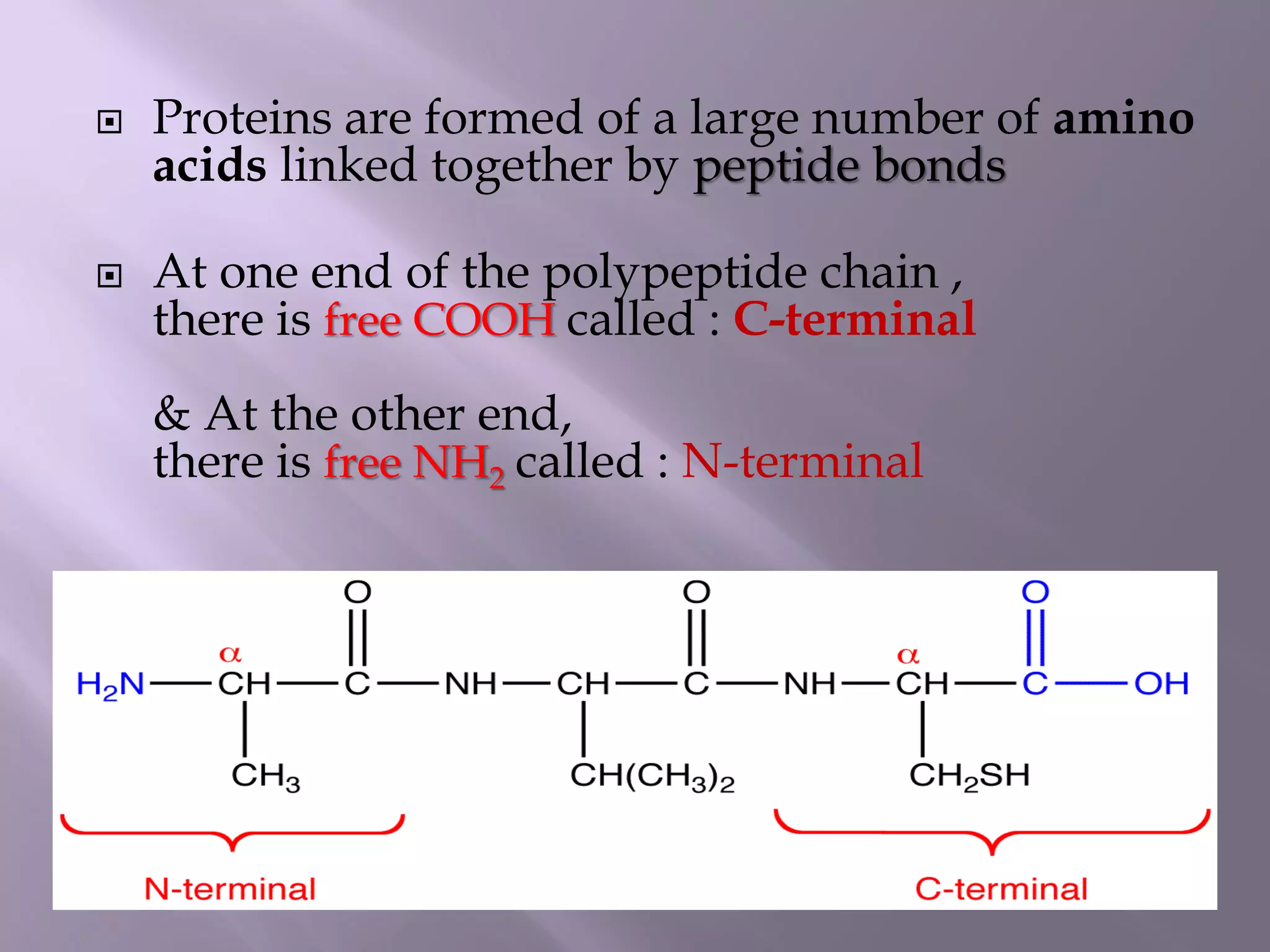
 Proteins are formed of a large number of amino
acids linked together by peptide bonds
 At one end of the polypeptide chain ,

there is free COOH called : C-terminal
& At the other end,
there is free NH2 called : N-terminal
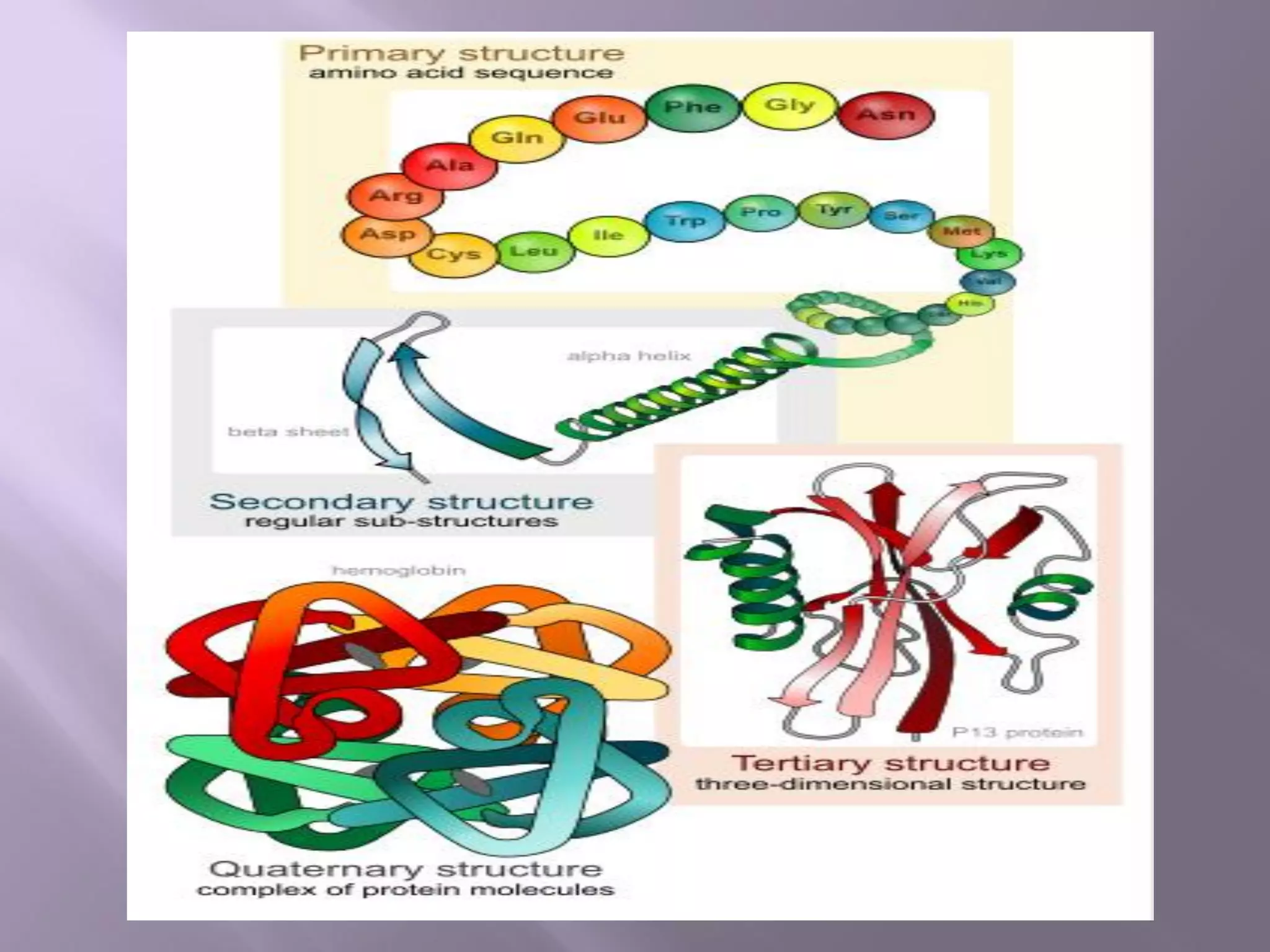
 There are 4 orders of protein
structure :
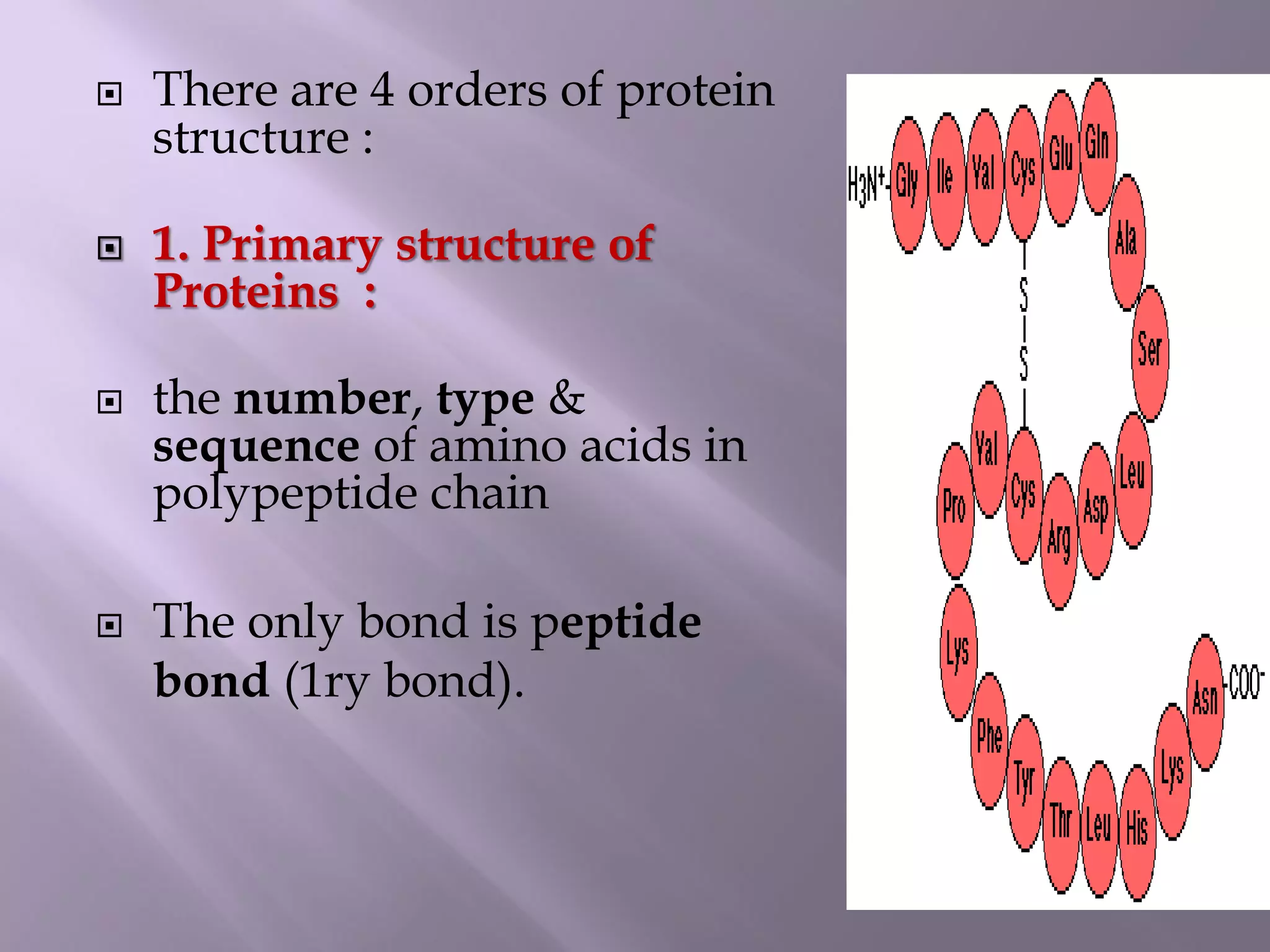
 1. Primary structure of
Proteins :
 the number, type &
sequence of amino acids in
polypeptide chain
 The only bond is peptide
bond (1ry bond).
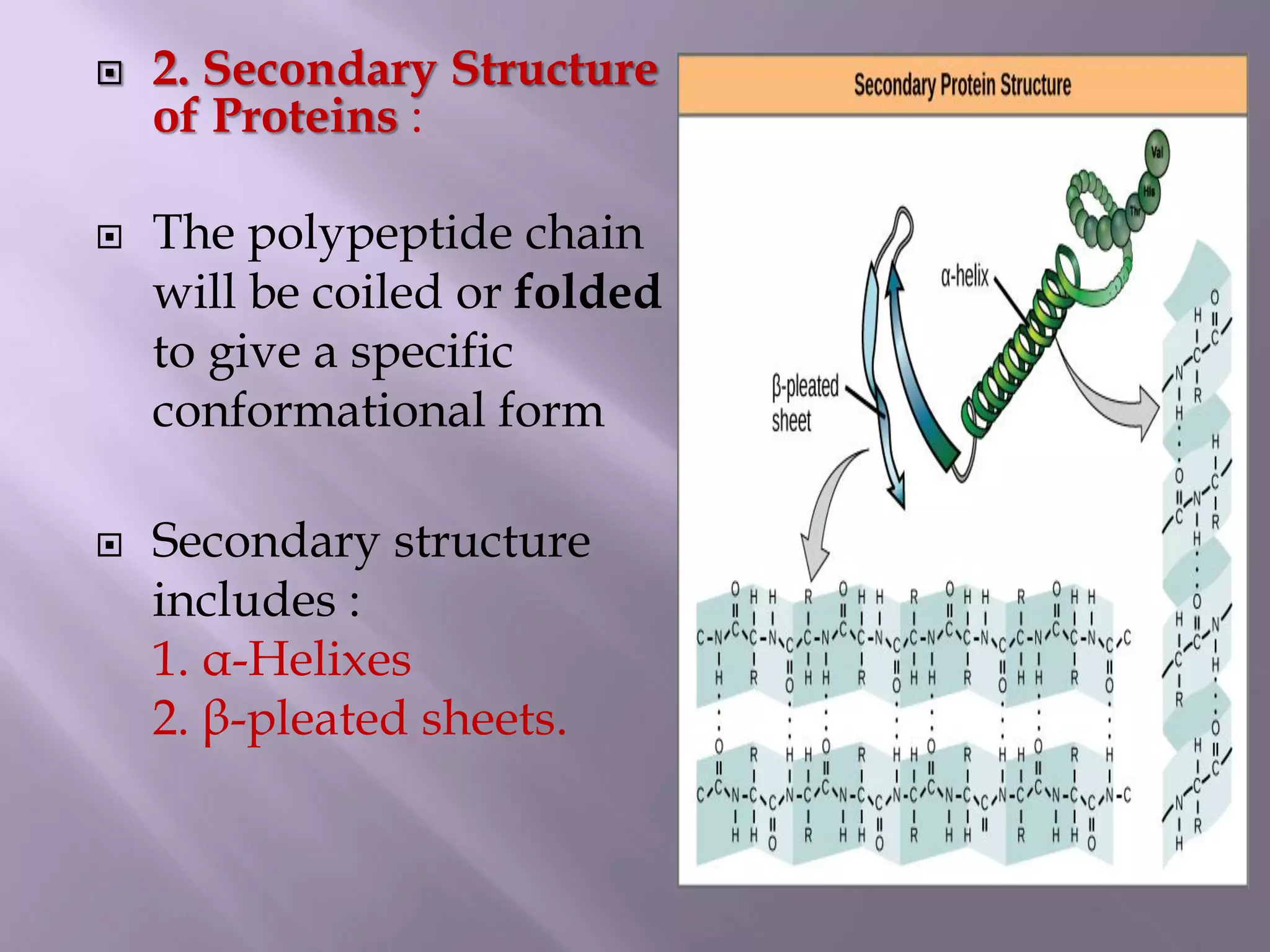
 2. Secondary Structure
of Proteins :
 The polypeptide chain
will be coiled or folded
to give a specific
conformational form
 Secondary structure
includes :
1. α-Helixes
2. β-pleated sheets.
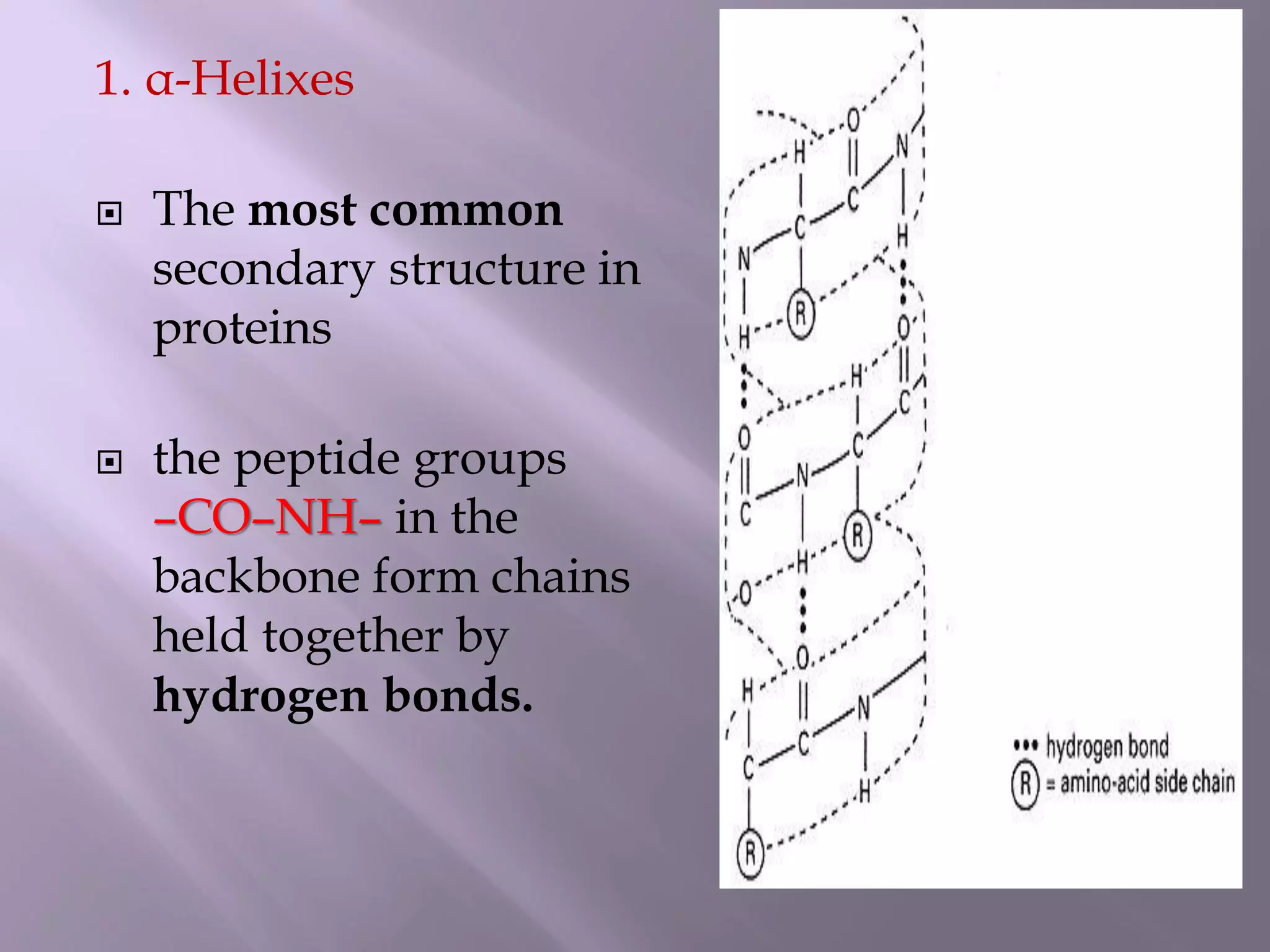
1. α-Helixes
 The most common
secondary structure in
proteins
 the peptide groups
–CO–NH– in the
backbone form chains
held together by
hydrogen bonds.
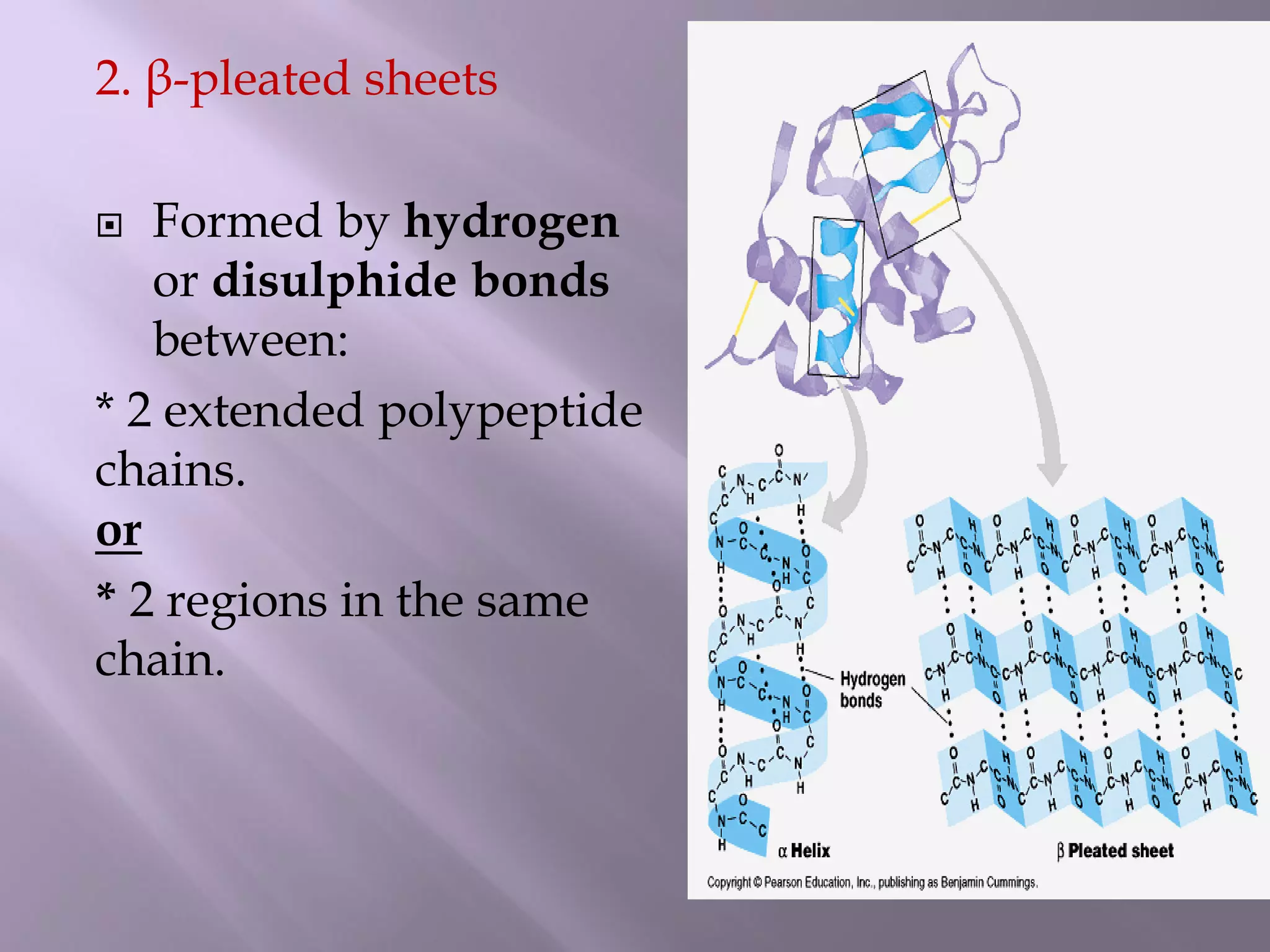
2. β-pleated sheets
 Formed by hydrogen
or disulphide bonds
between:
* 2 extended polypeptide
chains.
or
* 2 regions in the same
chain.
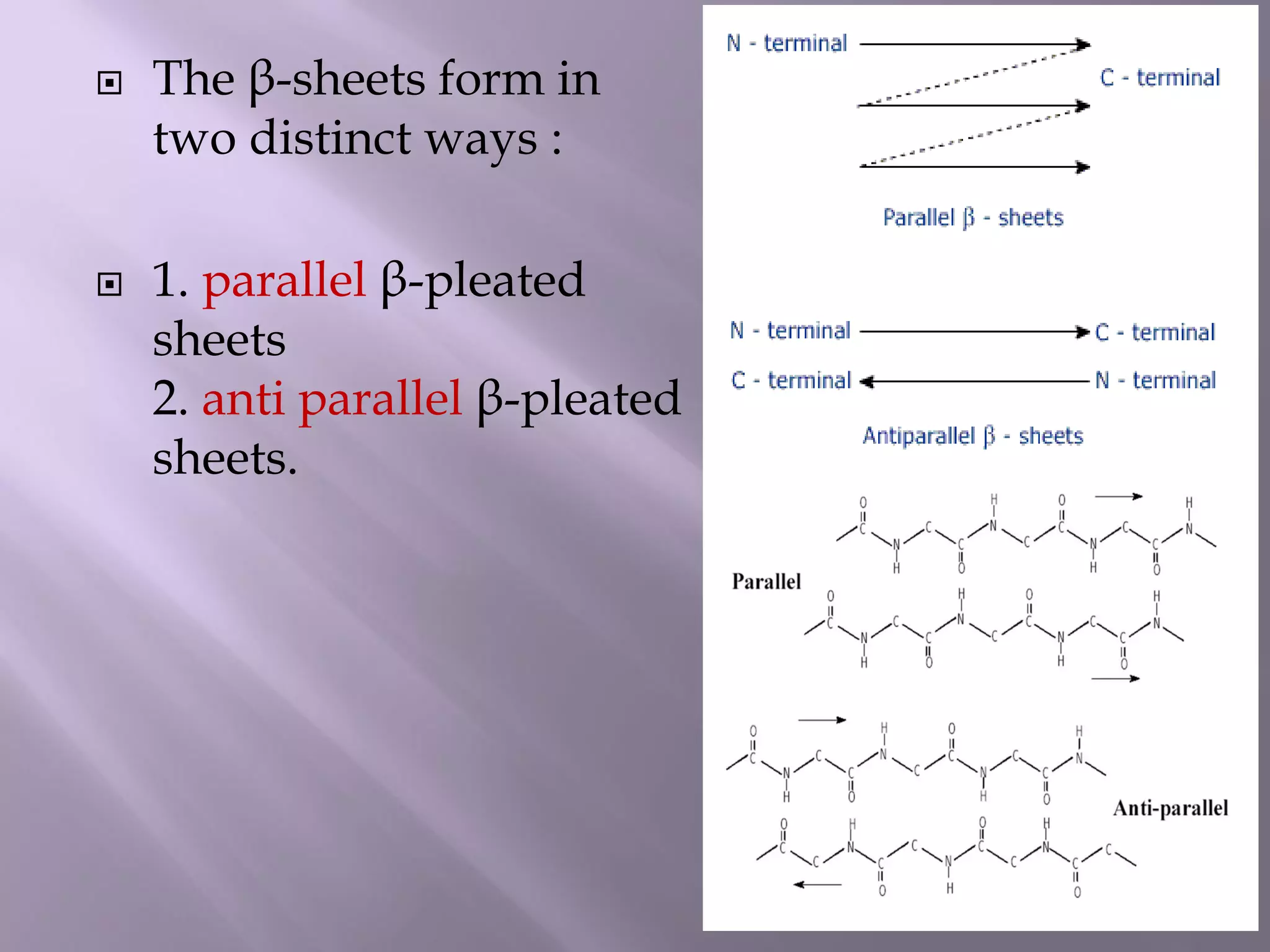
 The β-sheets form in
two distinct ways :
 1. parallel β-pleated
sheets
2. anti parallel β-pleated
sheets.
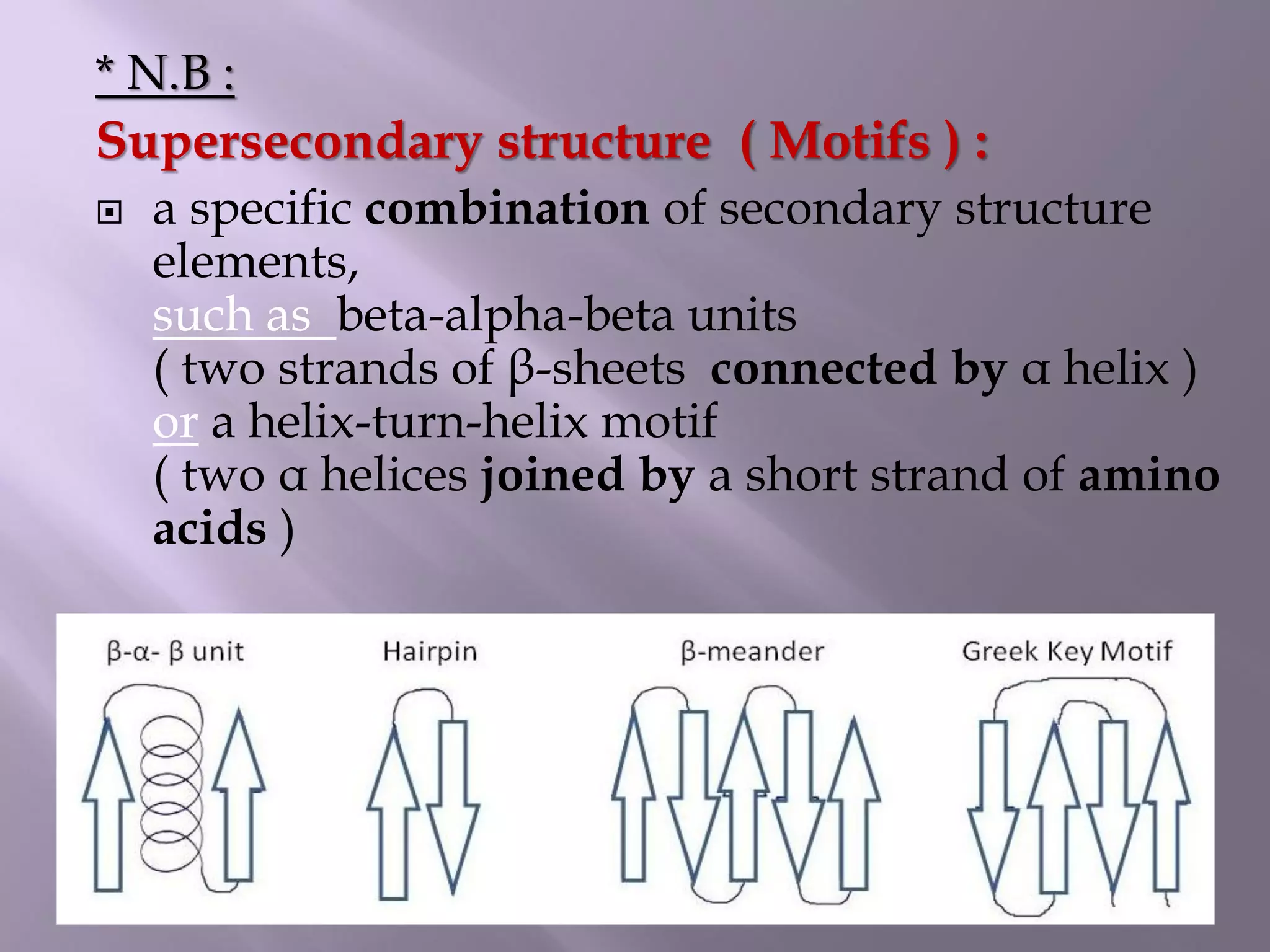
* N.B :
Supersecondary structure ( Motifs ) :
 a specific combination of secondary structure
elements,
such as beta-alpha-beta units
( two strands of β-sheets connected by α helix )
or a helix-turn-helix motif
( two α helices joined by a short strand of amino
acids )
 3. Tertiary Structure of Proteins
 This takes the α-Helixes and β-sheets and
allows them to fold into a three dimensional
structure giving the final arrangement of a
single polypeptide chain :
–Fibrous protein
–Globular protein
 Most proteins take on a globular structure
once folded.
 Forces Controlling Tertiary Protein Structure :
1-Hydrogen Bonds
2- Electrostatic (Ionic) Forces
3- van der Waals Forces
4- Disulphide bonds
* N.B :
Domains :
 They are basic functional three dimensional
structural units of polypeptides
 The core of domains is built from
Supersecondary structure elements ( Motifs )
 They often can be independently stable and
folded
 Many proteins consist of several structural
domains.
 4. Quaternary Structure of Proteins
 Many proteins consist of a single polypeptide
chain ( monomer )
 Others may consist of two or more polypeptide
chains ( polymer )
 The arrangement of these poly peptide
subunits is called : the Quaternary Structure of
Proteins
 i.e. Monomers are aggregated to form polymer
 Bonds in 4ry structure are:
1- Hydrogen
2- Ionic
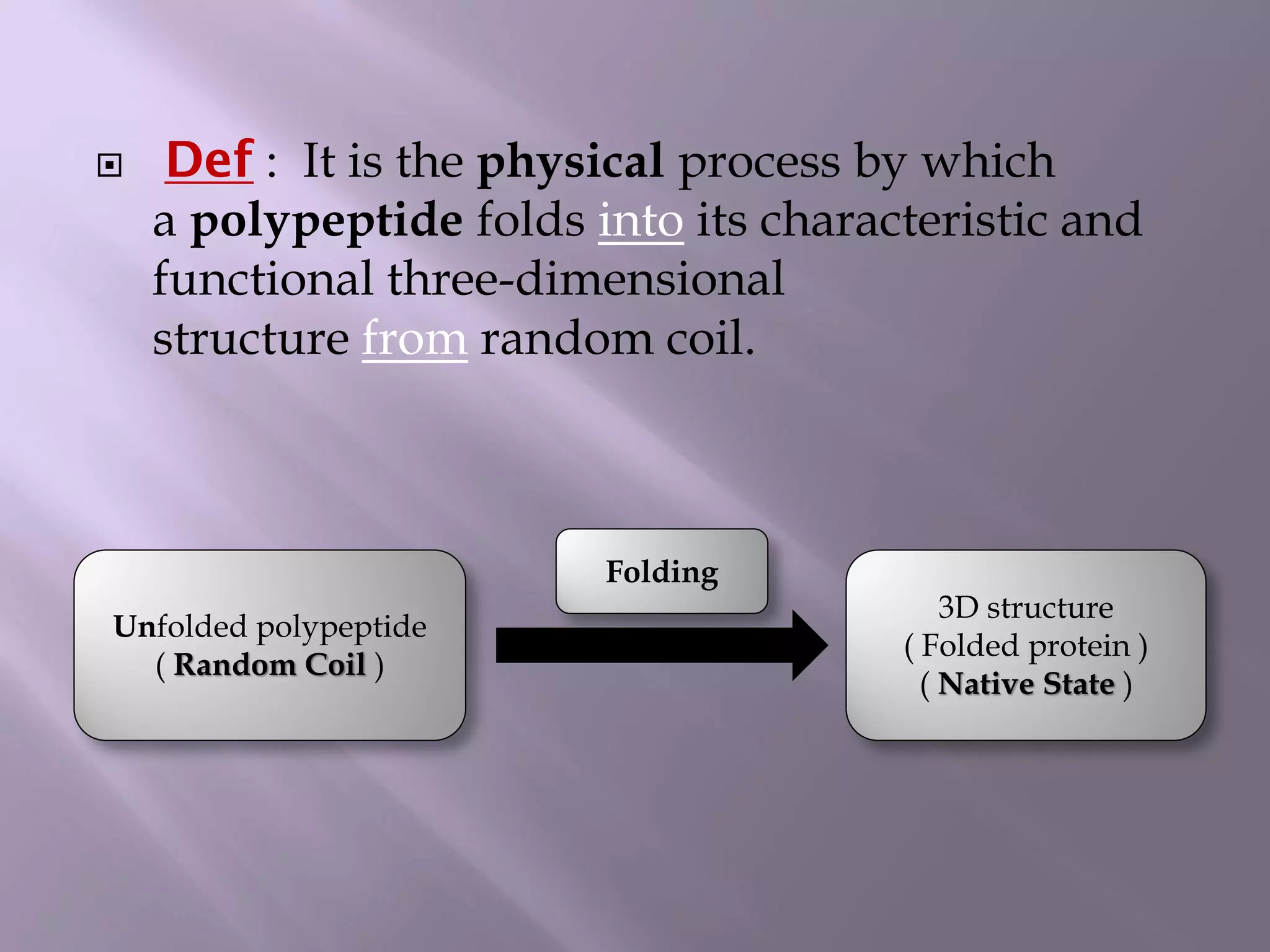
 Def : It is the physical process by which
a polypeptide folds into its characteristic and
functional three-dimensional
structure from random coil.
Unfolded polypeptide
( Random Coil )
3D structure
( Folded protein )
( Native State )
Folding
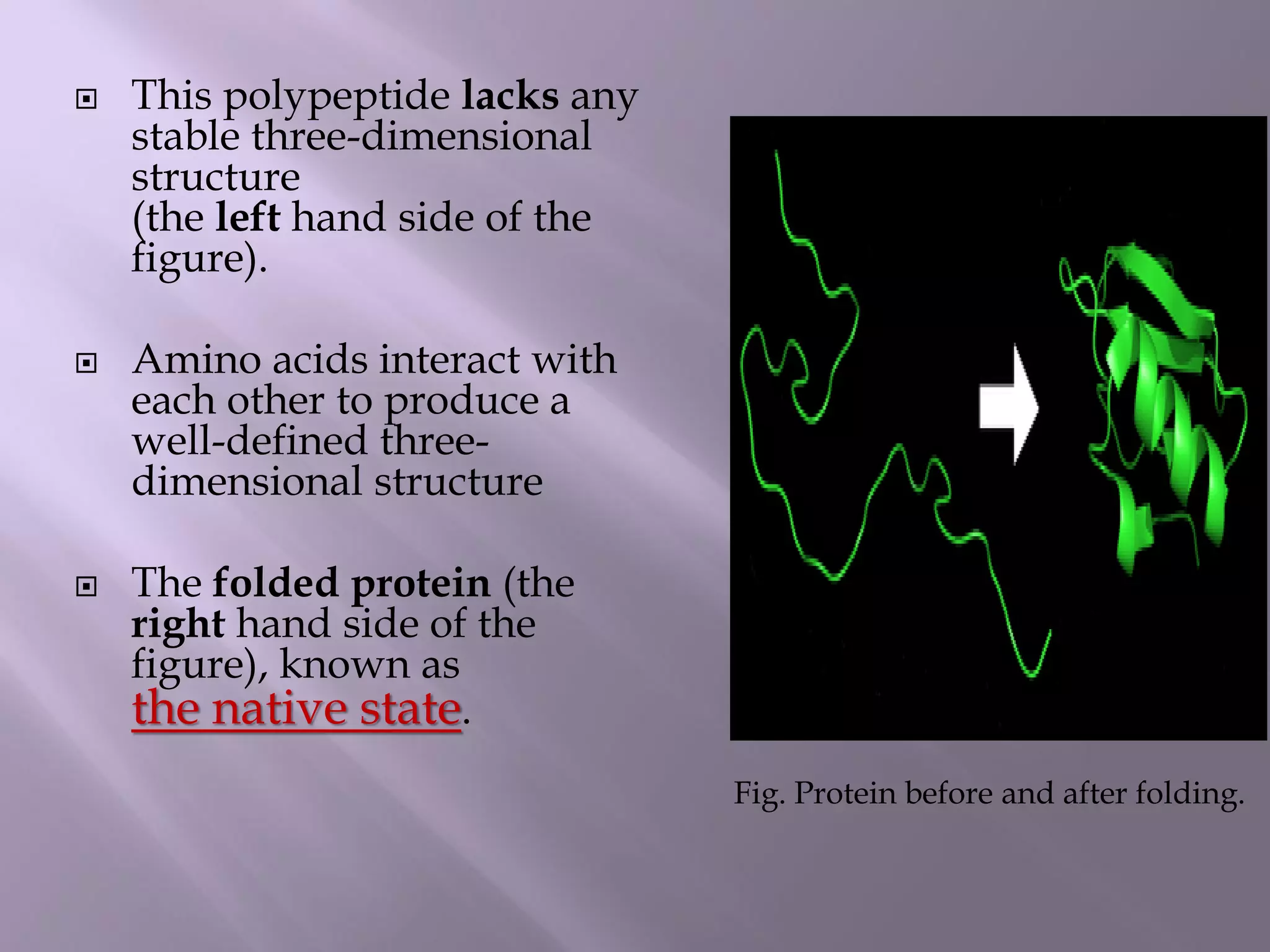
 This polypeptide lacks any
stable three-dimensional
structure
(the left hand side of the
figure).
 Amino acids interact with
each other to produce a
well-defined three-
dimensional structure
 The folded protein (the
right hand side of the
figure), known as
the native state.
Fig. Protein before and after folding.
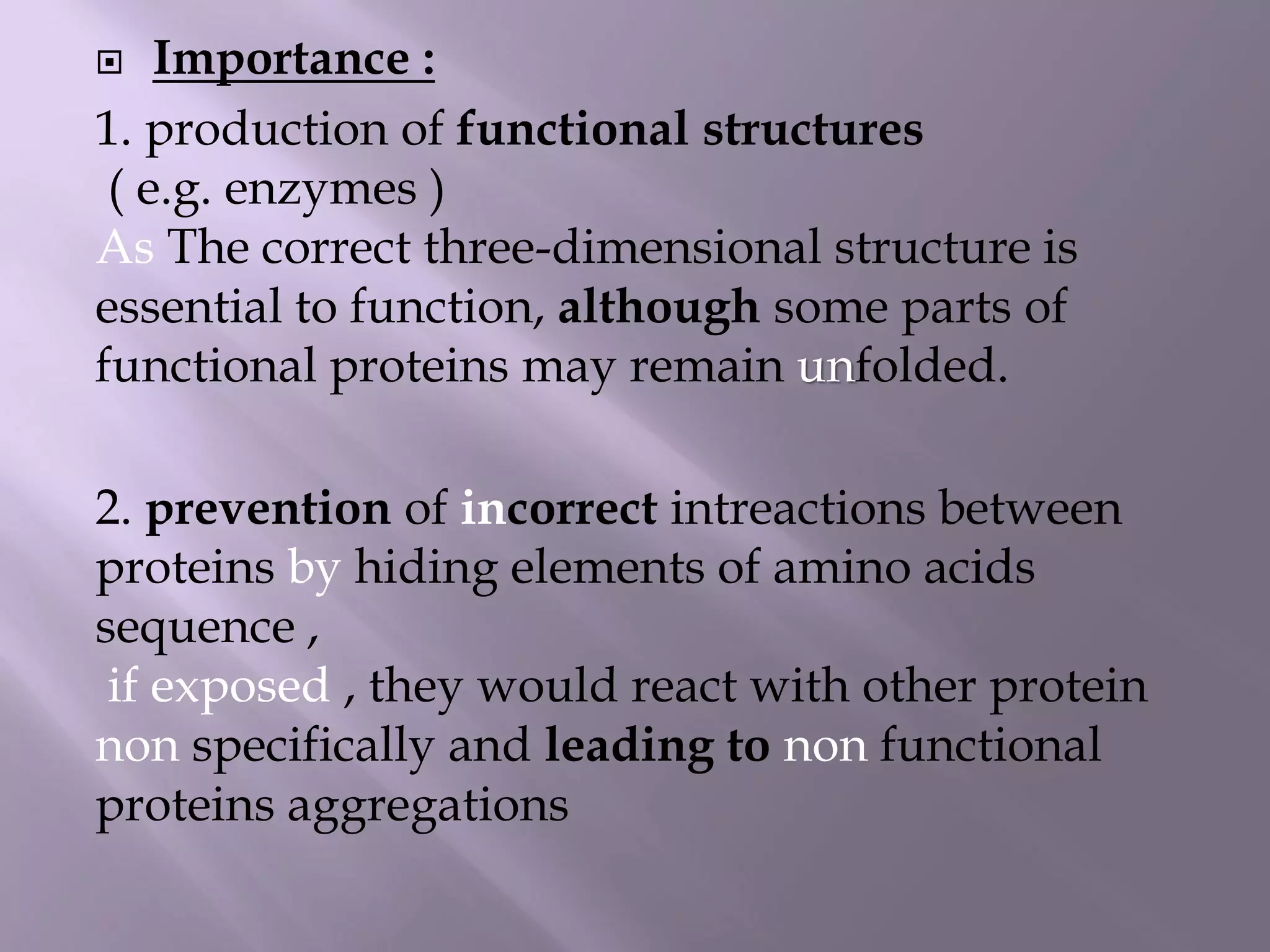
 Importance :
1. production of functional structures
( e.g. enzymes )
As The correct three-dimensional structure is
essential to function, although some parts of
functional proteins may remain unfolded.
2. prevention of incorrect intreactions between
proteins by hiding elements of amino acids
sequence ,
if exposed , they would react with other protein
non specifically and leading to non functional
proteins aggregations
 Failure to fold into native structure generally
produces inactive proteins,
but sometimes , misfolded proteins have
modified or toxic Function.
 Many allergies are caused by incorrect folding
of some proteins
 The amino-acid sequence of a protein
determines its native conformation.
 A protein molecule folds spontaneously
during or after biosynthesis
 The folding process depends on :
1. amino-acid sequence of a protein
2. the solvent (water or lipid bilayer),
3. the concentration of salts,
4. the pH,
5. the temperature,
6. the presence of cofactors and of
molecular chaperones.
 Minimizing the number of hydrophobic side-
chains exposed to water is an important driving
force behind the folding process.
 Formation of intramolecular hydrogen bonds
provides important contribution to protein
stability.
 The strength of hydrogen bonds depends on their
environment,
thus H-bonds contribute to the stability of the
native state when enveloped in a hydrophobic
core more than when exposed to the aqueous
environment
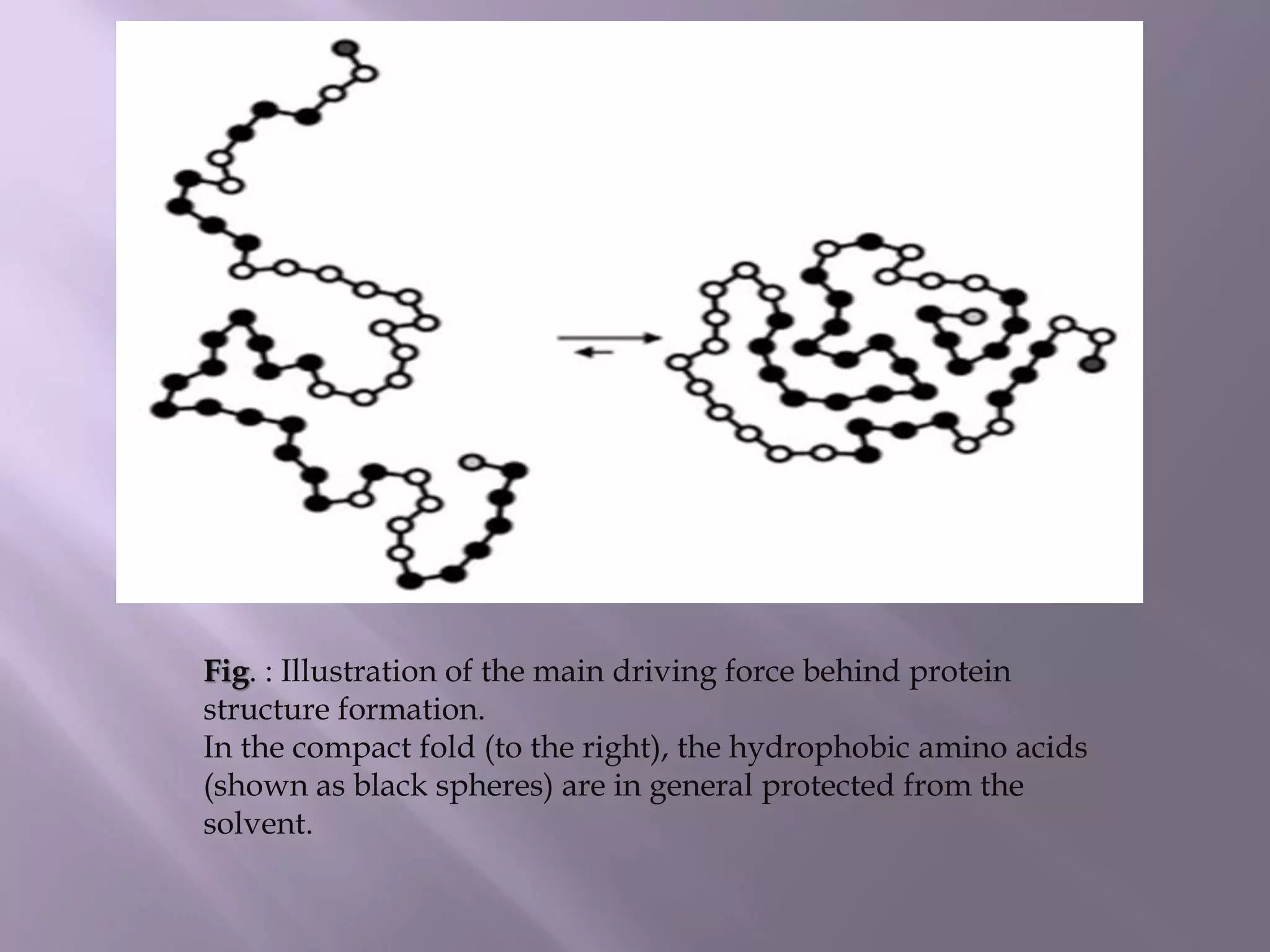
Fig. : Illustration of the main driving force behind protein
structure formation.
In the compact fold (to the right), the hydrophobic amino acids
(shown as black spheres) are in general protected from the
solvent.
 The process of folding often begins
co-translationally,
so that the N-terminal of the protein begins to
fold
while the C-terminal portion of the protein is
still being synthesized by the ribosome.
 N.B : Translation : is the process in which
cellular ribosomes create proteins
N.B.
Chaperones :
 Specialized proteins assist in :
1. the folding of other proteins.
2. prevent misfolding
 In eukaryotic organisms , chaperones are known
as heat shock proteins (HSP)
as they induced by heat shock ( higher
temperature than the ideal body temperature )
 There are two models of protein folding that are
currently being confirmed:
1. The diffusion collision model, in which
1. a nucleus is formed,
2. then the secondary structure is formed,
3. finally , collision & packing tightly of the
formed secondary structures together.
2. The nucleation-condensation model,
in which the secondary and tertiary structures of
the protein are made at the same time.
N.B. Recent studies have shown that some proteins
show characteristics of both of these folding models.
N.B.
 Folding is a spontaneous process independent
of energy inputs from nucleoside triphosphates
 The passage of the folded state is
mainly guided by :
1. hydrophobic interactions
2. formation of intramolecular hydrogen
bonds, and van der Waals forces
 Under some conditions , proteins will not fold into
their biochemically functional forms.
e.g :
• 1. Temperatures above or below the range that
cells tend to live in
• 2. High concentrations of solutes
• 3. extremes of pH
• 4. mechanical forces ( agitation )
• 5. presence of chemical denaturants
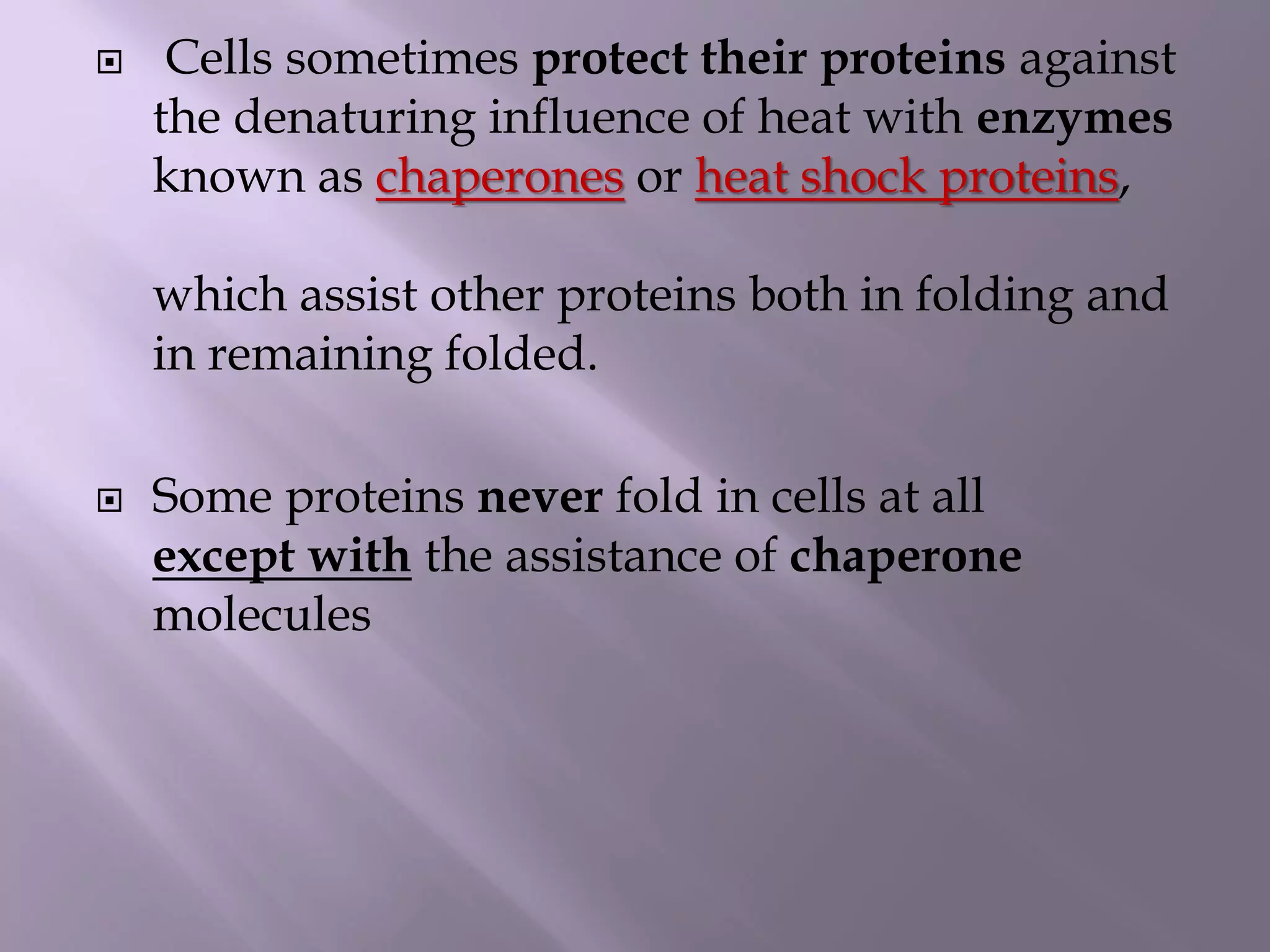
Effect : unfolding or "denaturation"
 N.B. Under certain conditions some proteins can
refold however, in many cases, denaturation is
irreversible.
 A fully denatured protein lacks both secondary
and tertiary structure, and exists as
random coil.
 Cells sometimes protect their proteins against
the denaturing influence of heat with enzymes
known as chaperones or heat shock proteins,
which assist other proteins both in folding and
in remaining folded.
 Some proteins never fold in cells at all
except with the assistance of chaperone
molecules
 Mis-folded proteins are associated with
illnesses such as :
1. Alzheimer's disease
2. cardiomyopathy ( heart muscle disease )
3. polyneuropathy(damage to multiple nerves )
4. mad cow disease
 protein replacement therapy
has been used to correct the latter disorders,
by using pharmaceutical chaperones
to fold mutated proteins to render them
functional.
 Several external factors could have a big
influence on the folding of proteins such as :
1. temperature,
2. external fields (electric, magnetic),
3. molecular crowding,
4. limitation of space
Protein folding & its relation to function (April 2014)

Protein folding & its relation to function (April 2014)

  • 1.
    PROTEIN FOLDING & ITSRELATION TO FUNCTION
  • 2.
    * Kareem FisalAlnakeeb Dr. Hussein Abdelaziz
  • 3.
     A )Protein Structure  B ) Protein folding  1. Relationship between folding and amino acid sequence  2. Disruption of the native state  3. Incorrect protein folding and neurodegenerative disease  4. Effect of external factors on the folding of proteins
  • 5.
     Proteins areformed of a large number of amino acids linked together by peptide bonds  At one end of the polypeptide chain , there is free COOH called : C-terminal & At the other end, there is free NH2 called : N-terminal
  • 6.
     There are4 orders of protein structure :  1. Primary structure of Proteins :  the number, type & sequence of amino acids in polypeptide chain  The only bond is peptide bond (1ry bond).
  • 7.
     2. SecondaryStructure of Proteins :  The polypeptide chain will be coiled or folded to give a specific conformational form  Secondary structure includes : 1. α-Helixes 2. β-pleated sheets.
  • 8.
    1. α-Helixes  Themost common secondary structure in proteins  the peptide groups –CO–NH– in the backbone form chains held together by hydrogen bonds.
  • 9.
    2. β-pleated sheets Formed by hydrogen or disulphide bonds between: * 2 extended polypeptide chains. or * 2 regions in the same chain.
  • 10.
     The β-sheetsform in two distinct ways :  1. parallel β-pleated sheets 2. anti parallel β-pleated sheets.
  • 11.
    * N.B : Supersecondarystructure ( Motifs ) :  a specific combination of secondary structure elements, such as beta-alpha-beta units ( two strands of β-sheets connected by α helix ) or a helix-turn-helix motif ( two α helices joined by a short strand of amino acids )
  • 12.
     3. TertiaryStructure of Proteins  This takes the α-Helixes and β-sheets and allows them to fold into a three dimensional structure giving the final arrangement of a single polypeptide chain : –Fibrous protein –Globular protein  Most proteins take on a globular structure once folded.
  • 13.
     Forces ControllingTertiary Protein Structure : 1-Hydrogen Bonds 2- Electrostatic (Ionic) Forces 3- van der Waals Forces 4- Disulphide bonds
  • 14.
    * N.B : Domains:  They are basic functional three dimensional structural units of polypeptides  The core of domains is built from Supersecondary structure elements ( Motifs )  They often can be independently stable and folded  Many proteins consist of several structural domains.
  • 15.
     4. QuaternaryStructure of Proteins  Many proteins consist of a single polypeptide chain ( monomer )  Others may consist of two or more polypeptide chains ( polymer )  The arrangement of these poly peptide subunits is called : the Quaternary Structure of Proteins  i.e. Monomers are aggregated to form polymer  Bonds in 4ry structure are: 1- Hydrogen 2- Ionic
  • 18.
     Def :It is the physical process by which a polypeptide folds into its characteristic and functional three-dimensional structure from random coil. Unfolded polypeptide ( Random Coil ) 3D structure ( Folded protein ) ( Native State ) Folding
  • 19.
     This polypeptidelacks any stable three-dimensional structure (the left hand side of the figure).  Amino acids interact with each other to produce a well-defined three- dimensional structure  The folded protein (the right hand side of the figure), known as the native state. Fig. Protein before and after folding.
  • 20.
     Importance : 1.production of functional structures ( e.g. enzymes ) As The correct three-dimensional structure is essential to function, although some parts of functional proteins may remain unfolded. 2. prevention of incorrect intreactions between proteins by hiding elements of amino acids sequence , if exposed , they would react with other protein non specifically and leading to non functional proteins aggregations
  • 21.
     Failure tofold into native structure generally produces inactive proteins, but sometimes , misfolded proteins have modified or toxic Function.  Many allergies are caused by incorrect folding of some proteins
  • 23.
     The amino-acidsequence of a protein determines its native conformation.  A protein molecule folds spontaneously during or after biosynthesis  The folding process depends on : 1. amino-acid sequence of a protein 2. the solvent (water or lipid bilayer), 3. the concentration of salts, 4. the pH, 5. the temperature, 6. the presence of cofactors and of molecular chaperones.
  • 24.
     Minimizing thenumber of hydrophobic side- chains exposed to water is an important driving force behind the folding process.  Formation of intramolecular hydrogen bonds provides important contribution to protein stability.  The strength of hydrogen bonds depends on their environment, thus H-bonds contribute to the stability of the native state when enveloped in a hydrophobic core more than when exposed to the aqueous environment
  • 25.
    Fig. : Illustrationof the main driving force behind protein structure formation. In the compact fold (to the right), the hydrophobic amino acids (shown as black spheres) are in general protected from the solvent.
  • 26.
     The processof folding often begins co-translationally, so that the N-terminal of the protein begins to fold while the C-terminal portion of the protein is still being synthesized by the ribosome.  N.B : Translation : is the process in which cellular ribosomes create proteins
  • 27.
    N.B. Chaperones :  Specializedproteins assist in : 1. the folding of other proteins. 2. prevent misfolding  In eukaryotic organisms , chaperones are known as heat shock proteins (HSP) as they induced by heat shock ( higher temperature than the ideal body temperature )
  • 28.
     There aretwo models of protein folding that are currently being confirmed: 1. The diffusion collision model, in which 1. a nucleus is formed, 2. then the secondary structure is formed, 3. finally , collision & packing tightly of the formed secondary structures together. 2. The nucleation-condensation model, in which the secondary and tertiary structures of the protein are made at the same time. N.B. Recent studies have shown that some proteins show characteristics of both of these folding models.
  • 29.
    N.B.  Folding isa spontaneous process independent of energy inputs from nucleoside triphosphates  The passage of the folded state is mainly guided by : 1. hydrophobic interactions 2. formation of intramolecular hydrogen bonds, and van der Waals forces
  • 31.
     Under someconditions , proteins will not fold into their biochemically functional forms. e.g : • 1. Temperatures above or below the range that cells tend to live in • 2. High concentrations of solutes • 3. extremes of pH • 4. mechanical forces ( agitation ) • 5. presence of chemical denaturants Effect : unfolding or "denaturation"
  • 32.
     N.B. Undercertain conditions some proteins can refold however, in many cases, denaturation is irreversible.  A fully denatured protein lacks both secondary and tertiary structure, and exists as random coil.
  • 33.
     Cells sometimesprotect their proteins against the denaturing influence of heat with enzymes known as chaperones or heat shock proteins, which assist other proteins both in folding and in remaining folded.  Some proteins never fold in cells at all except with the assistance of chaperone molecules
  • 35.
     Mis-folded proteinsare associated with illnesses such as : 1. Alzheimer's disease 2. cardiomyopathy ( heart muscle disease ) 3. polyneuropathy(damage to multiple nerves ) 4. mad cow disease
  • 36.
     protein replacementtherapy has been used to correct the latter disorders, by using pharmaceutical chaperones to fold mutated proteins to render them functional.
  • 38.
     Several externalfactors could have a big influence on the folding of proteins such as : 1. temperature, 2. external fields (electric, magnetic), 3. molecular crowding, 4. limitation of space