UNIT II: STRUCTURE FUNCTION CORRELATION IN PROTEINS
The Structure-Function correlation in Transcription factors
TATA box binding proteins,
p53 and GCN4 (Leucine zipper)
The Structure-Function correlation in fibrous proteins –
muscle fibers myosin, actin and the role in ATP in muscle contraction.
The Structure-Function correlation in Signal transducers –
GPCR and tyrosine kinase
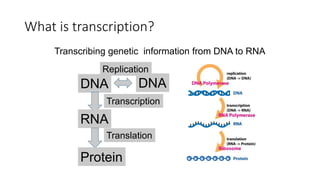
What is transcription?
Transcribing genetic information from DNA to RNA
DNA
RNA
Protein
Replication
DNA
Transcription
Translation
RNA Polymerase
Synthesizes RNA from DNA
RNA Polymerase I (Pol I)- Synthesizes rRNAs
RNA Polymerase II (Pol II)- Synthesizes mRNAs
RNA Polymerase III (Pol III)- Synthesizes tRNAs
What is transcription factor?
Distal to the RNA Pol II initiation site, there are different combinations of
specific DNA binding sequences each of which is recognized by a
corresponding site specific DNA binding protein.
These proteins are known as transcription factor(s).
These together with DNA form the control module of gene expression
Example: TFIID,TFIIA,TFIIB, TBP etc
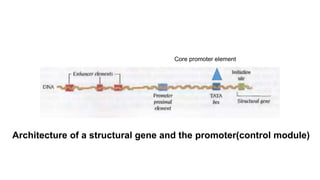
Architecture of a structural gene and the promoter(control module)
Core promoter element
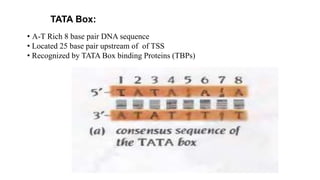
TATA Box:
• A-T Rich 8 base pair DNA sequence
• Located 25 base pair upstream of of TSS
• Recognized by TATA Box binding Proteins (TBPs)
Promoter proximal Element:
• 100-200 bp long
• Several transcription factors interact directly or indirectly with the pre
initiation complex
Enhancer Element:
• Resides further upstream or down stream of the TSS
• Few thousand to 20000 bp distant from the TSS
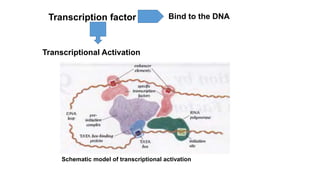
Schematic model of transcriptional activation
Transcription factor Bind to the DNA
Transcriptional Activation
TF
DNA
BINDING
ACTIVATION
DOMAIN
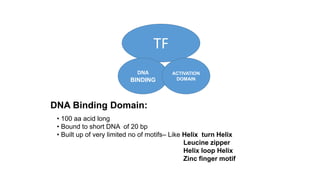
DNA Binding Domain:
• 100 aa acid long
• Bound to short DNA of 20 bp
• Built up of very limited no of motifs– Like Helix turn Helix
Leucine zipper
Helix loop Helix
Zinc finger motif
1. TATA Box Binding Protein (TBP)
• First isolated and purified from Yeast in 1988
• Single polypeptide chain of 27 kDa
• Conserved C Terminal domain of 180 aa
• N Terminal domain of varied length and diverse sequences
• C terminal domain having DNA binding and transcription
activation function
Structure of TBP
Crystal structure by Paul Sigler @ Yale University With
Yeast C trminal TBP and Yeast TATA box DNA
Stephen Burley @ Rockyfeller University with C Terminal
TBP of A. thaliana and TATA box DNA from Adeno virus
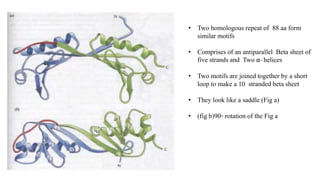
• Two homologous repeat of 88 aa form
similar motifs
• Comprises of an antiparallel Beta sheet of
five strands and Two α- helices
• Two motifs are joined together by a short
loop to make a 10 stranded beta sheet
• They look like a saddle (Fig a)
• (fig b)90◦ rotation of the Fig a
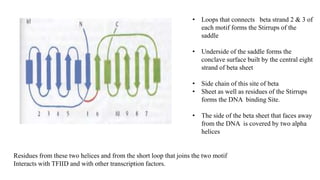
• Loops that connects beta strand 2 & 3 of
each motif forms the Stirrups of the
saddle
• Underside of the saddle forms the
conclave surface built by the central eight
strand of beta sheet
• Side chain of this site of beta
• Sheet as well as residues of the Stirrups
forms the DNA binding Site.
• The side of the beta sheet that faces away
from the DNA is covered by two alpha
helices
Residues from these two helices and from the short loop that joins the two motif
Interacts with TFIID and with other transcription factors.
How TBP binds to the DNA?
Answer: TBP binds to the minor groove of the DNA
and Induces large structural changes
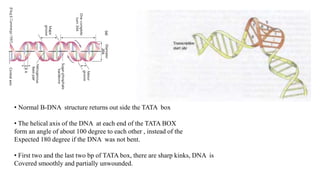
• Normal B-DNA structure returns out side the TATA box
• The helical axis of the DNA at each end of the TATA BOX
form an angle of about 100 degree to each other , instead of the
Expected 180 degree if the DNA was not bent.
• First two and the last two bp of TATA box, there are sharp kinks, DNA is
Covered smoothly and partially unwounded.
• Two Phenylalanine residues are partially inserted between first two and the last two bases, preventing
stacking of the adjacent bases and allow increase in rise Of the DNA
• The kinks at each end of the DNA and partial unwinding of the DNA produces a wide and shallow minor
groove.
• This exposed wide and shallow minor groove bind intimately to the concave undersurface of the TBP saddle.
DNA Modifications: Distortions:
a. Bending of DNA
b. Widening of the minor groove
c. Unwinding of the DNA
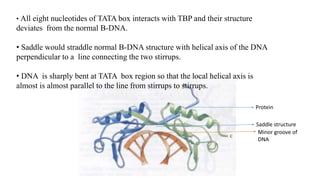
• All eight nucleotides of TATA box interacts with TBP and their structure
deviates from the normal B-DNA.
• Saddle would straddle normal B-DNA structure with helical axis of the DNA
perpendicular to a line connecting the two stirrups.
• DNA is sharply bent at TATA box region so that the local helical axis is
almost is almost parallel to the line from stirrups to stirrups.
Protein
Saddle structure
Minor groove of
DNA
What is the nature of the interaction?
• Strong hydrophobic interaction between the underside of TBP saddle and the minor
groove of DNA
• Side chains of eight central beta strands interacts with both the phosphate sugar Backbone
and the minor groove of the eight nucleotides of the TATA box.
• Fifteen side chains projecting from the beta strands make hydrophobic contacts With the
sugar and bases of DNA.
• The phosphate groups are hydrogen bonded to arginine and lysine side chains At the edges
of the interaction area.
Why specific to TA/AT sequence at 4 and 5 position of
bp?
Only sequence specific H bonds – center of box
Asn 69 – O2 of T4’ and N3 of A5’
Asn 159 – O2 of T5 and N3 of A4
Thr 124 &215– N3 of A both sides
Role of Conserved Val residues.
Val 71 and 122 on one side
Val 161 and 213 on the other side
Side chains of Val residues cause steric interference with NH2 substituent from
G-C or C-G basepair.
Flanking Val residues in combination with 6 H-bonds specify A-T or T-A at
positions 4 and 5 of TATA box
Why Minor groove???
Quasi – palindromicity
Functional implication of DNA bending
TBF – associated factors (TAF)
Significance of N – terminal in TBP
Why strong affinity between TBP-TATA Box? Around 100000 fold
more affinity than random DNA.
• Large interacting hydrophobic surface area
• Major distortion in the DNA
• SIX Hydrogen bonds between 4 side chain residues of TBP and 4
hydrogen bond acceptors from bases In the minor groove.
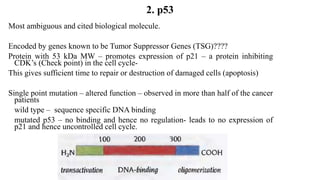
2. p53
Most ambiguous and cited biological molecule.
Encoded by genes known to be Tumor Suppressor Genes (TSG)????
Protein with 53 kDa MW – promotes expression of p21 – a protein inhibiting
CDK’s (Check point) in the cell cycle-
This gives sufficient time to repair or destruction of damaged cells (apoptosis)
Single point mutation – altered function – observed in more than half of the cancer
patients
wild type – sequence specific DNA binding
mutated p53 – no binding and hence no regulation- leads to no expression of
p21 and hence uncontrolled cell cycle.
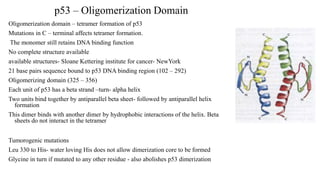
p53 – Oligomerization Domain
Oligomerization domain – tetramer formation of p53
Mutations in C – terminal affects tetramer formation.
The monomer still retains DNA binding function
No complete structure available
available structures- Sloane Kettering institute for cancer- NewYork
21 base pairs sequence bound to p53 DNA binding region (102 – 292)
Oligomerizing domain (325 – 356)
Each unit of p53 has a beta strand –turn- alpha helix
Two units bind together by antiparallel beta sheet- followed by antiparallel helix
formation
This dimer binds with another dimer by hydrophobic interactions of the helix. Beta
sheets do not interact in the tetramer
Tumorogenic mutations
Leu 330 to His- water loving His does not allow dimerization core to be formed
Glycine in turn if mutated to any other residue - also abolishes p53 dimerization
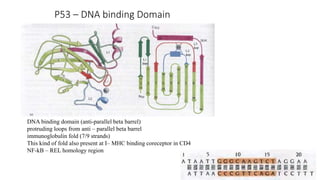
P53 – DNA binding Domain
DNA binding domain (anti-parallel beta barrel)
protruding loops from anti – parallel beta barrel
immunoglobulin fold (7/9 strands)
This kind of fold also present at I– MHC binding coreceptor in CD4
NF-kB – REL homology region
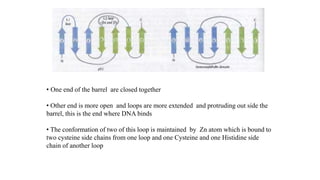
• One end of the barrel are closed together
• Other end is more open and loops are more extended and protruding out side the
barrel, this is the end where DNA binds
• The conformation of two of this loop is maintained by Zn atom which is bound to
two cysteine side chains from one loop and one Cysteine and one Histidine side
chain of another loop
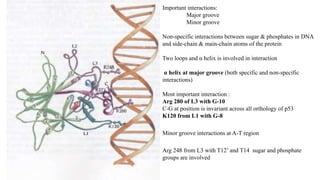
Important interactions:
Major groove
Minor groove
Non-specific interactions between sugar & phosphates in DNA
and side-chain & main-chain atoms of the protein
Two loops and α helix is involved in interaction
α helix at major groove (both specific and non-specific
interactions)
Most important interaction :
Arg 280 of L3 with G-10
C-G at position is invariant across all orthology of p53
K120 from L1 with G-8
Minor groove interactions at A-T region
Arg 248 from L3 with T12’ and T14 sugar and phosphate
groups are involved
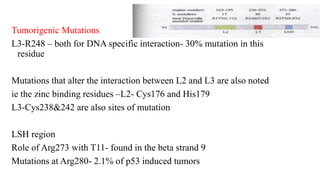
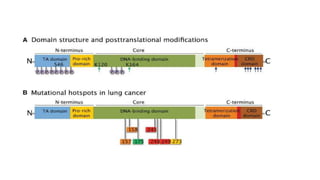
Tumorigenic Mutations
L3-R248 – both for DNA specific interaction- 30% mutation in this
residue
Mutations that alter the interaction between L2 and L3 are also noted
ie the zinc binding residues –L2- Cys176 and His179
L3-Cys238&242 are also sites of mutation
LSH region
Role of Arg273 with T11- found in the beta strand 9
Mutations at Arg280- 2.1% of p53 induced tumors
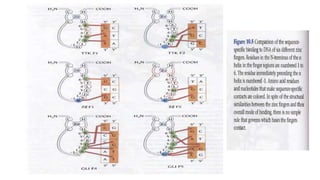
3. Zn finger transcription factors
A zinc finger is a small protein structural motif.
Characterized by the coordination of one or more zinc ions in order to stabilize
the fold.
Zinc fingers have become extremely useful in various therapeutic and research
capacities.
Engineering zinc fingers to have an affinity for a specific sequence is an area of
active research.
Zinc finger nucleases and zinc finger transcription factors are two of the most
important applications of this to be realized to date
 More than thousand different transcription factors contain Zn as an essential element Of their DNA binding
domains.
 Polypeptides are short about 50 aa
 Regular patterns of cysteine and /or Histidine residues along the chain
 These residues bind to the Zn atoms and thereby providing a scaffold for the folding of the Motif into a
small compact domain
 First described in 1985 by Aron Klug at MRC LMB Cambridge
 TFIIIA from Xenopus laevis
 344 aa, Nine repeated sequences of about 30 residue each
 Repeats are not identical in sequence but each contains two Cysteine and two Histidine at the N terminal
and C teminal end respectively.
• Zn is intrinsically present, Cysteine and histidine are the ligand of the Zn atom and loop between these
residues forms the DNA binding region. Each of these nine repeats are therefore called zinc finger
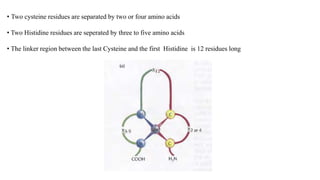
• Two cysteine residues are separated by two or four amino acids
• Two Histidine residues are seperated by three to five amino acids
• The linker region between the last Cysteine and the first Histidine is 12 residues long
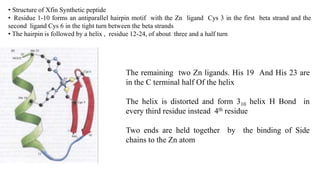
• Structure of Xfin Synthetic peptide
• Residue 1-10 forms an antiparallel hairpin motif with the Zn ligand Cys 3 in the first beta strand and the
second ligand Cys 6 in the tight turn between the beta strands
• The hairpin is followed by a helix , residue 12-24, of about three and a half turn
The remaining two Zn ligands. His 19 And His 23 are
in the C terminal half Of the helix
The helix is distorted and form 310 helix H Bond in
every third residue instead 4th residue
Two ends are held together by the binding of Side
chains to the Zn atom
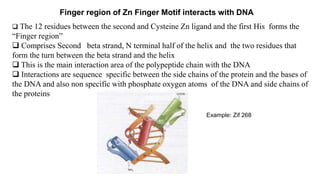
Finger region of Zn Finger Motif interacts with DNA
 The 12 residues between the second and Cysteine Zn ligand and the first His forms the
“Finger region”
 Comprises Second beta strand, N terminal half of the helix and the two residues that
form the turn between the beta strand and the helix
 This is the main interaction area of the polypeptide chain with the DNA
 Interactions are sequence specific between the side chains of the protein and the bases of
the DNA and also non specific with phosphate oxygen atoms of the DNA and side chains of
the proteins
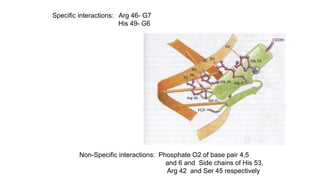
Example: Zif 268
Specific interactions: Arg 46- G7
His 49- G6
Non-Specific interactions: Phosphate O2 of base pair 4,5
and 6 and Side chains of His 53,
Arg 42 and Ser 45 respectively
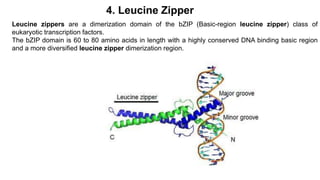
Leucine zippers are a dimerization domain of the bZIP (Basic-region leucine zipper) class of
eukaryotic transcription factors.
The bZIP domain is 60 to 80 amino acids in length with a highly conserved DNA binding basic region
and a more diversified leucine zipper dimerization region.
4. Leucine Zipper
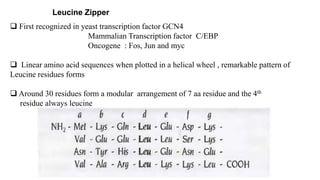
Leucine Zipper
 First recognized in yeast transcription factor GCN4
Mammalian Transcription factor C/EBP
Oncogene : Fos, Jun and myc
 Linear amino acid sequences when plotted in a helical wheel , remarkable pattern of
Leucine residues forms
 Around 30 residues form a modular arrangement of 7 aa residue and the 4th
residue always leucine
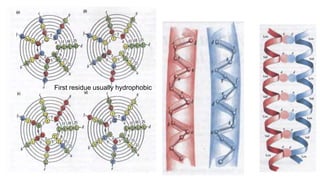
First residue usually hydrophobic
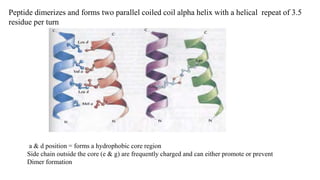
Peptide dimerizes and forms two parallel coiled coil alpha helix with a helical repeat of 3.5
residue per turn
a & d position = forms a hydrophobic core region
Side chain outside the core (e & g) are frequently charged and can either promote or prevent
Dimer formation
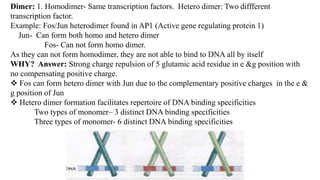
Dimer: 1. Homodimer- Same transcription factors. Hetero dimer: Two diffferent
transcription factor.
Example: Fos/Jun heterodimer found in AP1 (Active gene regulating protein 1)
Jun- Can form both homo and hetero dimer
Fos- Can not form homo dimer.
As they can not form homodimer, they are not able to bind to DNA all by itself
WHY? Answer: Strong charge repulsion of 5 glutamic acid residue in e &g position with
no compensating positive charge.
 Fos can form hetero dimer with Jun due to the complementary positive charges in the e &
g position of Jun
 Hetero dimer formation facilitates repertoire of DNA binding specificities
Two types of monomer– 3 distinct DNA binding specificities
Three types of monomer- 6 distinct DNA binding specificities
GCN4
 Yeast
 b/Zip family of transcription factor
 Monomer 281 aa
 Binds to promoter regions of more than 30 genes involved in amino acid biosynthesis
 Dimerization and DNA binding domains are in two different regions
Basic region and C terminal Leucine Zipper region
Basic region: Eight charged residues, mainly Arg which are involved in DNA Binding
DNA recognition region of GCN4 similar to Fos/Jun heterodimer of AP1
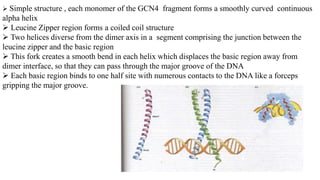
 Simple structure , each monomer of the GCN4 fragment forms a smoothly curved continuous
alpha helix
 Leucine Zipper region forms a coiled coil structure
 Two helices diverse from the dimer axis in a segment comprising the junction between the
leucine zipper and the basic region
 This fork creates a smooth bend in each helix which displaces the basic region away from
dimer interface, so that they can pass through the major groove of the DNA
 Each basic region binds to one half site with numerous contacts to the DNA like a forceps
gripping the major groove.
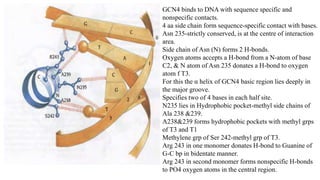
GCN4 binds to DNA with sequence specific and
nonspecific contacts.
4 aa side chain form sequence-specific contact with bases.
Asn 235-strictly conserved, is at the centre of interaction
area.
Side chain of Asn (N) forms 2 H-bonds.
Oxygen atoms accepts a H-bond from a N-atom of base
C2, & N atom of Asn 235 donates a H-bond to oxygen
atom f T3.
For this the α helix of GCN4 basic region lies deeply in
the major groove.
Specifies two of 4 bases in each half site.
N235 lies in Hydrophobic pocket-methyl side chains of
Ala 238 &239.
A238&239 forms hydrophobic pockets with methyl grps
of T3 and T1
Methylene grp of Ser 242-methyl grp of T3.
Arg 243 in one monomer donates H-bond to Guanine of
G-C bp in bidentate manner.
Arg 243 in second monomer forms nonspecific H-bonds
to PO4 oxygen atoms in the central region.
• Assignment Q
How does GCN4 dimer bind to half-sites comprising T1, C2,
and T3 when these half sites are separated by two nucleotides
instead of one?
Ans: flexibility of DNA and basic region of the GCN4- 10
degrees spread apart where DNA bends towards the coiled
coils to be closer with the fork interactions
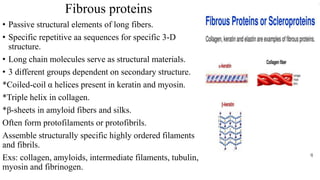
Fibrous proteins
• Passive structural elements of long fibers.
• Specific repetitive aa sequences for specific 3-D
structure.
• Long chain molecules serve as structural materials.
• 3 different groups dependent on secondary structure.
*Coiled-coil α helices present in keratin and myosin.
*Triple helix in collagen.
*β-sheets in amyloid fibers and silks.
Often form protofilaments or protofibrils.
Assemble structurally specific highly ordered filaments
and fibrils.
Exs: collagen, amyloids, intermediate filaments, tubulin,
myosin and fibrinogen.
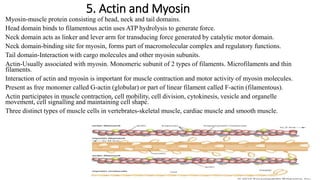
5. Actin and Myosin
Myosin-muscle protein consisting of head, neck and tail domains.
Head domain binds to filamentous actin uses ATP hydrolysis to generate force.
Neck domain acts as linker and lever arm for transducing force generated by catalytic motor domain.
Neck domain-binding site for myosin, forms part of macromolecular complex and regulatory functions.
Tail domain-Interaction with cargo molecules and other myosin subunits.
Actin-Usually associated with myosin. Monomeric subunit of 2 types of filaments. Microfilaments and thin
filaments.
Interaction of actin and myosin is important for muscle contraction and motor activity of myosin molecules.
Present as free monomer called G-actin (globular) or part of linear filament called F-actin (filamentous).
Actin participates in muscle contraction, cell mobility, cell division, cytokinesis, vesicle and organelle
movement, cell signalling and maintaining cell shape.
Three distinct types of muscle cells in vertebrates-skeletal muscle, cardiac muscle and smooth muscle.
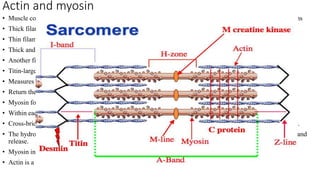
Actin and myosin
• Muscle contraction takes place by mutual sliding of 2 sets of interdigitating filaments made of fibrous proteins
• Thick filament-myosin
• Thin filament-actin.
• Thick and thin filaments organized in basic contractile units called sarcomere, each 2-3μm long.
• Another fibrous component of sarcomere is titin.
• Titin-largest known polypeptide chain with mol.wt of approx.3000kDa.
• Measures the length of sarcomere.
• Return the stretched muscle to correct length.
• Myosin form s cross bridges between actin and myosin filaments.
• Within each sarcomere relative sliding of thick and thin filaments brought by cross-bridges.
• Cross-bridges-parts of myosin molecules that stick out from myosin filament and interact with actin filament.
• The hydrolysis of ATP to ADP and phosphate couples the conformational change in myosin to actin binding and
release.
• Myosin in thick filament is a fibrous protein with individual chains arranged in helical coiled coils.
• Actin is a fibrous protein formed by linking together globular monomeric subunits.
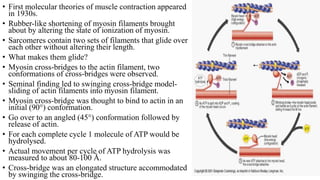
• First molecular theories of muscle contraction appeared
in 1930s.
• Rubber-like shortening of myosin filaments brought
about by altering the state of ionization of myosin.
• Sarcomeres contain two sets of filaments that glide over
each other without altering their length.
• What makes them glide?
• Myosin cross-bridges to the actin filament, two
conformations of cross-bridges were observed.
• Seminal finding led to swinging cross-bridge model-
sliding of actin filaments into myosin filament.
• Myosin cross-bridge was thought to bind to actin in an
initial (90°) conformation.
• Go over to an angled (45°) conformation followed by
release of actin.
• For each complete cycle 1 molecule of ATP would be
hydrolysed.
• Actual movement per cycle of ATP hydrolysis was
measured to about 80-100 Å.
• Cross-bridge was an elongated structure accommodated
by swinging the cross-bridge.
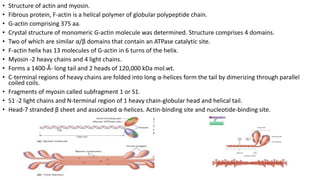
• Structure of actin and myosin.
• Fibrous protein, F-actin is a helical polymer of globular polypeptide chain.
• G-actin comprising 375 aa.
• Crystal structure of monomeric G-actin molecule was determined. Structure comprises 4 domains.
• Two of which are similar α/β domains that contain an ATPase catalytic site.
• F-actin helix has 13 molecules of G-actin in 6 turns of the helix.
• Myosin -2 heavy chains and 4 light chains.
• Forms a 1400-Å- long tail and 2 heads of 120,000 kDa mol.wt.
• C-terminal regions of heavy chains are folded into long α-helices form the tail by dimerizing through parallel
coiled coils.
• Fragments of myosin called subfragment 1 or S1.
• S1 -2 light chains and N-terminal region of 1 heavy chain-globular head and helical tail.
• Head-7 stranded β sheet and associated α-helices. Actin-binding site and nucleotide-binding site.
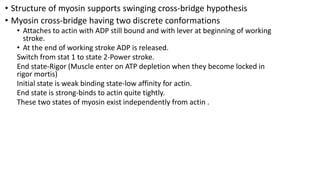
• Structure of myosin supports swinging cross-bridge hypothesis
• Myosin cross-bridge having two discrete conformations
• Attaches to actin with ADP still bound and with lever at beginning of working
stroke.
• At the end of working stroke ADP is released.
Switch from stat 1 to state 2-Power stroke.
End state-Rigor (Muscle enter on ATP depletion when they become locked in
rigor mortis)
Initial state is weak binding state-low affinity for actin.
End state is strong-binds to actin quite tightly.
These two states of myosin exist independently from actin .
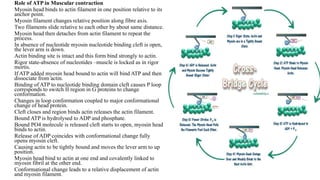
Role of ATP in Muscular contraction
Myosin head binds to actin filament in one position relative to its
anchor point.
Myosin filament changes relative position along fibre axis.
Two filaments slide relative to each other by about same distance.
Myosin head then detaches from actin filament to repeat the
process.
In absence of nucleotide myosin nucleotide binding cleft is open,
the lever arm is down.
Actin binding site is intact and this form bind strongly to actin.
Rigor state-absence of nucleotides –muscle is locked as in rigor
mortis.
If ATP added myosin head bound to actin will bind ATP and then
dissociate from actin.
Binding of ATP to nucleotide binding domain cleft causes P loop
corresponds to switch II region in G proteins to change
conformation.
Changes in loop conformation coupled to major conformational
change of head protein.
Cleft closes and region binds actin releases the actin filament.
Bound ATP is hydrolysed to ADP and phosphate.
Bound PO4 molecule is released cleft starts to open, myosin head
binds to actin.
Release of ADP coincides with conformational change fully
opens myosin cleft.
Causing actin to be tightly bound and moves the lever arm to up
position.
Myosin head bind to actin at one end and covalently linked to
myosin fibril at the other end.
Conformational change leads to a relative displacement of actin
and myosin filament.
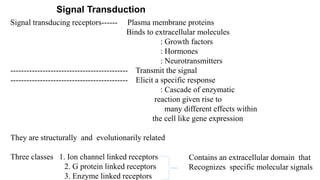
Signal Transduction
Signal transducing receptors------ Plasma membrane proteins
Binds to extracellular molecules
: Growth factors
: Hormones
: Neurotransmitters
-------------------------------------------- Transmit the signal
-------------------------------------------- Elicit a specific response
: Cascade of enzymatic
reaction given rise to
many different effects within
the cell like gene expression
They are structurally and evolutionarily related
Three classes 1. Ion channel linked receptors
2. G protein linked receptors
3. Enzyme linked receptors
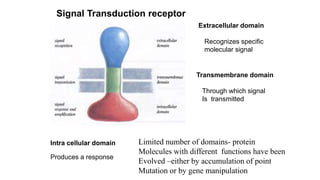
Contains an extracellular domain that
Recognizes specific molecular signals
Signal Transduction receptor
Extracellular domain
Recognizes specific
molecular signal
Transmembrane domain
Through which signal
Is transmitted
Intra cellular domain
Produces a response
Limited number of domains- protein
Molecules with different functions have been
Evolved –either by accumulation of point
Mutation or by gene manipulation
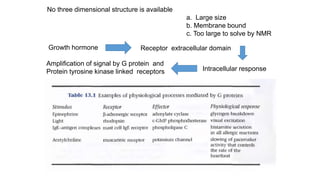
No three dimensional structure is available
a. Large size
b. Membrane bound
c. Too large to solve by NMR
Growth hormone Receptor extracellular domain
Intracellular response
Amplification of signal by G protein and
Protein tyrosine kinase linked receptors
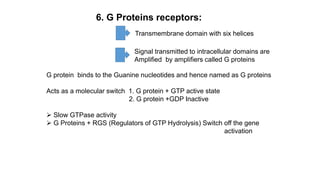
6. G Proteins receptors:
Transmembrane domain with six helices
Signal transmitted to intracellular domains are
Amplified by amplifiers called G proteins
G protein binds to the Guanine nucleotides and hence named as G proteins
Acts as a molecular switch 1. G protein + GTP active state
2. G protein +GDP Inactive
 Slow GTPase activity
 G Proteins + RGS (Regulators of GTP Hydrolysis) Switch off the gene
activation
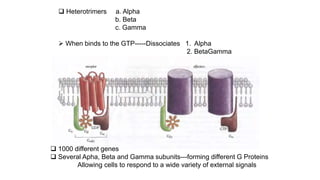
 Heterotrimers a. Alpha
b. Beta
c. Gamma
 When binds to the GTP-----Dissociates 1. Alpha
2. BetaGamma
 1000 different genes
 Several Apha, Beta and Gamma subunits---forming different G Proteins
Allowing cells to respond to a wide variety of external signals
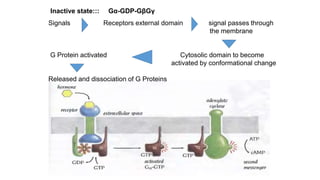
Inactive state::: Gα-GDP-GβGγ
Signals Receptors external domain signal passes through
the membrane
G Protein activated Cytosolic domain to become
activated by conformational change
Released and dissociation of G Proteins
 Second messenger molecule: a substance whose release within a cell is promoted by a
hormone and which brings about a response by the cell.
 GTPase activity determines the length and the time that the signal remains on
 Failure to turn off GTPase activity: Gα –GTP remain active
Consequence: Chlolera toxin prevents Gα – GTP breakdown continue excretion of Na
and water into the gut.
RAS: small GTPases: Example: KRAS, NRAS, and HRAS
 are molecular switch activated in response to protein tyrosine kinase receptor
 GTPase activity regulated by GAP
 25% tumor cells produce mutant Ras protein not regulated by GAP
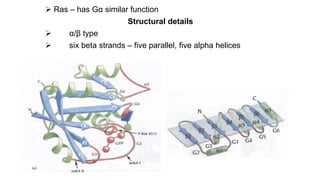
 Ras – has Gα similar function
Structural details
 α/β type
 six beta strands – five parallel, five alpha helices
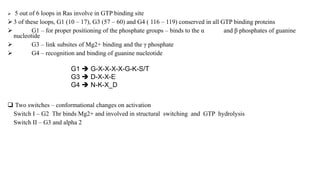
 5 out of 6 loops in Ras involve in GTP binding site
 3 of these loops, G1 (10 – 17), G3 (57 – 60) and G4 ( 116 – 119) conserved in all GTP binding proteins
 G1 – for proper positioning of the phosphate groups – binds to the α and β phosphates of guanine
nucleotide
 G3 – link subsites of Mg2+ binding and the γ phosphate
 G4 – recognition and binding of guanine nucleotide
 Two switches – conformational changes on activation
Switch I – G2 Thr binds Mg2+ and involved in structural switching and GTP hydrolysis
Switch II – G3 and alpha 2
G1  G-X-X-X-X-G-K-S/T
G3  D-X-X-E
G4  N-K-X_D
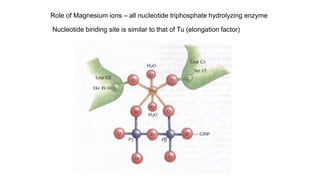
Role of Magnesium ions – all nucleotide triphosphate hydrolyzing enzyme
Nucleotide binding site is similar to that of Tu (elongation factor)
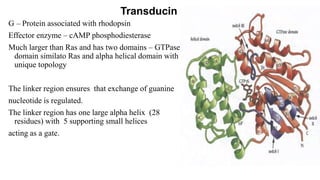
G – Protein associated with rhodopsin
Effector enzyme – cAMP phosphodiesterase
Much larger than Ras and has two domains – GTPase
domain similato Ras and alpha helical domain with
unique topology
The linker region ensures that exchange of guanine
nucleotide is regulated.
The linker region has one large alpha helix (28
residues) with 5 supporting small helices
acting as a gate.
Transducin
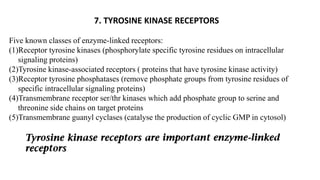
Five known classes of enzyme-linked receptors:
(1)Receptor tyrosine kinases (phosphorylate specific tyrosine residues on intracellular
signaling proteins)
(2)Tyrosine kinase-associated receptors ( proteins that have tyrosine kinase activity)
(3)Receptor tyrosine phosphatases (remove phosphate groups from tyrosine residues of
specific intracellular signaling proteins)
(4)Transmembrane receptor ser/thr kinases which add phosphate group to serine and
threonine side chains on target proteins
(5)Transmembrane guanyl cyclases (catalyse the production of cyclic GMP in cytosol)
7. TYROSINE KINASE RECEPTORS
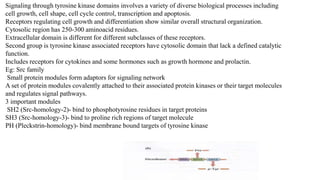
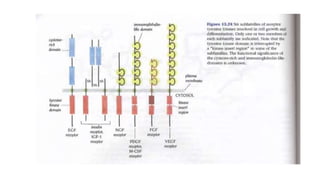
Signaling through tyrosine kinase domains involves a variety of diverse biological processes including
cell growth, cell shape, cell cycle control, transcription and apoptosis.
Receptors regulating cell growth and differentiation show similar overall structural organization.
Cytosolic region has 250-300 aminoacid residues.
Extracellular domain is different for different subclasses of these receptors.
Second group is tyrosine kinase associated receptors have cytosolic domain that lack a defined catalytic
function.
Includes receptors for cytokines and some hormones such as growth hormone and prolactin.
Eg: Src family
Small protein modules form adaptors for signaling network
A set of protein modules covalently attached to their associated protein kinases or their target molecules
and regulates signal pathways.
3 important modules
SH2 (Src-homology-2)- bind to phosphotyrosine residues in target proteins
SH3 (Src-homology-3)- bind to proline rich regions of target molecule
PH (Pleckstrin-homology)- bind membrane bound targets of tyrosine kinase
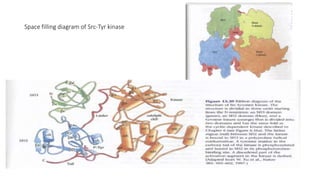
Space filling diagram of Src-Tyr kinase
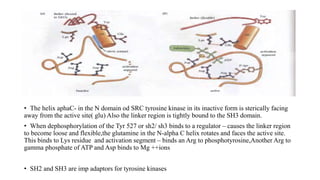
• The helix aphaC- in the N domain od SRC tyrosine kinase in its inactive form is sterically facing
away from the active site( glu) Also the linker region is tightly bound to the SH3 domain.
• When dephosphorylation of the Tyr 527 or sh2/ sh3 binds to a regulator – causes the linker region
to become loose and flexible,the glutamine in the N-alpha C helix rotates and faces the active site.
This binds to Lys residue and activation segment – binds an Arg to phosphotyrosine,Another Arg to
gamma phosphate of ATP and Asp binds to Mg ++ions
• SH2 and SH3 are imp adaptors for tyrosine kinases
THANK YOU

Unit II -examples of protein sec.structure.pptx

  • 1.
    UNIT II: STRUCTUREFUNCTION CORRELATION IN PROTEINS The Structure-Function correlation in Transcription factors TATA box binding proteins, p53 and GCN4 (Leucine zipper) The Structure-Function correlation in fibrous proteins – muscle fibers myosin, actin and the role in ATP in muscle contraction. The Structure-Function correlation in Signal transducers – GPCR and tyrosine kinase
  • 2.
    What is transcription? Transcribinggenetic information from DNA to RNA DNA RNA Protein Replication DNA Transcription Translation
  • 3.
    RNA Polymerase Synthesizes RNAfrom DNA RNA Polymerase I (Pol I)- Synthesizes rRNAs RNA Polymerase II (Pol II)- Synthesizes mRNAs RNA Polymerase III (Pol III)- Synthesizes tRNAs
  • 4.
    What is transcriptionfactor? Distal to the RNA Pol II initiation site, there are different combinations of specific DNA binding sequences each of which is recognized by a corresponding site specific DNA binding protein. These proteins are known as transcription factor(s). These together with DNA form the control module of gene expression Example: TFIID,TFIIA,TFIIB, TBP etc
  • 5.
    Architecture of astructural gene and the promoter(control module) Core promoter element
  • 6.
    TATA Box: • A-TRich 8 base pair DNA sequence • Located 25 base pair upstream of of TSS • Recognized by TATA Box binding Proteins (TBPs)
  • 7.
    Promoter proximal Element: •100-200 bp long • Several transcription factors interact directly or indirectly with the pre initiation complex Enhancer Element: • Resides further upstream or down stream of the TSS • Few thousand to 20000 bp distant from the TSS
  • 8.
    Schematic model oftranscriptional activation Transcription factor Bind to the DNA Transcriptional Activation
  • 9.
    TF DNA BINDING ACTIVATION DOMAIN DNA Binding Domain: •100 aa acid long • Bound to short DNA of 20 bp • Built up of very limited no of motifs– Like Helix turn Helix Leucine zipper Helix loop Helix Zinc finger motif
  • 10.
    1. TATA BoxBinding Protein (TBP) • First isolated and purified from Yeast in 1988 • Single polypeptide chain of 27 kDa • Conserved C Terminal domain of 180 aa • N Terminal domain of varied length and diverse sequences • C terminal domain having DNA binding and transcription activation function Structure of TBP Crystal structure by Paul Sigler @ Yale University With Yeast C trminal TBP and Yeast TATA box DNA Stephen Burley @ Rockyfeller University with C Terminal TBP of A. thaliana and TATA box DNA from Adeno virus
  • 11.
    • Two homologousrepeat of 88 aa form similar motifs • Comprises of an antiparallel Beta sheet of five strands and Two α- helices • Two motifs are joined together by a short loop to make a 10 stranded beta sheet • They look like a saddle (Fig a) • (fig b)90◦ rotation of the Fig a
  • 12.
    • Loops thatconnects beta strand 2 & 3 of each motif forms the Stirrups of the saddle • Underside of the saddle forms the conclave surface built by the central eight strand of beta sheet • Side chain of this site of beta • Sheet as well as residues of the Stirrups forms the DNA binding Site. • The side of the beta sheet that faces away from the DNA is covered by two alpha helices Residues from these two helices and from the short loop that joins the two motif Interacts with TFIID and with other transcription factors.
  • 13.
    How TBP bindsto the DNA? Answer: TBP binds to the minor groove of the DNA and Induces large structural changes
  • 14.
    • Normal B-DNAstructure returns out side the TATA box • The helical axis of the DNA at each end of the TATA BOX form an angle of about 100 degree to each other , instead of the Expected 180 degree if the DNA was not bent. • First two and the last two bp of TATA box, there are sharp kinks, DNA is Covered smoothly and partially unwounded.
  • 15.
    • Two Phenylalanineresidues are partially inserted between first two and the last two bases, preventing stacking of the adjacent bases and allow increase in rise Of the DNA • The kinks at each end of the DNA and partial unwinding of the DNA produces a wide and shallow minor groove. • This exposed wide and shallow minor groove bind intimately to the concave undersurface of the TBP saddle. DNA Modifications: Distortions: a. Bending of DNA b. Widening of the minor groove c. Unwinding of the DNA
  • 16.
    • All eightnucleotides of TATA box interacts with TBP and their structure deviates from the normal B-DNA. • Saddle would straddle normal B-DNA structure with helical axis of the DNA perpendicular to a line connecting the two stirrups. • DNA is sharply bent at TATA box region so that the local helical axis is almost is almost parallel to the line from stirrups to stirrups. Protein Saddle structure Minor groove of DNA
  • 17.
    What is thenature of the interaction? • Strong hydrophobic interaction between the underside of TBP saddle and the minor groove of DNA • Side chains of eight central beta strands interacts with both the phosphate sugar Backbone and the minor groove of the eight nucleotides of the TATA box. • Fifteen side chains projecting from the beta strands make hydrophobic contacts With the sugar and bases of DNA. • The phosphate groups are hydrogen bonded to arginine and lysine side chains At the edges of the interaction area.
  • 18.
    Why specific toTA/AT sequence at 4 and 5 position of bp? Only sequence specific H bonds – center of box Asn 69 – O2 of T4’ and N3 of A5’ Asn 159 – O2 of T5 and N3 of A4 Thr 124 &215– N3 of A both sides Role of Conserved Val residues. Val 71 and 122 on one side Val 161 and 213 on the other side Side chains of Val residues cause steric interference with NH2 substituent from G-C or C-G basepair. Flanking Val residues in combination with 6 H-bonds specify A-T or T-A at positions 4 and 5 of TATA box Why Minor groove??? Quasi – palindromicity Functional implication of DNA bending TBF – associated factors (TAF) Significance of N – terminal in TBP
  • 19.
    Why strong affinitybetween TBP-TATA Box? Around 100000 fold more affinity than random DNA. • Large interacting hydrophobic surface area • Major distortion in the DNA • SIX Hydrogen bonds between 4 side chain residues of TBP and 4 hydrogen bond acceptors from bases In the minor groove.
  • 20.
    2. p53 Most ambiguousand cited biological molecule. Encoded by genes known to be Tumor Suppressor Genes (TSG)???? Protein with 53 kDa MW – promotes expression of p21 – a protein inhibiting CDK’s (Check point) in the cell cycle- This gives sufficient time to repair or destruction of damaged cells (apoptosis) Single point mutation – altered function – observed in more than half of the cancer patients wild type – sequence specific DNA binding mutated p53 – no binding and hence no regulation- leads to no expression of p21 and hence uncontrolled cell cycle.
  • 21.
    p53 – OligomerizationDomain Oligomerization domain – tetramer formation of p53 Mutations in C – terminal affects tetramer formation. The monomer still retains DNA binding function No complete structure available available structures- Sloane Kettering institute for cancer- NewYork 21 base pairs sequence bound to p53 DNA binding region (102 – 292) Oligomerizing domain (325 – 356) Each unit of p53 has a beta strand –turn- alpha helix Two units bind together by antiparallel beta sheet- followed by antiparallel helix formation This dimer binds with another dimer by hydrophobic interactions of the helix. Beta sheets do not interact in the tetramer Tumorogenic mutations Leu 330 to His- water loving His does not allow dimerization core to be formed Glycine in turn if mutated to any other residue - also abolishes p53 dimerization
  • 22.
    P53 – DNAbinding Domain DNA binding domain (anti-parallel beta barrel) protruding loops from anti – parallel beta barrel immunoglobulin fold (7/9 strands) This kind of fold also present at I– MHC binding coreceptor in CD4 NF-kB – REL homology region
  • 23.
    • One endof the barrel are closed together • Other end is more open and loops are more extended and protruding out side the barrel, this is the end where DNA binds • The conformation of two of this loop is maintained by Zn atom which is bound to two cysteine side chains from one loop and one Cysteine and one Histidine side chain of another loop
  • 24.
    Important interactions: Major groove Minorgroove Non-specific interactions between sugar & phosphates in DNA and side-chain & main-chain atoms of the protein Two loops and α helix is involved in interaction α helix at major groove (both specific and non-specific interactions) Most important interaction : Arg 280 of L3 with G-10 C-G at position is invariant across all orthology of p53 K120 from L1 with G-8 Minor groove interactions at A-T region Arg 248 from L3 with T12’ and T14 sugar and phosphate groups are involved
  • 25.
    Tumorigenic Mutations L3-R248 –both for DNA specific interaction- 30% mutation in this residue Mutations that alter the interaction between L2 and L3 are also noted ie the zinc binding residues –L2- Cys176 and His179 L3-Cys238&242 are also sites of mutation LSH region Role of Arg273 with T11- found in the beta strand 9 Mutations at Arg280- 2.1% of p53 induced tumors
  • 27.
    3. Zn fingertranscription factors A zinc finger is a small protein structural motif. Characterized by the coordination of one or more zinc ions in order to stabilize the fold. Zinc fingers have become extremely useful in various therapeutic and research capacities. Engineering zinc fingers to have an affinity for a specific sequence is an area of active research. Zinc finger nucleases and zinc finger transcription factors are two of the most important applications of this to be realized to date
  • 28.
     More thanthousand different transcription factors contain Zn as an essential element Of their DNA binding domains.  Polypeptides are short about 50 aa  Regular patterns of cysteine and /or Histidine residues along the chain  These residues bind to the Zn atoms and thereby providing a scaffold for the folding of the Motif into a small compact domain  First described in 1985 by Aron Klug at MRC LMB Cambridge  TFIIIA from Xenopus laevis  344 aa, Nine repeated sequences of about 30 residue each  Repeats are not identical in sequence but each contains two Cysteine and two Histidine at the N terminal and C teminal end respectively. • Zn is intrinsically present, Cysteine and histidine are the ligand of the Zn atom and loop between these residues forms the DNA binding region. Each of these nine repeats are therefore called zinc finger
  • 29.
    • Two cysteineresidues are separated by two or four amino acids • Two Histidine residues are seperated by three to five amino acids • The linker region between the last Cysteine and the first Histidine is 12 residues long
  • 30.
    • Structure ofXfin Synthetic peptide • Residue 1-10 forms an antiparallel hairpin motif with the Zn ligand Cys 3 in the first beta strand and the second ligand Cys 6 in the tight turn between the beta strands • The hairpin is followed by a helix , residue 12-24, of about three and a half turn The remaining two Zn ligands. His 19 And His 23 are in the C terminal half Of the helix The helix is distorted and form 310 helix H Bond in every third residue instead 4th residue Two ends are held together by the binding of Side chains to the Zn atom
  • 31.
    Finger region ofZn Finger Motif interacts with DNA  The 12 residues between the second and Cysteine Zn ligand and the first His forms the “Finger region”  Comprises Second beta strand, N terminal half of the helix and the two residues that form the turn between the beta strand and the helix  This is the main interaction area of the polypeptide chain with the DNA  Interactions are sequence specific between the side chains of the protein and the bases of the DNA and also non specific with phosphate oxygen atoms of the DNA and side chains of the proteins Example: Zif 268
  • 32.
    Specific interactions: Arg46- G7 His 49- G6 Non-Specific interactions: Phosphate O2 of base pair 4,5 and 6 and Side chains of His 53, Arg 42 and Ser 45 respectively
  • 34.
    Leucine zippers area dimerization domain of the bZIP (Basic-region leucine zipper) class of eukaryotic transcription factors. The bZIP domain is 60 to 80 amino acids in length with a highly conserved DNA binding basic region and a more diversified leucine zipper dimerization region. 4. Leucine Zipper
  • 35.
    Leucine Zipper  Firstrecognized in yeast transcription factor GCN4 Mammalian Transcription factor C/EBP Oncogene : Fos, Jun and myc  Linear amino acid sequences when plotted in a helical wheel , remarkable pattern of Leucine residues forms  Around 30 residues form a modular arrangement of 7 aa residue and the 4th residue always leucine
  • 36.
  • 37.
    Peptide dimerizes andforms two parallel coiled coil alpha helix with a helical repeat of 3.5 residue per turn a & d position = forms a hydrophobic core region Side chain outside the core (e & g) are frequently charged and can either promote or prevent Dimer formation
  • 38.
    Dimer: 1. Homodimer-Same transcription factors. Hetero dimer: Two diffferent transcription factor. Example: Fos/Jun heterodimer found in AP1 (Active gene regulating protein 1) Jun- Can form both homo and hetero dimer Fos- Can not form homo dimer. As they can not form homodimer, they are not able to bind to DNA all by itself WHY? Answer: Strong charge repulsion of 5 glutamic acid residue in e &g position with no compensating positive charge.  Fos can form hetero dimer with Jun due to the complementary positive charges in the e & g position of Jun  Hetero dimer formation facilitates repertoire of DNA binding specificities Two types of monomer– 3 distinct DNA binding specificities Three types of monomer- 6 distinct DNA binding specificities
  • 39.
    GCN4  Yeast  b/Zipfamily of transcription factor  Monomer 281 aa  Binds to promoter regions of more than 30 genes involved in amino acid biosynthesis  Dimerization and DNA binding domains are in two different regions Basic region and C terminal Leucine Zipper region Basic region: Eight charged residues, mainly Arg which are involved in DNA Binding DNA recognition region of GCN4 similar to Fos/Jun heterodimer of AP1
  • 40.
     Simple structure, each monomer of the GCN4 fragment forms a smoothly curved continuous alpha helix  Leucine Zipper region forms a coiled coil structure  Two helices diverse from the dimer axis in a segment comprising the junction between the leucine zipper and the basic region  This fork creates a smooth bend in each helix which displaces the basic region away from dimer interface, so that they can pass through the major groove of the DNA  Each basic region binds to one half site with numerous contacts to the DNA like a forceps gripping the major groove.
  • 41.
    GCN4 binds toDNA with sequence specific and nonspecific contacts. 4 aa side chain form sequence-specific contact with bases. Asn 235-strictly conserved, is at the centre of interaction area. Side chain of Asn (N) forms 2 H-bonds. Oxygen atoms accepts a H-bond from a N-atom of base C2, & N atom of Asn 235 donates a H-bond to oxygen atom f T3. For this the α helix of GCN4 basic region lies deeply in the major groove. Specifies two of 4 bases in each half site. N235 lies in Hydrophobic pocket-methyl side chains of Ala 238 &239. A238&239 forms hydrophobic pockets with methyl grps of T3 and T1 Methylene grp of Ser 242-methyl grp of T3. Arg 243 in one monomer donates H-bond to Guanine of G-C bp in bidentate manner. Arg 243 in second monomer forms nonspecific H-bonds to PO4 oxygen atoms in the central region.
  • 42.
    • Assignment Q Howdoes GCN4 dimer bind to half-sites comprising T1, C2, and T3 when these half sites are separated by two nucleotides instead of one? Ans: flexibility of DNA and basic region of the GCN4- 10 degrees spread apart where DNA bends towards the coiled coils to be closer with the fork interactions
  • 43.
    Fibrous proteins • Passivestructural elements of long fibers. • Specific repetitive aa sequences for specific 3-D structure. • Long chain molecules serve as structural materials. • 3 different groups dependent on secondary structure. *Coiled-coil α helices present in keratin and myosin. *Triple helix in collagen. *β-sheets in amyloid fibers and silks. Often form protofilaments or protofibrils. Assemble structurally specific highly ordered filaments and fibrils. Exs: collagen, amyloids, intermediate filaments, tubulin, myosin and fibrinogen.
  • 44.
    5. Actin andMyosin Myosin-muscle protein consisting of head, neck and tail domains. Head domain binds to filamentous actin uses ATP hydrolysis to generate force. Neck domain acts as linker and lever arm for transducing force generated by catalytic motor domain. Neck domain-binding site for myosin, forms part of macromolecular complex and regulatory functions. Tail domain-Interaction with cargo molecules and other myosin subunits. Actin-Usually associated with myosin. Monomeric subunit of 2 types of filaments. Microfilaments and thin filaments. Interaction of actin and myosin is important for muscle contraction and motor activity of myosin molecules. Present as free monomer called G-actin (globular) or part of linear filament called F-actin (filamentous). Actin participates in muscle contraction, cell mobility, cell division, cytokinesis, vesicle and organelle movement, cell signalling and maintaining cell shape. Three distinct types of muscle cells in vertebrates-skeletal muscle, cardiac muscle and smooth muscle.
  • 45.
    Actin and myosin •Muscle contraction takes place by mutual sliding of 2 sets of interdigitating filaments made of fibrous proteins • Thick filament-myosin • Thin filament-actin. • Thick and thin filaments organized in basic contractile units called sarcomere, each 2-3μm long. • Another fibrous component of sarcomere is titin. • Titin-largest known polypeptide chain with mol.wt of approx.3000kDa. • Measures the length of sarcomere. • Return the stretched muscle to correct length. • Myosin form s cross bridges between actin and myosin filaments. • Within each sarcomere relative sliding of thick and thin filaments brought by cross-bridges. • Cross-bridges-parts of myosin molecules that stick out from myosin filament and interact with actin filament. • The hydrolysis of ATP to ADP and phosphate couples the conformational change in myosin to actin binding and release. • Myosin in thick filament is a fibrous protein with individual chains arranged in helical coiled coils. • Actin is a fibrous protein formed by linking together globular monomeric subunits.
  • 46.
    • First moleculartheories of muscle contraction appeared in 1930s. • Rubber-like shortening of myosin filaments brought about by altering the state of ionization of myosin. • Sarcomeres contain two sets of filaments that glide over each other without altering their length. • What makes them glide? • Myosin cross-bridges to the actin filament, two conformations of cross-bridges were observed. • Seminal finding led to swinging cross-bridge model- sliding of actin filaments into myosin filament. • Myosin cross-bridge was thought to bind to actin in an initial (90°) conformation. • Go over to an angled (45°) conformation followed by release of actin. • For each complete cycle 1 molecule of ATP would be hydrolysed. • Actual movement per cycle of ATP hydrolysis was measured to about 80-100 Å. • Cross-bridge was an elongated structure accommodated by swinging the cross-bridge.
  • 47.
    • Structure ofactin and myosin. • Fibrous protein, F-actin is a helical polymer of globular polypeptide chain. • G-actin comprising 375 aa. • Crystal structure of monomeric G-actin molecule was determined. Structure comprises 4 domains. • Two of which are similar α/β domains that contain an ATPase catalytic site. • F-actin helix has 13 molecules of G-actin in 6 turns of the helix. • Myosin -2 heavy chains and 4 light chains. • Forms a 1400-Å- long tail and 2 heads of 120,000 kDa mol.wt. • C-terminal regions of heavy chains are folded into long α-helices form the tail by dimerizing through parallel coiled coils. • Fragments of myosin called subfragment 1 or S1. • S1 -2 light chains and N-terminal region of 1 heavy chain-globular head and helical tail. • Head-7 stranded β sheet and associated α-helices. Actin-binding site and nucleotide-binding site.
  • 48.
    • Structure ofmyosin supports swinging cross-bridge hypothesis • Myosin cross-bridge having two discrete conformations • Attaches to actin with ADP still bound and with lever at beginning of working stroke. • At the end of working stroke ADP is released. Switch from stat 1 to state 2-Power stroke. End state-Rigor (Muscle enter on ATP depletion when they become locked in rigor mortis) Initial state is weak binding state-low affinity for actin. End state is strong-binds to actin quite tightly. These two states of myosin exist independently from actin .
  • 49.
    Role of ATPin Muscular contraction Myosin head binds to actin filament in one position relative to its anchor point. Myosin filament changes relative position along fibre axis. Two filaments slide relative to each other by about same distance. Myosin head then detaches from actin filament to repeat the process. In absence of nucleotide myosin nucleotide binding cleft is open, the lever arm is down. Actin binding site is intact and this form bind strongly to actin. Rigor state-absence of nucleotides –muscle is locked as in rigor mortis. If ATP added myosin head bound to actin will bind ATP and then dissociate from actin. Binding of ATP to nucleotide binding domain cleft causes P loop corresponds to switch II region in G proteins to change conformation. Changes in loop conformation coupled to major conformational change of head protein. Cleft closes and region binds actin releases the actin filament. Bound ATP is hydrolysed to ADP and phosphate. Bound PO4 molecule is released cleft starts to open, myosin head binds to actin. Release of ADP coincides with conformational change fully opens myosin cleft. Causing actin to be tightly bound and moves the lever arm to up position. Myosin head bind to actin at one end and covalently linked to myosin fibril at the other end. Conformational change leads to a relative displacement of actin and myosin filament.
  • 50.
    Signal Transduction Signal transducingreceptors------ Plasma membrane proteins Binds to extracellular molecules : Growth factors : Hormones : Neurotransmitters -------------------------------------------- Transmit the signal -------------------------------------------- Elicit a specific response : Cascade of enzymatic reaction given rise to many different effects within the cell like gene expression They are structurally and evolutionarily related Three classes 1. Ion channel linked receptors 2. G protein linked receptors 3. Enzyme linked receptors Contains an extracellular domain that Recognizes specific molecular signals
  • 51.
    Signal Transduction receptor Extracellulardomain Recognizes specific molecular signal Transmembrane domain Through which signal Is transmitted Intra cellular domain Produces a response Limited number of domains- protein Molecules with different functions have been Evolved –either by accumulation of point Mutation or by gene manipulation
  • 52.
    No three dimensionalstructure is available a. Large size b. Membrane bound c. Too large to solve by NMR Growth hormone Receptor extracellular domain Intracellular response Amplification of signal by G protein and Protein tyrosine kinase linked receptors
  • 53.
    6. G Proteinsreceptors: Transmembrane domain with six helices Signal transmitted to intracellular domains are Amplified by amplifiers called G proteins G protein binds to the Guanine nucleotides and hence named as G proteins Acts as a molecular switch 1. G protein + GTP active state 2. G protein +GDP Inactive  Slow GTPase activity  G Proteins + RGS (Regulators of GTP Hydrolysis) Switch off the gene activation
  • 54.
     Heterotrimers a.Alpha b. Beta c. Gamma  When binds to the GTP-----Dissociates 1. Alpha 2. BetaGamma  1000 different genes  Several Apha, Beta and Gamma subunits---forming different G Proteins Allowing cells to respond to a wide variety of external signals
  • 55.
    Inactive state::: Gα-GDP-GβGγ SignalsReceptors external domain signal passes through the membrane G Protein activated Cytosolic domain to become activated by conformational change Released and dissociation of G Proteins
  • 56.
     Second messengermolecule: a substance whose release within a cell is promoted by a hormone and which brings about a response by the cell.  GTPase activity determines the length and the time that the signal remains on  Failure to turn off GTPase activity: Gα –GTP remain active Consequence: Chlolera toxin prevents Gα – GTP breakdown continue excretion of Na and water into the gut. RAS: small GTPases: Example: KRAS, NRAS, and HRAS  are molecular switch activated in response to protein tyrosine kinase receptor  GTPase activity regulated by GAP  25% tumor cells produce mutant Ras protein not regulated by GAP
  • 57.
     Ras –has Gα similar function Structural details  α/β type  six beta strands – five parallel, five alpha helices
  • 58.
     5 outof 6 loops in Ras involve in GTP binding site  3 of these loops, G1 (10 – 17), G3 (57 – 60) and G4 ( 116 – 119) conserved in all GTP binding proteins  G1 – for proper positioning of the phosphate groups – binds to the α and β phosphates of guanine nucleotide  G3 – link subsites of Mg2+ binding and the γ phosphate  G4 – recognition and binding of guanine nucleotide  Two switches – conformational changes on activation Switch I – G2 Thr binds Mg2+ and involved in structural switching and GTP hydrolysis Switch II – G3 and alpha 2 G1  G-X-X-X-X-G-K-S/T G3  D-X-X-E G4  N-K-X_D
  • 59.
    Role of Magnesiumions – all nucleotide triphosphate hydrolyzing enzyme Nucleotide binding site is similar to that of Tu (elongation factor)
  • 60.
    G – Proteinassociated with rhodopsin Effector enzyme – cAMP phosphodiesterase Much larger than Ras and has two domains – GTPase domain similato Ras and alpha helical domain with unique topology The linker region ensures that exchange of guanine nucleotide is regulated. The linker region has one large alpha helix (28 residues) with 5 supporting small helices acting as a gate. Transducin
  • 61.
    Five known classesof enzyme-linked receptors: (1)Receptor tyrosine kinases (phosphorylate specific tyrosine residues on intracellular signaling proteins) (2)Tyrosine kinase-associated receptors ( proteins that have tyrosine kinase activity) (3)Receptor tyrosine phosphatases (remove phosphate groups from tyrosine residues of specific intracellular signaling proteins) (4)Transmembrane receptor ser/thr kinases which add phosphate group to serine and threonine side chains on target proteins (5)Transmembrane guanyl cyclases (catalyse the production of cyclic GMP in cytosol) 7. TYROSINE KINASE RECEPTORS
  • 62.
    Signaling through tyrosinekinase domains involves a variety of diverse biological processes including cell growth, cell shape, cell cycle control, transcription and apoptosis. Receptors regulating cell growth and differentiation show similar overall structural organization. Cytosolic region has 250-300 aminoacid residues. Extracellular domain is different for different subclasses of these receptors. Second group is tyrosine kinase associated receptors have cytosolic domain that lack a defined catalytic function. Includes receptors for cytokines and some hormones such as growth hormone and prolactin. Eg: Src family Small protein modules form adaptors for signaling network A set of protein modules covalently attached to their associated protein kinases or their target molecules and regulates signal pathways. 3 important modules SH2 (Src-homology-2)- bind to phosphotyrosine residues in target proteins SH3 (Src-homology-3)- bind to proline rich regions of target molecule PH (Pleckstrin-homology)- bind membrane bound targets of tyrosine kinase
  • 64.
    Space filling diagramof Src-Tyr kinase
  • 65.
    • The helixaphaC- in the N domain od SRC tyrosine kinase in its inactive form is sterically facing away from the active site( glu) Also the linker region is tightly bound to the SH3 domain. • When dephosphorylation of the Tyr 527 or sh2/ sh3 binds to a regulator – causes the linker region to become loose and flexible,the glutamine in the N-alpha C helix rotates and faces the active site. This binds to Lys residue and activation segment – binds an Arg to phosphotyrosine,Another Arg to gamma phosphate of ATP and Asp binds to Mg ++ions • SH2 and SH3 are imp adaptors for tyrosine kinases
  • 66.