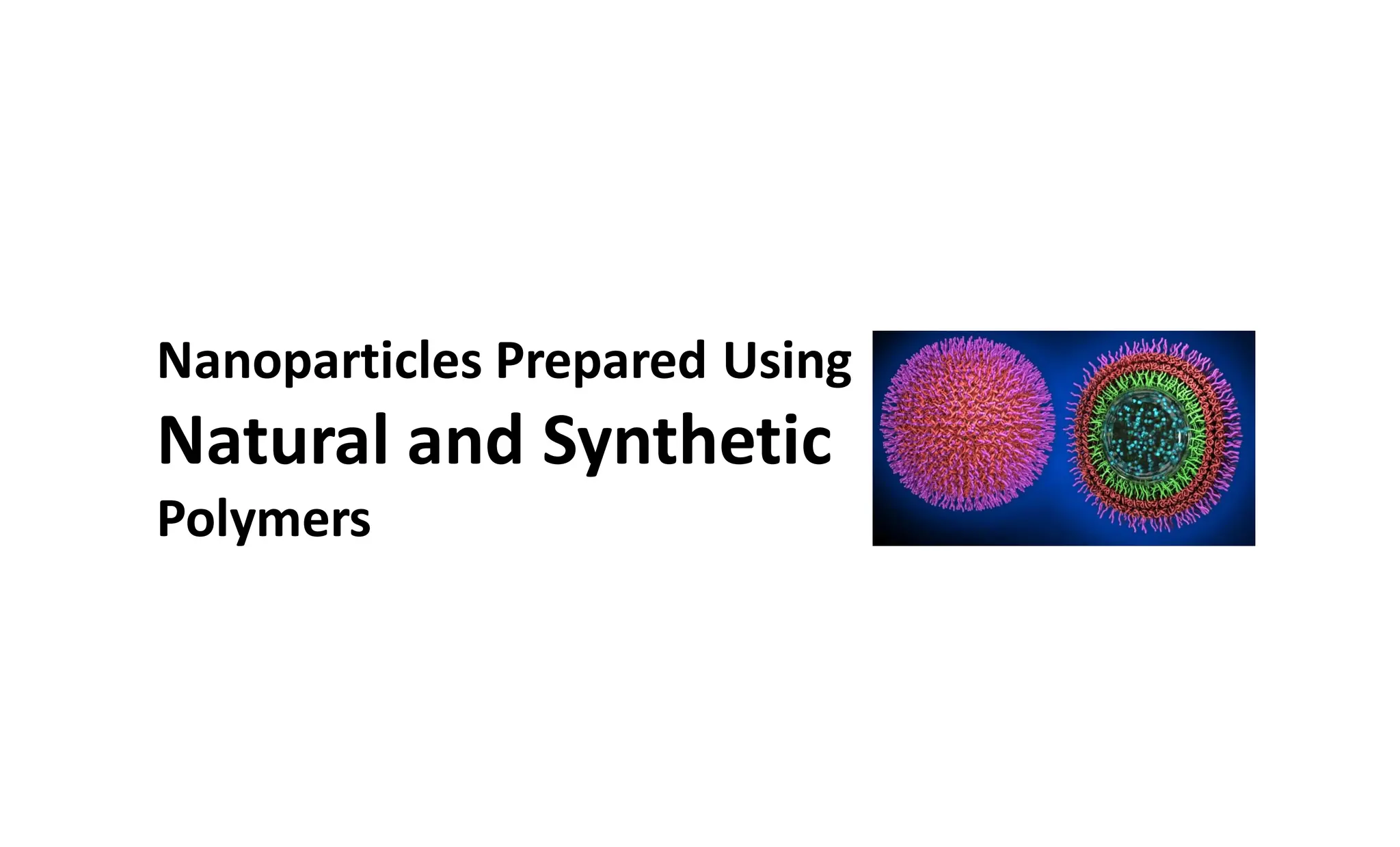
Nanoparticles Prepared Using
Natural and Synthetic
Polymers
• Ideally, biologically active agents should be encapsulated within
nanoparticles using polymers with well-defined physical and
chemical properties.
These polymers
1. protect the active ingredient
2. after local or systemic administration, potentially target and then
release the drug in a controlled, predictable manner.
• The use of polymeric nanoparticle aims to optimize therapeutic
effects while minimizing adverse effects.
POLYMERIC CARRIERS USED TO PREPARE
NANOPARTICLES
Polymers used in controlled drug delivery, including nanoparticles,
may be classified as either
(i) natural and synthetic
(ii) biodegradable and nonbiodegradable.
• The characteristics and performance, particularly in vivo, of
nanoparticles prepared using natural polymers may be less
predictable as these polymers may vary widely in chemical
composition and hence, physical properties.
• In addition, natural polymers are often mildly immunogenic.
Conversely, it is possible to synthesize polymers with
precise chemical composition, resulting in highly
predictable physical properties such as :
• Solubility
• Permeability
• Rates of biodegradation.
As a result, synthetic polymers are also more easily
designed for specific applications, such as
• controlled rates of dissolution, permeability, degradation,
and erosion
• for targeting.
• Biodegradability and biocompatibility are important properties of
polymeric materials that are to be injected or implanted into the
body.
• Nonbiodegradable polymeric nanoparticles may be used for
controlled drug delivery and also in the complimentary field of
diagnostic imaging.
• Examples of nonbiodegradable, synthetic polymers used in drug
delivery include polymethyl methacrylate while polystyrene
particles have been used as diagnostic agents.
Natural Biodegradable Polymers
Used to Prepare Nanoparticles
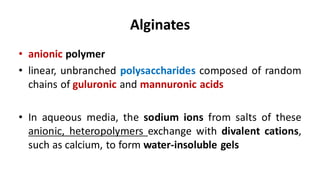
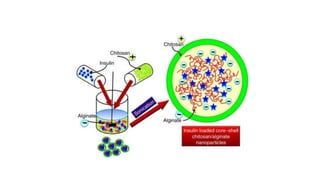
Alginates
• anionic polymer
• linear, unbranched polysaccharides composed of random
chains of guluronic and mannuronic acids
• In aqueous media, the sodium ions from salts of these
anionic, heteropolymers exchange with divalent cations,
such as calcium, to form water-insoluble gels
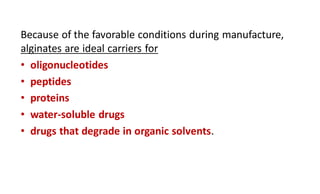
Because of the favorable conditions during manufacture,
alginates are ideal carriers for
• oligonucleotides
• peptides
• proteins
• water-soluble drugs
• drugs that degrade in organic solvents.
• Alginates are non immunogenic
• available in a wide range of molecular weights as
characterized by their inherent viscosity
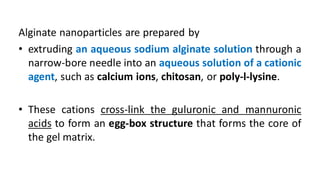
Alginate nanoparticles are prepared by
• extruding an aqueous sodium alginate solution through a
narrow-bore needle into an aqueous solution of a cationic
agent, such as calcium ions, chitosan, or poly-l-lysine.
• These cations cross-link the guluronic and mannuronic
acids to form an egg-box structure that forms the core of
the gel matrix.
drugs released from the alginate nanoparticles are
Controllable
pH sensitive
targeted efficiency
loading ability
protect the drugs from degradation.
A disadvantage of the use of alginates is
reversible ion exchange may result in the rapid release of
the therapeutic agent.
alginate nanoparticles used to
sustain antibacterial drug levels above the minimum inhibitory
concentration
in the liver, lungs, and spleen (target)
after pulmonary administration was demonstrated using isoniazid
>>>>>
Rifampicin >>>> TB Treatment
Pyrazinamide >>>>>>>>
• One method to prolong release from alginate particles is to
coat them with a cationic polymer
for example, poly-l-lysine or chitosan.
• In this application, the mass ratio of alginate to cationic
polymer is critical in terms of release characteristics and
particle size.
Chitosan
• Chitosan is a natural polymer obtained by deacetylation of
chitin, a component of crab shells.
• cationic polysaccharide composed of linear β(1,4)-linked d-
glucosamine.
Chitosan can entrap drugs by numerous mechanisms including
• chemical cross-linking
• ionic cross-linking
• ionic complexation
Pullulan
• Similar to dextran and cellulose, the glucans in pullulan
are water-soluble, linear polysaccharides that consist of
three α-1,4-linked glucose molecules polymerized by α-1,6
linkages on the terminal glucose
• Pullulan is a fermentation product of the yeast
Aureobasidium pullulans.
When made hydrophobic by acetylation, these polymers
will self-associate to form nanoparticles with a hydrophobic
core that will encapsulate hydrophobic drugs.
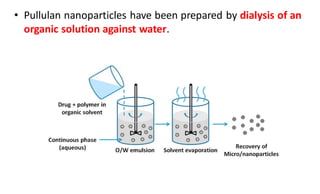
• Pullulan nanoparticles have been prepared by dialysis of an
organic solution against water.
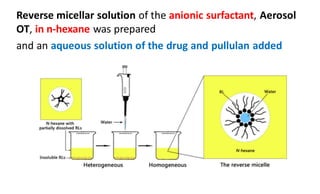
Reverse micellar solution of the anionic surfactant, Aerosol
OT, in n-hexane was prepared
and an aqueous solution of the drug and pullulan added
The nanoparticles are stabilized by cross-linking with
glutaraldehyde.
These delivery systems have been used in delivering
• Cytotoxic drugs
• Genes
• and as pH-sensitive delivery systems.
Gelatin
• natural, biodegradable protein obtained by acid- or base-
catalyzed hydrolysis of collagen.
It is a heterogenous mixture of single- or multi-stranded polypeptides
composed predominantly of glycine, proline, and hydroxyproline
residues and is degraded in vivo to amino acids.
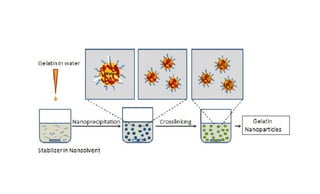
Gelatin nanoparticles are prepared by a two-step, desolvation
process.
this coacervation procedure involves the addition of either another
more water-soluble polymer or, a water-miscible (nonsolvent for
gelatin) to an aqueous gelatin solution above its gel temperature of
about 40°C.
The concentrated gelatin liquid particles are isolated and hardened
by chemical cross-linking with glutaraldehyde.
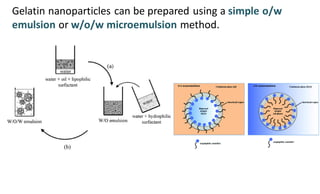
Gelatin nanoparticles can be prepared using a simple o/w
emulsion or w/o/w microemulsion method.
Gelatin nanoparticles have been used to deliver
Paclitaxel
Methotrexate
Doxorubicin
DNA
double-stranded oligonucleotides
genes.
PEGylation of the particles
• significantly enhances their circulation time in the blood
stream
• increases their uptake into cells by endocytosis.
Antibody-modified gelatin nanoparticles
• used for targeted uptake by lymphocytes
Gliadin
glycoprotein,component of gluten, is extracted from gluten
rich food such as wheat flour.
They are slightly hydrophobic and polar
 Bioactive molecules of variable polarity can be encapsulated into
gliadin nanoparticles.
Gliadin nanoparticles can be prepared by a desolvation method that
exploits the insolubility of this polymer in water.
 gliadin nanoparticles are precipitated when an ethanolic solution
of gliadin is poured into an aqueous solution.
Gliadin nanoparticles have been used to deliver
trans-retinoic acid
α-tocopherol
vitamin E.
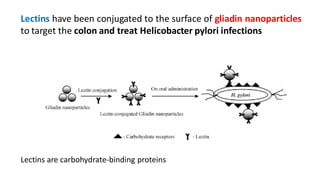
Lectins have been conjugated to the surface of gliadin nanoparticles
to target the colon and treat Helicobacter pylori infections
Lectins are carbohydrate-binding proteins
Synthetic Biodegradable Polymers Used to
Prepare Nanoparticles
Polylactide and Polylactide-co-Glycolide
The hydrophobic PLA may be used alone or copolymerized with poly-
glycolic acid to form a range of PLGA of widely varying polymeric ratios
and hence physicochemical properties.
PLA and PLGA polymers degrade by random bulk hydrolysis that is
catalyzed in acidic media.
The methods used to prepare PLA and PLGA nanoparticles as well as their range of applications,
physical properties, biological fate, and targetability have been comprehensively reviewed
Polyanhydrides
biodegradable polymers with a hydrophobic backbone and a
hydrolytically labile anhydride linkage.
 The application of polyanhydrides has been limited to :
film and microsphere formulation for sustained release of a
drug or protein at the site.
They are synthesized by ring-opening polymerization and
degrade by surface hydrolysis
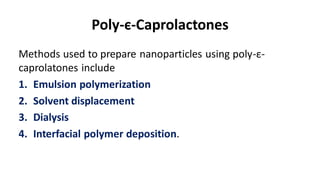
Poly-є-Caprolactones
Methods used to prepare nanoparticles using poly-ε-
caprolatones include
1. Emulsion polymerization
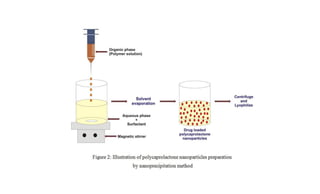
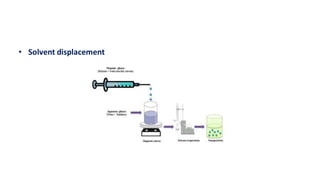
2. Solvent displacement
3. Dialysis
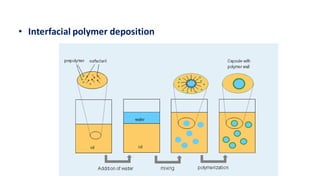
4. Interfacial polymer deposition.
• Solvent displacement
• Interfacial polymer deposition
These semicrystalline polymers are chemically stable, possess a low
glass transition temperature, and degrade slowly.
Hence, they have the potential for long-term drug delivery.
 Poly-ε-caprolactone nanoparticles have been used as vehicles to
deliver a wide range of drugs including tamoxifen, retinoic acid,
and griseofulvin.
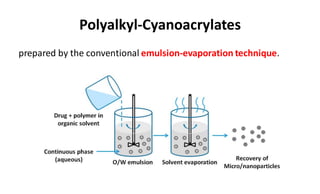
Polyalkyl-Cyanoacrylates
prepared by the conventional emulsion-evaporation technique.
uses
1. Sustaining drug release
2. overcome multidrug resistance at both the cellular and
subcellular levels
3. targeted delivery of PACA nanoparticles to cells has been
demonstrated by conjugation of polysaccharides to the
surface
Nonbiodegradable Polymers
Used to Prepare Nanoparticles
Polymethacrylate (PMA) and polymethyl
methacrylate (PMMA)
• PMMA Eudragit® nanoparticles can be prepared by
nanoprecipitation method that involves adding hydroalcoholic
solution of the polymer to an organic solvent.
• Incorporation of poly-acrylic acid into nanoparticles increased the
transfection efficiency of DNA.
• The side chain of PMMA can be modified to make these polymers
possess pH-dependent solubility and has been used to prepare
pH-sensitive nanoparticles to increase the oral bioavailability
Another Types
Thermosensitive Nanoparticles
Polyvinyl caprolactone nanoparticles
• exist in swollen state when dispersed in water at room
temperature.
• However, they shrink upon increasing temperature above
the volume phase transition temperature, expelling water
• Poly(N-isopropyl acrylamide) (NIPAAM)
has been extensively used to prepare thermosensitive
hydrogel based nanoparticles.
This polymer has a low critical solution temperature of 32°C to
34°C, above which it shrinks to release the drug.
Solid–Lipid Nanoparticles
• Although not polymers, purified triglycerides and waxes
that are solid at ambient and body temperatures can also
be used as nanoparticulate carriers.
These may be prepared by
1. high-speed homogenization
2. Microemulsions
3. emulsion-solvent evaporation
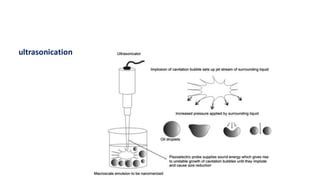
4. ultrasonication
ultrasonication
It is possible to prepare lipid nanoparticles with high drug loading,
particularly with lipophilic drugs that sustain release due to their
hydrophobicity and low drug diffusivity in the matrix.
CHARACTERIZATION OF
NANOPARTICLES
Physical Properties of Polymers
• The following physicochemical properties of polymers
greatly influence the:
Properties
method of preparation
performance of nanoparticles.
1- Molecular Weight
influences physical properties such as
• glass transition temperature
• viscosity in solutions
• Solubility
• Crystallinity
• degradation rate
• mechanical strength.
polymers with a lower molecular weight exhibit
lower viscosity
tensile strength
degrade more rapidly.
Hence, selection of a polymer with an appropriate molecular
weight is important for the intended application.
if a polymer degrades by acid-catalyzed, bulk hydrolysis,
a low-molecular-weight polymer will degrade faster due to
autocatalysis by the greater proportion of oligomers formed.
Inefficient polymeric synthesis may form polymers with high
polydispersity that degrade more rapidly than homopolymers of
similar molecular weight.
Note/ PDI values bigger than 0.7 indicate that the sample has a very broad
particle size distribution and is probably not suitable to be analyzed by the
dynamic light scattering (DLS) technique
2- Degree of Crystallinity
 Affects mechanical properties of polymers
For example, because of the uniform arrangement of its chains
within the lattice structure, a crystalline polymer will degrade slowly
than an amorphous form.
• However, pure crystalline polymers are brittle and usually less
suited to drug- delivery applications.
• Further, amorphous polymers possess poor mechanical
toughness.
Therefore, the polymers used in drug delivery are usually a
mixture of crystalline and amorphous forms.
3- Hydrophobicity
Factors that influence the hydrophobicity of the polymer include
• molecular weight
• aqueous solubility of the monomers
• degree of branching.
 increase in molecular weight increases the hydrophobicity,
 increase in the degree of branching results in a more water- soluble polymer.
Hence, nanoparticles prepared using a hydrophobic polymer
exhibit decreased water penetration and wettability,
resulting in
slower drug release
polymer degradation times than similar hydrophilic forms.
• However, the incorporation of a hydrophilic polymer or additives
into nanoparticles prepared using hydrophobic polymers will form
pores in aqueous media
to increase
 rate of polymer degradation
 erosion
 drug release.
 Method used to prepare nanoparticles will be
influenced by the relative hydrophilicity and
hydrophobicity of both the polymer and the drug.
4- Copolymer Ratio
• The choice of a polymer and the method of polymerization
directly affect the type of copolymer as well as its molecular
weight, crystallinity, and hydrophobicity.
 In general, copolymers used to prepare nanoparticles typically
contain both hydrophobic and hydrophilic segments
which facilitate greater flexibility in preparation and more
predictable physical properties such as release characteristics.
5- Biodegradability and Biocompatibility
• A biodegradable polymer must degrade into physiologically inert
products that are eliminated by the body.
• For example, PLGA polymers hydrolyze to form lactic and glycolic
acids that are further degraded into normal constituents of the
body.
Biocompatible polymers are defined as those that
1. not elicit immune reaction or inflammation
2. stable for the duration of action
3. completely metabolized in the body.
Most biodegradable polymers used in drug delivery are specifically
intended for parenteral administration, which is not a prerequisite
for oral delivery.
6- Solubility
influences the method of preparation and in vivo performance of
the nanoparticles.
 In general, if both the drug and the polymer are soluble in organic
solvents, a simple o/w emulsion technique or phase separation
can be used to prepare the nanoparticles.
• For protein and peptide drugs
a milder aqueous environment is preferable and therefore,
the choice of the polymer is critical and a multiple emulsion
technique may be used.
7- Drug–Polymer Interactions
• Chemical and physical interactions that occur depend on
the chemical nature of both the polymer and the drug.
• Drug–polymer interactions are chiefly determined by
Charge
Solubility
hydrophobicity
interactions alter the properties of the polymer
 glass transition temperature
 degree of crystallinity
 properties of the nanoparticles, for example, release
characteristics.
interactions that occur between a drug and a polymer can be
identified, and in some cases quantified, using:
• differential scanning calorimetry (DSC)
• thermogravimetric analysis (TGA)
• solid-state 13C NMR
• Fourier transform infrared spectroscopy (FT-IR)
• Flory Huggins interaction parameters
• comparison of total or partial solubility parameters
For example, isothermal calorimetry has been used to
determine the binding affinity between alginates and
chitosan as well as poly l-lysine
• Differences in the solubility of the drug in the polymer results in
the microphase separation of the drug within the matrix.
• Quantifying the binding affinity using isothermal calorimetry can
identify an electrostatic interaction between the polymer and the
drugs.
• Preparation of Polymeric Nanoparticles
The main methods used to prepare polymeric nanoparticles include
emulsion- solvent evaporation,
phase separation
supercritical fluid technology.
Properties of Nanoparticles that Affect
Biological Performance
1- Route of Administration
Nanoparticles have been administered by the followingroutes:
Oral
Intravenous
Subcutaneous
Intrathecal
Intraocular
pulmonary.
When selecting a route to administer nanoparticles, it is
important to consider
stability of the drug in biological fluids
anatomical and physiological characteristics of the route of
administration and at the target site.
• Oral delivery of nanoparticles may significantly increase the
bioavailability of poorly soluble drugs.
• after intravenous administration, the bioavailability of drugs may
decrease as macrophages will internalize hydrophobic unmodified
nanoparticles.
This problem may be circumvented by coating the surface of
nanoparticles with hydrophilic polyethylene glycol, which confers
“stealth” properties to these particles.
• pulmonary administration, nanoparticles may drain into the
lymphatic system and, as with all nebulizers and aerosols, the site of
deposition of the particles will depend on the type of the device
used.
• intrathecal delivery of nanoparticles may sustain the release of the
encapsulated drug.
2- Particle Size and Particle Size Distribution
• are critical factors in the performance of nanoparticles, as batches
with wide particle size distribution show significant variations in:
drug loading
drug release
Bioavailability
Efficacy.
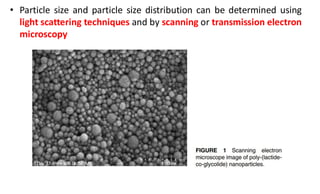
• Particle size and particle size distribution can be determined using
light scattering techniques and by scanning or transmission electron
microscopy
• Formulation of nanoparticles with a narrow size distribution will be
a challenge if emulsion cannot be produced with a narrow droplet
size distribution.
• As nanoparticles are internalized into cells by endocytosis, an
increase in particle size will decrease uptake and potentially,
bioavailability of the drug.
• The extent of endocytosis is dependent on the type of the target
cell.
3- Zeta Potential
• The charge on the surface of the nanospheres will influence
 their distribution in the body
 extent of uptake into the cells.
• Because cell membranes are negatively charged, there is greater
electrostatic affinity for positively charged nanoparticles.
Therefore, the surface of cationic or neutral nanoparticles may be
modified to confer a positive charge to enhance efficacy.
positively charged tripalmitin nanoparticles containing
etoposide
• prolonged residence time in the blood
• produced higher blood concentrations
• decreased clearance by the liver
• increased distribution into the brain and bone
4- Drug Loading and Loading Efficiency
• drug loading expresses the percent weight of active ingredient
encapsulated to the weight of nanoparticles
• drug loading efficiency is the ratio of the experimentally
determined percentage of drug content compared with actual, or
theoretical mass of drug used for the preparation of the
nanoparticles.
The loading efficiency depends on the polymer–drug
combination and the method used.
• Hydrophobic polymers encapsulate larger amounts of
hydrophobic drugs, whereas hydrophilic polymers entrap
greater amounts of more hydrophilic drugs.
• Several formulation parameters will influence the extent of
drug loading, such as
emulsifier type
weight ratio of polymer to drug
organic to aqueous phase ratio.
5- Dissolution Profile
• The in vitro release of drugs from nanoparticles may approximate
the drug release profile inside the body
• although the rate is usually faster in vivo due to the presence of
enzymes and surfactants in biological fluids.
An in vitro dissolution medium
 mimics the pH and salt concentrations in the body.
 Particularly for hydrophobic drugs, it is critical during dissolution
testing that sink conditions are maintained and pH and salt
concentrations of biological fluid are approximated.
• If solubility of the drug in the media is a limitation, it may be
necessary to add surfactants to the dissolution media.
The release data must be evaluated using well-known
equations to determine parameters such as
1. the mechanism(s) of release
2. order of release
3. dissolution rate constant
4. extent of release from the nanoparticles
5. Duration of release
6- Surface Modification
• The surface of nanoparticles may be modified to conjugate targeting
ligands or alter biodistribution.
1. Coating of nanoparticles with hydrophilic polymers such as
polyethylene glycol, heparin, or dextran, protects them from being
engulfed by the macrophages or kupffer cells, thereby increasing
their circulation time and enhancing drug bioavailability.
2. Surface modification of nanoparticles also involves alteration of the
surface charge as discussed previously.
7- Biocompatibility
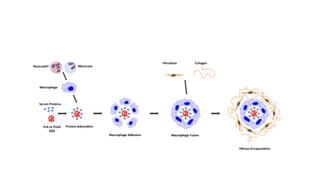
Tissue response to polymeric particles occurs in three phases.
 phase I, mild inflammation is observed with monocytes,
lymphocytes, and leucocytes surrounding the particle.
 Phase II, monocytes differentiate into macrophages, which
further differentiate into giant body cells and engulf the
particles. In some cases, fibrous tissue may be formed.
 Phase III involves further degradation of the particles.
The type of immune response elicited by the nanoparticles
will depend on:
1. the route of administration
2. the type of therapeutic agent encapsulated
3. the choice of the polymer.
Because of dynamic flow, minimal immune responses are
generally observed after intravenous administration.
IN VITRO CELL CULTURE
1- Internalization of Nanoparticles into Cells
The different mechanisms by which the nanoparticles are taken up
by the cells include
1. Endocytosis
2. Pinocytosis
3. fluid-phase diffusion
4. carrier-mediated
5. facilitated transport.
• endocytosis and carrier-mediated transport are ATP-
dependent
• facilitated transport and diffusion are energy-independent.
Nanoparticles undergo endolysosomal escape which
increases accumulation of particles inside the cell
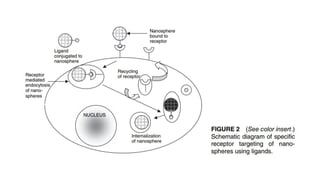
• Receptor-mediated transport involves the internalization of
nanoparticles through specific cell surface receptors on the cell
membrane, and is exploited in the design of nanoparticles to
specifically target these receptors
• Nanoparticles are primarily internalized by endocytosis.
• Once the particles are internalized, they transcytose
across cells deeper into the tissue.
Recently, it was demonstrated that the drug content in the
cells increased with particle size, suggesting that:
in addition to particle internalization, diffusion of free drug
released outside the cells may also play a role in enhancing
the total drug content of the cells
2- Protection from Efflux Pumps
Trans-membrane pumps, such as p-glycoprotein and multidrug-
resistance-associated protein, are present on the apical side of the
cells and actively efflux foreign substances, including drugs, out of
the cell, significantly reducing the drug uptake.
Nanoparticles can protect the encapsulated drug
from these efflux pumps.
3- Targeted Delivery
• Some limitations of drugs delivered using nanoparticulate
vehicles include
 nonspecific uptake into cells
 accumulation of particles in nonspecific regions
 inability to differentiate between diseased and normal
tissues.
Targeted delivery of nanoparticles
increases the extent of drug uptake at the site of action
while potentially reducing adverse effects.
improve the therapeutic efficacy and safety of drugs
Targeted delivery is based on:
(i) physiological or externally induced phenomena
1. pH and thermo-sensitive nanoparticles
2. ultrasound-triggered nanoparticles
3. magnetic nanoparticles
(ii) cell- or tissue-specific targeting
nanoparticles targeting
Transferrin
Folate
epidermal growth factor
(iii) permeability-enhancing targets
nanoparticles targeting
trans-activating transcriptional factor (TAT) peptide
integrin
polymeric nanoparticles ; synthetic and natural

polymeric nanoparticles ; synthetic and natural

  • 1.
  • 2.
    • Ideally, biologicallyactive agents should be encapsulated within nanoparticles using polymers with well-defined physical and chemical properties. These polymers 1. protect the active ingredient 2. after local or systemic administration, potentially target and then release the drug in a controlled, predictable manner. • The use of polymeric nanoparticle aims to optimize therapeutic effects while minimizing adverse effects.
  • 3.
    POLYMERIC CARRIERS USEDTO PREPARE NANOPARTICLES Polymers used in controlled drug delivery, including nanoparticles, may be classified as either (i) natural and synthetic (ii) biodegradable and nonbiodegradable.
  • 4.
    • The characteristicsand performance, particularly in vivo, of nanoparticles prepared using natural polymers may be less predictable as these polymers may vary widely in chemical composition and hence, physical properties. • In addition, natural polymers are often mildly immunogenic.
  • 5.
    Conversely, it ispossible to synthesize polymers with precise chemical composition, resulting in highly predictable physical properties such as : • Solubility • Permeability • Rates of biodegradation.
  • 6.
    As a result,synthetic polymers are also more easily designed for specific applications, such as • controlled rates of dissolution, permeability, degradation, and erosion • for targeting.
  • 7.
    • Biodegradability andbiocompatibility are important properties of polymeric materials that are to be injected or implanted into the body. • Nonbiodegradable polymeric nanoparticles may be used for controlled drug delivery and also in the complimentary field of diagnostic imaging. • Examples of nonbiodegradable, synthetic polymers used in drug delivery include polymethyl methacrylate while polystyrene particles have been used as diagnostic agents.
  • 8.
    Natural Biodegradable Polymers Usedto Prepare Nanoparticles
  • 9.
    Alginates • anionic polymer •linear, unbranched polysaccharides composed of random chains of guluronic and mannuronic acids • In aqueous media, the sodium ions from salts of these anionic, heteropolymers exchange with divalent cations, such as calcium, to form water-insoluble gels
  • 10.
    Because of thefavorable conditions during manufacture, alginates are ideal carriers for • oligonucleotides • peptides • proteins • water-soluble drugs • drugs that degrade in organic solvents.
  • 11.
    • Alginates arenon immunogenic • available in a wide range of molecular weights as characterized by their inherent viscosity
  • 12.
    Alginate nanoparticles areprepared by • extruding an aqueous sodium alginate solution through a narrow-bore needle into an aqueous solution of a cationic agent, such as calcium ions, chitosan, or poly-l-lysine. • These cations cross-link the guluronic and mannuronic acids to form an egg-box structure that forms the core of the gel matrix.
  • 14.
    drugs released fromthe alginate nanoparticles are Controllable pH sensitive targeted efficiency loading ability protect the drugs from degradation.
  • 15.
    A disadvantage ofthe use of alginates is reversible ion exchange may result in the rapid release of the therapeutic agent.
  • 16.
    alginate nanoparticles usedto sustain antibacterial drug levels above the minimum inhibitory concentration in the liver, lungs, and spleen (target) after pulmonary administration was demonstrated using isoniazid >>>>> Rifampicin >>>> TB Treatment Pyrazinamide >>>>>>>>
  • 17.
    • One methodto prolong release from alginate particles is to coat them with a cationic polymer for example, poly-l-lysine or chitosan. • In this application, the mass ratio of alginate to cationic polymer is critical in terms of release characteristics and particle size.
  • 18.
    Chitosan • Chitosan isa natural polymer obtained by deacetylation of chitin, a component of crab shells. • cationic polysaccharide composed of linear β(1,4)-linked d- glucosamine. Chitosan can entrap drugs by numerous mechanisms including • chemical cross-linking • ionic cross-linking • ionic complexation
  • 19.
    Pullulan • Similar todextran and cellulose, the glucans in pullulan are water-soluble, linear polysaccharides that consist of three α-1,4-linked glucose molecules polymerized by α-1,6 linkages on the terminal glucose • Pullulan is a fermentation product of the yeast Aureobasidium pullulans.
  • 20.
    When made hydrophobicby acetylation, these polymers will self-associate to form nanoparticles with a hydrophobic core that will encapsulate hydrophobic drugs.
  • 21.
    • Pullulan nanoparticleshave been prepared by dialysis of an organic solution against water.
  • 22.
    Reverse micellar solutionof the anionic surfactant, Aerosol OT, in n-hexane was prepared and an aqueous solution of the drug and pullulan added
  • 23.
    The nanoparticles arestabilized by cross-linking with glutaraldehyde. These delivery systems have been used in delivering • Cytotoxic drugs • Genes • and as pH-sensitive delivery systems.
  • 24.
    Gelatin • natural, biodegradableprotein obtained by acid- or base- catalyzed hydrolysis of collagen. It is a heterogenous mixture of single- or multi-stranded polypeptides composed predominantly of glycine, proline, and hydroxyproline residues and is degraded in vivo to amino acids.
  • 25.
    Gelatin nanoparticles areprepared by a two-step, desolvation process. this coacervation procedure involves the addition of either another more water-soluble polymer or, a water-miscible (nonsolvent for gelatin) to an aqueous gelatin solution above its gel temperature of about 40°C. The concentrated gelatin liquid particles are isolated and hardened by chemical cross-linking with glutaraldehyde.
  • 27.
    Gelatin nanoparticles canbe prepared using a simple o/w emulsion or w/o/w microemulsion method.
  • 28.
    Gelatin nanoparticles havebeen used to deliver Paclitaxel Methotrexate Doxorubicin DNA double-stranded oligonucleotides genes.
  • 29.
    PEGylation of theparticles • significantly enhances their circulation time in the blood stream • increases their uptake into cells by endocytosis. Antibody-modified gelatin nanoparticles • used for targeted uptake by lymphocytes
  • 30.
    Gliadin glycoprotein,component of gluten,is extracted from gluten rich food such as wheat flour. They are slightly hydrophobic and polar  Bioactive molecules of variable polarity can be encapsulated into gliadin nanoparticles.
  • 31.
    Gliadin nanoparticles canbe prepared by a desolvation method that exploits the insolubility of this polymer in water.  gliadin nanoparticles are precipitated when an ethanolic solution of gliadin is poured into an aqueous solution.
  • 32.
    Gliadin nanoparticles havebeen used to deliver trans-retinoic acid α-tocopherol vitamin E.
  • 33.
    Lectins have beenconjugated to the surface of gliadin nanoparticles to target the colon and treat Helicobacter pylori infections Lectins are carbohydrate-binding proteins
  • 34.
    Synthetic Biodegradable PolymersUsed to Prepare Nanoparticles
  • 35.
    Polylactide and Polylactide-co-Glycolide Thehydrophobic PLA may be used alone or copolymerized with poly- glycolic acid to form a range of PLGA of widely varying polymeric ratios and hence physicochemical properties. PLA and PLGA polymers degrade by random bulk hydrolysis that is catalyzed in acidic media.
  • 37.
    The methods usedto prepare PLA and PLGA nanoparticles as well as their range of applications, physical properties, biological fate, and targetability have been comprehensively reviewed
  • 38.
    Polyanhydrides biodegradable polymers witha hydrophobic backbone and a hydrolytically labile anhydride linkage.  The application of polyanhydrides has been limited to : film and microsphere formulation for sustained release of a drug or protein at the site.
  • 40.
    They are synthesizedby ring-opening polymerization and degrade by surface hydrolysis
  • 41.
    Poly-є-Caprolactones Methods used toprepare nanoparticles using poly-ε- caprolatones include 1. Emulsion polymerization 2. Solvent displacement 3. Dialysis 4. Interfacial polymer deposition.
  • 43.
  • 44.
  • 45.
    These semicrystalline polymersare chemically stable, possess a low glass transition temperature, and degrade slowly. Hence, they have the potential for long-term drug delivery.  Poly-ε-caprolactone nanoparticles have been used as vehicles to deliver a wide range of drugs including tamoxifen, retinoic acid, and griseofulvin.
  • 46.
    Polyalkyl-Cyanoacrylates prepared by theconventional emulsion-evaporation technique.
  • 47.
    uses 1. Sustaining drugrelease 2. overcome multidrug resistance at both the cellular and subcellular levels 3. targeted delivery of PACA nanoparticles to cells has been demonstrated by conjugation of polysaccharides to the surface
  • 48.
    Nonbiodegradable Polymers Used toPrepare Nanoparticles
  • 49.
    Polymethacrylate (PMA) andpolymethyl methacrylate (PMMA) • PMMA Eudragit® nanoparticles can be prepared by nanoprecipitation method that involves adding hydroalcoholic solution of the polymer to an organic solvent. • Incorporation of poly-acrylic acid into nanoparticles increased the transfection efficiency of DNA. • The side chain of PMMA can be modified to make these polymers possess pH-dependent solubility and has been used to prepare pH-sensitive nanoparticles to increase the oral bioavailability
  • 50.
  • 51.
    Thermosensitive Nanoparticles Polyvinyl caprolactonenanoparticles • exist in swollen state when dispersed in water at room temperature. • However, they shrink upon increasing temperature above the volume phase transition temperature, expelling water
  • 52.
    • Poly(N-isopropyl acrylamide)(NIPAAM) has been extensively used to prepare thermosensitive hydrogel based nanoparticles. This polymer has a low critical solution temperature of 32°C to 34°C, above which it shrinks to release the drug.
  • 53.
    Solid–Lipid Nanoparticles • Althoughnot polymers, purified triglycerides and waxes that are solid at ambient and body temperatures can also be used as nanoparticulate carriers.
  • 54.
    These may beprepared by 1. high-speed homogenization 2. Microemulsions 3. emulsion-solvent evaporation 4. ultrasonication
  • 55.
  • 56.
    It is possibleto prepare lipid nanoparticles with high drug loading, particularly with lipophilic drugs that sustain release due to their hydrophobicity and low drug diffusivity in the matrix.
  • 57.
  • 58.
    Physical Properties ofPolymers • The following physicochemical properties of polymers greatly influence the: Properties method of preparation performance of nanoparticles.
  • 59.
    1- Molecular Weight influencesphysical properties such as • glass transition temperature • viscosity in solutions • Solubility • Crystallinity • degradation rate • mechanical strength.
  • 60.
    polymers with alower molecular weight exhibit lower viscosity tensile strength degrade more rapidly. Hence, selection of a polymer with an appropriate molecular weight is important for the intended application.
  • 61.
    if a polymerdegrades by acid-catalyzed, bulk hydrolysis, a low-molecular-weight polymer will degrade faster due to autocatalysis by the greater proportion of oligomers formed.
  • 62.
    Inefficient polymeric synthesismay form polymers with high polydispersity that degrade more rapidly than homopolymers of similar molecular weight. Note/ PDI values bigger than 0.7 indicate that the sample has a very broad particle size distribution and is probably not suitable to be analyzed by the dynamic light scattering (DLS) technique
  • 63.
    2- Degree ofCrystallinity  Affects mechanical properties of polymers For example, because of the uniform arrangement of its chains within the lattice structure, a crystalline polymer will degrade slowly than an amorphous form.
  • 64.
    • However, purecrystalline polymers are brittle and usually less suited to drug- delivery applications. • Further, amorphous polymers possess poor mechanical toughness. Therefore, the polymers used in drug delivery are usually a mixture of crystalline and amorphous forms.
  • 65.
    3- Hydrophobicity Factors thatinfluence the hydrophobicity of the polymer include • molecular weight • aqueous solubility of the monomers • degree of branching.  increase in molecular weight increases the hydrophobicity,  increase in the degree of branching results in a more water- soluble polymer.
  • 66.
    Hence, nanoparticles preparedusing a hydrophobic polymer exhibit decreased water penetration and wettability, resulting in slower drug release polymer degradation times than similar hydrophilic forms.
  • 67.
    • However, theincorporation of a hydrophilic polymer or additives into nanoparticles prepared using hydrophobic polymers will form pores in aqueous media to increase  rate of polymer degradation  erosion  drug release.
  • 68.
     Method usedto prepare nanoparticles will be influenced by the relative hydrophilicity and hydrophobicity of both the polymer and the drug.
  • 69.
    4- Copolymer Ratio •The choice of a polymer and the method of polymerization directly affect the type of copolymer as well as its molecular weight, crystallinity, and hydrophobicity.
  • 70.
     In general,copolymers used to prepare nanoparticles typically contain both hydrophobic and hydrophilic segments which facilitate greater flexibility in preparation and more predictable physical properties such as release characteristics.
  • 71.
    5- Biodegradability andBiocompatibility • A biodegradable polymer must degrade into physiologically inert products that are eliminated by the body. • For example, PLGA polymers hydrolyze to form lactic and glycolic acids that are further degraded into normal constituents of the body.
  • 72.
    Biocompatible polymers aredefined as those that 1. not elicit immune reaction or inflammation 2. stable for the duration of action 3. completely metabolized in the body.
  • 73.
    Most biodegradable polymersused in drug delivery are specifically intended for parenteral administration, which is not a prerequisite for oral delivery.
  • 74.
    6- Solubility influences themethod of preparation and in vivo performance of the nanoparticles.  In general, if both the drug and the polymer are soluble in organic solvents, a simple o/w emulsion technique or phase separation can be used to prepare the nanoparticles.
  • 75.
    • For proteinand peptide drugs a milder aqueous environment is preferable and therefore, the choice of the polymer is critical and a multiple emulsion technique may be used.
  • 76.
    7- Drug–Polymer Interactions •Chemical and physical interactions that occur depend on the chemical nature of both the polymer and the drug. • Drug–polymer interactions are chiefly determined by Charge Solubility hydrophobicity
  • 77.
    interactions alter theproperties of the polymer  glass transition temperature  degree of crystallinity  properties of the nanoparticles, for example, release characteristics.
  • 78.
    interactions that occurbetween a drug and a polymer can be identified, and in some cases quantified, using: • differential scanning calorimetry (DSC) • thermogravimetric analysis (TGA) • solid-state 13C NMR • Fourier transform infrared spectroscopy (FT-IR) • Flory Huggins interaction parameters • comparison of total or partial solubility parameters
  • 79.
    For example, isothermalcalorimetry has been used to determine the binding affinity between alginates and chitosan as well as poly l-lysine
  • 80.
    • Differences inthe solubility of the drug in the polymer results in the microphase separation of the drug within the matrix. • Quantifying the binding affinity using isothermal calorimetry can identify an electrostatic interaction between the polymer and the drugs.
  • 81.
    • Preparation ofPolymeric Nanoparticles The main methods used to prepare polymeric nanoparticles include emulsion- solvent evaporation, phase separation supercritical fluid technology.
  • 82.
    Properties of Nanoparticlesthat Affect Biological Performance
  • 83.
    1- Route ofAdministration Nanoparticles have been administered by the followingroutes: Oral Intravenous Subcutaneous Intrathecal Intraocular pulmonary.
  • 84.
    When selecting aroute to administer nanoparticles, it is important to consider stability of the drug in biological fluids anatomical and physiological characteristics of the route of administration and at the target site.
  • 85.
    • Oral deliveryof nanoparticles may significantly increase the bioavailability of poorly soluble drugs. • after intravenous administration, the bioavailability of drugs may decrease as macrophages will internalize hydrophobic unmodified nanoparticles. This problem may be circumvented by coating the surface of nanoparticles with hydrophilic polyethylene glycol, which confers “stealth” properties to these particles.
  • 86.
    • pulmonary administration,nanoparticles may drain into the lymphatic system and, as with all nebulizers and aerosols, the site of deposition of the particles will depend on the type of the device used. • intrathecal delivery of nanoparticles may sustain the release of the encapsulated drug.
  • 87.
    2- Particle Sizeand Particle Size Distribution • are critical factors in the performance of nanoparticles, as batches with wide particle size distribution show significant variations in: drug loading drug release Bioavailability Efficacy.
  • 88.
    • Particle sizeand particle size distribution can be determined using light scattering techniques and by scanning or transmission electron microscopy
  • 89.
    • Formulation ofnanoparticles with a narrow size distribution will be a challenge if emulsion cannot be produced with a narrow droplet size distribution. • As nanoparticles are internalized into cells by endocytosis, an increase in particle size will decrease uptake and potentially, bioavailability of the drug. • The extent of endocytosis is dependent on the type of the target cell.
  • 90.
    3- Zeta Potential •The charge on the surface of the nanospheres will influence  their distribution in the body  extent of uptake into the cells. • Because cell membranes are negatively charged, there is greater electrostatic affinity for positively charged nanoparticles. Therefore, the surface of cationic or neutral nanoparticles may be modified to confer a positive charge to enhance efficacy.
  • 91.
    positively charged tripalmitinnanoparticles containing etoposide • prolonged residence time in the blood • produced higher blood concentrations • decreased clearance by the liver • increased distribution into the brain and bone
  • 92.
    4- Drug Loadingand Loading Efficiency • drug loading expresses the percent weight of active ingredient encapsulated to the weight of nanoparticles • drug loading efficiency is the ratio of the experimentally determined percentage of drug content compared with actual, or theoretical mass of drug used for the preparation of the nanoparticles.
  • 93.
    The loading efficiencydepends on the polymer–drug combination and the method used.
  • 94.
    • Hydrophobic polymersencapsulate larger amounts of hydrophobic drugs, whereas hydrophilic polymers entrap greater amounts of more hydrophilic drugs. • Several formulation parameters will influence the extent of drug loading, such as emulsifier type weight ratio of polymer to drug organic to aqueous phase ratio.
  • 95.
    5- Dissolution Profile •The in vitro release of drugs from nanoparticles may approximate the drug release profile inside the body • although the rate is usually faster in vivo due to the presence of enzymes and surfactants in biological fluids.
  • 96.
    An in vitrodissolution medium  mimics the pH and salt concentrations in the body.  Particularly for hydrophobic drugs, it is critical during dissolution testing that sink conditions are maintained and pH and salt concentrations of biological fluid are approximated.
  • 97.
    • If solubilityof the drug in the media is a limitation, it may be necessary to add surfactants to the dissolution media. The release data must be evaluated using well-known equations to determine parameters such as 1. the mechanism(s) of release 2. order of release 3. dissolution rate constant 4. extent of release from the nanoparticles 5. Duration of release
  • 98.
    6- Surface Modification •The surface of nanoparticles may be modified to conjugate targeting ligands or alter biodistribution. 1. Coating of nanoparticles with hydrophilic polymers such as polyethylene glycol, heparin, or dextran, protects them from being engulfed by the macrophages or kupffer cells, thereby increasing their circulation time and enhancing drug bioavailability. 2. Surface modification of nanoparticles also involves alteration of the surface charge as discussed previously.
  • 99.
    7- Biocompatibility Tissue responseto polymeric particles occurs in three phases.  phase I, mild inflammation is observed with monocytes, lymphocytes, and leucocytes surrounding the particle.  Phase II, monocytes differentiate into macrophages, which further differentiate into giant body cells and engulf the particles. In some cases, fibrous tissue may be formed.  Phase III involves further degradation of the particles.
  • 100.
    The type ofimmune response elicited by the nanoparticles will depend on: 1. the route of administration 2. the type of therapeutic agent encapsulated 3. the choice of the polymer. Because of dynamic flow, minimal immune responses are generally observed after intravenous administration.
  • 101.
  • 102.
    1- Internalization ofNanoparticles into Cells The different mechanisms by which the nanoparticles are taken up by the cells include 1. Endocytosis 2. Pinocytosis 3. fluid-phase diffusion 4. carrier-mediated 5. facilitated transport.
  • 103.
    • endocytosis andcarrier-mediated transport are ATP- dependent • facilitated transport and diffusion are energy-independent. Nanoparticles undergo endolysosomal escape which increases accumulation of particles inside the cell
  • 104.
    • Receptor-mediated transportinvolves the internalization of nanoparticles through specific cell surface receptors on the cell membrane, and is exploited in the design of nanoparticles to specifically target these receptors
  • 106.
    • Nanoparticles areprimarily internalized by endocytosis. • Once the particles are internalized, they transcytose across cells deeper into the tissue.
  • 107.
    Recently, it wasdemonstrated that the drug content in the cells increased with particle size, suggesting that: in addition to particle internalization, diffusion of free drug released outside the cells may also play a role in enhancing the total drug content of the cells
  • 108.
    2- Protection fromEfflux Pumps Trans-membrane pumps, such as p-glycoprotein and multidrug- resistance-associated protein, are present on the apical side of the cells and actively efflux foreign substances, including drugs, out of the cell, significantly reducing the drug uptake. Nanoparticles can protect the encapsulated drug from these efflux pumps.
  • 109.
    3- Targeted Delivery •Some limitations of drugs delivered using nanoparticulate vehicles include  nonspecific uptake into cells  accumulation of particles in nonspecific regions  inability to differentiate between diseased and normal tissues.
  • 110.
    Targeted delivery ofnanoparticles increases the extent of drug uptake at the site of action while potentially reducing adverse effects. improve the therapeutic efficacy and safety of drugs
  • 111.
    Targeted delivery isbased on: (i) physiological or externally induced phenomena 1. pH and thermo-sensitive nanoparticles 2. ultrasound-triggered nanoparticles 3. magnetic nanoparticles (ii) cell- or tissue-specific targeting nanoparticles targeting Transferrin Folate epidermal growth factor (iii) permeability-enhancing targets nanoparticles targeting trans-activating transcriptional factor (TAT) peptide integrin