Histotypic Culture
BHAVYASHREE P V
II M.SC BIOTECHNOLOGY
ALVA’S COLLEGE
MOODBIDRI
Three main types of techniques
• Organ culture- In this type of culture, the whole organs or small fragments of
the organs with their spatial and intrinsic properties are used in culture.
• Histotypic culture- The propagated cell lines grown in three dimensional
matrix to high density represent histotypic cultures.
• Organotypic cultures- Cells of different lineages are combined in
experimentally determined ratios and spatial relationships to recreate a
component of the organ under study.
Histotypic culture:
Growth and propagation of cell lines in three-dimensional matrix
to high cell density
It is possible to use dispersed monolayers to regenerate tissue
like structures
Commonly used techniques are:
Gel and sponge techniques
Hollow fibers
Spheroids
Rotating chamber systems
Immobilization of living cells in alginate
Filter well inserts
Cultures of neuronal aggregates
Gel and sponge techniques
• Leighton first demonstrated that both normal and
malignant cells penetrate cellulose sponge
• The gel or sponge are used which provide the matrix
for the morphogenesis and cell growth.
• The cell penetrates these gels and sponges while
growing.
• Collagen gel provides a matrix for the
morphogenesis of primitive epithelial structures.
• Many different types of cell can be shown to
penetrate such matrices and establish a tissuelike
histology
• The kidney epithelial cell line MDCK responds to
paracrine stimulation from fibroblasts by producing
tubular structures, but only in collagen gel
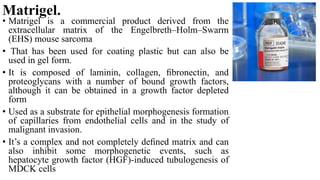
Matrigel.
• Matrigel is a commercial product derived from the
extracellular matrix of the Engelbreth–Holm–Swarm
(EHS) mouse sarcoma
• That has been used for coating plastic but can also be
used in gel form.
• It is composed of laminin, collagen, fibronectin, and
proteoglycans with a number of bound growth factors,
although it can be obtained in a growth factor depleted
form
• Used as a substrate for epithelial morphogenesis formation
of capillaries from endothelial cells and in the study of
malignant invasion.
• It’s a complex and not completely defined matrix and can
also inhibit some morphogenetic events, such as
hepatocyte growth factor (HGF)-induced tubulogenesis of
MDCK cells
Hollow fiber techniques
• Hollow fibers are used which helps in more
efficient nutrient and gas exchange
• In recent years, perfusion chambers with a
bed of plastic capillary fibers have been
developed to be used for histotypic type of
cultures
• The cells get attached to capillary fibers and
increase in cell density to form tissue like
structures
Contd…
• The fibers are gas- and nutrient permeable and support
cell growth on their outer surfaces.
• Medium, saturated with 5% CO2 in air, is pumped
through the centers of the capillaries, and cells are
added to the outer chamber surrounding the bundle of
fibers.
• The cells attach and grow on the outside of the
capillary fibers, fed by diffusion from the perfusate,
and can reach tissuelike cell densities.
• It’s an ideal system for studying the synthesis and
release of biopharmaceuticals and are now being
exploited on a semi-industrial scale
• Eg, in cultures, choriocarcinoma cells release more
human chorionic gonadotrophin than they would in
conventional monolayer culture and colonic carcinoma
cells produce elevated levels of CEA
Spheroids
• The re-associaton of dissociated cultured cells
leads to the formation of cluster of cells called
spheroids
• Similar to the reassembling of embryonic cells
into specialized structures
• Principle: spheroid cultures is that the cells in
heterotypic or homotypic aggregates have the
ability to sort themselves out and form groups
which form tissue like architecture
• The 3-D structure of spheroids allows the
experimental study aspects of drug penetration
and resistance to radiation or chemotherapy
that are dependent on intercellular contact.
Contd…
• The role of 3-D spatial configurations in gene expression in
cell populations and the assessment of cytotoxic treatment.
• Treatment end points include growth delay, determination
of the proportion of spheroids cured by treatment, and
colony formation in monolayer after disaggregation of
treated spheroids
• Use of spheroids to study the penetration of cytotoxic
drugs, antibodies, or other molecules used in targeted
therapy
• Application that is not possible in single-cell suspensions
or monolayer cultures. Spheroids have proved useful in the
study of cell killing by biologically targeted radionuclides
Rotating chamber systems
• Miniperm bioreactor:
• A conventional roller bottle in two-compartment
chambers.
• This kind of design is the MiniPERMTM, a two
compartment cylinder with cells in the smaller
compartment and medium in the larger, separated
by a semipermeable membrane.
• It is rotated to ensure mixing, and the medium can
be sparged or replaced without disturbing the cells
or product.
• E.g., monoclonal antibodies, the geometry of the
chamber and the slow rotation tend to favor
aggregate formation and enhance product
formation.
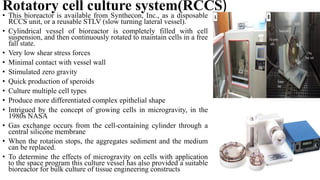
Rotatory cell culture system(RCCS)
• This bioreactor is available from Synthecon, Inc., as a disposable
RCCS unit, or a reusable STLV (slow turning lateral vessel).
• Cylindrical vessel of bioreactor is completely filled with cell
suspension, and then continuously rotated to maintain cells in a free
fall state.
• Very low shear stress forces
• Minimal contact with vessel wall
• Stimulated zero gravity
• Quick production of speroids
• Culture multiple cell types
• Produce more differentiated complex epithelial shape
• Intrigued by the concept of growing cells in microgravity, in the
1980s NASA
• Gas exchange occurs from the cell-containing cylinder through a
central silicone membrane
• When the rotation stops, the aggregates sediment and the medium
can be replaced.
• To determine the effects of microgravity on cells with application
to the space program this culture vessel has also provided a suitable
bioreactor for bulk culture of tissue engineering constructs
Immobilization of living cells in alginate
• Composed of alternating molecules of M and G, and
divalent cations bind strongly between separate G blocks
and initiate the formation of an extended alginate gel
network.
• At present, numerous cell types can be genetically
engineered to produce specific proteins of choice. By
encapsulating such cells in alginate, a valuable vehicle is
obtained for delivering specific recombinant proteins to
the organism.
• . Thus, such alginate ‘‘bioreactors’’ may have an important
therapeutic potential for the treatment of a number of
diseases, in which the alginate may prevent the
encapsulated cells from being destroyed by the immune
system.
Filter Well Inserts
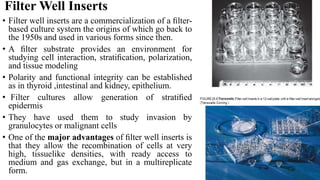
• Filter well inserts are a commercialization of a filter-
based culture system the origins of which go back to
the 1950s and used in various forms since then.
• A filter substrate provides an environment for
studying cell interaction, stratification, polarization,
and tissue modeling
• Polarity and functional integrity can be established
as in thyroid ,intestinal and kidney, epithelium.
• Filter cultures allow generation of stratified
epidermis
• They have used them to study invasion by
granulocytes or malignant cells
• One of the major advantages of filter well inserts is
that they allow the recombination of cells at very
high, tissuelike densities, with ready access to
medium and gas exchange, but in a multireplicate
form.
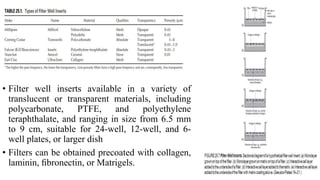
• Filter well inserts available in a variety of
translucent or transparent materials, including
polycarbonate, PTFE, and polyethylene
teraphthalate, and ranging in size from 6.5 mm
to 9 cm, suitable for 24-well, 12-well, and 6-
well plates, or larger dish
• Filters can be obtained precoated with collagen,
laminin, fibronectin, or Matrigels.
Cultures of Neuronal Aggregates
• Aggregating cultures of fetal brain cells have been
extensively used to study neural cell differentiation
• The aggregating cells follow the same developmental
sequence as observed in vivo, leading to an organoid
structure consisting of mature neurons, astrocytes, and
oligodendrocytes. A prominent neuropil is also formed
• In tumor biology, the aggregates can be used to study
brain tumor cell invasion in vitro
Tissue Equivalents and Tissue Engineering
Advatages and disadvantages
• Advantages
Development of a cell line over several generations
Scale-up is possible
Absolute control of physical environment
Homogeneity of sample
Less compound needed then in animal models
• Disadvantages
 Cells may lose some differentiated characteristics
 Hard to maintain
 Only grow small amount of tissue at high cost
 Dedifferentiation
 Instability, aneuploidy
References
• R.Ian Freshney,(2005),Culture Of Animal Cells: A Manual Of Bacis
Techniques, 5th edition,Jhon Wiley & Sons,New Jersey,pp 436-450
• R.Ian Freshney,(2005),Culture Of Animal Cells: A Manual Of Bacis
Techniques, 6th edition,Jhon Wiley & Sons,New Jersey,pp 486-492
Gel
• Gel and sponge technique-

Histotypic culture

  • 1.
    Histotypic Culture BHAVYASHREE PV II M.SC BIOTECHNOLOGY ALVA’S COLLEGE MOODBIDRI
  • 2.
    Three main typesof techniques • Organ culture- In this type of culture, the whole organs or small fragments of the organs with their spatial and intrinsic properties are used in culture. • Histotypic culture- The propagated cell lines grown in three dimensional matrix to high density represent histotypic cultures. • Organotypic cultures- Cells of different lineages are combined in experimentally determined ratios and spatial relationships to recreate a component of the organ under study.
  • 3.
    Histotypic culture: Growth andpropagation of cell lines in three-dimensional matrix to high cell density It is possible to use dispersed monolayers to regenerate tissue like structures
  • 4.
    Commonly used techniquesare: Gel and sponge techniques Hollow fibers Spheroids Rotating chamber systems Immobilization of living cells in alginate Filter well inserts Cultures of neuronal aggregates
  • 5.
    Gel and spongetechniques • Leighton first demonstrated that both normal and malignant cells penetrate cellulose sponge • The gel or sponge are used which provide the matrix for the morphogenesis and cell growth. • The cell penetrates these gels and sponges while growing. • Collagen gel provides a matrix for the morphogenesis of primitive epithelial structures. • Many different types of cell can be shown to penetrate such matrices and establish a tissuelike histology • The kidney epithelial cell line MDCK responds to paracrine stimulation from fibroblasts by producing tubular structures, but only in collagen gel
  • 6.
    Matrigel. • Matrigel isa commercial product derived from the extracellular matrix of the Engelbreth–Holm–Swarm (EHS) mouse sarcoma • That has been used for coating plastic but can also be used in gel form. • It is composed of laminin, collagen, fibronectin, and proteoglycans with a number of bound growth factors, although it can be obtained in a growth factor depleted form • Used as a substrate for epithelial morphogenesis formation of capillaries from endothelial cells and in the study of malignant invasion. • It’s a complex and not completely defined matrix and can also inhibit some morphogenetic events, such as hepatocyte growth factor (HGF)-induced tubulogenesis of MDCK cells
  • 7.
    Hollow fiber techniques •Hollow fibers are used which helps in more efficient nutrient and gas exchange • In recent years, perfusion chambers with a bed of plastic capillary fibers have been developed to be used for histotypic type of cultures • The cells get attached to capillary fibers and increase in cell density to form tissue like structures
  • 8.
    Contd… • The fibersare gas- and nutrient permeable and support cell growth on their outer surfaces. • Medium, saturated with 5% CO2 in air, is pumped through the centers of the capillaries, and cells are added to the outer chamber surrounding the bundle of fibers. • The cells attach and grow on the outside of the capillary fibers, fed by diffusion from the perfusate, and can reach tissuelike cell densities. • It’s an ideal system for studying the synthesis and release of biopharmaceuticals and are now being exploited on a semi-industrial scale • Eg, in cultures, choriocarcinoma cells release more human chorionic gonadotrophin than they would in conventional monolayer culture and colonic carcinoma cells produce elevated levels of CEA
  • 9.
    Spheroids • The re-associatonof dissociated cultured cells leads to the formation of cluster of cells called spheroids • Similar to the reassembling of embryonic cells into specialized structures • Principle: spheroid cultures is that the cells in heterotypic or homotypic aggregates have the ability to sort themselves out and form groups which form tissue like architecture • The 3-D structure of spheroids allows the experimental study aspects of drug penetration and resistance to radiation or chemotherapy that are dependent on intercellular contact.
  • 10.
    Contd… • The roleof 3-D spatial configurations in gene expression in cell populations and the assessment of cytotoxic treatment. • Treatment end points include growth delay, determination of the proportion of spheroids cured by treatment, and colony formation in monolayer after disaggregation of treated spheroids • Use of spheroids to study the penetration of cytotoxic drugs, antibodies, or other molecules used in targeted therapy • Application that is not possible in single-cell suspensions or monolayer cultures. Spheroids have proved useful in the study of cell killing by biologically targeted radionuclides
  • 11.
    Rotating chamber systems •Miniperm bioreactor: • A conventional roller bottle in two-compartment chambers. • This kind of design is the MiniPERMTM, a two compartment cylinder with cells in the smaller compartment and medium in the larger, separated by a semipermeable membrane. • It is rotated to ensure mixing, and the medium can be sparged or replaced without disturbing the cells or product. • E.g., monoclonal antibodies, the geometry of the chamber and the slow rotation tend to favor aggregate formation and enhance product formation.
  • 12.
    Rotatory cell culturesystem(RCCS) • This bioreactor is available from Synthecon, Inc., as a disposable RCCS unit, or a reusable STLV (slow turning lateral vessel). • Cylindrical vessel of bioreactor is completely filled with cell suspension, and then continuously rotated to maintain cells in a free fall state. • Very low shear stress forces • Minimal contact with vessel wall • Stimulated zero gravity • Quick production of speroids • Culture multiple cell types • Produce more differentiated complex epithelial shape • Intrigued by the concept of growing cells in microgravity, in the 1980s NASA • Gas exchange occurs from the cell-containing cylinder through a central silicone membrane • When the rotation stops, the aggregates sediment and the medium can be replaced. • To determine the effects of microgravity on cells with application to the space program this culture vessel has also provided a suitable bioreactor for bulk culture of tissue engineering constructs
  • 13.
    Immobilization of livingcells in alginate • Composed of alternating molecules of M and G, and divalent cations bind strongly between separate G blocks and initiate the formation of an extended alginate gel network. • At present, numerous cell types can be genetically engineered to produce specific proteins of choice. By encapsulating such cells in alginate, a valuable vehicle is obtained for delivering specific recombinant proteins to the organism. • . Thus, such alginate ‘‘bioreactors’’ may have an important therapeutic potential for the treatment of a number of diseases, in which the alginate may prevent the encapsulated cells from being destroyed by the immune system.
  • 14.
    Filter Well Inserts •Filter well inserts are a commercialization of a filter- based culture system the origins of which go back to the 1950s and used in various forms since then. • A filter substrate provides an environment for studying cell interaction, stratification, polarization, and tissue modeling • Polarity and functional integrity can be established as in thyroid ,intestinal and kidney, epithelium. • Filter cultures allow generation of stratified epidermis • They have used them to study invasion by granulocytes or malignant cells • One of the major advantages of filter well inserts is that they allow the recombination of cells at very high, tissuelike densities, with ready access to medium and gas exchange, but in a multireplicate form.
  • 15.
    • Filter wellinserts available in a variety of translucent or transparent materials, including polycarbonate, PTFE, and polyethylene teraphthalate, and ranging in size from 6.5 mm to 9 cm, suitable for 24-well, 12-well, and 6- well plates, or larger dish • Filters can be obtained precoated with collagen, laminin, fibronectin, or Matrigels.
  • 16.
    Cultures of NeuronalAggregates • Aggregating cultures of fetal brain cells have been extensively used to study neural cell differentiation • The aggregating cells follow the same developmental sequence as observed in vivo, leading to an organoid structure consisting of mature neurons, astrocytes, and oligodendrocytes. A prominent neuropil is also formed • In tumor biology, the aggregates can be used to study brain tumor cell invasion in vitro
  • 17.
    Tissue Equivalents andTissue Engineering
  • 18.
    Advatages and disadvantages •Advantages Development of a cell line over several generations Scale-up is possible Absolute control of physical environment Homogeneity of sample Less compound needed then in animal models • Disadvantages  Cells may lose some differentiated characteristics  Hard to maintain  Only grow small amount of tissue at high cost  Dedifferentiation  Instability, aneuploidy
  • 19.
    References • R.Ian Freshney,(2005),CultureOf Animal Cells: A Manual Of Bacis Techniques, 5th edition,Jhon Wiley & Sons,New Jersey,pp 436-450 • R.Ian Freshney,(2005),Culture Of Animal Cells: A Manual Of Bacis Techniques, 6th edition,Jhon Wiley & Sons,New Jersey,pp 486-492
  • 20.
    Gel • Gel andsponge technique-