ADVANCED – PRODUCTION
TECHNOLOGY OF CHILLI
Introduction of chilli
• BOTANICAL NAME : Capsicum annum L.
• FAMILY: Solanaceae
• Origin : Tropical America
• Tropical and sub tropical regions .
• The fruits are rich in vitamin, especially in vitamin A
and C.
• It is very important and indispensible item in every
kitchen for its pungency, spicy taste, besides the
appealing colour which adds to the food.
• Due to its several medicinal values, the demand of
chilli in the pharmaceutial industries is increasing
day to day.
• Chilli is one of the most valuable crops of India.
• It is used in India as a principle ingredient of various
curries and chutneys.
• Chilli - hot peppers
• Capsicums - bell peppers or sweet peppers.
• Green/ dried fruits are pungent
• pollination – bees
• Often cross pollinated
• Fruit type – multi seeded berry
• Chief constituent of pericarp,core and placenta is
a colorless principle – capsaicin or capsicutin -
pungency
• Major pigment – Capsanthin or capsorubin
• Yellow color – lutein
Species
• Highly pungent chilli – Capsicum frutescens
(Bird pepper/perennial chilli)
• Purple flowering – C.pubescens
• White flowering- C.annum,C.baccatum
• PM rest sp – C.pubescens ,C.microcarpum
• Anthracnose rst sp C.chinensis
Cultivars
• Wide range of cultivars with various pod and plant
characteristics, capsaicin content, duration and
yield are available in chilli.
• Major producer – AP
• INDIA is the major producer,consumer,exporter
• Highest pungency – Bhut Jolokia /Naga king chilli–
10k SHU
• Lowest pungency – Bell pepper
Varieties
• K 1 , K 2 , Co 2 , Co 4 ,PKM 1 , PMK 1( for semi try
conditions in southern districts ), PLR 1 , ( for
coastal regions of north-east tamilnadu) and
KKM ( CH )1.
HYBRIDS:
TNAU chilli hybrid Co 1.
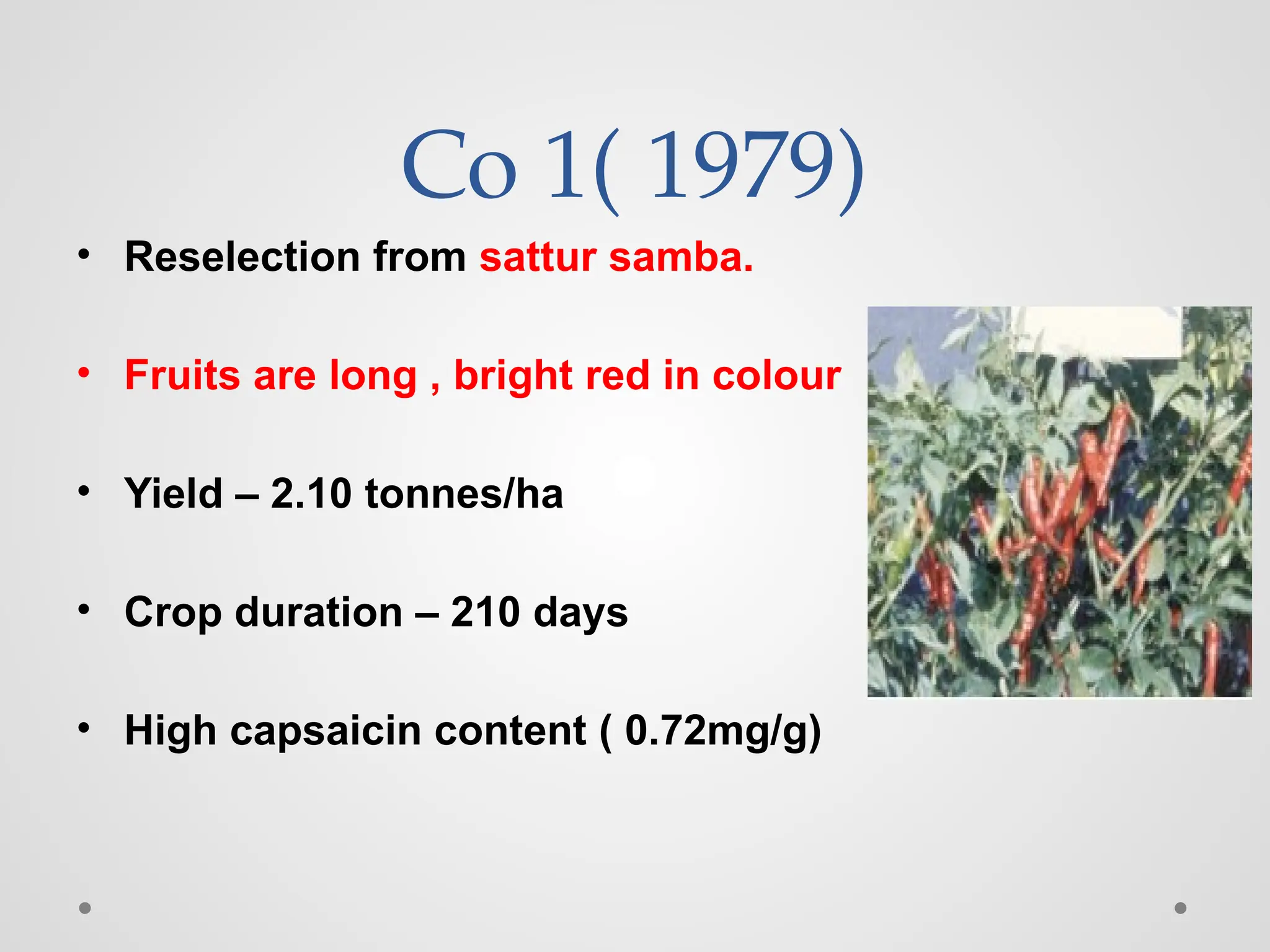
Co 1( 1979)
• Reselection from sattur samba.
• Fruits are long , bright red in colour
• Yield – 2.10 tonnes/ha
• Crop duration – 210 days
• High capsaicin content ( 0.72mg/g)
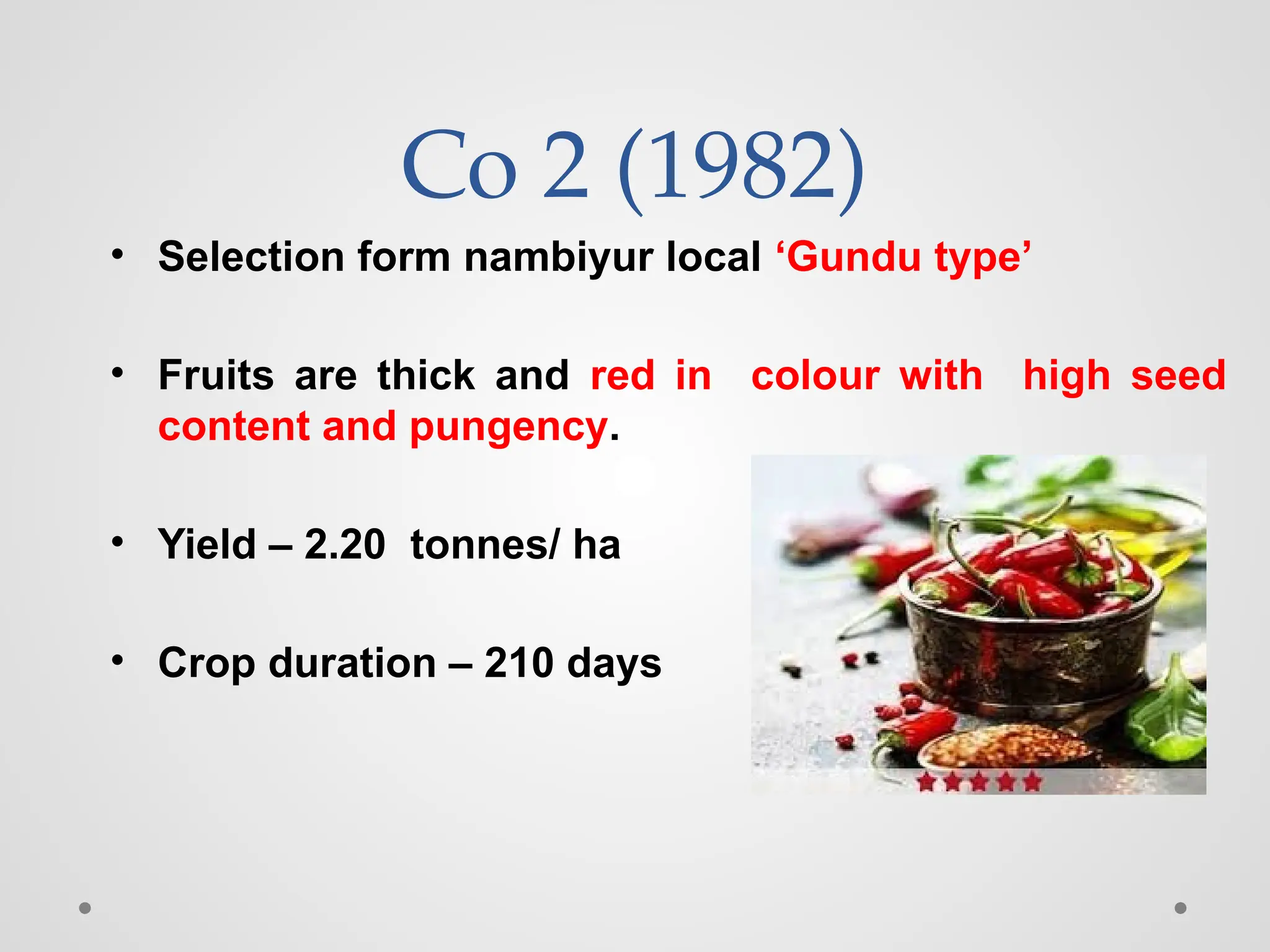
Co 2 (1982)
• Selection form nambiyur local ‘Gundu type’
• Fruits are thick and red in colour with high seed
content and pungency.
• Yield – 2.20 tonnes/ ha
• Crop duration – 210 days
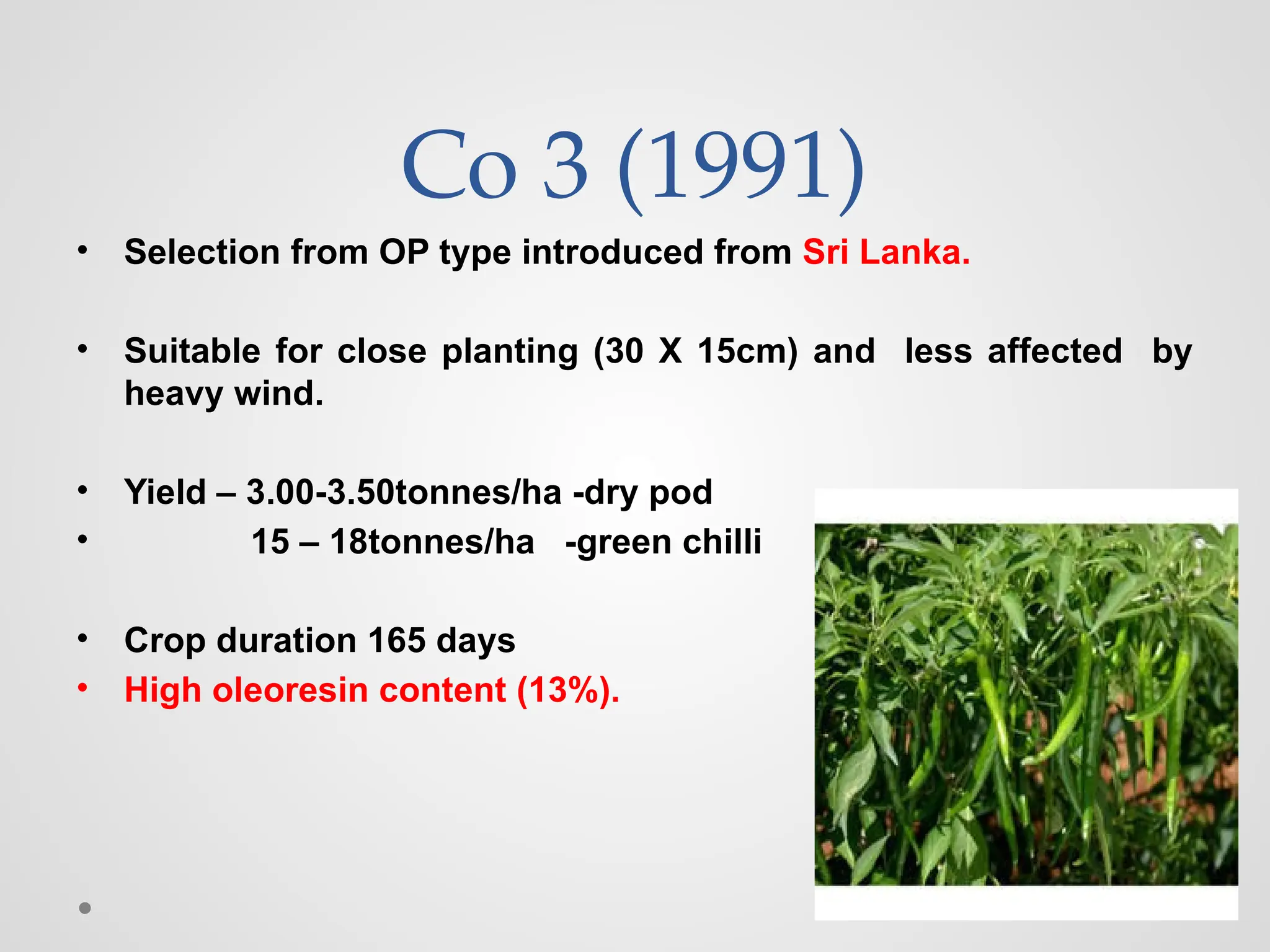
Co 3 (1991)
• Selection from OP type introduced from Sri Lanka.
• Suitable for close planting (30 X 15cm) and less affected by
heavy wind.
• Yield – 3.00-3.50tonnes/ha -dry pod
• 15 – 18tonnes/ha -green chilli
• Crop duration 165 days
• High oleoresin content (13%).
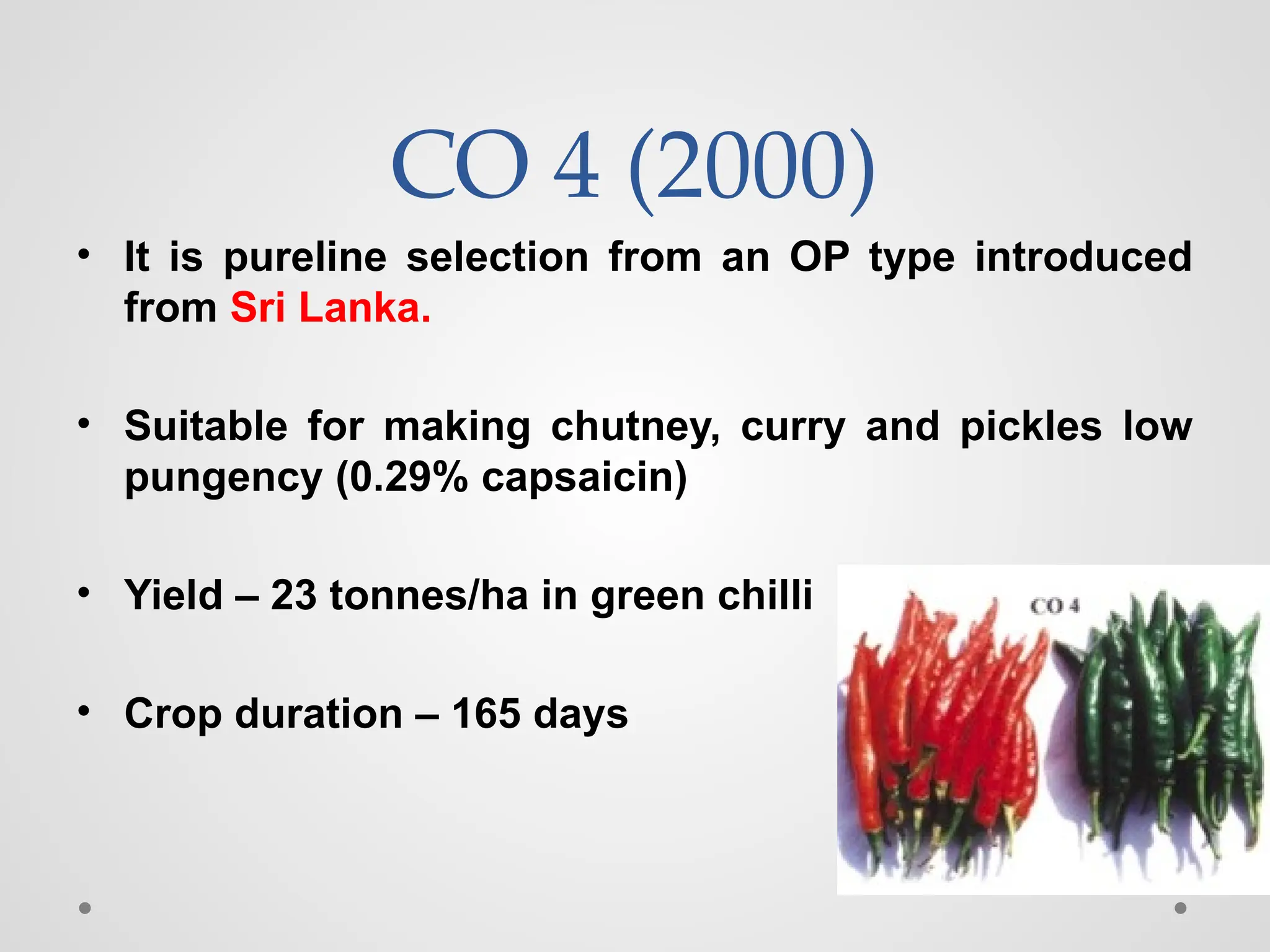
CO 4 (2000)
• It is pureline selection from an OP type introduced
from Sri Lanka.
• Suitable for making chutney, curry and pickles low
pungency (0.29% capsaicin)
• Yield – 23 tonnes/ha in green chilli
• Crop duration – 165 days
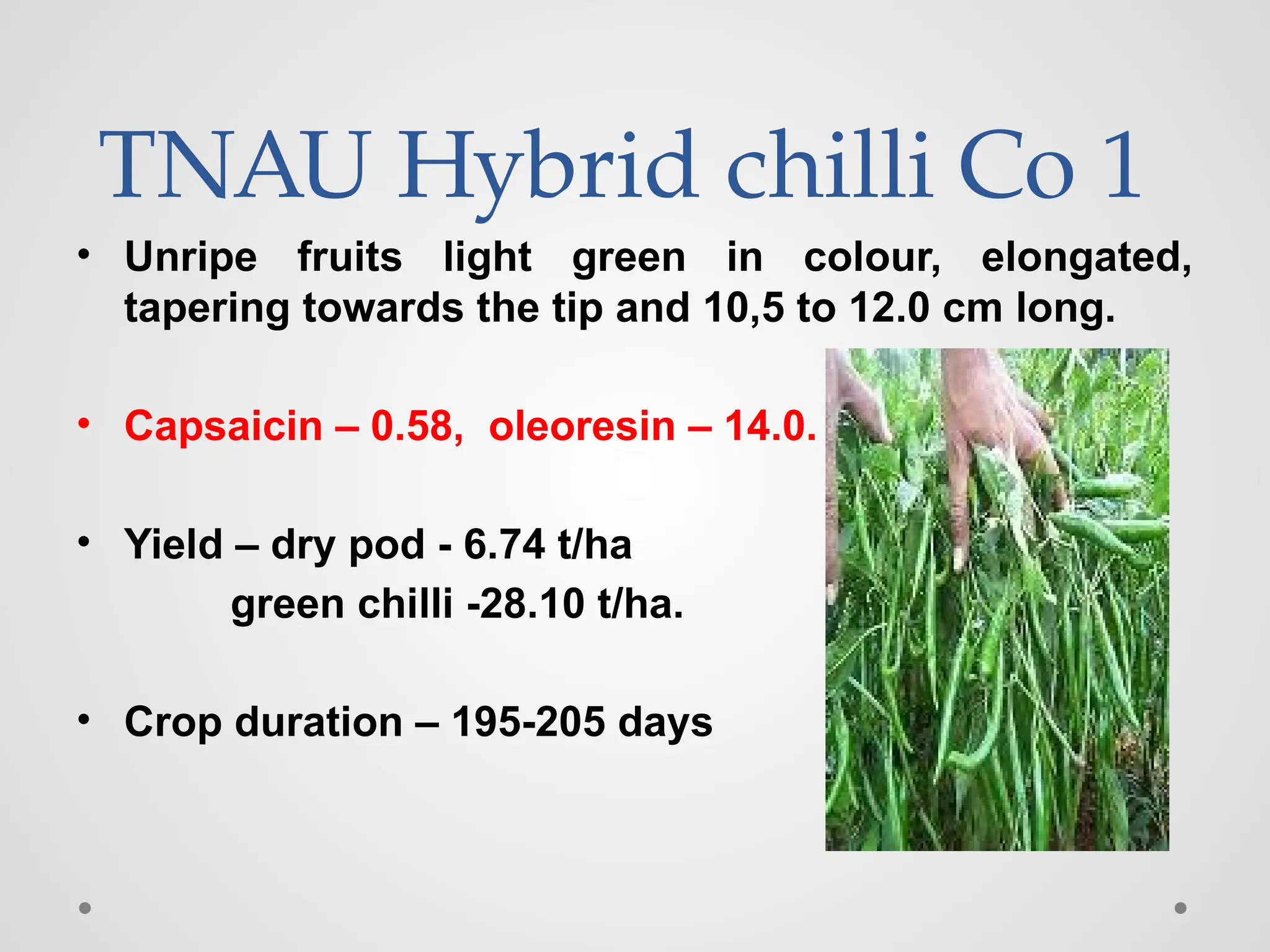
TNAU Hybrid chilli Co 1
• Unripe fruits light green in colour, elongated,
tapering towards the tip and 10,5 to 12.0 cm long.
• Capsaicin – 0.58, oleoresin – 14.0.
• Yield – dry pod - 6.74 t/ha
green chilli -28.10 t/ha.
• Crop duration – 195-205 days
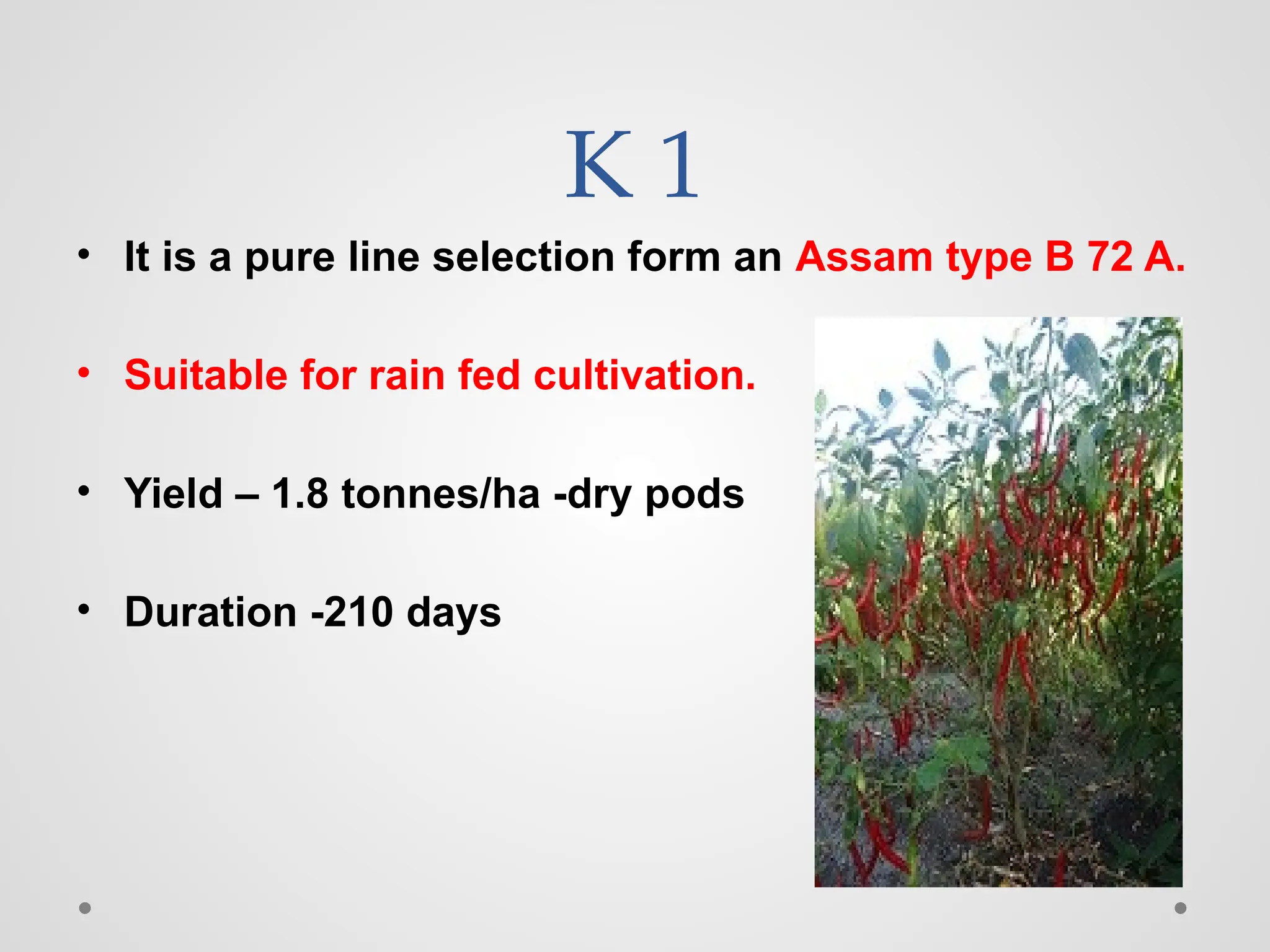
K 1
• It is a pure line selection form an Assam type B 72 A.
• Suitable for rain fed cultivation.
• Yield – 1.8 tonnes/ha -dry pods
• Duration -210 days
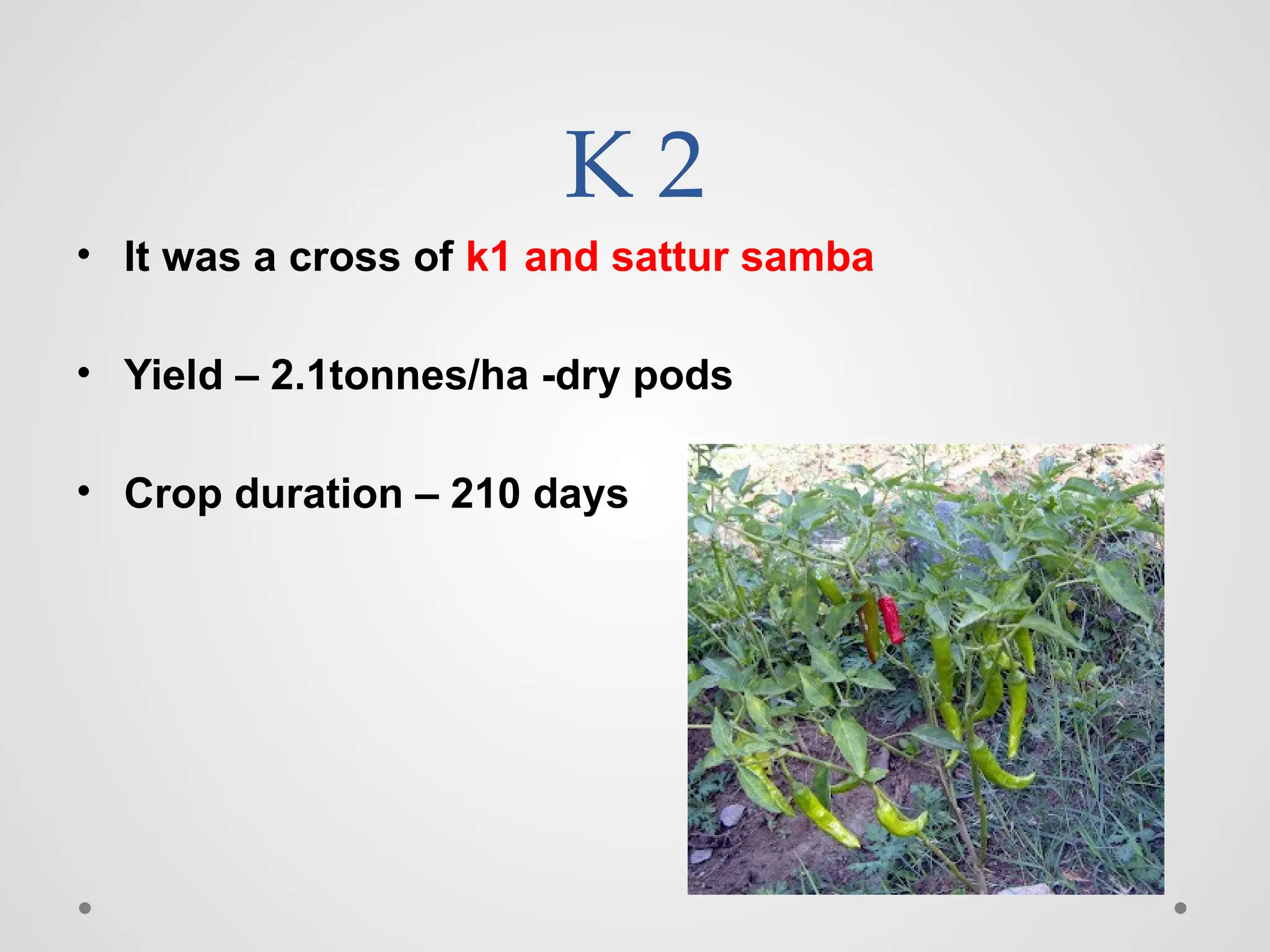
K 2
• It was a cross of k1 and sattur samba
• Yield – 2.1tonnes/ha -dry pods
• Crop duration – 210 days
KKM (CH1)
• High yield – 3.03 tonnes/ha of dry fruits with high capsaicin
content ( 0.54%).
• Early maturity - first harvest 92 days after planting
• non shrivelling nature even after drying
Suitable for export
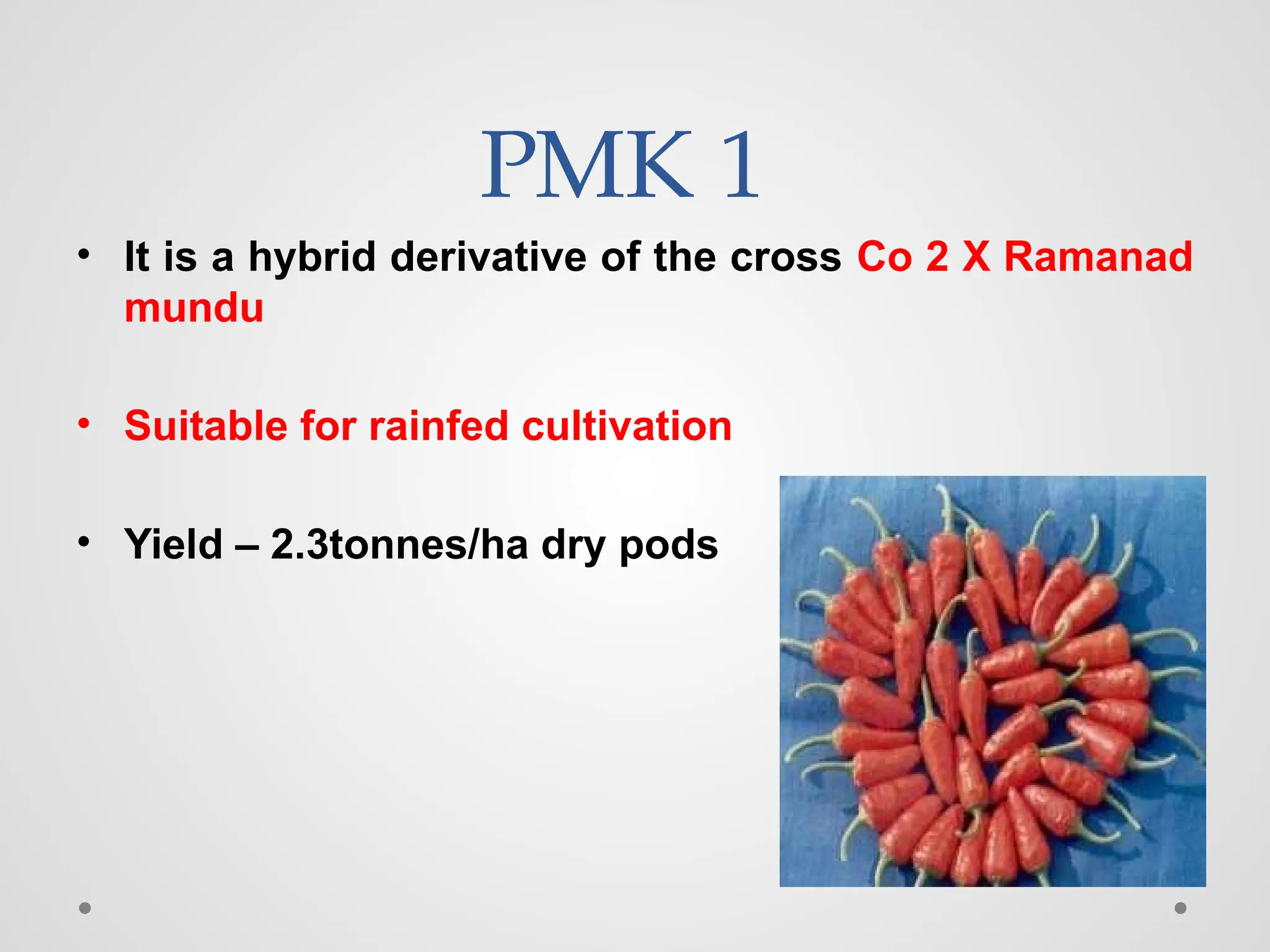
PMK 1
• It is a hybrid derivative of the cross Co 2 X Ramanad
mundu
• Suitable for rainfed cultivation
• Yield – 2.3tonnes/ha dry pods
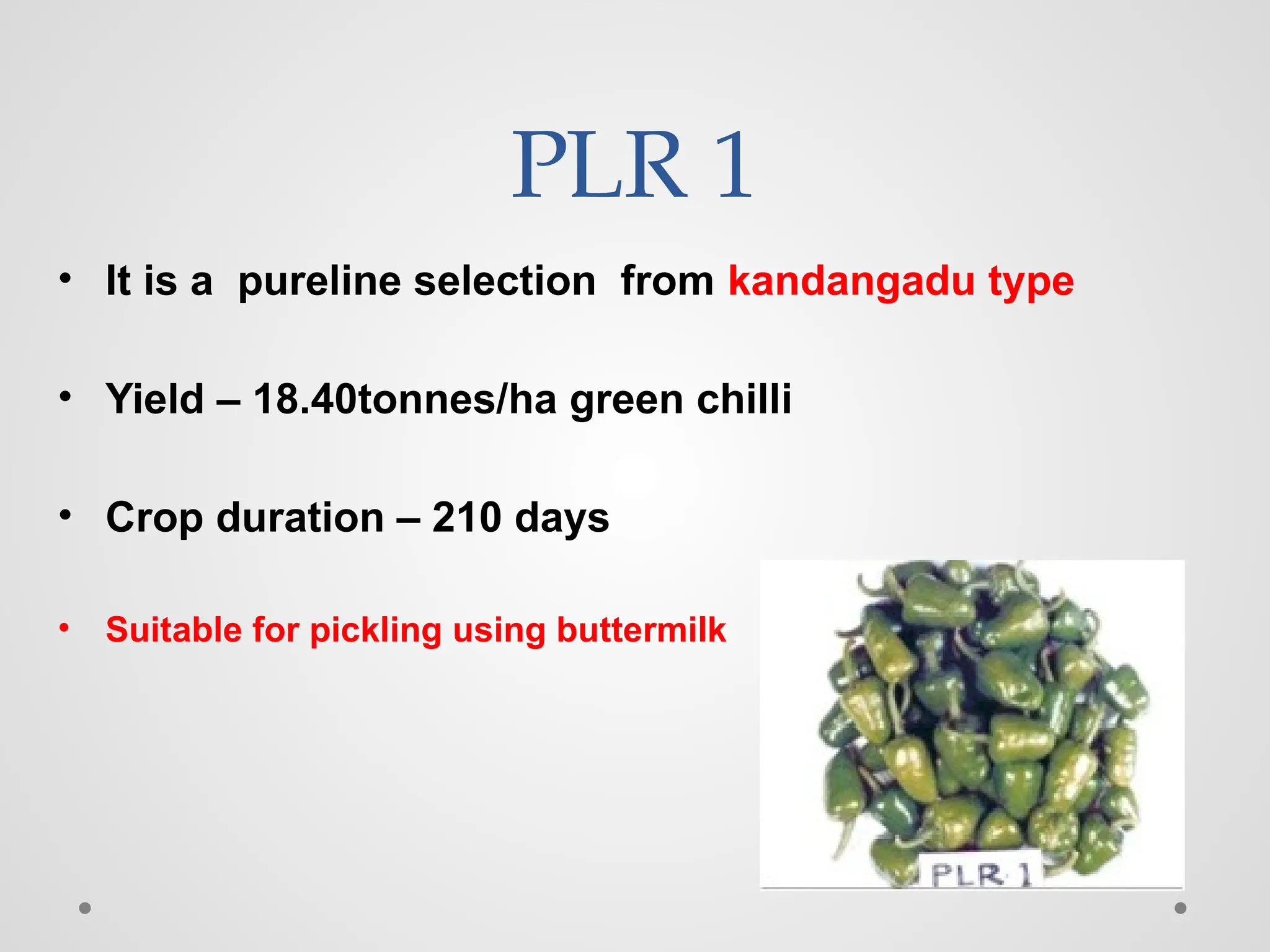
PLR 1
• It is a pureline selection from kandangadu type
• Yield – 18.40tonnes/ha green chilli
• Crop duration – 210 days
• Suitable for pickling using buttermilk
• Pusa jwala – Tol to thrips , mites, aphids.
• Pusa sadabahar- res to CMV ,TMV, TLCV
• Arka Suphal – res to powdery mildew
• Arka lohit – tol to powdery mildew , both irrigated
and rainfed .
• Konkan Keerthi- export variety
• Puri red – res to mosaic disease
• Jawala Mukhi- suitable for HTP
• Utkal reshmi – res to bacterial wilt
• Punjab surakh – multiple disease resistant variety
• Arka abhir, Punjab lal – suitable for colour extraction
SOIL
• Well drained loamy soils rich in organic matter with
PH range – 6.5 to 7.5
• Season of sowing :
1. january- february
2. june- july
3. september- october
Climate
Fruit drop and poor fruit set - >40˚c
Flower drop - >35˚c
SEED RATE
• Varieties - 1.0kg/ha
• Hybrids - 200-250g/ha
• Nursery area - 100 sq.m /ha
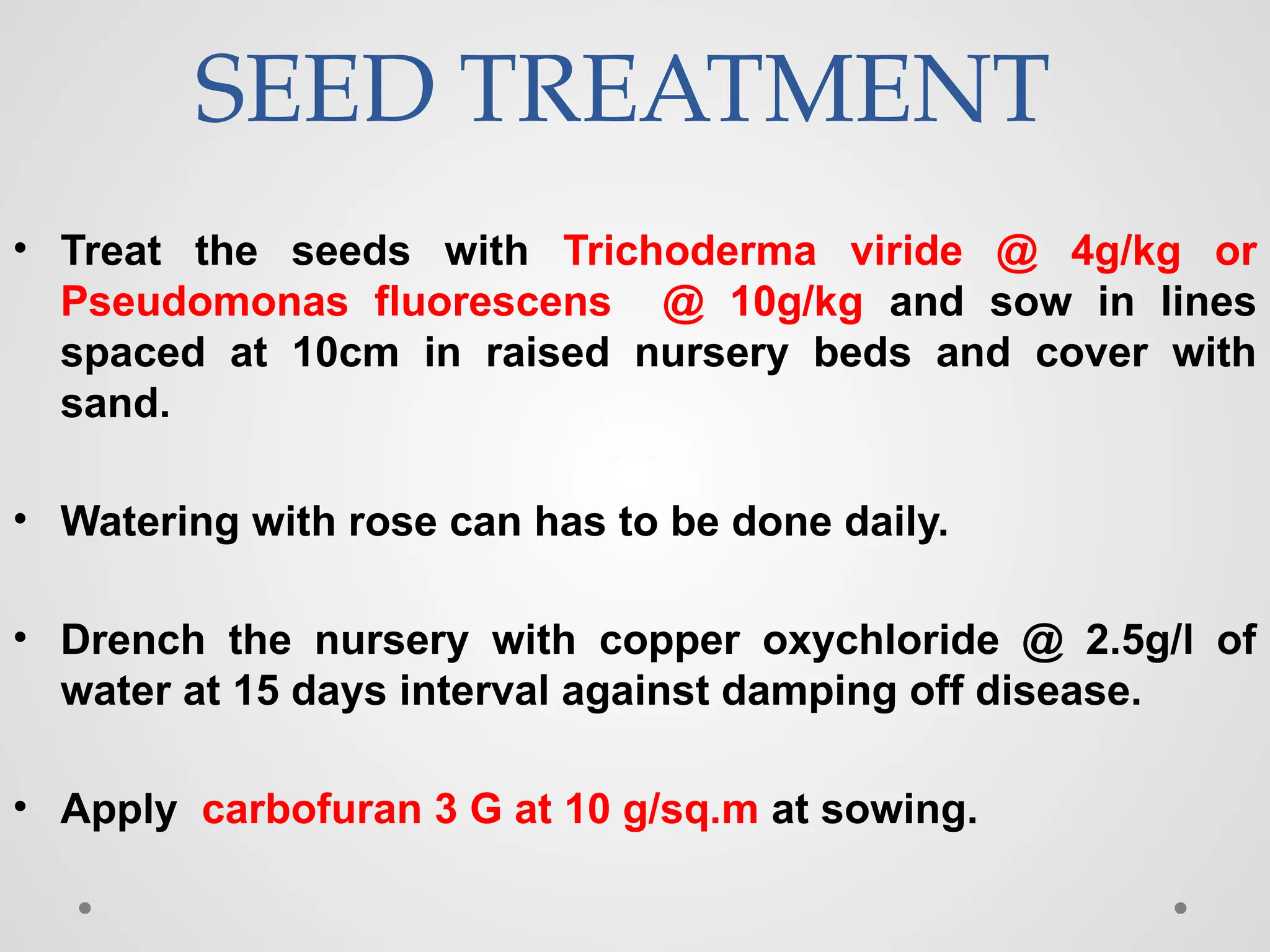
SEED TREATMENT
• Treat the seeds with Trichoderma viride @ 4g/kg or
Pseudomonas fluorescens @ 10g/kg and sow in lines
spaced at 10cm in raised nursery beds and cover with
sand.
• Watering with rose can has to be done daily.
• Drench the nursery with copper oxychloride @ 2.5g/l of
water at 15 days interval against damping off disease.
• Apply carbofuran 3 G at 10 g/sq.m at sowing.
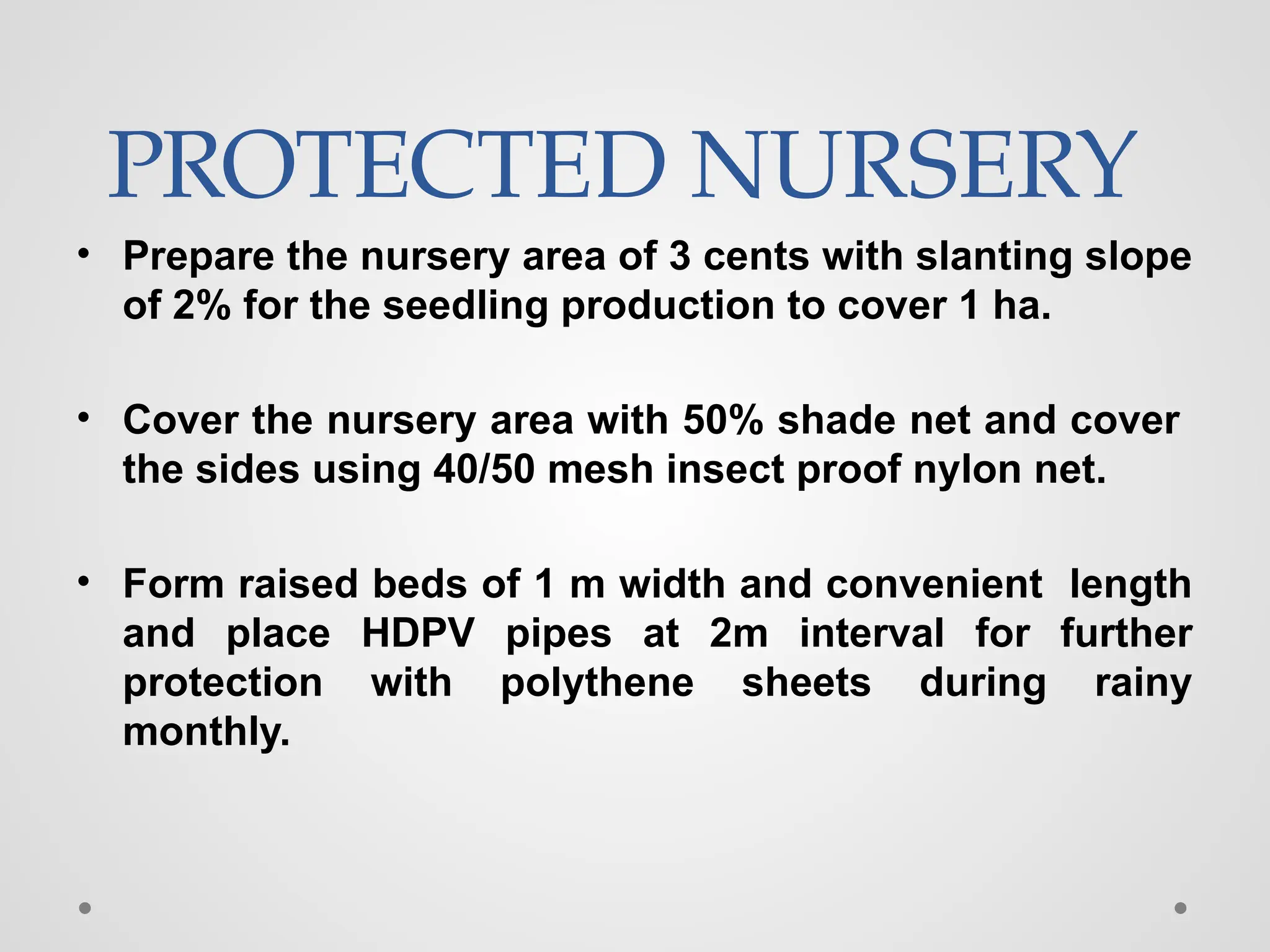
PROTECTED NURSERY
• Prepare the nursery area of 3 cents with slanting slope
of 2% for the seedling production to cover 1 ha.
• Cover the nursery area with 50% shade net and cover
the sides using 40/50 mesh insect proof nylon net.
• Form raised beds of 1 m width and convenient length
and place HDPV pipes at 2m interval for further
protection with polythene sheets during rainy
monthly.
• Mix sterilized coco peat @ 300kg with 5kg neem
cake along with Azospirillum and phosphobacteria
each @ 1kg.
• Approximately 1.2 kg of cocopeat is required for
filling one protray.
• 300 protrays (98 cells) are required for the
production of 29000 seedlings, which are required
for one hectare adopting a spacing of
90X60X45 cm in a paired row system.
• Sow the treated seed in protrays @ 1 seed per cell.
• Cover the seed with cocopeat and keep the trays one
above the other and cover with a polythene sheet till
germination starts.
• After 6 days place the protrays with germinated
seedling individually on the raised beds inside the
shade net.
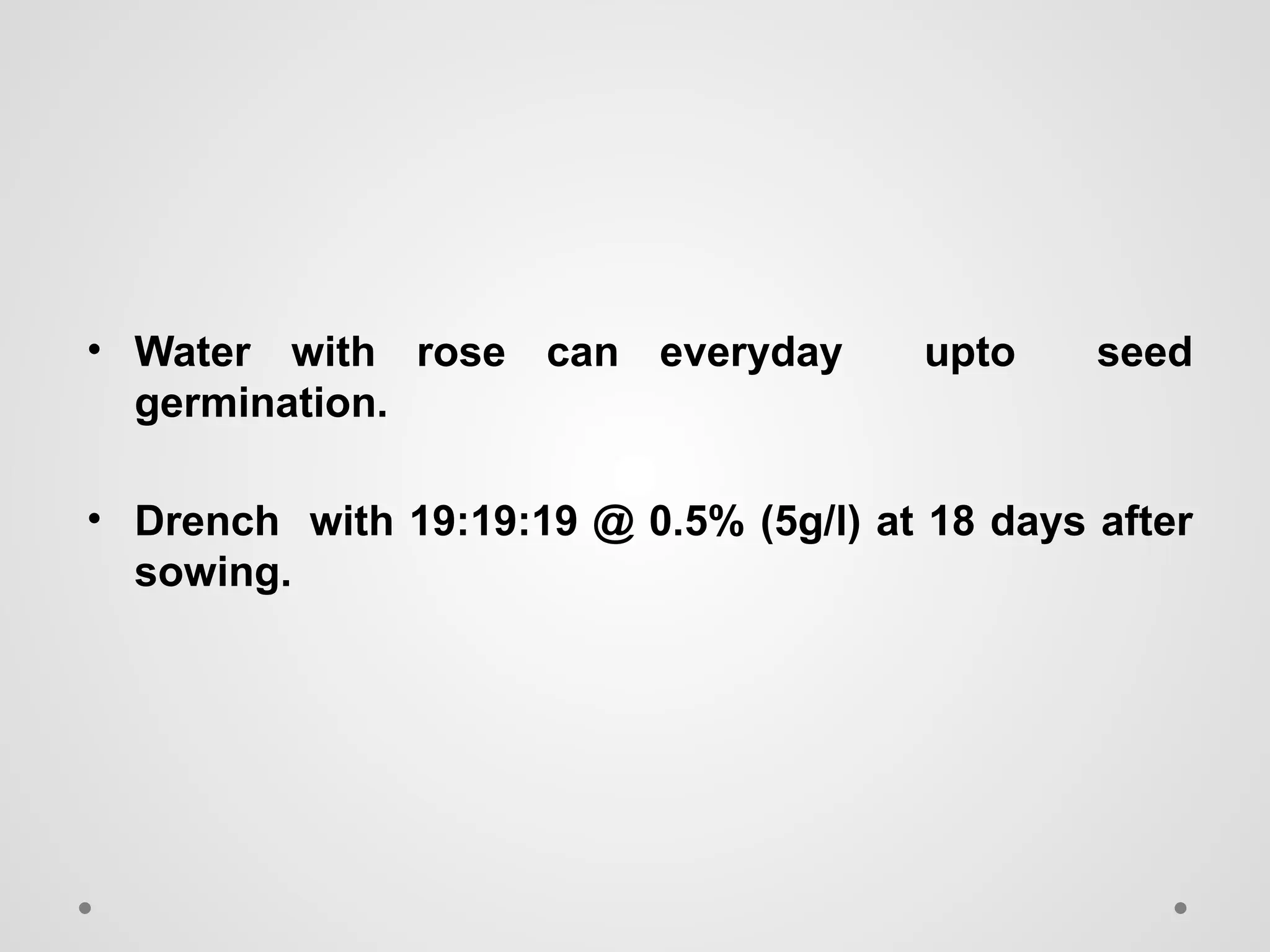
• Water with rose can everyday upto seed
germination.
• Drench with 19:19:19 @ 0.5% (5g/l) at 18 days after
sowing.
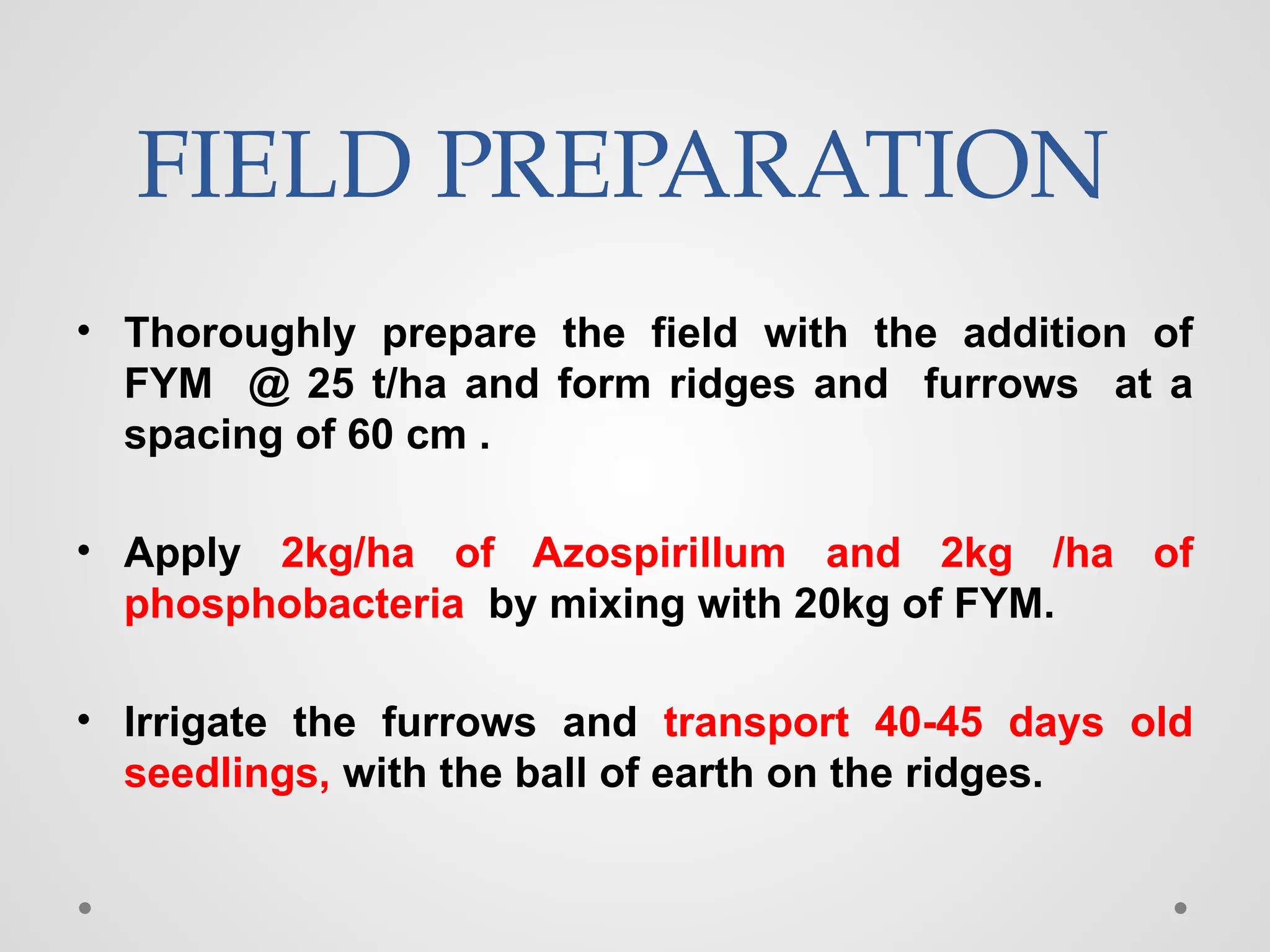
FIELD PREPARATION
• Thoroughly prepare the field with the addition of
FYM @ 25 t/ha and form ridges and furrows at a
spacing of 60 cm .
• Apply 2kg/ha of Azospirillum and 2kg /ha of
phosphobacteria by mixing with 20kg of FYM.
• Irrigate the furrows and transport 40-45 days old
seedlings, with the ball of earth on the ridges.
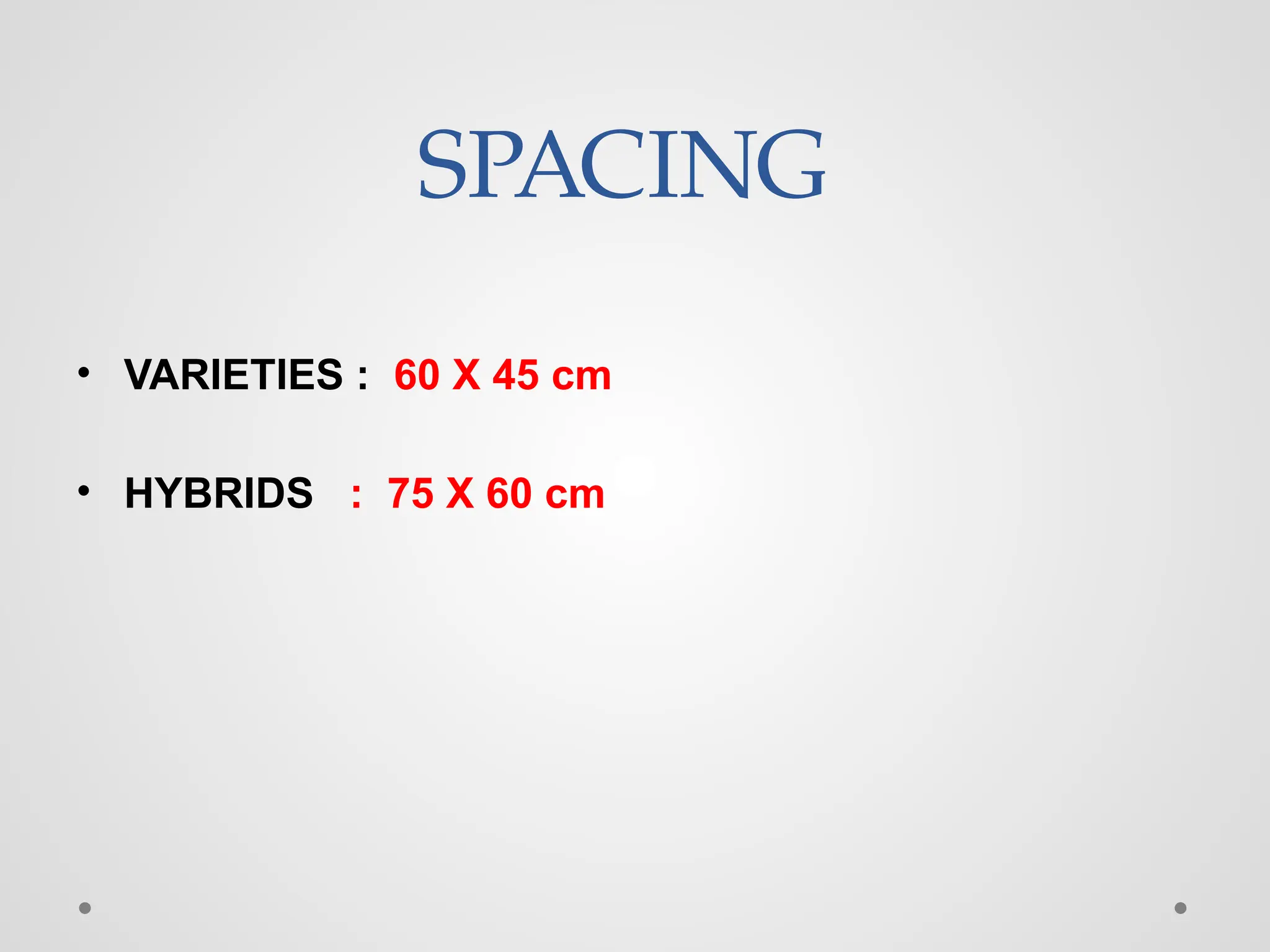
SPACING
• VARIETIES : 60 X 45 cm
• HYBRIDS : 75 X 60 cm
WEED CONTROL
• Apply pendimethalin 1.0kg /ha or Fluchloralin
1.0kg/ha as pre-emergece herbicide followed by
hand weedling once 30 days after planting.
• IRRIGATION :
• irrigate is done at weekly intervals.
DRIP IRRIGATION AND
FERTIGATION
• Apply FYM @ 25t/ha as basal before last ploughing.
• Apply 2kg/ha of Azospirillum and 2kg /ha
phosphobacteria by mixing with 20kg of FYM .
• Apply 75% Total recommended dose of
superphosphate i.e 375 kg/ha as basal .
• Install the drip irrigation with main and sub main
pipes and place lateral tubes at an interval of 1.5m.
• Place the drippers in lateral tubes at an interval of
60cm and 50cm spacing with 4 LPH and 3.5 LPH
capacities respectively.
• Form raised beds of 120 cm width at an interval of 8-
12hrs
• Before planting wet the beds using drip system for 8
to 12 hrs.
• Planting to be done at a spacing of 90X60X45cm in
the paired row system, using ropes marked at 60 cm
spacing
• Spray pendimethalin 1.0 kg / ha or fluchloralin 1.0
kg/ha as preemergency herbicide at third day after
planting.
• Gap filling to be done at seventh day after planting
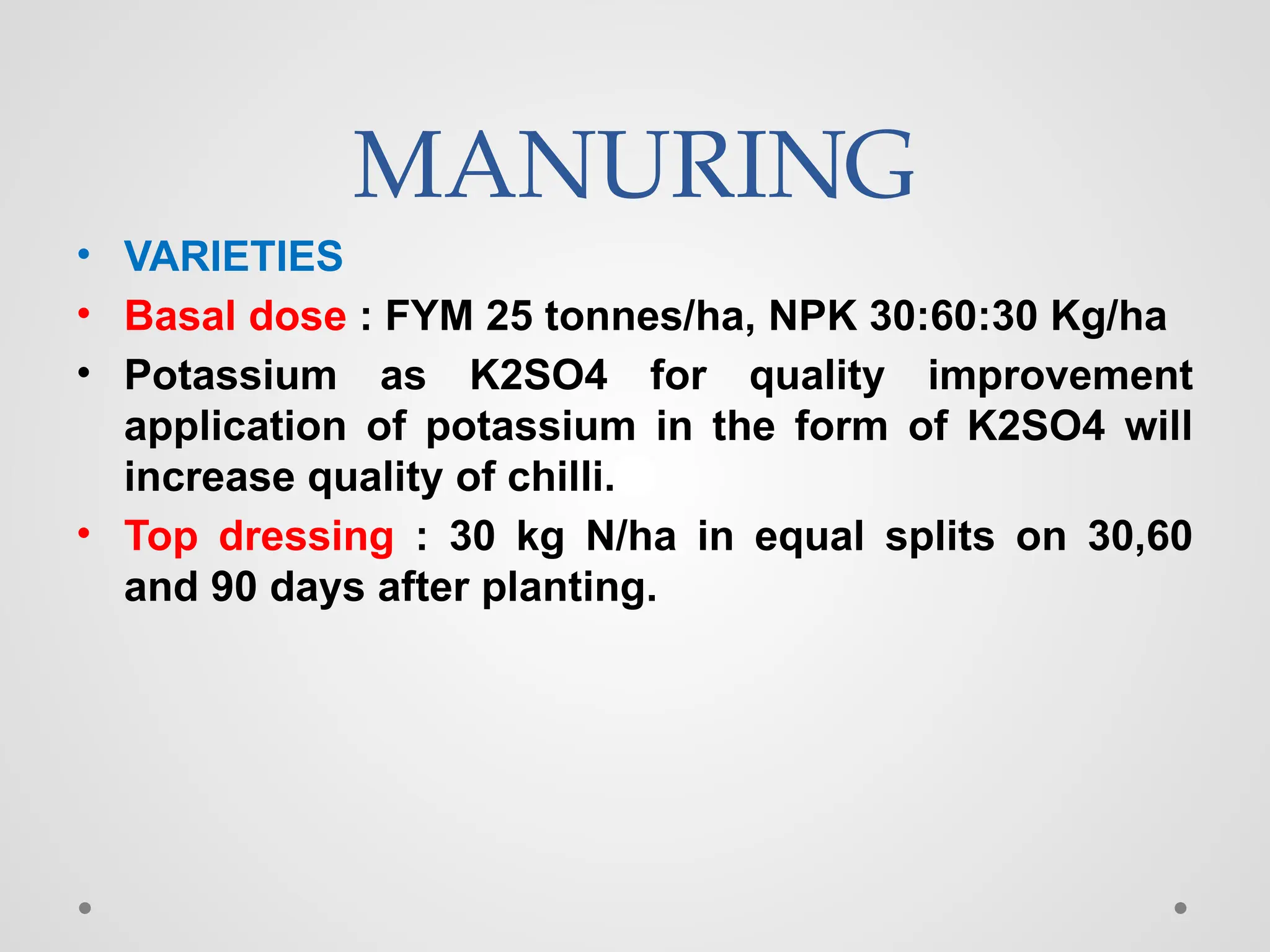
MANURING
• VARIETIES
• Basal dose : FYM 25 tonnes/ha, NPK 30:60:30 Kg/ha
• Potassium as K2SO4 for quality improvement
application of potassium in the form of K2SO4 will
increase quality of chilli.
• Top dressing : 30 kg N/ha in equal splits on 30,60
and 90 days after planting.
• HYBRIDS
• Basal dose : FYM 30 tonnes/ha , NPK 30:80:80 kg/ha
• Top dressing : 30 kg N/ha in equal splits on 30,60
and 90 days after planting.
AND MICRONUTRIENT
• Spray triacontonal @ 1.25 ml /l on 20 , 40, 60, 80th
day of planting.
• Foliar spray of ZnSo4 @ 0.5 % thrice at 10 days
interval from 40 days after planting.
• Spray 19 :19:19 Mn @ 1% at 60 days after planting.
INTERCROPPING
• The intercrops like onion and coriander can be
grown for getting additional income
• Its can also help to control the weed population .
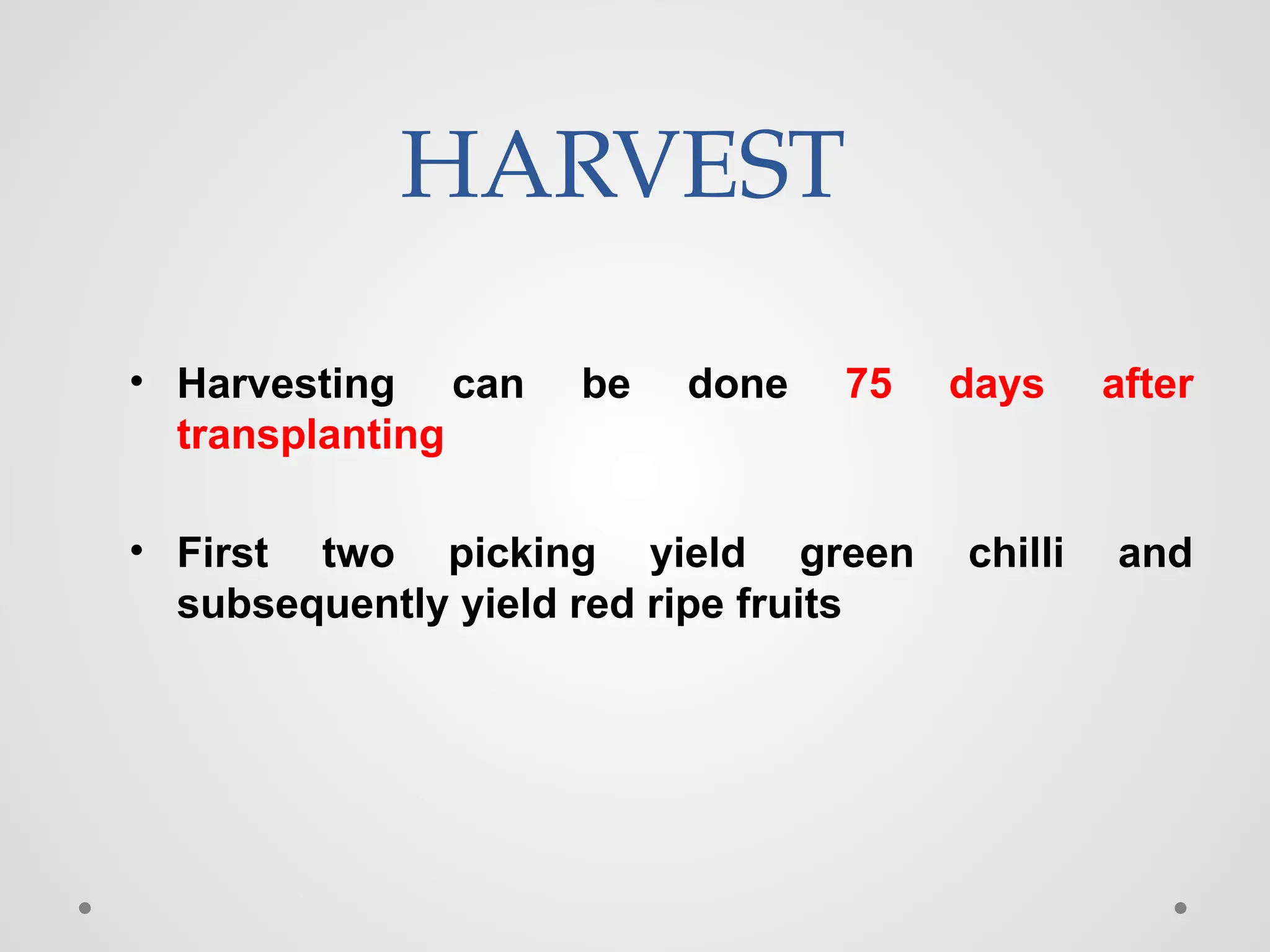
HARVEST
• Harvesting can be done 75 days after
transplanting
• First two picking yield green chilli and
subsequently yield red ripe fruits
YIELD
• VARIETIES : 2-3 t/ha of dry pods
10-15 t/ha of green chillies
• HYBRIDS : 25t/ha of green chillies
PESTS
• MAJOR PEST -THRIPS : Control by applying
carbofuran 3% G @ 33 kg/ha – vector for chilli leaf
curl virus
• APHID : control by applying of phorate 10% G @
10 kg/ha .
• GRAM CATERPILLAR : control by spraying of
carbaryl 50 WP 2 g /lit .
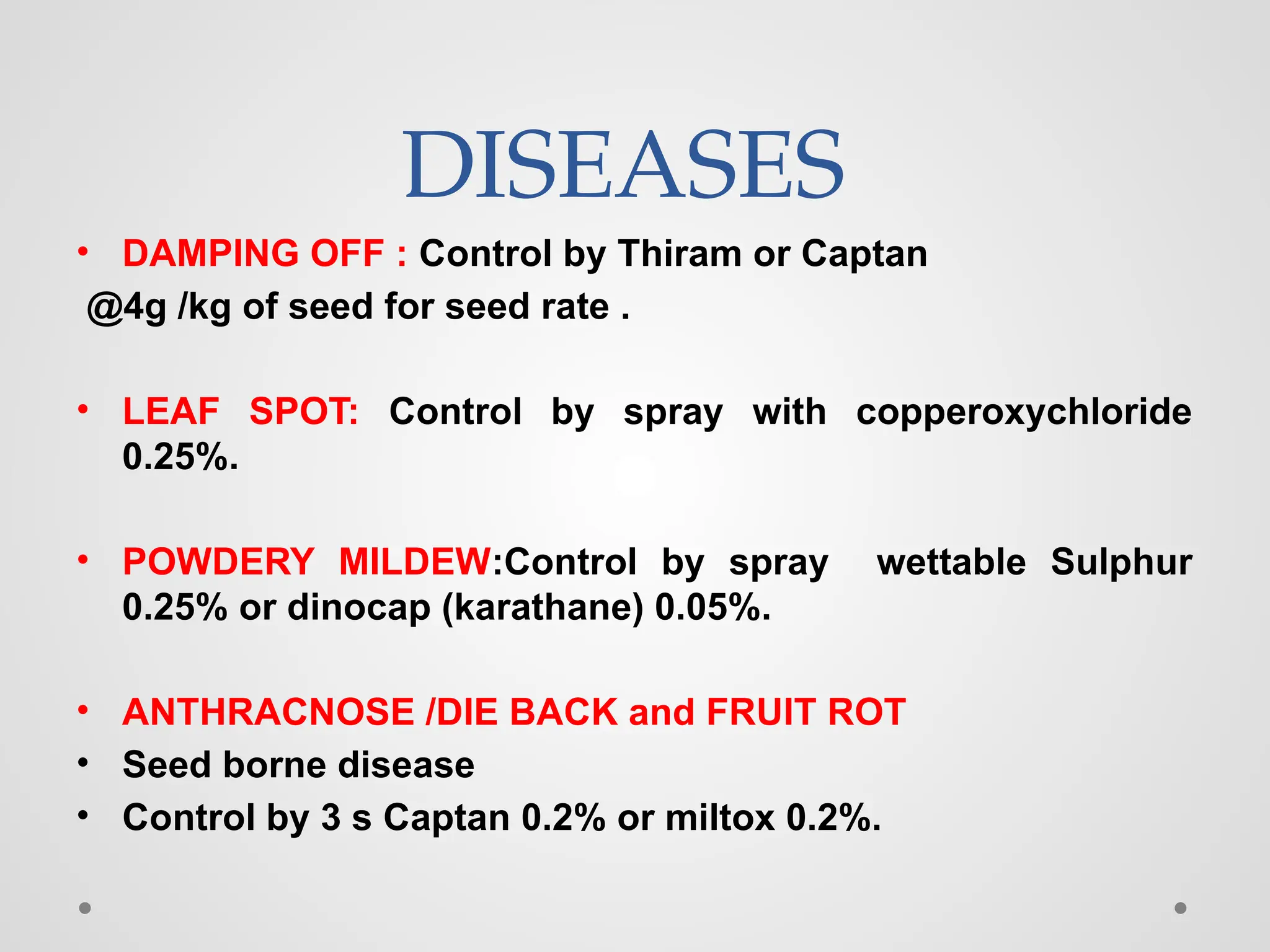
DISEASES
• DAMPING OFF : Control by Thiram or Captan
@4g /kg of seed for seed rate .
• LEAF SPOT: Control by spray with copperoxychloride
0.25%.
• POWDERY MILDEW:Control by spray wettable Sulphur
0.25% or dinocap (karathane) 0.05%.
• ANTHRACNOSE /DIE BACK and FRUIT ROT
• Seed borne disease
• Control by 3 s Captan 0.2% or miltox 0.2%.
Chilli leaf curl
• Leaves curl towards midrib and become deformed.
• Stunted plant growth due to shortened internodes and leaves
greatly reduced in size.
• Flower buds abcise before attaining full size and anthers do
not contain pollen grains.
• Management
• Apply Carbofuran 3G @ 4-5 Kg/acre in the mainfield to control
sucking complex and insect vectors selectively.
Thank you

CHILLI_ crop power point presented by p. Nirai pandi

  • 1.
  • 2.
    Introduction of chilli •BOTANICAL NAME : Capsicum annum L. • FAMILY: Solanaceae • Origin : Tropical America • Tropical and sub tropical regions . • The fruits are rich in vitamin, especially in vitamin A and C. • It is very important and indispensible item in every kitchen for its pungency, spicy taste, besides the appealing colour which adds to the food.
  • 3.
    • Due toits several medicinal values, the demand of chilli in the pharmaceutial industries is increasing day to day. • Chilli is one of the most valuable crops of India. • It is used in India as a principle ingredient of various curries and chutneys. • Chilli - hot peppers • Capsicums - bell peppers or sweet peppers. • Green/ dried fruits are pungent
  • 4.
    • pollination –bees • Often cross pollinated • Fruit type – multi seeded berry • Chief constituent of pericarp,core and placenta is a colorless principle – capsaicin or capsicutin - pungency • Major pigment – Capsanthin or capsorubin • Yellow color – lutein
  • 5.
    Species • Highly pungentchilli – Capsicum frutescens (Bird pepper/perennial chilli) • Purple flowering – C.pubescens • White flowering- C.annum,C.baccatum • PM rest sp – C.pubescens ,C.microcarpum • Anthracnose rst sp C.chinensis
  • 6.
    Cultivars • Wide rangeof cultivars with various pod and plant characteristics, capsaicin content, duration and yield are available in chilli. • Major producer – AP • INDIA is the major producer,consumer,exporter • Highest pungency – Bhut Jolokia /Naga king chilli– 10k SHU • Lowest pungency – Bell pepper
  • 7.
    Varieties • K 1, K 2 , Co 2 , Co 4 ,PKM 1 , PMK 1( for semi try conditions in southern districts ), PLR 1 , ( for coastal regions of north-east tamilnadu) and KKM ( CH )1. HYBRIDS: TNAU chilli hybrid Co 1.
  • 8.
    Co 1( 1979) •Reselection from sattur samba. • Fruits are long , bright red in colour • Yield – 2.10 tonnes/ha • Crop duration – 210 days • High capsaicin content ( 0.72mg/g)
  • 9.
    Co 2 (1982) •Selection form nambiyur local ‘Gundu type’ • Fruits are thick and red in colour with high seed content and pungency. • Yield – 2.20 tonnes/ ha • Crop duration – 210 days
  • 10.
    Co 3 (1991) •Selection from OP type introduced from Sri Lanka. • Suitable for close planting (30 X 15cm) and less affected by heavy wind. • Yield – 3.00-3.50tonnes/ha -dry pod • 15 – 18tonnes/ha -green chilli • Crop duration 165 days • High oleoresin content (13%).
  • 11.
    CO 4 (2000) •It is pureline selection from an OP type introduced from Sri Lanka. • Suitable for making chutney, curry and pickles low pungency (0.29% capsaicin) • Yield – 23 tonnes/ha in green chilli • Crop duration – 165 days
  • 12.
    TNAU Hybrid chilliCo 1 • Unripe fruits light green in colour, elongated, tapering towards the tip and 10,5 to 12.0 cm long. • Capsaicin – 0.58, oleoresin – 14.0. • Yield – dry pod - 6.74 t/ha green chilli -28.10 t/ha. • Crop duration – 195-205 days
  • 13.
    K 1 • Itis a pure line selection form an Assam type B 72 A. • Suitable for rain fed cultivation. • Yield – 1.8 tonnes/ha -dry pods • Duration -210 days
  • 14.
    K 2 • Itwas a cross of k1 and sattur samba • Yield – 2.1tonnes/ha -dry pods • Crop duration – 210 days
  • 15.
    KKM (CH1) • Highyield – 3.03 tonnes/ha of dry fruits with high capsaicin content ( 0.54%). • Early maturity - first harvest 92 days after planting • non shrivelling nature even after drying Suitable for export
  • 16.
    PMK 1 • Itis a hybrid derivative of the cross Co 2 X Ramanad mundu • Suitable for rainfed cultivation • Yield – 2.3tonnes/ha dry pods
  • 17.
    PLR 1 • Itis a pureline selection from kandangadu type • Yield – 18.40tonnes/ha green chilli • Crop duration – 210 days • Suitable for pickling using buttermilk
  • 18.
    • Pusa jwala– Tol to thrips , mites, aphids. • Pusa sadabahar- res to CMV ,TMV, TLCV • Arka Suphal – res to powdery mildew • Arka lohit – tol to powdery mildew , both irrigated and rainfed . • Konkan Keerthi- export variety • Puri red – res to mosaic disease • Jawala Mukhi- suitable for HTP • Utkal reshmi – res to bacterial wilt • Punjab surakh – multiple disease resistant variety • Arka abhir, Punjab lal – suitable for colour extraction
  • 19.
    SOIL • Well drainedloamy soils rich in organic matter with PH range – 6.5 to 7.5 • Season of sowing : 1. january- february 2. june- july 3. september- october Climate Fruit drop and poor fruit set - >40˚c Flower drop - >35˚c
  • 20.
    SEED RATE • Varieties- 1.0kg/ha • Hybrids - 200-250g/ha • Nursery area - 100 sq.m /ha
  • 21.
    SEED TREATMENT • Treatthe seeds with Trichoderma viride @ 4g/kg or Pseudomonas fluorescens @ 10g/kg and sow in lines spaced at 10cm in raised nursery beds and cover with sand. • Watering with rose can has to be done daily. • Drench the nursery with copper oxychloride @ 2.5g/l of water at 15 days interval against damping off disease. • Apply carbofuran 3 G at 10 g/sq.m at sowing.
  • 22.
    PROTECTED NURSERY • Preparethe nursery area of 3 cents with slanting slope of 2% for the seedling production to cover 1 ha. • Cover the nursery area with 50% shade net and cover the sides using 40/50 mesh insect proof nylon net. • Form raised beds of 1 m width and convenient length and place HDPV pipes at 2m interval for further protection with polythene sheets during rainy monthly.
  • 23.
    • Mix sterilizedcoco peat @ 300kg with 5kg neem cake along with Azospirillum and phosphobacteria each @ 1kg. • Approximately 1.2 kg of cocopeat is required for filling one protray. • 300 protrays (98 cells) are required for the production of 29000 seedlings, which are required for one hectare adopting a spacing of 90X60X45 cm in a paired row system.
  • 24.
    • Sow thetreated seed in protrays @ 1 seed per cell. • Cover the seed with cocopeat and keep the trays one above the other and cover with a polythene sheet till germination starts. • After 6 days place the protrays with germinated seedling individually on the raised beds inside the shade net.
  • 25.
    • Water withrose can everyday upto seed germination. • Drench with 19:19:19 @ 0.5% (5g/l) at 18 days after sowing.
  • 26.
    FIELD PREPARATION • Thoroughlyprepare the field with the addition of FYM @ 25 t/ha and form ridges and furrows at a spacing of 60 cm . • Apply 2kg/ha of Azospirillum and 2kg /ha of phosphobacteria by mixing with 20kg of FYM. • Irrigate the furrows and transport 40-45 days old seedlings, with the ball of earth on the ridges.
  • 27.
    SPACING • VARIETIES :60 X 45 cm • HYBRIDS : 75 X 60 cm
  • 28.
    WEED CONTROL • Applypendimethalin 1.0kg /ha or Fluchloralin 1.0kg/ha as pre-emergece herbicide followed by hand weedling once 30 days after planting. • IRRIGATION : • irrigate is done at weekly intervals.
  • 29.
    DRIP IRRIGATION AND FERTIGATION •Apply FYM @ 25t/ha as basal before last ploughing. • Apply 2kg/ha of Azospirillum and 2kg /ha phosphobacteria by mixing with 20kg of FYM . • Apply 75% Total recommended dose of superphosphate i.e 375 kg/ha as basal .
  • 30.
    • Install thedrip irrigation with main and sub main pipes and place lateral tubes at an interval of 1.5m. • Place the drippers in lateral tubes at an interval of 60cm and 50cm spacing with 4 LPH and 3.5 LPH capacities respectively. • Form raised beds of 120 cm width at an interval of 8- 12hrs
  • 31.
    • Before plantingwet the beds using drip system for 8 to 12 hrs. • Planting to be done at a spacing of 90X60X45cm in the paired row system, using ropes marked at 60 cm spacing • Spray pendimethalin 1.0 kg / ha or fluchloralin 1.0 kg/ha as preemergency herbicide at third day after planting. • Gap filling to be done at seventh day after planting
  • 32.
    MANURING • VARIETIES • Basaldose : FYM 25 tonnes/ha, NPK 30:60:30 Kg/ha • Potassium as K2SO4 for quality improvement application of potassium in the form of K2SO4 will increase quality of chilli. • Top dressing : 30 kg N/ha in equal splits on 30,60 and 90 days after planting.
  • 33.
    • HYBRIDS • Basaldose : FYM 30 tonnes/ha , NPK 30:80:80 kg/ha • Top dressing : 30 kg N/ha in equal splits on 30,60 and 90 days after planting.
  • 34.
    AND MICRONUTRIENT • Spraytriacontonal @ 1.25 ml /l on 20 , 40, 60, 80th day of planting. • Foliar spray of ZnSo4 @ 0.5 % thrice at 10 days interval from 40 days after planting. • Spray 19 :19:19 Mn @ 1% at 60 days after planting.
  • 35.
    INTERCROPPING • The intercropslike onion and coriander can be grown for getting additional income • Its can also help to control the weed population .
  • 36.
    HARVEST • Harvesting canbe done 75 days after transplanting • First two picking yield green chilli and subsequently yield red ripe fruits
  • 37.
    YIELD • VARIETIES :2-3 t/ha of dry pods 10-15 t/ha of green chillies • HYBRIDS : 25t/ha of green chillies
  • 38.
    PESTS • MAJOR PEST-THRIPS : Control by applying carbofuran 3% G @ 33 kg/ha – vector for chilli leaf curl virus • APHID : control by applying of phorate 10% G @ 10 kg/ha . • GRAM CATERPILLAR : control by spraying of carbaryl 50 WP 2 g /lit .
  • 40.
    DISEASES • DAMPING OFF: Control by Thiram or Captan @4g /kg of seed for seed rate . • LEAF SPOT: Control by spray with copperoxychloride 0.25%. • POWDERY MILDEW:Control by spray wettable Sulphur 0.25% or dinocap (karathane) 0.05%. • ANTHRACNOSE /DIE BACK and FRUIT ROT • Seed borne disease • Control by 3 s Captan 0.2% or miltox 0.2%.
  • 41.
    Chilli leaf curl •Leaves curl towards midrib and become deformed. • Stunted plant growth due to shortened internodes and leaves greatly reduced in size. • Flower buds abcise before attaining full size and anthers do not contain pollen grains. • Management • Apply Carbofuran 3G @ 4-5 Kg/acre in the mainfield to control sucking complex and insect vectors selectively.
  • 43.