


















Assignment Title
Producer Surplus and Marketing
Structure Conduct Performance
By
S.ADHIYAMAAN
B.Sc. Horticulture
PRODUCER’S SURPLUS
 This is the quantity which is actually made available to the non-producing
population of the country.
 From the marketing point of view, this surplus is more important than the
total production of commodities.
 An increase in production must be accompanied by an increase in the
marketable surplus for the economic development of the country.
Importance of Producer’s Surplus
 Framing Sound Price Policies
 Developing Proper Procurement and Purchase Strategies
 Checking Undue Price Fluctuations
 Export/Import policies
 Development of Transport and Storage Systems
Relationship between Marketed surplus and
Marketable surplus
 The marketed surplus is more than the marketable surplus
Marketed surplus > Marketable surplus
The marketed surplus is more than the marketable surplus when the farmer
retains a smaller quantity of crop than his actual family and farm requirements.
 The marketed surplus is less than the marketable surplus
Marketed surplus < Marketable surplus
This situation holds good under a) large farmers generally sell less than the
marketable surplus because of their better retention capacity.
 The marketed surplus may be equal to the marketable surplus
Marketed surplus = Marketable surplus
The marketed surplus may be equal to the marketable surplus when the farmer
neither retains more nor less than his requirement.
Types of Producer's Surplus
 Marketable Surplus
The marketable surplus is that quantity of the produce which can be made
available to the non-farm population of the country.
 Where
MS = Marketable surplus
P = Total production, and
C = Total requirements (family consumption, farm needs, payment to labour,
artisans, landlord and payments for social and religious work).
 Marketed Surplus
Marketed surplus is that quantity of the produce which the producer-farmer
actually sells in the market, irrespective of his requirements for family
consumption, farm needs and other payments.
Relationship between prices and marketable surplus
 Inverse relationship
This implies that the farmers' consumption is a residual, and that the
marketed surplus is inversely proportional to the price level. This behaviour
assumes that farmers have inelastic cash requirements.
 Positive relationship
This relationship is based on the assumption that farmers are price
conscious.
Selling Behaviour of Farmers
 It is determined by the following factors
 Financial condition of the farmer
 Nature of commodity to be marketed
 Marketable surplus
 Binding of farmer to particular middleman.
 Development of marketing institutions.
 Transport and infrastructure facilities availability.
 Market information
 Government policies
 Weather conditions at the time of harvest
 Packing materials and destination of markets.
Factors Affecting Marketable Surplus
 Size of Holding
 Production
 Price of the Commodity
 Size of Family
 Requirement of Seed and Feed
 Nature of Commodity
 Consumption Habits
M = f(x1, x2, x3, x4)
Market Structure
 The term structure refers to something that has organization and
dimension – shape, size and design; and which is evolved for the purpose
of performing a function.
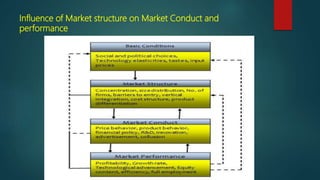
 Market structure refers to those organizational characteristics of a market
which influence the nature of competition and pricing, and affect the
conduct of business firms
 Market structure refers to those characteristics of the market which affect
the traders' behaviour and their performances.
Features of Market Structure
 The number of firms
 The market share of the largest firms
 The nature of costs
 The degree to which the industry is vertically integrated
 The extent of product differentiation
 Entry barriers
 The degree of standardization of product
 Pricing
Components of market
 Concentration of Market Power
 Degree of Product Differentiation
 Conditions for entry of Firms in the Market
 Flow of Market Information
 Degree of Integration
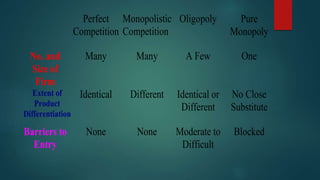
Types of market structure
Perfect
Competition
Monopolistic
Competition
Oligopoly Pure
Monopoly
No. and
Size of
Firm
Many Many A Few One
Extent of
Product
Differentiation
Identical Different Identical or
Different
No Close
Substitute
Barriers to
Entry
None None Moderate to
Difficult
Blocked
Characteristics of Monopoly
 Monopolies can maintain super-normal profits in the long run. As with
all firms, profits are maximized when MC = MR.
 With no close substitutes, the monopolist can derive super-normal
profits, area PABC.
 A monopolist with no substitutes would be able to derive the greatest
monopoly power.
Characteristics of Oligopoly
Duopoly & Characteristics of Monopolistic
Competition
 Duopoly Characteristics of Monopolistic Competition
Influence of Market structure on Market Conduct and
performance
Market Structure Dynamics
 Market dynamics are pricing signals that are created as a result of
changing supply and demand levels in a given market.
 Market dynamics is a fundamental concept in supply, demand and
pricing economic models
Market Conduct
 Market conduct refers to the price and other market policies pursued by sellers, in
terms both of their aims and of the way in which they coordinate their decisions and
make them mutually compatible.
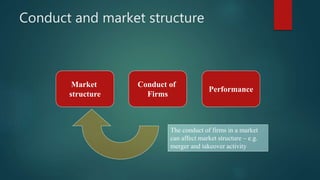
Conduct and market structure
Market
structure
Conduct of
Firms
Performance
The conduct of firms in a market
can affect market structure – e.g.
merger and takeover activity
Market Performance
Performance refers to the economic outcomes that result from the market
structure and the firms’ conduct. To evaluate an industry’s performance,
economists consider
 allocation efficiency;
 production efficiency;
 equity; and
 technological advancement.
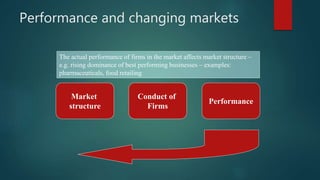
Performance and changing markets
Market
structure
Conduct of
Firms
Performance
The actual performance of firms in the market affects market structure –
e.g. rising dominance of best performing businesses – examples:
pharmaceuticals, food retailing
For satisfaction market performance, the market
structure, should keep pace with the following changes
 Production Pattern
 Demand Pattern
 Cost and Pattern of marketing functions
 Technological change in industry
Producers surplus and market structure conduct performance

Producers surplus and market structure conduct performance

  • 1.
    Assignment Title Producer Surplusand Marketing Structure Conduct Performance By S.ADHIYAMAAN B.Sc. Horticulture
  • 2.
    PRODUCER’S SURPLUS  Thisis the quantity which is actually made available to the non-producing population of the country.  From the marketing point of view, this surplus is more important than the total production of commodities.  An increase in production must be accompanied by an increase in the marketable surplus for the economic development of the country.
  • 3.
    Importance of Producer’sSurplus  Framing Sound Price Policies  Developing Proper Procurement and Purchase Strategies  Checking Undue Price Fluctuations  Export/Import policies  Development of Transport and Storage Systems
  • 4.
    Relationship between Marketedsurplus and Marketable surplus  The marketed surplus is more than the marketable surplus Marketed surplus > Marketable surplus The marketed surplus is more than the marketable surplus when the farmer retains a smaller quantity of crop than his actual family and farm requirements.  The marketed surplus is less than the marketable surplus Marketed surplus < Marketable surplus This situation holds good under a) large farmers generally sell less than the marketable surplus because of their better retention capacity.  The marketed surplus may be equal to the marketable surplus Marketed surplus = Marketable surplus The marketed surplus may be equal to the marketable surplus when the farmer neither retains more nor less than his requirement.
  • 5.
    Types of Producer'sSurplus  Marketable Surplus The marketable surplus is that quantity of the produce which can be made available to the non-farm population of the country.  Where MS = Marketable surplus P = Total production, and C = Total requirements (family consumption, farm needs, payment to labour, artisans, landlord and payments for social and religious work).  Marketed Surplus Marketed surplus is that quantity of the produce which the producer-farmer actually sells in the market, irrespective of his requirements for family consumption, farm needs and other payments.
  • 6.
    Relationship between pricesand marketable surplus  Inverse relationship This implies that the farmers' consumption is a residual, and that the marketed surplus is inversely proportional to the price level. This behaviour assumes that farmers have inelastic cash requirements.  Positive relationship This relationship is based on the assumption that farmers are price conscious.
  • 7.
    Selling Behaviour ofFarmers  It is determined by the following factors  Financial condition of the farmer  Nature of commodity to be marketed  Marketable surplus  Binding of farmer to particular middleman.  Development of marketing institutions.  Transport and infrastructure facilities availability.  Market information  Government policies  Weather conditions at the time of harvest  Packing materials and destination of markets.
  • 8.
    Factors Affecting MarketableSurplus  Size of Holding  Production  Price of the Commodity  Size of Family  Requirement of Seed and Feed  Nature of Commodity  Consumption Habits M = f(x1, x2, x3, x4)
  • 9.
    Market Structure  Theterm structure refers to something that has organization and dimension – shape, size and design; and which is evolved for the purpose of performing a function.  Market structure refers to those organizational characteristics of a market which influence the nature of competition and pricing, and affect the conduct of business firms  Market structure refers to those characteristics of the market which affect the traders' behaviour and their performances.
  • 10.
    Features of MarketStructure  The number of firms  The market share of the largest firms  The nature of costs  The degree to which the industry is vertically integrated  The extent of product differentiation  Entry barriers  The degree of standardization of product  Pricing
  • 11.
    Components of market Concentration of Market Power  Degree of Product Differentiation  Conditions for entry of Firms in the Market  Flow of Market Information  Degree of Integration
  • 12.
    Types of marketstructure
  • 13.
    Perfect Competition Monopolistic Competition Oligopoly Pure Monopoly No. and Sizeof Firm Many Many A Few One Extent of Product Differentiation Identical Different Identical or Different No Close Substitute Barriers to Entry None None Moderate to Difficult Blocked
  • 14.
    Characteristics of Monopoly Monopolies can maintain super-normal profits in the long run. As with all firms, profits are maximized when MC = MR.  With no close substitutes, the monopolist can derive super-normal profits, area PABC.  A monopolist with no substitutes would be able to derive the greatest monopoly power.
  • 15.
  • 16.
    Duopoly & Characteristicsof Monopolistic Competition  Duopoly Characteristics of Monopolistic Competition
  • 17.
    Influence of Marketstructure on Market Conduct and performance
  • 18.
    Market Structure Dynamics Market dynamics are pricing signals that are created as a result of changing supply and demand levels in a given market.  Market dynamics is a fundamental concept in supply, demand and pricing economic models
  • 19.
    Market Conduct  Marketconduct refers to the price and other market policies pursued by sellers, in terms both of their aims and of the way in which they coordinate their decisions and make them mutually compatible.
  • 20.
    Conduct and marketstructure Market structure Conduct of Firms Performance The conduct of firms in a market can affect market structure – e.g. merger and takeover activity
  • 21.
    Market Performance Performance refersto the economic outcomes that result from the market structure and the firms’ conduct. To evaluate an industry’s performance, economists consider  allocation efficiency;  production efficiency;  equity; and  technological advancement.
  • 22.
    Performance and changingmarkets Market structure Conduct of Firms Performance The actual performance of firms in the market affects market structure – e.g. rising dominance of best performing businesses – examples: pharmaceuticals, food retailing
  • 23.
    For satisfaction marketperformance, the market structure, should keep pace with the following changes  Production Pattern  Demand Pattern  Cost and Pattern of marketing functions  Technological change in industry