Prosthetic valves
Types
Selection
Complications
Types
• Bioprosthetic valves
– Heterograft (xenograft)
• Bovine
• porcine
– Homograft (allograft)
– Autograft
• Pericardial
• Pulmonary (Ross)
• Mechanical
– Caged ball valve
– Tilting disc valve
– Bileaflet valve
Heterografts(xenografts)
• Stentless
– Porcine
• Toronto SPV valve,
medtronic freestyle valve
• Stented
- facilitate implant, maintain 3D
relationship,more physiological flow
– Porcine
• Hancock , carpenteir
edward s, medtronic
– Bovine
• Stented bovine p prosthesis
The Hancock M.O. II aortic
bioprosthesis (porcine)
Carpentier-Edwards Duralex mitral
bioprosthesis
Tissue heterograft
• Advantages
- No need of anticoagulation after
1st 3 m
– Little hemolysis
• Disadvantages
– Limited ,uncertain durability
• Cuspal tear
• Perforation
• degeneration
– Rapid deterioration esp children
• Fibrin depostn
• Ca++
• 10-30% need re op in 10 yr
• 30-60% need re op in 15 yr
– Small size have poor
hemodynamics
Bioprosthetic valve
Preferred in
• Pregnancy
• Bleeding Diathesis
• Age> 70 years
• Poor compliance
Mechanical valves
– Caged ball valve
Advantages
• Oldest
• durabilty upto 40 yr
Disadvantages
• high profile
• hemolysis
• high thrombogenecity
• Poor hemodynamics in
small sizes
Unique features
• Occluder travels completely out
of the orifice, reduces thrombus
& pannus growing from the
sewing ring
• Continuously changing points of
contact of the ball reduces the
wear & tear in any one area
• Thrombogenic risk 4-6% / year
Starr Edwards Valve
• not suitable
- for the mitral position in patients with a small left
ventricular cavity
- for the aortic position in those with a small aortic
annulus
- those requiring a valve-aortic arch composite graft
Tilting disc valve- monoleaflet
• - Medtronic Hall valve
- Omnicarbon (Medical CV)
- Monostrut (Alliance Medical
Technologies)
- Bjork-Shiley valves
– Adv
• low profile
• Good hemodynamics even in
small sizes
• Excellent durability
• Permit central laminar flow
• Medtronic hall valve
– Titanium housing
– teflon sewing ring
– carbon coated disc
– disadv –
• Anticoagulation mandatory
• higher risk of thrombosis
than cage ball v
• sudden catastrophic valve
thrombosis
Bileaflet valve
Adv –
• Low bulk - flat profile
• Less thrombogenicy
• Central laminar flow
• two semicircular discs that
pivot between open and
closed positions
• No need for supporting
struts
• Good hemodynamics even
in small sizes
• 2 lat ,1 central minor orifice
, no chance of sudden
catastro thrombosis
Disadv-
• Anticoagulation
mandatory
• risk of thrombosis
St. Jude Medical mechanical heart valve
Carbomedics
Titanium housing
Pyrolytic carbon
Types of prosthetic valves and thrombogenicity
Type of valve Model Thrombogenicity
Mechanical
Caged ball Starr-Edwards ++++
Single tilting disc Bjork-Shiley,Medtronic Hall +++
Bileaflet St Jude Medical,Sorin
Bicarbon,Carbomedics
++
Bioprosthetic
Heterografts Carpentier-Edwards,Tissue
Med (Aspire), Hancock II
+ to ++
Homografts +
TTK chitra
• tilting disc valve
- metallic housing (cobalt based wrought alloy)
- circular disc high molecular weight polyethylene
- A polyester suture ring
• Hemodynamically comparable to other mechanical
valves
• valve related complications are similar
Characteristics of
Various
prosthetic valves
Flow Dynamics
Desired valves
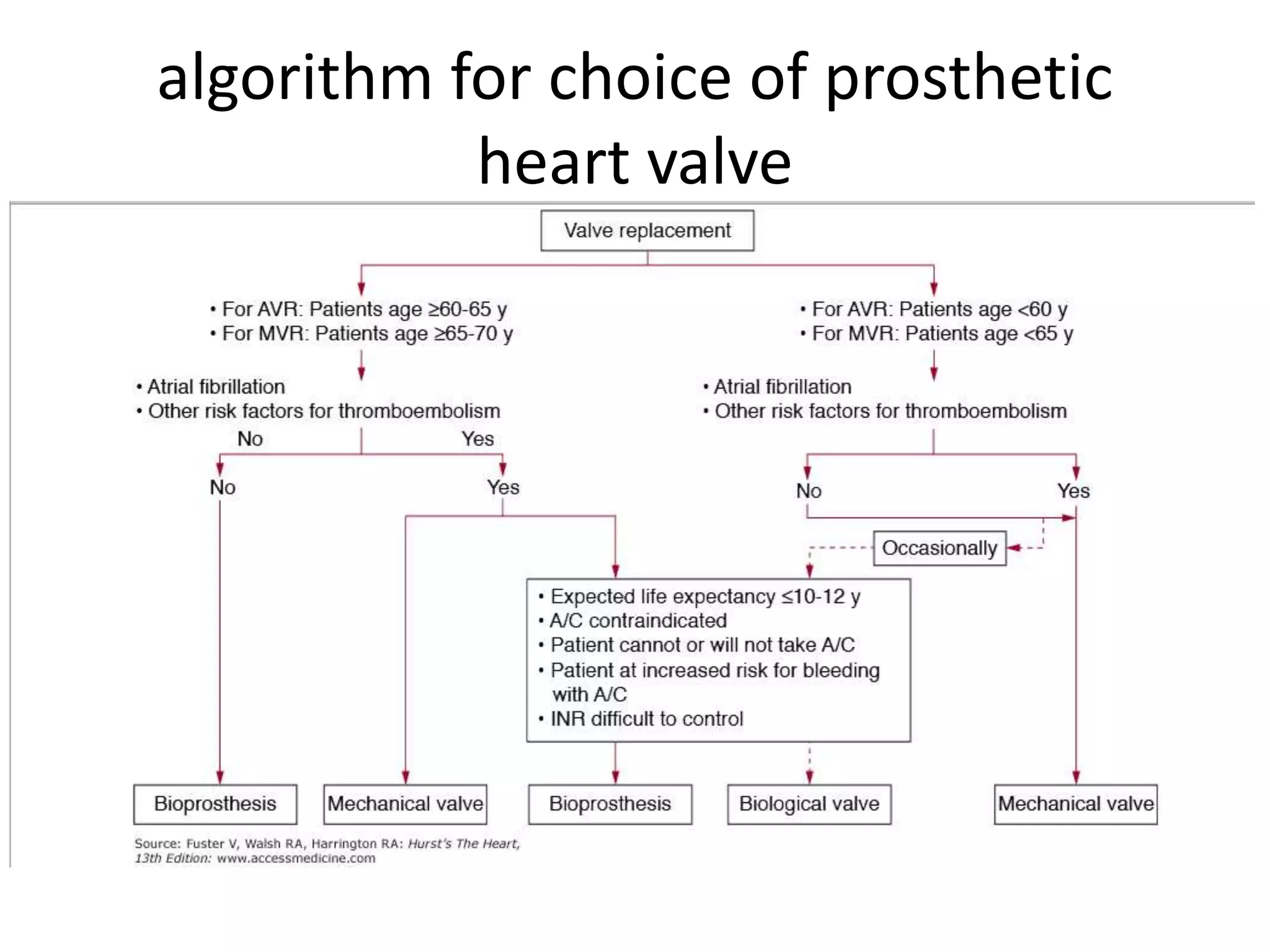
• Mechanical valves - preferred in young patients
who have a life expectancy of more than 10 to 15 years
who require long-term anticoagulant therapy for other
reasons (e.g., atrial fibrillation)
• Bioprosthetic valves
preferred in patients who are elderly
have a life expectancy of less than 10 to 15 years
who cannot take long-term anticoagulant therapy
• A bileaflet-tilting-disk or homograft prosthesis is most suitable
for a patient with a small valvular annulus in whom a
prosthesis with the largest possible effective orifice area is
desired.
algorithm for choice of prosthetic
heart valve
Radiologic Identification
Starr-Edwards caged ball
valve
Radiopaque base ring
Radiopaque cage
Three struts for the aortic
valve; 4 struts for the
mitral or tricuspid valve
Silastic ball impregnated
with barium that is mildly
radiopaque (but not in all
models)
TTE – stenosis
Valve area calculations
• Continuity equation
Area Ao prosthesis =
(diameter sewing ring)² x 0.785xLVOT VTI/ Ao prosthesis VTI
Area mitral prosthesis=
(diameter LVOT)²x 0.785xLVOT VTI/ VTI mitral prosthesis
• Pressure Half time ( mitral valve prosthesis)
• Dimensionless index-
LVOT velocity/ aortic prosthesis velocity
< 0.23 indicates prosthetic valve stenosis
Prosthetic Valve regugitation
• Mitral – velocity2.5m/sec
- jet area 2cm²
• Aortic -- aortic PHT≤ 250m/sec
-- flow reversal in aorta
Normal Doppler Values of Prosthetic
Valves
Aortic Position
Velocity Mean Gr
Starr Edward 3.1±0.5 24±4
St Jude 3.0±0.8 11±6
Medtronic Hall 2.6±0.3 12±3
Aortic Homograft 0.8±0.4 7±3
Hancock 2.4±0.4 11±2
Carpentier’s 2.4±0.5 14±6
Mitral Position
Velocity MeanGr
Starr Edward 1.8±0.5 7±2
St Jude 1.5±0.3 5±2
Medtronic Hall 1.6±0.3 5±2
Aortic Homograft 1.5±0.4 4±2
Hancock 1.5±0.3 5±2
Carpentier’s 1.5±0.3 5±2
Importance of TEE
• higher-resolution image than TTE
• size of vegetation defined more precisely
• peri annular complications indicating a locally
uncontrolled infection (abscesses, dehiscence,
fistulas) detected earlier
• limitation -inability to detect aortic prosthetic-valve
obstruction or regurgitation, especially when a mitral
prosthesis is present
Mitral Bileaflet
Cinefluoroscopy
• Structural integrity
• Motion of the disc or poppet
• excessive tilt ("rocking") of the base ring -
partial dehiscence of the valve
• Aortic valve prosthesis - RAO caudal
- LAO cranial
Mitral -- RAO cranial
Fluoroscopy of a normally functioning CarboMedics
bileaflet prosthesis in mitral position
A=opening angle B=closing angle
• St. Jude medical
bileaflet valve
– Mildly radiopaque
leaflets are best seen
when viewed on end
– Seen as radiopaque
lines when the leaflets
are fully open
– Base ring is not
visualized on most
models
MRI
• Not useful in assessing prosthetic-valve
structure
• used only when prosthetic-valve regurgitation
or para valvular leakage is suspected but not
adequately visualized by echocardiography
Cardiac Catheterization
• measure the transvalvular pressure gradient,
from which the EOA can be calculated
• can visualize and quantify valvular or
paravalvular regurgitation
Valve dysfunction
complication example Role of echo
Primary mechanical failure Ball variance
Strut fracture
Visualize structure, assess
gradient & regurgitation
Nonstructural dysfunction Pt- prosthesis mismatch
pannus
Gradient, visualize tissue in
& around the sewing ring
Bleeding event Intracranial hge Source of embolus,
presence & mobility of
masses
Endocarditis Vegetation, abcess,
dehiscence
Visualize area around the
sewing ring, echo dense /
lucent area, perivalvular
regurgitation
Thrombosis Thrombus impedes
opening &closing of
occluder mechanism
Localize mass, assess
gradient, detect
regurgitation
Embolism stroke Identify & characterize the
source of emboli
patient-prosthesis mismatch
• When the effective prosthetic valve area, after insertion into the
patient less than that of a normal valve (Rahimtoola in 1978)
• EOA indexed to BSA is less than 0.85 cm2/m2
• EOA (echo) differs from geometric orifice area (measured directly)
• EOA for each prostheses type & size obtained in literature from pts
normally functioning prostheses
• Average if > 1 value
-- mild (0.9 - 1 cm² /m²
-- moderate (0.6 - 0.9 cm2/m²
-- severe (iEOA < 0.6cm²/m² (Rahimtoola)
• in-vitro area of the majority of valve prostheses ( int
diameter <23 mm) < that of the normal human valve
area
• the in-vivo prosthetic area further reduced by IVS
hypertrophy, progressive endothelialization and
tissue ingrowth
(Aortic prosthetic devices may be functionally
stenotic)
three-step algorithm
• Step 1: Calculation of the patient BSA.
Step 2: Reference to the specific table for identification of the
adequate valvular EOA according to the patient BSA.
Step 3: Selection of the most appropriate type and size of
valve prosthesis according to the target iEOA
Valve Thrombosis
Incidence of 0.1 to 5.7 % per patient-year
<0.2% per year for mech valves
<0.1% bioprosthetic valves
• small thrombus, at the hinge portion of a bileaflet valve obstruct
the mechanism
• tilting disk -- a much larger thrombus to prevent function
• Ball and cage valves – less susceptible  occluder has no
contact at all with the valve housing for a portion of every cycle
Clinical
– Non obstructive- incidental/embolic phenomenon
– Partial obstruction- dyspnea,systemic embolism , fever
– Severe obstruction- overt heart failure
• Fibrinolytic therapy - Rt sided thrombosis
80-100% success rate
• Surgery for fibrinolysis failure/symptoms > 3 wk
• Surgery – Lt sided thrombosis, large clot
burden
FIBRINOLYTIC PROTOCOL
heart 2007;93:137-142
• 2 types of protocol
-rescue fibrinolysis (short protocol for unstable pt)
- long protocol for stable pt
• Short protocol
- r tPA 10 mg bolus + 90 mg in 90 min or
- SK 15lac in 60 min
• Long protocol
-- SK- 5lac u in 20 min f/b 15lac u for 10 hr
-- rtPA -- 10 mgbolus f/b 90mg/hr for 9 hrs
• Urokinase
– High dose: 4,500 IU/kg/h for 12 h without heparin
– Low dose: 2,000 IU/kg/h with heparin for 24 h
Embolisation
• cerebral embolization  CT normal/infarctwarf &
heparin – 72 hrs APTT lower therapeutic level till
the desired INR
• anticoagulantion delayed for at least 7 to 14 days -
ICH, extensive cerebral infarction  OAC
If embolic event occurs while the patient is on adequate
antithrombotic therapy
• If on warfarin with INR of 2.0 to 3.0: increase dose to
achieve INR of 2.5 to 3.5
• If on warfarin with INR of 2.5 to 3.5: add aspirin 50 to
100 mg/d
• If on warfarin with INR of 2.5 to 3.5, plus aspirin 80 to
100 mg/d: aspirin dose may also need to be increased
to 325 mg/d
• If on aspirin 325 mg/d: switch to warfarin with goal INR
of 2.0 to 3.0
Excessive Anticoagulation
• vit K 2.5 mg daily until the INR is acceptable
• fresh frozen plasma
• Human recombinant factor VIIa, 15 to 19 g/kg
(INR >10.0 with bleeding)
Structural Failure of Bioprosthetic Valves
• About 30 % of heterograft bioprosthetic valves and
10 to 20 % of homograft valves require replacement
within 10 to 15 years because of structural failure
• severe regurgitation due to a tear or rupture of one
or more of the valve cusps
• calcified and rigid valves
• Rarely severe valvular stenosis
Structural deterioration
• Higher incidence patients <40 years & with mitral
prostheses
• gradual onset of dyspnea and other symptoms of
heart failure
• Bioprosthetic-valve regurgitation or stenosis can be
detected by auscultation
• valve dysfunction assessed by echocardiography or
catheterization
Failure of Bio prosthetic Valves
Hemolysis
• Incidence - 6%
• Subclinical intravascular hemolysis
• severe hemolytic anemia uncommon & suggests
paravalvular leakage due to partial dehiscence of the
valve or infection
• Patients with a caged-ball valve / multiple prosthetic
valves have an increased incidence & severity of
hemolysis.
Hemolysis
• Pts with hemolytic anemia treated with iron & folate
supplements or blood transfusion
- decreased blood viscosity & increased COP a/w
anemia increase the hemolysis
• Paravalvular leakage & severe hemolysis – valve
replacement or repair
Para valvular leak
• improper implantation of a valve
• A heavily calcified annulus is a risk factor for
paravalvular leaks -- incomplete debridement of
calcium compromises both suture placement and
valve seating
• Active endocarditis is also a risk factor
• Late paravalvular leaks are suggestive of prosthetic
valve endocarditis
• generally result in hemolysis
• In the absence of a paravalvular leak, a normally
functioning modern valve should not result in
hemolysis
Paravalvular Regurgitation
• mild or moderate paravalvular leakage -
asymptomatic , may have only a mild hemolytic
anemia
- can be observed carefully with serial echo
• severe paravalvular leakage - usually have symptoms
of heart failure or severe anemia
- should be treated with surgical repair or
replacement of the valve
PVE (2-6%)
salient features
• Endovascular, microbial infection occurring on parts
of a valve prosthesis or on reconstructed native heart
valves , with or without implantation of an annular
ring
• early PVE is 5% higher in surgery during active IE
• Diagnostic approach, surgical indications same
PVE how diff from native?
PVE NVE
• Early- nosocomial
• Late- comm acquired
• Mech prosthesis -originate
from the sewing cuff /from
nearby located thrombi →
periprosthetic leaks, ring
abscesses, invasion of adjacent
tissue
• Bioprosthesis infections mostly
restricted to the cusps →
secondary bioprosthetic failure
• Staphylococci, HACEK group,
fungi occur more frequently in
PVE
• Strepto & enterococci found
more frequently in native
valve endocarditis
• vegetations larger
• irreversible adhesion
production of a biofilm,
 inhibit the host
defence
mechprotects against
antimicrobial Tt
• Duration of Tt longer
• Smaller
• No such biofilm
Pannus Valve obstruction occurs 5-10% of mechanical
valves per year
Thrombus
• mobile, somewhat less
echo-dense, associated with
spontaneous contrast
Pannus
• Pannus formation -more
common in aortic position
• fibrous tissue ingrowth
• highly echogenic
• usually firmly fixed to the
valve apparatus
• Pre valve jet suggests
pannus
MCQ
1.Factors favouring bioprostheses include all
except
a. Age > 70 yrs
b. Bleeding diathesis
c. Combined multivalvular placement
d. Poor compliance
2. Which of the following favours valve repair?
a. RHD
b. Endocarditis
c. Extensive leaflet destruction
d. MVP
3. Which is the most durable mechanical
prosthesis?
a. St Jude medical
b. Medtronic Hall
c. Starr- Edwards
d. Bjork Shiley
4. Indication for long term anticoagulation in
aortic bioprosthesis include all except
a. Prior embolic events
b. Atrial fibrillation
c. Ventricular tachycardia
d. LV dysfunction
5. 55yr male, s/p AVR for BAV , SR, good LV function,
Dental prophylaxis needed, anti thrombotic therapy
would be the following
a. Stop warf 72 hrs before procedure, restart after
control of bleeding
b. Stop warf 72 hrs before procedure, start heparin
48hrs before procedure
c. Stop warf 1wk before procedure
d. Continue warf
6 . Heparin alone regimen in a pregnant lady on
OAC, s/p MVR , thrombo embolic
complications would be
a. 25%
b. 33%
c. 43%
d. 45%
7. Ideal anti thrombotic therapy in a 45 yr female,
s/p MVR for RHD, with h/o embolic stroke would
be the following
a. Warfarin INR 2.5- 3.5, aspirin 50- 100mg
b. Warfarin INR 2.0 - 3.0, aspirin 50- 100mg
c. Warfarin INR 2.5- 3.5, aspirin 75- 150mg
d. Warfarin INR 2.0 - 3.0, aspirin 75- 150mg
8. Prosthetic valve thrombosis would be
catastrophic in the following
a. Bioprosthesis
b. Tilting disc valve
c. Bileaflet valve
d. Starr- Edwards valve
9. Mitral prostheses best assessed by
a. RAO cranial
b. RAO caudal
c. LAO cranial
d. LAO caudal
10. Clinical hemolysis is maximum with
a. Caged ball
b. Bioprosthesis
c. Tilting disc
d. Bileaflet

Prosthetic valves-.ppsx

  • 1.
  • 2.
    Types • Bioprosthetic valves –Heterograft (xenograft) • Bovine • porcine – Homograft (allograft) – Autograft • Pericardial • Pulmonary (Ross) • Mechanical – Caged ball valve – Tilting disc valve – Bileaflet valve
  • 3.
    Heterografts(xenografts) • Stentless – Porcine •Toronto SPV valve, medtronic freestyle valve • Stented - facilitate implant, maintain 3D relationship,more physiological flow – Porcine • Hancock , carpenteir edward s, medtronic – Bovine • Stented bovine p prosthesis The Hancock M.O. II aortic bioprosthesis (porcine) Carpentier-Edwards Duralex mitral bioprosthesis
  • 4.
    Tissue heterograft • Advantages -No need of anticoagulation after 1st 3 m – Little hemolysis • Disadvantages – Limited ,uncertain durability • Cuspal tear • Perforation • degeneration – Rapid deterioration esp children • Fibrin depostn • Ca++ • 10-30% need re op in 10 yr • 30-60% need re op in 15 yr – Small size have poor hemodynamics
  • 5.
    Bioprosthetic valve Preferred in •Pregnancy • Bleeding Diathesis • Age> 70 years • Poor compliance
  • 6.
    Mechanical valves – Cagedball valve Advantages • Oldest • durabilty upto 40 yr Disadvantages • high profile • hemolysis • high thrombogenecity • Poor hemodynamics in small sizes Unique features • Occluder travels completely out of the orifice, reduces thrombus & pannus growing from the sewing ring • Continuously changing points of contact of the ball reduces the wear & tear in any one area • Thrombogenic risk 4-6% / year
  • 7.
    Starr Edwards Valve •not suitable - for the mitral position in patients with a small left ventricular cavity - for the aortic position in those with a small aortic annulus - those requiring a valve-aortic arch composite graft
  • 8.
    Tilting disc valve-monoleaflet • - Medtronic Hall valve - Omnicarbon (Medical CV) - Monostrut (Alliance Medical Technologies) - Bjork-Shiley valves – Adv • low profile • Good hemodynamics even in small sizes • Excellent durability • Permit central laminar flow • Medtronic hall valve – Titanium housing – teflon sewing ring – carbon coated disc – disadv – • Anticoagulation mandatory • higher risk of thrombosis than cage ball v • sudden catastrophic valve thrombosis
  • 9.
    Bileaflet valve Adv – •Low bulk - flat profile • Less thrombogenicy • Central laminar flow • two semicircular discs that pivot between open and closed positions • No need for supporting struts • Good hemodynamics even in small sizes • 2 lat ,1 central minor orifice , no chance of sudden catastro thrombosis Disadv- • Anticoagulation mandatory • risk of thrombosis St. Jude Medical mechanical heart valve Carbomedics Titanium housing Pyrolytic carbon
  • 11.
    Types of prostheticvalves and thrombogenicity Type of valve Model Thrombogenicity Mechanical Caged ball Starr-Edwards ++++ Single tilting disc Bjork-Shiley,Medtronic Hall +++ Bileaflet St Jude Medical,Sorin Bicarbon,Carbomedics ++ Bioprosthetic Heterografts Carpentier-Edwards,Tissue Med (Aspire), Hancock II + to ++ Homografts +
  • 12.
    TTK chitra • tiltingdisc valve - metallic housing (cobalt based wrought alloy) - circular disc high molecular weight polyethylene - A polyester suture ring • Hemodynamically comparable to other mechanical valves • valve related complications are similar
  • 14.
  • 15.
  • 16.
    Desired valves • Mechanicalvalves - preferred in young patients who have a life expectancy of more than 10 to 15 years who require long-term anticoagulant therapy for other reasons (e.g., atrial fibrillation) • Bioprosthetic valves preferred in patients who are elderly have a life expectancy of less than 10 to 15 years who cannot take long-term anticoagulant therapy • A bileaflet-tilting-disk or homograft prosthesis is most suitable for a patient with a small valvular annulus in whom a prosthesis with the largest possible effective orifice area is desired.
  • 17.
    algorithm for choiceof prosthetic heart valve
  • 19.
    Radiologic Identification Starr-Edwards cagedball valve Radiopaque base ring Radiopaque cage Three struts for the aortic valve; 4 struts for the mitral or tricuspid valve Silastic ball impregnated with barium that is mildly radiopaque (but not in all models)
  • 20.
    TTE – stenosis Valvearea calculations • Continuity equation Area Ao prosthesis = (diameter sewing ring)² x 0.785xLVOT VTI/ Ao prosthesis VTI Area mitral prosthesis= (diameter LVOT)²x 0.785xLVOT VTI/ VTI mitral prosthesis • Pressure Half time ( mitral valve prosthesis) • Dimensionless index- LVOT velocity/ aortic prosthesis velocity < 0.23 indicates prosthetic valve stenosis
  • 21.
    Prosthetic Valve regugitation •Mitral – velocity2.5m/sec - jet area 2cm² • Aortic -- aortic PHT≤ 250m/sec -- flow reversal in aorta
  • 22.
    Normal Doppler Valuesof Prosthetic Valves Aortic Position Velocity Mean Gr Starr Edward 3.1±0.5 24±4 St Jude 3.0±0.8 11±6 Medtronic Hall 2.6±0.3 12±3 Aortic Homograft 0.8±0.4 7±3 Hancock 2.4±0.4 11±2 Carpentier’s 2.4±0.5 14±6 Mitral Position Velocity MeanGr Starr Edward 1.8±0.5 7±2 St Jude 1.5±0.3 5±2 Medtronic Hall 1.6±0.3 5±2 Aortic Homograft 1.5±0.4 4±2 Hancock 1.5±0.3 5±2 Carpentier’s 1.5±0.3 5±2
  • 23.
    Importance of TEE •higher-resolution image than TTE • size of vegetation defined more precisely • peri annular complications indicating a locally uncontrolled infection (abscesses, dehiscence, fistulas) detected earlier • limitation -inability to detect aortic prosthetic-valve obstruction or regurgitation, especially when a mitral prosthesis is present
  • 24.
  • 25.
    Cinefluoroscopy • Structural integrity •Motion of the disc or poppet • excessive tilt ("rocking") of the base ring - partial dehiscence of the valve • Aortic valve prosthesis - RAO caudal - LAO cranial Mitral -- RAO cranial
  • 26.
    Fluoroscopy of anormally functioning CarboMedics bileaflet prosthesis in mitral position A=opening angle B=closing angle
  • 27.
    • St. Judemedical bileaflet valve – Mildly radiopaque leaflets are best seen when viewed on end – Seen as radiopaque lines when the leaflets are fully open – Base ring is not visualized on most models
  • 28.
    MRI • Not usefulin assessing prosthetic-valve structure • used only when prosthetic-valve regurgitation or para valvular leakage is suspected but not adequately visualized by echocardiography
  • 29.
    Cardiac Catheterization • measurethe transvalvular pressure gradient, from which the EOA can be calculated • can visualize and quantify valvular or paravalvular regurgitation
  • 30.
    Valve dysfunction complication exampleRole of echo Primary mechanical failure Ball variance Strut fracture Visualize structure, assess gradient & regurgitation Nonstructural dysfunction Pt- prosthesis mismatch pannus Gradient, visualize tissue in & around the sewing ring Bleeding event Intracranial hge Source of embolus, presence & mobility of masses Endocarditis Vegetation, abcess, dehiscence Visualize area around the sewing ring, echo dense / lucent area, perivalvular regurgitation Thrombosis Thrombus impedes opening &closing of occluder mechanism Localize mass, assess gradient, detect regurgitation Embolism stroke Identify & characterize the source of emboli
  • 31.
    patient-prosthesis mismatch • Whenthe effective prosthetic valve area, after insertion into the patient less than that of a normal valve (Rahimtoola in 1978) • EOA indexed to BSA is less than 0.85 cm2/m2 • EOA (echo) differs from geometric orifice area (measured directly) • EOA for each prostheses type & size obtained in literature from pts normally functioning prostheses • Average if > 1 value -- mild (0.9 - 1 cm² /m² -- moderate (0.6 - 0.9 cm2/m² -- severe (iEOA < 0.6cm²/m² (Rahimtoola)
  • 32.
    • in-vitro areaof the majority of valve prostheses ( int diameter <23 mm) < that of the normal human valve area • the in-vivo prosthetic area further reduced by IVS hypertrophy, progressive endothelialization and tissue ingrowth (Aortic prosthetic devices may be functionally stenotic)
  • 33.
    three-step algorithm • Step1: Calculation of the patient BSA. Step 2: Reference to the specific table for identification of the adequate valvular EOA according to the patient BSA. Step 3: Selection of the most appropriate type and size of valve prosthesis according to the target iEOA
  • 35.
    Valve Thrombosis Incidence of0.1 to 5.7 % per patient-year <0.2% per year for mech valves <0.1% bioprosthetic valves • small thrombus, at the hinge portion of a bileaflet valve obstruct the mechanism • tilting disk -- a much larger thrombus to prevent function • Ball and cage valves – less susceptible  occluder has no contact at all with the valve housing for a portion of every cycle Clinical – Non obstructive- incidental/embolic phenomenon – Partial obstruction- dyspnea,systemic embolism , fever – Severe obstruction- overt heart failure
  • 36.
    • Fibrinolytic therapy- Rt sided thrombosis 80-100% success rate • Surgery for fibrinolysis failure/symptoms > 3 wk • Surgery – Lt sided thrombosis, large clot burden
  • 37.
    FIBRINOLYTIC PROTOCOL heart 2007;93:137-142 •2 types of protocol -rescue fibrinolysis (short protocol for unstable pt) - long protocol for stable pt • Short protocol - r tPA 10 mg bolus + 90 mg in 90 min or - SK 15lac in 60 min • Long protocol -- SK- 5lac u in 20 min f/b 15lac u for 10 hr -- rtPA -- 10 mgbolus f/b 90mg/hr for 9 hrs • Urokinase – High dose: 4,500 IU/kg/h for 12 h without heparin – Low dose: 2,000 IU/kg/h with heparin for 24 h
  • 40.
    Embolisation • cerebral embolization CT normal/infarctwarf & heparin – 72 hrs APTT lower therapeutic level till the desired INR • anticoagulantion delayed for at least 7 to 14 days - ICH, extensive cerebral infarction  OAC
  • 41.
    If embolic eventoccurs while the patient is on adequate antithrombotic therapy • If on warfarin with INR of 2.0 to 3.0: increase dose to achieve INR of 2.5 to 3.5 • If on warfarin with INR of 2.5 to 3.5: add aspirin 50 to 100 mg/d • If on warfarin with INR of 2.5 to 3.5, plus aspirin 80 to 100 mg/d: aspirin dose may also need to be increased to 325 mg/d • If on aspirin 325 mg/d: switch to warfarin with goal INR of 2.0 to 3.0
  • 42.
    Excessive Anticoagulation • vitK 2.5 mg daily until the INR is acceptable • fresh frozen plasma • Human recombinant factor VIIa, 15 to 19 g/kg (INR >10.0 with bleeding)
  • 43.
    Structural Failure ofBioprosthetic Valves • About 30 % of heterograft bioprosthetic valves and 10 to 20 % of homograft valves require replacement within 10 to 15 years because of structural failure • severe regurgitation due to a tear or rupture of one or more of the valve cusps • calcified and rigid valves • Rarely severe valvular stenosis
  • 44.
    Structural deterioration • Higherincidence patients <40 years & with mitral prostheses • gradual onset of dyspnea and other symptoms of heart failure • Bioprosthetic-valve regurgitation or stenosis can be detected by auscultation • valve dysfunction assessed by echocardiography or catheterization
  • 45.
    Failure of Bioprosthetic Valves
  • 46.
    Hemolysis • Incidence -6% • Subclinical intravascular hemolysis • severe hemolytic anemia uncommon & suggests paravalvular leakage due to partial dehiscence of the valve or infection • Patients with a caged-ball valve / multiple prosthetic valves have an increased incidence & severity of hemolysis.
  • 47.
    Hemolysis • Pts withhemolytic anemia treated with iron & folate supplements or blood transfusion - decreased blood viscosity & increased COP a/w anemia increase the hemolysis • Paravalvular leakage & severe hemolysis – valve replacement or repair
  • 48.
    Para valvular leak •improper implantation of a valve • A heavily calcified annulus is a risk factor for paravalvular leaks -- incomplete debridement of calcium compromises both suture placement and valve seating • Active endocarditis is also a risk factor • Late paravalvular leaks are suggestive of prosthetic valve endocarditis • generally result in hemolysis • In the absence of a paravalvular leak, a normally functioning modern valve should not result in hemolysis
  • 49.
    Paravalvular Regurgitation • mildor moderate paravalvular leakage - asymptomatic , may have only a mild hemolytic anemia - can be observed carefully with serial echo • severe paravalvular leakage - usually have symptoms of heart failure or severe anemia - should be treated with surgical repair or replacement of the valve
  • 50.
    PVE (2-6%) salient features •Endovascular, microbial infection occurring on parts of a valve prosthesis or on reconstructed native heart valves , with or without implantation of an annular ring • early PVE is 5% higher in surgery during active IE • Diagnostic approach, surgical indications same
  • 51.
    PVE how difffrom native? PVE NVE • Early- nosocomial • Late- comm acquired • Mech prosthesis -originate from the sewing cuff /from nearby located thrombi → periprosthetic leaks, ring abscesses, invasion of adjacent tissue • Bioprosthesis infections mostly restricted to the cusps → secondary bioprosthetic failure • Staphylococci, HACEK group, fungi occur more frequently in PVE • Strepto & enterococci found more frequently in native valve endocarditis
  • 52.
    • vegetations larger •irreversible adhesion production of a biofilm,  inhibit the host defence mechprotects against antimicrobial Tt • Duration of Tt longer • Smaller • No such biofilm
  • 53.
    Pannus Valve obstructionoccurs 5-10% of mechanical valves per year Thrombus • mobile, somewhat less echo-dense, associated with spontaneous contrast Pannus • Pannus formation -more common in aortic position • fibrous tissue ingrowth • highly echogenic • usually firmly fixed to the valve apparatus • Pre valve jet suggests pannus
  • 56.
  • 57.
    1.Factors favouring bioprosthesesinclude all except a. Age > 70 yrs b. Bleeding diathesis c. Combined multivalvular placement d. Poor compliance
  • 58.
    2. Which ofthe following favours valve repair? a. RHD b. Endocarditis c. Extensive leaflet destruction d. MVP
  • 59.
    3. Which isthe most durable mechanical prosthesis? a. St Jude medical b. Medtronic Hall c. Starr- Edwards d. Bjork Shiley
  • 60.
    4. Indication forlong term anticoagulation in aortic bioprosthesis include all except a. Prior embolic events b. Atrial fibrillation c. Ventricular tachycardia d. LV dysfunction
  • 61.
    5. 55yr male,s/p AVR for BAV , SR, good LV function, Dental prophylaxis needed, anti thrombotic therapy would be the following a. Stop warf 72 hrs before procedure, restart after control of bleeding b. Stop warf 72 hrs before procedure, start heparin 48hrs before procedure c. Stop warf 1wk before procedure d. Continue warf
  • 62.
    6 . Heparinalone regimen in a pregnant lady on OAC, s/p MVR , thrombo embolic complications would be a. 25% b. 33% c. 43% d. 45%
  • 63.
    7. Ideal antithrombotic therapy in a 45 yr female, s/p MVR for RHD, with h/o embolic stroke would be the following a. Warfarin INR 2.5- 3.5, aspirin 50- 100mg b. Warfarin INR 2.0 - 3.0, aspirin 50- 100mg c. Warfarin INR 2.5- 3.5, aspirin 75- 150mg d. Warfarin INR 2.0 - 3.0, aspirin 75- 150mg
  • 64.
    8. Prosthetic valvethrombosis would be catastrophic in the following a. Bioprosthesis b. Tilting disc valve c. Bileaflet valve d. Starr- Edwards valve
  • 65.
    9. Mitral prosthesesbest assessed by a. RAO cranial b. RAO caudal c. LAO cranial d. LAO caudal
  • 66.
    10. Clinical hemolysisis maximum with a. Caged ball b. Bioprosthesis c. Tilting disc d. Bileaflet