Prosthetic Heart Valves
    Dr Mohamed Salih Aziz
          MRCP- UK
introduction

The first mechanical prosthetic heart valve
  was implanted in 1952.
Over the years, 30 different mechanical
  designs have originated worldwide. These
  valves have progressed from simple caged
  ball valves, to modern bileaflet valves.
Prosthetic Heart Valves


In 1961, Starr and Edwards reported the
  first clinically successful placement of
  a prosthetic heart valve. Since that
  time, great strides in the development
  of new prosthetic valves (PVs) and in
  the surgical technique for their
  placement have led to improved
  valvular hemodynamics and durability
  and decreased valvular complications.
Prosthetic Heart Valves


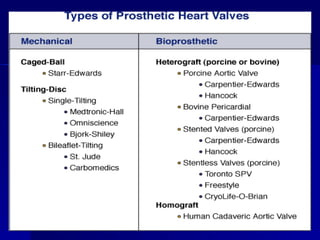
Types of Prosthetic Heart Valves ;

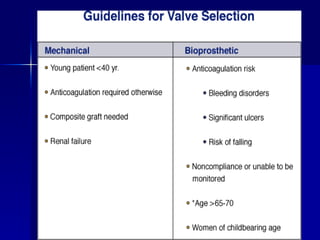
       (1) Mechanical
       (2) Bioproshetic
Mechanical Valves

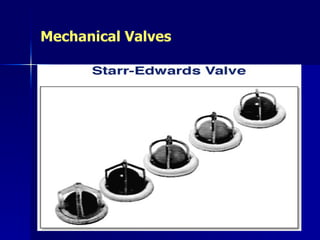
Mechanical valves have evolved over the past 30
  yrs from the initial caged- ball model of Starr &
  Edwards to a tilting- disk design .
The tilting-disk design of Bjork & Shiley and
  Medtronic-Hall valves improved hemodynamics
  flow characteristics and increased the effective
  orifice area EOA over the caged-ball valve .
Mechanical Valves
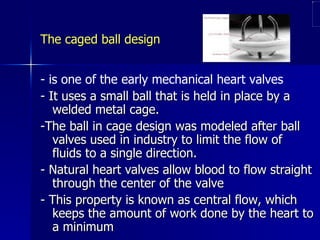
The caged ball design


- is one of the early mechanical heart valves
- It uses a small ball that is held in place by a
   welded metal cage.
-The ball in cage design was modeled after ball
   valves used in industry to limit the flow of
   fluids to a single direction.
- Natural heart valves allow blood to flow straight
   through the center of the valve
- This property is known as central flow, which
   keeps the amount of work done by the heart to
   a minimum
The caged ball design

   With non-central flow, the heart must work
    harder to compensate for the momentum lost
    to the change of direction of the fluid.
   Caged-ball valves completely block central flow,
    therefore the blood requires more energy to
    flow around the central ball.
   the ball is notorious for causing damage to
    blood cells due to collisions thus the pt is
    required to take life long anticoagulants
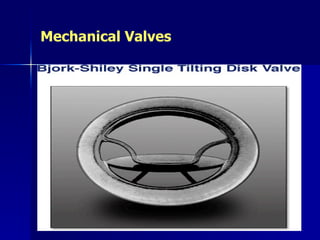
The tilting-disc valves

- In the mid-1960s, a new class of
  prosthetic valves were designed that used a
  tilting disc to better mimic the natural patterns
  of blood flow.
-The tilting-disc valves have a polymer disc held
  in place by two welded struts.
-The titling-disc valves open at an angle of 60°
  and close shut completely at a rate of 70
  times/minute.
Mechanical Valves
The Tilting-disc Valves

-This tilting pattern provides improved central
  flow while still preventing backflow.
-The tilting-disc valves reduce mechanical
  damage to blood cells. This improved flow
  pattern reduced blood clotting and infection.
-the only problem with this design is its tendency
  for the outlet struts to fracture as a result of
  fatigue from the repeated ramming of the
  struts by the disc.
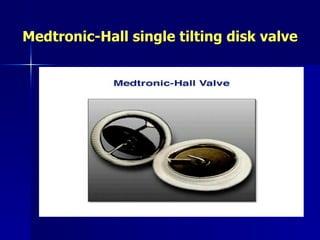
Medtronic-Hall single tilting disk valve

 has a Teflon sewing ring, and titanium
  housing machined from solid cylinder and a
  carbon-coated disk with flat parallel sides.
The disk which opens to 75 degree in the
  aortic model and 70 in the mitral, is retained
  by an S shaped guide strut that protrudes
  through a hole in the center of the disk.
Medtronic-Hall single tilting disk valve
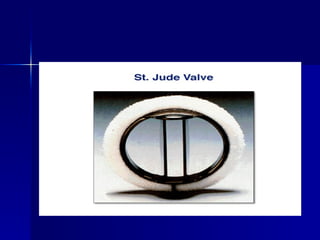
Bileaflet Valves

* In 1979, a new mechanical heart valve was
  introduced.
*These valves were known as bileaflet valves,
  and consisted of two semicircular leaflets that
  pivot on hinges. The carbon leaflets exhibit high
  strength and excellent biocompatibility. The
  leaflets swing open completely, parallel to the
  direction of the blood flow.
*They do not close completely, which allows
  some backflow.
Bileaflet valves

 *Since backflow is one of the properties of
  defective valves, the bileaflet valves are still
  not ideal valves.
 *The bileaflet valve constitutes the majority
  of modern valve designs.
*These valves are distinguished mainly for
  providing the closest approximation to
  central flow achieved in a natural heart
  valve
Advantages of mechanical valves;


The main advantages of mechanical
 valves are their high durability.
Mechanical heart valves are placed in
 young patients because they typically
 last for the lifetime of the patient
Disadvantages of mechanical valves;

increased risk of blood clotting
mechanical valve recipients must take
  anti-coagulant drugs (sodium warfarin)
  chronically, which effectively makes
  them borderline hemophiliacs.
PROSTHETIC TISSUE VALVES

Bioproshetic heart valves are divided into:
 A) Heterografts( from another species)
 B) Allografts/Homografts( human cadever)
The design of bioprosthetic valves are closer to the design
   of the natural valve.
Bioprosthetic valves do not require long-term
   anticoagulats, have better hemodynamics, do not cause
   damage to blood cells, and do not suffer from many of
   the structural problems experienced by the mechanical
   heart valves
Human Tissue Valves


Homografts;
valves that are transplanted from
  another human being.
Autografts;
valves that are transplanted from one
  position to another within the same
  person
Human tissue valves

A homograft is a valve that is transplanted from a
  deceased person to a recipient.
they do not require immunosuppressive therapy.
  A homograft that has been donated must be
  cryopreserved in liquid nitrogen until it is
  needed.
homografts tend to have good hemodynamics
  and good durability. it is not clear whether
  homografts have better hemodynamics or
  durability than animal tissue valves.
Human tissue valves

Autografts are valves taken from the same patient
  that they are implanted into.
The most common autograft procedure is the Ross
  procedure, which is used in patients with
  diseased aortic valves (The dysfunctional aortic
  valve is removed and the patient's pulmonic
  valve is then transplanted to the aortic position)
A homograft pulmonic valve is usually used to
  replace the patient’s pulmonic valve
Continue Ross procedure


   The Ross procedure allows the patient the
    advantage of receiving a living valve in the
    aortic position.
   The long term survival and freedom from
    complications for patients with aortic valve
    disease are better with the Ross Procedure than
    any other type of valve replacement .
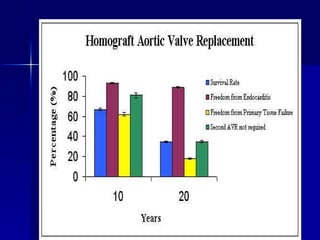
   After 20 years, only 15% of patients require
    additional valve procedures .
Continue Ross procedure


   In cases where a human pulmonary
    artery homograft is used to replace the
    patients’ pulmonary valve, freedom from
    failure has been 94% after 5 years time,
    and 83% at 20 years.
   The tissues of the patients’ pulmonary
    valve have not shown a tendency to
    calcify, degenerate, perforate, or develop
    leakage
Animal Tissue Valves

   Animal tissue valves are often referred to as
    heterograft or xenograft valves.
   These valves are most often heart tissues
    recovered from animals at the time of
    commercial meat processing.
   The leaflet valve tissue of the animals is
    inspected, and the highest quality leaflet tissues
    are then preserved.
   They are then stiffened by a tanning solution .
Animal Tissue Valves


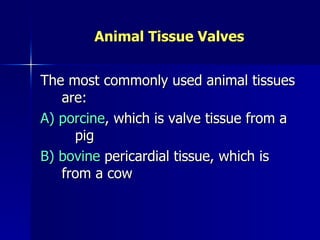
The most commonly used animal tissues
   are:
A) porcine, which is valve tissue from a
     pig
B) bovine pericardial tissue, which is
   from a cow
Porcine valves

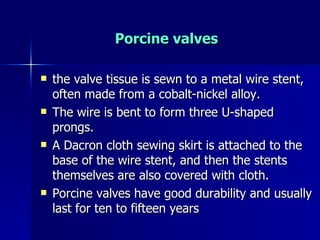
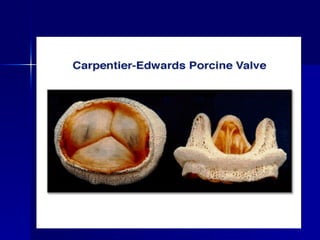
   the valve tissue is sewn to a metal wire stent,
    often made from a cobalt-nickel alloy.
   The wire is bent to form three U-shaped
    prongs.
   A Dacron cloth sewing skirt is attached to the
    base of the wire stent, and then the stents
    themselves are also covered with cloth.
   Porcine valves have good durability and usually
    last for ten to fifteen years
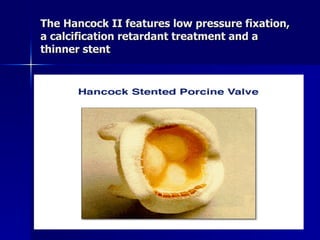
The Hancock II features low pressure fixation,
a calcification retardant treatment and a
thinner stent
Bovine pericardial valves

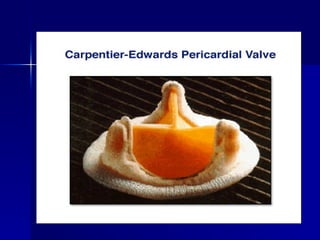
   Are similar to porcine valves in design.
   The major difference is the location of the small
    metal cylinder which joins the ends of the wire
    stents together.
   In the case of pericardial valves, the metal
    cylinder is located in the middle of one of the
    stent post loops.
   Pericardial valves have excellent hemodynamics
    and have durability equal to that of standard
    porcine valves after 10 years
St. Jude Toronto Stentless Porcine
                Valve (SPV)
   It represents a recent advance in the use of
                         heterograft valves
 Are Stentless valves made by removing the
entire aortic root and adjacent aorta as a block,
usually from a pig.
 The coronary arteries are tied off, and the

entire section is trimmed and then implanted into
the patient .
 Reports have documented superior

              hemodynamics when matched with
LV mass index and wall thickness normalizes
sooner postoperatively.
Early data suggest that durability and valvular
characteristics are similar to those in the
homografts.
If an elderly pt requires bioproshesis, the
stentless heterograft valve appears to be
indicated, especially in a pt with small aortic
annulus.
Evaluation

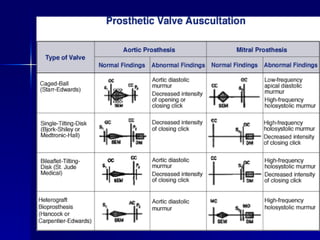
The evaluation of prosthetic valve begins with
  careful cardiac auscultation and
  understanding of normal findings for each
  type of valve in both the aortic and mitral
  positions.
Mechanical valves produce high-pitched crisp
  valve sounds;
  - in tilting discs models, closure is louder
      than opening.
  - in caged-ball design opening is louder
      than closure
Continue auscultation;

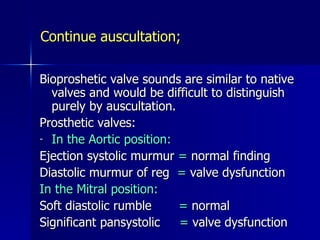
Bioproshetic valve sounds are similar to native
  valves and would be difficult to distinguish
  purely by auscultation.
Prosthetic valves:
- In the Aortic position:

Ejection systolic murmur = normal finding
Diastolic murmur of reg = valve dysfunction
In the Mitral position:
Soft diastolic rumble     = normal
Significant pansystolic   = valve dysfunction
Continue auscultation;

Ingeneral, a change in the intensity or
  quality of the valve sounds or a new
  changing murmur would signify
  abnormal valve function and warrant
  further evaluation.
Evaluation; Echocardiography


Advantages;
 1) determine baseline function
     immediately after surgery
2) Monitor performance serially over time
3) Detecting dysfunction
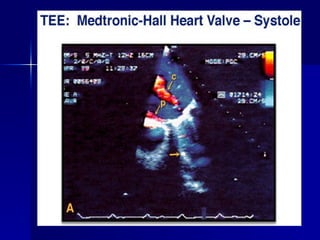
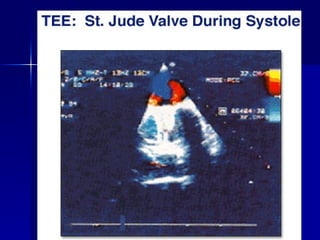
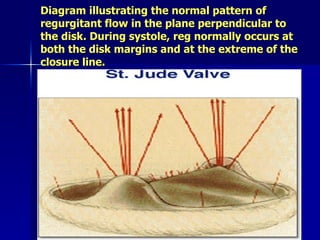
Diagram illustrating the normal pattern of
regurgitant flow in the plane perpendicular to
the disk. During systole, reg normally occurs at
both the disk margins and at the extreme of the
closure line.
Complications of prosthetic valves


(1) thrombosis and thromboembolism
(2) Structural valvular deterioration and
     failure
(3) Endocarditis
(4) Paravalvular leak
Prosthetic valve thrombosis

- 0.1% to almost 6% per patient-year depending
   on the valve type, anticoagulation status, and
   valve position.
- Thromboebolism in patients with mechanical
   valves has an incidence of :
  * 4% per patient –year eout anticoagulation.
  * 2% ~      ~ ~ ~ e antiplatelet ttt.
  * 1% ~      ~ ~ ~ e adequate warfarin ttt
Prosthetic valve thrombosis


Risk factors for thrombosis and thrombo-
embolism include:
     - caged-ball valves
     - valves in mitral position
     - inadequate anticoagulation.
     - multiple prosthetic valves
     - pts > 70yrs, AF, LV dysfunction
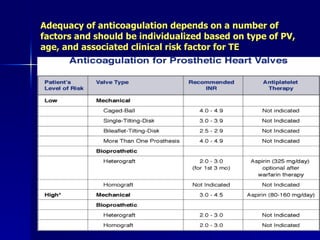
Adequacy of anticoagulation depends on a number of
factors and should be individualized based on type of PV,
age, and associated clinical risk factor for TE
In general, for mechanical valves
           INR values:

 * < 2.0 are inadequate.
 * from 2.5 to 3.5 are adequate for most
     newer mechanical valves.
 * > 3.5 are reserved for higher risk
    patients.
ASA/WARFARIN

   The addition of low dose ASA to warfarin
    therapy reduce overall mortality, especially
    from major systemic embolism, but also may
    increases the risk of bleeding.
    ASA/warfarin may best be used in high-stroke-
    risk pts with a newer mechanical valve and
    therefore a therapeutic INR of 2.5.
Clinical presentation of PV
                thrombosis

   Insidious onset of fatigue and SOB
    acute CV collapse .
              Clinical findings
   Decreased PV sounds
   A new murmur
   Change of a previous detected
    murmur.
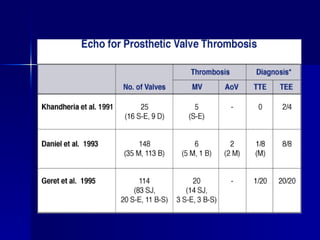
Echo findings of PV thrombosis

    decreased movement of the disk
    increased transvalvular gradient
    significant valvular regurgitation
    thrombus size, number, and location
    TEE is better able to visualize and determine
    the number of PV thrombi.
    TEE can miss anterior AV thrombi and may be
    inferior may be inferior for accurate Doppler
    measurements of transvalvular gradient
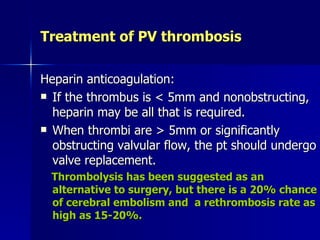
Treatment of PV thrombosis

Heparin anticoagulation:
 If the thrombus is < 5mm and nonobstructing,
  heparin may be all that is required.
 When thrombi are > 5mm or significantly
  obstructing valvular flow, the pt should undergo
  valve replacement.
  Thrombolysis has been suggested as an
  alternative to surgery, but there is a 20% chance
  of cerebral embolism and a rethrombosis rate as
  high as 15-20%.
Structural Valve failure


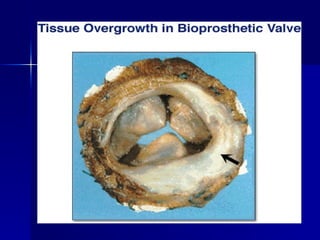
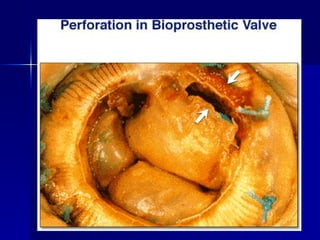
Structural valve failure is essentially
  confined to bioprosthetic valves with
  one historical exception:
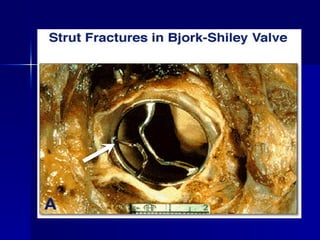
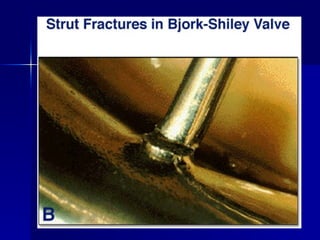
The Bjork-Shiley single tilting disk was
  withdrawn from use in 1986 after
  reports of strut fracture
Structural Valve damage (SVD)

   Homograft valves, in general, last longer than
    heterograft.
    SVD occurs more rapidly in younger pts and in
    pts with PVs in mitral position.
    valves in mitral versus aortic position are
    subjected to a higher closing pressure and
    increased stress on the valve
    reoperation for bioproshetic valve failure has
    significantly higher mortality ( 25-30%) than
    initial valve replacement.
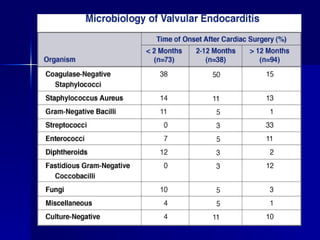
Prosthetic Valve Endocarditis PVE

   Incidence is 3-6%
    Early PVE , occurring <60 days from
    valve surgery, usually results from
    contaminated surgical devices or a
    postoperative wound infection ,
    common bacteria are staph
    epedermidis, staph aureus, and gram
    negative bacteria
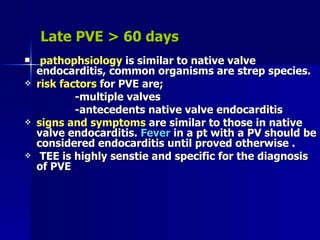
Late PVE > 60 days
    pathophsiology is similar to native valve
    endocarditis, common organisms are strep species.
   risk factors for PVE are;
            -multiple valves
            -antecedents native valve endocarditis
   signs and symptoms are similar to those in native
    valve endocarditis. Fever in a pt with a PV should be
    considered endocarditis until proved otherwise .
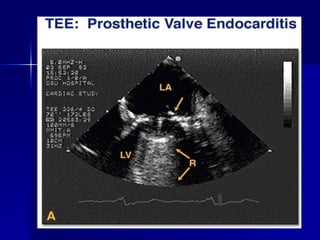
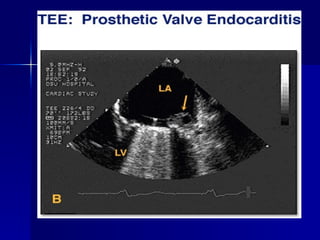
    TEE is highly senstie and specific for the diagnosis
    of PVE
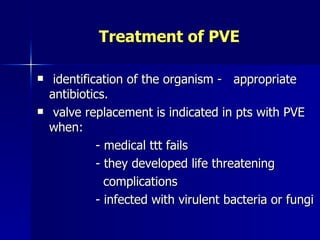
Treatment of PVE

    identification of the organism - appropriate
    antibiotics.
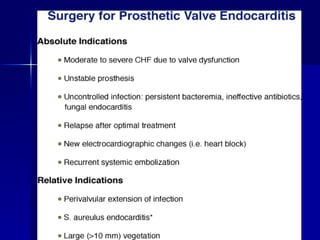
    valve replacement is indicated in pts with PVE
    when:
              - medical ttt fails
              - they developed life threatening
                complications
              - infected with virulent bacteria or fungi
Prosthetic Heart Valves

Prosthetic Heart Valves

  • 1.
    Prosthetic Heart Valves Dr Mohamed Salih Aziz MRCP- UK
  • 2.
    introduction The first mechanicalprosthetic heart valve was implanted in 1952. Over the years, 30 different mechanical designs have originated worldwide. These valves have progressed from simple caged ball valves, to modern bileaflet valves.
  • 3.
    Prosthetic Heart Valves In1961, Starr and Edwards reported the first clinically successful placement of a prosthetic heart valve. Since that time, great strides in the development of new prosthetic valves (PVs) and in the surgical technique for their placement have led to improved valvular hemodynamics and durability and decreased valvular complications.
  • 4.
    Prosthetic Heart Valves Typesof Prosthetic Heart Valves ; (1) Mechanical (2) Bioproshetic
  • 6.
    Mechanical Valves Mechanical valveshave evolved over the past 30 yrs from the initial caged- ball model of Starr & Edwards to a tilting- disk design . The tilting-disk design of Bjork & Shiley and Medtronic-Hall valves improved hemodynamics flow characteristics and increased the effective orifice area EOA over the caged-ball valve .
  • 7.
  • 8.
    The caged balldesign - is one of the early mechanical heart valves - It uses a small ball that is held in place by a welded metal cage. -The ball in cage design was modeled after ball valves used in industry to limit the flow of fluids to a single direction. - Natural heart valves allow blood to flow straight through the center of the valve - This property is known as central flow, which keeps the amount of work done by the heart to a minimum
  • 9.
    The caged balldesign  With non-central flow, the heart must work harder to compensate for the momentum lost to the change of direction of the fluid.  Caged-ball valves completely block central flow, therefore the blood requires more energy to flow around the central ball.  the ball is notorious for causing damage to blood cells due to collisions thus the pt is required to take life long anticoagulants
  • 10.
    The tilting-disc valves -In the mid-1960s, a new class of prosthetic valves were designed that used a tilting disc to better mimic the natural patterns of blood flow. -The tilting-disc valves have a polymer disc held in place by two welded struts. -The titling-disc valves open at an angle of 60° and close shut completely at a rate of 70 times/minute.
  • 11.
  • 12.
    The Tilting-disc Valves -Thistilting pattern provides improved central flow while still preventing backflow. -The tilting-disc valves reduce mechanical damage to blood cells. This improved flow pattern reduced blood clotting and infection. -the only problem with this design is its tendency for the outlet struts to fracture as a result of fatigue from the repeated ramming of the struts by the disc.
  • 13.
    Medtronic-Hall single tiltingdisk valve has a Teflon sewing ring, and titanium housing machined from solid cylinder and a carbon-coated disk with flat parallel sides. The disk which opens to 75 degree in the aortic model and 70 in the mitral, is retained by an S shaped guide strut that protrudes through a hole in the center of the disk.
  • 14.
  • 15.
    Bileaflet Valves * In1979, a new mechanical heart valve was introduced. *These valves were known as bileaflet valves, and consisted of two semicircular leaflets that pivot on hinges. The carbon leaflets exhibit high strength and excellent biocompatibility. The leaflets swing open completely, parallel to the direction of the blood flow. *They do not close completely, which allows some backflow.
  • 16.
    Bileaflet valves *Sincebackflow is one of the properties of defective valves, the bileaflet valves are still not ideal valves. *The bileaflet valve constitutes the majority of modern valve designs. *These valves are distinguished mainly for providing the closest approximation to central flow achieved in a natural heart valve
  • 18.
    Advantages of mechanicalvalves; The main advantages of mechanical valves are their high durability. Mechanical heart valves are placed in young patients because they typically last for the lifetime of the patient
  • 19.
    Disadvantages of mechanicalvalves; increased risk of blood clotting mechanical valve recipients must take anti-coagulant drugs (sodium warfarin) chronically, which effectively makes them borderline hemophiliacs.
  • 20.
    PROSTHETIC TISSUE VALVES Bioprosheticheart valves are divided into: A) Heterografts( from another species) B) Allografts/Homografts( human cadever) The design of bioprosthetic valves are closer to the design of the natural valve. Bioprosthetic valves do not require long-term anticoagulats, have better hemodynamics, do not cause damage to blood cells, and do not suffer from many of the structural problems experienced by the mechanical heart valves
  • 21.
    Human Tissue Valves Homografts; valvesthat are transplanted from another human being. Autografts; valves that are transplanted from one position to another within the same person
  • 22.
    Human tissue valves Ahomograft is a valve that is transplanted from a deceased person to a recipient. they do not require immunosuppressive therapy. A homograft that has been donated must be cryopreserved in liquid nitrogen until it is needed. homografts tend to have good hemodynamics and good durability. it is not clear whether homografts have better hemodynamics or durability than animal tissue valves.
  • 23.
    Human tissue valves Autograftsare valves taken from the same patient that they are implanted into. The most common autograft procedure is the Ross procedure, which is used in patients with diseased aortic valves (The dysfunctional aortic valve is removed and the patient's pulmonic valve is then transplanted to the aortic position) A homograft pulmonic valve is usually used to replace the patient’s pulmonic valve
  • 24.
    Continue Ross procedure  The Ross procedure allows the patient the advantage of receiving a living valve in the aortic position.  The long term survival and freedom from complications for patients with aortic valve disease are better with the Ross Procedure than any other type of valve replacement .  After 20 years, only 15% of patients require additional valve procedures .
  • 25.
    Continue Ross procedure  In cases where a human pulmonary artery homograft is used to replace the patients’ pulmonary valve, freedom from failure has been 94% after 5 years time, and 83% at 20 years.  The tissues of the patients’ pulmonary valve have not shown a tendency to calcify, degenerate, perforate, or develop leakage
  • 27.
    Animal Tissue Valves  Animal tissue valves are often referred to as heterograft or xenograft valves.  These valves are most often heart tissues recovered from animals at the time of commercial meat processing.  The leaflet valve tissue of the animals is inspected, and the highest quality leaflet tissues are then preserved.  They are then stiffened by a tanning solution .
  • 28.
    Animal Tissue Valves Themost commonly used animal tissues are: A) porcine, which is valve tissue from a pig B) bovine pericardial tissue, which is from a cow
  • 29.
    Porcine valves  the valve tissue is sewn to a metal wire stent, often made from a cobalt-nickel alloy.  The wire is bent to form three U-shaped prongs.  A Dacron cloth sewing skirt is attached to the base of the wire stent, and then the stents themselves are also covered with cloth.  Porcine valves have good durability and usually last for ten to fifteen years
  • 31.
    The Hancock IIfeatures low pressure fixation, a calcification retardant treatment and a thinner stent
  • 32.
    Bovine pericardial valves  Are similar to porcine valves in design.  The major difference is the location of the small metal cylinder which joins the ends of the wire stents together.  In the case of pericardial valves, the metal cylinder is located in the middle of one of the stent post loops.  Pericardial valves have excellent hemodynamics and have durability equal to that of standard porcine valves after 10 years
  • 34.
    St. Jude TorontoStentless Porcine Valve (SPV)  It represents a recent advance in the use of heterograft valves  Are Stentless valves made by removing the entire aortic root and adjacent aorta as a block, usually from a pig.  The coronary arteries are tied off, and the entire section is trimmed and then implanted into the patient .  Reports have documented superior hemodynamics when matched with
  • 35.
    LV mass indexand wall thickness normalizes sooner postoperatively. Early data suggest that durability and valvular characteristics are similar to those in the homografts. If an elderly pt requires bioproshesis, the stentless heterograft valve appears to be indicated, especially in a pt with small aortic annulus.
  • 36.
    Evaluation The evaluation ofprosthetic valve begins with careful cardiac auscultation and understanding of normal findings for each type of valve in both the aortic and mitral positions. Mechanical valves produce high-pitched crisp valve sounds; - in tilting discs models, closure is louder than opening. - in caged-ball design opening is louder than closure
  • 37.
    Continue auscultation; Bioproshetic valvesounds are similar to native valves and would be difficult to distinguish purely by auscultation. Prosthetic valves: - In the Aortic position: Ejection systolic murmur = normal finding Diastolic murmur of reg = valve dysfunction In the Mitral position: Soft diastolic rumble = normal Significant pansystolic = valve dysfunction
  • 39.
    Continue auscultation; Ingeneral, achange in the intensity or quality of the valve sounds or a new changing murmur would signify abnormal valve function and warrant further evaluation.
  • 40.
    Evaluation; Echocardiography Advantages; 1)determine baseline function immediately after surgery 2) Monitor performance serially over time 3) Detecting dysfunction
  • 44.
    Diagram illustrating thenormal pattern of regurgitant flow in the plane perpendicular to the disk. During systole, reg normally occurs at both the disk margins and at the extreme of the closure line.
  • 46.
    Complications of prostheticvalves (1) thrombosis and thromboembolism (2) Structural valvular deterioration and failure (3) Endocarditis (4) Paravalvular leak
  • 47.
    Prosthetic valve thrombosis -0.1% to almost 6% per patient-year depending on the valve type, anticoagulation status, and valve position. - Thromboebolism in patients with mechanical valves has an incidence of : * 4% per patient –year eout anticoagulation. * 2% ~ ~ ~ ~ e antiplatelet ttt. * 1% ~ ~ ~ ~ e adequate warfarin ttt
  • 48.
    Prosthetic valve thrombosis Riskfactors for thrombosis and thrombo- embolism include: - caged-ball valves - valves in mitral position - inadequate anticoagulation. - multiple prosthetic valves - pts > 70yrs, AF, LV dysfunction
  • 49.
    Adequacy of anticoagulationdepends on a number of factors and should be individualized based on type of PV, age, and associated clinical risk factor for TE
  • 50.
    In general, formechanical valves INR values: * < 2.0 are inadequate. * from 2.5 to 3.5 are adequate for most newer mechanical valves. * > 3.5 are reserved for higher risk patients.
  • 51.
    ASA/WARFARIN  The addition of low dose ASA to warfarin therapy reduce overall mortality, especially from major systemic embolism, but also may increases the risk of bleeding.  ASA/warfarin may best be used in high-stroke- risk pts with a newer mechanical valve and therefore a therapeutic INR of 2.5.
  • 52.
    Clinical presentation ofPV thrombosis  Insidious onset of fatigue and SOB  acute CV collapse . Clinical findings  Decreased PV sounds  A new murmur  Change of a previous detected murmur.
  • 53.
    Echo findings ofPV thrombosis  decreased movement of the disk  increased transvalvular gradient  significant valvular regurgitation  thrombus size, number, and location TEE is better able to visualize and determine the number of PV thrombi. TEE can miss anterior AV thrombi and may be inferior may be inferior for accurate Doppler measurements of transvalvular gradient
  • 55.
    Treatment of PVthrombosis Heparin anticoagulation:  If the thrombus is < 5mm and nonobstructing, heparin may be all that is required.  When thrombi are > 5mm or significantly obstructing valvular flow, the pt should undergo valve replacement. Thrombolysis has been suggested as an alternative to surgery, but there is a 20% chance of cerebral embolism and a rethrombosis rate as high as 15-20%.
  • 56.
    Structural Valve failure Structuralvalve failure is essentially confined to bioprosthetic valves with one historical exception: The Bjork-Shiley single tilting disk was withdrawn from use in 1986 after reports of strut fracture
  • 61.
    Structural Valve damage(SVD)  Homograft valves, in general, last longer than heterograft.  SVD occurs more rapidly in younger pts and in pts with PVs in mitral position.  valves in mitral versus aortic position are subjected to a higher closing pressure and increased stress on the valve  reoperation for bioproshetic valve failure has significantly higher mortality ( 25-30%) than initial valve replacement.
  • 62.
    Prosthetic Valve EndocarditisPVE  Incidence is 3-6%  Early PVE , occurring <60 days from valve surgery, usually results from contaminated surgical devices or a postoperative wound infection , common bacteria are staph epedermidis, staph aureus, and gram negative bacteria
  • 63.
    Late PVE >60 days  pathophsiology is similar to native valve endocarditis, common organisms are strep species.  risk factors for PVE are; -multiple valves -antecedents native valve endocarditis  signs and symptoms are similar to those in native valve endocarditis. Fever in a pt with a PV should be considered endocarditis until proved otherwise .  TEE is highly senstie and specific for the diagnosis of PVE
  • 67.
    Treatment of PVE  identification of the organism - appropriate antibiotics.  valve replacement is indicated in pts with PVE when: - medical ttt fails - they developed life threatening complications - infected with virulent bacteria or fungi