PRESENTATION ON
“ADHESION”
SUBMITTED BY
NIKET SHAH
M.Sc. MECHANICAL ENGINEERING
1
Contents
1. Introduction
2. Mechanism of Adhesion
3. Friction Due to Adhesion
4. Formation of wear particles
5. Reducing adhesion
6. Example: Mechanical Seal
7. Conclusion
8. Reference
2
1. Introduction
Definition: The state in
which two surfaces are
held together by
interfacial forces which
consist of valence forces
or interlocking actions
or both.
ASTM Definition of Term Relating to Adhesion D907-70, ASTM, Philadelphia, PA, 1970. Advanced Techniques for
Surface Engineering
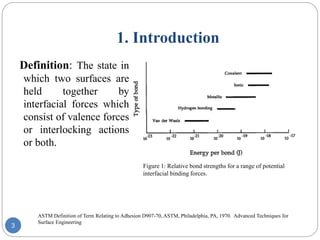
Figure 1: Relative bond strengths for a range of potential
interfacial binding forces.
3
2. Mechanism of Adhesion
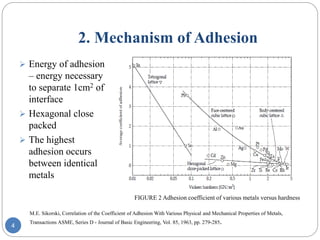
 Energy of adhesion
– energy necessary
to separate 1cm2 of
interface
 Hexagonal close
packed
 The highest
adhesion occurs
between identical
metals
FIGURE 2 Adhesion coefficient of various metals versus hardness
M.E. Sikorski, Correlation of the Coefficient of Adhesion With Various Physical and Mechanical Properties of Metals,
Transactions ASME, Series D - Journal of Basic Engineering, Vol. 85, 1963, pp. 279-285.4
3. Friction Due to Adhesion
FIGURE 3 Schematic diagram of the apparatus for FIGURE 4 Effect of oxygen on the friction
measurements of friction in a vacuum of clean iron
J.S. McFarlane and D. Tabor, Relation Between Friction and Adhesion, Proc. Roy. Soc., London,
Series A, Vol. 202, 1950, pp. 244-253.5
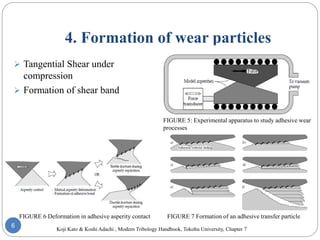
4. Formation of wear particles
 Tangential Shear under
compression
 Formation of shear band
Koji Kato & Koshi Adachi , Modern Tribology Handbook, Tokohu University, Chapter 7
FIGURE 5: Experimental apparatus to study adhesive wear
processes
FIGURE 6 Deformation in adhesive asperity contact FIGURE 7 Formation of an adhesive transfer particle
6
5. Reducing adhesion
 Increasing Hardness[hardness
is most dominant parameter]
 Combination of dissimilar
materials
 Surface roughness
 Use of lubricant
 Material with high melting
point
 To limit the size of contact
 Risk of disappearance of
natural oxide layers
FIGURE 9 Surface roughness comparison
FIGURE 8 Dendrites of zinc electrodeposited onto a zinc surface
David E Pakham,Ch 2, Theories of Fundamental Adhesion, Handbook of Adhesion Technology, Vol 2, Springer
Publication, Pg 22-23
7
6. Example: Mechanical Seal
Mechanical Seal
FIGURE 10 Centrifugal pump FIGURE 11 Mechanical Seal major components
FIGURE 12 Mechanical Seal Faces FIGURE 13 Metal to metal adhesion
8
Material Properties for seal faces
Michael Huebner, Material Selection for Mechanical Seal, Flowserve corporation, Deer Park, Texas.
FIGURE 14 Material comparison for mechanical seal faces
9
7. Conclusion
All materials has the tendency to adhere when brought into
close contact. Contaminants and lubricants can reduce the
tendency to adhere but adhesion can never be entirely
eliminated. Adhesion is the root cause of failure between
metal sliding.
10
8. Reference
 Gwidon W. Stachowiak and Andrew W. Batchelor, Engineering Tribology,
Butterworth Heinmann Publication, Pg 533-550.
 HEF Groupe, Handbook of Surface Treatments and coatings.
 W. Gissler and H. A. Jehn, Advanced Techniques for Surface Engineering, Kluwer
Academic Publishers, Vol 1, Pg 31-41.
 M.E. Sikorski, Correlation of the Coefficient of Adhesion With Various Physical and
Mechanical Properties of Metals, Transactions ASME, Series D - Journal of Basic
Engineering, Vol. 85, 1963, pp. 279-285.
 J.S. McFarlane and D. Tabor, Relation Between Friction and Adhesion, Proc. Roy.
Soc., London, Series A, Vol. 202, 1950, pp. 244-253.
 Koji Kato & Koshi Adachi , Modern Tribology Handbook, Tokohu University,
Chapter 7
 David E Pakham,Ch 2, Theories of Fundamental Adhesion, Handbook of Adhesion
Technology, Vol 2, Springer Publication, Pg 22-23
 Michael Huebner, Material Selection for Mechanical Seal, Flowserve corporation,
Deer Park, Texas.
11
THANK YOU
12

Adhesion

  • 1.
    PRESENTATION ON “ADHESION” SUBMITTED BY NIKETSHAH M.Sc. MECHANICAL ENGINEERING 1
  • 2.
    Contents 1. Introduction 2. Mechanismof Adhesion 3. Friction Due to Adhesion 4. Formation of wear particles 5. Reducing adhesion 6. Example: Mechanical Seal 7. Conclusion 8. Reference 2
  • 3.
    1. Introduction Definition: Thestate in which two surfaces are held together by interfacial forces which consist of valence forces or interlocking actions or both. ASTM Definition of Term Relating to Adhesion D907-70, ASTM, Philadelphia, PA, 1970. Advanced Techniques for Surface Engineering Figure 1: Relative bond strengths for a range of potential interfacial binding forces. 3
  • 4.
    2. Mechanism ofAdhesion  Energy of adhesion – energy necessary to separate 1cm2 of interface  Hexagonal close packed  The highest adhesion occurs between identical metals FIGURE 2 Adhesion coefficient of various metals versus hardness M.E. Sikorski, Correlation of the Coefficient of Adhesion With Various Physical and Mechanical Properties of Metals, Transactions ASME, Series D - Journal of Basic Engineering, Vol. 85, 1963, pp. 279-285.4
  • 5.
    3. Friction Dueto Adhesion FIGURE 3 Schematic diagram of the apparatus for FIGURE 4 Effect of oxygen on the friction measurements of friction in a vacuum of clean iron J.S. McFarlane and D. Tabor, Relation Between Friction and Adhesion, Proc. Roy. Soc., London, Series A, Vol. 202, 1950, pp. 244-253.5
  • 6.
    4. Formation ofwear particles  Tangential Shear under compression  Formation of shear band Koji Kato & Koshi Adachi , Modern Tribology Handbook, Tokohu University, Chapter 7 FIGURE 5: Experimental apparatus to study adhesive wear processes FIGURE 6 Deformation in adhesive asperity contact FIGURE 7 Formation of an adhesive transfer particle 6
  • 7.
    5. Reducing adhesion Increasing Hardness[hardness is most dominant parameter]  Combination of dissimilar materials  Surface roughness  Use of lubricant  Material with high melting point  To limit the size of contact  Risk of disappearance of natural oxide layers FIGURE 9 Surface roughness comparison FIGURE 8 Dendrites of zinc electrodeposited onto a zinc surface David E Pakham,Ch 2, Theories of Fundamental Adhesion, Handbook of Adhesion Technology, Vol 2, Springer Publication, Pg 22-23 7
  • 8.
    6. Example: MechanicalSeal Mechanical Seal FIGURE 10 Centrifugal pump FIGURE 11 Mechanical Seal major components FIGURE 12 Mechanical Seal Faces FIGURE 13 Metal to metal adhesion 8
  • 9.
    Material Properties forseal faces Michael Huebner, Material Selection for Mechanical Seal, Flowserve corporation, Deer Park, Texas. FIGURE 14 Material comparison for mechanical seal faces 9
  • 10.
    7. Conclusion All materialshas the tendency to adhere when brought into close contact. Contaminants and lubricants can reduce the tendency to adhere but adhesion can never be entirely eliminated. Adhesion is the root cause of failure between metal sliding. 10
  • 11.
    8. Reference  GwidonW. Stachowiak and Andrew W. Batchelor, Engineering Tribology, Butterworth Heinmann Publication, Pg 533-550.  HEF Groupe, Handbook of Surface Treatments and coatings.  W. Gissler and H. A. Jehn, Advanced Techniques for Surface Engineering, Kluwer Academic Publishers, Vol 1, Pg 31-41.  M.E. Sikorski, Correlation of the Coefficient of Adhesion With Various Physical and Mechanical Properties of Metals, Transactions ASME, Series D - Journal of Basic Engineering, Vol. 85, 1963, pp. 279-285.  J.S. McFarlane and D. Tabor, Relation Between Friction and Adhesion, Proc. Roy. Soc., London, Series A, Vol. 202, 1950, pp. 244-253.  Koji Kato & Koshi Adachi , Modern Tribology Handbook, Tokohu University, Chapter 7  David E Pakham,Ch 2, Theories of Fundamental Adhesion, Handbook of Adhesion Technology, Vol 2, Springer Publication, Pg 22-23  Michael Huebner, Material Selection for Mechanical Seal, Flowserve corporation, Deer Park, Texas. 11
  • 12.