Notes: Subatomic Particles CW: Graphic Organizer H: An Atom
Subatomic Particles December 8, 2008
Objectives Describe three subatomic particles Define amu, atomic mass, atomic number, isotope
1. The Latin word  atomos , is the basis for the word atom. What does the word  atomos  mean? nucleus indivisible small
2.  Indirect evidence about an object is evidence gathered  A. by reading a textbook B. using your senses C.  without any experimenting
3.  Rutherford’s  model of the atom is similar to  A. the solar system B. raw chocolate chip cookie dough C. a peach
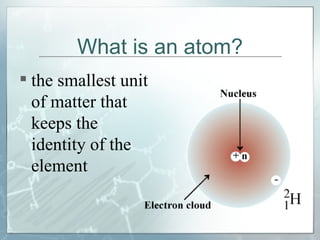
What is an atom? the smallest unit of matter that keeps the identity of the element
 
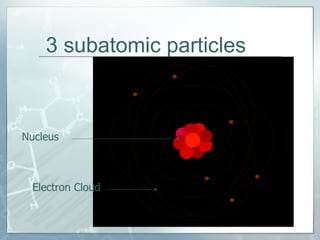
Nucleus Electron Cloud   3 subatomic particles
Protons   Positive charge Found in the nucleus Mass of 1 AMU (atomic mass unit)
Atomic Number This number indicates the number of protons in an atom The number of protons identifies the atom.
Neutrons No charge Found in the nucleus Mass of 1 AMU (atomic mass unit)
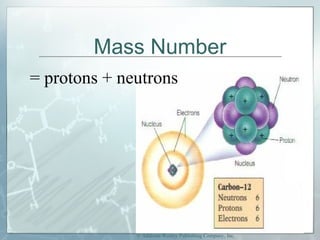
Mass Number = protons + neutrons © Addison-Wesley Publishing Company, Inc.
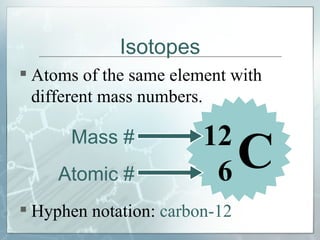
Isotopes Atoms of the same element with different mass numbers. Hyphen notation:  carbon-12 Mass # Atomic #
It’s the Isotopes!
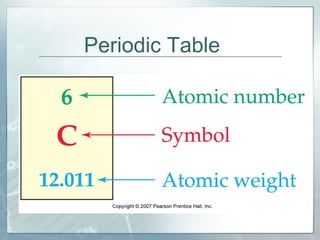
Periodic Table
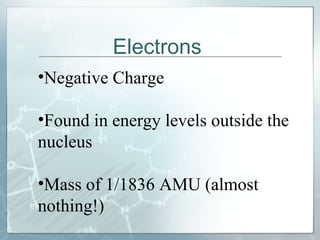
Electrons   Negative Charge Found in energy levels outside the nucleus Mass of 1/1836 AMU (almost nothing!)
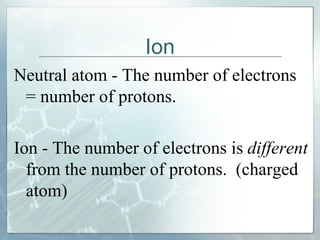
Ion Neutral atom - The number of electrons = number of protons.  Ion - The number of electrons is  different  from the number of protons.  (charged atom)
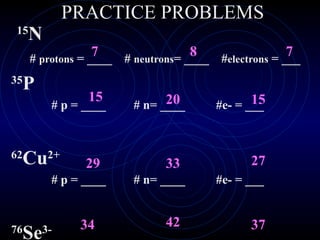
PRACTICE PROBLEMS 15 N #  protons  = ____  #  neutrons = ____  # electrons  = ___ 35 P # p = ____  # n= ____  #e- = ___ 62 Cu 2+ # p = ____  # n= ____  #e- = ___ 76 Se 3- # p = ____  # n= ____  #e- = ___ 7 8 7 15 20 15 29 33 27 34 42 37
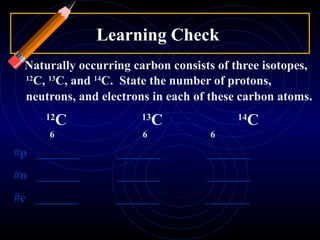
Learning Check  Naturally occurring carbon consists of three isotopes,  12 C,  13 C, and  14 C.  State the number of protons, neutrons, and electrons in each of these carbon atoms .  12 C   13 C 14 C   6   6    6 #p  _______  _______  _______  #n  _______  _______  _______  #e  _______  _______  _______
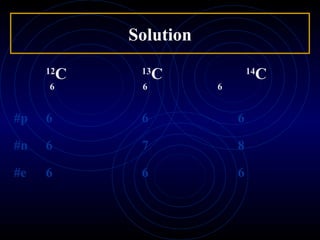
Solution 12 C   13 C   14 C   6   6    6 #p  6  6  6  #n  6  7  8 #e  6    6  6
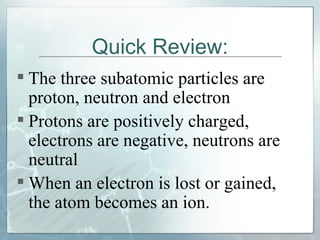
Quick Review: The three subatomic particles are proton, neutron and electron Protons are positively charged, electrons are negative, neutrons are neutral When an electron is lost or gained, the atom becomes an ion.

Subatomic Particles 2008

  • 1.
    Notes: Subatomic ParticlesCW: Graphic Organizer H: An Atom
  • 2.
  • 3.
    Objectives Describe threesubatomic particles Define amu, atomic mass, atomic number, isotope
  • 4.
    1. The Latinword atomos , is the basis for the word atom. What does the word atomos mean? nucleus indivisible small
  • 5.
    2. Indirectevidence about an object is evidence gathered A. by reading a textbook B. using your senses C. without any experimenting
  • 6.
    3. Rutherford’s model of the atom is similar to A. the solar system B. raw chocolate chip cookie dough C. a peach
  • 7.
    What is anatom? the smallest unit of matter that keeps the identity of the element
  • 8.
  • 9.
    Nucleus Electron Cloud 3 subatomic particles
  • 10.
    Protons Positive charge Found in the nucleus Mass of 1 AMU (atomic mass unit)
  • 11.
    Atomic Number Thisnumber indicates the number of protons in an atom The number of protons identifies the atom.
  • 12.
    Neutrons No chargeFound in the nucleus Mass of 1 AMU (atomic mass unit)
  • 13.
    Mass Number =protons + neutrons © Addison-Wesley Publishing Company, Inc.
  • 14.
    Isotopes Atoms ofthe same element with different mass numbers. Hyphen notation: carbon-12 Mass # Atomic #
  • 15.
  • 16.
  • 17.
    Electrons Negative Charge Found in energy levels outside the nucleus Mass of 1/1836 AMU (almost nothing!)
  • 18.
    Ion Neutral atom- The number of electrons = number of protons. Ion - The number of electrons is different from the number of protons. (charged atom)
  • 19.
    PRACTICE PROBLEMS 15N # protons = ____ # neutrons = ____ # electrons = ___ 35 P # p = ____ # n= ____ #e- = ___ 62 Cu 2+ # p = ____ # n= ____ #e- = ___ 76 Se 3- # p = ____ # n= ____ #e- = ___ 7 8 7 15 20 15 29 33 27 34 42 37
  • 20.
    Learning Check Naturally occurring carbon consists of three isotopes, 12 C, 13 C, and 14 C. State the number of protons, neutrons, and electrons in each of these carbon atoms . 12 C 13 C 14 C 6 6 6 #p _______ _______ _______ #n _______ _______ _______ #e _______ _______ _______
  • 21.
    Solution 12 C 13 C 14 C 6 6 6 #p 6 6 6 #n 6 7 8 #e 6 6 6
  • 22.
    Quick Review: Thethree subatomic particles are proton, neutron and electron Protons are positively charged, electrons are negative, neutrons are neutral When an electron is lost or gained, the atom becomes an ion.