Real Life Chemistry By: Jasmine Xie
Table of Contents Definitions of: Matter Not Matter Pure Substance Element Compounds Mixtures Heterogeneous Mixtures Homogeneous Mixtures Mass Volume Density  Viscosity State Conductivity Physical Changes Chemical Changes
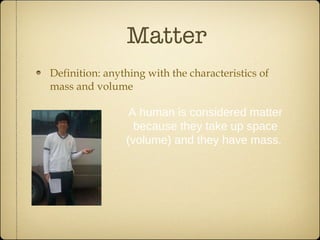
Matter Definition: anything with the characteristics of mass and volume A human is considered matter because they take up space (volume) and they have mass.
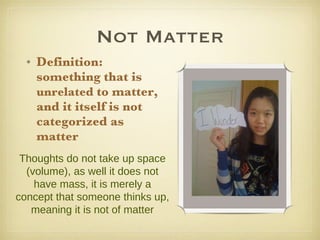
Not Matter Definition: something that is  unrelated  to matter, and it itself is not categorized as matter Thoughts do not take up space (volume), as well it does not have mass, it is merely a concept that someone thinks up, meaning it is not of matter
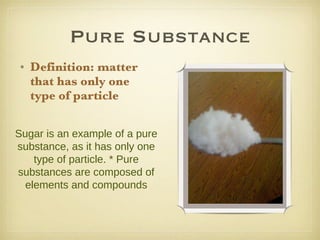
Pure Substance Definition: matter that has only one type of particle Sugar is an example of a pure substance, as it has only one type of particle. * Pure substances are composed of elements and compounds
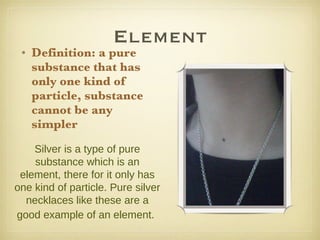
Element Definition: a pure substance that has only one kind of particle, substance cannot be any simpler Silver is a type of pure substance which is an element, there for it only has one kind of particle. Pure silver necklaces like these are a good example of an element.
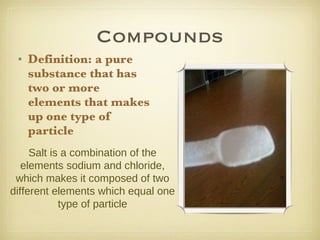
Compounds Definition: a pure substance that has two or more elements that makes up one type of particle Salt is a combination of the elements sodium and chloride, which makes it composed of two different elements which equal one type of particle
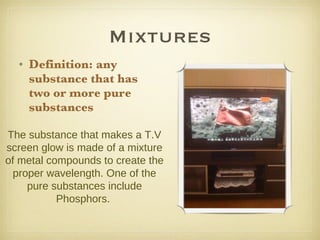
Mixtures Definition: any substance that has two or more pure substances The substance that makes a T.V screen glow is made of a mixture of metal compounds to create the proper wavelength. One of the pure substances include Phosphors.
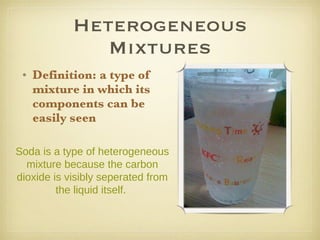
Heterogeneous Mixtures Definition: a type of mixture in which its components can be easily seen Soda is a type of heterogeneous mixture because the carbon dioxide is visibly seperated from the liquid itself.
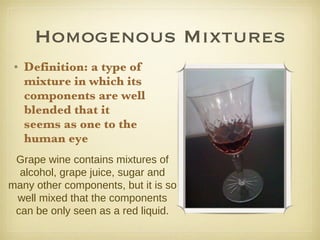
Homogenous Mixtures Definition: a type of mixture in which its components are well blended that it seems as one to the human eye   Grape wine contains mixtures of alcohol, grape juice, sugar and many other components, but it is so well mixed that the components can be only seen as a red liquid.
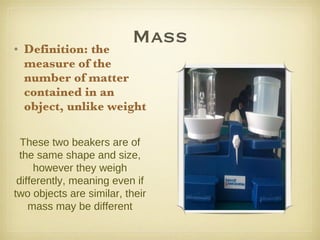
Mass Definition: the measure of the number of matter contained in an object, unlike weight These two beakers are of the same shape and size, however they weigh differently, meaning even if two objects are similar, their mass may be different
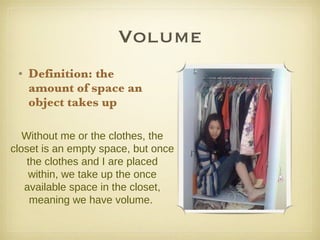
Volume Definition: the amount of space an object takes up   Without me or the clothes, the closet is an empty space, but once the clothes and I are placed within, we take up the once available space in the closet, meaning we have volume.
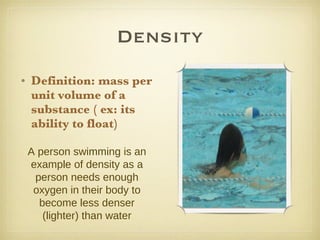
Density Definition: mass per unit volume of a substance ( ex: its ability to float) A person swimming is an example of density as a person needs enough oxygen in their body to become less denser (lighter) than water
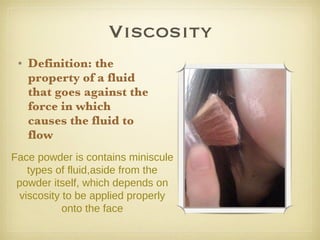
Viscosity Definition: the property of a fluid that goes against the force in which causes the fluid to flow  Face powder is contains miniscule types of fluid,aside from the powder itself, which depends on viscosity to be applied properly onto the face
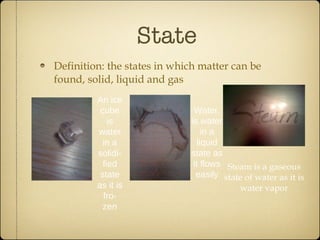
State Definition: the states in which matter can be found, solid, liquid and gas An ice cube is water in a  solidi -fied state as it is fro-zen Water, is water in a liquid state as it flows easily Steam is a gaseous state of water as it is water vapor
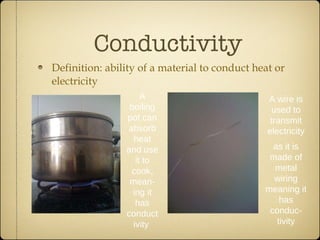
Conductivity Definition: ability of a material to conduct heat or electricity A boiling pot can absorb heat and use it to cook, mean-ing it has conductivity  A wire is used to transmit electricity as it is made of metal wiring meaning it has conduc-tivity
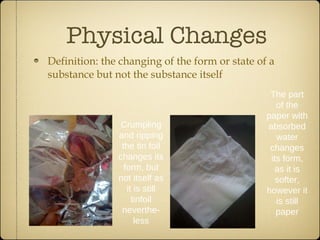
Physical Changes Definition: the changing of the form or state of a substance but not the substance itself Crumpling and ripping the tin foil changes its form, but not itself as it is still tinfoil neverthe-less The part of the paper with absorbed water changes its form, as it is softer, however it is still paper
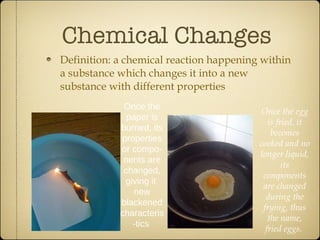
Chemical Changes Definition: a chemical reaction happening within a substance which changes it into a new substance with different properties Once the paper is burned, its properties or compo-nents are changed, giving it  new blackened characteris-tics  Once the egg is fried, it becomes cooked and no longer liquid, its components are changed during the frying, thus the name, fried eggs.

Real life chemistry ppt[1]

  • 1.
    Real Life ChemistryBy: Jasmine Xie
  • 2.
    Table of ContentsDefinitions of: Matter Not Matter Pure Substance Element Compounds Mixtures Heterogeneous Mixtures Homogeneous Mixtures Mass Volume Density Viscosity State Conductivity Physical Changes Chemical Changes
  • 3.
    Matter Definition: anythingwith the characteristics of mass and volume A human is considered matter because they take up space (volume) and they have mass.
  • 4.
    Not Matter Definition:something that is unrelated to matter, and it itself is not categorized as matter Thoughts do not take up space (volume), as well it does not have mass, it is merely a concept that someone thinks up, meaning it is not of matter
  • 5.
    Pure Substance Definition:matter that has only one type of particle Sugar is an example of a pure substance, as it has only one type of particle. * Pure substances are composed of elements and compounds
  • 6.
    Element Definition: apure substance that has only one kind of particle, substance cannot be any simpler Silver is a type of pure substance which is an element, there for it only has one kind of particle. Pure silver necklaces like these are a good example of an element.
  • 7.
    Compounds Definition: apure substance that has two or more elements that makes up one type of particle Salt is a combination of the elements sodium and chloride, which makes it composed of two different elements which equal one type of particle
  • 8.
    Mixtures Definition: anysubstance that has two or more pure substances The substance that makes a T.V screen glow is made of a mixture of metal compounds to create the proper wavelength. One of the pure substances include Phosphors.
  • 9.
    Heterogeneous Mixtures Definition:a type of mixture in which its components can be easily seen Soda is a type of heterogeneous mixture because the carbon dioxide is visibly seperated from the liquid itself.
  • 10.
    Homogenous Mixtures Definition:a type of mixture in which its components are well blended that it seems as one to the human eye Grape wine contains mixtures of alcohol, grape juice, sugar and many other components, but it is so well mixed that the components can be only seen as a red liquid.
  • 11.
    Mass Definition: themeasure of the number of matter contained in an object, unlike weight These two beakers are of the same shape and size, however they weigh differently, meaning even if two objects are similar, their mass may be different
  • 12.
    Volume Definition: theamount of space an object takes up Without me or the clothes, the closet is an empty space, but once the clothes and I are placed within, we take up the once available space in the closet, meaning we have volume.
  • 13.
    Density Definition: massper unit volume of a substance ( ex: its ability to float) A person swimming is an example of density as a person needs enough oxygen in their body to become less denser (lighter) than water
  • 14.
    Viscosity Definition: theproperty of a fluid that goes against the force in which causes the fluid to flow Face powder is contains miniscule types of fluid,aside from the powder itself, which depends on viscosity to be applied properly onto the face
  • 15.
    State Definition: thestates in which matter can be found, solid, liquid and gas An ice cube is water in a solidi -fied state as it is fro-zen Water, is water in a liquid state as it flows easily Steam is a gaseous state of water as it is water vapor
  • 16.
    Conductivity Definition: abilityof a material to conduct heat or electricity A boiling pot can absorb heat and use it to cook, mean-ing it has conductivity A wire is used to transmit electricity as it is made of metal wiring meaning it has conduc-tivity
  • 17.
    Physical Changes Definition:the changing of the form or state of a substance but not the substance itself Crumpling and ripping the tin foil changes its form, but not itself as it is still tinfoil neverthe-less The part of the paper with absorbed water changes its form, as it is softer, however it is still paper
  • 18.
    Chemical Changes Definition:a chemical reaction happening within a substance which changes it into a new substance with different properties Once the paper is burned, its properties or compo-nents are changed, giving it new blackened characteris-tics Once the egg is fried, it becomes cooked and no longer liquid, its components are changed during the frying, thus the name, fried eggs.