Notes: Chemical Reactions CW: Types of Reactions H: Types of Chemical Reactions
Chemical Reactions  January 28, 2010
Objectives Identify parts of a chemical equation Recognize four types of chemical reactions Describe Law of Conservation of Mass
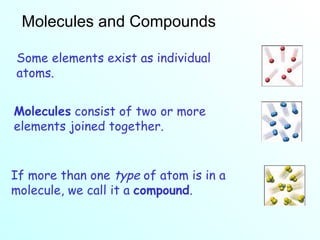
Molecules and Compounds Some elements exist as individual atoms. Molecules  consist of two or more elements joined together. If more than one  type  of atom is in a molecule, we call it a  compound .
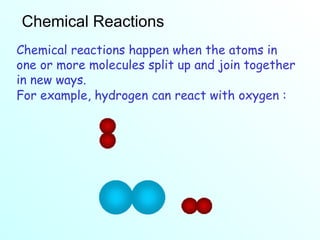
Chemical Reactions Chemical reactions happen when the atoms in one or more molecules split up and join together in new ways. For example, hydrogen can react with oxygen :
When a reaction takes place, things happen. There may be a gas given off, a color change or a solid material appearing. There could also be changes we can’t see, such as a temperature change. The mass of the reactants (the chemicals we start with) is always the same as the mass of the products (the chemicals we end with). Law of Conservation of Mass
 
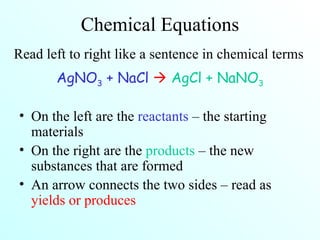
Chemical Equations On the left are the  reactants  – the starting materials On the right are the  products  – the new substances that are formed An arrow connects the two sides – read as  yields or produces AgNO 3  + NaCl     AgCl + NaNO 3 Read left to right like a sentence in chemical terms
 
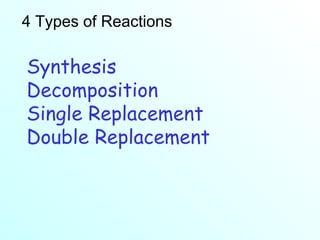
4 Types of Reactions Synthesis Decomposition Single Replacement Double Replacement
 
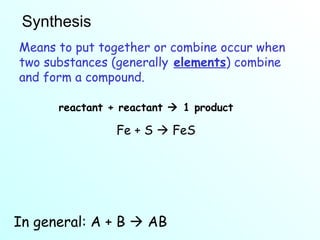
Synthesis Means to put together or combine  occur when two substances (generally   elements ) combine and form a compound.  In general: A + B    AB Fe + S    FeS reactant + reactant    1 product
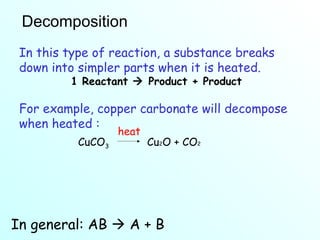
Decomposition In this type of reaction, a substance breaks down into simpler parts when it is heated. 1 Reactant    Product + Product  In general: AB    A + B CuCO 3 heat Cu 2 O + CO 2 For example, copper carbonate will decompose when heated :
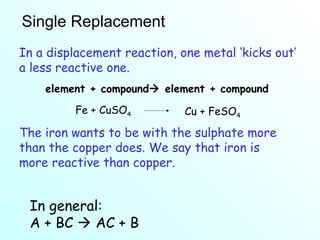
Single Replacement In a displacement reaction, one metal ‘kicks out’ a less reactive one. The iron wants to be with the sulphate more than the copper does. We say that iron is more reactive than copper. element + compound   element + compound In general:  A + BC    AC + B Fe + CuSO 4 Cu + FeSO 4
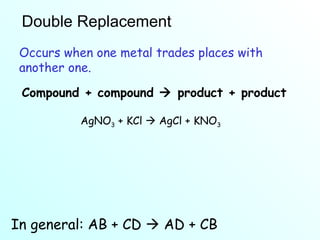
Double Replacement Occurs when one metal trades places with another one. AgNO 3  + KCl    AgCl + KNO 3 Compound + compound    product + product In general: AB + CD    AD + CB

Reactions2010

  • 1.
    Notes: Chemical ReactionsCW: Types of Reactions H: Types of Chemical Reactions
  • 2.
    Chemical Reactions January 28, 2010
  • 3.
    Objectives Identify partsof a chemical equation Recognize four types of chemical reactions Describe Law of Conservation of Mass
  • 4.
    Molecules and CompoundsSome elements exist as individual atoms. Molecules consist of two or more elements joined together. If more than one type of atom is in a molecule, we call it a compound .
  • 5.
    Chemical Reactions Chemicalreactions happen when the atoms in one or more molecules split up and join together in new ways. For example, hydrogen can react with oxygen :
  • 6.
    When a reactiontakes place, things happen. There may be a gas given off, a color change or a solid material appearing. There could also be changes we can’t see, such as a temperature change. The mass of the reactants (the chemicals we start with) is always the same as the mass of the products (the chemicals we end with). Law of Conservation of Mass
  • 7.
  • 8.
    Chemical Equations Onthe left are the reactants – the starting materials On the right are the products – the new substances that are formed An arrow connects the two sides – read as yields or produces AgNO 3 + NaCl  AgCl + NaNO 3 Read left to right like a sentence in chemical terms
  • 9.
  • 10.
    4 Types ofReactions Synthesis Decomposition Single Replacement Double Replacement
  • 11.
  • 12.
    Synthesis Means toput together or combine occur when two substances (generally elements ) combine and form a compound. In general: A + B  AB Fe + S  FeS reactant + reactant  1 product
  • 13.
    Decomposition In thistype of reaction, a substance breaks down into simpler parts when it is heated. 1 Reactant  Product + Product In general: AB  A + B CuCO 3 heat Cu 2 O + CO 2 For example, copper carbonate will decompose when heated :
  • 14.
    Single Replacement Ina displacement reaction, one metal ‘kicks out’ a less reactive one. The iron wants to be with the sulphate more than the copper does. We say that iron is more reactive than copper. element + compound  element + compound In general: A + BC  AC + B Fe + CuSO 4 Cu + FeSO 4
  • 15.
    Double Replacement Occurswhen one metal trades places with another one. AgNO 3 + KCl  AgCl + KNO 3 Compound + compound  product + product In general: AB + CD  AD + CB

Editor's Notes

  • #13 We see the red / brown copper metal start to appear in place of the grey iron, and the solution changes colour from blue to green, as copper sulphate is blue but iron sulphate is green. We see the red / brown copper metal start to appear in place of the grey iron, and the solution changes colour from blue to green, as copper sulphate is blue but iron sulphate is green.
  • #15 We see the red / brown copper metal start to appear in place of the grey iron, and the solution changes colour from blue to green, as copper sulphate is blue but iron sulphate is green. We see the red / brown copper metal start to appear in place of the grey iron, and the solution changes colour from blue to green, as copper sulphate is blue but iron sulphate is green.