Classification of Elements January 13, 2011
Objectives Describe characteristics of metals, nonmetals, and metalloids Define period, periodic law, family, malleable, ductile. valence electrons Describe how elements are arranged on the periodic table
 
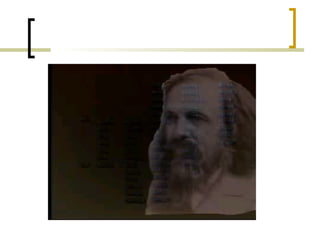
Henry Mosley (1914) Determined that each  atom  has a unique number of positive charges.  Discovered isotopes Rearranged Mendeleyev’s table by their atomic number
 
Periodic Law Because properties of elements repeated in an orderly way, it was called  periodic .  Properties of elements are a function of their atomic numbers. 
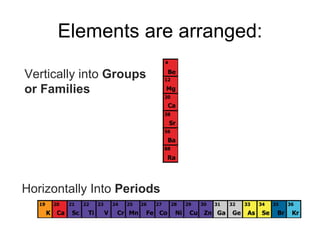
Elements are arranged: Vertically into  Groups or Families Horizontally Into  Periods
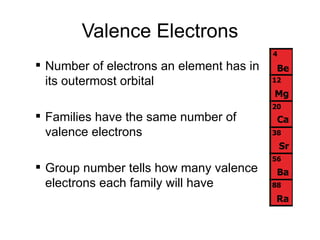
Valence Electrons Number of electrons an element has in its outermost orbital Families have the same number of valence electrons Group number tells how many valence electrons each family will have
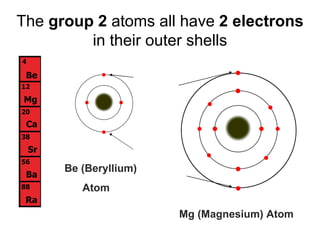
The  group 2  atoms all have  2 electrons  in their outer shells Be (Beryllium) Atom Mg (Magnesium) Atom
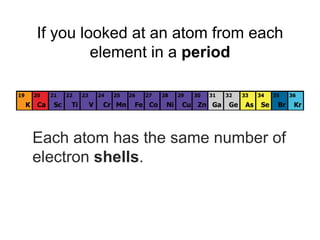
If you looked at an atom from each element in a  period Each atom has the same number of electron  shells .
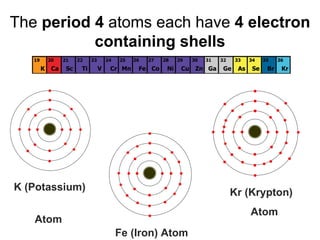
The  period 4  atoms each have  4 electron   containing shells K (Potassium)  Atom Fe (Iron) Atom Kr (Krypton)  Atom 4 th  Shell
Metals shiny (they have luster) solids at room temperature good conductors  malleable  - capable of being hammered out into thin sheets  ductile  - drawn out into wire or threads
Located to the left of the zigzag line Most elements are metals Usually have few valence electrons
Non-metals Can be found as solids, liquids, or gases at room temperature  Typically dull and brittle  Poor conductors All non-metals except hydrogen are found on the right side of the zigzag line Many valance electrons
Metalloids Border both sides of the zigzag line each has some of the properties of a metal and non metal can become good conductors under certain conditions such as high temperatures Also called semiconductors

classification of elements

  • 1.
  • 2.
    Objectives Describe characteristicsof metals, nonmetals, and metalloids Define period, periodic law, family, malleable, ductile. valence electrons Describe how elements are arranged on the periodic table
  • 3.
  • 4.
    Henry Mosley (1914)Determined that each atom has a unique number of positive charges. Discovered isotopes Rearranged Mendeleyev’s table by their atomic number
  • 5.
  • 6.
    Periodic Law Becauseproperties of elements repeated in an orderly way, it was called periodic . Properties of elements are a function of their atomic numbers. 
  • 7.
    Elements are arranged:Vertically into Groups or Families Horizontally Into Periods
  • 8.
    Valence Electrons Numberof electrons an element has in its outermost orbital Families have the same number of valence electrons Group number tells how many valence electrons each family will have
  • 9.
    The group2 atoms all have 2 electrons in their outer shells Be (Beryllium) Atom Mg (Magnesium) Atom
  • 10.
    If you lookedat an atom from each element in a period Each atom has the same number of electron shells .
  • 11.
    The period4 atoms each have 4 electron containing shells K (Potassium) Atom Fe (Iron) Atom Kr (Krypton) Atom 4 th Shell
  • 12.
    Metals shiny (theyhave luster) solids at room temperature good conductors malleable - capable of being hammered out into thin sheets ductile - drawn out into wire or threads
  • 13.
    Located to theleft of the zigzag line Most elements are metals Usually have few valence electrons
  • 14.
    Non-metals Can befound as solids, liquids, or gases at room temperature Typically dull and brittle Poor conductors All non-metals except hydrogen are found on the right side of the zigzag line Many valance electrons
  • 15.
    Metalloids Border bothsides of the zigzag line each has some of the properties of a metal and non metal can become good conductors under certain conditions such as high temperatures Also called semiconductors