General Chemistry 1
Science, Technology, Engineering, and Mathematics
Lesson 1.2
Properties of Matter
2
What is the first thing you notice when you hold
and read a book?
3
Is it hard or soft?
Is it thick or thin?
Is it heavy or light?
Does it burn when
you place it near a
flame?
4
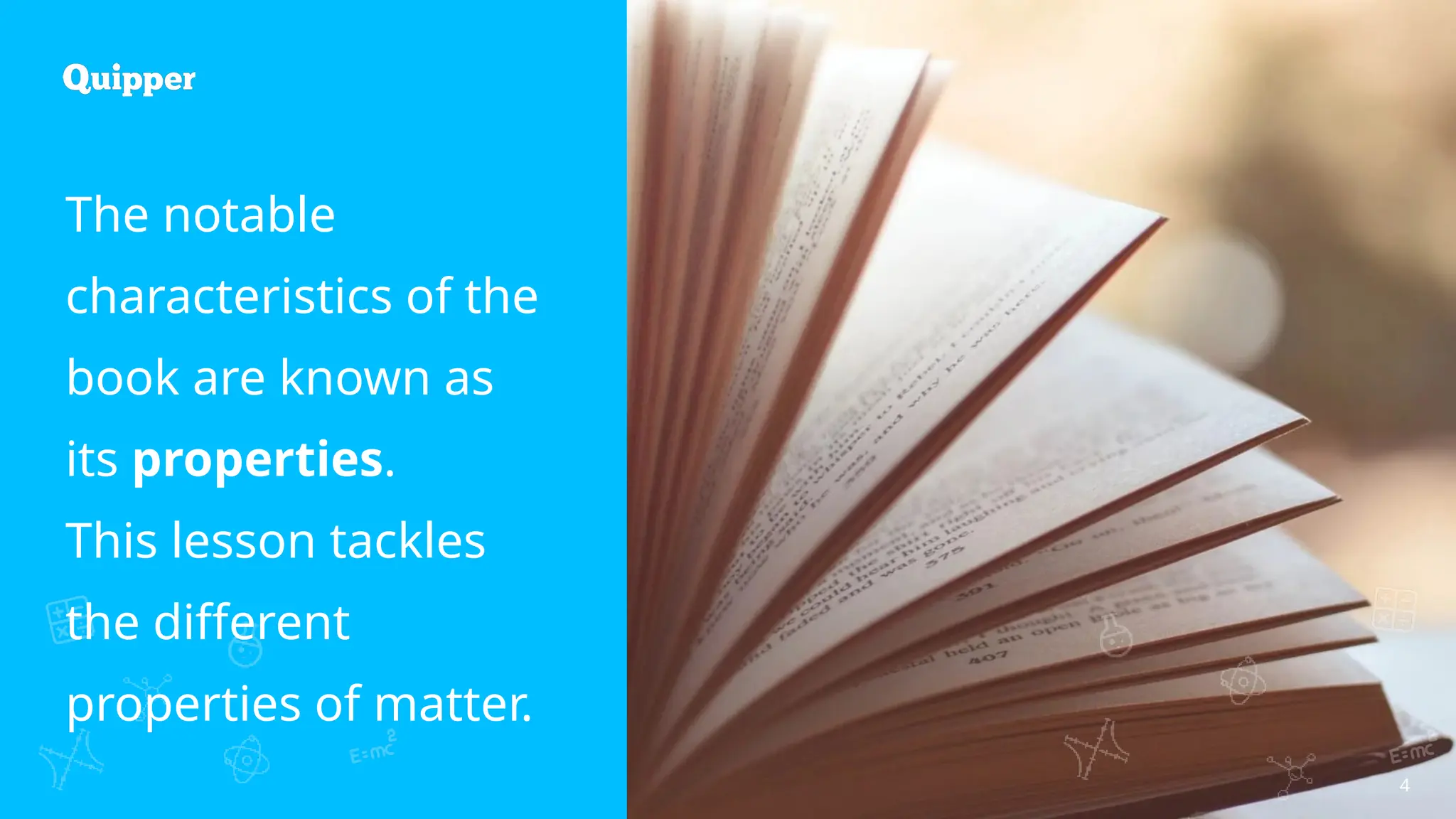
The notable
characteristics of the
book are known as
its properties.
This lesson tackles
the different
properties of matter.
5
What properties are
common in all forms of
matter?
Learning Competencies
At the end of the lesson, you should be able to do the
following:
6
● Distinguish between physical and chemical
properties and give examples (STEM_GC11MP-
Ia-b-3).
● Distinguish between extensive and intensive
properties and give examples (STEM_GC11MP-
Ia-b-4).
Learning Objectives
At the end of the lesson, you should be able to do the
following:
7
● Enumerate the general properties of matter.
● Distinguish between physical and chemical
properties of matter.
● Enumerate physical and chemical properties of
matter.
Learning Objectives
At the end of the lesson, you should be able to do the
following:
8
● Distinguish between extensive and intensive
properties of matter.
● Enumerate extensive and intensive properties of
matter.
9
Matter is anything that occupies space and has mass.
● General properties of matter:
○ mass
○ weight
○ volume
○ density
○ specific gravity
Matter
10
Mass
Mass is the amount of matter in an object
The more matter is present in an object means the
greater its mass.
It is usually expressed in grams (g) or kilograms (kg)
General Properties of Matter
11
General Properties of Matter
Mass
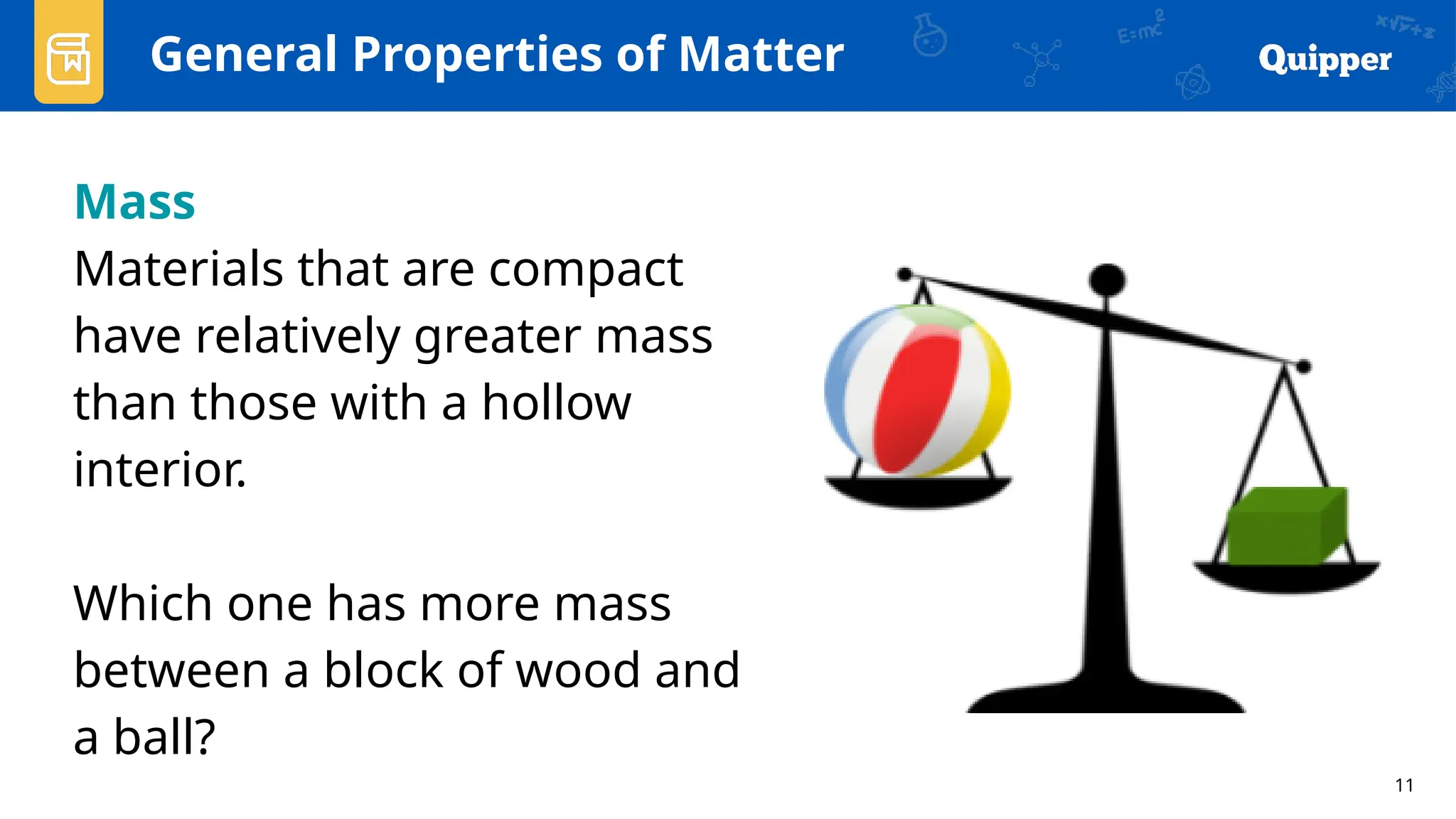
Materials that are compact
have relatively greater mass
than those with a hollow
interior.
Which one has more mass
between a block of wood and
a ball?
12
Weight
It is the measure of force that acts on an object.
It is expressed as the amount of matter (mass) multiplied
by the gravitational force that acts on it.
○ The greater the gravitational force that acts on an
object, the “heavier” it weighs.
It is expressed in newtons (N).
General Properties of Matter
13
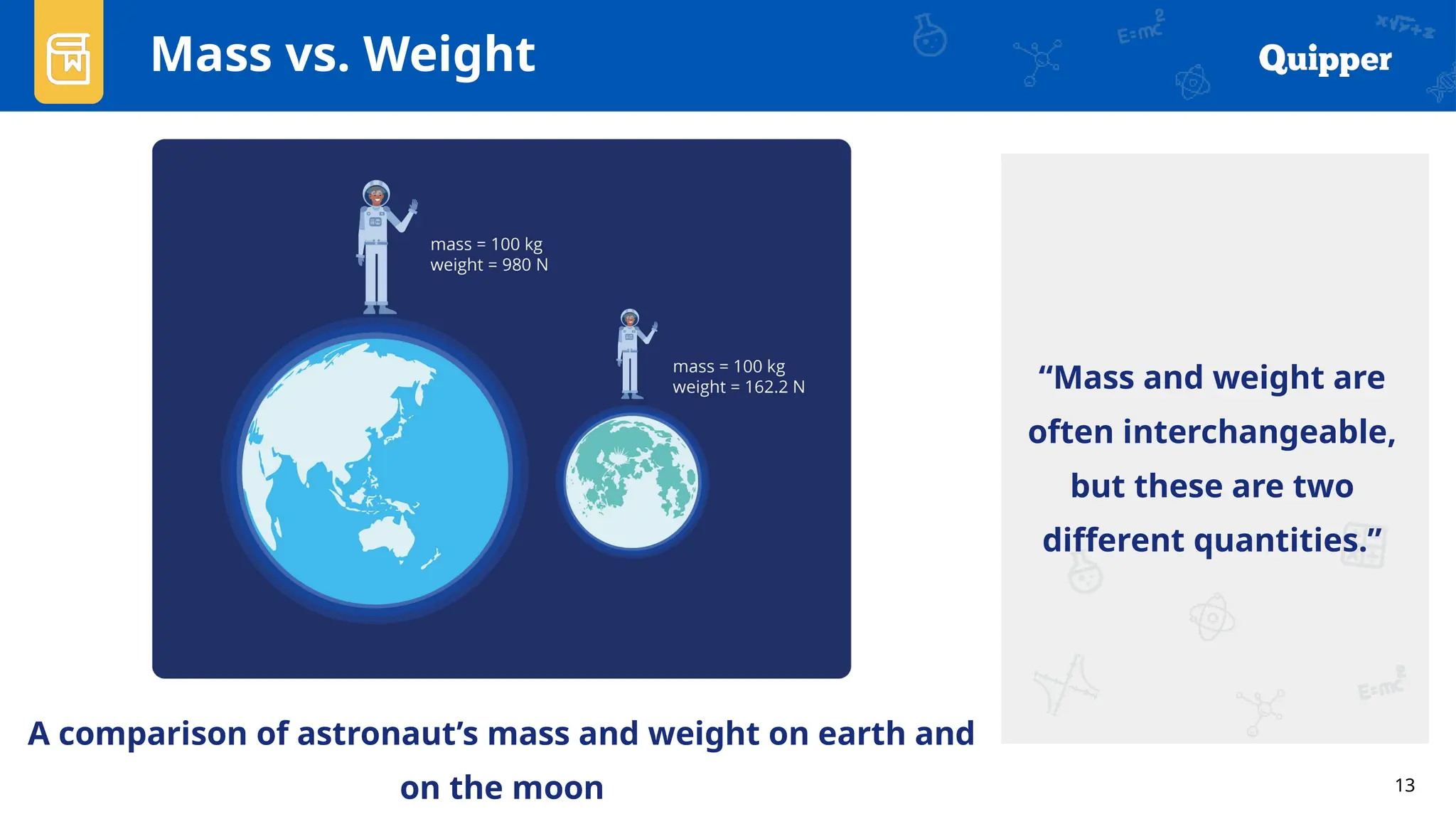
Mass vs. Weight
A comparison of astronaut’s mass and weight on earth and
on the moon
“Mass and weight are
often interchangeable,
but these are two
different quantities.”
14
General Properties of Matter
Volume
It is the amount of space occupied by matter
It can be measured using instruments with graduations
or by getting the dimensions of the object.
It is expressed in liters (L) for liquids, or cubic length (l3
)
for solids.
15
General Properties of Matter
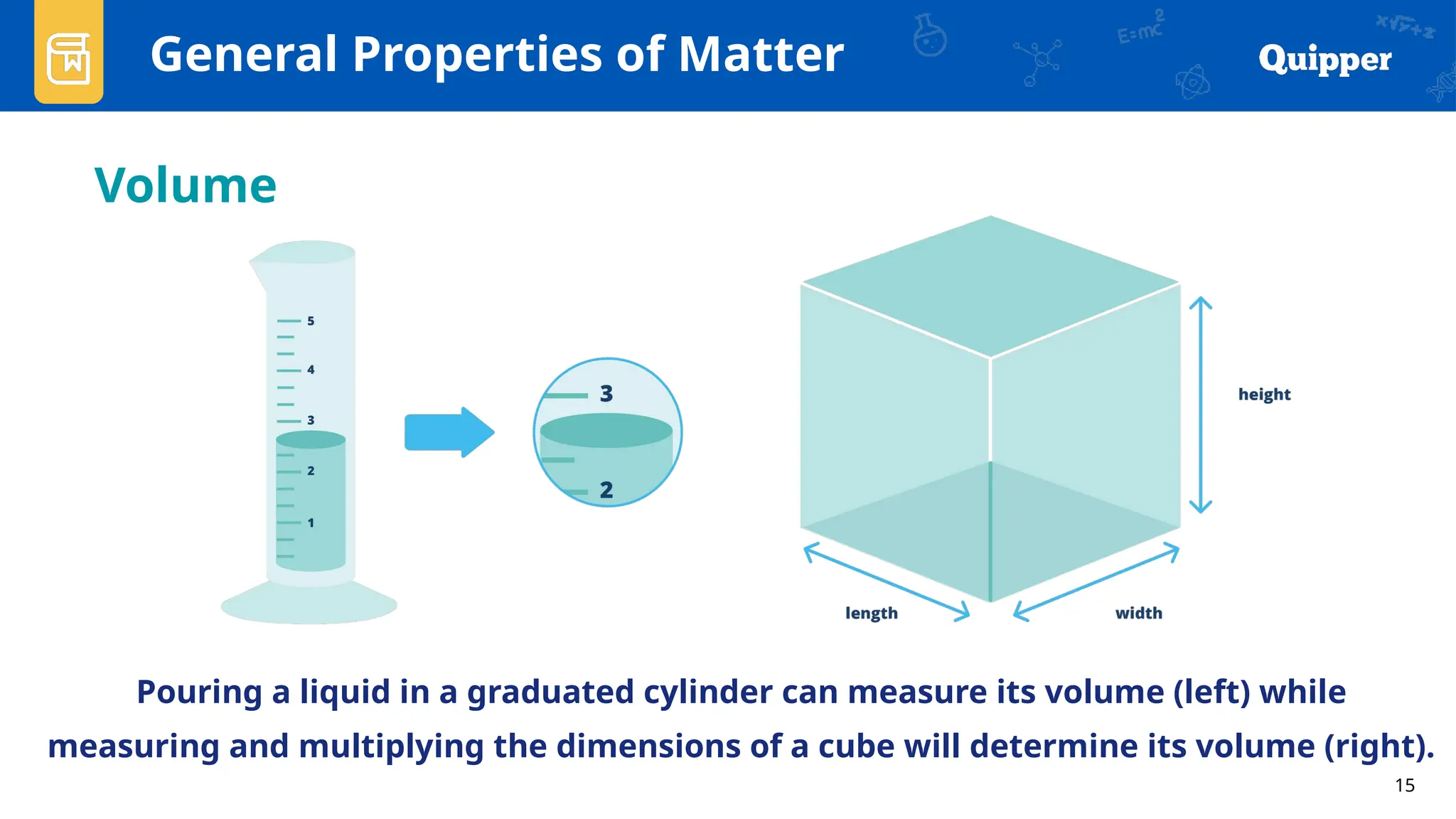
Pouring a liquid in a graduated cylinder can measure its volume (left) while
measuring and multiplying the dimensions of a cube will determine its volume (right).
Volume
16
General Properties of Matter
Density
It is the ratio between mass and volume.
It is expressed in kilograms per cubic meter (kg/m3
) or
grams per cubic centimeter (g/cm3
).
It tells how compact an object is.
○ An object with greater mass has more compact
particles than the lighter ones.
17
General Properties of Matter
Specific Gravity
It is the ratio of a substance’s density to a standard
substance.
It is also known as relative density.
It is a dimensionless quantity.
18
General Properties of Matter
Specific Gravity
Water at 4 o
C, which is at its densest, is commonly used as
a standard for comparison of liquids and solids.
Air at room temperature (20 o
C) is the usual standard for
comparison of gases.
19
How can you distinguish
physical from chemical
properties of matter?
20
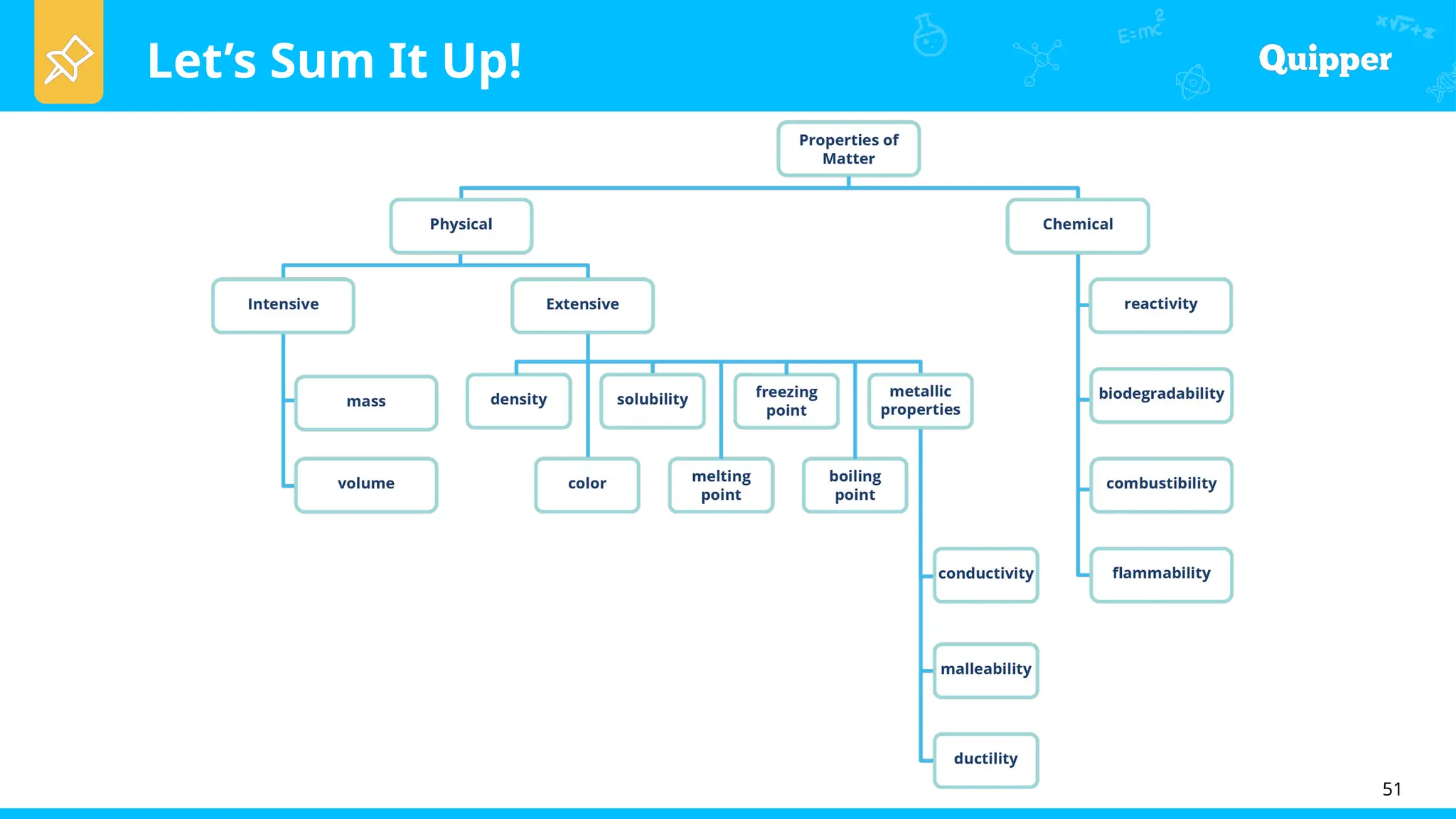
Physical Properties
Physical Properties
These are qualities that are readily observable or
measurable without changing the matter’s composition.
General properties such as mass, volume, weight,
density, and specific gravity are all examples of physical
properties.
These are often used to describe or observe matter.
21
Physical Properties
Can you give other examples of physical properties?
22
Physical Properties
● melting point
● boiling point
● freezing point
● solubility
● metallic properties
● size
● texture
● shape
● color
23
Physical Properties
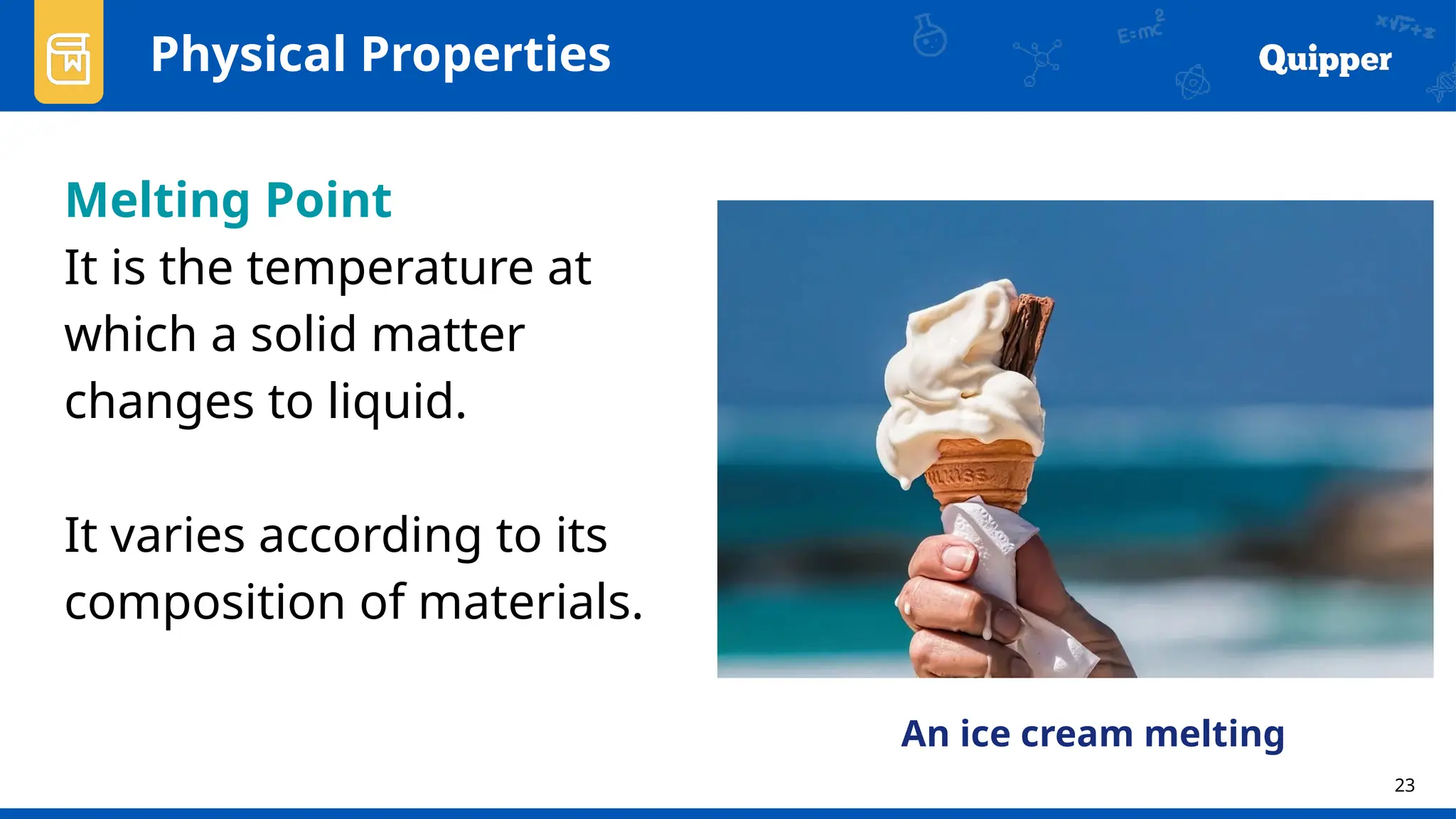
Melting Point
It is the temperature at
which a solid matter
changes to liquid.
It varies according to its
composition of materials.
An ice cream melting
24
Physical Properties
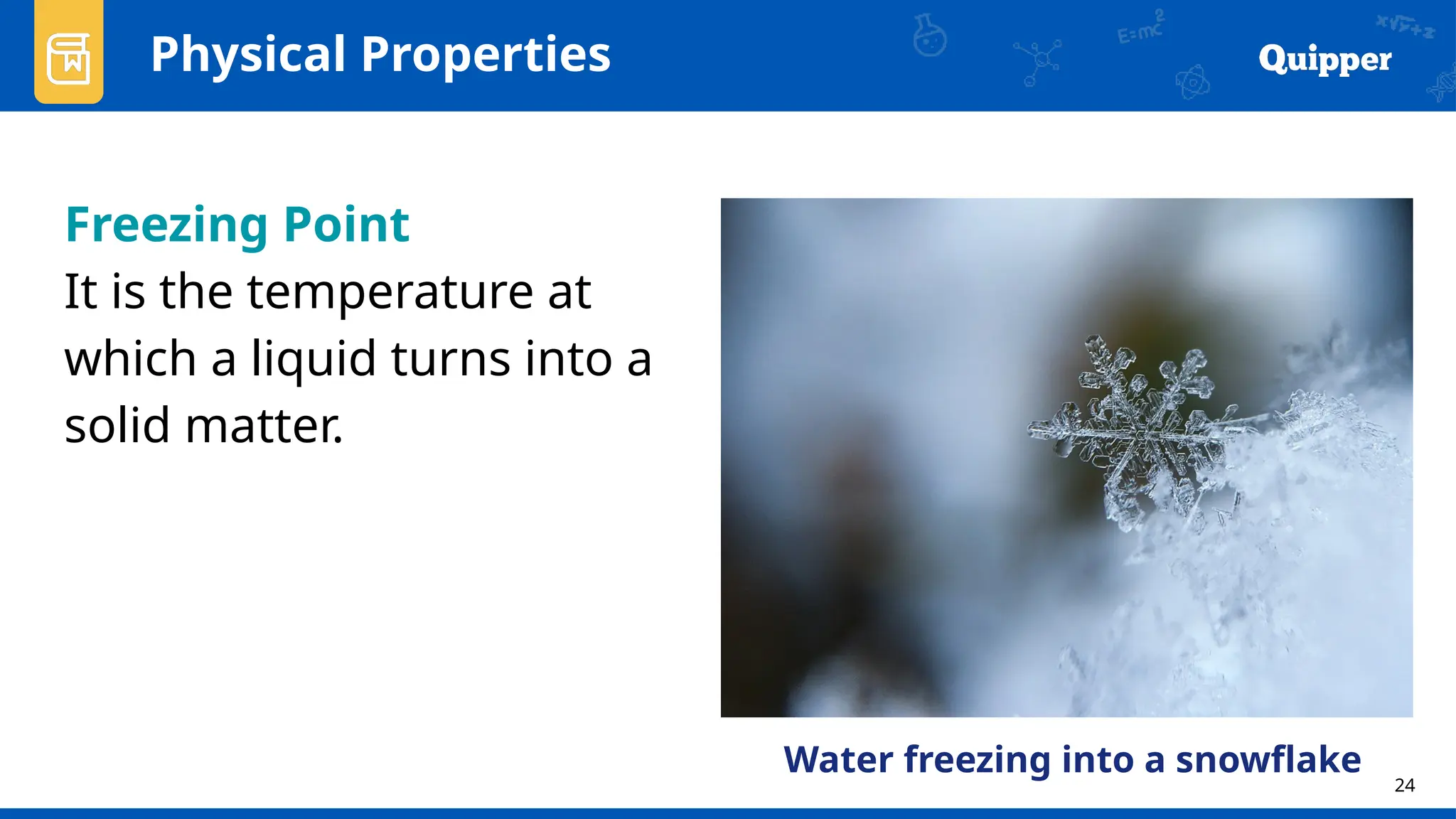
Freezing Point
It is the temperature at
which a liquid turns into a
solid matter.
Water freezing into a snowflake
25
Physical Properties
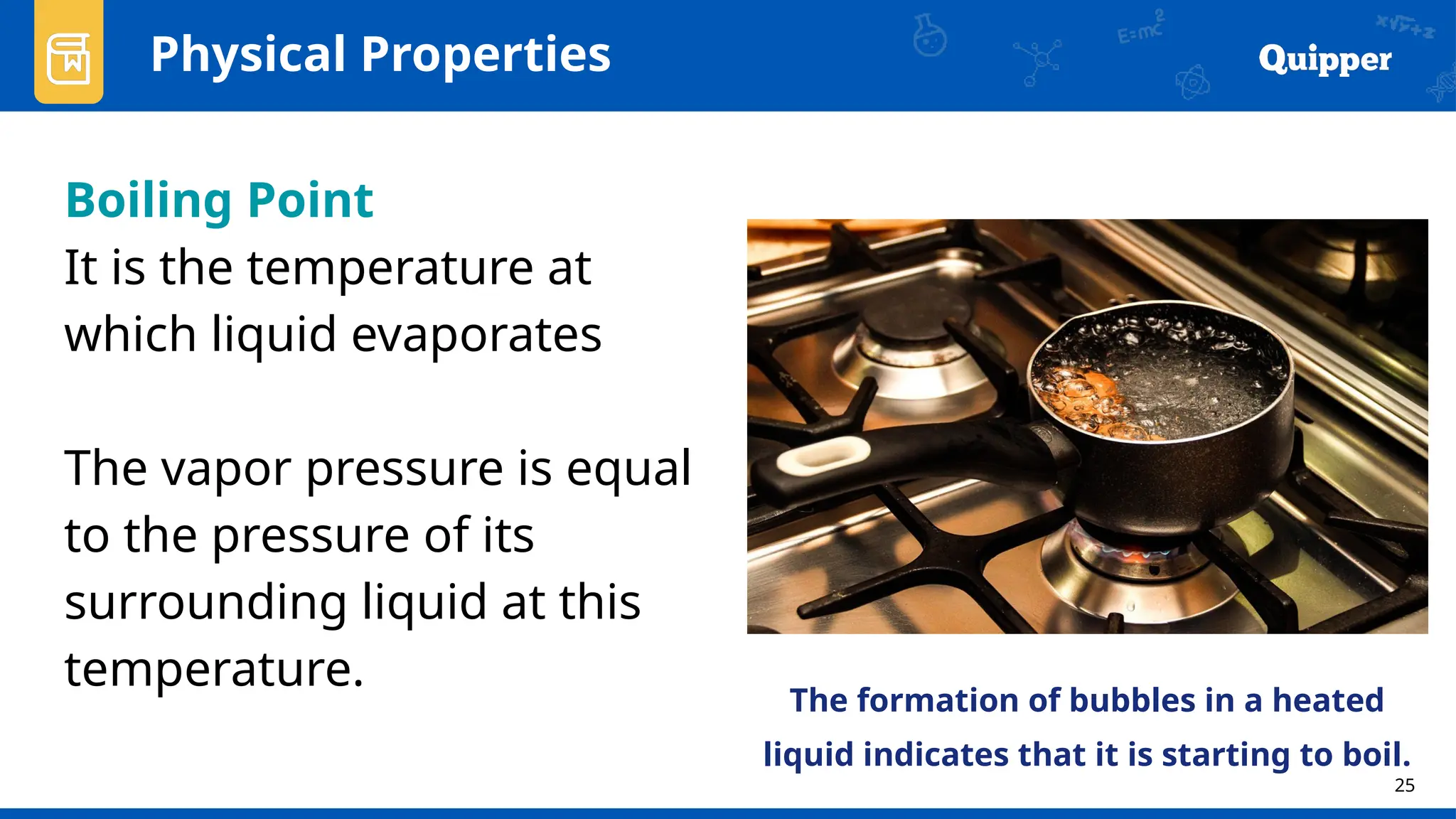
Boiling Point
It is the temperature at
which liquid evaporates
The vapor pressure is equal
to the pressure of its
surrounding liquid at this
temperature.
The formation of bubbles in a heated
liquid indicates that it is starting to boil.
26
Physical Properties
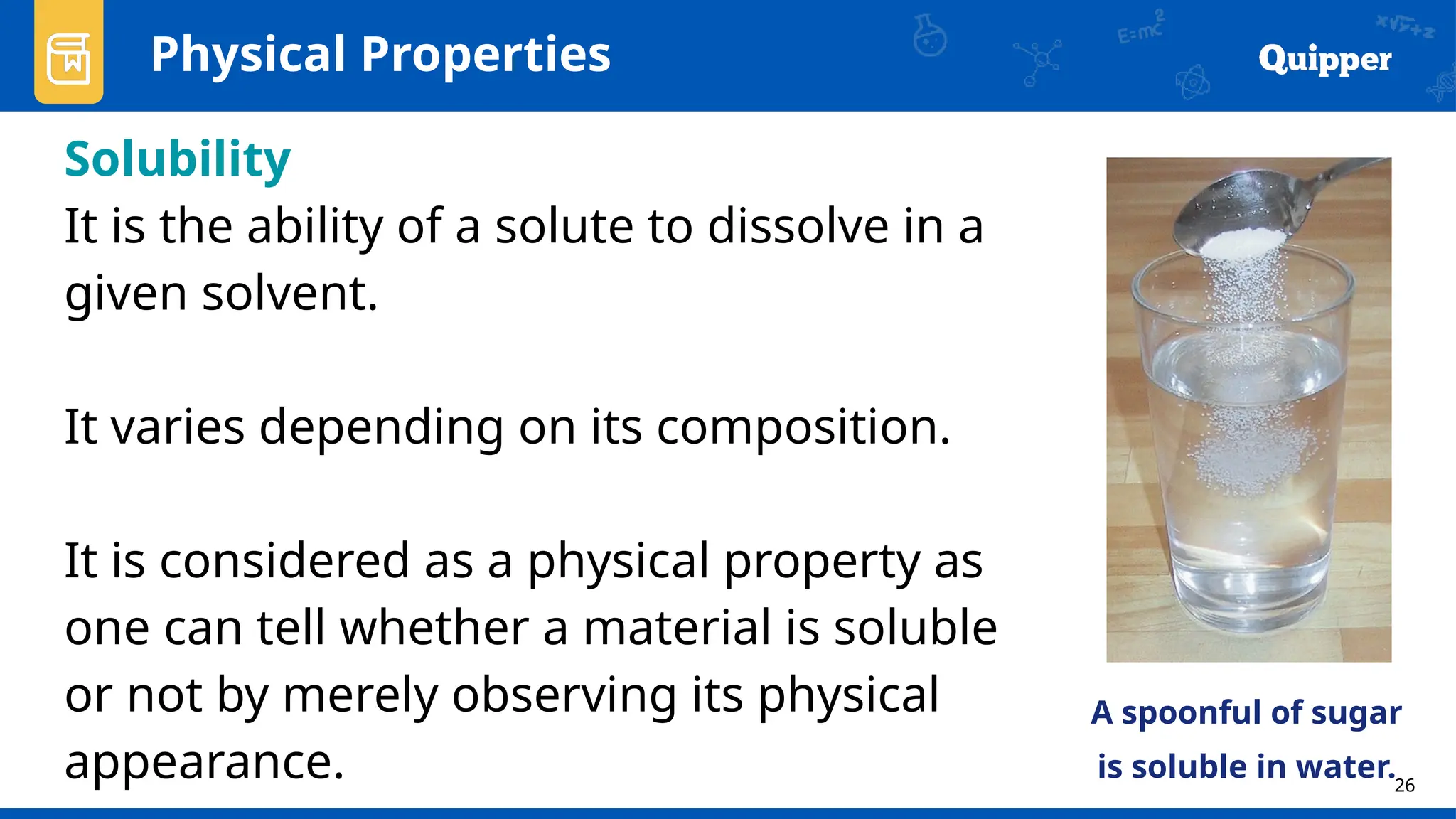
Solubility
It is the ability of a solute to dissolve in a
given solvent.
It varies depending on its composition.
It is considered as a physical property as
one can tell whether a material is soluble
or not by merely observing its physical
appearance.
A spoonful of sugar
is soluble in water.
27
Physical Properties
Metallic Properties
These are qualities that are observed specifically in
metals.
○ conductivity
○ malleability
○ ductility
28
Physical Properties
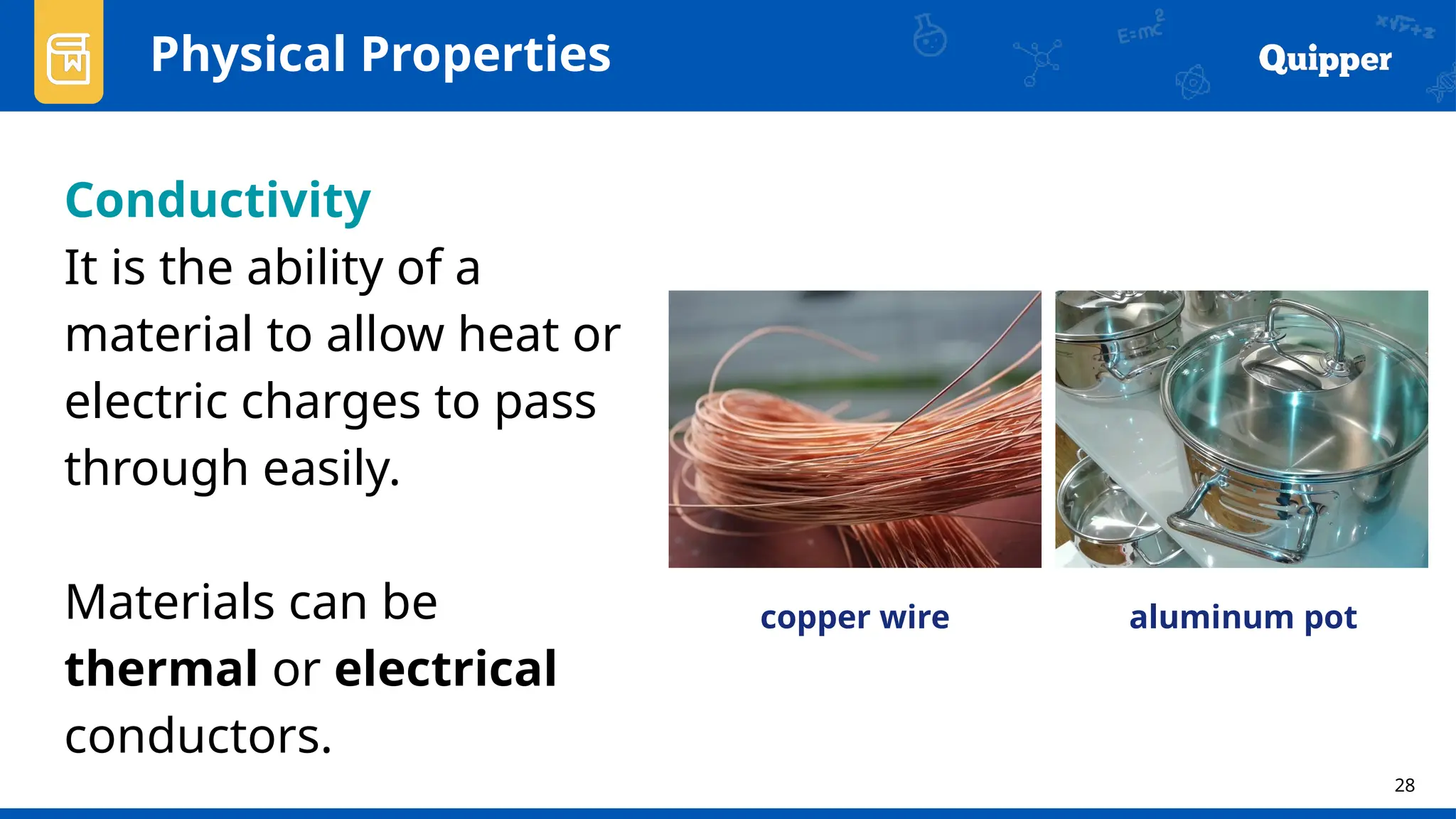
Conductivity
It is the ability of a
material to allow heat or
electric charges to pass
through easily.
Materials can be
thermal or electrical
conductors.
copper wire aluminum pot
29
Physical Properties
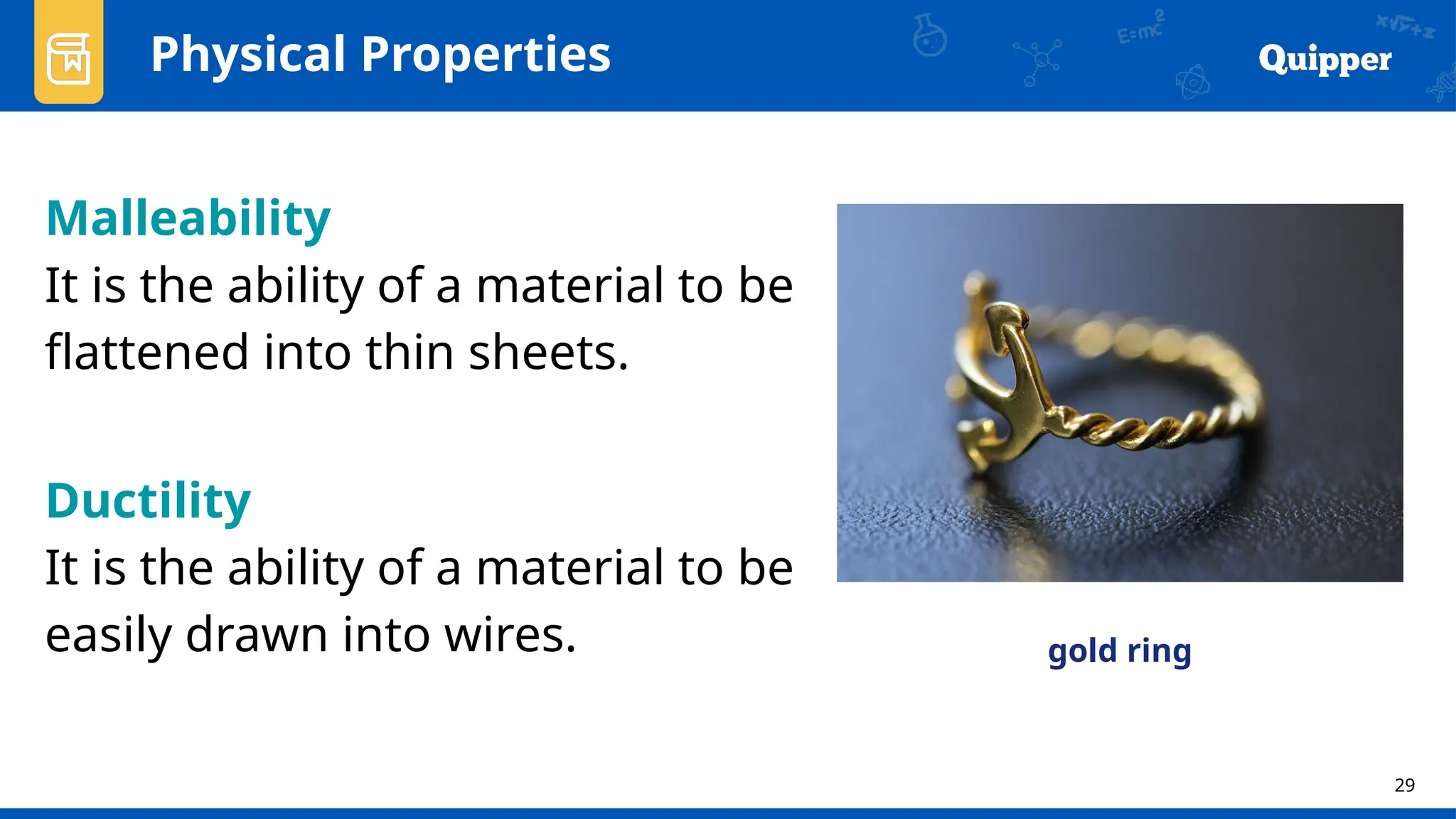
Malleability
It is the ability of a material to be
flattened into thin sheets.
Ductility
It is the ability of a material to be
easily drawn into wires. gold ring
30
How can physical properties of
matter distinguish one
substance from another?
Remember
31
Qualities that are readily observable
or measurable without changing the
matter’s composition are known as
physical properties.
32
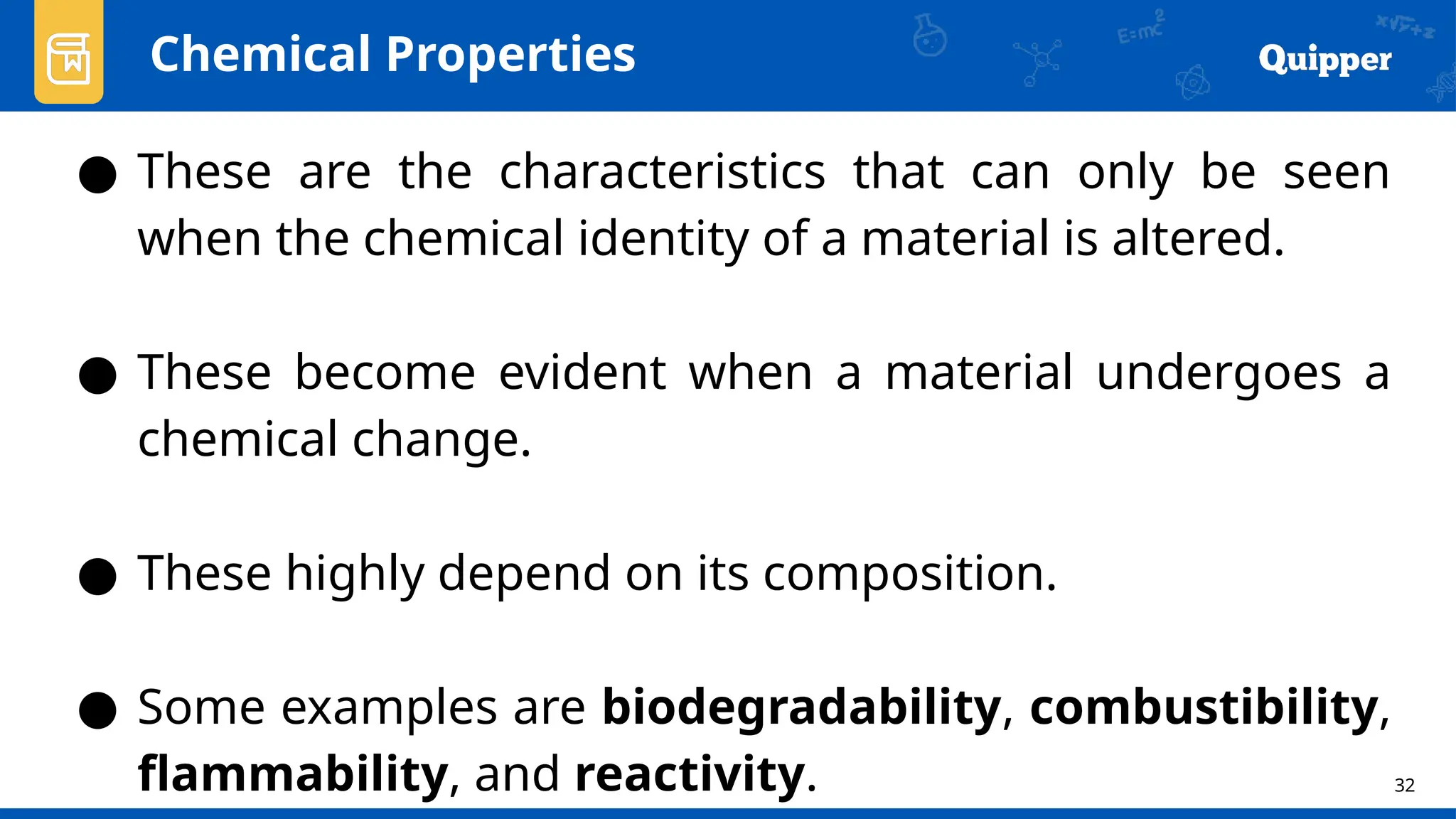
Chemical Properties
● These are the characteristics that can only be seen
when the chemical identity of a material is altered.
● These become evident when a material undergoes a
chemical change.
● These highly depend on its composition.
● Some examples are biodegradability, combustibility,
flammability, and reactivity.
33
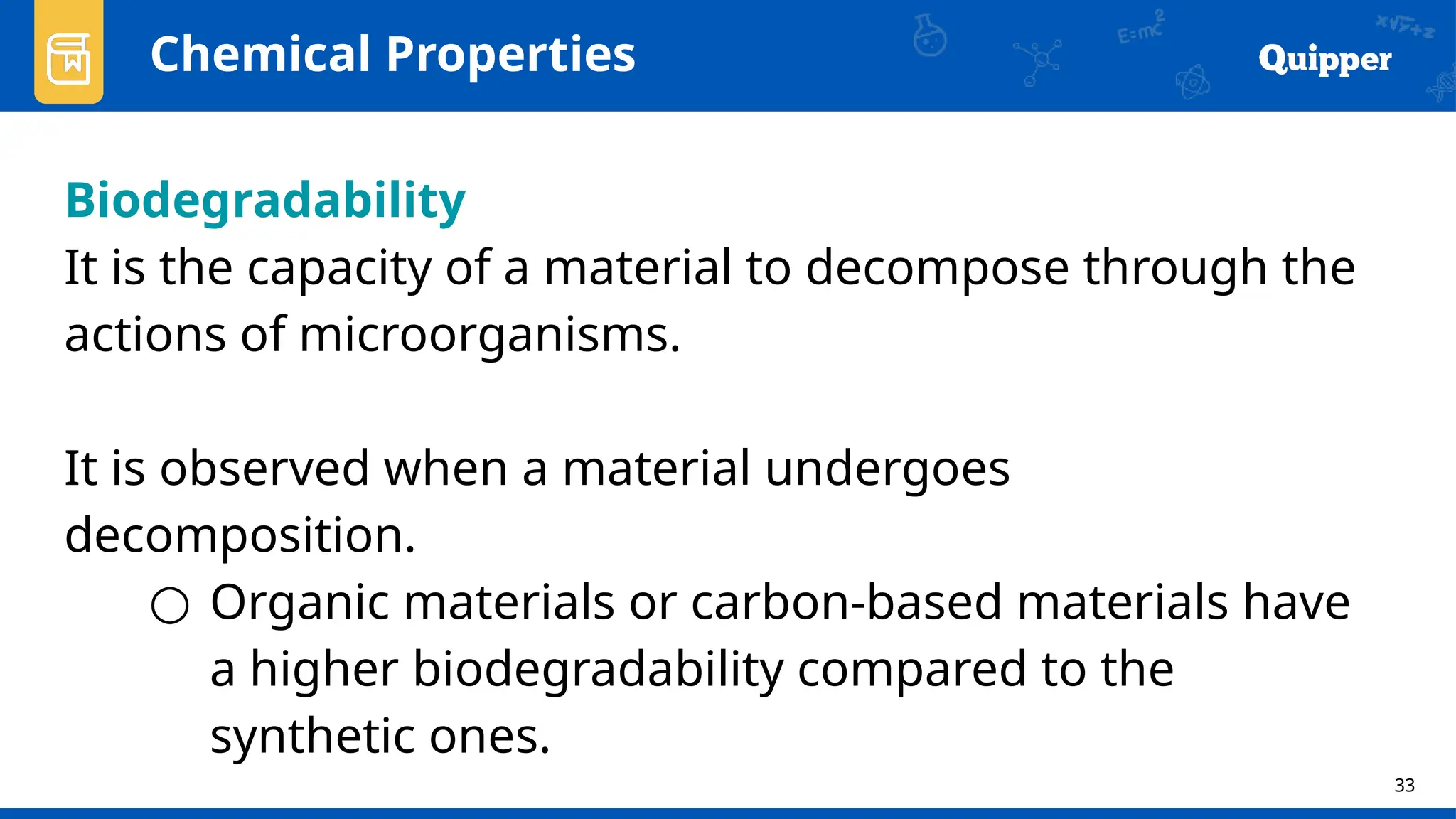
Chemical Properties
Biodegradability
It is the capacity of a material to decompose through the
actions of microorganisms.
It is observed when a material undergoes
decomposition.
○ Organic materials or carbon-based materials have
a higher biodegradability compared to the
synthetic ones.
34
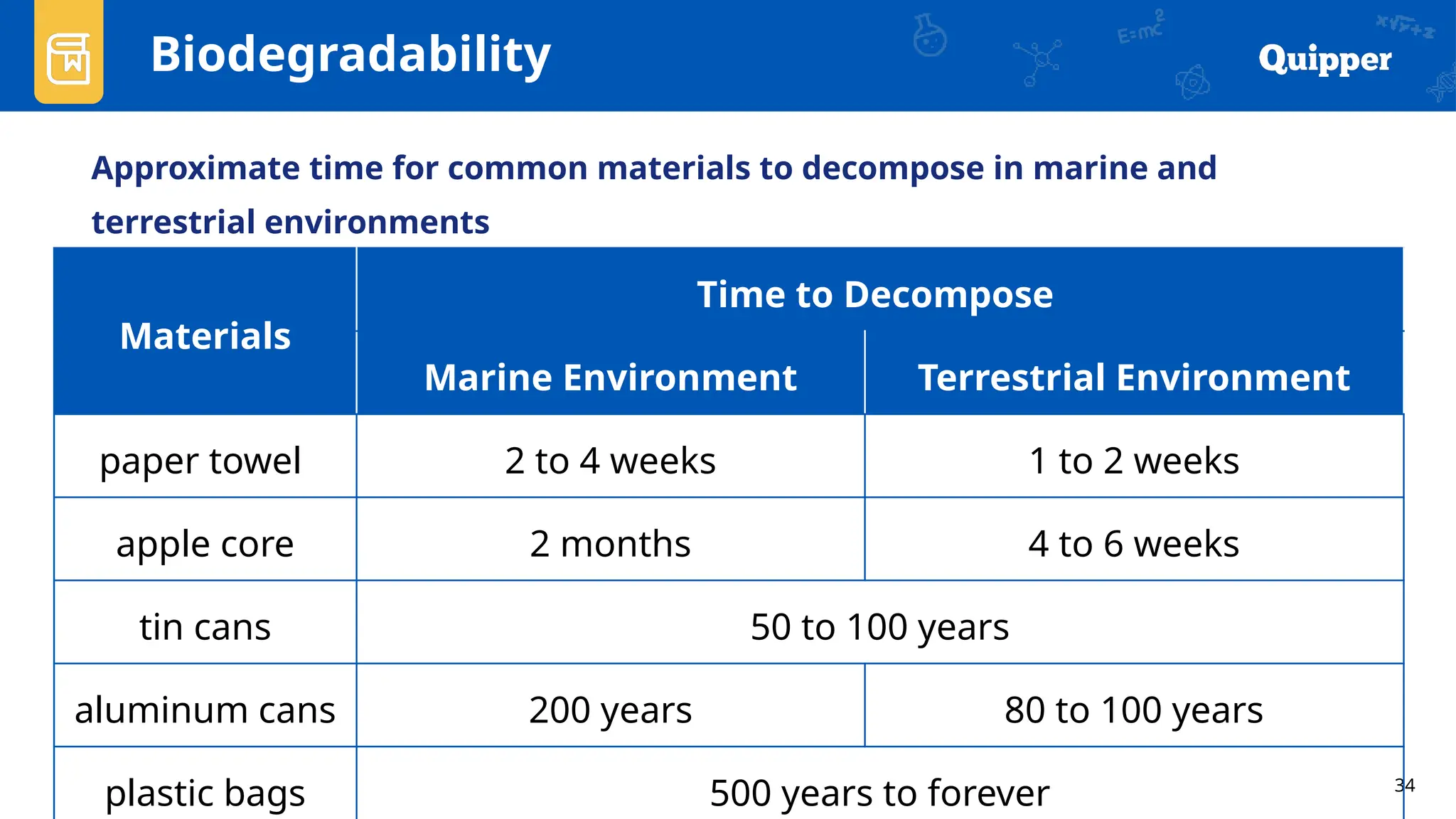
Biodegradability
Approximate time for common materials to decompose in marine and
terrestrial environments
Materials
Time to Decompose
Marine Environment Terrestrial Environment
paper towel 2 to 4 weeks 1 to 2 weeks
apple core 2 months 4 to 6 weeks
tin cans 50 to 100 years
aluminum cans 200 years 80 to 100 years
plastic bags 500 years to forever
35
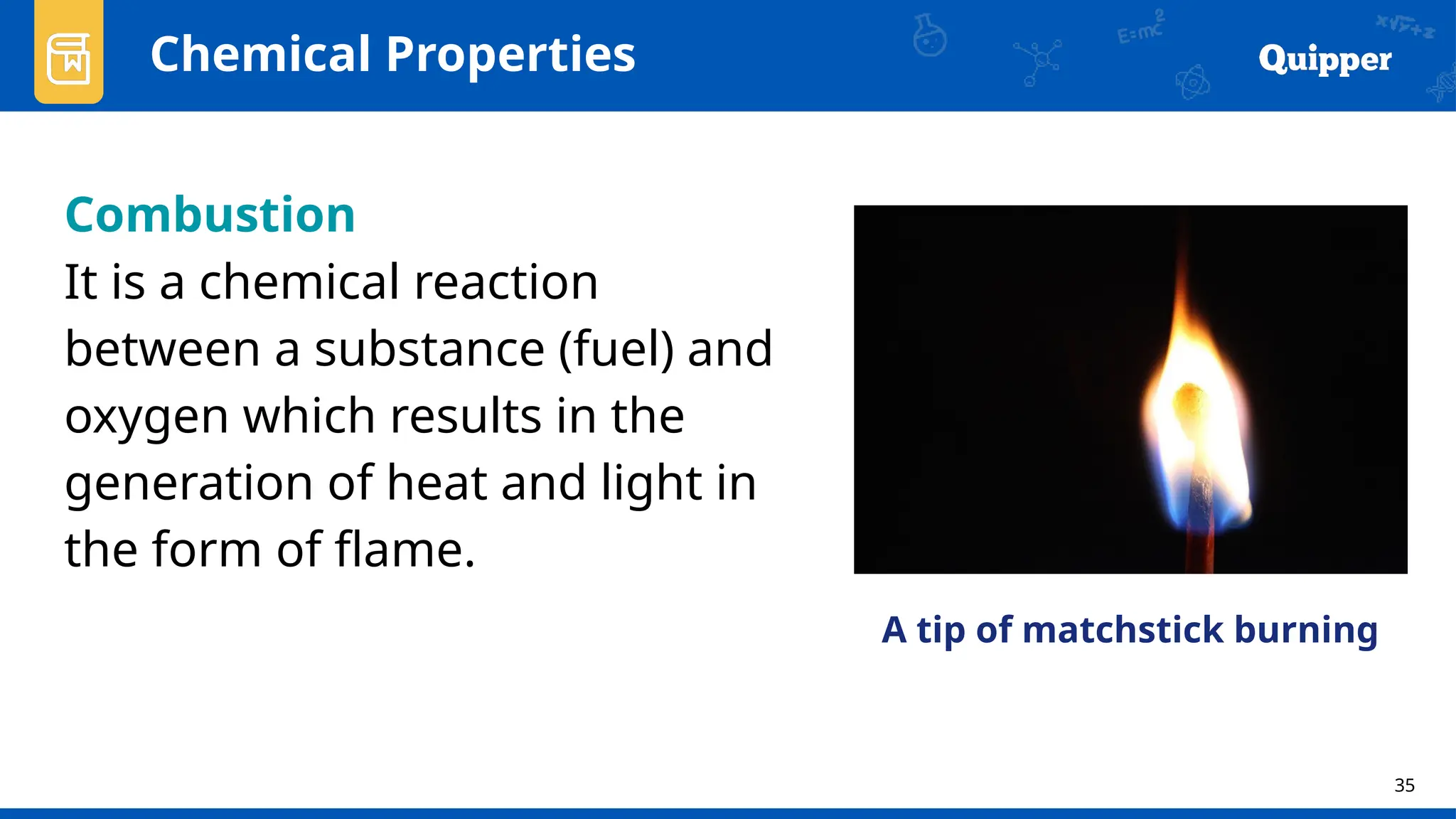
Chemical Properties
Combustion
It is a chemical reaction
between a substance (fuel) and
oxygen which results in the
generation of heat and light in
the form of flame.
A tip of matchstick burning
36
Chemical Properties
Combustibility
It is the ability of a material to combust or burn.
Flammability
It is the ability of a combustible material to catch flame
easily.
37
Chemical Properties
Combustibility and Flammability
It is the main difference between the two properties:
ease and rate of how an object burns.
Not all combustible materials are flammable.
○ A block of wood may only burn when exposed to a
specific amount of heat and oxygen, but putting a
flame near it will not necessarily make it burn
instantly.
38
Combustibility and Flammability
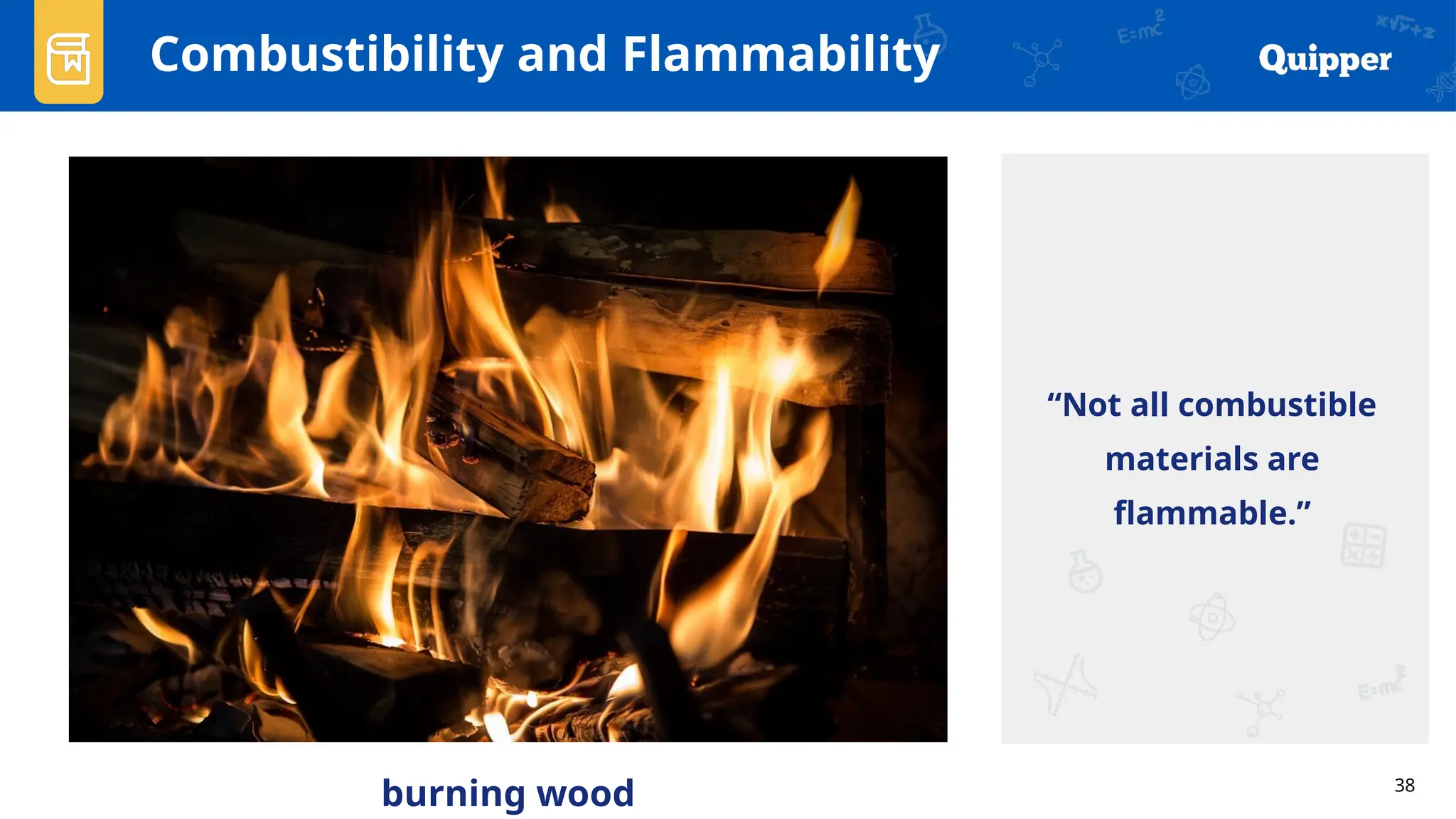
burning wood
“Not all combustible
materials are
flammable.”
39
Chemical Properties
Reactivity
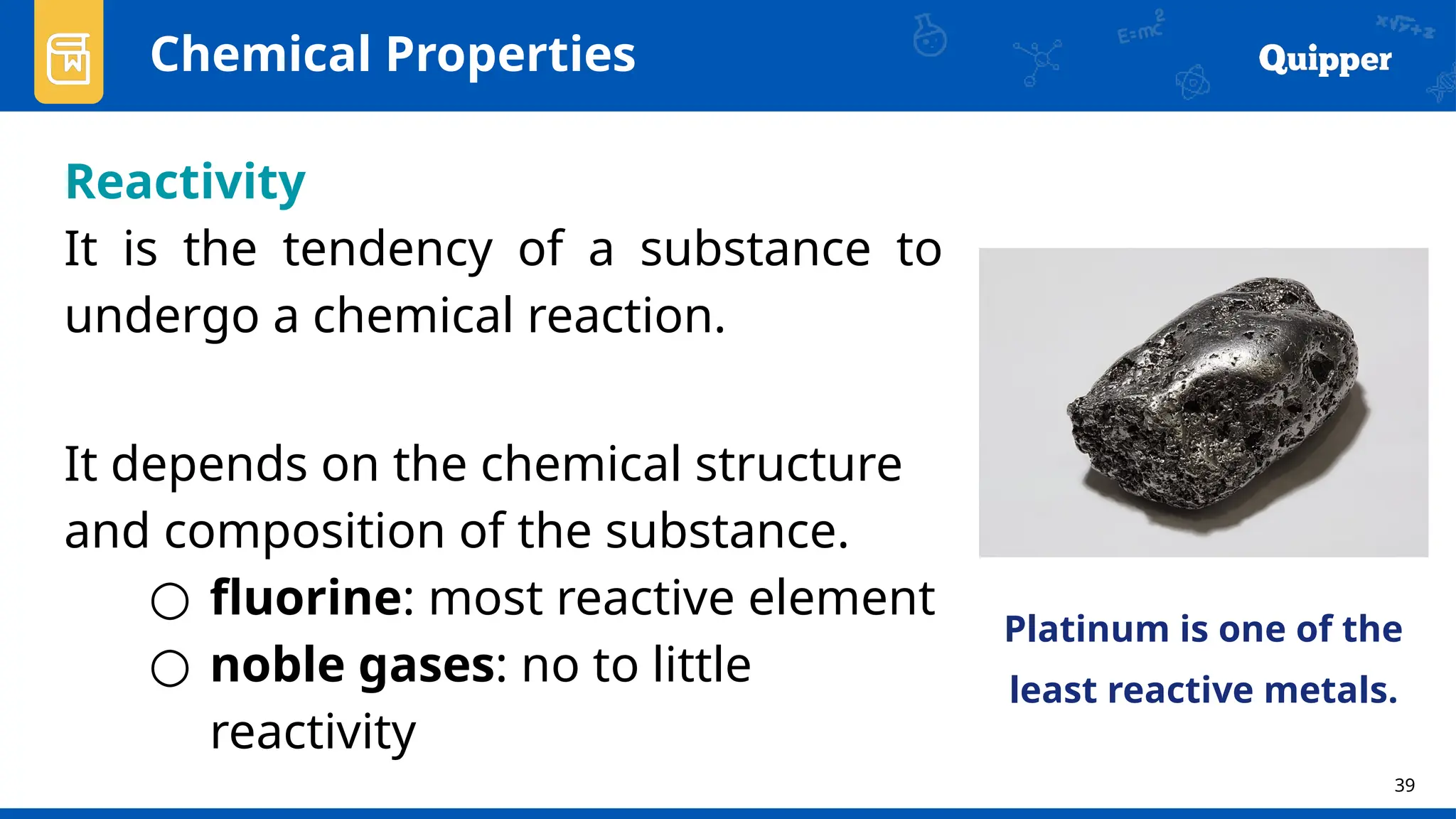
It is the tendency of a substance to
undergo a chemical reaction.
It depends on the chemical structure
and composition of the substance.
○ fluorine: most reactive element
○ noble gases: no to little
reactivity
Platinum is one of the
least reactive metals.
40
How can chemical properties of
matter distinguish one
substance from another?
Remember
41
The characteristics that can only be
seen when the chemical identity of a
material is altered are known as
chemical properties.
42
Physical Properties of Matter
● These may be further classified as intensive or
extensive.
● These are based on whether a physical property
depends on the amount of matter or not.
43
How will you differentiate
intensive from extensive
properties of matter?
44
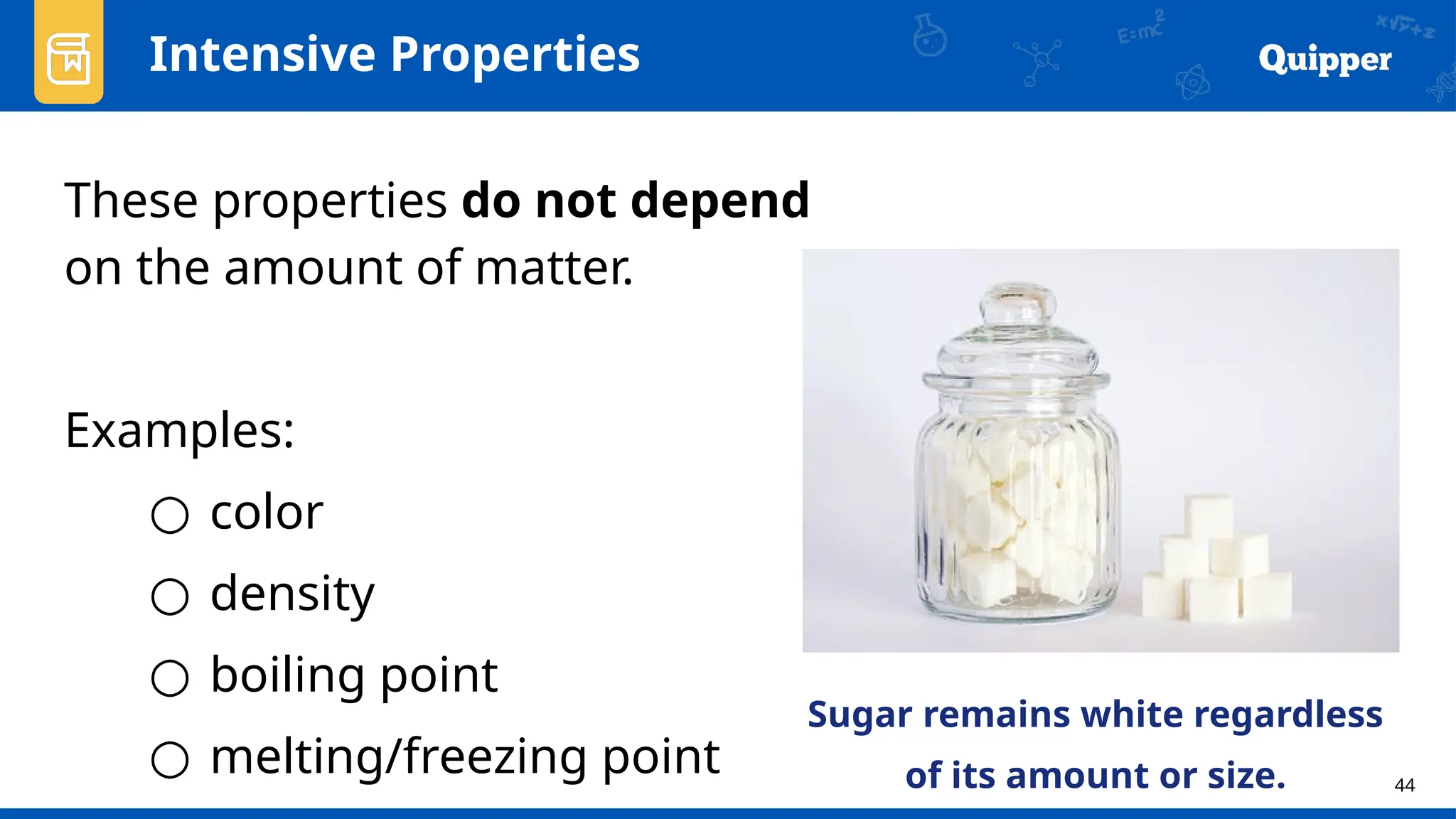
Intensive Properties
These properties do not depend
on the amount of matter.
Examples:
○ color
○ density
○ boiling point
○ melting/freezing point
Sugar remains white regardless
of its amount or size.
45
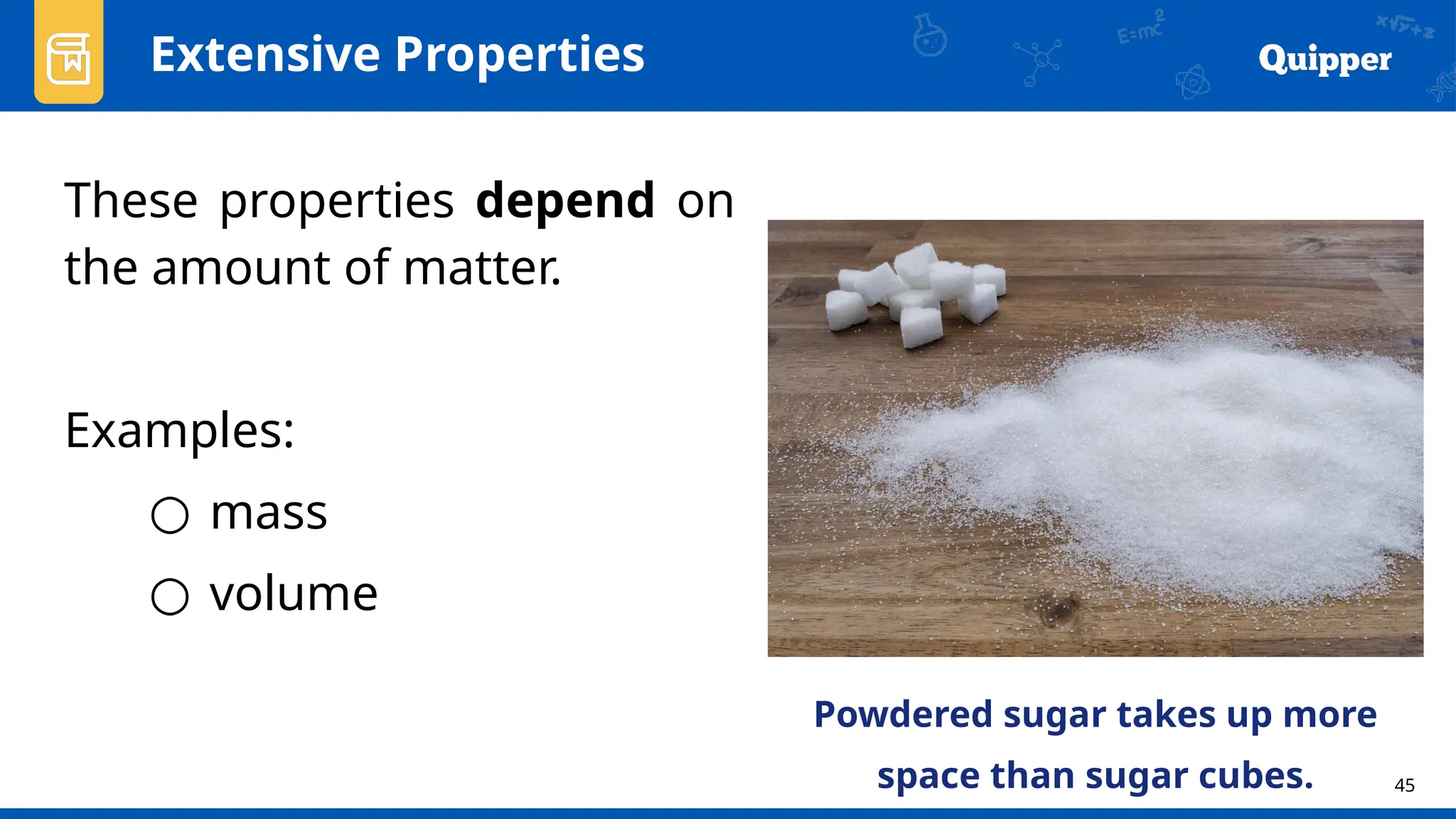
Extensive Properties
These properties depend on
the amount of matter.
Examples:
○ mass
○ volume
Powdered sugar takes up more
space than sugar cubes.
Remember
46
Physical properties of matter may be
categorized as intensive or extensive
based on its dependence on the
amount of matter.
Check Your
Understanding
47
Tell whether the statement is true or false.
1. General properties of matter are characteristics that
are specific to a certain kind of material.
2. Chemical properties may only be observed when a
material undergoes a chemical change.
3. Combustibility is a property that is readily observable
even without changing the chemical identity of the
material being observed.
Let’s Sum It Up!
48
● The characteristics of matter that are present to
all kinds of matter are known as general
properties of matter.
● Qualities that are readily observable or
measurable without changing the matter’s
composition are known as physical properties.
Let’s Sum It Up!
49
● Physical properties of matter may be further
classified based on whether it depends on the
amount of matter.
○ Intensive properties are physical properties
that do not depend on the amount of matter.
○ Extensive properties are physical properties
that depend on the amount of matter.
Let’s Sum It Up!
50
● The characteristics that can only be seen when
the chemical identity of a material is altered are
known as chemical properties.
Let’s Sum It Up!
51
Challenge Yourself
52
52
Density is the ratio between mass
and volume. If mass and volume are
both extensive physical properties of
matter, how come density is an
intensive property of matter?
Photo Credits
53
● Slide 24. SaltinWaterSolutionLiquid, by Chris 73 is licensed under CC BY 3.0 via
Wikimedia Commons.
● Slide 37. Platinum-nugget, by Alchemist-hp is licensed under CC BY-SA 3.0 via
Wikimedia Commons.
Bibliography
54
Chang, Raymond, and Kenneth A. Goldsby. General Chemistry: the Essential Concepts. New York:
McGraw-Hill, 2014.
Handwerker, Mark J. Science Essentials. San Francisco, CA.: Jossey-Bass, 2005.
Hawe, Alan, Dan Davies, Kendra McMahon, Lee Towler, Chris Collier, and Tonie Scott. Science 5–11: A
Guide for Teachers. 2nd ed. New York, NY: David Fulton Publishers, 2009.
Petrucci, Ralph H. General Chemistry: Principles and Modern Applications. Toronto, Ont.: Pearson
Canada, 2011. Print.
Silberberg, Martin S. Principles of General Chemistry. New York: McGraw-Hill, 2013.

a powerpoint presentation in general chemistru garde 11 stem

  • 1.
    General Chemistry 1 Science,Technology, Engineering, and Mathematics Lesson 1.2 Properties of Matter
  • 2.
    2 What is thefirst thing you notice when you hold and read a book?
  • 3.
    3 Is it hardor soft? Is it thick or thin? Is it heavy or light? Does it burn when you place it near a flame?
  • 4.
    4 The notable characteristics ofthe book are known as its properties. This lesson tackles the different properties of matter.
  • 5.
    5 What properties are commonin all forms of matter?
  • 6.
    Learning Competencies At theend of the lesson, you should be able to do the following: 6 ● Distinguish between physical and chemical properties and give examples (STEM_GC11MP- Ia-b-3). ● Distinguish between extensive and intensive properties and give examples (STEM_GC11MP- Ia-b-4).
  • 7.
    Learning Objectives At theend of the lesson, you should be able to do the following: 7 ● Enumerate the general properties of matter. ● Distinguish between physical and chemical properties of matter. ● Enumerate physical and chemical properties of matter.
  • 8.
    Learning Objectives At theend of the lesson, you should be able to do the following: 8 ● Distinguish between extensive and intensive properties of matter. ● Enumerate extensive and intensive properties of matter.
  • 9.
    9 Matter is anythingthat occupies space and has mass. ● General properties of matter: ○ mass ○ weight ○ volume ○ density ○ specific gravity Matter
  • 10.
    10 Mass Mass is theamount of matter in an object The more matter is present in an object means the greater its mass. It is usually expressed in grams (g) or kilograms (kg) General Properties of Matter
  • 11.
    11 General Properties ofMatter Mass Materials that are compact have relatively greater mass than those with a hollow interior. Which one has more mass between a block of wood and a ball?
  • 12.
    12 Weight It is themeasure of force that acts on an object. It is expressed as the amount of matter (mass) multiplied by the gravitational force that acts on it. ○ The greater the gravitational force that acts on an object, the “heavier” it weighs. It is expressed in newtons (N). General Properties of Matter
  • 13.
    13 Mass vs. Weight Acomparison of astronaut’s mass and weight on earth and on the moon “Mass and weight are often interchangeable, but these are two different quantities.”
  • 14.
    14 General Properties ofMatter Volume It is the amount of space occupied by matter It can be measured using instruments with graduations or by getting the dimensions of the object. It is expressed in liters (L) for liquids, or cubic length (l3 ) for solids.
  • 15.
    15 General Properties ofMatter Pouring a liquid in a graduated cylinder can measure its volume (left) while measuring and multiplying the dimensions of a cube will determine its volume (right). Volume
  • 16.
    16 General Properties ofMatter Density It is the ratio between mass and volume. It is expressed in kilograms per cubic meter (kg/m3 ) or grams per cubic centimeter (g/cm3 ). It tells how compact an object is. ○ An object with greater mass has more compact particles than the lighter ones.
  • 17.
    17 General Properties ofMatter Specific Gravity It is the ratio of a substance’s density to a standard substance. It is also known as relative density. It is a dimensionless quantity.
  • 18.
    18 General Properties ofMatter Specific Gravity Water at 4 o C, which is at its densest, is commonly used as a standard for comparison of liquids and solids. Air at room temperature (20 o C) is the usual standard for comparison of gases.
  • 19.
    19 How can youdistinguish physical from chemical properties of matter?
  • 20.
    20 Physical Properties Physical Properties Theseare qualities that are readily observable or measurable without changing the matter’s composition. General properties such as mass, volume, weight, density, and specific gravity are all examples of physical properties. These are often used to describe or observe matter.
  • 21.
    21 Physical Properties Can yougive other examples of physical properties?
  • 22.
    22 Physical Properties ● meltingpoint ● boiling point ● freezing point ● solubility ● metallic properties ● size ● texture ● shape ● color
  • 23.
    23 Physical Properties Melting Point Itis the temperature at which a solid matter changes to liquid. It varies according to its composition of materials. An ice cream melting
  • 24.
    24 Physical Properties Freezing Point Itis the temperature at which a liquid turns into a solid matter. Water freezing into a snowflake
  • 25.
    25 Physical Properties Boiling Point Itis the temperature at which liquid evaporates The vapor pressure is equal to the pressure of its surrounding liquid at this temperature. The formation of bubbles in a heated liquid indicates that it is starting to boil.
  • 26.
    26 Physical Properties Solubility It isthe ability of a solute to dissolve in a given solvent. It varies depending on its composition. It is considered as a physical property as one can tell whether a material is soluble or not by merely observing its physical appearance. A spoonful of sugar is soluble in water.
  • 27.
    27 Physical Properties Metallic Properties Theseare qualities that are observed specifically in metals. ○ conductivity ○ malleability ○ ductility
  • 28.
    28 Physical Properties Conductivity It isthe ability of a material to allow heat or electric charges to pass through easily. Materials can be thermal or electrical conductors. copper wire aluminum pot
  • 29.
    29 Physical Properties Malleability It isthe ability of a material to be flattened into thin sheets. Ductility It is the ability of a material to be easily drawn into wires. gold ring
  • 30.
    30 How can physicalproperties of matter distinguish one substance from another?
  • 31.
    Remember 31 Qualities that arereadily observable or measurable without changing the matter’s composition are known as physical properties.
  • 32.
    32 Chemical Properties ● Theseare the characteristics that can only be seen when the chemical identity of a material is altered. ● These become evident when a material undergoes a chemical change. ● These highly depend on its composition. ● Some examples are biodegradability, combustibility, flammability, and reactivity.
  • 33.
    33 Chemical Properties Biodegradability It isthe capacity of a material to decompose through the actions of microorganisms. It is observed when a material undergoes decomposition. ○ Organic materials or carbon-based materials have a higher biodegradability compared to the synthetic ones.
  • 34.
    34 Biodegradability Approximate time forcommon materials to decompose in marine and terrestrial environments Materials Time to Decompose Marine Environment Terrestrial Environment paper towel 2 to 4 weeks 1 to 2 weeks apple core 2 months 4 to 6 weeks tin cans 50 to 100 years aluminum cans 200 years 80 to 100 years plastic bags 500 years to forever
  • 35.
    35 Chemical Properties Combustion It isa chemical reaction between a substance (fuel) and oxygen which results in the generation of heat and light in the form of flame. A tip of matchstick burning
  • 36.
    36 Chemical Properties Combustibility It isthe ability of a material to combust or burn. Flammability It is the ability of a combustible material to catch flame easily.
  • 37.
    37 Chemical Properties Combustibility andFlammability It is the main difference between the two properties: ease and rate of how an object burns. Not all combustible materials are flammable. ○ A block of wood may only burn when exposed to a specific amount of heat and oxygen, but putting a flame near it will not necessarily make it burn instantly.
  • 38.
    38 Combustibility and Flammability burningwood “Not all combustible materials are flammable.”
  • 39.
    39 Chemical Properties Reactivity It isthe tendency of a substance to undergo a chemical reaction. It depends on the chemical structure and composition of the substance. ○ fluorine: most reactive element ○ noble gases: no to little reactivity Platinum is one of the least reactive metals.
  • 40.
    40 How can chemicalproperties of matter distinguish one substance from another?
  • 41.
    Remember 41 The characteristics thatcan only be seen when the chemical identity of a material is altered are known as chemical properties.
  • 42.
    42 Physical Properties ofMatter ● These may be further classified as intensive or extensive. ● These are based on whether a physical property depends on the amount of matter or not.
  • 43.
    43 How will youdifferentiate intensive from extensive properties of matter?
  • 44.
    44 Intensive Properties These propertiesdo not depend on the amount of matter. Examples: ○ color ○ density ○ boiling point ○ melting/freezing point Sugar remains white regardless of its amount or size.
  • 45.
    45 Extensive Properties These propertiesdepend on the amount of matter. Examples: ○ mass ○ volume Powdered sugar takes up more space than sugar cubes.
  • 46.
    Remember 46 Physical properties ofmatter may be categorized as intensive or extensive based on its dependence on the amount of matter.
  • 47.
    Check Your Understanding 47 Tell whetherthe statement is true or false. 1. General properties of matter are characteristics that are specific to a certain kind of material. 2. Chemical properties may only be observed when a material undergoes a chemical change. 3. Combustibility is a property that is readily observable even without changing the chemical identity of the material being observed.
  • 48.
    Let’s Sum ItUp! 48 ● The characteristics of matter that are present to all kinds of matter are known as general properties of matter. ● Qualities that are readily observable or measurable without changing the matter’s composition are known as physical properties.
  • 49.
    Let’s Sum ItUp! 49 ● Physical properties of matter may be further classified based on whether it depends on the amount of matter. ○ Intensive properties are physical properties that do not depend on the amount of matter. ○ Extensive properties are physical properties that depend on the amount of matter.
  • 50.
    Let’s Sum ItUp! 50 ● The characteristics that can only be seen when the chemical identity of a material is altered are known as chemical properties.
  • 51.
  • 52.
    Challenge Yourself 52 52 Density isthe ratio between mass and volume. If mass and volume are both extensive physical properties of matter, how come density is an intensive property of matter?
  • 53.
    Photo Credits 53 ● Slide24. SaltinWaterSolutionLiquid, by Chris 73 is licensed under CC BY 3.0 via Wikimedia Commons. ● Slide 37. Platinum-nugget, by Alchemist-hp is licensed under CC BY-SA 3.0 via Wikimedia Commons.
  • 54.
    Bibliography 54 Chang, Raymond, andKenneth A. Goldsby. General Chemistry: the Essential Concepts. New York: McGraw-Hill, 2014. Handwerker, Mark J. Science Essentials. San Francisco, CA.: Jossey-Bass, 2005. Hawe, Alan, Dan Davies, Kendra McMahon, Lee Towler, Chris Collier, and Tonie Scott. Science 5–11: A Guide for Teachers. 2nd ed. New York, NY: David Fulton Publishers, 2009. Petrucci, Ralph H. General Chemistry: Principles and Modern Applications. Toronto, Ont.: Pearson Canada, 2011. Print. Silberberg, Martin S. Principles of General Chemistry. New York: McGraw-Hill, 2013.