REPORT WRITING
VENKATESH DAMODHARAN
I-YEAR MBA
SRI KRISHNA COLLEGE OF ENGINEERING AND
TECHNOLOGY
REPORT WRITING
 It is any informational work made with an intention to
relay information or recounting certain events in a
presentable manner.
 Reports are often conveyed in writing, speech, television,
or film.
 Report is an administrative necessity.
 Most official form of information or work is completed
via report.
 Report is always written in a sequential manner in order
of occurrence
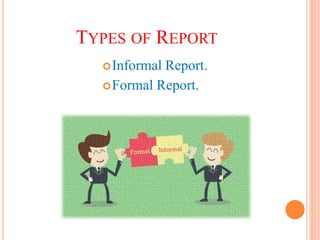
TYPES OF REPORT
Informal Report.
Formal Report.
INFORMAL REPORT
The informal report functions to inform, analyse, and
recommend.
• It usually takes the form of a memo, letter or a very short
international document like a monthly financial report,
monthly activities report, research and development report,
etc.
• This report differs from the formal report in length and
formality.
• It is written according to organization style and rules, but
usually does not include the preliminary (front) and
supplemental (back) material.
• The informal report is usually more controversial in tone
and typically deals with everyday problems and issues
addressed to a narrow readership inside the organization.
INFORMAL REPORT - TYPES
 Progress report
 Sales activity report
 Personnel evaluation
 Financial report
 Feasibility report
 Literature review
 Credit report
FORMAL REPORT
 The formal report is the collection and
interpretation of data and information.
 • The formal report is complex and used at an
official level.
 • It is often a written account of a major project.
 • Examples of subject matter include new
technologies, the advisability of launching a new
project line, results of a study or experiment, an
annual report, or a year old review of
developments in the field.
FORMAL REPORT - TYPES
Informational reports
Analytical reports
Recommendation reports
FORMAT FOR REPORT WRITING
 Format of a Report
 Title page
 Acknowledgements
 Contents page
 Abstract
 Introduction
 Body
 Conclusion
 References
Queries
EFFORT NEVER DIES

Types of report writing

  • 1.
    REPORT WRITING VENKATESH DAMODHARAN I-YEARMBA SRI KRISHNA COLLEGE OF ENGINEERING AND TECHNOLOGY
  • 3.
    REPORT WRITING  Itis any informational work made with an intention to relay information or recounting certain events in a presentable manner.  Reports are often conveyed in writing, speech, television, or film.  Report is an administrative necessity.  Most official form of information or work is completed via report.  Report is always written in a sequential manner in order of occurrence
  • 4.
    TYPES OF REPORT InformalReport. Formal Report.
  • 5.
    INFORMAL REPORT The informalreport functions to inform, analyse, and recommend. • It usually takes the form of a memo, letter or a very short international document like a monthly financial report, monthly activities report, research and development report, etc. • This report differs from the formal report in length and formality. • It is written according to organization style and rules, but usually does not include the preliminary (front) and supplemental (back) material. • The informal report is usually more controversial in tone and typically deals with everyday problems and issues addressed to a narrow readership inside the organization.
  • 6.
    INFORMAL REPORT -TYPES  Progress report  Sales activity report  Personnel evaluation  Financial report  Feasibility report  Literature review  Credit report
  • 7.
    FORMAL REPORT  Theformal report is the collection and interpretation of data and information.  • The formal report is complex and used at an official level.  • It is often a written account of a major project.  • Examples of subject matter include new technologies, the advisability of launching a new project line, results of a study or experiment, an annual report, or a year old review of developments in the field.
  • 8.
    FORMAL REPORT -TYPES Informational reports Analytical reports Recommendation reports
  • 9.
    FORMAT FOR REPORTWRITING  Format of a Report  Title page  Acknowledgements  Contents page  Abstract  Introduction  Body  Conclusion  References
  • 10.
  • 11.