Effective Report
Writing
Presented By:-Ibrahim Bello
MEANING
• “A report is a statement of the result of an
investigation or of any matter/activity on
which definite information is required.”
(Oxford English Dictionary)
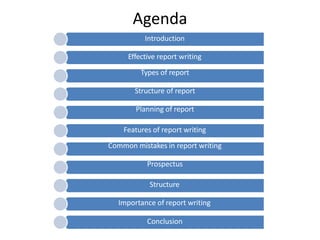
Agenda
Introduction
Effective report writing
Types of report
Structure of report
Planning of report
Features of report writing
Common mistakes in report writing
Prospectus
Structure
Importance of report writing
Conclusion
Introduction
• It is a study of facts & information
• It is formed in a structured format
• Based on observation and analysis
• It helps the management of an organization or a donor
to make an informed decision about a project
• It is an outcome of an any activity
An effective report can be written
going through the following steps-
• Determine the objective of the report
• Collect the required material (facts) for the report
• Study and examine the facts gathered
• Begin writing draft report
• Review draft report
• Prepare an outline for the report, i.e., draft the
report
• Edit the drafted report
• Distribute the draft report to the management
team and ask for feedback and
recommendations
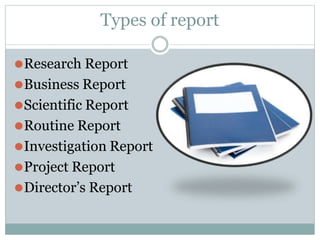
Types of report
⚫Research Report
⚫Business Report
⚫Scientific Report
⚫Routine Report
⚫Investigation Report
⚫Project Report
⚫Director’s Report
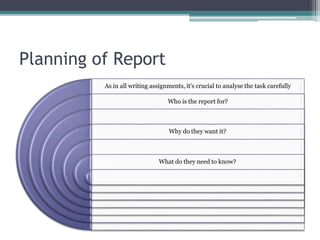
Planning of Report
As in all writing assignments, it's crucial to analyse the task carefully
Who is the report for?
Why do they want it?
What do they need to know?
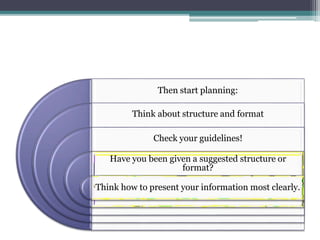
Then start planning:
Think about structure and format
Check your guidelines!
Have you been given a suggested structure or
format?
Think how to present your information most clearly.
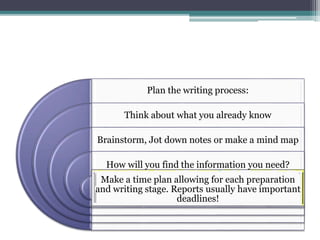
Plan the writing process:
Think about what you already know
Brainstorm, Jot down notes or make a mind map
How will you find the information you need?
Make a time plan allowing for each preparation
and writing stage. Reports usually have important
deadlines!
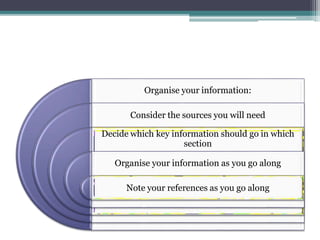
Organise your information:
Consider the sources you will need
Decide which key information should go in which
section
Organise your information as you go along
Note your references as you go along
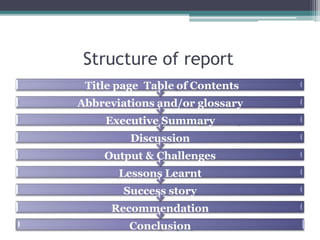
Structure of report
Title page Table of Contents
Abbreviations and/or glossary
Executive Summary
Discussion
Output & Challenges
Lessons Learnt
Success story
Recommendation
Conclusion
Features of good Report Writing
• It has a clear thoughts
• It is complete & self-explanatory
• It is comprehensive but compact
• It is accurate in all aspects
• It has suitable format for readers
• It support facts & is factual
• It has an impersonal style
• It has proper date & signature
• It has a reference to relevant details
• It follows an impartial approach
• It has all essential technical details
• It is presented in a lucid style
• It is a reliable document
• It is arranged in a logical manner
Advantage of Report Writing
1. Keep Records:
Report keeps record and provides valuable source of
information. We can re-use this information for future
reference.
2. Provide Information:
Report provides information in terms of tables, graphs,
charts and illustration and therefore we can be aware of
facts and figures as an update. Nowadays, information are
treated as the most valuable asset.
3. Indicate Status:
Report indicates the current status of any project and
therefore we keep on knowing what we are doing. It
communicates to donors and founders for project
progresses.
4. Facilitates Research:
It facilitates research work as it is source of quantitative and
qualitative information. For example, A market report shown
the market condition of a product.
5. Setting Actions:
Report shows comparison and analysis with critical
evaluation and therefore it helps to determine future actions.
6. Decision Making:
Decisions can be easily made based on the recommendations
given in report.
7. Building Relation:
Report builds relationship between author and reader. It
creates impression on author's knowledge and philosophy
and also provides insight regarding his analytical and critical
understanding.
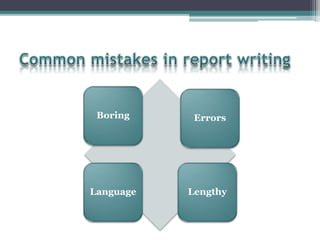
Boring Errors
Language Lengthy
Conclusion
Reports in written form are useful for future
reference reports provide adequate and correct
information as well as statistical data to
management and helps in decision making .a
report provides information of unknown facts ie
new ideas new vision new solution to problem new
research about a particular matter. a report
provides valuable information of all sectors in the
business hence report are useful for solving the
problem of various department. Report acts as an
important and effective internal tool of
communication.
REFERENCES
• www.selfmade.com
• www.linkedin.com
Report Writing Training for Staff.pptx

Report Writing Training for Staff.pptx

  • 1.
  • 2.
    MEANING • “A reportis a statement of the result of an investigation or of any matter/activity on which definite information is required.” (Oxford English Dictionary)
  • 3.
    Agenda Introduction Effective report writing Typesof report Structure of report Planning of report Features of report writing Common mistakes in report writing Prospectus Structure Importance of report writing Conclusion
  • 4.
    Introduction • It isa study of facts & information • It is formed in a structured format • Based on observation and analysis • It helps the management of an organization or a donor to make an informed decision about a project • It is an outcome of an any activity
  • 5.
    An effective reportcan be written going through the following steps- • Determine the objective of the report • Collect the required material (facts) for the report • Study and examine the facts gathered • Begin writing draft report • Review draft report
  • 6.
    • Prepare anoutline for the report, i.e., draft the report • Edit the drafted report • Distribute the draft report to the management team and ask for feedback and recommendations
  • 7.
    Types of report ⚫ResearchReport ⚫Business Report ⚫Scientific Report ⚫Routine Report ⚫Investigation Report ⚫Project Report ⚫Director’s Report
  • 8.
    Planning of Report Asin all writing assignments, it's crucial to analyse the task carefully Who is the report for? Why do they want it? What do they need to know?
  • 9.
    Then start planning: Thinkabout structure and format Check your guidelines! Have you been given a suggested structure or format? Think how to present your information most clearly.
  • 10.
    Plan the writingprocess: Think about what you already know Brainstorm, Jot down notes or make a mind map How will you find the information you need? Make a time plan allowing for each preparation and writing stage. Reports usually have important deadlines!
  • 11.
    Organise your information: Considerthe sources you will need Decide which key information should go in which section Organise your information as you go along Note your references as you go along
  • 12.
    Structure of report Titlepage Table of Contents Abbreviations and/or glossary Executive Summary Discussion Output & Challenges Lessons Learnt Success story Recommendation Conclusion
  • 13.
    Features of goodReport Writing • It has a clear thoughts • It is complete & self-explanatory • It is comprehensive but compact • It is accurate in all aspects • It has suitable format for readers
  • 14.
    • It supportfacts & is factual • It has an impersonal style • It has proper date & signature • It has a reference to relevant details • It follows an impartial approach
  • 15.
    • It hasall essential technical details • It is presented in a lucid style • It is a reliable document • It is arranged in a logical manner
  • 16.
  • 17.
    1. Keep Records: Reportkeeps record and provides valuable source of information. We can re-use this information for future reference. 2. Provide Information: Report provides information in terms of tables, graphs, charts and illustration and therefore we can be aware of facts and figures as an update. Nowadays, information are treated as the most valuable asset. 3. Indicate Status: Report indicates the current status of any project and therefore we keep on knowing what we are doing. It communicates to donors and founders for project progresses.
  • 18.
    4. Facilitates Research: Itfacilitates research work as it is source of quantitative and qualitative information. For example, A market report shown the market condition of a product. 5. Setting Actions: Report shows comparison and analysis with critical evaluation and therefore it helps to determine future actions. 6. Decision Making: Decisions can be easily made based on the recommendations given in report. 7. Building Relation: Report builds relationship between author and reader. It creates impression on author's knowledge and philosophy and also provides insight regarding his analytical and critical understanding.
  • 19.
  • 20.
    Conclusion Reports in writtenform are useful for future reference reports provide adequate and correct information as well as statistical data to management and helps in decision making .a report provides information of unknown facts ie new ideas new vision new solution to problem new research about a particular matter. a report provides valuable information of all sectors in the business hence report are useful for solving the problem of various department. Report acts as an important and effective internal tool of communication.
  • 21.