REPORT
WRITNG
Report writing is the process of presenting information in a structured and
organized way, typically in written form. Report is the presentation of facts .
Reports can be used for various purposes, such as informing decision-
making, documenting progress, or justifying recommendations.
What is Report ?
• Effective Communication: Reports provide a clear and concise
way to present complex information to a large audience. They
ensure everyone is on the same page and can understand the
key points.
• Decision-Making Support: Reports can help analyze data and
draw conclusions, providing valuable insights to inform
decision-making processes.
• Documentation and Record Keeping: Reports serve as a
documented record of progress, findings, and
recommendations. This can be crucial for future reference and
accountability.
• Professional Image: Well-written reports can enhance your
professional image and showcase your analytical and
communication skills.
.
Why use report writing?
Research and Analysis:
Critical Thinking
Clarity and Conciseness:
Importance of Report Writing
Report writing often necessitates research
and analysis of various sources. This
enhances your research skills and ability to
evaluate information effectively.
Writing reports involves analyzing data,
identifying patterns, and drawing
conclusions. This strengthens your critical
thinking and problem-solving skills.
Reports require you to organize your
thoughts and present information in a
clear and concise manner. This improves
communication and comprehension for
the reader.
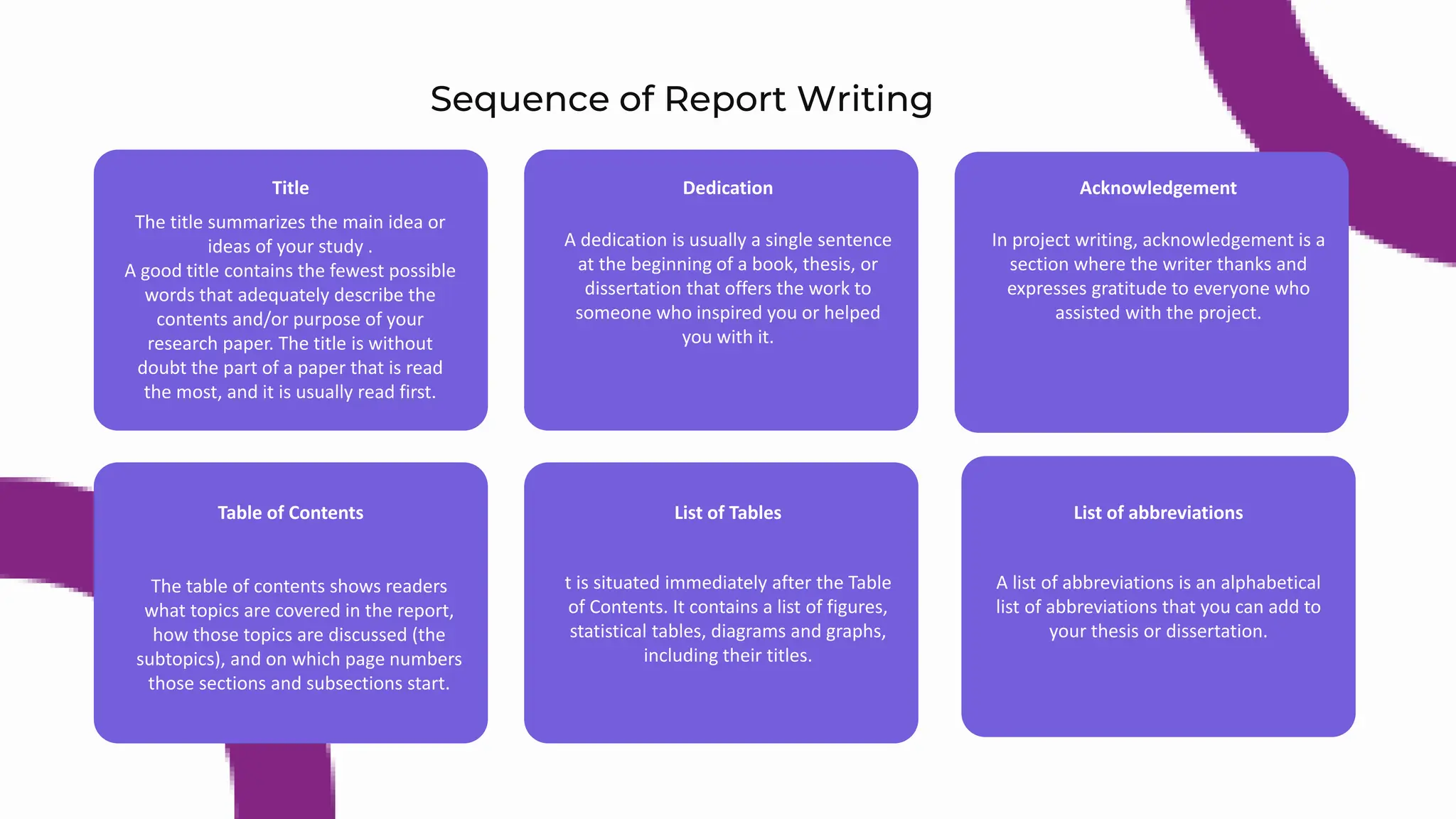
The title summarizes the main idea or
ideas of your study .
A good title contains the fewest possible
words that adequately describe the
contents and/or purpose of your
research paper. The title is without
doubt the part of a paper that is read
the most, and it is usually read first.
A dedication is usually a single sentence
at the beginning of a book, thesis, or
dissertation that offers the work to
someone who inspired you or helped
you with it.
In project writing, acknowledgement is a
section where the writer thanks and
expresses gratitude to everyone who
assisted with the project.
Title Dedication Acknowledgement
Sequence of Report Writing
Table of Contents
The table of contents shows readers
what topics are covered in the report,
how those topics are discussed (the
subtopics), and on which page numbers
those sections and subsections start.
List of Tables
t is situated immediately after the Table
of Contents. It contains a list of figures,
statistical tables, diagrams and graphs,
including their titles.
List of abbreviations
A list of abbreviations is an alphabetical
list of abbreviations that you can add to
your thesis or dissertation.
A preface is your opportunity to inform
your audience about your experiences
during the writing of your thesis or
dissertation.
An executive summary should
summarize the key points of the report.
It should restate the purpose of the
report, highlight the major points of the
report, and describe any results,
conclusions, or recommendations from
the report.
The body of your report is a detailed
discussion of your work for those
readers who want to know in some
depth and completeness what was done.
Preface Executive Summary Body of Report
References
In your writing, you cite or refer to the
source of information. A reference gives
the readers details about the source so
that they have a good understanding of
what kind of source it is and could find
the source themselves if necessary. The
references are typically listed at the end
of the lab report.
An appendix** comes at the end (after
the reference list) of a report, research
project, or dissertation and contains any
additional information such as raw data
or interview transcripts.
Glossary. A glossary is a list of
definitions. You may include a glossary in
a technical report if it uses a number of
terms with which readers may not be
familiar.
Appendix Glossary
• Body
• References
• Glossary
• Appendix
• List of tables
• List of abbreviations
• Executive summary
• Table of contents
• Preface
• Dedication
• Acknowledgement
• Title
How to write Report ?
• Font - Calibri- Entire Report
• In total report you have to make font size 12
• Headings - 12 + bold
• Sub headings - 12 + bold + Atelic
• The title of Chapter - 14 + Bold
• The sub Title of Chapter - 13
• Captions - 10 + bold
• Line spacing one
• Page size A4 in ms word
• Margins 2cm all 4 sides
• Alignment justified
• Page no should be on top center
• No headers and footers
• Pictures should be HD quality
• When use pictures use wrap facility
• Your report should visually nice
• Numeric sequences
chap 1
1.1.1
Certain Parameters for
professional Report
THANK
YOU
For Your Attention

Report writng 1 communication skills BBA

  • 1.
  • 2.
    Report writing isthe process of presenting information in a structured and organized way, typically in written form. Report is the presentation of facts . Reports can be used for various purposes, such as informing decision- making, documenting progress, or justifying recommendations. What is Report ?
  • 3.
    • Effective Communication:Reports provide a clear and concise way to present complex information to a large audience. They ensure everyone is on the same page and can understand the key points. • Decision-Making Support: Reports can help analyze data and draw conclusions, providing valuable insights to inform decision-making processes. • Documentation and Record Keeping: Reports serve as a documented record of progress, findings, and recommendations. This can be crucial for future reference and accountability. • Professional Image: Well-written reports can enhance your professional image and showcase your analytical and communication skills. . Why use report writing?
  • 4.
    Research and Analysis: CriticalThinking Clarity and Conciseness: Importance of Report Writing Report writing often necessitates research and analysis of various sources. This enhances your research skills and ability to evaluate information effectively. Writing reports involves analyzing data, identifying patterns, and drawing conclusions. This strengthens your critical thinking and problem-solving skills. Reports require you to organize your thoughts and present information in a clear and concise manner. This improves communication and comprehension for the reader.
  • 5.
    The title summarizesthe main idea or ideas of your study . A good title contains the fewest possible words that adequately describe the contents and/or purpose of your research paper. The title is without doubt the part of a paper that is read the most, and it is usually read first. A dedication is usually a single sentence at the beginning of a book, thesis, or dissertation that offers the work to someone who inspired you or helped you with it. In project writing, acknowledgement is a section where the writer thanks and expresses gratitude to everyone who assisted with the project. Title Dedication Acknowledgement Sequence of Report Writing Table of Contents The table of contents shows readers what topics are covered in the report, how those topics are discussed (the subtopics), and on which page numbers those sections and subsections start. List of Tables t is situated immediately after the Table of Contents. It contains a list of figures, statistical tables, diagrams and graphs, including their titles. List of abbreviations A list of abbreviations is an alphabetical list of abbreviations that you can add to your thesis or dissertation.
  • 6.
    A preface isyour opportunity to inform your audience about your experiences during the writing of your thesis or dissertation. An executive summary should summarize the key points of the report. It should restate the purpose of the report, highlight the major points of the report, and describe any results, conclusions, or recommendations from the report. The body of your report is a detailed discussion of your work for those readers who want to know in some depth and completeness what was done. Preface Executive Summary Body of Report References In your writing, you cite or refer to the source of information. A reference gives the readers details about the source so that they have a good understanding of what kind of source it is and could find the source themselves if necessary. The references are typically listed at the end of the lab report. An appendix** comes at the end (after the reference list) of a report, research project, or dissertation and contains any additional information such as raw data or interview transcripts. Glossary. A glossary is a list of definitions. You may include a glossary in a technical report if it uses a number of terms with which readers may not be familiar. Appendix Glossary
  • 7.
    • Body • References •Glossary • Appendix • List of tables • List of abbreviations • Executive summary • Table of contents • Preface • Dedication • Acknowledgement • Title How to write Report ?
  • 8.
    • Font -Calibri- Entire Report • In total report you have to make font size 12 • Headings - 12 + bold • Sub headings - 12 + bold + Atelic • The title of Chapter - 14 + Bold • The sub Title of Chapter - 13 • Captions - 10 + bold • Line spacing one • Page size A4 in ms word • Margins 2cm all 4 sides • Alignment justified • Page no should be on top center • No headers and footers • Pictures should be HD quality • When use pictures use wrap facility • Your report should visually nice • Numeric sequences chap 1 1.1.1 Certain Parameters for professional Report
  • 9.