VLSI ARCHITECTURE FOR
AN IMAGE COMPRESSION
SYSTEM USING VECTOR
QUANTIZATION
Presented by:
DEBASISH PAIKARAY
PRATYUSH KU. SAHOO
SAUMYA RANJAN NANDA
ABINASH MISHRA
Guided By: Mr. P.K.NANDA
Asst. Professor
Dept. of ECE
TALK FLOW
 Motivation
 Objective
 Introduction
 Image compression techniques
 Distortion measures
 Scalar quantization
 Vector quantization
 LBG Algorithm
 MSVQ
 VLSI Architecture of MSVQ
 Cost effective VLSI Architecture of MSVQ
 Results & Analysis
 Conclusion
 Reference
Motivation
Better Result can be achieved by
Multistage Vector Quantization over
Single stage Vector Quantization.
Objective
To propose a VLSI Architecture for an image
compression system using Vector Quantization
Introduction
 Data compression is a process of reducing the
amount of data required to represent a given
quantity of information, so that it takes lesser
storage space and lesser transmission time than
the data which is not compressed.
 A fundamental goal of data compression is to
reduce the bit rate for transmission or data storage
while maintaining an acceptable fidelity or image
quality.
Fundamentals
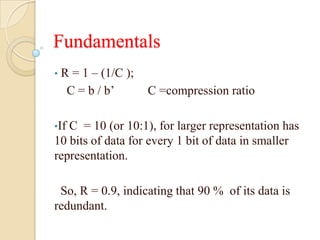
• R = 1 – (1/C );
C = b / b’ C =compression ratio
•If C = 10 (or 10:1), for larger representation has
10 bits of data for every 1 bit of data in smaller
representation.
So, R = 0.9, indicating that 90 % of its data is
redundant.
Compression Techniques
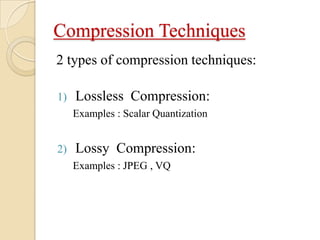
2 types of compression techniques:
1) Lossless Compression:
Examples : Scalar Quantization
2) Lossy Compression:
Examples : JPEG , VQ
Distortion Measures
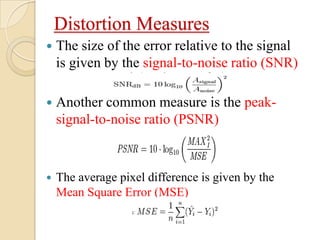
 The size of the error relative to the signal
is given by the signal-to-noise ratio (SNR)
 Another common measure is the peak-
signal-to-noise ratio (PSNR)
 The average pixel difference is given by the
Mean Square Error (MSE)
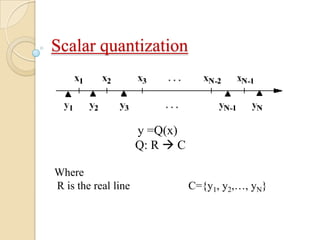
Scalar quantization
y=Q(x)
y =Q(x)
Q: R  C
Where
R is the real line C={y1, y2,…, yN}
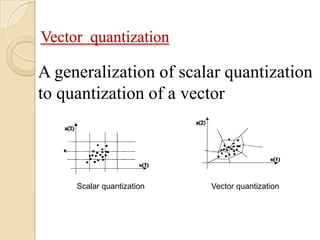
Vector quantization
A generalization of scalar quantization
to quantization of a vector
Scalar quantization Vector quantization
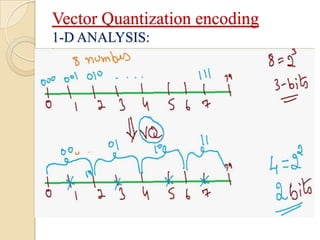
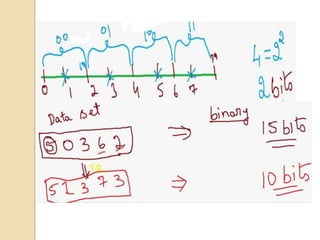
Vector Quantization encoding
1-D ANALYSIS:
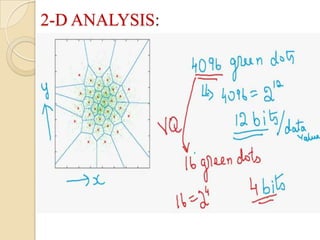
2-D ANALYSIS:
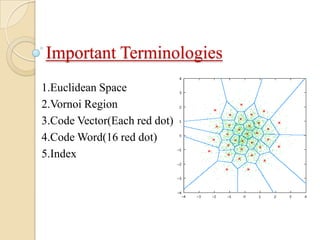
Important Terminologies
1.Euclidean Space
2.Vornoi Region
3.Code Vector(Each red dot)
4.Code Word(16 red dot)
5.Index
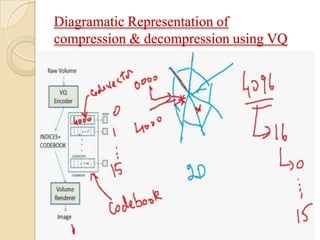
Diagramatic Representation of
compression & decompression using VQ
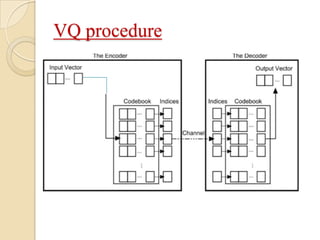
VQ procedure
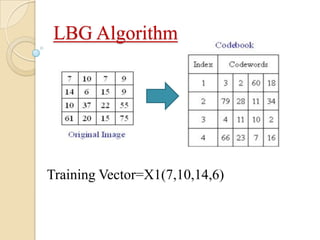
LBG Algorithm
Training Vector=X1(7,10,14,6)
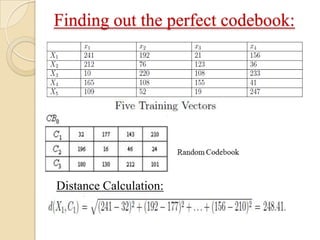
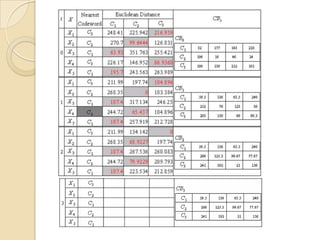
Finding out the perfect codebook:
Distance Calculation:
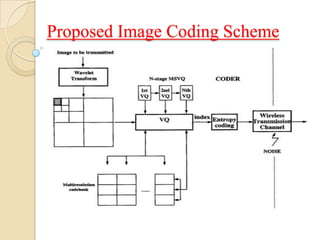
Proposed Image Coding Scheme
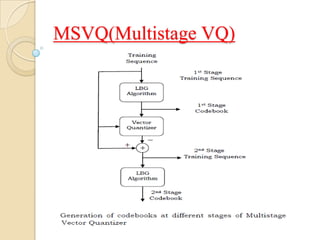
MSVQ(Multistage VQ)
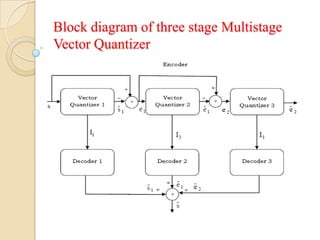
Block diagram of three stage Multistage
Vector Quantizer
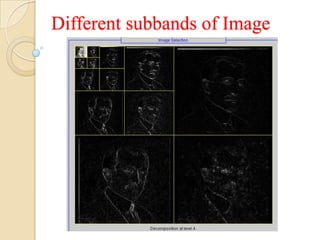
Different subbands of Image
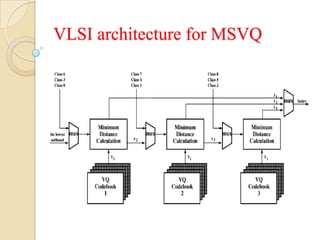
VLSI architecture for MSVQ
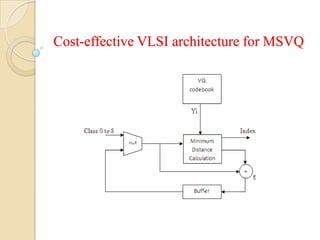
Cost-effective VLSI architecture for MSVQ
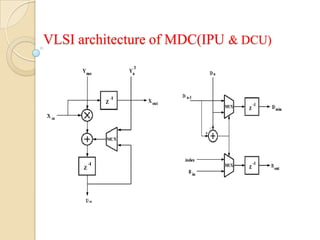
VLSI architecture of MDC(IPU & DCU)
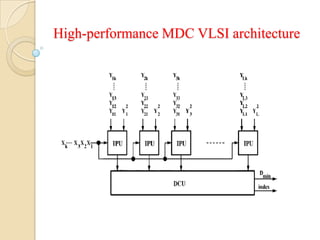
High-performance MDC VLSI architecture
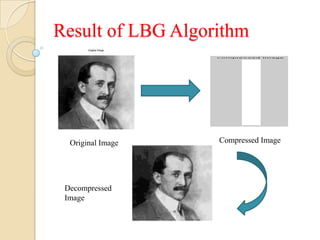
Result of LBG Algorithm
Decompressed
Image
Original Image Compressed Image
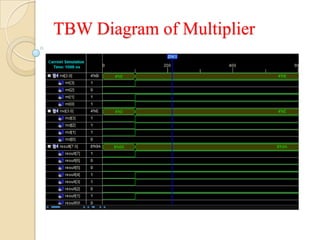
TBW Diagram of Multiplier
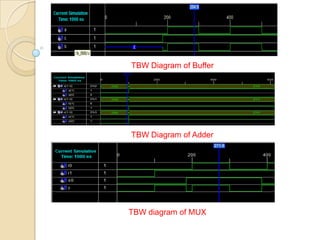
TBW Diagram of Buffer
TBW Diagram of Adder
TBW diagram of MUX
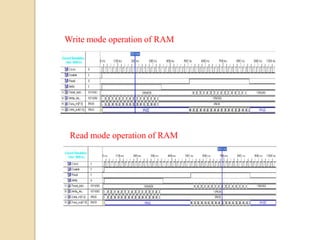
Write mode operation of RAM
Read mode operation of RAM
Application of vector quantization
 Vector quantization technique is
efficiently used in various areas of
biometric modalities like finger print
pattern recognition ,face recognition by
generating codebooks of desired size.
Conclusion
We have successfully designed an efficient
codebook using LBG Algorithm &
proposed an cost effective MSVQ VLSI
architecture for an Image compression
system.
REFERENCES
1.Y. Linde, A. Buzo, and R. M. Gray, “An algorithm for vector quantizer design,” IEEE
Trans. Commun., vol. COM-28, pp. 84-95, Jan. 1980.
2.Nasser m. Nasrabadi, Membeire,E E E,A nd robert A. King,” Image Coding Using Vector
Quantization: A Review” IEEE Transactions on Communications, vol. 36, no. 8, august 1988
3. A. K. Jain, “Image data compression: A review,” Proc. IEEE, vol. 69, pp. 349-389, Mar.
1981.
4. A. Buzo, A. H. Gray, R. M. Gray, and J. D. Markel, “Speech coding based upon vector
quantization,” IEEE Trans. Acoust. Speech, Signal Processing, vol. ASSP-28, pp. 562-
574, Oct. 1980.
5. R. M. Gray, “Vector quantization,” IEEE ASSP Mag., pp. 4-29, Apr. 1984.
6.Khalid Sayood ,”Introduction to Image Compression”,3rd edition
7. Seung-Kwon Paek and Lee-Sup Kim,”A Real Time Wavelet VQ Algorithm and Its VLSI
Architecture”, IEEE Transaction on Circuits & Systems for video Technology, Vol. 10, No.
3,April 2000.
8. Tzu-Chuen Lu, Ching-Yun Chang, “A Survey of VQ Codebook Generation” , Journal of
Information Hiding and Multimedia Signal Processing, Volume 1, Number 3, July 2010.
9. Jyoti Singhai and Rakesh singhai,”MSVQ: A Data compression technique foe multimedia
application”,Journal of Scientific & Industrial Research, Vol. 65,December 2006,pp. 982-985.
THANK YOU
ALL…..

Project pptVLSI ARCHITECTURE FOR AN IMAGE COMPRESSION SYSTEM USING VECTOR QUANTIZATION

  • 1.
    VLSI ARCHITECTURE FOR ANIMAGE COMPRESSION SYSTEM USING VECTOR QUANTIZATION Presented by: DEBASISH PAIKARAY PRATYUSH KU. SAHOO SAUMYA RANJAN NANDA ABINASH MISHRA Guided By: Mr. P.K.NANDA Asst. Professor Dept. of ECE
  • 2.
    TALK FLOW  Motivation Objective  Introduction  Image compression techniques  Distortion measures  Scalar quantization  Vector quantization  LBG Algorithm  MSVQ  VLSI Architecture of MSVQ  Cost effective VLSI Architecture of MSVQ  Results & Analysis  Conclusion  Reference
  • 3.
    Motivation Better Result canbe achieved by Multistage Vector Quantization over Single stage Vector Quantization.
  • 4.
    Objective To propose aVLSI Architecture for an image compression system using Vector Quantization
  • 5.
    Introduction  Data compressionis a process of reducing the amount of data required to represent a given quantity of information, so that it takes lesser storage space and lesser transmission time than the data which is not compressed.  A fundamental goal of data compression is to reduce the bit rate for transmission or data storage while maintaining an acceptable fidelity or image quality.
  • 6.
    Fundamentals • R =1 – (1/C ); C = b / b’ C =compression ratio •If C = 10 (or 10:1), for larger representation has 10 bits of data for every 1 bit of data in smaller representation. So, R = 0.9, indicating that 90 % of its data is redundant.
  • 7.
    Compression Techniques 2 typesof compression techniques: 1) Lossless Compression: Examples : Scalar Quantization 2) Lossy Compression: Examples : JPEG , VQ
  • 8.
    Distortion Measures  Thesize of the error relative to the signal is given by the signal-to-noise ratio (SNR)  Another common measure is the peak- signal-to-noise ratio (PSNR)  The average pixel difference is given by the Mean Square Error (MSE)
  • 9.
    Scalar quantization y=Q(x) y =Q(x) Q:R  C Where R is the real line C={y1, y2,…, yN}
  • 10.
    Vector quantization A generalizationof scalar quantization to quantization of a vector Scalar quantization Vector quantization
  • 11.
  • 13.
  • 14.
    Important Terminologies 1.Euclidean Space 2.VornoiRegion 3.Code Vector(Each red dot) 4.Code Word(16 red dot) 5.Index
  • 15.
  • 16.
  • 17.
  • 18.
    Finding out theperfect codebook: Distance Calculation:
  • 20.
  • 21.
  • 22.
    Block diagram ofthree stage Multistage Vector Quantizer
  • 23.
  • 24.
  • 25.
  • 26.
    VLSI architecture ofMDC(IPU & DCU)
  • 27.
  • 28.
    Result of LBGAlgorithm Decompressed Image Original Image Compressed Image
  • 29.
    TBW Diagram ofMultiplier
  • 30.
    TBW Diagram ofBuffer TBW Diagram of Adder TBW diagram of MUX
  • 31.
    Write mode operationof RAM Read mode operation of RAM
  • 32.
    Application of vectorquantization  Vector quantization technique is efficiently used in various areas of biometric modalities like finger print pattern recognition ,face recognition by generating codebooks of desired size.
  • 33.
    Conclusion We have successfullydesigned an efficient codebook using LBG Algorithm & proposed an cost effective MSVQ VLSI architecture for an Image compression system.
  • 34.
    REFERENCES 1.Y. Linde, A.Buzo, and R. M. Gray, “An algorithm for vector quantizer design,” IEEE Trans. Commun., vol. COM-28, pp. 84-95, Jan. 1980. 2.Nasser m. Nasrabadi, Membeire,E E E,A nd robert A. King,” Image Coding Using Vector Quantization: A Review” IEEE Transactions on Communications, vol. 36, no. 8, august 1988 3. A. K. Jain, “Image data compression: A review,” Proc. IEEE, vol. 69, pp. 349-389, Mar. 1981. 4. A. Buzo, A. H. Gray, R. M. Gray, and J. D. Markel, “Speech coding based upon vector quantization,” IEEE Trans. Acoust. Speech, Signal Processing, vol. ASSP-28, pp. 562- 574, Oct. 1980. 5. R. M. Gray, “Vector quantization,” IEEE ASSP Mag., pp. 4-29, Apr. 1984. 6.Khalid Sayood ,”Introduction to Image Compression”,3rd edition 7. Seung-Kwon Paek and Lee-Sup Kim,”A Real Time Wavelet VQ Algorithm and Its VLSI Architecture”, IEEE Transaction on Circuits & Systems for video Technology, Vol. 10, No. 3,April 2000. 8. Tzu-Chuen Lu, Ching-Yun Chang, “A Survey of VQ Codebook Generation” , Journal of Information Hiding and Multimedia Signal Processing, Volume 1, Number 3, July 2010. 9. Jyoti Singhai and Rakesh singhai,”MSVQ: A Data compression technique foe multimedia application”,Journal of Scientific & Industrial Research, Vol. 65,December 2006,pp. 982-985.
  • 35.