
Submitted by,
C.Priyanka Karancy,
M.Tech, CCE
PR13CS2013
 In Optical Fiber Communication, Signal Encoding
uses a set of rules for arranging the signal symbols
in a particular pattern. This process is called
Channel or line coding.
 To introduce redundancy into the data stream for
the purpose of minimizing the error that results
from channel interference effects.
 Depending on the amount of redundancy
introduced, any degree of error-free transmission
of digital data can be archived, provided that the
data rate that includes this redundancy is less than
the channel capacity. This is called Shannon
channel-coding theory.
 There are 3 basic types of line coding, that is used
for optical fiber transmission links:
i)NRZ(Non-Return-to-Zero) Format
ii)RZ(Return Zero) Format
iii)PE(Phase Encoded) Format
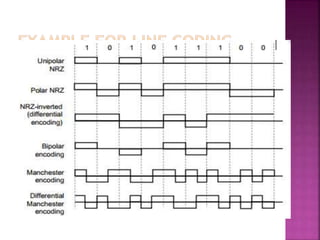
 A non-return-to-zero (NRZ) line code is
a binary code in which 1s are represented by
one significant condition (positive voltage) and 0s
are represented by some other significant condition
(negative voltage), with no other neutral or rest
condition.
 The pulses have more energy than a return-to-
zero(RZ) code. Unlike RZ, NRZ does not have a
rest state. NRZ is not inherently a self-clocking
signal, thus some additional synchronization
technique must be used for avoiding bit slip.
 RZ takes place even if a number of consecutive 0s
or 1s occur in the signal. The signal is self-
clocking.
 That a separate clock does not need to be sent
alongside the signal, but suffers from using twice
the bandwidth to achieve the same data-rate as
compared to non-return-to-zero format.
 The mBnB code converts a block of m input bits to
a block of n code bits.
 Coding efficiency is determined by the ratio m/n,
but generally n is chosen as m+1.
 The mBnB codes is elimination of the dc
component that may exist in the data source.
Hence code words are selected to preserve balance.
 The insertion of transitions to ensure adequate
timing recovery. Hence the selection of code words
also attempts to provide at least one transition in
each code and to minimize the distance(number of
bits) between transitions.
THANK YOU

Line Coding in OFC

  • 1.
  • 2.
     In OpticalFiber Communication, Signal Encoding uses a set of rules for arranging the signal symbols in a particular pattern. This process is called Channel or line coding.
  • 3.
     To introduceredundancy into the data stream for the purpose of minimizing the error that results from channel interference effects.  Depending on the amount of redundancy introduced, any degree of error-free transmission of digital data can be archived, provided that the data rate that includes this redundancy is less than the channel capacity. This is called Shannon channel-coding theory.
  • 5.
     There are3 basic types of line coding, that is used for optical fiber transmission links: i)NRZ(Non-Return-to-Zero) Format ii)RZ(Return Zero) Format iii)PE(Phase Encoded) Format
  • 6.
     A non-return-to-zero(NRZ) line code is a binary code in which 1s are represented by one significant condition (positive voltage) and 0s are represented by some other significant condition (negative voltage), with no other neutral or rest condition.  The pulses have more energy than a return-to- zero(RZ) code. Unlike RZ, NRZ does not have a rest state. NRZ is not inherently a self-clocking signal, thus some additional synchronization technique must be used for avoiding bit slip.
  • 7.
     RZ takesplace even if a number of consecutive 0s or 1s occur in the signal. The signal is self- clocking.  That a separate clock does not need to be sent alongside the signal, but suffers from using twice the bandwidth to achieve the same data-rate as compared to non-return-to-zero format.
  • 8.
     The mBnBcode converts a block of m input bits to a block of n code bits.  Coding efficiency is determined by the ratio m/n, but generally n is chosen as m+1.
  • 10.
     The mBnBcodes is elimination of the dc component that may exist in the data source. Hence code words are selected to preserve balance.  The insertion of transitions to ensure adequate timing recovery. Hence the selection of code words also attempts to provide at least one transition in each code and to minimize the distance(number of bits) between transitions.
  • 11.