Survey on High Productivity Computing Systems
(HPCS) Languages
SALIYA EKANAYAKE
3/11/2013 PART OF QUALIFIER PRESENTATION 1
School of Informatics and Computing
Indiana University
Outline
Parallel Programs
Parallel Programming Memory Models
Idioms of Parallel Computing
◦ Data Parallel Computation
◦ Data Distribution
◦ Asynchronous Remote Tasks
◦ Nested Parallelism
◦ Remote Transactions
3/11/2013 PART OF QUALIFIER PRESENTATION 2
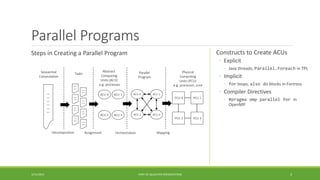
Parallel Programs
Steps in Creating a Parallel Program
3/11/2013 PART OF QUALIFIER PRESENTATION 3
…
…
…
…
…
…
ACU 0
ACU 2
ACU 1
ACU 3
ACU 0
ACU 2
ACU 1
ACU 3
PCU 0
PCU 2
PCU 1
PCU 3
Sequential
Computation
…
…
…
…
…
…
…
…
…
…
…
…
…
…
…
…
Tasks
Abstract
Computing
Units (ACU)
e.g. processes
Parallel
Program
Physical
Computing
Units (PCU)
e.g. processor, core
Decomposition Assignment Orchestration Mapping
Constructs to Create ACUs
◦ Explicit
◦ Java threads, Parallel.Foreach in TPL
◦ Implicit
◦ for loops, also do blocks in Fortress
◦ Compiler Directives
◦ #pragma omp parallel for in
OpenMP
Parallel Programming Memory Models
3/11/2013 PART OF QUALIFIER PRESENTATION 4
Task
Shared Global Address Space
...Task Task Task
CPU
Network
Processor
Memory
Processor
CPU CPU
Memory
Processor
CPU CPU
Memory
...
Shared Global Address Space
Task
CPU
Task
Task
Task
Local Address
Space
Task Task Task
Local Address
Space
Local Address
Space
Local Address
Space
...
CPU
Network
Processor
Memory
Processor
CPU CPU
Memory
Processor
CPU CPU
Memory
...Task
CPU
Task
Task
Local
Address
Space
Local Address
Space
Task
Shared Global
Address Space
... Task Task
Shared Global
Address Space
... Task Task
Shared Global
Address Space
... Task
...
Local Address
Space
Local Address
Space
Task Task Task
Task
...
Task Task
Partitioned Shared Address Space
Local Address
Space
Local Address
Space
Local Address
Space
X XX Y
Z
Array [ ]
Task 1 Task 2 Task 3
Local Address Spaces
Partitioned Shared Address Space
Each task has declared a private variable X
Task 1 has declared another private variable Y
Task 3 has declared a shared variable Z
An array is declared as shared across the shared address space
Every task can access variable Z
Every task can access each element of the array
Only Task 1 can access variable Y
Each copy of X is local to the task declaring it and may not necessarily contain the
same value
Access of elements local to a task in the array is faster than accessing other
elements.
Task 3 may access Z faster than Task 1 and Task 2
Shared
Distributed
PartitionedGlobalAddressSpace
Hybrid
SharedMemory
Implementation
DistributedMemory
Implementation
Idioms of Parallel Computing
Common Task
Language
Chapel X10 Fortress
Data parallel computation forall finish … for … async for
Data distribution dmapped DistArray arrays, vectors, matrices
Asynchronous Remote Tasks on … begin at … async spawn … at
Nested parallelism cobegin … forall for … async for … spawn
Remote transactions
on … atomic
(not implemented yet)
at … atomic at … atomic
3/11/2013 PART OF QUALIFIER PRESENTATION 5
Data Parallel Computation
3/11/2013 PART OF QUALIFIER PRESENTATION 6
forall (a,b,c) in zip (A,B,C) do
a = b + alpha * c;
forall i in 1 … N do
a(i) = b(i);
[i in 1 … N] a(i) = b(i);
A = B + alpha * C;
writeln(+ reduce [i in 1 .. 10] i**2;)
for (p in A)
A(p) = 2 * A(p);
for ([i] in 1 .. N)
sum += i;
finish for (p in A)
async A(p) = 2 * A(p);
for i <- 1:10 do
A[i] := i end
A:ZZ32[3,3]=[1 2 3;4 5 6;7 8 9]
for (i,j) <- A.indices() do
A[i,j] := i end
for a <- A do
println(a) end
for a <- {[ZZ32] 1,3,5,7,9} do
println(a) end
end
for i <- sequential(1:10) do
A[i] := i end
for a <- sequential({[ZZ32] 1,3,10,8,6}) do
println(a) end
end
Chapel X10 Fortress
Zipper
Arithmetic
domain
Short
Forms
StatementContextExpressionContext
SequentialParallel
Array
Number
Range
ParallelSequential
Array
Indices
Array
Elements
Number
Range
Set
Data Distribution
3/11/2013 PART OF QUALIFIER PRESENTATION 7
Chapel X10 Fortress
Domain and Array
var D: domain(2) = [1 .. m, 1 .. n];
var A: [D] real;
const D = [1..n, 1..n];
const BD = D dmapped Block(boundingBox=D);
var BA: [BD] real;
Box Distribution of Domain
val R = (0..5) * (1..3);
val arr = new Array[Int](R,10);
Region and Array
val blk = Dist.makeBlock((1..9)*(1..9));
val data : DistArray[Int]= DistArray.make[Int](blk, ([i,j]:Point(2)) => i*j);
Box Distribution of Array
Intended
◦ blocked
◦ blockCyclic
◦ columnMajor
◦ rowMajor
◦ Default
No Working Implementation
Asynchronous Remote Tasks
3/11/2013 PART OF QUALIFIER PRESENTATION 8
Chapel X10 Fortress
Asynchronous
Remote and Asynchronous
• at (p) async S
migrates the computation to p and spawns a new activity in p to
evaluate S and returns control
• async at (p) S
spawns a new activity in current place and returns control while the
spawned activity migrates the computation to p and evaluates S
there
• async at (p) async S
spawns a new activity in current place and returns control while the
spawned activity migrates the computation to p and spawns another
activity in p to evaluate S there
begin writeline(“Hello”);
writeline(“Hi”);
on A[i] do begin
A[i] = 2 * A[i]
writeline(“Hello”);
writeline(“Hi”);
{ // activity T
async {S1;} // spawns T1
async {S2;} // spawns T2
}
Asynchronous
Remote and Asynchronous
(v,w) := (exp1,
at a.region(i) do exp2 end)
spawn at a.region(i) do exp end
do
v := exp1
at a.region(i) do
w := exp2
end
x := v+w
end
Remote and Asynchronous
Implicit Multiple Threads and
Region Shift
Implicit Thread Group and Region
Shift
Nested Parallelism
3/11/2013 PART OF QUALIFIER PRESENTATION 9
Chapel X10 Fortress
Data Parallelism Inside Task
Parallelism
cobegin {
forall (a,b,c) in (A,B,C) do
a = b + alpha * c;
forall (d,e,f) in (D,E,F) do
d = e + beta * f;
}
sync forall (a) in (A) do
if (a % 5 ==0) then
begin f(a);
else
a = g(a);
Task Parallelism Inside Data
Parallelism
finish { async S1; async S2; }
Data Parallelism Inside Task
Parallelism
Given a data parallel code in X10 it is possible to
spawn new activities inside the body that gets
evaluated in parallel. However, in the absence of
a built-in data parallel construct, a scenario that
requires such nesting may be custom
implemented with constructs like finish, for,
and async instead of first having to make data
parallel code and embedding task parallelism
Note on Task Parallelism Inside Data
Parallelism
T:Thread[Any] = spawn do exp end
T.wait()
do exp1 also do exp2 end
Explicit Thread
Structural
Construct
Data Parallelism Inside Task
Parallelism
arr:Array[ZZ32,ZZ32]=array[ZZ32](4).fill(id)
for i <- arr.indices() do
t = spawn do arr[i]:= factorial(i) end
t.wait()
end
Note on Task Parallelism Inside Data
Parallelism
Remote Transactions
3/11/2013 PART OF QUALIFIER PRESENTATION 10
X10 Fortress
def pop() : T {
var ret : T;
when(size>0) {
ret = list.removeAt(0);
size --;
}
return ret;
}
var n : Int = 0;
finish {
async atomic n = n + 1; //(a)
async atomic n = n + 2; //(b)
}
var n : Int = 0;
finish {
async n = n + 1; //(a) -- BAD
async atomic n = n + 2; //(b)
}
Unconditional Local
Conditional Local
val blk = Dist.makeBlock((1..1)*(1..1),0);
val data = DistArray.make[Int](blk, ([i,j]:Point(2)) => 0);
val pt : Point = [1,1];
finish for (pl in Place.places()) {
async{
val dataloc = blk(pt);
if (dataloc != pl){
Console.OUT.println("Point " + pt + " is in place " + dataloc);
at (dataloc) atomic {
data(pt) = data(pt) + 1;
}
}
else {
Console.OUT.println("Point " + pt + " is in place " + pl);
atomic data(pt) = data(pt) + 2;
}
}
}
Console.OUT.println("Final value of point " + pt + " is " + data(pt));
Unconditional Remote
The atomicity is weak in the sense that an atomic block appears
atomic only to other atomic blocks running at the same place. Atomic
code running at remote places or non-atomic code running at local or
remote places may interfere with local atomic code, if care is not
taken
do
x:Z32 := 0
y:Z32 := 0
z:Z32 := 0
atomic do
x += 1
y += 1
also atomic do
z := x + y
end
z
end
Local
f(y:ZZ32):ZZ32=y y
D:Array[ZZ32,ZZ32]=array[ZZ32](4).fill(f)
q:ZZ32=0
at D.region(2) atomic do
println("at D.region(2)")
q:=D[2]
println("q in first atomic: " q)
also at D.region(1) atomic do
println("at D.region(1)")
q+=1
println("q in second atomic: " q)
end
println("Final q: " q)
Remote (true if distributions were
implemented)
K-Means Implementation
Why K-Means?
◦ Simple to Comprehend
◦ Broad Enough to Exploit Most of the Idioms
Distributed Parallel Implementations
◦ Chapel and X10
Parallel Non Distributed Implementation
◦ Fortress
Complete Working Code in Appendix of Paper
3/11/2013 PART OF QUALIFIER PRESENTATION 11
3/11/2013 PART OF QUALIFIER PRESENTATION 12
Thank you!

Survey onhpcs languages

  • 1.
    Survey on HighProductivity Computing Systems (HPCS) Languages SALIYA EKANAYAKE 3/11/2013 PART OF QUALIFIER PRESENTATION 1 School of Informatics and Computing Indiana University
  • 2.
    Outline Parallel Programs Parallel ProgrammingMemory Models Idioms of Parallel Computing ◦ Data Parallel Computation ◦ Data Distribution ◦ Asynchronous Remote Tasks ◦ Nested Parallelism ◦ Remote Transactions 3/11/2013 PART OF QUALIFIER PRESENTATION 2
  • 3.
    Parallel Programs Steps inCreating a Parallel Program 3/11/2013 PART OF QUALIFIER PRESENTATION 3 … … … … … … ACU 0 ACU 2 ACU 1 ACU 3 ACU 0 ACU 2 ACU 1 ACU 3 PCU 0 PCU 2 PCU 1 PCU 3 Sequential Computation … … … … … … … … … … … … … … … … Tasks Abstract Computing Units (ACU) e.g. processes Parallel Program Physical Computing Units (PCU) e.g. processor, core Decomposition Assignment Orchestration Mapping Constructs to Create ACUs ◦ Explicit ◦ Java threads, Parallel.Foreach in TPL ◦ Implicit ◦ for loops, also do blocks in Fortress ◦ Compiler Directives ◦ #pragma omp parallel for in OpenMP
  • 4.
    Parallel Programming MemoryModels 3/11/2013 PART OF QUALIFIER PRESENTATION 4 Task Shared Global Address Space ...Task Task Task CPU Network Processor Memory Processor CPU CPU Memory Processor CPU CPU Memory ... Shared Global Address Space Task CPU Task Task Task Local Address Space Task Task Task Local Address Space Local Address Space Local Address Space ... CPU Network Processor Memory Processor CPU CPU Memory Processor CPU CPU Memory ...Task CPU Task Task Local Address Space Local Address Space Task Shared Global Address Space ... Task Task Shared Global Address Space ... Task Task Shared Global Address Space ... Task ... Local Address Space Local Address Space Task Task Task Task ... Task Task Partitioned Shared Address Space Local Address Space Local Address Space Local Address Space X XX Y Z Array [ ] Task 1 Task 2 Task 3 Local Address Spaces Partitioned Shared Address Space Each task has declared a private variable X Task 1 has declared another private variable Y Task 3 has declared a shared variable Z An array is declared as shared across the shared address space Every task can access variable Z Every task can access each element of the array Only Task 1 can access variable Y Each copy of X is local to the task declaring it and may not necessarily contain the same value Access of elements local to a task in the array is faster than accessing other elements. Task 3 may access Z faster than Task 1 and Task 2 Shared Distributed PartitionedGlobalAddressSpace Hybrid SharedMemory Implementation DistributedMemory Implementation
  • 5.
    Idioms of ParallelComputing Common Task Language Chapel X10 Fortress Data parallel computation forall finish … for … async for Data distribution dmapped DistArray arrays, vectors, matrices Asynchronous Remote Tasks on … begin at … async spawn … at Nested parallelism cobegin … forall for … async for … spawn Remote transactions on … atomic (not implemented yet) at … atomic at … atomic 3/11/2013 PART OF QUALIFIER PRESENTATION 5
  • 6.
    Data Parallel Computation 3/11/2013PART OF QUALIFIER PRESENTATION 6 forall (a,b,c) in zip (A,B,C) do a = b + alpha * c; forall i in 1 … N do a(i) = b(i); [i in 1 … N] a(i) = b(i); A = B + alpha * C; writeln(+ reduce [i in 1 .. 10] i**2;) for (p in A) A(p) = 2 * A(p); for ([i] in 1 .. N) sum += i; finish for (p in A) async A(p) = 2 * A(p); for i <- 1:10 do A[i] := i end A:ZZ32[3,3]=[1 2 3;4 5 6;7 8 9] for (i,j) <- A.indices() do A[i,j] := i end for a <- A do println(a) end for a <- {[ZZ32] 1,3,5,7,9} do println(a) end end for i <- sequential(1:10) do A[i] := i end for a <- sequential({[ZZ32] 1,3,10,8,6}) do println(a) end end Chapel X10 Fortress Zipper Arithmetic domain Short Forms StatementContextExpressionContext SequentialParallel Array Number Range ParallelSequential Array Indices Array Elements Number Range Set
  • 7.
    Data Distribution 3/11/2013 PARTOF QUALIFIER PRESENTATION 7 Chapel X10 Fortress Domain and Array var D: domain(2) = [1 .. m, 1 .. n]; var A: [D] real; const D = [1..n, 1..n]; const BD = D dmapped Block(boundingBox=D); var BA: [BD] real; Box Distribution of Domain val R = (0..5) * (1..3); val arr = new Array[Int](R,10); Region and Array val blk = Dist.makeBlock((1..9)*(1..9)); val data : DistArray[Int]= DistArray.make[Int](blk, ([i,j]:Point(2)) => i*j); Box Distribution of Array Intended ◦ blocked ◦ blockCyclic ◦ columnMajor ◦ rowMajor ◦ Default No Working Implementation
  • 8.
    Asynchronous Remote Tasks 3/11/2013PART OF QUALIFIER PRESENTATION 8 Chapel X10 Fortress Asynchronous Remote and Asynchronous • at (p) async S migrates the computation to p and spawns a new activity in p to evaluate S and returns control • async at (p) S spawns a new activity in current place and returns control while the spawned activity migrates the computation to p and evaluates S there • async at (p) async S spawns a new activity in current place and returns control while the spawned activity migrates the computation to p and spawns another activity in p to evaluate S there begin writeline(“Hello”); writeline(“Hi”); on A[i] do begin A[i] = 2 * A[i] writeline(“Hello”); writeline(“Hi”); { // activity T async {S1;} // spawns T1 async {S2;} // spawns T2 } Asynchronous Remote and Asynchronous (v,w) := (exp1, at a.region(i) do exp2 end) spawn at a.region(i) do exp end do v := exp1 at a.region(i) do w := exp2 end x := v+w end Remote and Asynchronous Implicit Multiple Threads and Region Shift Implicit Thread Group and Region Shift
  • 9.
    Nested Parallelism 3/11/2013 PARTOF QUALIFIER PRESENTATION 9 Chapel X10 Fortress Data Parallelism Inside Task Parallelism cobegin { forall (a,b,c) in (A,B,C) do a = b + alpha * c; forall (d,e,f) in (D,E,F) do d = e + beta * f; } sync forall (a) in (A) do if (a % 5 ==0) then begin f(a); else a = g(a); Task Parallelism Inside Data Parallelism finish { async S1; async S2; } Data Parallelism Inside Task Parallelism Given a data parallel code in X10 it is possible to spawn new activities inside the body that gets evaluated in parallel. However, in the absence of a built-in data parallel construct, a scenario that requires such nesting may be custom implemented with constructs like finish, for, and async instead of first having to make data parallel code and embedding task parallelism Note on Task Parallelism Inside Data Parallelism T:Thread[Any] = spawn do exp end T.wait() do exp1 also do exp2 end Explicit Thread Structural Construct Data Parallelism Inside Task Parallelism arr:Array[ZZ32,ZZ32]=array[ZZ32](4).fill(id) for i <- arr.indices() do t = spawn do arr[i]:= factorial(i) end t.wait() end Note on Task Parallelism Inside Data Parallelism
  • 10.
    Remote Transactions 3/11/2013 PARTOF QUALIFIER PRESENTATION 10 X10 Fortress def pop() : T { var ret : T; when(size>0) { ret = list.removeAt(0); size --; } return ret; } var n : Int = 0; finish { async atomic n = n + 1; //(a) async atomic n = n + 2; //(b) } var n : Int = 0; finish { async n = n + 1; //(a) -- BAD async atomic n = n + 2; //(b) } Unconditional Local Conditional Local val blk = Dist.makeBlock((1..1)*(1..1),0); val data = DistArray.make[Int](blk, ([i,j]:Point(2)) => 0); val pt : Point = [1,1]; finish for (pl in Place.places()) { async{ val dataloc = blk(pt); if (dataloc != pl){ Console.OUT.println("Point " + pt + " is in place " + dataloc); at (dataloc) atomic { data(pt) = data(pt) + 1; } } else { Console.OUT.println("Point " + pt + " is in place " + pl); atomic data(pt) = data(pt) + 2; } } } Console.OUT.println("Final value of point " + pt + " is " + data(pt)); Unconditional Remote The atomicity is weak in the sense that an atomic block appears atomic only to other atomic blocks running at the same place. Atomic code running at remote places or non-atomic code running at local or remote places may interfere with local atomic code, if care is not taken do x:Z32 := 0 y:Z32 := 0 z:Z32 := 0 atomic do x += 1 y += 1 also atomic do z := x + y end z end Local f(y:ZZ32):ZZ32=y y D:Array[ZZ32,ZZ32]=array[ZZ32](4).fill(f) q:ZZ32=0 at D.region(2) atomic do println("at D.region(2)") q:=D[2] println("q in first atomic: " q) also at D.region(1) atomic do println("at D.region(1)") q+=1 println("q in second atomic: " q) end println("Final q: " q) Remote (true if distributions were implemented)
  • 11.
    K-Means Implementation Why K-Means? ◦Simple to Comprehend ◦ Broad Enough to Exploit Most of the Idioms Distributed Parallel Implementations ◦ Chapel and X10 Parallel Non Distributed Implementation ◦ Fortress Complete Working Code in Appendix of Paper 3/11/2013 PART OF QUALIFIER PRESENTATION 11
  • 12.
    3/11/2013 PART OFQUALIFIER PRESENTATION 12 Thank you!