COURSE OVERVIEW &
INTRODUCTION TO PROJECT
MANAGEMENT
PROJECTS HISTORY
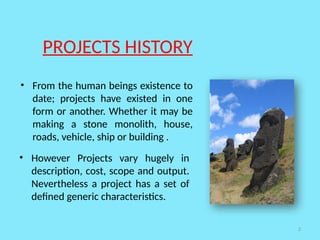
• From the human beings existence to
date; projects have existed in one
form or another. Whether it may be
making a stone monolith, house,
roads, vehicle, ship or building .
3
• However Projects vary hugely in
description, cost, scope and output.
Nevertheless a project has a set of
defined generic characteristics.
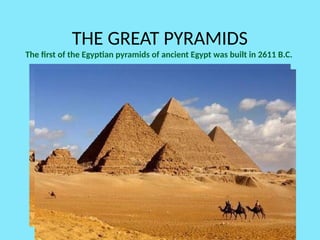
THE GREAT PYRAMIDS
The first of the Egyptian pyramids of ancient Egypt was built in 2611 B.C.
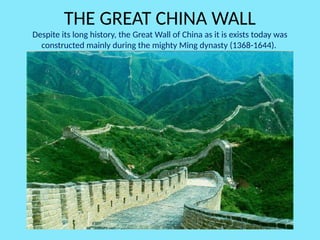
THE GREAT CHINA WALL
Despite its long history, the Great Wall of China as it is exists today was
constructed mainly during the mighty Ming dynasty (1368-1644).
6
CONCISE HISTORY OF PROJECT MANAGEMENT
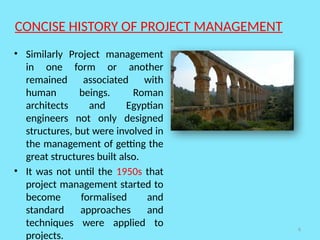
• Similarly Project management
in one form or another
remained associated with
human beings. Roman
architects and Egyptian
engineers not only designed
structures, but were involved in
the management of getting the
great structures built also.
• It was not until the 1950s that
project management started to
become formalised and
standard approaches and
techniques were applied to
projects.
7
Project Management Certifications
• Certified Associate in Project Management (CAPM)®
• Project Management Professional (PMP)®
• Program Management Professional (PgMP)®
• PMI Agile Certified Practitioner (PMI-ACP)SM
• PMI Risk Management Professional (PMI-RMP)®
• PMI Scheduling Professional (PMI-SP)®
8
FEW HISTORICAL MILESTONES OF PROJECT MANAGEMENT
 1917: THE GANTT CHART DEVELOPED BY HENRY GANTT
• One of the forefathers of project management, Henry
Gantt, is best-known for creating his self-named
scheduling diagram, the Gantt chart. It was a radical
idea and an innovation of worldwide importance in the
1920s. One of its first uses was on the Hoover Dam
project started in 1931. Gantt charts are still in use
today and form an important part of the project
managers' toolkit.
9
FEW HISTORICAL MILESTONES OF PROJECT MANAGEMENT
 1957: THE CRITICAL PATH METHOD (CPM) INVENTED BY THE
DUPONT CORPORATION.
• Developed by Dupont, CPM is a technique used to
predict project duration by analyzing which sequence
of activities has the least amount of scheduling
flexibility. Dupont designed it to address the complex
process of shutting down chemical plants for
maintenance, and then restarting them. The technique
was so successful that it saved the corporation
$1 million in the first year of its implementation.
10
FEW HISTORICAL MILESTONES OF PROJECT MANAGEMENT
1958: THE PROGRAM EVALUATION REVIEW TECHNIQUE
(PERT) INVENTED FOR THE U.S. NAVY'S POLARIS PROJECT.
• The United States Department of Defense's US Navy
Special Projects Office developed PERT as part of the
Polaris mobile submarine-launched ballistic missile
project during the cold war. PERT is a method for
analyzing the tasks involved in completing a project,
especially the time needed to complete each task and
identifying the minimum, maximum and most likely
time needed to complete the total project.
11
FEW HISTORICAL MILESTONES OF PROJECT MANAGEMENT
 1962: UNITED STATES DEPARTMENT OF DEFENSE MANDATE
THE WORK BREAKDOWN STRUCTURE (WBS) APPROACH
• The United States Department of Defense (DOD)
created the WBS concept as part of the Polaris mobile
submarine-launched ballistic missile project. After
completing the project, the DOD published the work
breakdown structure it used and mandated the
following of this procedure in future projects of this
scope and size. WBS is an exhaustive, hierarchical tree
structure of deliverables and tasks that need to be
performed to complete a project. Later adopted by the
private sector, the WBS remains one of the most
common and useful project management tools.
12
FEW HISTORICAL MILESTONES OF PROJECT MANAGEMENT
 1969: PROJECT MANAGEMENT INSTITUTE (PMI) WAS LAUNCHED TO
PROMOTE THE PROJECT MANAGEMENT PROFESSION.
 1986: SCRUM NAMED AS A PROJECT MANAGEMENT STYLE.
 1996: FIRST EDITION OF (PMBOK GUIDE) PUBLISHED BY PMI.
 2000: SECOND EDITION OF (PMBOK GUIDE) PUBLISHED BY PMI.
 2004: THIRD EDITION OF (PMBOK GUIDE) PUBLISHED BY PMI.
 1997: CRITICAL CHAIN PROJECT MANAGEMENT (CCPM) INVENTED.
 1998: THE AMERICAN NATIONAL STANDARDS INSTITUTE (ANSI)
RECOGNISED PMBOK AS A STANDARD.
 2008: 4TH EDITION OF PMBOK GUIDE RELEASED.
 2012: ISO 21500 STANDARD FOR PROJECT MANAGEMENT RELEASED.
 2012: 5TH EDITION OF PMBOK GUIDE RELEASED.
BURJ KHALIFA-DUBAI
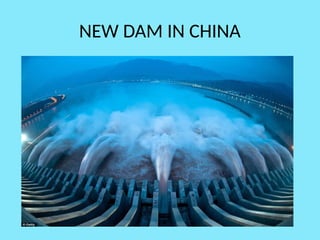
NEW DAM IN CHINA
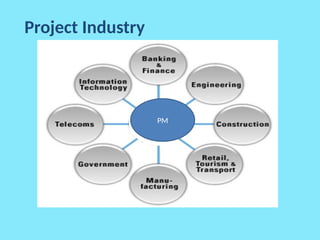
PM
Project Industry
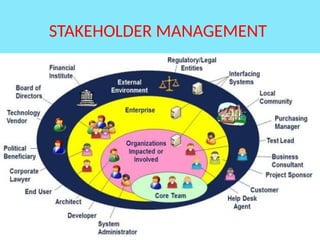
STAKEHOLDER MANAGEMENT
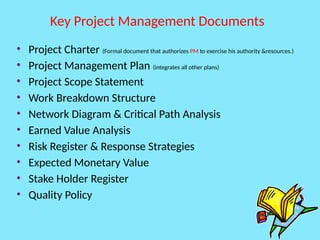
Key Project Management Documents
• Project Charter (Formal document that authorizes PM to exercise his authority &resources.)
• Project Management Plan (integrates all other plans)
• Project Scope Statement
• Work Breakdown Structure
• Network Diagram & Critical Path Analysis
• Earned Value Analysis
• Risk Register & Response Strategies
• Expected Monetary Value
• Stake Holder Register
• Quality Policy
Operations are permanent
endeavors & does not terminate
when current objectives are met
rather it continues
What are Operations
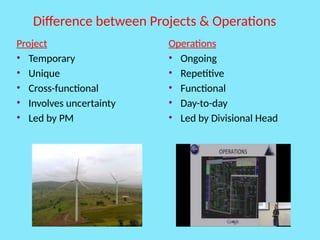
Difference between Projects & Operations
Project
• Temporary
• Unique
• Cross-functional
• Involves uncertainty
• Led by PM
Operations
• Ongoing
• Repetitive
• Functional
• Day-to-day
• Led by Divisional Head
Importance of Project Management
• Organize your approach
• Generates a realistic schedule
• Track progress and control your project
• Identify where to focus your resources
• Identify problems early before they become crises
• Last but not the least Saves TIME & MONEY
Reasons of Project Failure
• Scope Creep
• Unrealistic Planning & Scheduling
• Poor Requirements Gathering
• Lack of Resources.
• Lack of stated Project Goals & Purpose
• Poor Risk Management/Analysis
• Lack of Communication
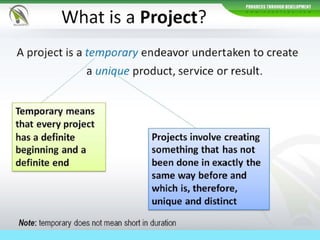
A project can create
• A product that can be either a component of
another item, an enhancement of an item
• A service or a capability to perform a service
(e.g., a business function that supports
production or distribution)
• An improvement in the existing product or
service lines (e.g., A Six Sigma project)
• A result, such as an outcome or document
(e.g., a research project that develops
knowledge)
Program
 A program is defined as a group of related
projects, subprograms, and program activities
managed in a coordinated way to obtain
benefits not available from managing them
individually.
 Programs may include elements of related work
outside the scope of the discrete projects in the
program.
 A project may or may not be part of a program
but a program will always have projects.
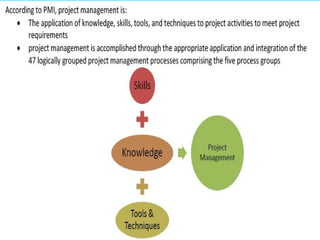
Program management
 Program management is the application of
knowledge, skills, tools, and techniques to a
program in order to meet the program
requirements and to obtain benefits and
control not available by managing projects
individually.
Portfolio
• A portfolio refers to projects, programs, sub-
portfolios, and operations managed as a group
to achieve strategic objectives
• The projects or programs of the portfolio may
not necessarily be interdependent or directly
related
• For example, an infrastructure firm that has the
strategic objective of “maximizing the return
on its investments” may put together a
portfolio that includes a mix of projects in oil
and gas, power, water, roads, rail, and airports.
Portfolio management
• Portfolio management refers to the centralized
management of one or more portfolios to
achieve strategic objectives.
• Portfolio management focuses on ensuring that
projects and programs are reviewed to
prioritize resource allocation, and that the
management of the portfolio is consistent with
and aligned to organizational strategies.
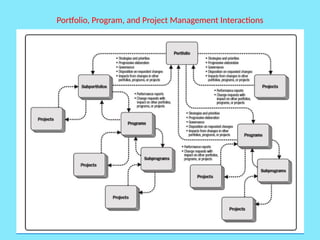
Portfolio, Program, and Project Management Interactions
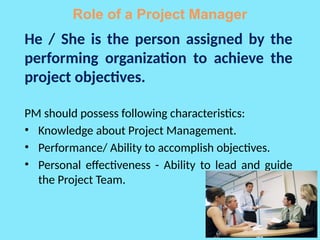
He / She is the person assigned by the
performing organization to achieve the
project objectives.
PM should possess following characteristics:
• Knowledge about Project Management.
• Performance/ Ability to accomplish objectives.
• Personal effectiveness - Ability to lead and guide
the Project Team.
Role of a Project Manager
Interpersonal Skills of a Project Manager
• Leadership • Team building,
• Motivation • Communication,
• Influencing • Decision making,
• Political and cultural awareness,
• Negotiation • Trust building,
• Conflict management
• Coaching.
Project team
• The project team includes:
– Project manager
– Project management staff - Group of individuals
who act together in performing the work of the
project to achieve its objectives
– Other team members who carry out the work but
who are not necessarily involved with
management of the project.
Project team
• This team is comprised of individuals from
different groups with specific subject matter
knowledge or with a specific skill set to carry
out the work of the project.
• The structure and characteristics of a project
team can vary widely, but one constant is the
project manager’s role as the leader of the
team, regardless of what authority the project
manager may have over its members.
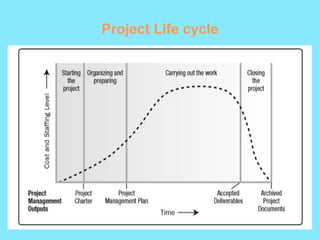
Project Life cycle
• A project life cycle is the series of phases that a
project passes through from its initiation to its
closure.
• The phases are generally sequential, and their
names and numbers are determined by the
management and control needs of the
organization or organizations involved in the
project, the nature of the project itself, and its
area of application.
characteristics of the Project Life cycle
• All projects can be mapped to the following
generic life cycle structure
 Starting the project
 Organizing and preparing,
 Carrying out the project work
 Closing the project.
Project Life cycle
Process Groups
Process Groups
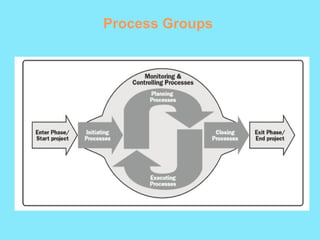
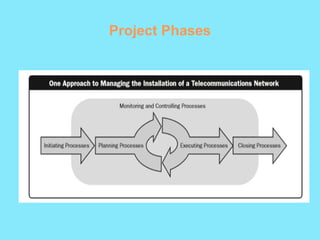
• Initiating Process Group. Those processes
performed to define a new project or a new
phase of an existing project by obtaining
authorization to start the project or phase.
•Planning Process Group. Those processes
required to establish the scope of the project,
refine the objectives, and define the course of
action required to attain the objectives that the
project was undertaken to achieve.
Process Groups
• Executing Process Group. Those processes
performed to complete the work defined in the
project management plan to satisfy the project
specifications.
• Monitoring and controlling Process Group.
Those processes required to track, review, and
regulate the progress and performance of the
project; identify any areas in which changes to
the plan are required; and initiate the
corresponding changes.
Process Groups
Closing Process Group. Those processes
performed to finalize all activities across all
Process Groups to formally close the project or
phase.
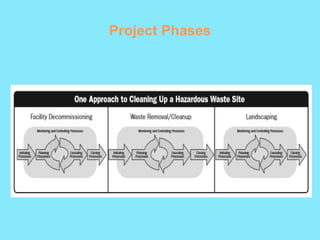
Project Phases
Project Phases
• A project phase is a collection of logically
related project activities that culminates in the
completion of one or more deliverables
• A project may be divided into any number of
phases.
• Project phases are used when the nature of the
work to be performed is unique to a portion of
the project, and are typically linked to the
development of a specific major deliverable.
Project Phases
• A phase may emphasize processes from a
particular Project Management Process Group,
but it is likely that most or all processes will be
executed in some form in each phase.
Project phases typically are completed
sequentially, but can overlap in some project
situations.
Different phases typically have a different
duration or effort.
Project Phases
• The project phases can be broken down by
functional or partial objectives, intermediate
results or deliverables, specific milestones
within the overall scope of work, or financial
availability
• Phases are generally time bounded, with a
start and ending or control point.
• A life cycle can be documented within a
methodology
Project Phases
48
Project Management Body of Knowledge (PMBOK) Guide
• The PMBOK Guide identifies that subset of the project
management body of knowledge that is generally recognized as
good practice.
• “Generally recognized” means the knowledge and practices
described are applicable to most projects most of the time, and
there is consensus about their value and usefulness.
• “Good practice” means there is general agreement that the
application of the knowledge, skills, tools, and techniques can
enhance the chances of success over many projects.
• “Good practice” does not mean that the knowledge described
should always be applied uniformly to all projects; the
organization and/or project management team is responsible for
determining what is appropriate for any given project.
49
Project Management Body of Knowledge (PMBOK) Guide
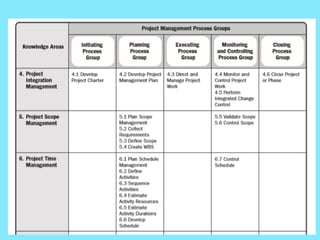
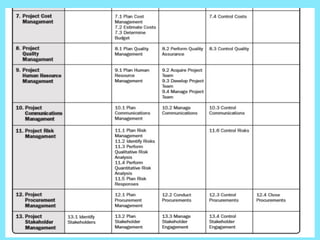
• The PMBOK Guide identifies following:
– 5 x process groups
– 10 knowledge areas
– 47 Processes
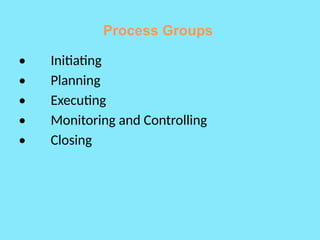
Process Groups
• Initiating
• Planning
• Executing
• Monitoring and Controlling
• Closing
PMBOK 6TH
EDITION
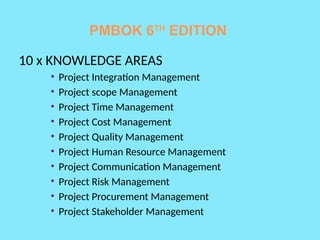
10 x KNOWLEDGE AREAS
• Project Integration Management
• Project scope Management
• Project Time Management
• Project Cost Management
• Project Quality Management
• Project Human Resource Management
• Project Communication Management
• Project Risk Management
• Project Procurement Management
• Project Stakeholder Management
INTRODUCTION TO Project Management ch 1.pptx

INTRODUCTION TO Project Management ch 1.pptx

  • 2.
    COURSE OVERVIEW & INTRODUCTIONTO PROJECT MANAGEMENT
  • 3.
    PROJECTS HISTORY • Fromthe human beings existence to date; projects have existed in one form or another. Whether it may be making a stone monolith, house, roads, vehicle, ship or building . 3 • However Projects vary hugely in description, cost, scope and output. Nevertheless a project has a set of defined generic characteristics.
  • 4.
    THE GREAT PYRAMIDS Thefirst of the Egyptian pyramids of ancient Egypt was built in 2611 B.C.
  • 5.
    THE GREAT CHINAWALL Despite its long history, the Great Wall of China as it is exists today was constructed mainly during the mighty Ming dynasty (1368-1644).
  • 6.
    6 CONCISE HISTORY OFPROJECT MANAGEMENT • Similarly Project management in one form or another remained associated with human beings. Roman architects and Egyptian engineers not only designed structures, but were involved in the management of getting the great structures built also. • It was not until the 1950s that project management started to become formalised and standard approaches and techniques were applied to projects.
  • 7.
    7 Project Management Certifications •Certified Associate in Project Management (CAPM)® • Project Management Professional (PMP)® • Program Management Professional (PgMP)® • PMI Agile Certified Practitioner (PMI-ACP)SM • PMI Risk Management Professional (PMI-RMP)® • PMI Scheduling Professional (PMI-SP)®
  • 8.
    8 FEW HISTORICAL MILESTONESOF PROJECT MANAGEMENT  1917: THE GANTT CHART DEVELOPED BY HENRY GANTT • One of the forefathers of project management, Henry Gantt, is best-known for creating his self-named scheduling diagram, the Gantt chart. It was a radical idea and an innovation of worldwide importance in the 1920s. One of its first uses was on the Hoover Dam project started in 1931. Gantt charts are still in use today and form an important part of the project managers' toolkit.
  • 9.
    9 FEW HISTORICAL MILESTONESOF PROJECT MANAGEMENT  1957: THE CRITICAL PATH METHOD (CPM) INVENTED BY THE DUPONT CORPORATION. • Developed by Dupont, CPM is a technique used to predict project duration by analyzing which sequence of activities has the least amount of scheduling flexibility. Dupont designed it to address the complex process of shutting down chemical plants for maintenance, and then restarting them. The technique was so successful that it saved the corporation $1 million in the first year of its implementation.
  • 10.
    10 FEW HISTORICAL MILESTONESOF PROJECT MANAGEMENT 1958: THE PROGRAM EVALUATION REVIEW TECHNIQUE (PERT) INVENTED FOR THE U.S. NAVY'S POLARIS PROJECT. • The United States Department of Defense's US Navy Special Projects Office developed PERT as part of the Polaris mobile submarine-launched ballistic missile project during the cold war. PERT is a method for analyzing the tasks involved in completing a project, especially the time needed to complete each task and identifying the minimum, maximum and most likely time needed to complete the total project.
  • 11.
    11 FEW HISTORICAL MILESTONESOF PROJECT MANAGEMENT  1962: UNITED STATES DEPARTMENT OF DEFENSE MANDATE THE WORK BREAKDOWN STRUCTURE (WBS) APPROACH • The United States Department of Defense (DOD) created the WBS concept as part of the Polaris mobile submarine-launched ballistic missile project. After completing the project, the DOD published the work breakdown structure it used and mandated the following of this procedure in future projects of this scope and size. WBS is an exhaustive, hierarchical tree structure of deliverables and tasks that need to be performed to complete a project. Later adopted by the private sector, the WBS remains one of the most common and useful project management tools.
  • 12.
    12 FEW HISTORICAL MILESTONESOF PROJECT MANAGEMENT  1969: PROJECT MANAGEMENT INSTITUTE (PMI) WAS LAUNCHED TO PROMOTE THE PROJECT MANAGEMENT PROFESSION.  1986: SCRUM NAMED AS A PROJECT MANAGEMENT STYLE.  1996: FIRST EDITION OF (PMBOK GUIDE) PUBLISHED BY PMI.  2000: SECOND EDITION OF (PMBOK GUIDE) PUBLISHED BY PMI.  2004: THIRD EDITION OF (PMBOK GUIDE) PUBLISHED BY PMI.  1997: CRITICAL CHAIN PROJECT MANAGEMENT (CCPM) INVENTED.  1998: THE AMERICAN NATIONAL STANDARDS INSTITUTE (ANSI) RECOGNISED PMBOK AS A STANDARD.  2008: 4TH EDITION OF PMBOK GUIDE RELEASED.  2012: ISO 21500 STANDARD FOR PROJECT MANAGEMENT RELEASED.  2012: 5TH EDITION OF PMBOK GUIDE RELEASED.
  • 16.
  • 17.
  • 18.
  • 19.
  • 21.
    Key Project ManagementDocuments • Project Charter (Formal document that authorizes PM to exercise his authority &resources.) • Project Management Plan (integrates all other plans) • Project Scope Statement • Work Breakdown Structure • Network Diagram & Critical Path Analysis • Earned Value Analysis • Risk Register & Response Strategies • Expected Monetary Value • Stake Holder Register • Quality Policy
  • 22.
    Operations are permanent endeavors& does not terminate when current objectives are met rather it continues What are Operations
  • 23.
    Difference between Projects& Operations Project • Temporary • Unique • Cross-functional • Involves uncertainty • Led by PM Operations • Ongoing • Repetitive • Functional • Day-to-day • Led by Divisional Head
  • 24.
    Importance of ProjectManagement • Organize your approach • Generates a realistic schedule • Track progress and control your project • Identify where to focus your resources • Identify problems early before they become crises • Last but not the least Saves TIME & MONEY
  • 25.
    Reasons of ProjectFailure • Scope Creep • Unrealistic Planning & Scheduling • Poor Requirements Gathering • Lack of Resources. • Lack of stated Project Goals & Purpose • Poor Risk Management/Analysis • Lack of Communication
  • 26.
    A project cancreate • A product that can be either a component of another item, an enhancement of an item • A service or a capability to perform a service (e.g., a business function that supports production or distribution) • An improvement in the existing product or service lines (e.g., A Six Sigma project) • A result, such as an outcome or document (e.g., a research project that develops knowledge)
  • 27.
    Program  A programis defined as a group of related projects, subprograms, and program activities managed in a coordinated way to obtain benefits not available from managing them individually.  Programs may include elements of related work outside the scope of the discrete projects in the program.  A project may or may not be part of a program but a program will always have projects.
  • 28.
    Program management  Programmanagement is the application of knowledge, skills, tools, and techniques to a program in order to meet the program requirements and to obtain benefits and control not available by managing projects individually.
  • 29.
    Portfolio • A portfoliorefers to projects, programs, sub- portfolios, and operations managed as a group to achieve strategic objectives • The projects or programs of the portfolio may not necessarily be interdependent or directly related • For example, an infrastructure firm that has the strategic objective of “maximizing the return on its investments” may put together a portfolio that includes a mix of projects in oil and gas, power, water, roads, rail, and airports.
  • 30.
    Portfolio management • Portfoliomanagement refers to the centralized management of one or more portfolios to achieve strategic objectives. • Portfolio management focuses on ensuring that projects and programs are reviewed to prioritize resource allocation, and that the management of the portfolio is consistent with and aligned to organizational strategies.
  • 31.
    Portfolio, Program, andProject Management Interactions
  • 32.
    He / Sheis the person assigned by the performing organization to achieve the project objectives. PM should possess following characteristics: • Knowledge about Project Management. • Performance/ Ability to accomplish objectives. • Personal effectiveness - Ability to lead and guide the Project Team. Role of a Project Manager
  • 33.
    Interpersonal Skills ofa Project Manager • Leadership • Team building, • Motivation • Communication, • Influencing • Decision making, • Political and cultural awareness, • Negotiation • Trust building, • Conflict management • Coaching.
  • 34.
    Project team • Theproject team includes: – Project manager – Project management staff - Group of individuals who act together in performing the work of the project to achieve its objectives – Other team members who carry out the work but who are not necessarily involved with management of the project.
  • 35.
    Project team • Thisteam is comprised of individuals from different groups with specific subject matter knowledge or with a specific skill set to carry out the work of the project. • The structure and characteristics of a project team can vary widely, but one constant is the project manager’s role as the leader of the team, regardless of what authority the project manager may have over its members.
  • 36.
    Project Life cycle •A project life cycle is the series of phases that a project passes through from its initiation to its closure. • The phases are generally sequential, and their names and numbers are determined by the management and control needs of the organization or organizations involved in the project, the nature of the project itself, and its area of application.
  • 37.
    characteristics of theProject Life cycle • All projects can be mapped to the following generic life cycle structure  Starting the project  Organizing and preparing,  Carrying out the project work  Closing the project.
  • 38.
  • 39.
  • 40.
    Process Groups • InitiatingProcess Group. Those processes performed to define a new project or a new phase of an existing project by obtaining authorization to start the project or phase. •Planning Process Group. Those processes required to establish the scope of the project, refine the objectives, and define the course of action required to attain the objectives that the project was undertaken to achieve.
  • 41.
    Process Groups • ExecutingProcess Group. Those processes performed to complete the work defined in the project management plan to satisfy the project specifications. • Monitoring and controlling Process Group. Those processes required to track, review, and regulate the progress and performance of the project; identify any areas in which changes to the plan are required; and initiate the corresponding changes.
  • 42.
    Process Groups Closing ProcessGroup. Those processes performed to finalize all activities across all Process Groups to formally close the project or phase.
  • 43.
  • 44.
    Project Phases • Aproject phase is a collection of logically related project activities that culminates in the completion of one or more deliverables • A project may be divided into any number of phases. • Project phases are used when the nature of the work to be performed is unique to a portion of the project, and are typically linked to the development of a specific major deliverable.
  • 45.
    Project Phases • Aphase may emphasize processes from a particular Project Management Process Group, but it is likely that most or all processes will be executed in some form in each phase. Project phases typically are completed sequentially, but can overlap in some project situations. Different phases typically have a different duration or effort.
  • 46.
    Project Phases • Theproject phases can be broken down by functional or partial objectives, intermediate results or deliverables, specific milestones within the overall scope of work, or financial availability • Phases are generally time bounded, with a start and ending or control point. • A life cycle can be documented within a methodology
  • 47.
  • 48.
    48 Project Management Bodyof Knowledge (PMBOK) Guide • The PMBOK Guide identifies that subset of the project management body of knowledge that is generally recognized as good practice. • “Generally recognized” means the knowledge and practices described are applicable to most projects most of the time, and there is consensus about their value and usefulness. • “Good practice” means there is general agreement that the application of the knowledge, skills, tools, and techniques can enhance the chances of success over many projects. • “Good practice” does not mean that the knowledge described should always be applied uniformly to all projects; the organization and/or project management team is responsible for determining what is appropriate for any given project.
  • 49.
    49 Project Management Bodyof Knowledge (PMBOK) Guide • The PMBOK Guide identifies following: – 5 x process groups – 10 knowledge areas – 47 Processes
  • 50.
    Process Groups • Initiating •Planning • Executing • Monitoring and Controlling • Closing
  • 51.
    PMBOK 6TH EDITION 10 xKNOWLEDGE AREAS • Project Integration Management • Project scope Management • Project Time Management • Project Cost Management • Project Quality Management • Project Human Resource Management • Project Communication Management • Project Risk Management • Project Procurement Management • Project Stakeholder Management

Editor's Notes

  • #21 Project Charter Business Need Authority and Responsibility Project Justification Project Description Assumptions Project Scope Statement Objectives Deliverables Milestones Requirements Limits & Exclusions