MindMaps
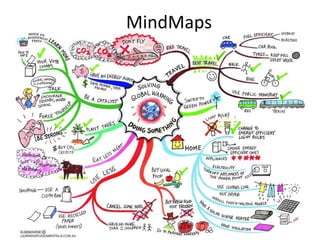
What is a MindMap? A MindMap is a visual form of note-making that can be done either individually or as part of a group. At its heart is a central image or idea. A Mind Map is a powerful graphic technique which provides a universal key to unlock the potential of the brain
What is a MindMap? The Mind Map can be applied to every aspect of life where improved learning and clearer thinking will enhance your productivity  It harnesses the full range of cortical skills – word, image, number, logic, rhythm, colour and spatial awareness – in a single, uniquely powerful manner. In so doing, it gives you the freedom to capture the infinite power and creativity of your brain.
 
Creating a MindMap The subject of attention is crystallised in a central image The main themes of the subject radiate from the central image on branches Branches hold a key image / word printed on the associated line - details radiate out The branches form a connected nodal structure.
 
MindMap Guidelines A Mind Map is open to free interpretation by each individual.
MindMap Guidelines Start in the centre with an image of the topic, using at least three colours.
MindMap Guidelines Use images, symbols, codes and dimensions throughout the Mind Map.
MindMap Guidelines Select key words and print using upper or lower case letters.
MindMap Guidelines Each word/image must be alone and sitting on its own line.
MindMap Guidelines The lines must be connected, starting from the central image. The central lines are thicker, organic and flowing, becoming thinner as they radiate out from the centre.
 
MindMap Guidelines Make the lines the same length as the word/image.
MindMap Guidelines Use colours – your own code – throughout the Mind Map.
MindMap Guidelines Develop your own personal style of Mind Mapping.
MindMap Guidelines Use emphasis and show associations in your Mind Map.
MindMap Guidelines Keep the Mind Map clear by using Radiant hierarchy, numerical order or outlines to embrace your branches.
 
Benefits of MindMaps Just as the branches are all connected, so all the ideas are all related to each other, this gives MindMaps an additional depth that a simple list can never achieve. By working from the centre outwards, a MindMap encourages learner’s thoughts to grow outwards. Soon the learner’s ideas will expand and radiate creative thinking.
Benefits of MindMaps MindMaps are an effective thinking tool because they work with the brain and encourage it to develop associations between ideas: each branch of the MindMap is associated with the previous branch. This is a visual map which complements how the brain works and can lead to significant results.
 
Uses of MindMaps Planning Brainstorming Group thinking Documenting Note taking Resources
MindMaps in Computing Requirements gathering Fusebox Architecting Development brainstorming Testing and debugging Project management
 

MindMaps

  • 1.
  • 2.
    What is aMindMap? A MindMap is a visual form of note-making that can be done either individually or as part of a group. At its heart is a central image or idea. A Mind Map is a powerful graphic technique which provides a universal key to unlock the potential of the brain
  • 3.
    What is aMindMap? The Mind Map can be applied to every aspect of life where improved learning and clearer thinking will enhance your productivity It harnesses the full range of cortical skills – word, image, number, logic, rhythm, colour and spatial awareness – in a single, uniquely powerful manner. In so doing, it gives you the freedom to capture the infinite power and creativity of your brain.
  • 4.
  • 5.
    Creating a MindMapThe subject of attention is crystallised in a central image The main themes of the subject radiate from the central image on branches Branches hold a key image / word printed on the associated line - details radiate out The branches form a connected nodal structure.
  • 6.
  • 7.
    MindMap Guidelines AMind Map is open to free interpretation by each individual.
  • 8.
    MindMap Guidelines Startin the centre with an image of the topic, using at least three colours.
  • 9.
    MindMap Guidelines Useimages, symbols, codes and dimensions throughout the Mind Map.
  • 10.
    MindMap Guidelines Selectkey words and print using upper or lower case letters.
  • 11.
    MindMap Guidelines Eachword/image must be alone and sitting on its own line.
  • 12.
    MindMap Guidelines Thelines must be connected, starting from the central image. The central lines are thicker, organic and flowing, becoming thinner as they radiate out from the centre.
  • 13.
  • 14.
    MindMap Guidelines Makethe lines the same length as the word/image.
  • 15.
    MindMap Guidelines Usecolours – your own code – throughout the Mind Map.
  • 16.
    MindMap Guidelines Developyour own personal style of Mind Mapping.
  • 17.
    MindMap Guidelines Useemphasis and show associations in your Mind Map.
  • 18.
    MindMap Guidelines Keepthe Mind Map clear by using Radiant hierarchy, numerical order or outlines to embrace your branches.
  • 19.
  • 20.
    Benefits of MindMapsJust as the branches are all connected, so all the ideas are all related to each other, this gives MindMaps an additional depth that a simple list can never achieve. By working from the centre outwards, a MindMap encourages learner’s thoughts to grow outwards. Soon the learner’s ideas will expand and radiate creative thinking.
  • 21.
    Benefits of MindMapsMindMaps are an effective thinking tool because they work with the brain and encourage it to develop associations between ideas: each branch of the MindMap is associated with the previous branch. This is a visual map which complements how the brain works and can lead to significant results.
  • 22.
  • 23.
    Uses of MindMapsPlanning Brainstorming Group thinking Documenting Note taking Resources
  • 24.
    MindMaps in ComputingRequirements gathering Fusebox Architecting Development brainstorming Testing and debugging Project management
  • 25.