PROJECT MANAGEMENT
INTRODUCTION
The word ‘project’ came from the Latin
word projectum from the Latin verb
proicese (to throw something forwards)
which in turn comes from ‘pro’ which
denote something that proceeds the
action of the next part of the word.
PROJECT
A project is a combination of interrelated
activities with well defined objectives to
be completed in a specific time period.
Project is something special which is
different from routine and regular
activities
DEFINITIONS
 According to Harrison, “ Project is a non
routine, non repetitive, one-off
undertaking, with well defined time,
financial and technical performance
goal;”
 According to Project Management
Institute (PMI), “Project can be defined
as a temporary endeavor undertaken to
accomplish a unique objective at goal.”
EXAMPLES OF PROJECT
Construction of a house.
Writing a book.
Building a dam.
Introducing a new product in the market.
Construction of a new bridge over a
river.
A Politician contesting an election.
Organizing a seminar.
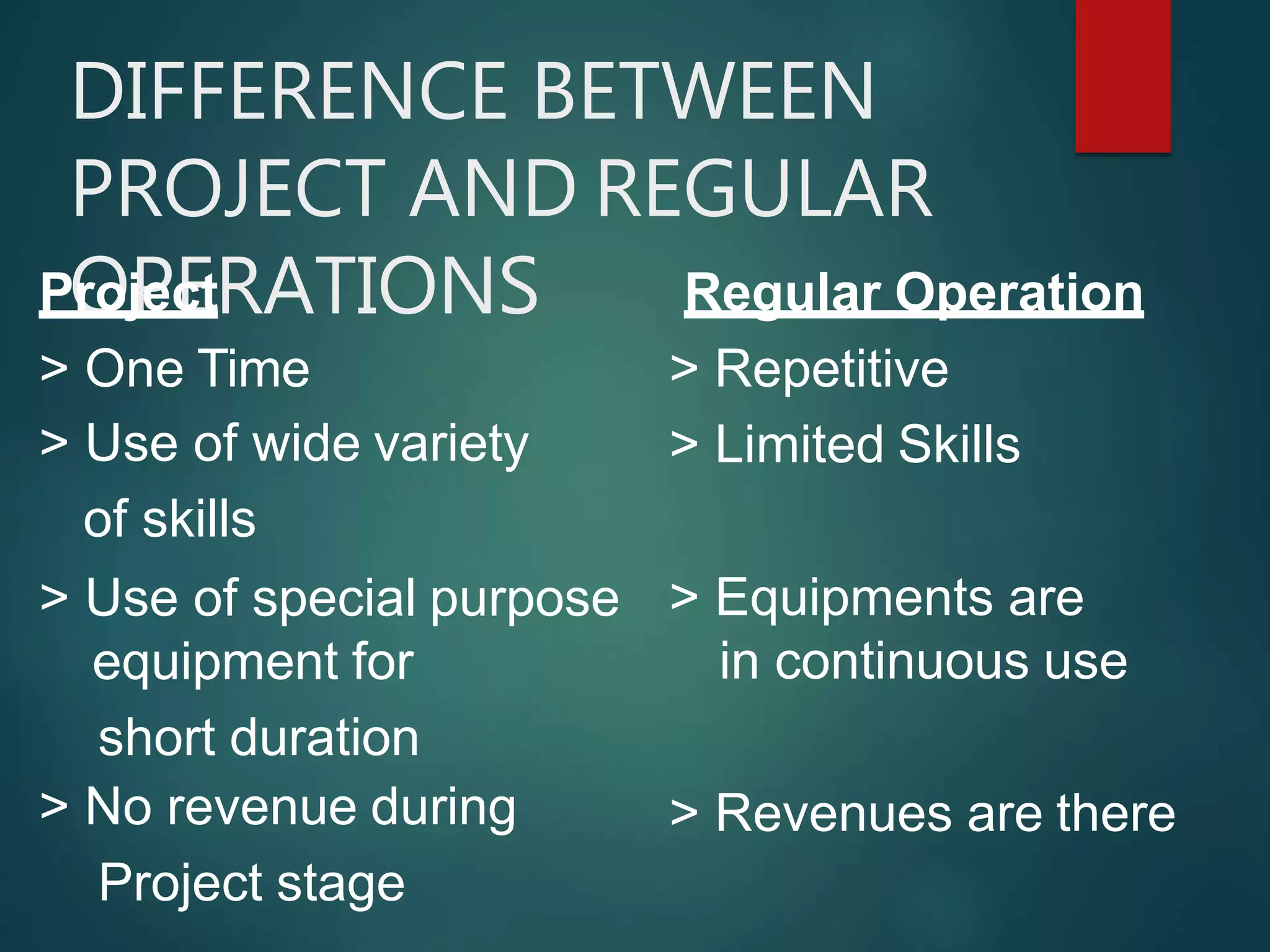
DIFFERENCE BETWEEN
PROJECT AND REGULAR
OPERATIONSProject Regular Operation
> Repetitive
> Limited Skills
> Equipments are
in continuous use
> Revenues are there
> One Time
> Use of wide variety
of skills
> Use of special purpose
equipment for
short duration
> No revenue during
Project stage
CHARACTERISTICS OF PROJECT
Well defined objectives
Uniqueness (Non-routine
activity) Complexity (Demands
team work) Life cycle
Risk and uncertainty
Change (In response to
environment) Non Recurring
Duration of activities
uncertain Completion
deadline
CHARACTERISTICS
OF
PROJECT(contd.)Involves resources
Optimality
Multidisciplinary & Interdependencies
Forecasting
Definite time limit
Team work
Conflict for resources
A separate disposable team
Performance measurement
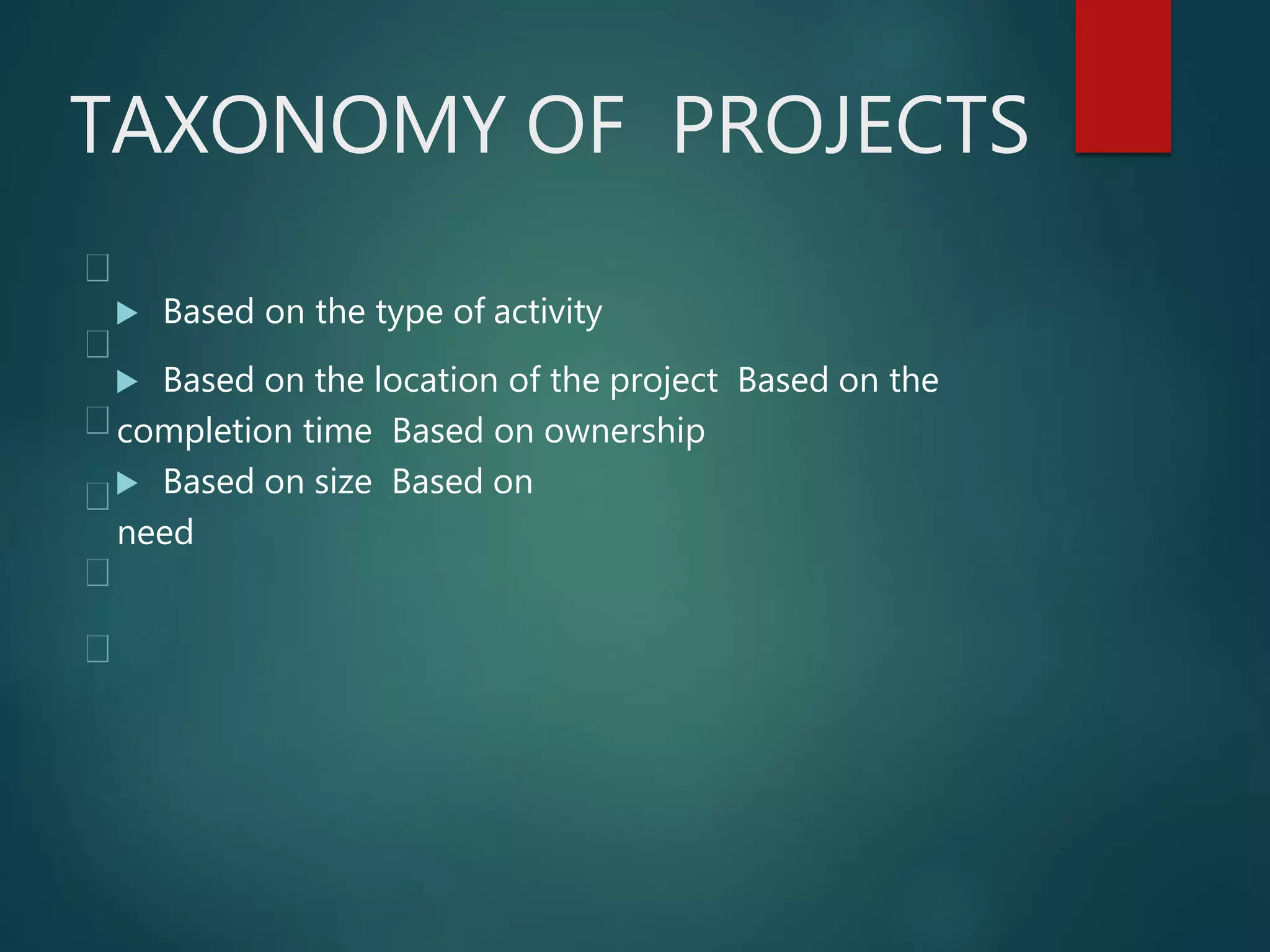
TAXONOMY OF PROJECTS
 Based on the type of activity
 Based on the location of the project Based on the
completion time Based on ownership
 Based on size Based on
need
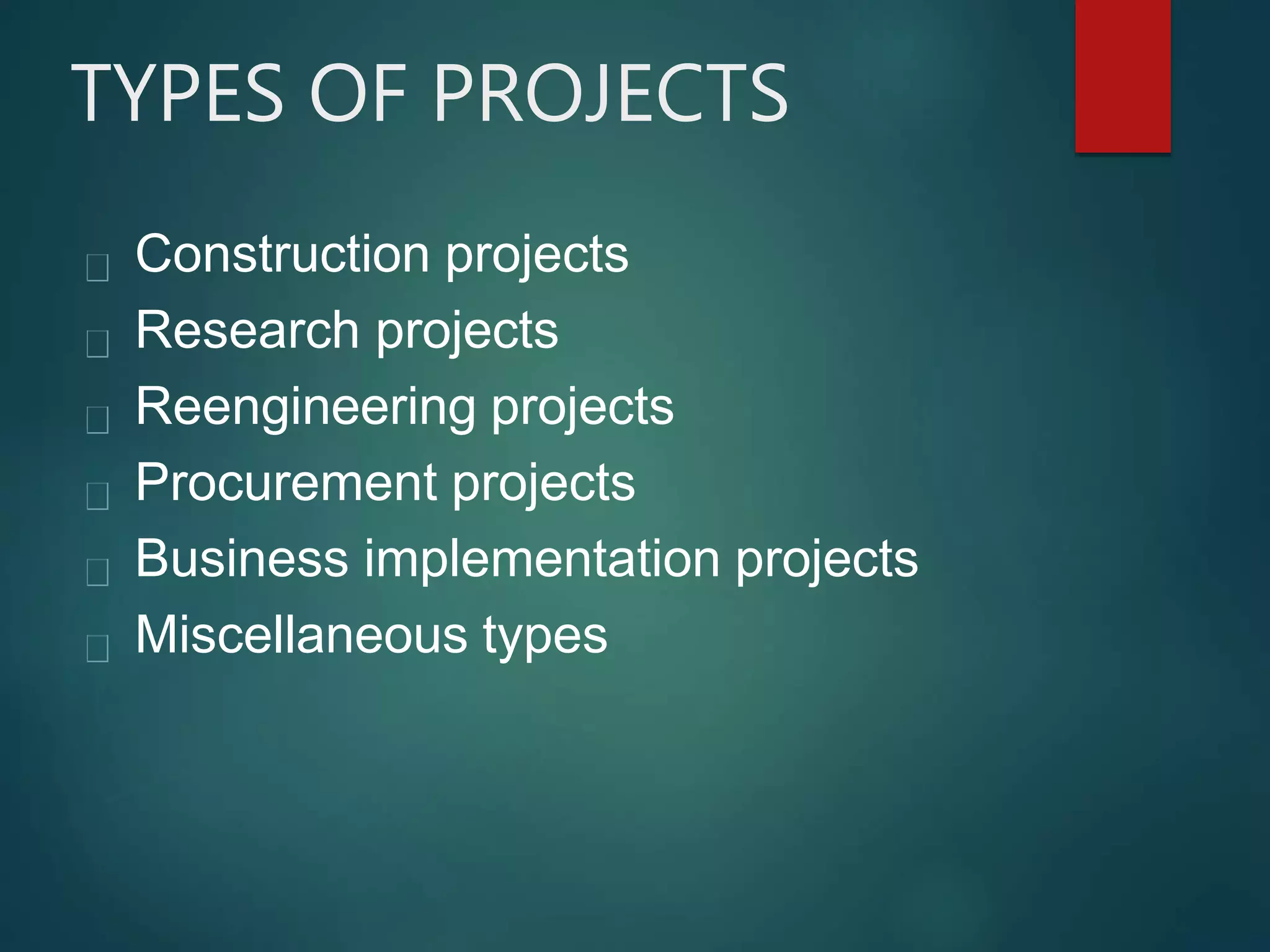
TYPES OF PROJECTS
Construction projects
Research projects
Reengineering projects
Procurement projects
Business implementation projects
Miscellaneous types
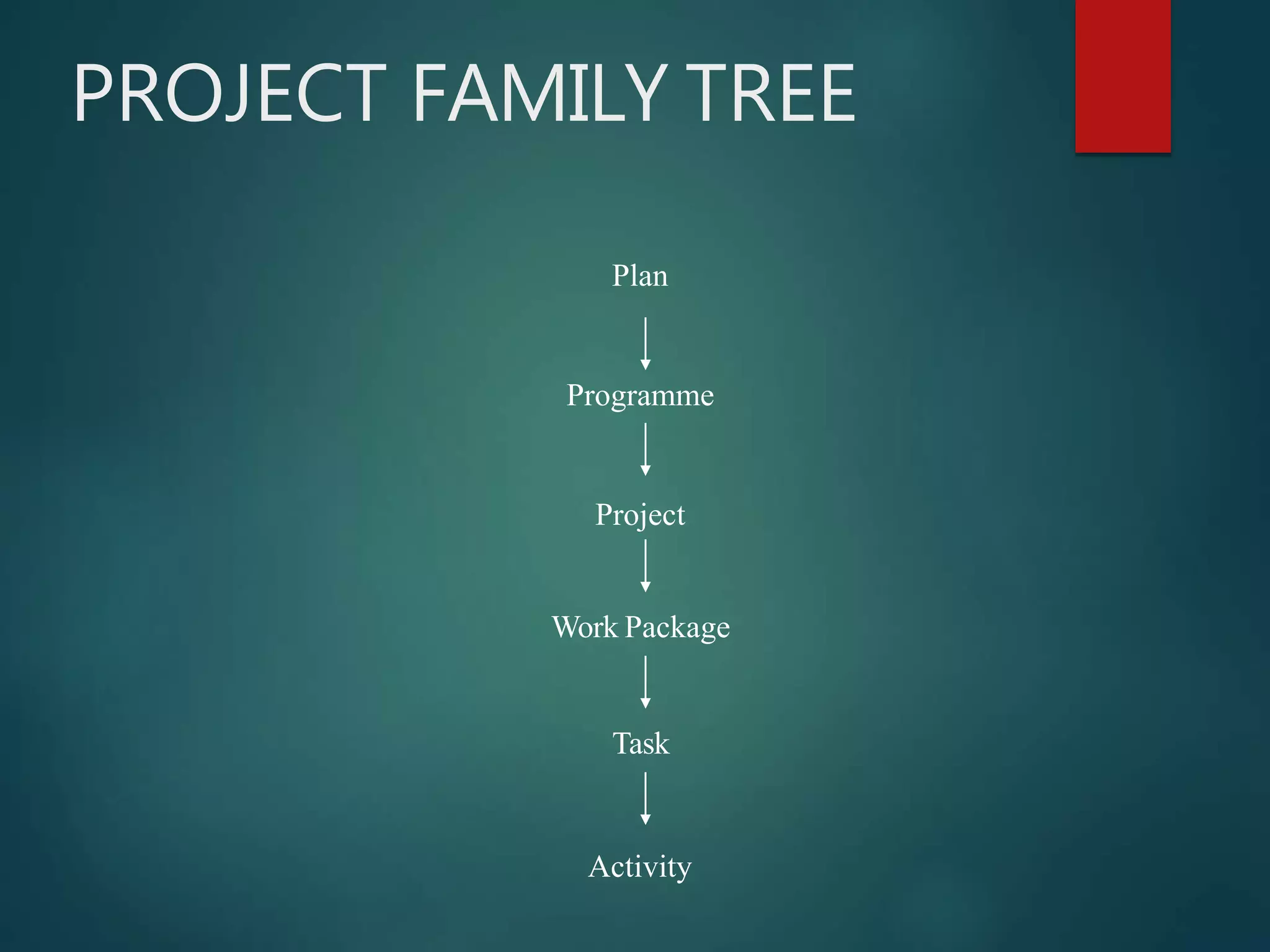
PROJECT FAMILY TREE
Plan
Programme
Project
Work Package
Task
Activity
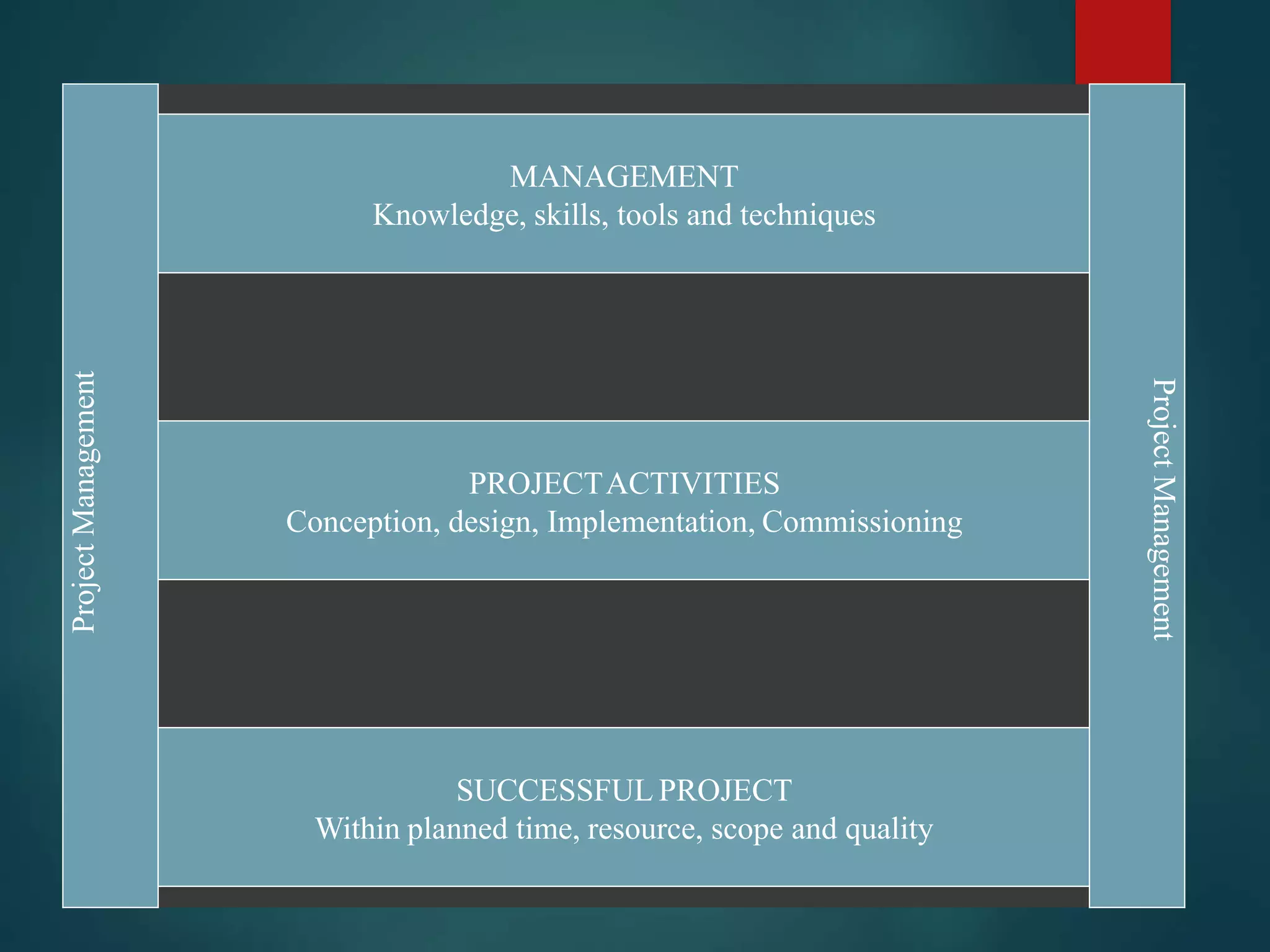
ProjectManagement
ProjectManagement
MANAGEMENT
Knowledge, skills, tools and techniques
PROJECTACTIVITIES
Conception, design, Implementation, Commissioning
SUCCESSFUL PROJECT
Within planned time, resource, scope and quality
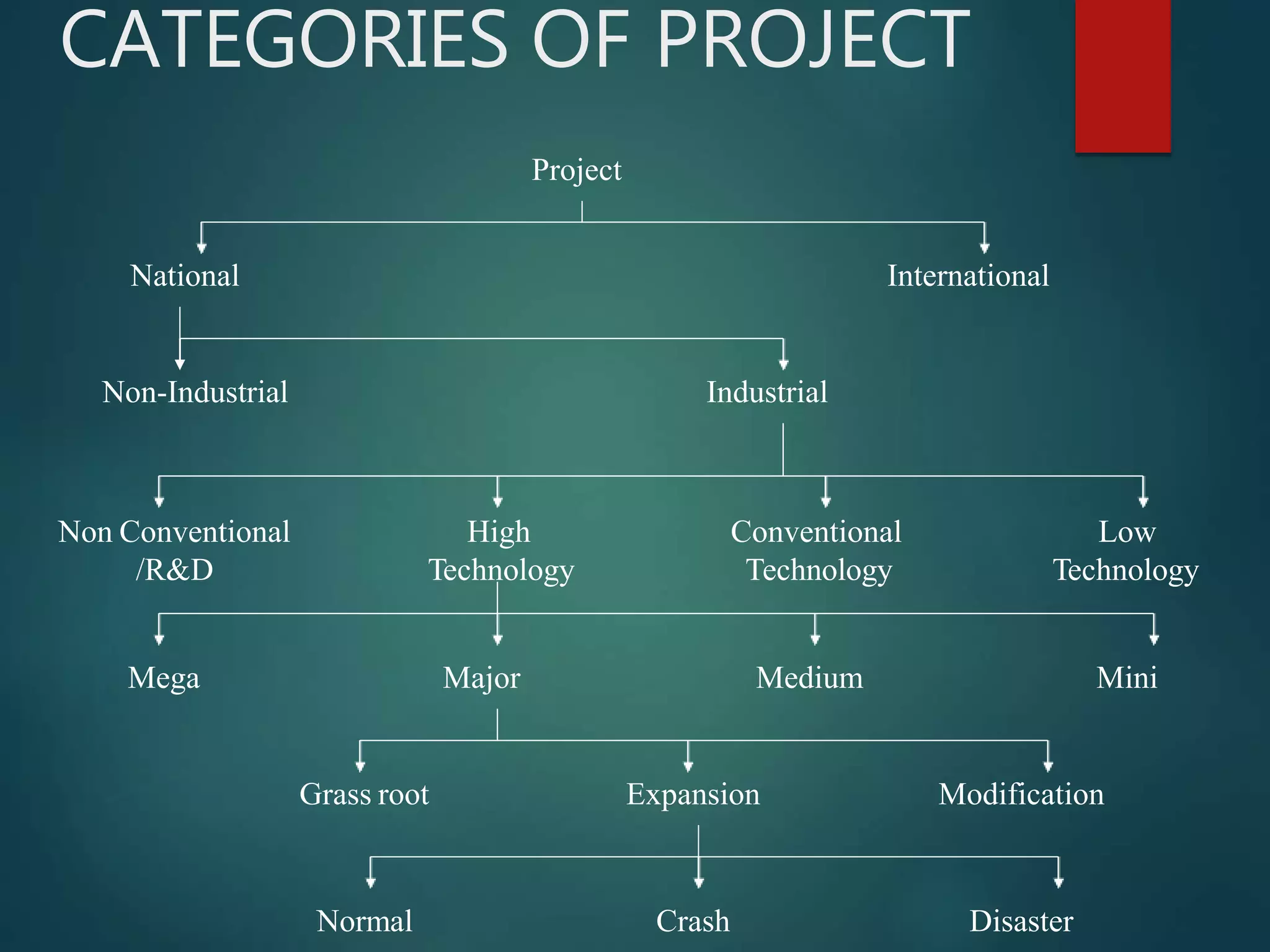
CATEGORIES OF PROJECT
Project
InternationalNational
IndustrialNon-Industrial
Low
Technology
Conventional
Technology
High
Technology
Non Conventional
/R&D
MiniMediumMajorMega
ModificationExpansionGrass root
DisasterCrashNormal
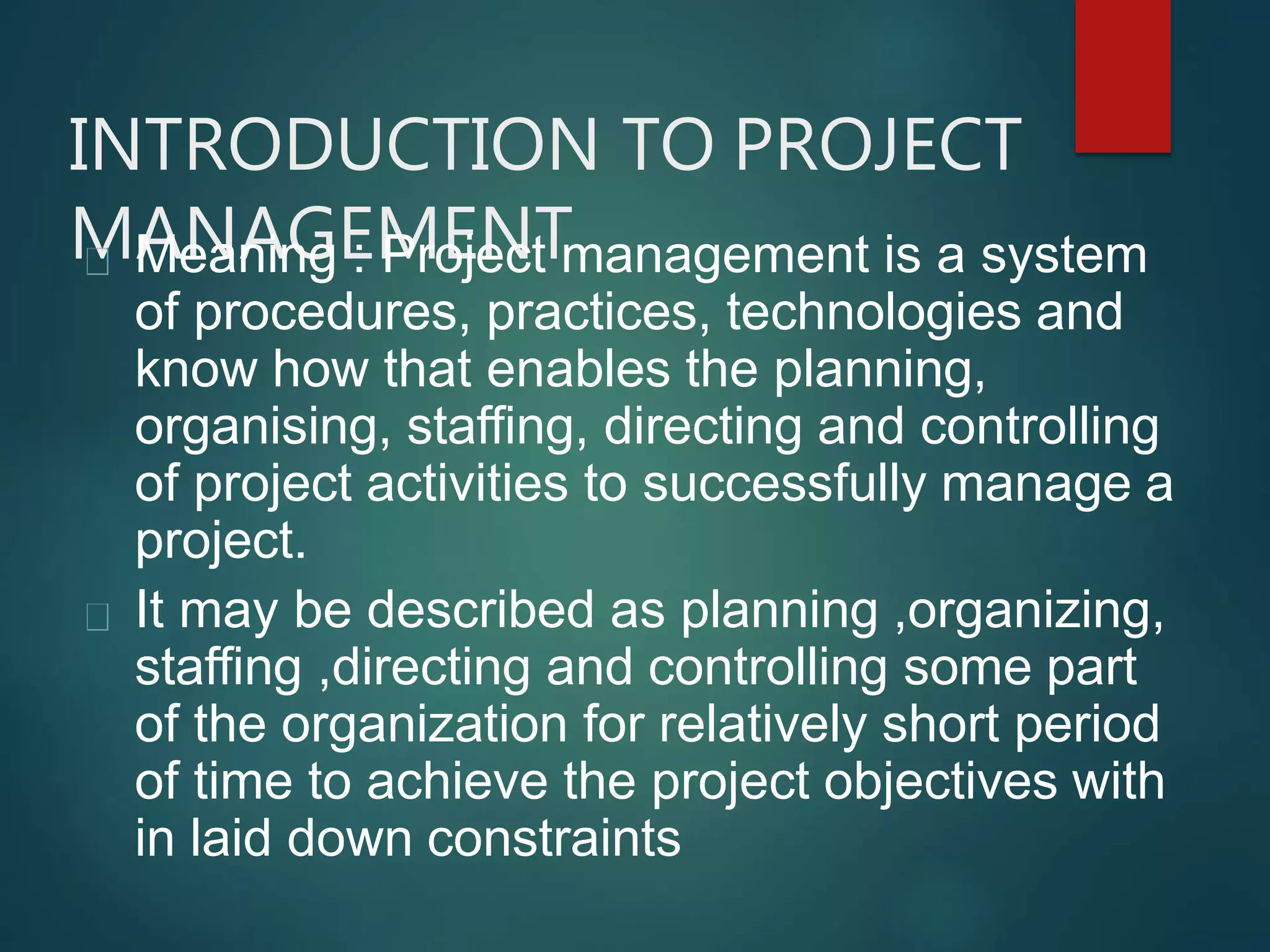
INTRODUCTION TO PROJECT
MANAGEMENTMeaning : Project management is a system
of procedures, practices, technologies and
know how that enables the planning,
organising, staffing, directing and controlling
of project activities to successfully manage a
project.
It may be described as planning ,organizing,
staffing ,directing and controlling some part
of the organization for relatively short period
of time to achieve the project objectives with
in laid down constraints
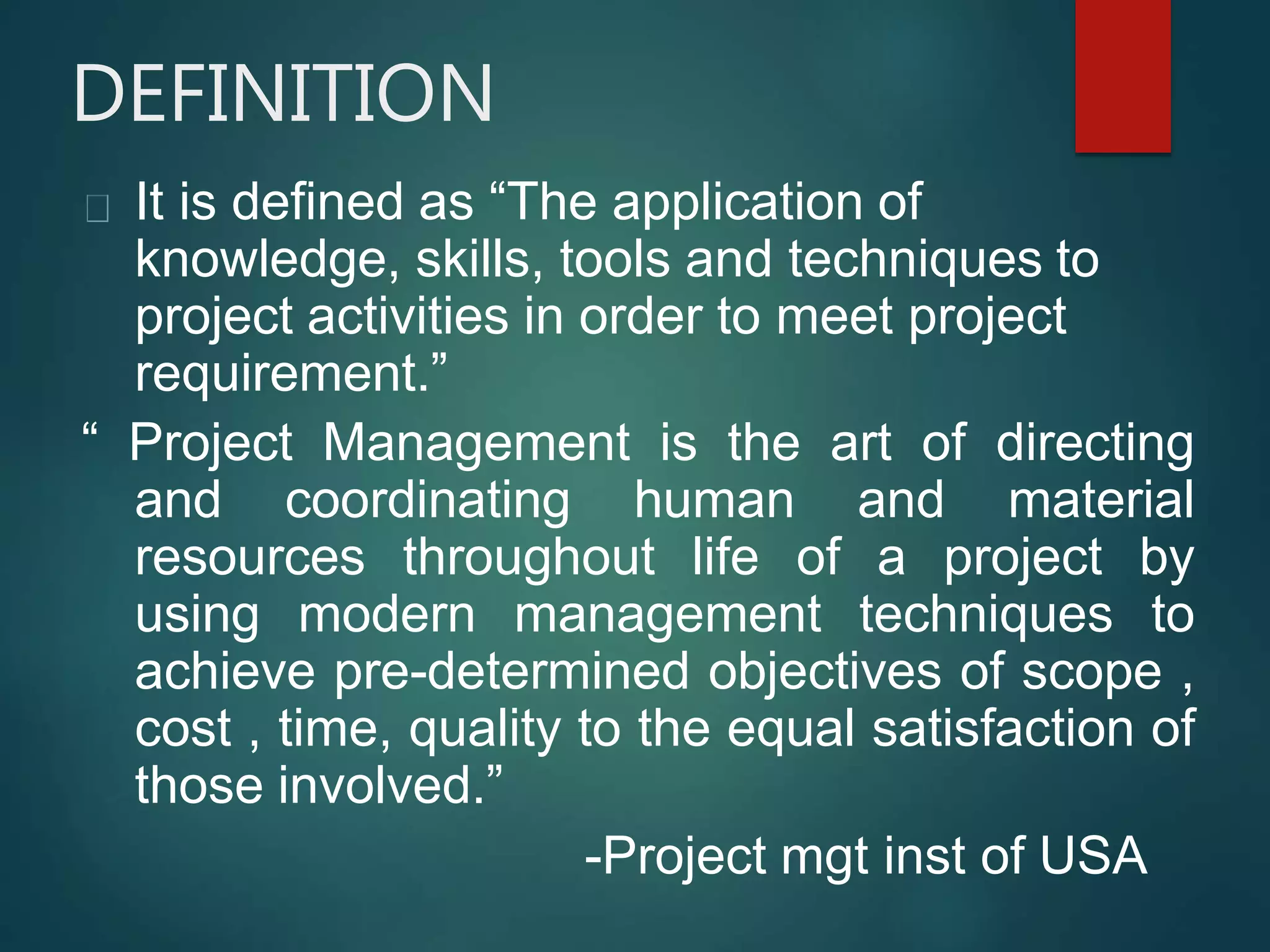
DEFINITION
It is defined as “The application of
knowledge, skills, tools and techniques to
project activities in order to meet project
requirement.”
“ Project Management is the art of directing
and coordinating human and material
resources throughout life of a project by
using modern management techniques to
achieve pre-determined objectives of scope ,
cost , time, quality to the equal satisfaction of
those involved.”
-Project mgt inst of USA
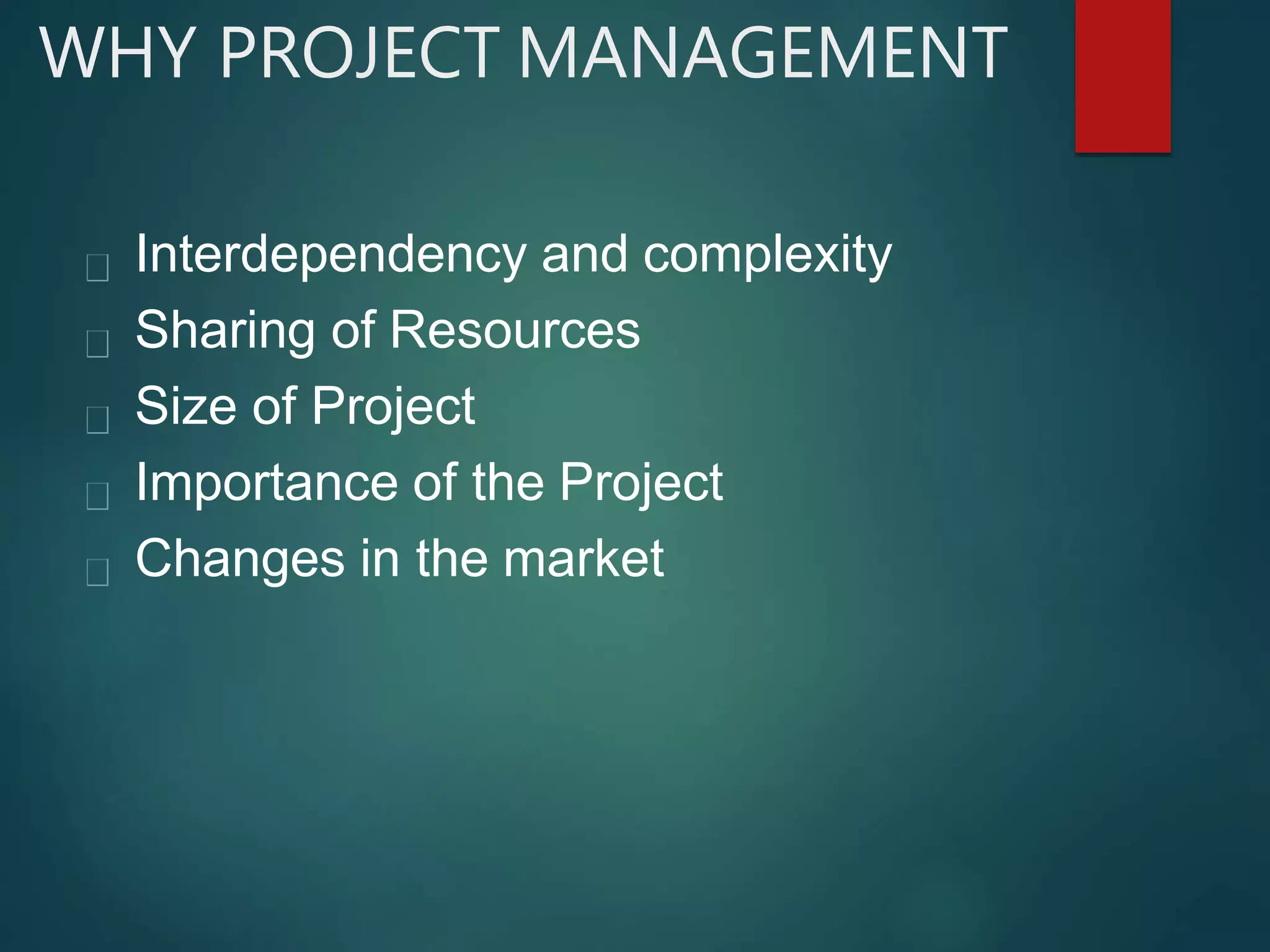
WHY PROJECT MANAGEMENT
Interdependency and complexity
Sharing of Resources
Size of Project
Importance of the Project
Changes in the market
3 Ws OF PROJECT
MANAGEMENTWhat : Scientific application of modern
techniques and tools.
Whom : In planning, financing,
implementing, monitoring, controlling
and coordinating unique activities of
project
Why : To produce desirable outputs in
accordance with predetermined
objectives within constrains of time and
cost.
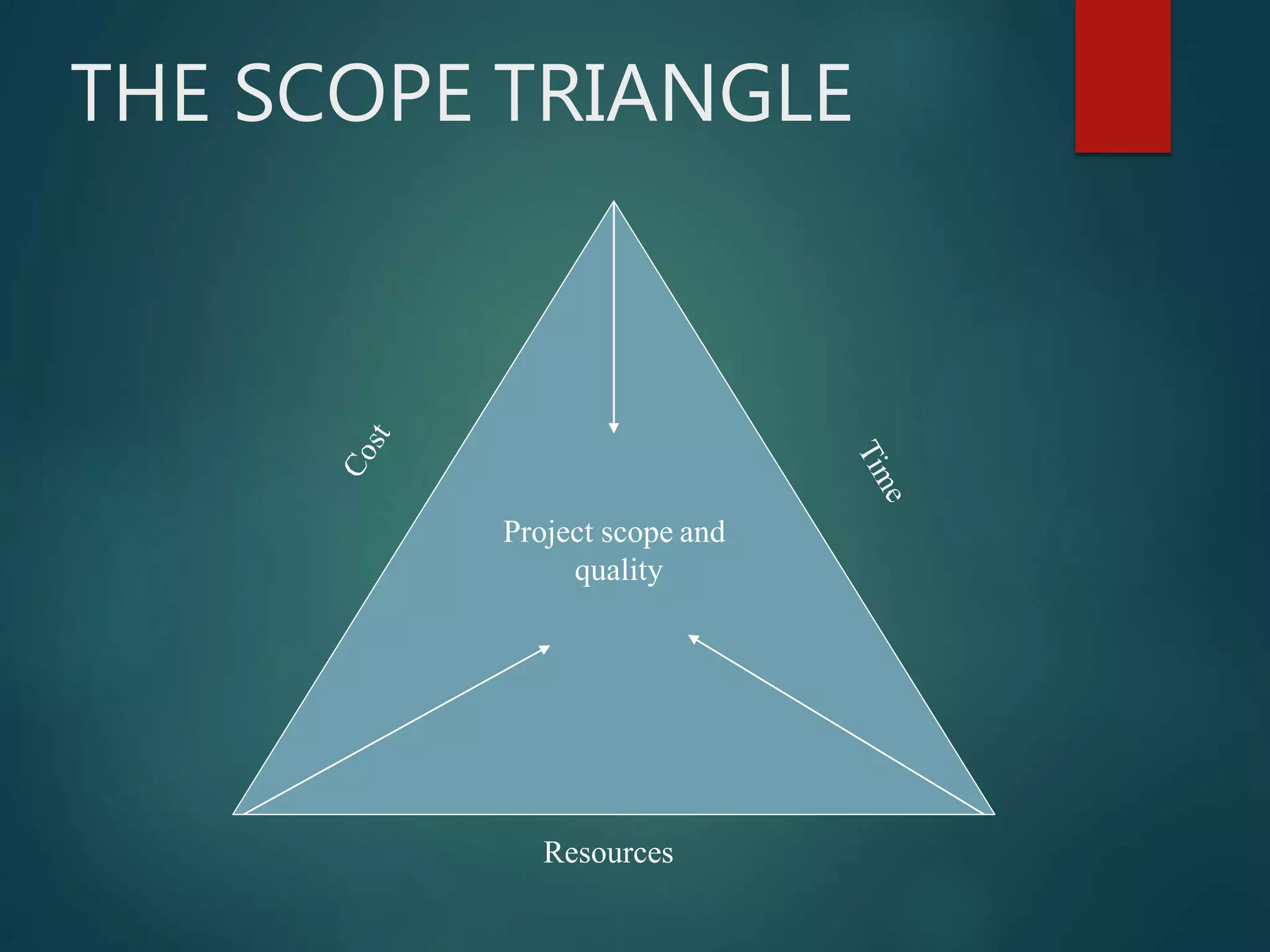
THE SCOPE TRIANGLE
Resources
Project scope and
quality
PROJECT PARAMETERS
Defining project scope
Defining quality
Managing time
Managing cost
Managing resources
IMPORTANCE OF PROJECT
MANAGEMENTIncreasing size and complexity of
projects
Increasing importance of financial
controls
Urgency of early completion
Growing amount of statutory regulations
Increased sophistication of technology
Inability of managers and architects to
manage the things
Shortening of product life cycle
Global competition
Cost control
Explosion of knowledge
Focus on customers
BENEFITS OF PROJECT
MANAGEMENT
Clear description of work to be
performed Responsibilities and
assessment of tasks Time limit for task
completion
Measurement of accomplishment
against plans is possible
Problems are exposed in advance
allowing corrective action
Objective that cannot be met are
identified early
ELEMENTS OF A SUCCESSFUL
PROJECTHas been finished on time.
Is within its cost budget.
Performs to technical/performance
standards which satisfies the end user.

Project management PPT

  • 1.
  • 2.
    INTRODUCTION The word ‘project’came from the Latin word projectum from the Latin verb proicese (to throw something forwards) which in turn comes from ‘pro’ which denote something that proceeds the action of the next part of the word.
  • 3.
    PROJECT A project isa combination of interrelated activities with well defined objectives to be completed in a specific time period. Project is something special which is different from routine and regular activities
  • 4.
    DEFINITIONS  According toHarrison, “ Project is a non routine, non repetitive, one-off undertaking, with well defined time, financial and technical performance goal;”  According to Project Management Institute (PMI), “Project can be defined as a temporary endeavor undertaken to accomplish a unique objective at goal.”
  • 5.
    EXAMPLES OF PROJECT Constructionof a house. Writing a book. Building a dam. Introducing a new product in the market. Construction of a new bridge over a river. A Politician contesting an election. Organizing a seminar.
  • 6.
    DIFFERENCE BETWEEN PROJECT ANDREGULAR OPERATIONSProject Regular Operation > Repetitive > Limited Skills > Equipments are in continuous use > Revenues are there > One Time > Use of wide variety of skills > Use of special purpose equipment for short duration > No revenue during Project stage
  • 7.
    CHARACTERISTICS OF PROJECT Welldefined objectives Uniqueness (Non-routine activity) Complexity (Demands team work) Life cycle Risk and uncertainty Change (In response to environment) Non Recurring Duration of activities uncertain Completion deadline
  • 8.
    CHARACTERISTICS OF PROJECT(contd.)Involves resources Optimality Multidisciplinary &Interdependencies Forecasting Definite time limit Team work Conflict for resources A separate disposable team Performance measurement
  • 9.
    TAXONOMY OF PROJECTS Based on the type of activity  Based on the location of the project Based on the completion time Based on ownership  Based on size Based on need
  • 10.
    TYPES OF PROJECTS Constructionprojects Research projects Reengineering projects Procurement projects Business implementation projects Miscellaneous types
  • 11.
  • 12.
    ProjectManagement ProjectManagement MANAGEMENT Knowledge, skills, toolsand techniques PROJECTACTIVITIES Conception, design, Implementation, Commissioning SUCCESSFUL PROJECT Within planned time, resource, scope and quality
  • 13.
    CATEGORIES OF PROJECT Project InternationalNational IndustrialNon-Industrial Low Technology Conventional Technology High Technology NonConventional /R&D MiniMediumMajorMega ModificationExpansionGrass root DisasterCrashNormal
  • 14.
    INTRODUCTION TO PROJECT MANAGEMENTMeaning: Project management is a system of procedures, practices, technologies and know how that enables the planning, organising, staffing, directing and controlling of project activities to successfully manage a project. It may be described as planning ,organizing, staffing ,directing and controlling some part of the organization for relatively short period of time to achieve the project objectives with in laid down constraints
  • 15.
    DEFINITION It is definedas “The application of knowledge, skills, tools and techniques to project activities in order to meet project requirement.” “ Project Management is the art of directing and coordinating human and material resources throughout life of a project by using modern management techniques to achieve pre-determined objectives of scope , cost , time, quality to the equal satisfaction of those involved.” -Project mgt inst of USA
  • 16.
    WHY PROJECT MANAGEMENT Interdependencyand complexity Sharing of Resources Size of Project Importance of the Project Changes in the market
  • 17.
    3 Ws OFPROJECT MANAGEMENTWhat : Scientific application of modern techniques and tools. Whom : In planning, financing, implementing, monitoring, controlling and coordinating unique activities of project Why : To produce desirable outputs in accordance with predetermined objectives within constrains of time and cost.
  • 18.
  • 19.
    PROJECT PARAMETERS Defining projectscope Defining quality Managing time Managing cost Managing resources
  • 20.
    IMPORTANCE OF PROJECT MANAGEMENTIncreasingsize and complexity of projects Increasing importance of financial controls Urgency of early completion Growing amount of statutory regulations Increased sophistication of technology Inability of managers and architects to manage the things
  • 21.
    Shortening of productlife cycle Global competition Cost control Explosion of knowledge Focus on customers
  • 22.
    BENEFITS OF PROJECT MANAGEMENT Cleardescription of work to be performed Responsibilities and assessment of tasks Time limit for task completion Measurement of accomplishment against plans is possible Problems are exposed in advance allowing corrective action Objective that cannot be met are identified early
  • 23.
    ELEMENTS OF ASUCCESSFUL PROJECTHas been finished on time. Is within its cost budget. Performs to technical/performance standards which satisfies the end user.