All Rights ReservedFundamentals of Entrepreneurship
© Oxford Fajar Sdn. Bhd. (008974-T), 2013 1– 1
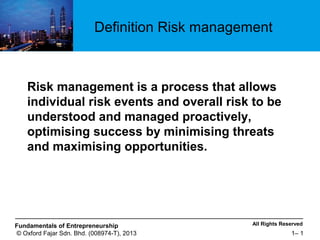
Risk management is a process that allows
individual risk events and overall risk to be
understood and managed proactively,
optimising success by minimising threats
and maximising opportunities.
Definition Risk management
All Rights ReservedFundamentals of Entrepreneurship
© Oxford Fajar Sdn. Bhd. (008974-T), 2013 1– 2
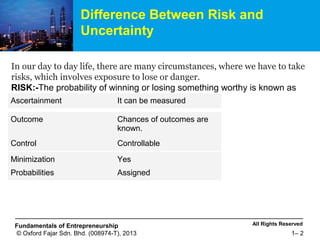
Difference Between Risk and
Uncertainty
In our day to day life, there are many circumstances, where we have to take
risks, which involves exposure to lose or danger.
RISK:-The probability of winning or losing something worthy is known as
risk.Ascertainment It can be measured
Outcome Chances of outcomes are
known.
Control Controllable
Minimization Yes
Probabilities Assigned
All Rights ReservedFundamentals of Entrepreneurship
© Oxford Fajar Sdn. Bhd. (008974-T), 2013 1– 3
Uncertainty
 Uncertainty implies a situation where the future events
are not known.
 Ascertainment -It cannot be measured
 Outcome-The outcome is unknown.
 Control-Uncontrollable
 Minimization-No
 Probabilities-Not assigned
All Rights ReservedFundamentals of Entrepreneurship
© Oxford Fajar Sdn. Bhd. (008974-T), 2013 1– 4
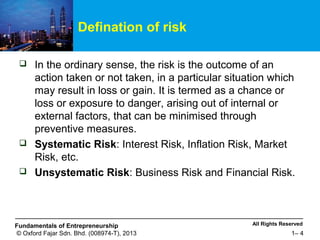
Defination of risk
 In the ordinary sense, the risk is the outcome of an
action taken or not taken, in a particular situation which
may result in loss or gain. It is termed as a chance or
loss or exposure to danger, arising out of internal or
external factors, that can be minimised through
preventive measures.
 Systematic Risk: Interest Risk, Inflation Risk, Market
Risk, etc.
 Unsystematic Risk: Business Risk and Financial Risk.
All Rights ReservedFundamentals of Entrepreneurship
© Oxford Fajar Sdn. Bhd. (008974-T), 2013 1– 5
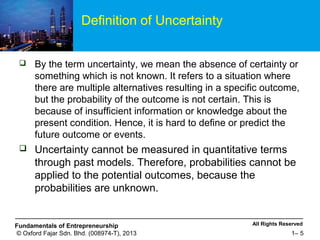
Definition of Uncertainty
 By the term uncertainty, we mean the absence of certainty or
something which is not known. It refers to a situation where
there are multiple alternatives resulting in a specific outcome,
but the probability of the outcome is not certain. This is
because of insufficient information or knowledge about the
present condition. Hence, it is hard to define or predict the
future outcome or events.
 Uncertainty cannot be measured in quantitative terms
through past models. Therefore, probabilities cannot be
applied to the potential outcomes, because the
probabilities are unknown.
All Rights ReservedFundamentals of Entrepreneurship
© Oxford Fajar Sdn. Bhd. (008974-T), 2013 1– 6
Types of risk
 Systematic Risk - Systematic risk influences a large number of
assets. A significant political event, for example, could affect several of
the assets in your portfolio. It is virtually impossible to protect yourself
against this type of risk.
 Unsystematic Risk - Unsystematic risk is sometimes referred to as
"specific risk". This kind of risk affects a very small number of assets.
An example is news that affects a specific stock such as a sudden
strike by employees. Diversification is the only way to protect yourself
from unsystematic risk. (We will discuss diversification later in this
tutorial).
All Rights ReservedFundamentals of Entrepreneurship
© Oxford Fajar Sdn. Bhd. (008974-T), 2013 1– 7
 Default Risk- is the risk that a company or individual will be unable
to pay the contractual interest or principal on its debt obligations.
This type of risk is of particular concern to investors who hold
bonds in their portfolios. Government bonds, especially those
issued by the federal government, have the least amount of default
risk and the lowest returns, while corporate bonds tend to have the
highest amount of default risk but also higher interest rates. Bonds
with a lower chance of default are considered to be investment
grade, while bonds with higher chances are considered to be junk
bonds. Bond rating services, such as Moody's, allows investors to
determine which bonds are investment-grade, and which bonds are
junk.
All Rights ReservedFundamentals of Entrepreneurship
© Oxford Fajar Sdn. Bhd. (008974-T), 2013 1– 8
 Country Risk - Country risk refers to the risk that a country won't be
able to honor its financial commitments. When a country defaults on
its obligations, this can harm the performance of all other financial
instruments in that country as well as other countries it has relations
with. Country risk applies to stocks, bonds, mutual funds, options and
futures that are issued within a particular country. This type of risk is
most often seen in emerging markets or countries that have a severe
deficit.
All Rights ReservedFundamentals of Entrepreneurship
© Oxford Fajar Sdn. Bhd. (008974-T), 2013 1– 9
 Foreign-Exchange Risk - When investing in foreign countries you
must consider the fact that currency exchange rates can change the
price of the asset as well. Foreign-exchange risk applies to all
financial instruments that are in a currency other than your domestic
currency. As an example, if you are a resident of America and invest
in some Canadian stock in Canadian dollars, even if the share value
appreciates, you may lose money if the Canadian dollar depreciates
in relation to the American dollar.
 Interest Rate Risk -is the risk that an investment's value will change as a
result of a change in interest rates. This risk affects the value of bonds more
directly than stocks.
All Rights ReservedFundamentals of Entrepreneurship
© Oxford Fajar Sdn. Bhd. (008974-T), 2013 1– 10
 Political Risk - Political risk represents the financial risk
that a country's government will suddenly change its
policies. This is a major reason why developing
countries lack foreign investment.
Market Risk - This is the most familiar of all risks. Also referred to
as volatility, market risk is the the day-to-day fluctuations in a
stock's price. Market risk applies mainly to stocks and options. As a
whole, stocks tend to perform well during a bull market and poorly
during a bear market - volatility is not so much a cause but an
effect of certain market forces.
All Rights ReservedFundamentals of Entrepreneurship
© Oxford Fajar Sdn. Bhd. (008974-T), 2013 1– 11
What Is Risk Analysis?
 What Is Risk Analysis?
 Risk Analysis is a process that helps you identify and manage potential
problems that could undermine key business initiatives or projects.
 To carry out a Risk Analysis, you must first identify the possible threats
that you face, and then estimate the likelihood that these threats will
materialize.
 Risk Analysis can be complex, as you'll need to draw on detailed
information such as project plans, financial data, security protocols,
marketing forecasts, and other relevant information. However, it's an
essential planning tool, and one that could save time, money, and
reputations.
All Rights ReservedFundamentals of Entrepreneurship
© Oxford Fajar Sdn. Bhd. (008974-T), 2013 1– 12
 When you're planning projects, to help you anticipate and
neutralize possible problems.
 When you're deciding whether or not to move forward with a
project.
 When you're improving safety and managing potential risks in the
workplace.
 When you're preparing for events such as equipment or technology
failure, theft, staff sickness, or natural disasters.
 When you're planning for changes in your environment, such as
new competitors coming into the market, or changes to government
policy.
When to Use Risk Analysis

All Rights ReservedFundamentals of Entrepreneurship
© Oxford Fajar Sdn. Bhd. (008974-T), 2013 1– 13
 1. Identify Threats
 Human – Illness, death, injury, or other loss of a key individual.
 Operational – Disruption to supplies and operations, loss of access to essential
assets, or failures in distribution.
 Reputational – Loss of customer or employee confidence, or damage to market
reputation.
 Procedural – Failures of accountability, internal systems, or controls, or from
fraud.
 Project – Going over budget, taking too long on key tasks, or experiencing
issues with product or service quality.
 Financial – Business failure, stock market fluctuations, interest rate changes, or
non-availability of funding.
How to Use Risk Analysis

All Rights ReservedFundamentals of Entrepreneurship
© Oxford Fajar Sdn. Bhd. (008974-T), 2013 1– 14
 Technical – Advances in technology, or from technical
failure.
 Natural – Weather, natural disasters, or disease.
 Political – Changes in tax, public opinion, government
policy, or foreign influence.
 Structural – Dangerous chemicals, poor lighting, falling
boxes, or any situation where staff, products, or technology
can be harmed.
All Rights ReservedFundamentals of Entrepreneurship
© Oxford Fajar Sdn. Bhd. (008974-T), 2013 1– 15
 2. Estimate Risk
 Once you've identified the threats you're facing, you need to
calculate out both the likelihood of these threats being realized, and
their possible impact.
 One way of doing this is to make your best estimate of the
probability of the event occurring, and then to multiply this by the
amount it will cost you to set things right if it happens. This gives
you a value for the risk:
 Risk Value = Probability of Event x Cost of Event
 You think that there's an 80 percent chance of this happening within the next year, because
your landlord has recently increased rents for other businesses. If this happens, it will cost your
business an extra $500,000 over the next year.
 So the risk value of the rent increase is:
 0.80 (Probability of Event) x $500,000 (Cost of Event) = $400,000 (Risk Value)
All Rights ReservedFundamentals of Entrepreneurship
© Oxford Fajar Sdn. Bhd. (008974-T), 2013 1– 16
How to Manage Risk
 In some cases, you may want to avoid the risk altogether. This
could mean not getting involved in a business venture, passing on
a project, or skipping a high-risk activity. This is a good option
when taking the risk involves no advantage to your organization, or
when the cost of addressing the effects is not worthwhile.
 Share the RiskYou could also opt to share the risk – and the
potential gain – with other people, teams, organizations, or third
parties.
 For instance, you share risk when you insure your office building
and your inventory with a third-party insurance company, or when
you partner with another organization in a joint product
development initiative.
All Rights ReservedFundamentals of Entrepreneurship
© Oxford Fajar Sdn. Bhd. (008974-T), 2013 1– 17
 Accept the Risk
For example, you might accept the risk of a project launching late if the
potential sales will still cover your costs.
 Controlling Risk If you choose to accept the risk, there are a number
of ways in which you can reduce its impact.
 Preventative action involves aiming to prevent a high-risk situation
from happening. It includes health and safety training, firewall protection
on corporate servers, and cross-training your team.
 Detective action involves identifying the points in a process where
something could go wrong, and then putting steps in place to fix the
problems promptly if they occur. Detective actions include double-
checking finance reports, conducting safety testing before a product is
released, or installing sensors to detect product defects.



Risk all notes muj 4semester

  • 1.
    All Rights ReservedFundamentalsof Entrepreneurship © Oxford Fajar Sdn. Bhd. (008974-T), 2013 1– 1 Risk management is a process that allows individual risk events and overall risk to be understood and managed proactively, optimising success by minimising threats and maximising opportunities. Definition Risk management
  • 2.
    All Rights ReservedFundamentalsof Entrepreneurship © Oxford Fajar Sdn. Bhd. (008974-T), 2013 1– 2 Difference Between Risk and Uncertainty In our day to day life, there are many circumstances, where we have to take risks, which involves exposure to lose or danger. RISK:-The probability of winning or losing something worthy is known as risk.Ascertainment It can be measured Outcome Chances of outcomes are known. Control Controllable Minimization Yes Probabilities Assigned
  • 3.
    All Rights ReservedFundamentalsof Entrepreneurship © Oxford Fajar Sdn. Bhd. (008974-T), 2013 1– 3 Uncertainty  Uncertainty implies a situation where the future events are not known.  Ascertainment -It cannot be measured  Outcome-The outcome is unknown.  Control-Uncontrollable  Minimization-No  Probabilities-Not assigned
  • 4.
    All Rights ReservedFundamentalsof Entrepreneurship © Oxford Fajar Sdn. Bhd. (008974-T), 2013 1– 4 Defination of risk  In the ordinary sense, the risk is the outcome of an action taken or not taken, in a particular situation which may result in loss or gain. It is termed as a chance or loss or exposure to danger, arising out of internal or external factors, that can be minimised through preventive measures.  Systematic Risk: Interest Risk, Inflation Risk, Market Risk, etc.  Unsystematic Risk: Business Risk and Financial Risk.
  • 5.
    All Rights ReservedFundamentalsof Entrepreneurship © Oxford Fajar Sdn. Bhd. (008974-T), 2013 1– 5 Definition of Uncertainty  By the term uncertainty, we mean the absence of certainty or something which is not known. It refers to a situation where there are multiple alternatives resulting in a specific outcome, but the probability of the outcome is not certain. This is because of insufficient information or knowledge about the present condition. Hence, it is hard to define or predict the future outcome or events.  Uncertainty cannot be measured in quantitative terms through past models. Therefore, probabilities cannot be applied to the potential outcomes, because the probabilities are unknown.
  • 6.
    All Rights ReservedFundamentalsof Entrepreneurship © Oxford Fajar Sdn. Bhd. (008974-T), 2013 1– 6 Types of risk  Systematic Risk - Systematic risk influences a large number of assets. A significant political event, for example, could affect several of the assets in your portfolio. It is virtually impossible to protect yourself against this type of risk.  Unsystematic Risk - Unsystematic risk is sometimes referred to as "specific risk". This kind of risk affects a very small number of assets. An example is news that affects a specific stock such as a sudden strike by employees. Diversification is the only way to protect yourself from unsystematic risk. (We will discuss diversification later in this tutorial).
  • 7.
    All Rights ReservedFundamentalsof Entrepreneurship © Oxford Fajar Sdn. Bhd. (008974-T), 2013 1– 7  Default Risk- is the risk that a company or individual will be unable to pay the contractual interest or principal on its debt obligations. This type of risk is of particular concern to investors who hold bonds in their portfolios. Government bonds, especially those issued by the federal government, have the least amount of default risk and the lowest returns, while corporate bonds tend to have the highest amount of default risk but also higher interest rates. Bonds with a lower chance of default are considered to be investment grade, while bonds with higher chances are considered to be junk bonds. Bond rating services, such as Moody's, allows investors to determine which bonds are investment-grade, and which bonds are junk.
  • 8.
    All Rights ReservedFundamentalsof Entrepreneurship © Oxford Fajar Sdn. Bhd. (008974-T), 2013 1– 8  Country Risk - Country risk refers to the risk that a country won't be able to honor its financial commitments. When a country defaults on its obligations, this can harm the performance of all other financial instruments in that country as well as other countries it has relations with. Country risk applies to stocks, bonds, mutual funds, options and futures that are issued within a particular country. This type of risk is most often seen in emerging markets or countries that have a severe deficit.
  • 9.
    All Rights ReservedFundamentalsof Entrepreneurship © Oxford Fajar Sdn. Bhd. (008974-T), 2013 1– 9  Foreign-Exchange Risk - When investing in foreign countries you must consider the fact that currency exchange rates can change the price of the asset as well. Foreign-exchange risk applies to all financial instruments that are in a currency other than your domestic currency. As an example, if you are a resident of America and invest in some Canadian stock in Canadian dollars, even if the share value appreciates, you may lose money if the Canadian dollar depreciates in relation to the American dollar.  Interest Rate Risk -is the risk that an investment's value will change as a result of a change in interest rates. This risk affects the value of bonds more directly than stocks.
  • 10.
    All Rights ReservedFundamentalsof Entrepreneurship © Oxford Fajar Sdn. Bhd. (008974-T), 2013 1– 10  Political Risk - Political risk represents the financial risk that a country's government will suddenly change its policies. This is a major reason why developing countries lack foreign investment. Market Risk - This is the most familiar of all risks. Also referred to as volatility, market risk is the the day-to-day fluctuations in a stock's price. Market risk applies mainly to stocks and options. As a whole, stocks tend to perform well during a bull market and poorly during a bear market - volatility is not so much a cause but an effect of certain market forces.
  • 11.
    All Rights ReservedFundamentalsof Entrepreneurship © Oxford Fajar Sdn. Bhd. (008974-T), 2013 1– 11 What Is Risk Analysis?  What Is Risk Analysis?  Risk Analysis is a process that helps you identify and manage potential problems that could undermine key business initiatives or projects.  To carry out a Risk Analysis, you must first identify the possible threats that you face, and then estimate the likelihood that these threats will materialize.  Risk Analysis can be complex, as you'll need to draw on detailed information such as project plans, financial data, security protocols, marketing forecasts, and other relevant information. However, it's an essential planning tool, and one that could save time, money, and reputations.
  • 12.
    All Rights ReservedFundamentalsof Entrepreneurship © Oxford Fajar Sdn. Bhd. (008974-T), 2013 1– 12  When you're planning projects, to help you anticipate and neutralize possible problems.  When you're deciding whether or not to move forward with a project.  When you're improving safety and managing potential risks in the workplace.  When you're preparing for events such as equipment or technology failure, theft, staff sickness, or natural disasters.  When you're planning for changes in your environment, such as new competitors coming into the market, or changes to government policy. When to Use Risk Analysis 
  • 13.
    All Rights ReservedFundamentalsof Entrepreneurship © Oxford Fajar Sdn. Bhd. (008974-T), 2013 1– 13  1. Identify Threats  Human – Illness, death, injury, or other loss of a key individual.  Operational – Disruption to supplies and operations, loss of access to essential assets, or failures in distribution.  Reputational – Loss of customer or employee confidence, or damage to market reputation.  Procedural – Failures of accountability, internal systems, or controls, or from fraud.  Project – Going over budget, taking too long on key tasks, or experiencing issues with product or service quality.  Financial – Business failure, stock market fluctuations, interest rate changes, or non-availability of funding. How to Use Risk Analysis 
  • 14.
    All Rights ReservedFundamentalsof Entrepreneurship © Oxford Fajar Sdn. Bhd. (008974-T), 2013 1– 14  Technical – Advances in technology, or from technical failure.  Natural – Weather, natural disasters, or disease.  Political – Changes in tax, public opinion, government policy, or foreign influence.  Structural – Dangerous chemicals, poor lighting, falling boxes, or any situation where staff, products, or technology can be harmed.
  • 15.
    All Rights ReservedFundamentalsof Entrepreneurship © Oxford Fajar Sdn. Bhd. (008974-T), 2013 1– 15  2. Estimate Risk  Once you've identified the threats you're facing, you need to calculate out both the likelihood of these threats being realized, and their possible impact.  One way of doing this is to make your best estimate of the probability of the event occurring, and then to multiply this by the amount it will cost you to set things right if it happens. This gives you a value for the risk:  Risk Value = Probability of Event x Cost of Event  You think that there's an 80 percent chance of this happening within the next year, because your landlord has recently increased rents for other businesses. If this happens, it will cost your business an extra $500,000 over the next year.  So the risk value of the rent increase is:  0.80 (Probability of Event) x $500,000 (Cost of Event) = $400,000 (Risk Value)
  • 16.
    All Rights ReservedFundamentalsof Entrepreneurship © Oxford Fajar Sdn. Bhd. (008974-T), 2013 1– 16 How to Manage Risk  In some cases, you may want to avoid the risk altogether. This could mean not getting involved in a business venture, passing on a project, or skipping a high-risk activity. This is a good option when taking the risk involves no advantage to your organization, or when the cost of addressing the effects is not worthwhile.  Share the RiskYou could also opt to share the risk – and the potential gain – with other people, teams, organizations, or third parties.  For instance, you share risk when you insure your office building and your inventory with a third-party insurance company, or when you partner with another organization in a joint product development initiative.
  • 17.
    All Rights ReservedFundamentalsof Entrepreneurship © Oxford Fajar Sdn. Bhd. (008974-T), 2013 1– 17  Accept the Risk For example, you might accept the risk of a project launching late if the potential sales will still cover your costs.  Controlling Risk If you choose to accept the risk, there are a number of ways in which you can reduce its impact.  Preventative action involves aiming to prevent a high-risk situation from happening. It includes health and safety training, firewall protection on corporate servers, and cross-training your team.  Detective action involves identifying the points in a process where something could go wrong, and then putting steps in place to fix the problems promptly if they occur. Detective actions include double- checking finance reports, conducting safety testing before a product is released, or installing sensors to detect product defects.  