
RACHANA PRADEEP
Assistant Professor
 UNIT 1: Project-Meaning,
characteristics,importance,types, steps in
identification of project, classification of
projects, stages in project life cycle,
identification, formulation and
implementation
 The word PROJECT comes from the Latin
word PROJECTUM from the Latin verb
PROICERE; which means “to throw something
forwards” which in turn comes from PRO-,
which denotes something that precedes the
action of the next part of the word in time
and ICERE, “to throw”. The word PROJECT
thus actually originally meant “something
that comes before anything else happens”.
 A project in business and science is a
temporary endeavor undertaken to create a
unique product, service, or result. Basically, it
is planned to achieve a particular aim. The aim
of a project is to attain its objective and then
terminate. Some of the reasons to start a
project can be:
 A customer request or market demand
 An organizational need
 A customer request
 A technological advance
 A legal requirement
 Projects and operations differ primarily in that
operations are ongoing and repetitive, while
projects are temporary and unique. Generally,
a project is a means of organizing some
activities that cannot be addressed within the
normal operational limits.
 Some examples of a project are:
 Developing a new product or service
 Constructing a building or facility
 Renovating the kitchen
 Designing a new transportation vehicle
 Acquiring a new or modified data system
 Organizing a meeting
 Implementing a new business process
 “A project is a temporary Endeavour undertaken to
create a unique product or service.”
 - Institute of project Management
 “A project is a specific, finite task to be
accomplished, whether it is large or small scale and
whether it is
 long or short run is not particularly relevant.”
 - Meredith and Camuel
 “Project management is the process of achieving
project objectives through the traditional
 organizational structure and over the specialties of
the individuals concerned. Project management is
 applicable for any (unique, one time, one of a kind)
undertaking concerned with a specify and
 objectives”
 - Professor Harold Kerzner
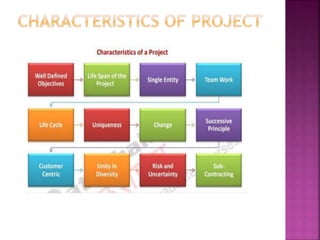
 1. Well defined objectives: Every project must
have well defined set of objectives. No project can
be without set of objectives. Once these objectives
are accomplished, the project ceases to exist.
Needless to say that a project is deemed to be
completed when the whole things are completed and
performing satisfactorily..
 FINANCIAL OBJECTIVES
 QUALITY OBJECTIVES
 TECHNICAL OBJECTIVES
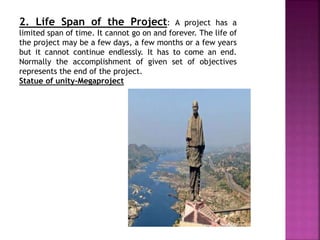
2. Life Span of the Project: A project has a
limited span of time. It cannot go on and forever. The life of
the project may be a few days, a few months or a few years
but it cannot continue endlessly. It has to come an end.
Normally the accomplishment of given set of objectives
represents the end of the project.
Statue of unity-Megaproject
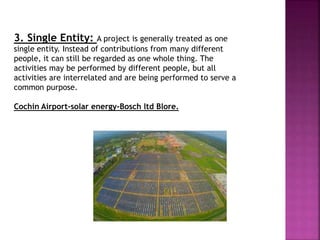
3. Single Entity: A project is generally treated as one
single entity. Instead of contributions from many different
people, it can still be regarded as one whole thing. The
activities may be performed by different people, but all
activities are interrelated and are being performed to serve a
common purpose.
Cochin Airport-solar energy-Bosch ltd Blore.
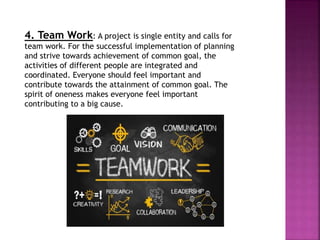
4. Team Work: A project is single entity and calls for
team work. For the successful implementation of planning
and strive towards achievement of common goal, the
activities of different people are integrated and
coordinated. Everyone should feel important and
contribute towards the attainment of common goal. The
spirit of oneness makes everyone feel important
contributing to a big cause.
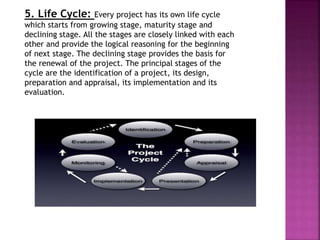
5. Life Cycle: Every project has its own life cycle
which starts from growing stage, maturity stage and
declining stage. All the stages are closely linked with each
other and provide the logical reasoning for the beginning
of next stage. The declining stage provides the basis for
the renewal of the project. The principal stages of the
cycle are the identification of a project, its design,
preparation and appraisal, its implementation and its
evaluation.
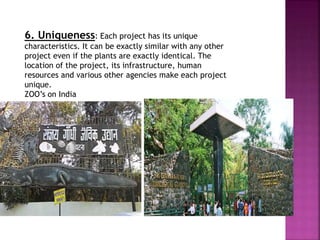
6. Uniqueness: Each project has its unique
characteristics. It can be exactly similar with any other
project even if the plants are exactly identical. The
location of the project, its infrastructure, human
resources and various other agencies make each project
unique.
ZOO’s on India
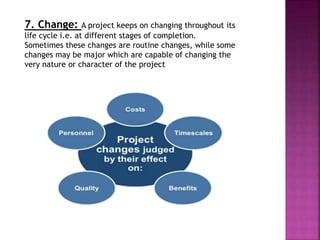
7. Change: A project keeps on changing throughout its
life cycle i.e. at different stages of completion.
Sometimes these changes are routine changes, while some
changes may be major which are capable of changing the
very nature or character of the project
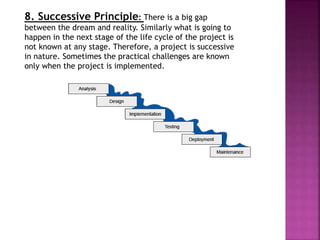
8. Successive Principle: There is a big gap
between the dream and reality. Similarly what is going to
happen in the next stage of the life cycle of the project is
not known at any stage. Therefore, a project is successive
in nature. Sometimes the practical challenges are known
only when the project is implemented.
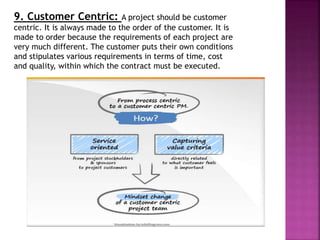
9. Customer Centric: A project should be customer
centric. It is always made to the order of the customer. It is
made to order because the requirements of each project are
very much different. The customer puts their own conditions
and stipulates various requirements in terms of time, cost
and quality, within which the contract must be executed.
10. Unity in Diversity: A project is a unique and a
complex set of incalculable varieties. These varieties may be in
terms of technology, material, equipment, machinery, human
resources, work culture and ethics etc. But in spite of
diversities, all activities of the project are interrelated and
coordinated in such a manner that it strives for the attainment
of common goal of the project.
11. Risk and Uncertainty: A certain degree of risk and
uncertainty associated with every project. The degree of risk
and uncertainty depends on how a project has been passed
through the various life cycle phases. A well defined project will
have the least degree of risk and uncertainty.
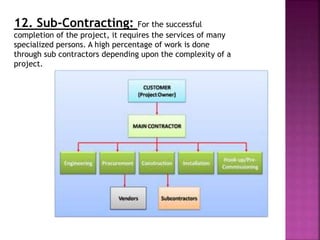
12. Sub-Contracting: For the successful
completion of the project, it requires the services of many
specialized persons. A high percentage of work is done
through sub contractors depending upon the complexity of a
project.
1.Rapidly changing technologies: Technologies are changing very
fast, so all manufacturing as well as service organizations have
to cope up with technological changes, which provide a big
scope for project management
2. High entropy of the system: Changes are very fast. So, energy
levels are high. To adapt to the fast changing world, no
organization can stick to old things or systems. Any modification or
modernization leads to the need of project.
3. Squeezed life cycle of products: Product life cycle is squeezed
to a great extent with innovations taking place at a very rapid
rate. Projects are needed for the upgradation of products
4. Globalization impact: All producers and service providers in
the present world are exposed globally. They need to modify
their system of operations to match the global practices, thus
creating opportunity forprojects.
5. Large organizations: They face problems of management of huge
workforce and work division, so they divide their work in projects
and create a team to accomplish the objectives in the form of
projects. This has also helped the organization to develop a
method for performance appraisal.
6. Customer focus: Increased customer focus has been a market
trend in recent times. A few years back, cost reduction was a
major formula of success for an enterprise. Thus, there was more
emphasis on standardization. In recent years, customer focus has
redirected market towards customization. Though it is not purely
customization, it is more of a combination of standardization and
customization. All this has led to the application of project
management.
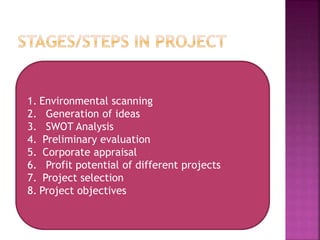
1. Environmental scanning
2. Generation of ideas
3. SWOT Analysis
4. Preliminary evaluation
5. Corporate appraisal
6. Profit potential of different projects
7. Project selection
8. Project objectives
The environmental scanning covers both scanning of
external environment as well as internal environment.
The scanning of external environment includes
identification of the opportunities and threats to the
organizations whereas internal environment include the
study of strengths and weaknesses of the organizations.
So environment is an aggregate of all conditions
whether external or internal that surrounds and affects
business. While scanning of business environment, an
entrepreneur should take into consideration the
different types of environment such as Economic
environment, Technological environment, Competitive
environment, Socio-demographic environment and
Governmental environment.
It is primarily concerned with the germination of project idea.
Entrepreneur may develop few ideas which he/she may think,
suit to the existing environment. The project idea may be
discovered from both internal and external resources.
SWOT Analysis means Strengths, Weaknesses, Opportunities,
and Threats. It is a method which enables the organization
to identify opportunities that can be profitably exploited by
it. SWOT analysis helps the entrepreneur in stimulating the
flow of ideas.
An entrepreneur may have many project ideas. So some sort
of preliminary evaluation is required to eliminate those
project ideas which are not feasible:
* The project idea should confirm to the government
regulatory framework. It should be compatible with the
national goals, priorities and policies of the government.
*There must be a sizeable market available to consume the
product made from the new project.
* The idea must be compatible with the interest,
personality and resources of the entrepreneur.
* In simple words it should be compatible with men, money,
material and market at the disposal of entrepreneur. In the
words of Murphy “A real opportunity has three
characteristics: (a) It fits the personality of the
entrepreneur-it squares with his abilities, training, and
proclivities, (b) It is accessible to him and (c) It offers him
the prospect of rapid growth and high return on invested
capital.
•The material needed for the project must be easily and
economically available. Because success of the project
depends upon availability of resources.
• Cost factor should be taken into consideration. The
entrepreneur must be in a position to realize an acceptable
profit level.
• Indian economy from the view point of entrepreneur is
still underdeveloped. It can absorb a lot more
entrepreneurs. So entering an already stagnant market will
not be a very good idea. So entrepreneur must analyze the
risk factor before entering into a market.
• Inherent risk in the project such as changes in demand,
technological changes, variation in business cycle, entry of
substitutes, and competition from imports should be
properly examined before starting a project.
After preliminary evaluation, corporate appraisal of project
should be conducted in order to make sure the availability of
raw material, equipment, selling and distribution costs and
customer behavior in relation to that project.
The important aspect to be considered in this respect is as
follows:
(a) Raw material availability: The entrepreneur should
ensure the availability of raw material. For this he should
investigate the sources of raw material, various suppliers of
raw material, inviting price quotation from suppliers, credit
period allowed by suppliers and terms and conditions of
supply of raw materials.
(b) Production, operations and equipment availability: Before
implementing the project, the entrepreneur should investigate the
availability of plant and equipment which is required for the production
of that product. To achieve this he must study the comparative features
of various manufacturers in terms of price, Guarantees and Warranties
after sale service, Technical and skilled staff requirement, operative
capacity, location and layout, cost structure, repair and maintenance of
equipment and condition of plant and machinery.
(c) Marketing and Research and Development: In this segment the
entrepreneur has to study the market share, product line, distribution
network, marketing and distribution cost, advertising and publicity
programme for the product, market practices such as credit policy,
product positioning, laboratories and testing facilities available, co-
ordination between research and operations.
(d) Financial and Human resources: They include financial
leverage, cost of capital, cash flows and liquidity, tax situation,
corporate stage, competence and loyalty of employees, state of
industrial relations and relation with shareholders and creditors.
(e) Consumer and Consumer behavior: The entrepreneur should
analyze the categories of consumers such as industrial, foreign and
retailer, comparative qualities of own product with competitive
products, purchasing power of consumer, consumption pattern,
consumer priorities and identification of customers needs.
Before entering a new venture a person must look into the profit
potential of that project and compare it with the other identified
projects. So in this step he needs to prioritize the list of projects,
taking some things kept into mind such as:
•Competition among existing firms
• Bargaining power of buyers and suppliers
• Existence of substitute products
• Threat of new entrants
• Divisional key performance indicators
•Time and ease to complete each projects
• Resources required for each project and
• Five year corporate plans and goals
After studying profit potential of each project and preparing
prioritization list, entrepreneur will come to know the overall
rating of the different project ideas. The project with
maximum rating will be the most feasible in comparison to
other projects. The process involved in selecting a project out
of some prospects is also described as “Zeroing in process”.
While selecting a project, the entrepreneur should keep in
mind about the Location, Technology, Size of investment,
Equipment, and Marketing of project.
Project objective starts where project identification ends.
Objectives are the foundations on which the project design
is built. Project objectives are concerned with defining in a
precise manner what the project is expected to achieve and
to provide a measure of performance for the project. The
essential requirements of project objectives are:
•It should be simple.
• It should be realistic and attainable.
• It should be specific.
• I t should be consistent with available resources.
•It should be consistent with organizational plan, policies
and procedures.
• It should be measurable, tangible and verifiable.
• So above are the various stages/steps in project
identification which can surely help an entrepreneur in
Identifying and selecting a right project suitable to his/her
capabilities and shills, resources and market needs.
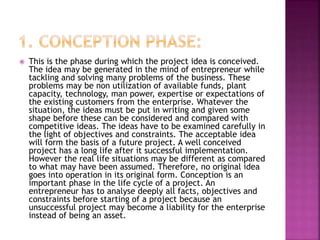
Each project has five stages from
start to end. These stages are:
1. Conception/identification Phase
2. Definition/formulation Phase
3. Planning and Organising Phase
4. Implementation Phase
5. Project Clean-up/Termination
Phase
 This is the phase during which the project idea is conceived.
The idea may be generated in the mind of entrepreneur while
tackling and solving many problems of the business. These
problems may be non utilization of available funds, plant
capacity, technology, man power, expertise or expectations of
the existing customers from the enterprise. Whatever the
situation, the ideas must be put in writing and given some
shape before these can be considered and compared with
competitive ideas. The ideas have to be examined carefully in
the light of objectives and constraints. The acceptable idea
will form the basis of a future project. A well conceived
project has a long life after it successful implementation.
However the real life situations may be different as compared
to what may have been assumed. Therefore, no original idea
goes into operation in its original form. Conception is an
important phase in the life cycle of a project. An
entrepreneur has to analyse deeply all facts, objectives and
constraints before starting of a project because an
unsuccessful project may become a liability for the enterprise
instead of being an asset.
 In the phase the idea generated during the conception phase is
developed. Facts relating to the idea are collected and presented. A
document is produced describing details of the project, necessary
information relating to customers or financial institutions to make up
their minds on the project idea. The following are the key areas to
be examined during this phase:
 Quality and quantity of raw materials
 Calculations as to the size or capacity of plant
 Location and the site of plant ∑ The technology to be employed
 Layout of project
 Layout of plant and machinery
 Civil engineering works
 Manpower requirements
 Financial requirements
 Schedule of implementation
 Further in-depth studies can also be asked for. If this phase is not
properly done, it will increase the risk content of the project. And
sometimes hasty decisions may prove disastrous for the project.
Therefore, a project is brought into existence only when its idea has
been properly conceived, analysed in the definition stage for its
successful implementation
 Although this phase starts after definition phase, but in practice it starts
with the conception of an idea. Planning, as it is often defined, is making
the decision in advance. If planning is not properly done, it may fatal the
objective of starting a project. During this phase the firm deals with the
action steps to convert its ideas into reality. Some organisations also
prepare Project “Execution Plan” for the successful implementation of
the project. The important aspects covers in the plan are:
 Project infrastructure and supporting services
 Scheduling and Budgeting
 Human Resource Planning
 Licensing and governmental clearances
 Financial Requirements
 Systems and procedure
 Identification of project manager
 Site preparation and investigation
 Construction resources and materials
 Work packaging
 Generally this phase is taken as part of the implementation phase
because this phase is not confined to documentation or merely paper
work but lot of other activities which are important for the project are
organised under this phase. Various aspects viz. marketing, technical,
financial, economic and ecological are analysed in detail.
 This is a very important phase of the project where
the people actually see the project first time.
Implementation phase for a project involves setting
up of manufacturing facilities. It consists of various
activities:
 Project and engineering design
 Negotiations and contracting
 Ordering of equipments
 Construction
 Training
 Plant Commissioning
 Testing and checking Implementation phase is a very
complex, time consuming and risky. It has a high need
for coordination and control.
 All techniques of project management are applied for
the successful implementation of the project.
 This is a transition phase in which projects actually
starts working. This phase is considered as clean-
up because the project personnel have to perform
clean up task like drawings, documents, files,
operation and maintenance manuals, catalogues
are given to the clients or the owners of the
project. To satisfy customers, clients and
contractors, the experts are to undertake many
test runs. The most important task during this
phase is to plan about retaining of certain
employees involved in the execution of the
project. All project personnel cannot be suddenly
asked to go. The first among the employees to
move are the design engineers. Most of them move
to new project sites because the same people will
never be required again at that site till a new
project comes and rest are retained at field for
residual engineering
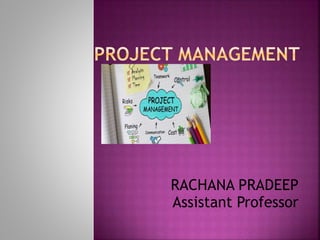
PROJECT MANAGEMENT

PROJECT MANAGEMENT

  • 1.
  • 2.
     UNIT 1:Project-Meaning, characteristics,importance,types, steps in identification of project, classification of projects, stages in project life cycle, identification, formulation and implementation
  • 3.
     The wordPROJECT comes from the Latin word PROJECTUM from the Latin verb PROICERE; which means “to throw something forwards” which in turn comes from PRO-, which denotes something that precedes the action of the next part of the word in time and ICERE, “to throw”. The word PROJECT thus actually originally meant “something that comes before anything else happens”.
  • 4.
     A projectin business and science is a temporary endeavor undertaken to create a unique product, service, or result. Basically, it is planned to achieve a particular aim. The aim of a project is to attain its objective and then terminate. Some of the reasons to start a project can be:  A customer request or market demand  An organizational need  A customer request  A technological advance  A legal requirement
  • 5.
     Projects andoperations differ primarily in that operations are ongoing and repetitive, while projects are temporary and unique. Generally, a project is a means of organizing some activities that cannot be addressed within the normal operational limits.  Some examples of a project are:  Developing a new product or service  Constructing a building or facility  Renovating the kitchen  Designing a new transportation vehicle  Acquiring a new or modified data system  Organizing a meeting  Implementing a new business process
  • 6.
     “A projectis a temporary Endeavour undertaken to create a unique product or service.”  - Institute of project Management  “A project is a specific, finite task to be accomplished, whether it is large or small scale and whether it is  long or short run is not particularly relevant.”  - Meredith and Camuel  “Project management is the process of achieving project objectives through the traditional  organizational structure and over the specialties of the individuals concerned. Project management is  applicable for any (unique, one time, one of a kind) undertaking concerned with a specify and  objectives”  - Professor Harold Kerzner
  • 8.
     1. Welldefined objectives: Every project must have well defined set of objectives. No project can be without set of objectives. Once these objectives are accomplished, the project ceases to exist. Needless to say that a project is deemed to be completed when the whole things are completed and performing satisfactorily..  FINANCIAL OBJECTIVES  QUALITY OBJECTIVES  TECHNICAL OBJECTIVES
  • 9.
    2. Life Spanof the Project: A project has a limited span of time. It cannot go on and forever. The life of the project may be a few days, a few months or a few years but it cannot continue endlessly. It has to come an end. Normally the accomplishment of given set of objectives represents the end of the project. Statue of unity-Megaproject
  • 10.
    3. Single Entity:A project is generally treated as one single entity. Instead of contributions from many different people, it can still be regarded as one whole thing. The activities may be performed by different people, but all activities are interrelated and are being performed to serve a common purpose. Cochin Airport-solar energy-Bosch ltd Blore.
  • 11.
    4. Team Work:A project is single entity and calls for team work. For the successful implementation of planning and strive towards achievement of common goal, the activities of different people are integrated and coordinated. Everyone should feel important and contribute towards the attainment of common goal. The spirit of oneness makes everyone feel important contributing to a big cause.
  • 12.
    5. Life Cycle:Every project has its own life cycle which starts from growing stage, maturity stage and declining stage. All the stages are closely linked with each other and provide the logical reasoning for the beginning of next stage. The declining stage provides the basis for the renewal of the project. The principal stages of the cycle are the identification of a project, its design, preparation and appraisal, its implementation and its evaluation.
  • 13.
    6. Uniqueness: Eachproject has its unique characteristics. It can be exactly similar with any other project even if the plants are exactly identical. The location of the project, its infrastructure, human resources and various other agencies make each project unique. ZOO’s on India
  • 14.
    7. Change: Aproject keeps on changing throughout its life cycle i.e. at different stages of completion. Sometimes these changes are routine changes, while some changes may be major which are capable of changing the very nature or character of the project
  • 15.
    8. Successive Principle:There is a big gap between the dream and reality. Similarly what is going to happen in the next stage of the life cycle of the project is not known at any stage. Therefore, a project is successive in nature. Sometimes the practical challenges are known only when the project is implemented.
  • 16.
    9. Customer Centric:A project should be customer centric. It is always made to the order of the customer. It is made to order because the requirements of each project are very much different. The customer puts their own conditions and stipulates various requirements in terms of time, cost and quality, within which the contract must be executed.
  • 17.
    10. Unity inDiversity: A project is a unique and a complex set of incalculable varieties. These varieties may be in terms of technology, material, equipment, machinery, human resources, work culture and ethics etc. But in spite of diversities, all activities of the project are interrelated and coordinated in such a manner that it strives for the attainment of common goal of the project. 11. Risk and Uncertainty: A certain degree of risk and uncertainty associated with every project. The degree of risk and uncertainty depends on how a project has been passed through the various life cycle phases. A well defined project will have the least degree of risk and uncertainty.
  • 18.
    12. Sub-Contracting: Forthe successful completion of the project, it requires the services of many specialized persons. A high percentage of work is done through sub contractors depending upon the complexity of a project.
  • 19.
    1.Rapidly changing technologies:Technologies are changing very fast, so all manufacturing as well as service organizations have to cope up with technological changes, which provide a big scope for project management 2. High entropy of the system: Changes are very fast. So, energy levels are high. To adapt to the fast changing world, no organization can stick to old things or systems. Any modification or modernization leads to the need of project. 3. Squeezed life cycle of products: Product life cycle is squeezed to a great extent with innovations taking place at a very rapid rate. Projects are needed for the upgradation of products
  • 20.
    4. Globalization impact:All producers and service providers in the present world are exposed globally. They need to modify their system of operations to match the global practices, thus creating opportunity forprojects. 5. Large organizations: They face problems of management of huge workforce and work division, so they divide their work in projects and create a team to accomplish the objectives in the form of projects. This has also helped the organization to develop a method for performance appraisal. 6. Customer focus: Increased customer focus has been a market trend in recent times. A few years back, cost reduction was a major formula of success for an enterprise. Thus, there was more emphasis on standardization. In recent years, customer focus has redirected market towards customization. Though it is not purely customization, it is more of a combination of standardization and customization. All this has led to the application of project management.
  • 21.
    1. Environmental scanning 2.Generation of ideas 3. SWOT Analysis 4. Preliminary evaluation 5. Corporate appraisal 6. Profit potential of different projects 7. Project selection 8. Project objectives
  • 22.
    The environmental scanningcovers both scanning of external environment as well as internal environment. The scanning of external environment includes identification of the opportunities and threats to the organizations whereas internal environment include the study of strengths and weaknesses of the organizations. So environment is an aggregate of all conditions whether external or internal that surrounds and affects business. While scanning of business environment, an entrepreneur should take into consideration the different types of environment such as Economic environment, Technological environment, Competitive environment, Socio-demographic environment and Governmental environment.
  • 23.
    It is primarilyconcerned with the germination of project idea. Entrepreneur may develop few ideas which he/she may think, suit to the existing environment. The project idea may be discovered from both internal and external resources.
  • 24.
    SWOT Analysis meansStrengths, Weaknesses, Opportunities, and Threats. It is a method which enables the organization to identify opportunities that can be profitably exploited by it. SWOT analysis helps the entrepreneur in stimulating the flow of ideas.
  • 25.
    An entrepreneur mayhave many project ideas. So some sort of preliminary evaluation is required to eliminate those project ideas which are not feasible: * The project idea should confirm to the government regulatory framework. It should be compatible with the national goals, priorities and policies of the government. *There must be a sizeable market available to consume the product made from the new project. * The idea must be compatible with the interest, personality and resources of the entrepreneur. * In simple words it should be compatible with men, money, material and market at the disposal of entrepreneur. In the words of Murphy “A real opportunity has three characteristics: (a) It fits the personality of the entrepreneur-it squares with his abilities, training, and proclivities, (b) It is accessible to him and (c) It offers him the prospect of rapid growth and high return on invested capital.
  • 26.
    •The material neededfor the project must be easily and economically available. Because success of the project depends upon availability of resources. • Cost factor should be taken into consideration. The entrepreneur must be in a position to realize an acceptable profit level. • Indian economy from the view point of entrepreneur is still underdeveloped. It can absorb a lot more entrepreneurs. So entering an already stagnant market will not be a very good idea. So entrepreneur must analyze the risk factor before entering into a market. • Inherent risk in the project such as changes in demand, technological changes, variation in business cycle, entry of substitutes, and competition from imports should be properly examined before starting a project.
  • 27.
    After preliminary evaluation,corporate appraisal of project should be conducted in order to make sure the availability of raw material, equipment, selling and distribution costs and customer behavior in relation to that project. The important aspect to be considered in this respect is as follows: (a) Raw material availability: The entrepreneur should ensure the availability of raw material. For this he should investigate the sources of raw material, various suppliers of raw material, inviting price quotation from suppliers, credit period allowed by suppliers and terms and conditions of supply of raw materials.
  • 28.
    (b) Production, operationsand equipment availability: Before implementing the project, the entrepreneur should investigate the availability of plant and equipment which is required for the production of that product. To achieve this he must study the comparative features of various manufacturers in terms of price, Guarantees and Warranties after sale service, Technical and skilled staff requirement, operative capacity, location and layout, cost structure, repair and maintenance of equipment and condition of plant and machinery. (c) Marketing and Research and Development: In this segment the entrepreneur has to study the market share, product line, distribution network, marketing and distribution cost, advertising and publicity programme for the product, market practices such as credit policy, product positioning, laboratories and testing facilities available, co- ordination between research and operations.
  • 29.
    (d) Financial andHuman resources: They include financial leverage, cost of capital, cash flows and liquidity, tax situation, corporate stage, competence and loyalty of employees, state of industrial relations and relation with shareholders and creditors. (e) Consumer and Consumer behavior: The entrepreneur should analyze the categories of consumers such as industrial, foreign and retailer, comparative qualities of own product with competitive products, purchasing power of consumer, consumption pattern, consumer priorities and identification of customers needs.
  • 30.
    Before entering anew venture a person must look into the profit potential of that project and compare it with the other identified projects. So in this step he needs to prioritize the list of projects, taking some things kept into mind such as: •Competition among existing firms • Bargaining power of buyers and suppliers • Existence of substitute products • Threat of new entrants • Divisional key performance indicators •Time and ease to complete each projects • Resources required for each project and • Five year corporate plans and goals
  • 31.
    After studying profitpotential of each project and preparing prioritization list, entrepreneur will come to know the overall rating of the different project ideas. The project with maximum rating will be the most feasible in comparison to other projects. The process involved in selecting a project out of some prospects is also described as “Zeroing in process”. While selecting a project, the entrepreneur should keep in mind about the Location, Technology, Size of investment, Equipment, and Marketing of project.
  • 32.
    Project objective startswhere project identification ends. Objectives are the foundations on which the project design is built. Project objectives are concerned with defining in a precise manner what the project is expected to achieve and to provide a measure of performance for the project. The essential requirements of project objectives are: •It should be simple. • It should be realistic and attainable. • It should be specific. • I t should be consistent with available resources. •It should be consistent with organizational plan, policies and procedures. • It should be measurable, tangible and verifiable. • So above are the various stages/steps in project identification which can surely help an entrepreneur in Identifying and selecting a right project suitable to his/her capabilities and shills, resources and market needs.
  • 33.
    Each project hasfive stages from start to end. These stages are: 1. Conception/identification Phase 2. Definition/formulation Phase 3. Planning and Organising Phase 4. Implementation Phase 5. Project Clean-up/Termination Phase
  • 35.
     This isthe phase during which the project idea is conceived. The idea may be generated in the mind of entrepreneur while tackling and solving many problems of the business. These problems may be non utilization of available funds, plant capacity, technology, man power, expertise or expectations of the existing customers from the enterprise. Whatever the situation, the ideas must be put in writing and given some shape before these can be considered and compared with competitive ideas. The ideas have to be examined carefully in the light of objectives and constraints. The acceptable idea will form the basis of a future project. A well conceived project has a long life after it successful implementation. However the real life situations may be different as compared to what may have been assumed. Therefore, no original idea goes into operation in its original form. Conception is an important phase in the life cycle of a project. An entrepreneur has to analyse deeply all facts, objectives and constraints before starting of a project because an unsuccessful project may become a liability for the enterprise instead of being an asset.
  • 36.
     In thephase the idea generated during the conception phase is developed. Facts relating to the idea are collected and presented. A document is produced describing details of the project, necessary information relating to customers or financial institutions to make up their minds on the project idea. The following are the key areas to be examined during this phase:  Quality and quantity of raw materials  Calculations as to the size or capacity of plant  Location and the site of plant ∑ The technology to be employed  Layout of project  Layout of plant and machinery  Civil engineering works  Manpower requirements  Financial requirements  Schedule of implementation  Further in-depth studies can also be asked for. If this phase is not properly done, it will increase the risk content of the project. And sometimes hasty decisions may prove disastrous for the project. Therefore, a project is brought into existence only when its idea has been properly conceived, analysed in the definition stage for its successful implementation
  • 37.
     Although thisphase starts after definition phase, but in practice it starts with the conception of an idea. Planning, as it is often defined, is making the decision in advance. If planning is not properly done, it may fatal the objective of starting a project. During this phase the firm deals with the action steps to convert its ideas into reality. Some organisations also prepare Project “Execution Plan” for the successful implementation of the project. The important aspects covers in the plan are:  Project infrastructure and supporting services  Scheduling and Budgeting  Human Resource Planning  Licensing and governmental clearances  Financial Requirements  Systems and procedure  Identification of project manager  Site preparation and investigation  Construction resources and materials  Work packaging  Generally this phase is taken as part of the implementation phase because this phase is not confined to documentation or merely paper work but lot of other activities which are important for the project are organised under this phase. Various aspects viz. marketing, technical, financial, economic and ecological are analysed in detail.
  • 38.
     This isa very important phase of the project where the people actually see the project first time. Implementation phase for a project involves setting up of manufacturing facilities. It consists of various activities:  Project and engineering design  Negotiations and contracting  Ordering of equipments  Construction  Training  Plant Commissioning  Testing and checking Implementation phase is a very complex, time consuming and risky. It has a high need for coordination and control.  All techniques of project management are applied for the successful implementation of the project.
  • 39.
     This isa transition phase in which projects actually starts working. This phase is considered as clean- up because the project personnel have to perform clean up task like drawings, documents, files, operation and maintenance manuals, catalogues are given to the clients or the owners of the project. To satisfy customers, clients and contractors, the experts are to undertake many test runs. The most important task during this phase is to plan about retaining of certain employees involved in the execution of the project. All project personnel cannot be suddenly asked to go. The first among the employees to move are the design engineers. Most of them move to new project sites because the same people will never be required again at that site till a new project comes and rest are retained at field for residual engineering