The Work Breakdown

     IT project management
Project Time Management
PMBOK®
   Activity definition
       Identifying what activities must be completed to produce the project scope deliverables
   Activity sequencing
       Determining whether activities can be completed sequentially or in parallel and any
        dependencies that may exist among them
   Activity resource estimation
       Identifying the type of resources (people, technology, facilities, etc.) and the quantity of
        resources needed to carry out project activities
   Activity duration estimation
       Estimating the time to complete each activity
   Schedule development
       Based on the availability of resources, the activities, their sequence, and time estimates, a
        schedule for the entire budget can be developed
   Schedule control
       Ensuring that proper processes and procedures are in place in order to control changes
        to the project schedule
Work Breakdown Structure (WBS)
   The WBS represents a logical decomposition of the work
    to be performed and focuses on how the product,
    service, or result is naturally subdivided. It is an outline of
    what work is to be performed
           PMBOK Guide® (17).
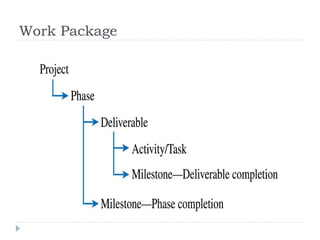
Work Package
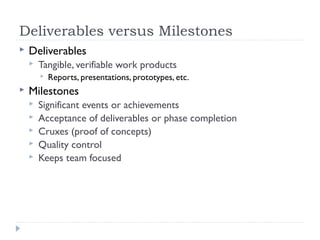
Deliverables versus Milestones
   Deliverables
       Tangible, verifiable work products
           Reports, presentations, prototypes, etc.
   Milestones
       Significant events or achievements
       Acceptance of deliverables or phase completion
       Cruxes (proof of concepts)
       Quality control
       Keeps team focused
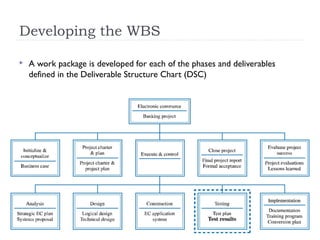
Developing the WBS

   A work package is developed for each of the phases and deliverables
    defined in the Deliverable Structure Chart (DSC)
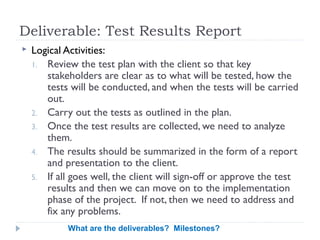
Deliverable: Test Results Report
   Logical Activities:
    1. Review the test plan with the client so that key
       stakeholders are clear as to what will be tested, how the
       tests will be conducted, and when the tests will be carried
       out.
    2. Carry out the tests as outlined in the plan.
    3. Once the test results are collected, we need to analyze
       them.
    4. The results should be summarized in the form of a report
       and presentation to the client.
    5. If all goes well, the client will sign-off or approve the test
       results and then we can move on to the implementation
       phase of the project. If not, then we need to address and
       fix any problems.
            What are the deliverables? Milestones?
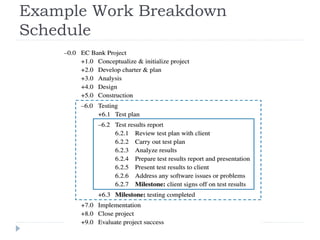
Example Work Breakdown
Schedule
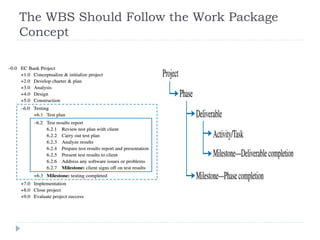
The WBS Should Follow the Work Package
Concept
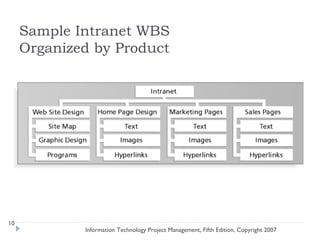
Sample Intranet WBS
     Organized by Product


10
             Information Technology Project Management, Fifth Edition, Copyright 2007
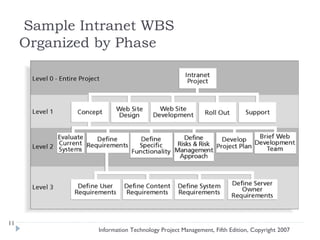
Sample Intranet WBS
     Organized by Phase


11
              Information Technology Project Management, Fifth Edition, Copyright 2007
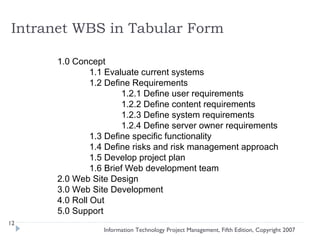
Intranet WBS in Tabular Form

      1.0 Concept
               1.1 Evaluate current systems
               1.2 Define Requirements
                        1.2.1 Define user requirements
                        1.2.2 Define content requirements
                        1.2.3 Define system requirements
                        1.2.4 Define server owner requirements
               1.3 Define specific functionality
               1.4 Define risks and risk management approach
               1.5 Develop project plan
               1.6 Brief Web development team
      2.0 Web Site Design
      3.0 Web Site Development
      4.0 Roll Out
      5.0 Support
12
                 Information Technology Project Management, Fifth Edition, Copyright 2007
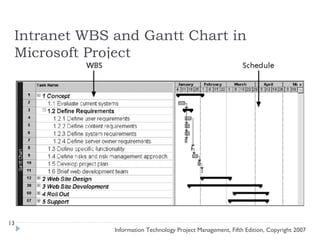
Intranet WBS and Gantt Chart in
 Microsoft Project


13
              Information Technology Project Management, Fifth Edition, Copyright 2007
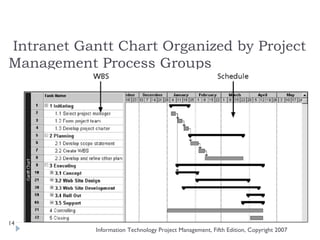
Intranet Gantt Chart Organized by Project
Management Process Groups


14
            Information Technology Project Management, Fifth Edition, Copyright 2007
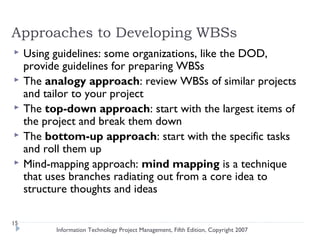
Approaches to Developing WBSs
    Using guidelines: some organizations, like the DOD,
     provide guidelines for preparing WBSs
    The analogy approach: review WBSs of similar projects
     and tailor to your project
    The top-down approach: start with the largest items of
     the project and break them down
    The bottom-up approach: start with the specific tasks
     and roll them up
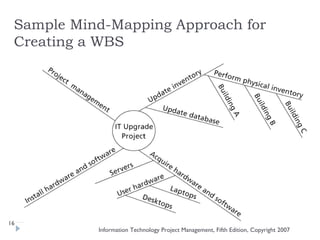
    Mind-mapping approach: mind mapping is a technique
     that uses branches radiating out from a core idea to
     structure thoughts and ideas

15
           Information Technology Project Management, Fifth Edition, Copyright 2007
Sample Mind-Mapping Approach for
 Creating a WBS


16
           Information Technology Project Management, Fifth Edition, Copyright 2007
The WBS…
   Should be “deliverable-oriented”
   Should support the project’s MOV
   Have enough detail to support planning and control
   Should involve those who will be doing the work
   Should include learning cycles and past lessons learned
Estimation Techniques - Traditional
Project Management Approaches
   Guesstimating
   Delphi Technique
   Time Boxing
   Top-Down
   Bottom-Up
   Analogous Estimates (Past experiences)
   Parametric Modeling (Statistical)
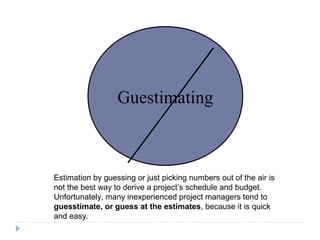
Guestimating


Estimation by guessing or just picking numbers out of the air is
not the best way to derive a project’s schedule and budget.
Unfortunately, many inexperienced project managers tend to
guesstimate, or guess at the estimates, because it is quick
and easy.
Delphi Technique
   Involves multiple, anonymous experts
   Each expert makes an estimate
   Estimates compared
       If close, can be averaged
       If not, do another iteration until consensus is reached
Time Boxing

               A “box” of time is allocated
                for a specific activity, task, or
                deliverable
               Can focus a team if used
                effectively
               Can demoralize a team if not
                used effectively
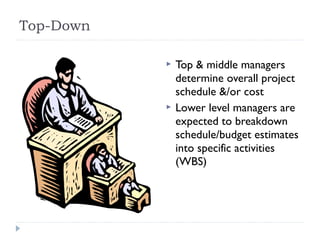
Top-Down

              Top & middle managers
               determine overall project
               schedule &/or cost
              Lower level managers are
               expected to breakdown
               schedule/budget estimates
               into specific activities
               (WBS)
Bottom-Up

   Schedules & budgets are
    constructed from WBS
   Starts with people who
    will be doing the work
   Schedules & budgets are
    the aggregate of detailed
    activities & costs
Analogous Estimates
   Similar to Top-Down approach
   Use information from previous, similar projects as a basis
    for estimation
Parametric Modeling
   Use project characteristics (parameters) in a
    mathematical model to estimate
   Example: $50/ LOC based on:
       Programming language
       Level of expertise
       Size & complexity
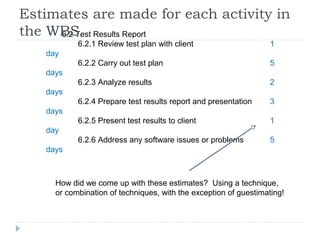
Estimates are made for each activity in
the WBS Results Report
     6.2 Test
           6.2.1 Review test plan with client                    1
   day
           6.2.2 Carry out test plan                             5
   days
           6.2.3 Analyze results                                 2
   days
           6.2.4 Prepare test results report and presentation    3
   days
           6.2.5 Present test results to client                  1
   day
           6.2.6 Address any software issues or problems         5
   days


     How did we come up with these estimates? Using a technique,
     or combination of techniques, with the exception of guestimating!
What can cause inaccurate estimates?

     Scope changes              No (or poor)
     Overlooked tasks            methodology
     Poor developer-user        Changes in team
      communication              Red tape
     Poor understanding         Lack of project control
      of project goals           Not identifying or
     Insufficient analysis       understanding impact of
                                  risks
Other Factors to Consider When Estimating
   Rate at which requirements may change
   Experience & capabilities of project team
   Process or methods used in development
   Specific activities to be performed
   Programming languages or development tools to be used
   Probable number of bugs or defects & removal methods
   Environment or ergonomics of work space
   Geographic separation of team across locations
   Schedule pressure placed on the team
How can estimates be improved?

                   Experience!
                       Lessons learned
                       Best Practices
                   Revision
                   Monitor
                   Focus on deliverables
                   Control

WBS PROJECT

  • 1.
    The Work Breakdown IT project management
  • 2.
    Project Time Management PMBOK®  Activity definition  Identifying what activities must be completed to produce the project scope deliverables  Activity sequencing  Determining whether activities can be completed sequentially or in parallel and any dependencies that may exist among them  Activity resource estimation  Identifying the type of resources (people, technology, facilities, etc.) and the quantity of resources needed to carry out project activities  Activity duration estimation  Estimating the time to complete each activity  Schedule development  Based on the availability of resources, the activities, their sequence, and time estimates, a schedule for the entire budget can be developed  Schedule control  Ensuring that proper processes and procedures are in place in order to control changes to the project schedule
  • 3.
    Work Breakdown Structure(WBS)  The WBS represents a logical decomposition of the work to be performed and focuses on how the product, service, or result is naturally subdivided. It is an outline of what work is to be performed  PMBOK Guide® (17).
  • 4.
  • 5.
    Deliverables versus Milestones  Deliverables  Tangible, verifiable work products  Reports, presentations, prototypes, etc.  Milestones  Significant events or achievements  Acceptance of deliverables or phase completion  Cruxes (proof of concepts)  Quality control  Keeps team focused
  • 6.
    Developing the WBS  A work package is developed for each of the phases and deliverables defined in the Deliverable Structure Chart (DSC)
  • 7.
    Deliverable: Test ResultsReport  Logical Activities: 1. Review the test plan with the client so that key stakeholders are clear as to what will be tested, how the tests will be conducted, and when the tests will be carried out. 2. Carry out the tests as outlined in the plan. 3. Once the test results are collected, we need to analyze them. 4. The results should be summarized in the form of a report and presentation to the client. 5. If all goes well, the client will sign-off or approve the test results and then we can move on to the implementation phase of the project. If not, then we need to address and fix any problems. What are the deliverables? Milestones?
  • 8.
  • 9.
    The WBS ShouldFollow the Work Package Concept
  • 10.
    Sample Intranet WBS Organized by Product 10 Information Technology Project Management, Fifth Edition, Copyright 2007
  • 11.
    Sample Intranet WBS Organized by Phase 11 Information Technology Project Management, Fifth Edition, Copyright 2007
  • 12.
    Intranet WBS inTabular Form 1.0 Concept 1.1 Evaluate current systems 1.2 Define Requirements 1.2.1 Define user requirements 1.2.2 Define content requirements 1.2.3 Define system requirements 1.2.4 Define server owner requirements 1.3 Define specific functionality 1.4 Define risks and risk management approach 1.5 Develop project plan 1.6 Brief Web development team 2.0 Web Site Design 3.0 Web Site Development 4.0 Roll Out 5.0 Support 12 Information Technology Project Management, Fifth Edition, Copyright 2007
  • 13.
    Intranet WBS andGantt Chart in Microsoft Project 13 Information Technology Project Management, Fifth Edition, Copyright 2007
  • 14.
    Intranet Gantt ChartOrganized by Project Management Process Groups 14 Information Technology Project Management, Fifth Edition, Copyright 2007
  • 15.
    Approaches to DevelopingWBSs  Using guidelines: some organizations, like the DOD, provide guidelines for preparing WBSs  The analogy approach: review WBSs of similar projects and tailor to your project  The top-down approach: start with the largest items of the project and break them down  The bottom-up approach: start with the specific tasks and roll them up  Mind-mapping approach: mind mapping is a technique that uses branches radiating out from a core idea to structure thoughts and ideas 15 Information Technology Project Management, Fifth Edition, Copyright 2007
  • 16.
    Sample Mind-Mapping Approachfor Creating a WBS 16 Information Technology Project Management, Fifth Edition, Copyright 2007
  • 17.
    The WBS…  Should be “deliverable-oriented”  Should support the project’s MOV  Have enough detail to support planning and control  Should involve those who will be doing the work  Should include learning cycles and past lessons learned
  • 18.
    Estimation Techniques -Traditional Project Management Approaches  Guesstimating  Delphi Technique  Time Boxing  Top-Down  Bottom-Up  Analogous Estimates (Past experiences)  Parametric Modeling (Statistical)
  • 19.
    Guestimating Estimation by guessingor just picking numbers out of the air is not the best way to derive a project’s schedule and budget. Unfortunately, many inexperienced project managers tend to guesstimate, or guess at the estimates, because it is quick and easy.
  • 20.
    Delphi Technique  Involves multiple, anonymous experts  Each expert makes an estimate  Estimates compared  If close, can be averaged  If not, do another iteration until consensus is reached
  • 21.
    Time Boxing  A “box” of time is allocated for a specific activity, task, or deliverable  Can focus a team if used effectively  Can demoralize a team if not used effectively
  • 22.
    Top-Down  Top & middle managers determine overall project schedule &/or cost  Lower level managers are expected to breakdown schedule/budget estimates into specific activities (WBS)
  • 23.
    Bottom-Up  Schedules & budgets are constructed from WBS  Starts with people who will be doing the work  Schedules & budgets are the aggregate of detailed activities & costs
  • 24.
    Analogous Estimates  Similar to Top-Down approach  Use information from previous, similar projects as a basis for estimation
  • 25.
    Parametric Modeling  Use project characteristics (parameters) in a mathematical model to estimate  Example: $50/ LOC based on:  Programming language  Level of expertise  Size & complexity
  • 26.
    Estimates are madefor each activity in the WBS Results Report 6.2 Test 6.2.1 Review test plan with client 1 day 6.2.2 Carry out test plan 5 days 6.2.3 Analyze results 2 days 6.2.4 Prepare test results report and presentation 3 days 6.2.5 Present test results to client 1 day 6.2.6 Address any software issues or problems 5 days How did we come up with these estimates? Using a technique, or combination of techniques, with the exception of guestimating!
  • 27.
    What can causeinaccurate estimates?  Scope changes  No (or poor)  Overlooked tasks methodology  Poor developer-user  Changes in team communication  Red tape  Poor understanding  Lack of project control of project goals  Not identifying or  Insufficient analysis understanding impact of risks
  • 28.
    Other Factors toConsider When Estimating  Rate at which requirements may change  Experience & capabilities of project team  Process or methods used in development  Specific activities to be performed  Programming languages or development tools to be used  Probable number of bugs or defects & removal methods  Environment or ergonomics of work space  Geographic separation of team across locations  Schedule pressure placed on the team
  • 29.
    How can estimatesbe improved?  Experience!  Lessons learned  Best Practices  Revision  Monitor  Focus on deliverables  Control