PROJECT
MANAGEMENT
1
Project Management Overview
• What is a project?
• What is project management?
• What is project success?
• What factors determine project success?
2
What is a Project?
3
What is a Project?
“A project is usually a one-time activity with a well-defined set of desired end
results…complex enough that the subtasks required careful coordination and
control in terms of timing, precedence, cost and performance.”
Project Management: A Managerial Approach
Jack R. Meredith and Samuel J. Mantel, Jr.
1995
The assignment of resources to accomplish specific results (deliverables) with a
well-defined schedule and budget.
Accenture (1999)
“something that is contemplated, devised, or planned; a plan; a scheme; an
undertaking”
The Macquarie Concise Dictionary
Third Edition (1998)
4
Project Characteristics
A Project…
 Has specific objectives
 Has a start and end date
 Has a budget
 Has an ‘owner’/’sponsor’
 Produces specific deliverables
 Can vary vastly in size, complexity and duration
 May be a phase within a larger project or a phase within a
program
5
What is an Operation?
6
Operations and Projects
• Operations and projects share many characteristics:
• Performed by people.
• Constrained by limited resources.
• Planned, executed, and controlled.
• Operations may include activities such as:
• Financial management and control
• Continuous manufacture
• Product distribution
• Projects may include activities such as:
• Developing a new product or service.
• Effecting a change in structure, staffing, or style of an organization.
• Developing or acquiring a new or modified information system.
7
Projects are Temporary
• Temporary means that every project has a definite beginning
and a definite end.
• The end is reached:
• When the project’s objectives have been achieved, or
• When it becomes clear that the project objectives will not or cannot
be met and the project is terminated.
• Temporary does not necessarily mean short in duration:
• many projects last for several years.
• The duration of a project is finite:
• projects are not ongoing efforts.
8
The Product of a Project is Unique
• A product or service may be unique even if the category it belongs to is large.
• For example, many thousands of office buildings have been
developed, but each individual facility is unique—different
owner, different design, different location, different
contractors, and so on.
• Because the product of each project is unique, the
characteristics that distinguish the product or service must be
progressively elaborated.
• Progressively means “proceeding in steps; continuing steadily
by increments”
• Elaborated means “worked out with care and detail; developed
thoroughly”
9
Comparative Overview
10
What is Project Management ?
11
What is Project Management?
• Project management is the application of knowledge,
skills, tools, and techniques to project activities in order to
meet or exceed stakeholder needs and expectations from a
project
• Meeting stakeholder needs and expectations involves
balancing competing demands among:
• Scope, time, cost, and quality.
• Stakeholders with differing needs and expectations.
• Identified requirements (needs) and unidentified requirements
• (expectations).
12
What is Project Success?
Factors in Project Success
• Project Management Philosophy
• Project Management Role and Responsibility
• Project Management Principles and Practices
14
Project Management Philosophy
• The “Golden Rule” of Project Management is three
words:
• Plan
• Organize
• Control
15
Project Management Roles and Responsibilities
• Project Execution
• Maintain Customer Relations
• Create a Positive Environment
16
• Project Execution Strategy
• Project Management
• Quality
• Safety
• Risk Management
• Design/Develop/Program
• Implementation
• Documentation
• Training
Project Execution Plan
Maintain Customer Relations
• Develop Communication
• Ensure Timely Participation
• Include the Customer on the
Project Team
• Develop Trust and Confidence
Safety
Maintain a positive and safe working environment
19
Project Management Principles and Practices
• Define Project Objectives
• Develop Project Execution Plan
• Define Baselines for Control
• Manage Risk
• Close out Effectively
20
Define S.M.A.R.T. Project Objectives
• S pecific
• M easurable
• A ssignable
• R ealistic
• T ime related
21
The Four Cornerstones of Project Management
Cost
Scope
Schedule
Quality
The Four Cornerstones of Project Management
Cost
Scope
Schedule
Quality
Scope
Poor scope definition is the major contributing factor
to cost overruns in the engineering and construction
industry.
CAUTION
24
Cost Influence Relative Time
Initial Scoping Effort
• Sets the baseline for cost and schedule
• Must involve the right people
• Must include implementation
• Identifies items not included
• Maximum influence on project cost
• Breaks project into manageable pieces
26
Drawings Estimate
Cost
Reports
Contracts
• Facility
• Services
Bill
of
MaterialsWBS Element/
Work Package
Schedule
The WBS
27
Successful Work Breakdown
• Status and completion is easily measured
• Definite beginning and end
• It is familiar with prior experience
• Manageable work assignments
• One continuous stream of work from start to finish
28
Steps for constructing a WBS
• Divide the project into major objectives
• Partition objectives into activities
• Divide activities with missing characteristics into
subactivities
• Repeat #3 until all subactivities have desired
characteristics
• Lowest subactivities are the basis of work
packages
29
The effect of “creeping scope” is
a major cause of cost overruns
Cost
Creeping scope
To manage creeping scope
• Keep scope documents current
• Freeze design after the estimate has been
approved
• Allow only those changes that are justified by
benefit
• Use an effective change management procedure
31
The Four Commandments of Good Project Scope
Written
Well defined
Clearly understood
Achievable
32
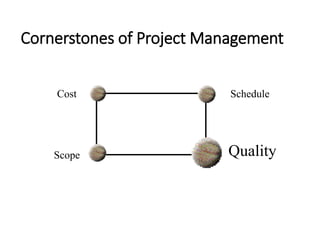
Cornerstones of Project Management
Cost
Scope
Schedule
Quality
Aspects of Cost
• Estimate Basis for Control
• Cost Control Application of control procedures
to follow financial progress
34
Estimate Requirements
• Define project cost integrate scope, schedule, and
resources
• Define estimate basis
• Identify potential risks
• Identify contingency/escalation
• Identify items not included
35
Elements of Cost Control
• Establish the baseline (estimate)
• Measure variation from baseline
• Take corrective action
36
Cost Control System
• Detailed project scope/work package
• Control estimate
• Chart of accounts
• Cost status report
• Forecasting process
• Change management procedure
• Cash flow forecast
37
Project Control
Project
Day 1
--------------
To do list:
Kick off meeting
Project schedule
Integration of Cost and Time
Basic Elements of the Control System
• A project plan: Scope, schedule, estimates
• A monitoring system which measures performance
against plan
• A reporting system which identifies deviations from
the plan
• A system which communicates deviations to the
right people
• Corrective actions
• Forecasting the project outcome
40
Key Control Philosophies
• Define the baseline for control
• Divide project into manageable pieces
• Remember: Ability to influence cost is maximum
early in the project
41
Key Control Philosophies
• Define and manage risk/opportunity
• Integrate scope and estimated cost into schedule
• Make informed decisions
• Anticipate deviations/changes
• Adopt the “end product” approach
• Plan ahead from phase to phase
42
Basic Project Control Steps
• Define the project scope
• Develop a project plan consistent with:
• project scope
• estimates (cost constraints)
• schedule (constraints
• resources available
• Report progress and compare with budget and forecast
• Control by taking corrective action
43
Cornerstones of Project Management
Cost
Scope
Schedule
Quality
Schedule
• Planning - Identification of the sequence of events
necessary to complete the project
• Scheduling - Determination of timing and
assembly of project activities to give overall
completion time
45
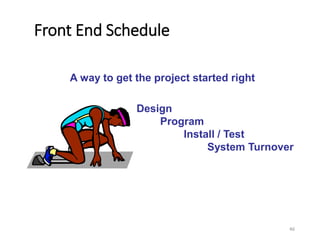
Front End Schedule
A way to get the project started right
Design
Program
Install / Test
System Turnover
46
Basis for Project Schedule
• Project objectives
• Project scope
• Project milestones
• Project estimate (budget)
• Resource availability
47
The Critical Path
• Identifies project priorities
• Shows activity relationships
• Enables schedule analysis
• Reflects project strategy
• Promotes teamwork
48
Cornerstones of Project Management
Cost
Scope
Schedule
Quality
Design
Basis
Continuous Improvement
Quality Assurance
Quality
Control
Total Project
Quality
Management
Total Project Quality Management
50
Project Quality Improvement
• Develop a quality management plan early in the
project
• Include representatives from all affected
organizational units on the project team
• Initiate the project effectively through kick-off and
alignment meetings
• Review performance and measure success
51
Project Quality Improvement
• Define scope and review periodically
• Limit scope changes
formal change procedure
require justification
• Complete more engineering up-front before defining
cost and scheduling
• Obtain constructability, operability and maintainability
input to design
52
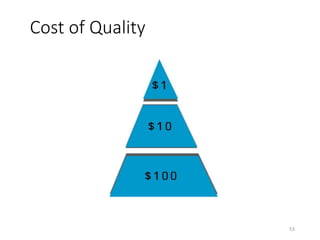
Cost of Quality
53
Risk Management
54
Manage Risk
• What is risk?
• Sources of risk
• Kinds of risk
• Risk Management Process
• Identify risks
• Define consequences
• Develop a mitigation plan
• Document
55
Sources of Risk
Technical
Financial
Socio-Economic
Contractual
56
Risk Management Process
Identify Risk
Analyze Risk
Respond to Risk
Document Risk
57
Sources of Help to Identify Risk
• Site investigations
• Contract documents
• Schedule
• Team brainstorming
• Body of experience
58
Risk Control Methods
• Avoid
• Reduce
• Share
• Insure
• Accept
• with contingency
• without contingency
• Contain
59
Risk Containment
• Clearly define insurance responsibilities in
contracts
• Use qualified personnel
• Document and communicate project
strategy
• Define roles and responsibilities
• Prepare contingency plans for critical
activities
• Use up-front team building
60
Risk Containment
• Use qualifies contractors and vendors
• Preconstruction work briefings
(especially safety)
• Rehearse critical activities or use
mock-ups
• Use strong project control systems
• Manage contingency
61
Project Close-out
Project Closeout - Major Phases
• Obtain client acceptance
• Document the project
• Conduct the post implementation audit
• Issue the final report
63
Plan the Work…
Work the Plan
Successful Project Management
64
Exercise - Plan a Project
65

Project Management

  • 1.
  • 2.
    Project Management Overview •What is a project? • What is project management? • What is project success? • What factors determine project success? 2
  • 3.
    What is aProject? 3
  • 4.
    What is aProject? “A project is usually a one-time activity with a well-defined set of desired end results…complex enough that the subtasks required careful coordination and control in terms of timing, precedence, cost and performance.” Project Management: A Managerial Approach Jack R. Meredith and Samuel J. Mantel, Jr. 1995 The assignment of resources to accomplish specific results (deliverables) with a well-defined schedule and budget. Accenture (1999) “something that is contemplated, devised, or planned; a plan; a scheme; an undertaking” The Macquarie Concise Dictionary Third Edition (1998) 4
  • 5.
    Project Characteristics A Project… Has specific objectives  Has a start and end date  Has a budget  Has an ‘owner’/’sponsor’  Produces specific deliverables  Can vary vastly in size, complexity and duration  May be a phase within a larger project or a phase within a program 5
  • 6.
    What is anOperation? 6
  • 7.
    Operations and Projects •Operations and projects share many characteristics: • Performed by people. • Constrained by limited resources. • Planned, executed, and controlled. • Operations may include activities such as: • Financial management and control • Continuous manufacture • Product distribution • Projects may include activities such as: • Developing a new product or service. • Effecting a change in structure, staffing, or style of an organization. • Developing or acquiring a new or modified information system. 7
  • 8.
    Projects are Temporary •Temporary means that every project has a definite beginning and a definite end. • The end is reached: • When the project’s objectives have been achieved, or • When it becomes clear that the project objectives will not or cannot be met and the project is terminated. • Temporary does not necessarily mean short in duration: • many projects last for several years. • The duration of a project is finite: • projects are not ongoing efforts. 8
  • 9.
    The Product ofa Project is Unique • A product or service may be unique even if the category it belongs to is large. • For example, many thousands of office buildings have been developed, but each individual facility is unique—different owner, different design, different location, different contractors, and so on. • Because the product of each project is unique, the characteristics that distinguish the product or service must be progressively elaborated. • Progressively means “proceeding in steps; continuing steadily by increments” • Elaborated means “worked out with care and detail; developed thoroughly” 9
  • 10.
  • 11.
    What is ProjectManagement ? 11
  • 12.
    What is ProjectManagement? • Project management is the application of knowledge, skills, tools, and techniques to project activities in order to meet or exceed stakeholder needs and expectations from a project • Meeting stakeholder needs and expectations involves balancing competing demands among: • Scope, time, cost, and quality. • Stakeholders with differing needs and expectations. • Identified requirements (needs) and unidentified requirements • (expectations). 12
  • 13.
  • 14.
    Factors in ProjectSuccess • Project Management Philosophy • Project Management Role and Responsibility • Project Management Principles and Practices 14
  • 15.
    Project Management Philosophy •The “Golden Rule” of Project Management is three words: • Plan • Organize • Control 15
  • 16.
    Project Management Rolesand Responsibilities • Project Execution • Maintain Customer Relations • Create a Positive Environment 16
  • 17.
    • Project ExecutionStrategy • Project Management • Quality • Safety • Risk Management • Design/Develop/Program • Implementation • Documentation • Training Project Execution Plan
  • 18.
    Maintain Customer Relations •Develop Communication • Ensure Timely Participation • Include the Customer on the Project Team • Develop Trust and Confidence
  • 19.
    Safety Maintain a positiveand safe working environment 19
  • 20.
    Project Management Principlesand Practices • Define Project Objectives • Develop Project Execution Plan • Define Baselines for Control • Manage Risk • Close out Effectively 20
  • 21.
    Define S.M.A.R.T. ProjectObjectives • S pecific • M easurable • A ssignable • R ealistic • T ime related 21
  • 22.
    The Four Cornerstonesof Project Management Cost Scope Schedule Quality
  • 23.
    The Four Cornerstonesof Project Management Cost Scope Schedule Quality
  • 24.
    Scope Poor scope definitionis the major contributing factor to cost overruns in the engineering and construction industry. CAUTION 24
  • 25.
  • 26.
    Initial Scoping Effort •Sets the baseline for cost and schedule • Must involve the right people • Must include implementation • Identifies items not included • Maximum influence on project cost • Breaks project into manageable pieces 26
  • 27.
    Drawings Estimate Cost Reports Contracts • Facility •Services Bill of MaterialsWBS Element/ Work Package Schedule The WBS 27
  • 28.
    Successful Work Breakdown •Status and completion is easily measured • Definite beginning and end • It is familiar with prior experience • Manageable work assignments • One continuous stream of work from start to finish 28
  • 29.
    Steps for constructinga WBS • Divide the project into major objectives • Partition objectives into activities • Divide activities with missing characteristics into subactivities • Repeat #3 until all subactivities have desired characteristics • Lowest subactivities are the basis of work packages 29
  • 30.
    The effect of“creeping scope” is a major cause of cost overruns Cost Creeping scope
  • 31.
    To manage creepingscope • Keep scope documents current • Freeze design after the estimate has been approved • Allow only those changes that are justified by benefit • Use an effective change management procedure 31
  • 32.
    The Four Commandmentsof Good Project Scope Written Well defined Clearly understood Achievable 32
  • 33.
    Cornerstones of ProjectManagement Cost Scope Schedule Quality
  • 34.
    Aspects of Cost •Estimate Basis for Control • Cost Control Application of control procedures to follow financial progress 34
  • 35.
    Estimate Requirements • Defineproject cost integrate scope, schedule, and resources • Define estimate basis • Identify potential risks • Identify contingency/escalation • Identify items not included 35
  • 36.
    Elements of CostControl • Establish the baseline (estimate) • Measure variation from baseline • Take corrective action 36
  • 37.
    Cost Control System •Detailed project scope/work package • Control estimate • Chart of accounts • Cost status report • Forecasting process • Change management procedure • Cash flow forecast 37
  • 38.
    Project Control Project Day 1 -------------- Todo list: Kick off meeting Project schedule
  • 39.
  • 40.
    Basic Elements ofthe Control System • A project plan: Scope, schedule, estimates • A monitoring system which measures performance against plan • A reporting system which identifies deviations from the plan • A system which communicates deviations to the right people • Corrective actions • Forecasting the project outcome 40
  • 41.
    Key Control Philosophies •Define the baseline for control • Divide project into manageable pieces • Remember: Ability to influence cost is maximum early in the project 41
  • 42.
    Key Control Philosophies •Define and manage risk/opportunity • Integrate scope and estimated cost into schedule • Make informed decisions • Anticipate deviations/changes • Adopt the “end product” approach • Plan ahead from phase to phase 42
  • 43.
    Basic Project ControlSteps • Define the project scope • Develop a project plan consistent with: • project scope • estimates (cost constraints) • schedule (constraints • resources available • Report progress and compare with budget and forecast • Control by taking corrective action 43
  • 44.
    Cornerstones of ProjectManagement Cost Scope Schedule Quality
  • 45.
    Schedule • Planning -Identification of the sequence of events necessary to complete the project • Scheduling - Determination of timing and assembly of project activities to give overall completion time 45
  • 46.
    Front End Schedule Away to get the project started right Design Program Install / Test System Turnover 46
  • 47.
    Basis for ProjectSchedule • Project objectives • Project scope • Project milestones • Project estimate (budget) • Resource availability 47
  • 48.
    The Critical Path •Identifies project priorities • Shows activity relationships • Enables schedule analysis • Reflects project strategy • Promotes teamwork 48
  • 49.
    Cornerstones of ProjectManagement Cost Scope Schedule Quality
  • 50.
    Design Basis Continuous Improvement Quality Assurance Quality Control TotalProject Quality Management Total Project Quality Management 50
  • 51.
    Project Quality Improvement •Develop a quality management plan early in the project • Include representatives from all affected organizational units on the project team • Initiate the project effectively through kick-off and alignment meetings • Review performance and measure success 51
  • 52.
    Project Quality Improvement •Define scope and review periodically • Limit scope changes formal change procedure require justification • Complete more engineering up-front before defining cost and scheduling • Obtain constructability, operability and maintainability input to design 52
  • 53.
  • 54.
  • 55.
    Manage Risk • Whatis risk? • Sources of risk • Kinds of risk • Risk Management Process • Identify risks • Define consequences • Develop a mitigation plan • Document 55
  • 56.
  • 57.
    Risk Management Process IdentifyRisk Analyze Risk Respond to Risk Document Risk 57
  • 58.
    Sources of Helpto Identify Risk • Site investigations • Contract documents • Schedule • Team brainstorming • Body of experience 58
  • 59.
    Risk Control Methods •Avoid • Reduce • Share • Insure • Accept • with contingency • without contingency • Contain 59
  • 60.
    Risk Containment • Clearlydefine insurance responsibilities in contracts • Use qualified personnel • Document and communicate project strategy • Define roles and responsibilities • Prepare contingency plans for critical activities • Use up-front team building 60
  • 61.
    Risk Containment • Usequalifies contractors and vendors • Preconstruction work briefings (especially safety) • Rehearse critical activities or use mock-ups • Use strong project control systems • Manage contingency 61
  • 62.
  • 63.
    Project Closeout -Major Phases • Obtain client acceptance • Document the project • Conduct the post implementation audit • Issue the final report 63
  • 64.
    Plan the Work… Workthe Plan Successful Project Management 64
  • 65.
    Exercise - Plana Project 65