PROJECT MANAGEMENT
CONCEPTS
Presented by :
Najam ul Hassan
OBJECTIVES
• Create awareness of the concepts of Project
Management and its importance
• Understand the various tools available to a
Project Manager to perform his duties
effectively
• Highlight the areas of the application of these
concepts during the execution of projects
Importance of Project Management
• Getting things done in the correct manner
• Planned and prioritized work distribution and
accomplishment
• Identification of key process bottlenecks and
suggested preventive actions
• Project management process improvement
• Improved risk management
• Standardized reports, templates, processes
and lexicon
What is a Project ?
What is a Project ?
 Has a defined objective
 Has a deadline
 Requires integration of
knowledge and experience
from various organizations
When task(s),
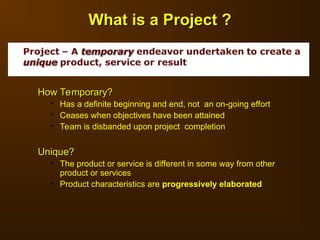
How Temporary?
How Temporary?
 Has a definite beginning and end, not an on-going effort
 Ceases when objectives have been attained
 Team is disbanded upon project completion
Unique?
Unique?
 The product or service is different in some way from other
product or services
 Product characteristics are progressively elaborated
What is a Project ?
What is a Project ?
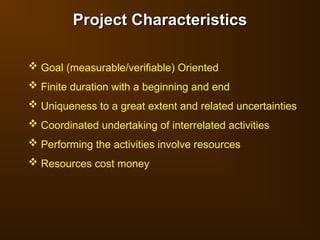
Project Characteristics
 Goal (measurable/verifiable) Oriented
 Finite duration with a beginning and end
 Uniqueness to a great extent and related uncertainties
 Coordinated undertaking of interrelated activities
 Performing the activities involve resources
 Resources cost money
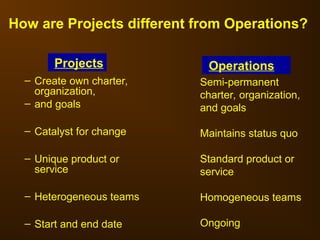
How are Projects different from Operations?
– Create own charter,
organization,
– and goals
– Catalyst for change
– Unique product or
service
– Heterogeneous teams
– Start and end date
Semi-permanent
charter, organization,
and goals
Maintains status quo
Standard product or
service
Homogeneous teams
Ongoing
Projects Operations
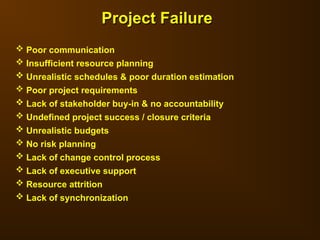
 Poor communication
 Insufficient resource planning
 Unrealistic schedules & poor duration estimation
 Poor project requirements
 Lack of stakeholder buy-in & no accountability
 Undefined project success / closure criteria
 Unrealistic budgets
 No risk planning
 Lack of change control process
 Lack of executive support
 Resource attrition
 Lack of synchronization
Project Failure
Project Failure
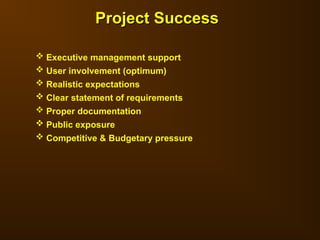
 Executive management support
 User involvement (optimum)
 Realistic expectations
 Clear statement of requirements
 Proper documentation
 Public exposure
 Competitive & Budgetary pressure
Project Success
Project Success
Project Life Cycle
Project Life Cycle
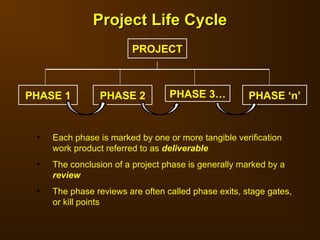
• Each phase is marked by one or more tangible verification
work product referred to as deliverable
• The conclusion of a project phase is generally marked by a
review
• The phase reviews are often called phase exits, stage gates,
or kill points
PROJECT
PHASE 1 PHASE 2 PHASE 3… PHASE ‘n’
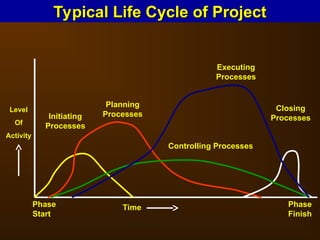
Level
Of
Activity
Initiating
Processes
Planning
Processes
Executing
Processes
Closing
Processes
Controlling Processes
Phase
Finish
Phase
Start
Time
Typical Life Cycle of Project
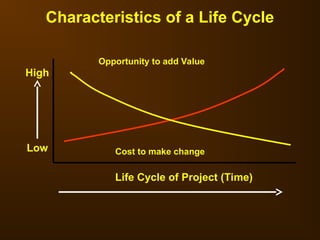
Life Cycle of Project (Time)
High
Low Cost to make change
Opportunity to add Value
Characteristics of a Life Cycle
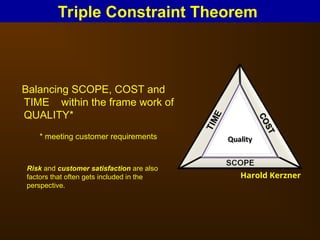
Balancing SCOPE, COST and
TIME within the frame work of
QUALITY*
* meeting customer requirements
Harold Kerzner
Risk and customer satisfaction are also
factors that often gets included in the
perspective.
Triple Constraint Theorem
The application of knowledge, skills, tools, and techniques
to project activities in order to meet or exceed
stakeholder needs and expectations
Project Management
Project Management
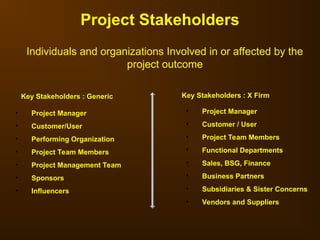
• Project Manager
• Customer/User
• Performing Organization
• Project Team Members
• Project Management Team
• Sponsors
• Influencers
Key Stakeholders : Generic
• Project Manager
• Customer / User
• Project Team Members
• Functional Departments
• Sales, BSG, Finance
• Business Partners
• Subsidiaries & Sister Concerns
• Vendors and Suppliers
Key Stakeholders : X Firm
Project Stakeholders
Individuals and organizations Involved in or affected by the
project outcome
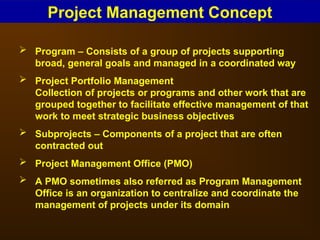
 Program – Consists of a group of projects supporting
broad, general goals and managed in a coordinated way
 Project Portfolio Management
Collection of projects or programs and other work that are
grouped together to facilitate effective management of that
work to meet strategic business objectives
 Subprojects – Components of a project that are often
contracted out
 Project Management Office (PMO)
 A PMO sometimes also referred as Program Management
Office is an organization to centralize and coordinate the
management of projects under its domain
Project Management Concept
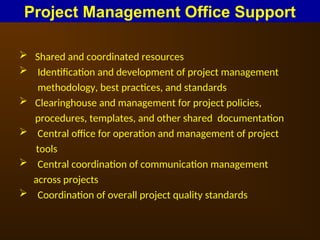
 Shared and coordinated resources
 Identification and development of project management
methodology, best practices, and standards
 Clearinghouse and management for project policies,
procedures, templates, and other shared documentation
 Central office for operation and management of project
tools
 Central coordination of communication management
across projects
 Coordination of overall project quality standards
Project Management Office Support
Project Management Philosophy
The “Golden Rule” of Project Management is three
words:
-Plan
-Organize
-Control
Project Initiation
Project Initiation
Project Initiation
 Conduct Project Selection Methods
 Define Scope
 Document Project Risks, Assumptions, and
Constraints
 Identify and Perform Stakeholder Analysis
 Develop Project Charter
 Obtain Project Charter Approval
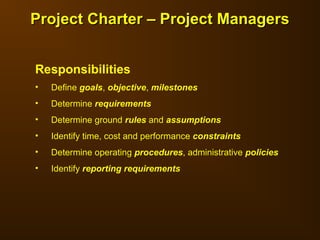
Responsibilities
• Define goals, objective, milestones
• Determine requirements
• Determine ground rules and assumptions
• Identify time, cost and performance constraints
• Determine operating procedures, administrative policies
• Identify reporting requirements
Project Charter – Project Managers
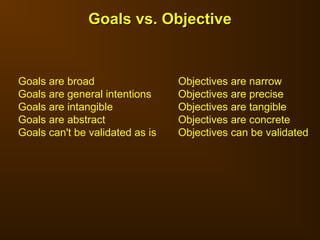
Goals vs. Objective
Goals vs. Objective
Goals are broad Objectives are narrow
Goals are general intentions Objectives are precise
Goals are intangible Objectives are tangible
Goals are abstract Objectives are concrete
Goals can't be validated as is Objectives can be validated
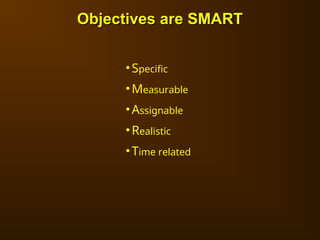
Objectives are SMART
•Specific
•Measurable
•Assignable
•Realistic
•Time related
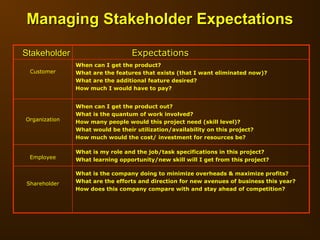
Expectations
Expectations
Stakeholder
Stakeholder
Shareholder
Employee
What is my role and the job/task specifications in this project?
What learning opportunity/new skill will I get from this project?
Organization
When can I get the product out?
What is the quantum of work involved?
How many people would this project need (skill level)?
What would be their utilization/availability on this project?
How much would the cost/ investment for resources be?
When can I get the product?
What are the features that exists (that I want eliminated now)?
What are the additional feature desired?
How much I would have to pay?
Customer
What is the company doing to minimize overheads & maximize profits?
What are the efforts and direction for new avenues of business this year?
How does this company compare with and stay ahead of competition?
Managing Stakeholder Expectations
Project Planning
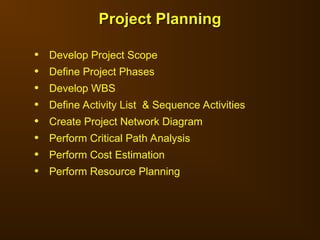
• Develop Project Scope
• Define Project Phases
• Develop WBS
• Define Activity List & Sequence Activities
• Create Project Network Diagram
• Perform Critical Path Analysis
• Perform Cost Estimation
• Perform Resource Planning
Project Planning
Project Planning
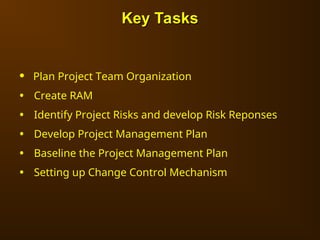
• Plan Project Team Organization
• Create RAM
• Identify Project Risks and develop Risk Reponses
• Develop Project Management Plan
• Baseline the Project Management Plan
• Setting up Change Control Mechanism
Key Tasks
Key Tasks
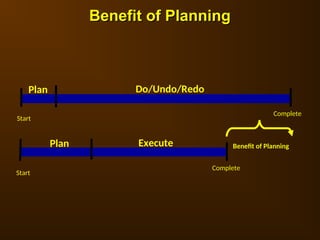
Plan Do/Undo/Redo
Start
Complete
Plan Execute
Start
Complete
Benefit of Planning
Benefit of Planning
Benefit of Planning
Project Scope
Project Scope
What is the WORK we are supposed to do to
deliver the final service / product to the
customer?
Product Scope
Product Scope
The features and functionalities that categorize
a product or service
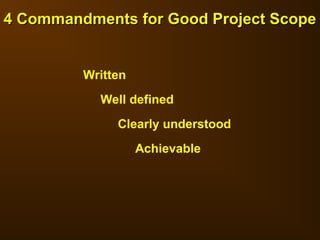
4 Commandments for Good Project Scope
Written
Well defined
Clearly understood
Achievable
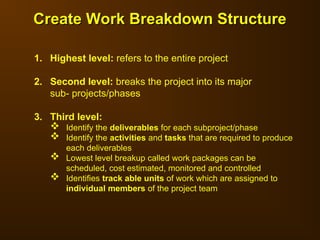
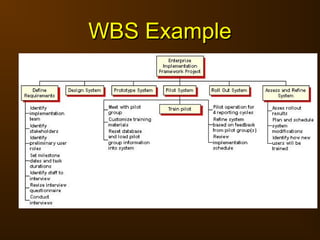
1. Highest level: refers to the entire project
2. Second level: breaks the project into its major
sub- projects/phases
3. Third level:
 Identify the deliverables for each subproject/phase
 Identify the activities and tasks that are required to produce
each deliverables
 Lowest level breakup called work packages can be
scheduled, cost estimated, monitored and controlled
 Identifies track able units of work which are assigned to
individual members of the project team
Create Work Breakdown Structure
WBS Example
WBS Example
Schedule Management
Schedule Management
 Create the Activity List
 State the Activity Relationships
 State the Resource Requirements
 Estimate the Activity Duration
 Create Project Schedule
Prepare Network Diagram
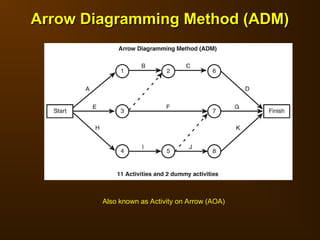
Project schedule network diagrams are schematic displays
of the project’s schedule activities and the logical
relationships among them, also referred to as
dependencies.
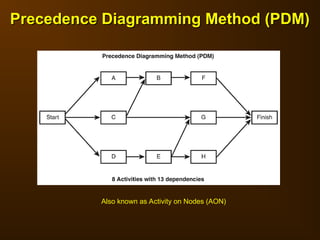
Precedence Diagramming Method (PDM)
Also known as Activity on Nodes (AON)
Arrow Diagramming Method (ADM)
Also known as Activity on Arrow (AOA)
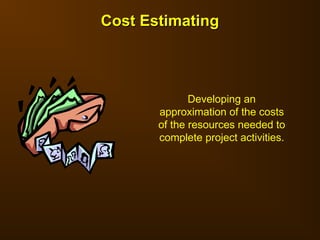
Developing an
approximation of the costs
of the resources needed to
complete project activities.
Cost Estimating
Cost Estimating
Analogous estimating
Bottom Up Estimating
Parametric Estimating
Cost Estimating
Cost Estimating
Customer Relations
 Develop Communication
 Ensure Timely Participation
 Include the Customer on the
Project Team
 Develop Trust and Confidence
Team Requirements
Team Requirements
•Skills needed ?
•Individuals identified ?
•When are they needed ?
•Where are they ?
•Training needed ?
•Interpersonal compatibility ?
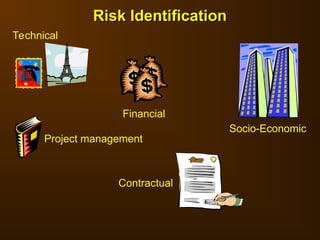
Risk Identification
Risk Identification
Financial
Socio-Economic
Contractual
Project management
Technical
Risk Response Plan
Risk Response Plan
 Avoid
 Mitigate
 Transfer
 Accept
 with contingency
 without contingency
 Share
 Enhance
 Exploit
Project Management Plan
 Project scope management plan
 Schedule management plan
 Staffing management plan
 Communication management plan
 Risk management plan
 Procurement management plan
 Milestone list
 Resource calendar
 Schedule baseline
 Cost baseline
 Risk register
Project Execution
Project Execution process
requires the project manager
and the project team to perform
multiple actions to execute the
project management plan to
accomplish the work defined in
the project scope statement.
Project Execution
Project Execution
 Expend effort and spend funds to accomplish the project objectives
 Staff, train, and manage the project team members assigned to the
project
 Obtain quotations, bids, offers, or proposals as appropriate
 Select sellers by choosing from among potential sellers
 Obtain, manage, and use resources including materials, tools,
equipment, and facilities
 Implement the planned methods and standards
Project Execution -
Project Execution -
Major Activities
Major Activities
• Create, control, verify, and validate project deliverables
• Manage sellers
• Adapt approved changes into the project’s scope, plans, and
environment
• Establish and manage project communication channels, both external
and internal to the project team
• Collect project data and report cost, schedule, technical and quality
progress, and status information to facilitate forecasting
• Collect and document lessons learned, and implement approved
process improvement activities
Project Execution -
Project Execution -
Major Activities (Cont)
Project Controlling
The Monitor and Control Project Work process is
performed to monitor project processes
associated with initiating, planning, executing,
and closing.
Project Controlling
Project Controlling
• Data Collection & Status Reporting
• Project Monitoring & Tracking
• Earned Value Analysis
• Variance Analysis
Project Controlling
Project Controlling
 Provides clear indication of progress
 Keeps everyone informed
 Encourages the addressing of problems
 Provides credible completion estimates
Benefits of Tracking the Project
Basic Elements of Control System
 A project plan: Scope, schedule, estimates
 A monitoring system which measures performance against
plan
 A reporting system which identifies deviations from the plan
 A system which communicates deviations to the right people
 Corrective actions
 Forecasting the project outcome
Elements of Schedule Control
 Establish the baseline (estimate)
Measure variation from baseline
Take corrective action
4 Key Questions to be asked
 Did the task start?
 If yes, on what date?
 What date will the task finish?
 If finished, on what date did it finish?
Schedule Tracking
Schedule Tracking
Project Closure
The Close Project process involves
performing the project closure portion of
the project management plan
Project Closure
Project Closure
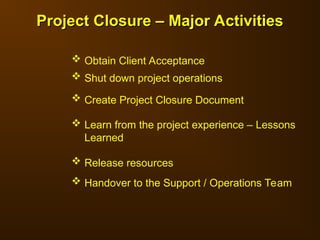
 Obtain Client Acceptance
 Shut down project operations
 Create Project Closure Document
 Learn from the project experience – Lessons
Learned
 Release resources
 Handover to the Support / Operations Team
Project Closure – Major Activities
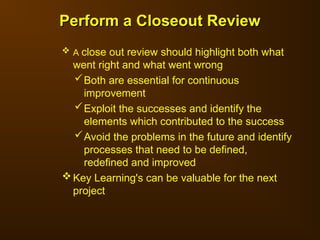
 A close out review should highlight both what
went right and what went wrong
Both are essential for continuous
improvement
Exploit the successes and identify the
elements which contributed to the success
Avoid the problems in the future and identify
processes that need to be defined,
redefined and improved
Key Learning's can be valuable for the next
project
Perform a Closeout Review
 Less overall project cost
 Timely project completion
 Effective use of resources
 Improved risk management
 Identification of key process bottlenecks and
suggested preventive actions
 Higher quality of the final product
 Standardized reports, templates, processes and
lexicon
Project Management - Getting Things
Done
Done
Thank you

Project management ALL ABOUT PROJECTS AND HIS

  • 1.
  • 2.
    OBJECTIVES • Create awarenessof the concepts of Project Management and its importance • Understand the various tools available to a Project Manager to perform his duties effectively • Highlight the areas of the application of these concepts during the execution of projects
  • 3.
    Importance of ProjectManagement • Getting things done in the correct manner • Planned and prioritized work distribution and accomplishment • Identification of key process bottlenecks and suggested preventive actions • Project management process improvement • Improved risk management • Standardized reports, templates, processes and lexicon
  • 4.
    What is aProject ? What is a Project ?  Has a defined objective  Has a deadline  Requires integration of knowledge and experience from various organizations When task(s),
  • 5.
    How Temporary? How Temporary? Has a definite beginning and end, not an on-going effort  Ceases when objectives have been attained  Team is disbanded upon project completion Unique? Unique?  The product or service is different in some way from other product or services  Product characteristics are progressively elaborated What is a Project ? What is a Project ?
  • 6.
    Project Characteristics Project Characteristics Goal (measurable/verifiable) Oriented  Finite duration with a beginning and end  Uniqueness to a great extent and related uncertainties  Coordinated undertaking of interrelated activities  Performing the activities involve resources  Resources cost money
  • 7.
    How are Projectsdifferent from Operations? – Create own charter, organization, – and goals – Catalyst for change – Unique product or service – Heterogeneous teams – Start and end date Semi-permanent charter, organization, and goals Maintains status quo Standard product or service Homogeneous teams Ongoing Projects Operations
  • 8.
     Poor communication Insufficient resource planning  Unrealistic schedules & poor duration estimation  Poor project requirements  Lack of stakeholder buy-in & no accountability  Undefined project success / closure criteria  Unrealistic budgets  No risk planning  Lack of change control process  Lack of executive support  Resource attrition  Lack of synchronization Project Failure Project Failure
  • 9.
     Executive managementsupport  User involvement (optimum)  Realistic expectations  Clear statement of requirements  Proper documentation  Public exposure  Competitive & Budgetary pressure Project Success Project Success
  • 10.
    Project Life Cycle ProjectLife Cycle • Each phase is marked by one or more tangible verification work product referred to as deliverable • The conclusion of a project phase is generally marked by a review • The phase reviews are often called phase exits, stage gates, or kill points PROJECT PHASE 1 PHASE 2 PHASE 3… PHASE ‘n’
  • 11.
  • 12.
    Life Cycle ofProject (Time) High Low Cost to make change Opportunity to add Value Characteristics of a Life Cycle
  • 13.
    Balancing SCOPE, COSTand TIME within the frame work of QUALITY* * meeting customer requirements Harold Kerzner Risk and customer satisfaction are also factors that often gets included in the perspective. Triple Constraint Theorem
  • 14.
    The application ofknowledge, skills, tools, and techniques to project activities in order to meet or exceed stakeholder needs and expectations Project Management Project Management
  • 15.
    • Project Manager •Customer/User • Performing Organization • Project Team Members • Project Management Team • Sponsors • Influencers Key Stakeholders : Generic • Project Manager • Customer / User • Project Team Members • Functional Departments • Sales, BSG, Finance • Business Partners • Subsidiaries & Sister Concerns • Vendors and Suppliers Key Stakeholders : X Firm Project Stakeholders Individuals and organizations Involved in or affected by the project outcome
  • 16.
     Program –Consists of a group of projects supporting broad, general goals and managed in a coordinated way  Project Portfolio Management Collection of projects or programs and other work that are grouped together to facilitate effective management of that work to meet strategic business objectives  Subprojects – Components of a project that are often contracted out  Project Management Office (PMO)  A PMO sometimes also referred as Program Management Office is an organization to centralize and coordinate the management of projects under its domain Project Management Concept
  • 17.
     Shared andcoordinated resources  Identification and development of project management methodology, best practices, and standards  Clearinghouse and management for project policies, procedures, templates, and other shared documentation  Central office for operation and management of project tools  Central coordination of communication management across projects  Coordination of overall project quality standards Project Management Office Support
  • 18.
    Project Management Philosophy ProjectManagement Philosophy The “Golden Rule” of Project Management is three words: -Plan -Organize -Control
  • 19.
  • 20.
    Project Initiation Project Initiation Conduct Project Selection Methods  Define Scope  Document Project Risks, Assumptions, and Constraints  Identify and Perform Stakeholder Analysis  Develop Project Charter  Obtain Project Charter Approval
  • 21.
    Responsibilities • Define goals,objective, milestones • Determine requirements • Determine ground rules and assumptions • Identify time, cost and performance constraints • Determine operating procedures, administrative policies • Identify reporting requirements Project Charter – Project Managers Project Charter – Project Managers
  • 22.
    Goals vs. Objective Goalsvs. Objective Goals are broad Objectives are narrow Goals are general intentions Objectives are precise Goals are intangible Objectives are tangible Goals are abstract Objectives are concrete Goals can't be validated as is Objectives can be validated
  • 23.
    Objectives are SMART Objectivesare SMART •Specific •Measurable •Assignable •Realistic •Time related
  • 24.
    Expectations Expectations Stakeholder Stakeholder Shareholder Employee What is myrole and the job/task specifications in this project? What learning opportunity/new skill will I get from this project? Organization When can I get the product out? What is the quantum of work involved? How many people would this project need (skill level)? What would be their utilization/availability on this project? How much would the cost/ investment for resources be? When can I get the product? What are the features that exists (that I want eliminated now)? What are the additional feature desired? How much I would have to pay? Customer What is the company doing to minimize overheads & maximize profits? What are the efforts and direction for new avenues of business this year? How does this company compare with and stay ahead of competition? Managing Stakeholder Expectations Managing Stakeholder Expectations
  • 25.
  • 26.
    • Develop ProjectScope • Define Project Phases • Develop WBS • Define Activity List & Sequence Activities • Create Project Network Diagram • Perform Critical Path Analysis • Perform Cost Estimation • Perform Resource Planning Project Planning Project Planning
  • 27.
    • Plan ProjectTeam Organization • Create RAM • Identify Project Risks and develop Risk Reponses • Develop Project Management Plan • Baseline the Project Management Plan • Setting up Change Control Mechanism Key Tasks Key Tasks
  • 28.
    Plan Do/Undo/Redo Start Complete Plan Execute Start Complete Benefitof Planning Benefit of Planning Benefit of Planning
  • 29.
    Project Scope Project Scope Whatis the WORK we are supposed to do to deliver the final service / product to the customer?
  • 30.
    Product Scope Product Scope Thefeatures and functionalities that categorize a product or service
  • 31.
    4 Commandments forGood Project Scope 4 Commandments for Good Project Scope Written Well defined Clearly understood Achievable
  • 32.
    1. Highest level:refers to the entire project 2. Second level: breaks the project into its major sub- projects/phases 3. Third level:  Identify the deliverables for each subproject/phase  Identify the activities and tasks that are required to produce each deliverables  Lowest level breakup called work packages can be scheduled, cost estimated, monitored and controlled  Identifies track able units of work which are assigned to individual members of the project team Create Work Breakdown Structure Create Work Breakdown Structure
  • 33.
  • 34.
    Schedule Management Schedule Management Create the Activity List  State the Activity Relationships  State the Resource Requirements  Estimate the Activity Duration  Create Project Schedule
  • 35.
    Prepare Network Diagram PrepareNetwork Diagram Project schedule network diagrams are schematic displays of the project’s schedule activities and the logical relationships among them, also referred to as dependencies.
  • 36.
    Precedence Diagramming Method(PDM) Precedence Diagramming Method (PDM) Also known as Activity on Nodes (AON)
  • 37.
    Arrow Diagramming Method(ADM) Arrow Diagramming Method (ADM) Also known as Activity on Arrow (AOA)
  • 38.
    Developing an approximation ofthe costs of the resources needed to complete project activities. Cost Estimating Cost Estimating
  • 39.
    Analogous estimating Bottom UpEstimating Parametric Estimating Cost Estimating Cost Estimating
  • 40.
    Customer Relations  DevelopCommunication  Ensure Timely Participation  Include the Customer on the Project Team  Develop Trust and Confidence
  • 41.
    Team Requirements Team Requirements •Skillsneeded ? •Individuals identified ? •When are they needed ? •Where are they ? •Training needed ? •Interpersonal compatibility ?
  • 42.
  • 43.
    Risk Response Plan RiskResponse Plan  Avoid  Mitigate  Transfer  Accept  with contingency  without contingency  Share  Enhance  Exploit
  • 44.
    Project Management Plan ProjectManagement Plan  Project scope management plan  Schedule management plan  Staffing management plan  Communication management plan  Risk management plan  Procurement management plan  Milestone list  Resource calendar  Schedule baseline  Cost baseline  Risk register
  • 45.
  • 46.
    Project Execution process requiresthe project manager and the project team to perform multiple actions to execute the project management plan to accomplish the work defined in the project scope statement. Project Execution Project Execution
  • 47.
     Expend effortand spend funds to accomplish the project objectives  Staff, train, and manage the project team members assigned to the project  Obtain quotations, bids, offers, or proposals as appropriate  Select sellers by choosing from among potential sellers  Obtain, manage, and use resources including materials, tools, equipment, and facilities  Implement the planned methods and standards Project Execution - Project Execution - Major Activities Major Activities
  • 48.
    • Create, control,verify, and validate project deliverables • Manage sellers • Adapt approved changes into the project’s scope, plans, and environment • Establish and manage project communication channels, both external and internal to the project team • Collect project data and report cost, schedule, technical and quality progress, and status information to facilitate forecasting • Collect and document lessons learned, and implement approved process improvement activities Project Execution - Project Execution - Major Activities (Cont) Major Activities (Cont)
  • 49.
  • 50.
    The Monitor andControl Project Work process is performed to monitor project processes associated with initiating, planning, executing, and closing. Project Controlling Project Controlling
  • 51.
    • Data Collection& Status Reporting • Project Monitoring & Tracking • Earned Value Analysis • Variance Analysis Project Controlling Project Controlling
  • 52.
     Provides clearindication of progress  Keeps everyone informed  Encourages the addressing of problems  Provides credible completion estimates Benefits of Tracking the Project Benefits of Tracking the Project
  • 53.
    Basic Elements ofControl System Basic Elements of Control System  A project plan: Scope, schedule, estimates  A monitoring system which measures performance against plan  A reporting system which identifies deviations from the plan  A system which communicates deviations to the right people  Corrective actions  Forecasting the project outcome
  • 54.
    Elements of ScheduleControl Elements of Schedule Control  Establish the baseline (estimate) Measure variation from baseline Take corrective action
  • 55.
    4 Key Questionsto be asked  Did the task start?  If yes, on what date?  What date will the task finish?  If finished, on what date did it finish? Schedule Tracking Schedule Tracking
  • 56.
  • 57.
    The Close Projectprocess involves performing the project closure portion of the project management plan Project Closure Project Closure
  • 58.
     Obtain ClientAcceptance  Shut down project operations  Create Project Closure Document  Learn from the project experience – Lessons Learned  Release resources  Handover to the Support / Operations Team Project Closure – Major Activities Project Closure – Major Activities
  • 59.
     A closeout review should highlight both what went right and what went wrong Both are essential for continuous improvement Exploit the successes and identify the elements which contributed to the success Avoid the problems in the future and identify processes that need to be defined, redefined and improved Key Learning's can be valuable for the next project Perform a Closeout Review Perform a Closeout Review
  • 60.
     Less overallproject cost  Timely project completion  Effective use of resources  Improved risk management  Identification of key process bottlenecks and suggested preventive actions  Higher quality of the final product  Standardized reports, templates, processes and lexicon Project Management - Getting Things Project Management - Getting Things Done Done
  • 61.

Editor's Notes

  • #11 What are some examples of projects?
  • #13 What are some examples of projects?
  • #16 Related Endeavors Certain types of endeavors are closely related to projects. There is often a hierarchy of strategic plan, program, project, and subproject, in which a program consisting of several associated projects will contribute to the achievement of a strategic plan. These related undertakings are described below. Programs A program is a group of projects managed in a coordinated way to obtain benefits not available from managing them individually. Many programs also include elements of ongoing operations. For example: The “XYZ airplane program” includes either the project or projects to design and develop the aircraft, as well as the ongoing manufacturing and support of that craft in the field Many electronics firms have program managers who are responsible for both individual product releases (projects) and the coordination of multiple releases over time (an ongoing operation) Programs may also involve a series of repetitive or cyclical undertakings; for example: Utilities often speak of an annual “construction program,” a regular, ongoing operation that involves many projects Many nonprofit organizations have a “fundraising program,” an ongoing effort to obtain financial support that often involves a series of discrete projects, such as a membership drive or an auction Subprojects Projects are frequently divided into more manageable components or subprojects. Subprojects are often contracted to an external enterprise or to another functional unit in the performing organization. Subprojects based on the project process, such as a single phase. Subprojects according to human resource skill requirements, such as the installation of plumbing or electrical fixtures on a construction project. Subprojects involving technology, such as automated testing of computer programs on a software development projects. Subprojects are typically referred to as projects and managed as such. Project Portfolio Management Project portfolio management refers to the selection and support of projects or program investments. These investments in projects and programs are guided by the organization’s strategic plan and available resources. Organizations manage their portfolios based on specific goals. With Portfolio Management organizations can maximize the value of the portfolio by careful examination of various projects or programs for inclusion in portfolio and timely exclusion of projects not meeting the portfolio’s strategic objectives. Project Management Office A project management office (PMO) is an organizational unit to centralize and coordinate the management of projects under its domain. A PMO can also be referred to as a “program management office,” “project office,” or “program office.” A PMO oversees the management of projects, programs, or a combination of both. The projects supported or administered by the PMO may not be related other than by being managed together. Some PMOs, however, do coordinate and manage related projects. In many organizations, those projects are indeed grouped or are related in some manner based on the way the PMO will coordinate and manage those projects. The PMO focuses on the coordinated planning, prioritization and execution of projects and subprojects that are tied to the parent organization’s or client’s overall business objectives.
  • #17 Related Endeavors Certain types of endeavors are closely related to projects. There is often a hierarchy of strategic plan, program, project, and subproject, in which a program consisting of several associated projects will contribute to the achievement of a strategic plan. These related undertakings are described below. Programs A program is a group of projects managed in a coordinated way to obtain benefits not available from managing them individually. Many programs also include elements of ongoing operations. For example: The “XYZ airplane program” includes either the project or projects to design and develop the aircraft, as well as the ongoing manufacturing and support of that craft in the field Many electronics firms have program managers who are responsible for both individual product releases (projects) and the coordination of multiple releases over time (an ongoing operation) Programs may also involve a series of repetitive or cyclical undertakings; for example: Utilities often speak of an annual “construction program,” a regular, ongoing operation that involves many projects Many nonprofit organizations have a “fundraising program,” an ongoing effort to obtain financial support that often involves a series of discrete projects, such as a membership drive or an auction Subprojects Projects are frequently divided into more manageable components or subprojects. Subprojects are often contracted to an external enterprise or to another functional unit in the performing organization. Subprojects based on the project process, such as a single phase. Subprojects according to human resource skill requirements, such as the installation of plumbing or electrical fixtures on a construction project. Subprojects involving technology, such as automated testing of computer programs on a software development projects. Subprojects are typically referred to as projects and managed as such. Project Portfolio Management Project portfolio management refers to the selection and support of projects or program investments. These investments in projects and programs are guided by the organization’s strategic plan and available resources. Organizations manage their portfolios based on specific goals. With Portfolio Management organizations can maximize the value of the portfolio by careful examination of various projects or programs for inclusion in portfolio and timely exclusion of projects not meeting the portfolio’s strategic objectives. Project Management Office A project management office (PMO) is an organizational unit to centralize and coordinate the management of projects under its domain. A PMO can also be referred to as a “program management office,” “project office,” or “program office.” A PMO oversees the management of projects, programs, or a combination of both. The projects supported or administered by the PMO may not be related other than by being managed together. Some PMOs, however, do coordinate and manage related projects. In many organizations, those projects are indeed grouped or are related in some manner based on the way the PMO will coordinate and manage those projects. The PMO focuses on the coordinated planning, prioritization and execution of projects and subprojects that are tied to the parent organization’s or client’s overall business objectives.
  • #29 What are some examples of projects?
  • #30 What are some examples of projects?
  • #31 What are some examples of projects?
  • #34 Templates are great time savers for creation of the activity list.
  • #42 Technical, quality, performance risks : caused by a reliance on unproven technology and/or unrealistic performance goals. Project management risks : caused by resource conflicts, incompatible goals and/or inadequate funding External risks : caused by dependencies on external agency / regulatory issues / weather driven reasons
  • #44 Project Baselines The baseline is the plan against which all project progress will be measured The baseline is set at the end of the planning phase. Base Lining Process Communicate the setting of the baseline to all groups that are impacted. Distribute approved plans and supporting assumptions in accordance with project framework decisions Archive a copy of the schedule and resource plans along with the assumptions Ensure that any contracts with suppliers and customers are consistent with the baseline Change Baseline Once set, it should not be easily changed The baseline plan can only be changed after: Major events which cause change have been identified and communicated Impact of changes has been approved
  • #46 Project Execution Project Execution process requires the project manager and the project team to perform multiple actions to execute the project management plan to accomplish the work defined in the project scope statement. Some of those actions are: • Perform activities to accomplish project objectives • Expend effort and spend funds to accomplish the project objectives • Staff, train, and manage the project team members assigned to the project • Obtain quotations, bids, offers, or proposals as appropriate • Select sellers by choosing from among potential sellers • Obtain, manage, and use resources including materials, tools, equipment, and facilities • Implement the planned methods and standards • Create, control, verify, and validate project deliverables • Manage risks and implement risk response activities • Manage sellers • Adapt approved changes into the project’s scope, plans, and environment • Establish and manage project communication channels, both external and internal to the project team • Collect project data and report cost, schedule, technical and quality progress, and status information to facilitate forecasting • Collect and document lessons learned, and implement approved process improvement activities.